


Mobile App vs Mobile-First Web
Choosing between a native app and a mobile-first website can make or break your go-to-market. This guide cuts through the noise so you can choose confidently. We’ll compare costs, timelines, UX, growth mechanics, and maintenance then give you a concrete decision framework and case studies. For clarity, our main keyword is mobile app vs mobile web, and we’ll also address how “mobile-first web” and PWAs (progressive web apps) fit the picture.
A few facts to anchor your decision: mobile now drives ~64% of global web traffic, but people still spend the overwhelming majority of their smartphone time inside apps browsers account for <6% of smartphone time. That usage split explains why apps excel at retention and frequency, while the web still dominates discovery. Exploding TopicsDataReportal – Global Digital Insights
What “mobile-first web” means in 2025
Mobile-first web is the practice of designing and building your website for small screens and touch interactions first, then progressively enhancing for larger screens. A modern mobile-first site is fast (Core Web Vitals), accessible, and often PWA-ready (installable, offline-capable, and re-engageable via push). Importantly, mobile-first does not mean “mobile-only.” Teams must still protect desktop usability; in fact, NN/g warned that naive mobile-first layouts can degrade desktop UX when content becomes too sparse or stretched.
Mobile App vs Mobile Web: Pros & Cons at a Glance
Native Mobile App — Strengths
-
Habit & retention:
Homescreen presence, push notifications, and deeper native integrations drive repeat use (time-in-app remains dominant). -
Performance & hardware:
Rich offline support, background tasks, sensors, camera/AR, haptics, OS-level sharing. -
Commerce:
Native wallets (Apple Pay/Google Pay), subscriptions, and proven in-app monetization ecosystems.
Native Mobile App — Constraints
-
Distribution & fees:
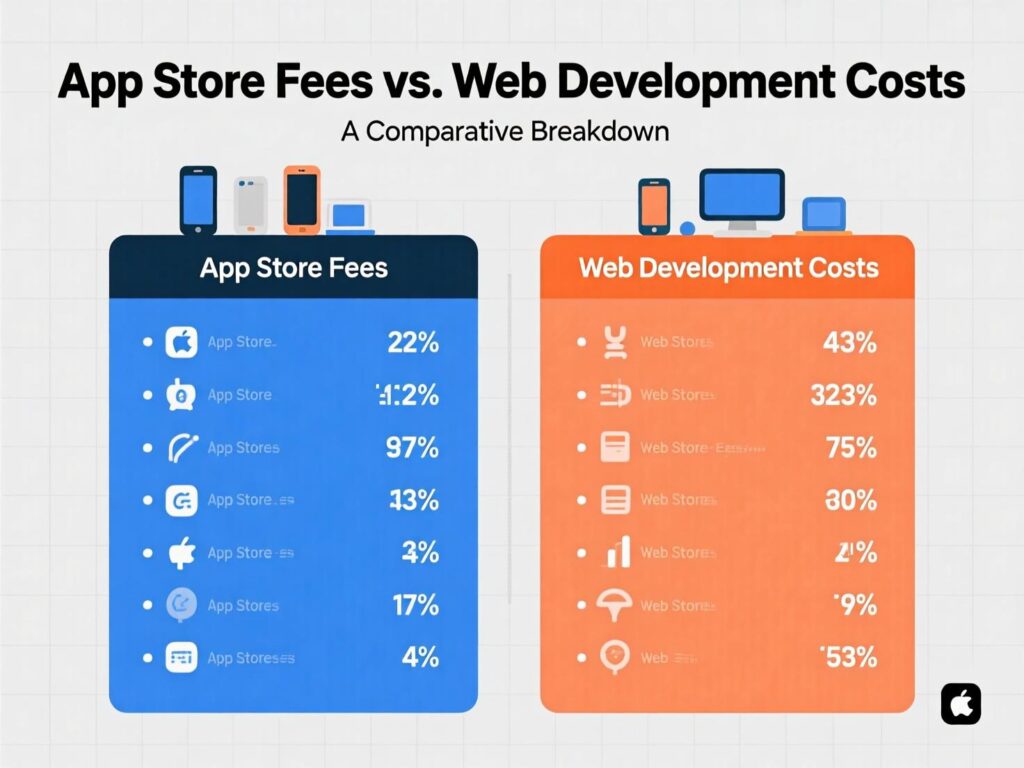
Store reviews, policies, and commission structures (Apple 15% for Small Business Program up to $1M; typically 30% otherwise; Google Play 15% for first $1M/year and 15% for subscriptions). EU DMA brings evolving options and fees. -
Friction:
People download fewer new apps and are choosy with installs; app time is high, but downloads and total hours slightly softened in 2024 even as revenue rose. -
Cost & maintenance:
Two platforms (iOS, Android) unless using cross-platform; OS updates and device fragmentation add overhead.
Mobile-First Web/PWA — Strengths
-
Reach & discovery: URL-based, indexable, instant access via search/social; no install wall.
-
Speed to ship: One codebase; ship continuously; no store gatekeepers.
-
Capabilities: Installable PWAs, offline cache, background sync, and Web Push now supported on iOS/iPadOS 16.4+ for Home Screen web apps.
Mobile-First Web/PWA — Constraints
-
Re-engagement friction: Install prompts exist, but discovery of the installation UI is still weaker than app stores; you must deliberately surface the prompt using
beforeinstallpromptand in-app buttons. -
APIs & parity gaps: Many native features exist on the web, but parity still varies by browser/OS (especially advanced background or low-level APIs).
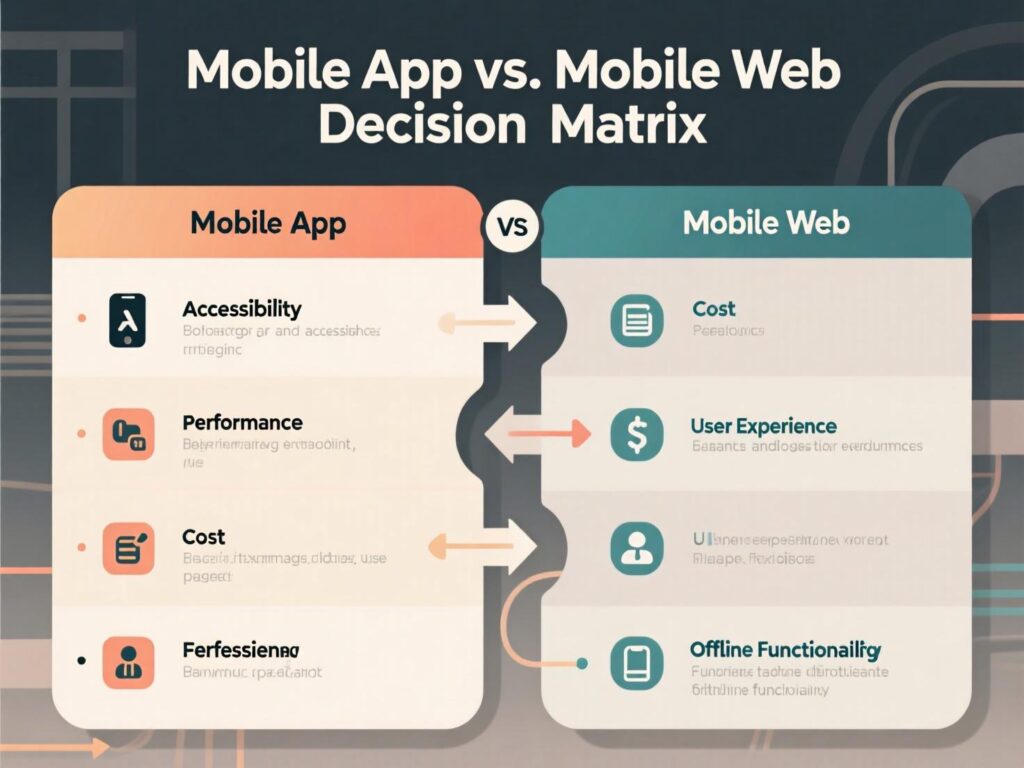
When to choose mobile app vs mobile web
-
Choose a native mobile app if you need:
-
Deep device integration (BLE, background geofencing, complex media capture).
-
High-frequency use cases (banking, social, messaging, ride-hailing).
-
Monetization via subscriptions/IAP and push-driven habit loops.
-
-
Choose mobile-first web/PWA if you need:
-
Broad top-funnel reach, SEO traffic, and frictionless first-touch.
-
Fast iteration, lower upfront cost, and easier cross-platform support.
-
Install as a “nice-to-have” plus Web Push for opt-in re-engagement.
-
Cost, timelines, and policy realities in mobile app vs mobile web
Build cost:
A high-quality native app usually costs more initially than a mobile-first site/PWA (two platforms, QA matrices, store readiness). Cross-platform frameworks reduce cost but don’t erase policy or device testing.
Time to market:
The web ships continuously; app releases need review and staged rollouts.
Payments & fees:
-
Apple:
15% (Small Business Program under $1M) or 30% standard; evolving EU fee options under DMA. -
Google Play:
15% for first $1M annually and 15% for subscriptions from day one (region rules and alternative billing may adjust percentages).
Re-engagement & growth loops: mobile app vs mobile web
-
Apps: App store presence, push notifications by default, homescreen real estate, and OS surfaces (widgets, share sheets).
-
Web: Instant shareability (links), SEO/Answer-Engine visibility, and social embeds. PWAs can be installed and push-enabled—even on iOS since 16.4 but you must design the prompt and education moments.
Case studies (real-world signals)
-
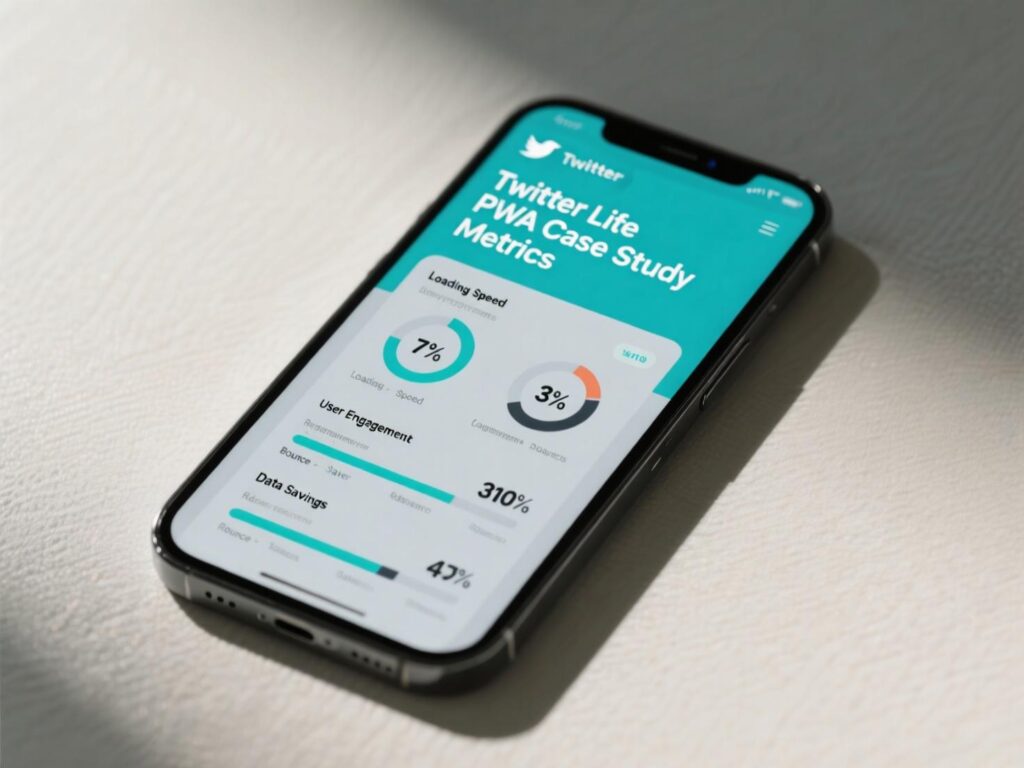
Twitter Lite (PWA):
+65% pages/session, +75% Tweets sent, −20% bounce after launching the PWA—proof that a high-performance mobile web can rival app engagement when executed well. -
Pinterest (Mobile Web Rebuild/PWA):
+40% time spent, +60% core engagements, +44% user-generated ad revenue after overhauling their mobile web.
These results are context-specific but illustrate how performance-first mobile web can close the gap with apps for certain intents.
Decision Framework for mobile app vs mobile web
Frequency:
Will typical users engage weekly+? If yes, app gains more from push/habit; else lean mobile-first web.
Acquisition channel:
Is organic search/social your #1 channel? Start web.
Capabilities:
Do you need background tasks, BLE, or deep OS hooks? Likely app.
Monetization:
Subscriptions/IAP central to revenue? App (but model fees into CAC/LTV).
Speed & budget:
Need to ship in weeks and iterate daily? Web/PWA first.
Governance risk:
Can app-store policy shifts impact your unit economics (EU DMA, fee tiers)? Consider web hedge.
Team & roadmap:
One team, one codebase? Web; Multi-disciplinary mobile org? App + web.
Implementation paths that minimize risk
Path A — Web-first, app-later
Build a mobile-first PWA: instant load, strong CWV, install prompt, and Web Push.
Validate activation, retention, and monetization via the web.
Product-market fit? Then ship a thin native shell (or cross-platform) to capture app-store discovery and richer hooks.
Path B — App-first with web growth
Ship a focused native app for core, high-frequency jobs-to-be-done.
Maintain a content-rich mobile-first site for SEO, onboarding, and account flows; direct ready users to app (smart banners/deep links).
Expand web features into a PWA to cover low-intent users.
Practical UX notes for mobile-first web (so you don’t hurt desktop)
-
Design system:
Tokenize spacing/typography; scale up responsibly on wide screens. -
Layout:
Avoid single-column mega-scroll on desktop; use grids and progressive disclosure. -
Navigation:
Bottom nav/tabs on mobile; traditional top nav on desktop. -
Performance:
LCP <2.5s, CLS <0.1; optimize JS for interactivity (INP).
(NN/g cautions on mobile-first designs that degrade desktop if not balanced.)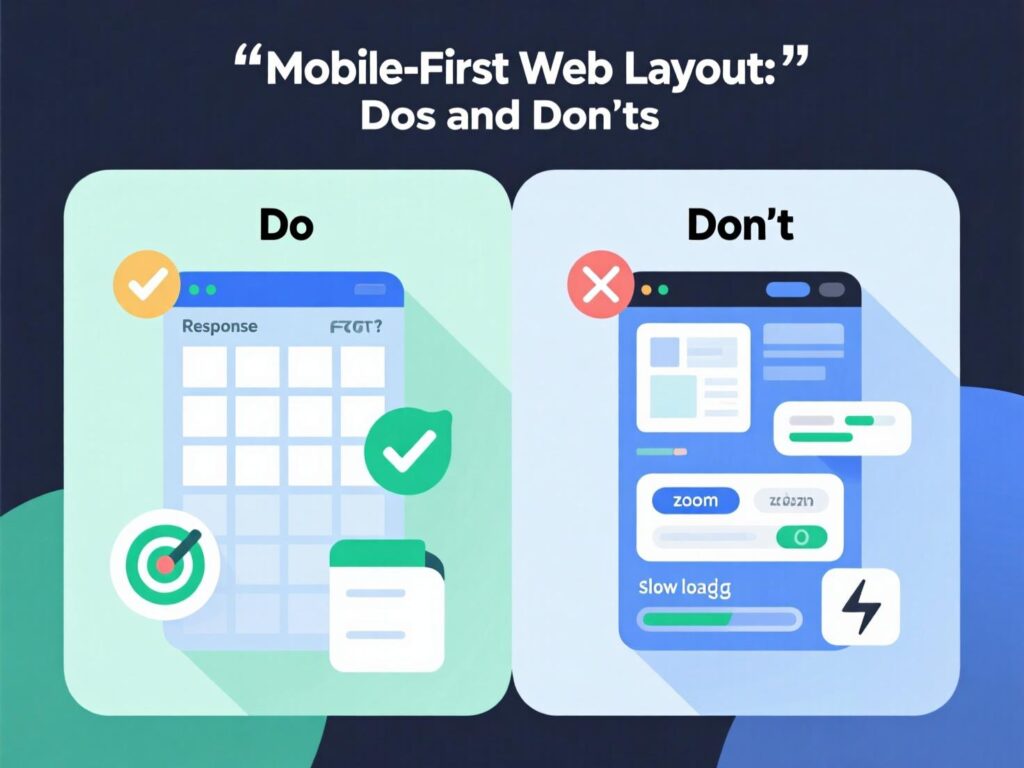
How to present the install on web (PWA)
-
Detect installability and surface your own install UI via
beforeinstallprompt, rather than relying on subtle browser UI. -
Educate users on benefits (offline, speed, notifications) and provide a one-tap install CTA inside the app chrome.
Two quick, concrete examples
Case A — Regional grocer (PWA-first):
A mid-market grocer shipped a PWA with offline lists, quick re-orders, and Web Push for substitutions. Result: faster launch (10 weeks), organic discovery via SEO, and a path to native later for in-store scanning and wallet passes. (Pattern inspired by PWA installs & push capabilities on iOS 16.4+.)
Case B — Fitness marketplace (App-first):
A marketplace with high-frequency bookings launched native apps for scheduling, geofenced check-ins, and Apple/Google Wallet passes. The companion mobile-first site handled SEO content and onboarding. Downloads softened YoY in the market overall, but subscriber ARPU grew mirroring wider trends.
To Sum Up
There’s no single “right” choice. If your product depends on deep OS features and high-frequency behavior, start with an app. If your growth is fueled by reach, SEO, and rapid iteration, go mobile-first web/PWA first. Many winners do both: web for top-funnel and long-tail, app for habit and monetization. Start where your riskiest assumptions live, instrument aggressively, and let the data not dogma decide.
CTA: Want a tailored build plan (scope, timelines, and ROI simulation) for your use case? Get a free 30-minute consult and we’ll map Web-first, App-first, and Hybrid paths with budget ranges and milestones.
FAQs
Q1 . How do I decide between a mobile app vs mobile web for a new product?
A . Start from user frequency and capabilities. High-frequency, hardware-heavy use cases (e.g., ride-hailing) lean native app. Broad discovery, content, and rapid iteration favor mobile-first web/PWA. Map ROI by estimating CAC/LTV with or without app-store fees.
Schema expander: Decision depends on frequency, capabilities, cost, and growth channels.
Q2 . How does a PWA compare to a native app on iOS?
A . PWAs can be installed and now support Web Push on iOS/iPadOS 16.4+ (when added to Home Screen), but some APIs still lag native. Plan around parity gaps.
Schema expander: Web Push works for Home Screen apps; capabilities vary by browser/OS.
Q3 . How can I measure if web is “enough” before investing in an app?
A . Track weekly active users, push opt-in (web), install rate, return visits, and checkout conversion on your PWA. If cohorts plateau due to missing features (e.g., offline background sync), schedule native.
Schema expander: Use cohort retention and feature gap analysis.
Q4 . How much does an app store commission affect pricing?
A . App commission is typically 15% for small developers (Apple, under $1M) and 15% for Google’s first $1M/yr and subscriptions; standard rates can reach 30%. Factor fees into pricing and channel mix; EU rules are changing.
Schema expander: Fees vary by tier, product type, and region.
Q5 . How does push messaging compare on web vs app?
A . Native push is straightforward on apps. On the web, PWAs support push on major platforms, including iOS 16.4+ when installed, but user education and install prompts matter.
Schema expander: Promote install and request permission with clear benefits.
Q6 . How can a mobile app vs mobile web decision impact SEO?
A . Web/PWA gives you indexable pages and Answer-Engine visibility. Apps need web content for discovery anyway; pair an app with a strong mobile-first site.
Schema expander: Use hybrid: web for discovery, app for retention.
Q7 . How do I reduce install friction for PWAs?
A . Implement a custom install button using the beforeinstallprompt event; educate users on offline and speed benefits.
Schema expander: Detect installability and provide clear calls to install.
Q8 . How does market behavior affect mobile app vs mobile web?
A . People still spend far more time in apps (<6% of time in browsers), but web captures top-funnel intent and search. Downloads softened in 2024 while in-app spend rose. Use both channels strategically.
Schema expander: Apps dominate time; web dominates discovery.
Q9 . How can I run an experiment before fully committing?
A . Ship a PWA MVP first. Validate activation and retention; if cohorts improve with push/install, consider native. Or launch a narrow native MVP to validate high-frequency workflows while keeping a content-rich web.
Schema expander: Stage roadmap in learning phases.