


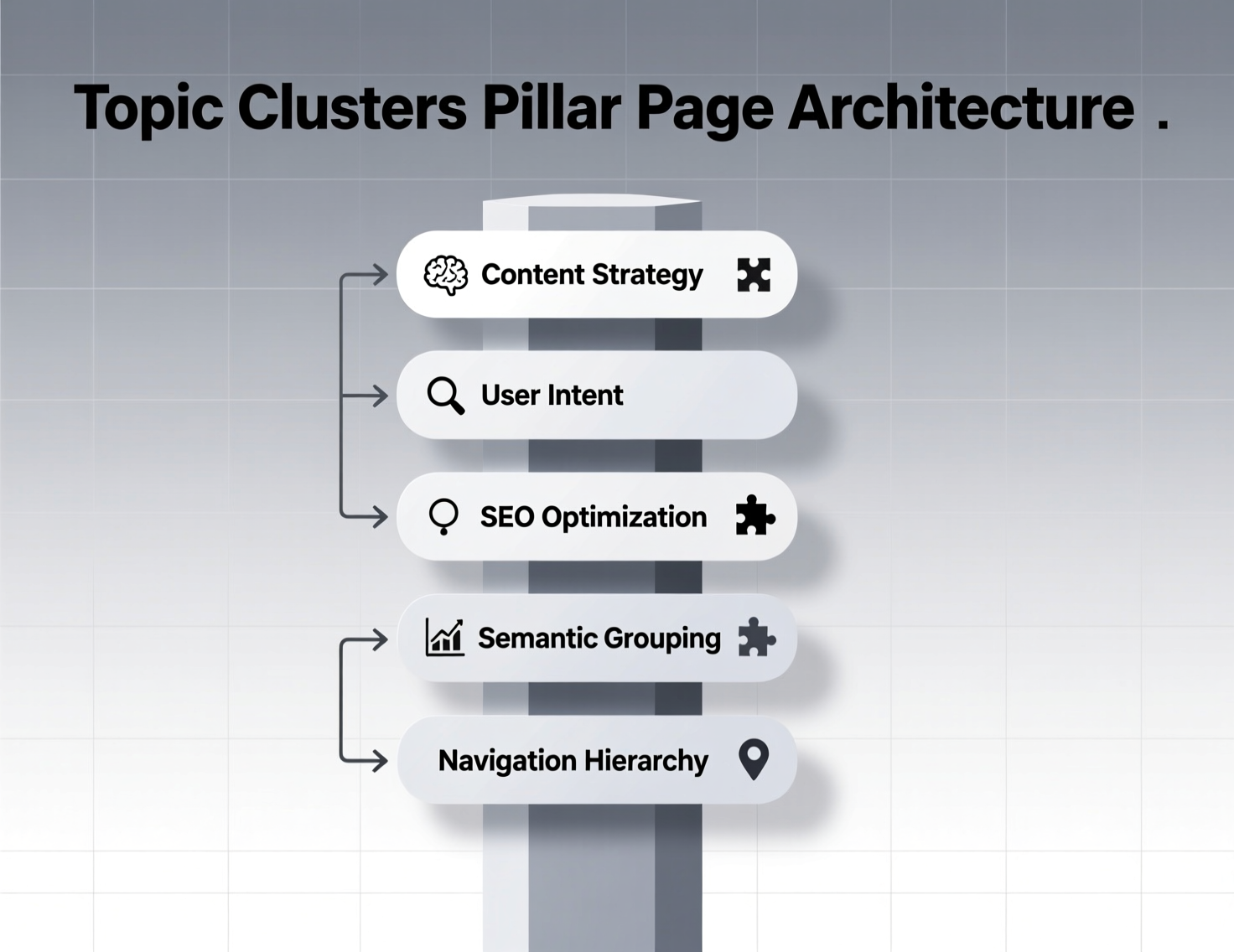
Topic Clusters
If your content still revolves around isolated posts targeting single keywords, you’re leaving authority—and traffic on the table. Modern search favors topic clusters: cohesive webs of content organized around pillar pages and connected with purposeful internal links. Done well, topic clusters help search engines understand your depth across a subject and help users navigate from big-picture guidance to precise answers.
Pillar pages act as the hub; supporting pieces cover subtopics; internal links bind everything into a crawlable, comprehensible structure. This guide clarifies how topic clusters compare to SEO SILOs, when to use each, and exactly how to wire your internal links so authority flows where you need it most. We’ll finish with a practical build checklist and measurement plan you can use this quarter. (On trends: SEOs continue moving from single-keyword pages to topic models and hub-and-spoke content.)
What Are Topic Clusters? (and why they outperform one-off posts)
Topic clusters are interlinked collections of pages that cover a subject comprehensively: one pillar page provides the overview; cluster pages dig into distinct subtopics; internal links connect everything. This structure signals breadth (pillar) and depth (clusters), improving findability and intent coverage. Authoritative guides from Semrush, Yoast, and Conductor outline the approach and show how pillar pages map to cluster content and intent. Semrush+2Yoast+2
Key components.
-
Pillar page (hub)
Comprehensive, navigational overview that links to all cluster pages. -
Cluster pages (spokes)
Focused answers mapped to intents and SERP formats; each links back to the pillar and across related clusters where relevant. -
Internal links
Descriptive anchors that clarify relationships and funnel equity.
Pillar Pages vs. Topic Clusters vs. SEO SILOs
Confusion persists because people mix terms. Here’s the practical breakdown, with consensus from leading guides.
Definitions at a glance
-
Pillar page
A long-form, high-value page covering a broad topic with internal links to subpages. Think “ultimate guide” with TOC, schema, and clear CTAs. -
Topic cluster
The pillar + its interlinked subtopics + navigation patterns tying them together. -
SEO SILO
A stricter architecture that isolates categories and discourages cross-linking between silos. Some SEOs critique silos as too rigid for modern, intent-based search.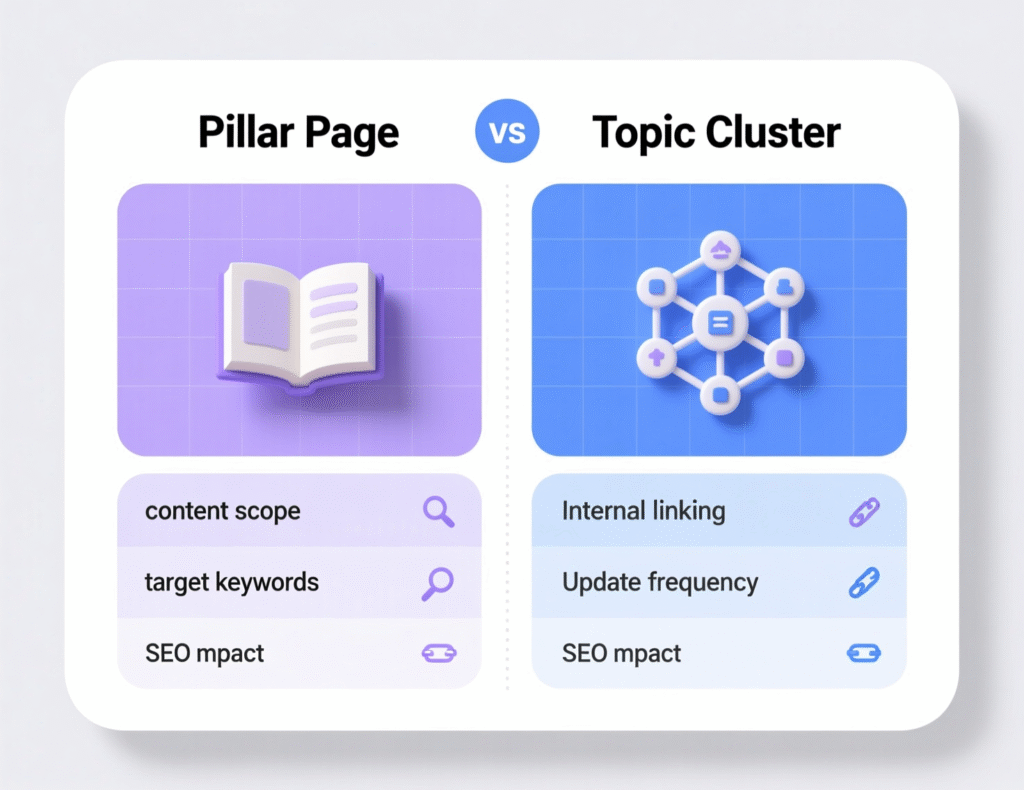
When to use each
-
Use topic clusters
When your audience asks many related questions and SERPs show mixed intents (guides, comparisons, FAQs). -
Use pillar pages
When a broad topic deserves a single “anchor asset” that earns links and distributes equity to supporting pieces. -
Use (lightweight) silos
For large catalogs or highly discrete categories, but allow contextual cross-links where user intent overlaps; rigid isolation can harm discoverability.
Internal Links: The Engine Inside Topic Clusters
Internal links are not decoration; they are the information architecture. Build rules that teams can repeat.
The hub-and-spoke pattern
-
From pillar → cluster: link using anchors that match how users search (“internal linking best practices,” “pillar page examples”).
-
From cluster → pillar: use a consistent, descriptive anchor (not “click here”).
-
Side-links between related clusters: add sparingly where searcher next steps are clear (e.g., from “topic cluster keyword research” to “internal link templates”). Guidance from reputable SEO sources consistently emphasizes intent-led mapping over mechanical keyword stuffing.
Avoiding over-isolation (the SILO trap)
SILO diagrams often discourage cross-links, but modern guidance notes that excessive isolation can hide relevant content and confuse crawlers about relationships. Use breadcrumbs, related links, and contextual in-copy links to maintain clarity without chaos.

Helpful linking elements
-
TOC jump links on the pillar.
-
Breadcrumbs (category → pillar → cluster).
-
“Next step” boxes at the end of clusters (editorially chosen).
-
Related questions (FAQ accordions) marked up with schema for AEO visibility. AEO is rising with generative results—well-structured answers help LLMs and search surfaces extract and attribute.
How to Build Topic Clusters (a repeatable 10-step method)
Pick the main topic & intent landscape.
Validate with SERP sampling and Trends (look for steady or rising interest).
Collect keywords
From multiple tools; group by intent. Keyword Strategy Builder / Keyword Explorer features can accelerate clustering.
Define the pillar page scope
(outline, TOC, FAQs) and decide which questions remain as separate cluster pages.
Map URL structure
(short, hyphenated slugs) and navigation (breadcrumbs, hub nav).
Draft internal link templates
(approved anchor variants per target).
Create briefs
For each cluster page with target intent, SERP features, and schema blocks (FAQ, HowTo).
Write pillar first,
Then publish 3–5 clusters within 2 weeks to establish the web of meaning.
Mark up schema
(Article, FAQPage, HowTo), add TOC and jump links for skimmability.
Cross-link
New content to existing relevant pages to avoid orphaning.
Measure & iterate
Watch impressions per cluster, assisted clicks to pillar, and internal link CTR. If a cluster draws links, reciprocate via prominent pillar links.
Real-World Examples & Pitfalls
Example 1 (B2B SaaS, security niche)
A SaaS brand launched a “Zero Trust Security” pillar with clusters on “network segmentation,” “identity governance,” and “least privilege examples.” By consolidating scattered blog posts into a single topic cluster with clear internal links, help-center docs began ranking for educational queries while the pillar captured broader intent and earned natural links from roundups. (Principle supported by authoritative pillar-cluster frameworks.)
Example 2 (Ecommerce, home fitness)
An ecommerce brand created a “Home Gym Guide” pillar and clusters on “adjustable dumbbells vs kettlebells,” “folding treadmills,” and “small-space workouts.” The pillar linked to product category pages and how-to guides; how-tos linked back with consistent anchors. This internal link mesh improved discoverability across informational and commercial intent—an approach aligned with current best practice.
Common pitfalls
-
One page per keyword (thin, overlapping content).
-
Rigid SILOs that block necessary cross-links.
-
Vague anchors (“read more”) that waste context.
-
Unscalable URL patterns and missing breadcrumbs.
-
Publishing the pillar without clusters (hub with no spokes).
Measurement: KPIs That Prove Cluster Value
-
Cluster-level impressions & clicks (Search Console by URL folder or regex).
-
Pillar assisted conversions (landing page view + page group).
-
Internal link CTR (from pillar → cluster and back).
-
Link acquisition to the pillar (and distribution to spokes).
-
Coverage of PAA questions & rich results (FAQ/HowTo).
-
Time-to-first-rank for new clusters vs. isolated posts.
Industry sources emphasize using volume, intent, and difficulty to prioritize—then tracking at topic level, not just per URL.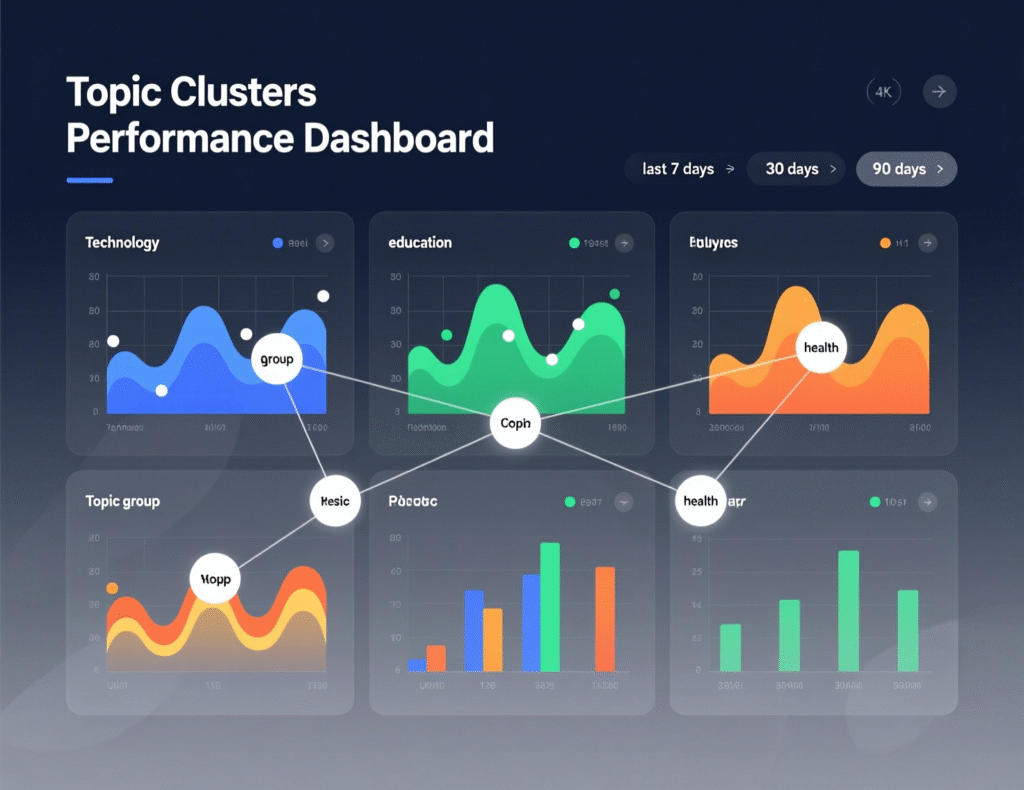
Final Words
Topic clusters win because they mirror how people learn: start broad, then zoom in. Pillar pages set the narrative; cluster pages satisfy specific intents; internal links choreograph the journey and clarify authority to crawlers. Don’t over-engineer SILOs prioritize a flexible, intent-first architecture that uses contextual cross-links. If you ship a well-planned pillar with 5–10 tightly scoped clusters, add schema, and measure cluster-level outcomes, you’ll create compounding visibility. Ready to map your first topic cluster and pillar page? Scroll to the How-To checklist and schema, pick a topic, and start building this week.
CTA: Need help turning this framework into an editorial calendar and internal linking spec? Get a custom cluster map and 90-day content plan tailored to your site.
FAQs
Q : How do topic clusters improve rankings?
A : They organize coverage by intent, help crawlers understand relationships, and distribute link equity via internal links. Pillar pages rank for broad terms while clusters capture long-tails and featured snippets; together, they signal topical authority.
Expander: Add FAQ schema and consistent anchors to strengthen extractability for AEO and SERP features.
Q : How are pillar pages different from topic clusters?
A : A pillar is one page; a topic cluster is the whole system (pillar + clusters + links). Pillars earn links and route authority; clusters cover subtopics in depth and point back to the pillar.
Expander: Use a TOC and hub navigation on the pillar to help users and crawlers.
Q : How do SILOs compare to topic clusters?
A : SILOs strictly segment categories and often limit cross-linking; clusters are more flexible and intent-driven. Over-isolation can hinder discovery—modern guidance favors context-led cross-links.
Expander: Keep clear taxonomy but allow relevant cross-links to satisfy journeys.
Q : How many cluster pages should I launch with a pillar?
A : Start with 5–10 high-intent topics that collectively cover breadth. Add more based on gaps and PAA data. Quality and linking matter more than raw count.
Expander: Publish clusters within 2–4 weeks of the pillar to establish relationships.
Q : How do I choose keywords for a topic cluster?
A : Use seed topics, group by intent, validate with tools (Semrush, Ahrefs), and prioritize by difficulty and opportunity.
Expander: Also check Google Trends for seasonality.
Q : How should I structure internal links?
A : Pillar ↔ cluster reciprocal links with descriptive anchors; add side-links between adjacent clusters; surface related content modules and breadcrumbs.
Expander: Audit internal link CTR and “link depth” to the pillar quarterly.
Q : How long should a pillar page be?
A : As long as needed to be a definitive overview (often 3,000–5,000+ words), with concise sections and links out to detailed clusters.
Expander: Long doesn’t mean bloated—use TOC, jump links, and scannable design.
Q : How can I measure topic cluster performance?
A : Track impressions/clicks by folder or regex, internal link CTR, assisted conversions on the pillar, and rich result capture.
Expander: Compare time-to-rank for cluster pages vs. isolated articles.
Q : How does AEO change cluster strategy?
A : Answer engines favor structured, comprehensive, interlinked answers. Well-marked FAQs/HowTos and clear internal linking increase inclusion in AI summaries.