


Generative AI Content Creation in the Middle East
Generative AI Content Creation in the Middle East
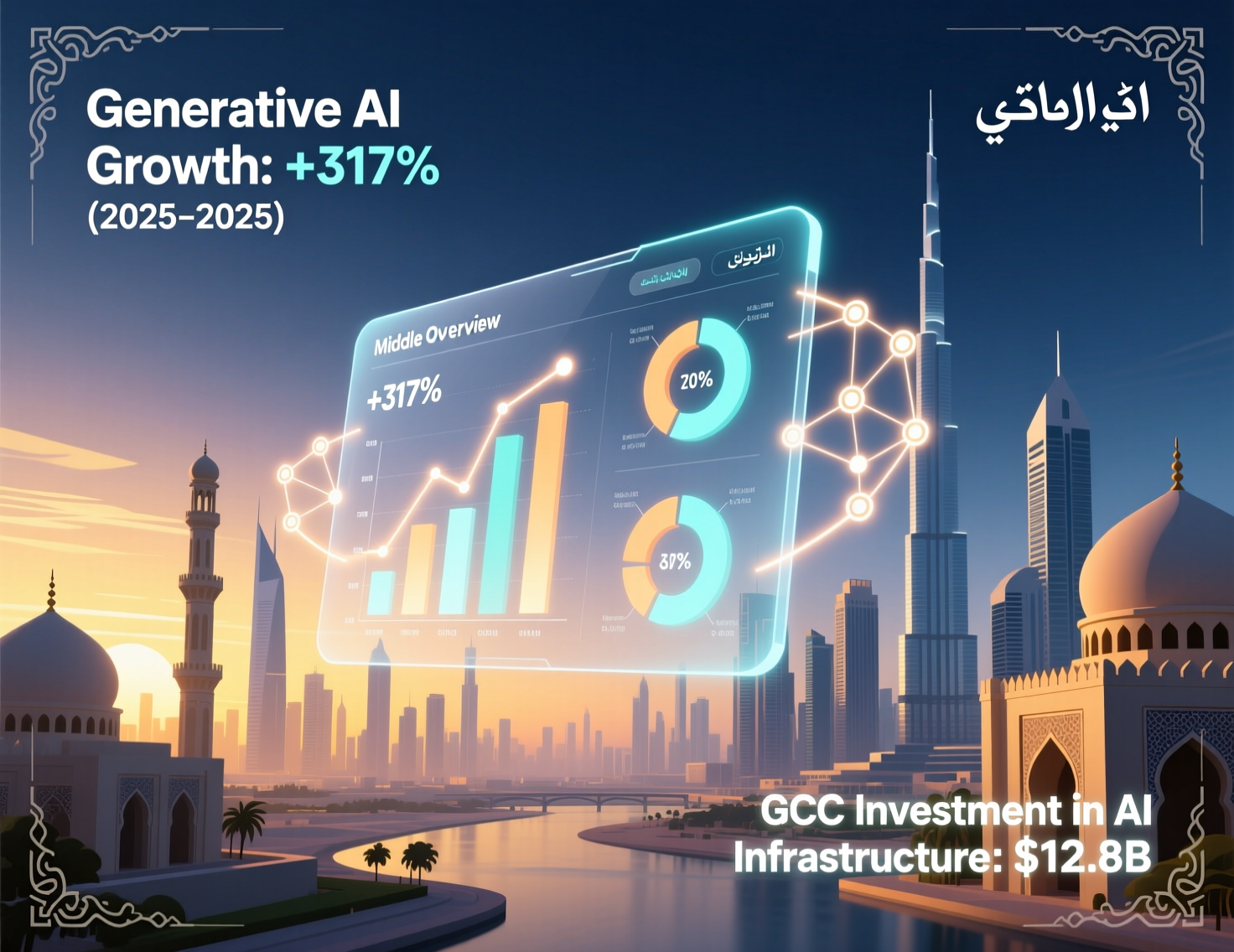
Generative AI Content Creation in the Middle East: A Practical GCC Guide for KSA, UAE and Qatar
Generative AI content creation in the Middle East is transforming how brands in Saudi Arabia, the UAE and Qatar produce Arabic content, moving from slow, manual production to scalable, AI-powered Arabic content workflows that still keep humans in control. For GCC marketers, the real value comes when machine learning for Arabic language content is combined with local compliance, cultural sensitivity and clear governance over data residency and synthetic media.
Introduction
Across Riyadh, Dubai, Abu Dhabi and Doha, generative AI content creation in the Middle East has moved from experiment to boardroom priority. CMOs, digital leaders and government communication teams are asking the same question: how do we use AI to scale Arabic content without losing trust, culture and compliance?
GCC digital content boom in Saudi Arabia, UAE and Qatar
The GCC is in the middle of a digital content boom:
In Saudi Arabia
Vision 2030, e-government services and a fast-growing ecommerce scene in Riyadh, Jeddah and Dammam are driving massive demand for Arabic content across apps, portals and social media.
In the UAE
Dubai and Abu Dhabi host regional hubs for tourism, fintech, logistics and real estate all needing always-on Arabic and English content, plus video and social formats.
In Qatar
Doha and Lusail are building long-term sports, events and Smart Nation ecosystems, with content around major tournaments, infrastructure and citizen services.
For brands, media houses and government entities, this means more campaigns, more channels and more formats. Manual copywriting alone cannot keep up – which is why AI-powered Arabic content workflows and automation of social media content in the Middle East are suddenly on every roadmap.
The gap between global AI content advice and Arabic reality
Most global advice on generative AI assumes English content, Western platforms and very different regulatory environments. But Arabic markets have their own reality:
Complex language structure and rich morphology that standard models often mishandle.
Gulf dialects (Saudi, Emirati, Qatari, Kuwaiti, Bahraini, Omani) that differ from Modern Standard Arabic and from each other.
Stricter rules on religious, political and social topics, plus content censorship and platform moderation.
Data residency expectations, especially in KSA and the UAE, where regulators push for local or regional cloud regions.
So when a global blog says “just plug your brand into a generic AI copy tool”, a CMO in Riyadh or a government team in Doha knows that’s not enough. They need Saudi-friendly AI content generators, UAE-based platforms and GCC-aware partners who understand the nuance.
what this guide covers for KSA, UAE and Qatar teams
This guide is written for marketing, communication, media and digital leaders in KSA, UAE and Qatar who want a practical, realistic view of generative AI:
How generative AI changes Arabic content creation for GCC brands.
Which tools and GCC generative AI platforms for Arabic brands to consider global, Arabic-first and GCC-hosted.
What to know about compliance, ethics and data residency (SAMA, SDAIA, NDMO, DGA, TDRA, ADGM, DIFC, QCB, Qatar Digital Government).
High-impact use cases across ecommerce, media, sports, government, education and Islamic content.
A step-by-step implementation roadmap tailored to Riyadh, Dubai, Abu Dhabi and Doha teams.
What Does Generative AI Change in Arabic Content Creation for GCC Brands?
What does generative AI change in Arabic content creation for brands in the GCC?
In simple terms, it shifts teams from manually crafting every asset to orchestrating AI-powered Arabic content workflows where humans design prompts, guardrails and approvals. Instead of asking “Can AI replace my writers?”, GCC leaders ask “How can my writers and editors become AI conductors?”
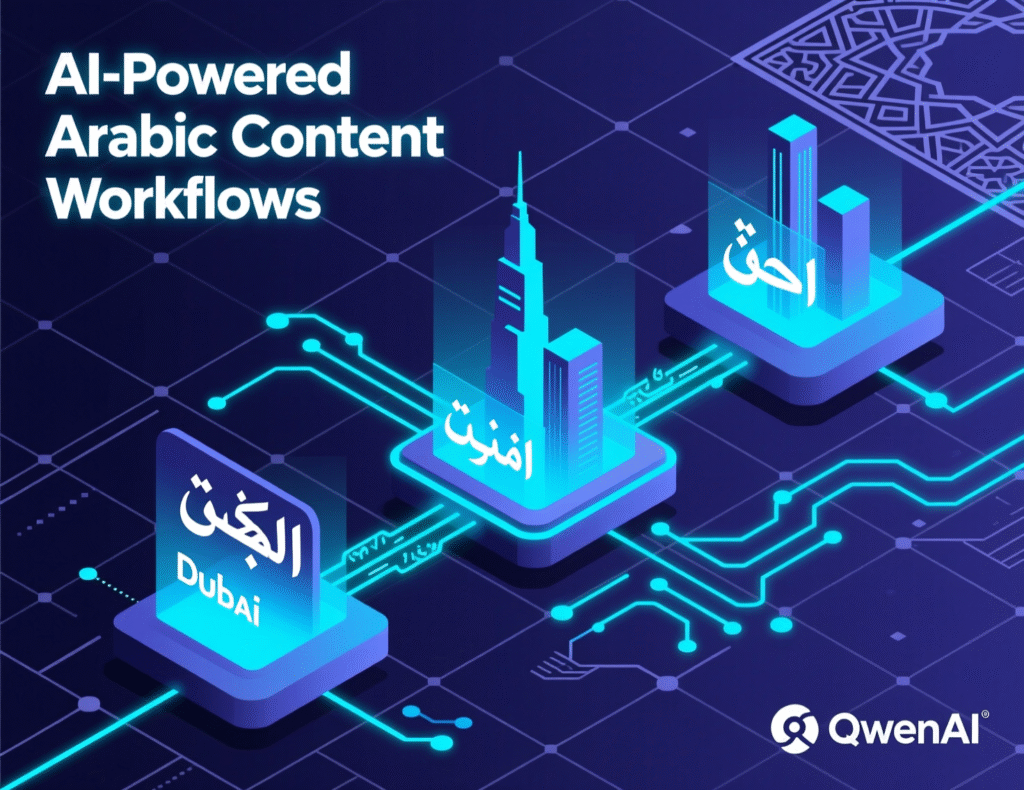
From manual production to AI-powered Arabic content workflows in Riyadh, Dubai and Doha
Before generative AI, a typical campaign in Riyadh, Dubai or Doha looked like this:
Brief is created in English, then translated to Arabic.
Copywriters adapt it for social media, email, landing pages and app screens.
Designers and video editors handle thumbnails, storyboards and subtitles.
Every change from compliance or legal means another rewrite and re-export.
With generative AI content creation in the Middle East, the workflow changes:
Strategy and messaging are agreed at human level.
AI models generate first drafts of Arabic and English copy, variations for different audiences and platforms, and even initial visual concepts.
Editors, brand guardians and legal teams review, refine and approve – focusing on quality and risk, not typing speed.
Automation tools push approved content into CMS, marketing automation, ecommerce platforms and UAE Arabic social media AI tools.
For teams in Riyadh, Dubai and Doha, this means more testable variations, faster localisation and better usage of scarce senior talent.
Human vs AI content in Arabic markets: strengths, limits and hybrid models
A key concern across human vs AI content in Arabic markets is quality and authenticity. Practically, each side has strengths:
AI strengths
Fast production of drafts, options and translations.
Pattern recognition: it can mirror a style guide once properly trained.
Great for repetitive formats: product descriptions, FAQs, metadata, SEO outlines.
AI limits
Struggles with sarcasm, subtle humour and religious nuances.
May mix dialects or produce “textbook Arabic” that feels cold or foreign.
Hallucination risk when mentioning regulations, fatwas or government programmes.
Human strengths
Deep understanding of culture, religion and local context.
Ability to balance commercial goals with social sensitivity.
Relationship with stakeholders – sales, Shariah boards, regulators, communities.
The winning model in GCC is hybrid.
Use machine learning for Arabic language content to generate options and structure, then rely on humans in Riyadh, Dubai and Doha to refine tone, verify facts and sign off.
Synthetic media, deepfake risks and brand safety in GCC campaigns
As generative AI moves from text to images and video, synthetic media and deepfake risks in GCC become board-level issues:
AI-generated voices that imitate known sheikhs, leaders or celebrities.
Synthetic presenters in thobe or abaya delivering messages that may be misused.
Fake “news clips” or fatwa-style announcements circulating on social media.
For GCC brands, especially in finance, government, health and Islamic content, the rule is simple: be stricter than global peers. That means:
Clear internal policies on when AI-generated faces, voices or scripts are allowed.
Legal review for any synthetic persona that could be mistaken for a real authority.
Monitoring for impersonation and misuse of brand assets across platforms.
Arabic AI Content Tools & Workflows.
Generative AI can flood your brand with content but without the right tools and workflows, the quality will hurt more than help. Here we look at platform choices and the challenges of automation of social media content in the Middle East when Arabic is involved.
Best generative AI tools for Arabic content: global vs Arabic-first vs GCC-based platforms
GCC teams typically face three categories of tools:
Global AI suites
Strengths: powerful models, integrations, mature features.
Risks: limited Arabic training, weaker Gulf dialects, data stored in US/EU regions.
Arabic-first platforms
Focus on Arabic morphology, diacritics, right-to-left UX and regional examples.
Often better at Modern Standard Arabic and some Gulf dialect support.
Check how they handle sensitive religious and social topics.
GCC-hosted or GCC-compliant platforms
Build on cloud regions like AWS Bahrain, Azure UAE Central or GCP Doha.
Easier alignment with data residency expectations in KSA, UAE and Qatar.
May offer specific compliance features for SAMA, TDRA, ADGM, QCB or other regulators.
In practice, many enterprises end up with a mixed stack
A GCC-friendly base platform integrated with global tools for specialised tasks, all connected to their existing CRM, CMS and marketing automation.
AI-powered Arabic content workflows for SEO, social media and video in the Middle East
To move from experiments to results, you need repeatable workflows. A few examples:
SEO content for Saudi ecommerce
Use AI to generate keyword clusters, article outlines and FAQ ideas in Arabic and English.
Draft long-form product guides, then have Saudi editors in Riyadh localise examples (mada, SADAD, Open Banking KSA) and add local payment and delivery context.
Social media automation for Dubai tourism
Use AI to create daily content calendars in Arabic and English for Instagram, TikTok and X.
Generate carousel copy, captions and hashtag suggestions, then route posts via a human approval stage before publishing via a UAE Arabic social media AI tool.
Video and subtitle workflows in Doha media houses
Use AI to generate scripts and auto-subtitles for Arabic/English videos covering sports and events in Doha and Lusail.
Human editors clean the subtitles, validate sponsorship messages and ensure cultural compliance.
These workflows give you control: machines generate at scale, humans decide what goes live.
Main challenges of using generative AI for Arabic language and Gulf dialects
What are the main challenges of using generative AI for Arabic language and Gulf dialects?
The biggest hurdles are language quality, dialect differentiation and cultural nuance:
Dialect confusion
Models may mix Saudi, Emirati, Qatari, Egyptian and Levantine phrases in one text.
Formality issues
Too formal (classical) Arabic for light social content, or too casual tone for government portals.
Orthography & RTL
Errors in punctuation, numbering and right-to-left layout that break UX on landing pages and apps.
Religious and cultural context
Generating Islamic content (duas, hadith references, fatwa-style explanations) without strong guardrails is risky.
Data scarcity
Compared to English, there is less high-quality, labelled GCC Arabic data to train models on.
Mitigation strategies include custom glossaries for Saudi, Emirati and Qatari brands, strict human review for dialect content, and partnering with agencies who specialise in AI-powered Arabic content workflows rather than generic AI copywriting.
Compliance, Ethics & Data Residency for AI Content in GCC
Generative AI is not just a technology decision it’s a risk and governance decision, especially in regulated sectors like banking, telecom, health and government services.
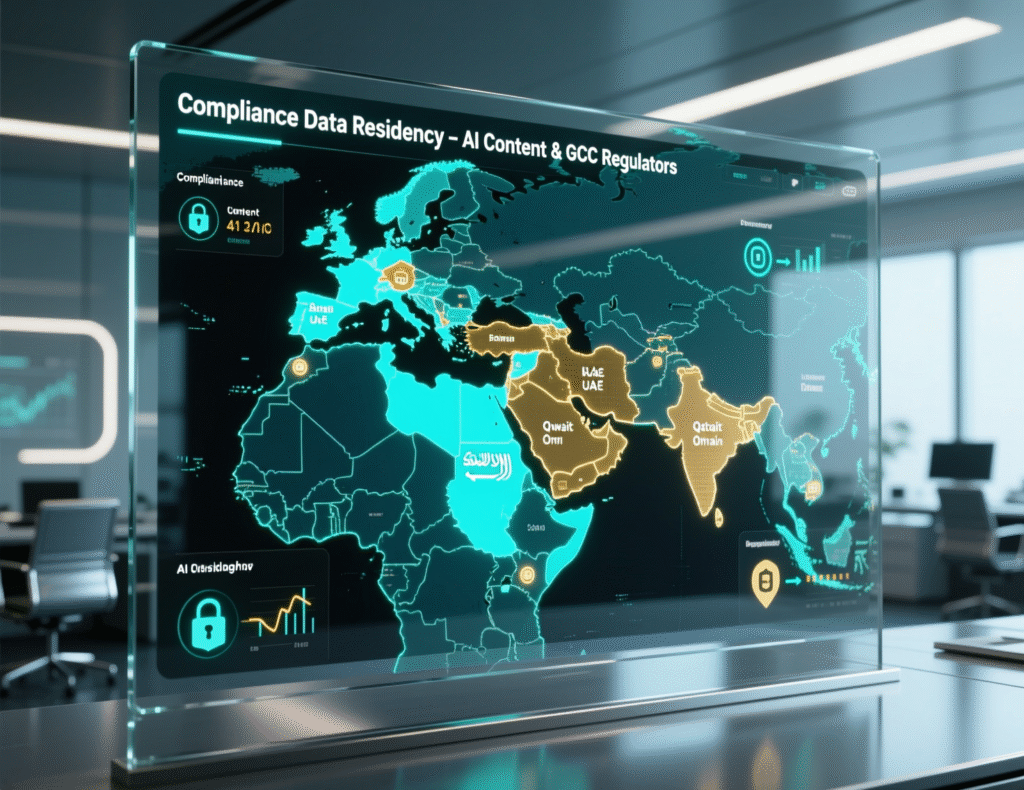
Saudi Arabia: SAMA, SDAIA, NDMO, DGA and media rules for AI-generated content
In Saudi Arabia, several bodies influence your AI content strategy:
SAMA (Saudi Central Bank) for banking, fintech and insurance marketing.
SDAIA and NDMO for data governance, AI principles and data classification.
DGA (Digital Government Authority) and MCIT for digital government and open data.
For generative AI content creation in the Middle East, Saudi teams should:
Classify what data is fed into AI tools (customer data vs. public marketing content).
Prefer platforms that support data residency in KSA or at least GCC regions (e.g., AWS Bahrain) for sensitive workloads.
Set clear internal rules on AI-generated disclosures in ads and content, especially for finance and health.
UAE: TDRA, ADGM, DIFC and data residency for AI content platforms in Dubai and Abu Dhabi
How do UAE and Qatar regulations affect the use of AI-generated media and advertising? In the UAE, regulators focus on telecom, digital content and financial services:
TDRA oversees telecoms and digital content frameworks for websites and apps.
ADGM and DIFC provide financial free zones with their own data protection rules, inspired by global standards.
Initiatives like Dubai Future Foundation and UAE AI Strategy 2031 push innovation, but within clear risk frameworks.
For Dubai and Abu Dhabi-based teams:
Map where your AI tools host and process data, and verify alignment with TDRA and free-zone rules.
For financial marketing, ensure your vendors understand ADGM/DIFC data protection and consent requirements.
When using synthetic media (avatars, voice clones), include internal guidance on transparency and brand safety.
Qatar: QCB, Qatar Digital Government and media law for synthetic and AI-generated content
In Qatar, the regulatory picture involves:
QCB for banking, fintech and payment communication.
Qatar Digital Government and related Smart Nation programmes.
Media and advertising laws that apply to broadcasters, agencies and online platforms.
For AI-generated content in Doha and Lusail, key actions are:
Check whether media and advertising contracts cover synthetic media and deepfake scenarios.
Ensure that AI tools used for sports, events and government campaigns comply with local data rules and Qatar Digital ID initiatives.
When in doubt, label AI-generated visuals or voices in sensitive domains to protect long-term trust.
High-Impact Generative AI Use Cases in Arabic Content Across GCC Sectors
Generative AI becomes truly valuable when you can point to specific GCC use cases that improve ROI and citizen experience.
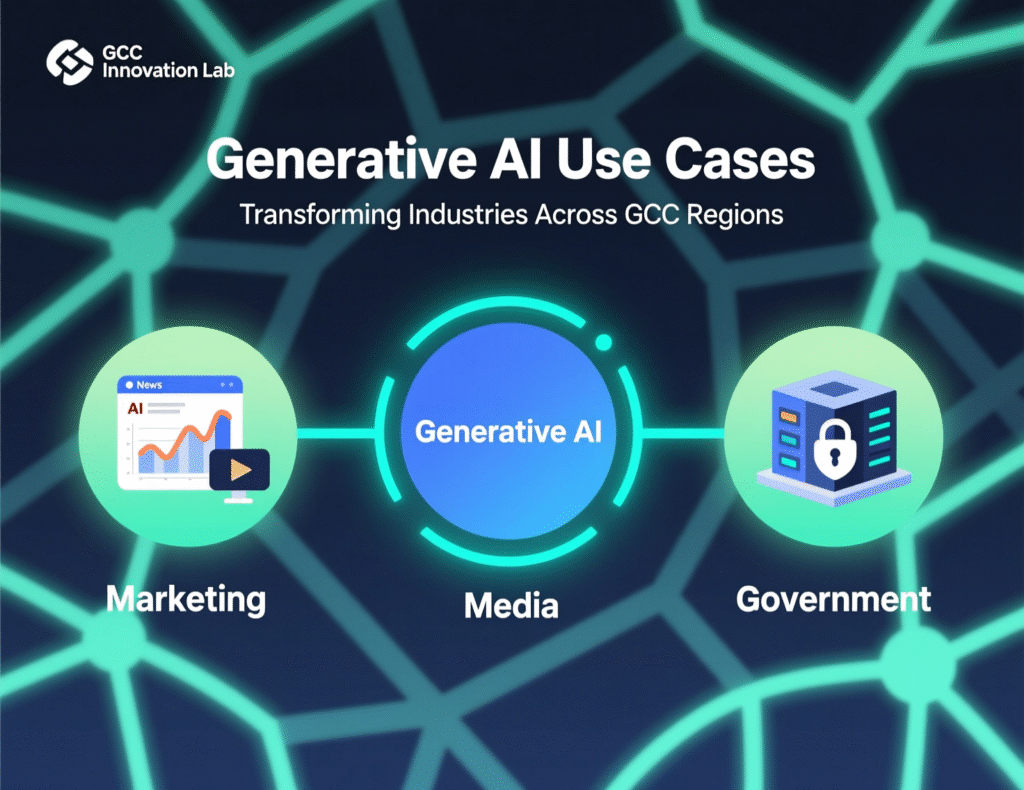
Marketing and ecommerce
Riyadh retail & fintech
A Saudi ecommerce brand integrated a Saudi-friendly AI content generator to create product descriptions, mada/SADAD payment explainer texts and Open Banking KSA FAQs in Arabic and English.
Human editors in Jeddah refined tone and ensured SAMA-compliant wording for financial benefits.
Dubai tourism & hospitality
A Dubai destination platform uses AI to generate personalised itineraries in Arabic and English for families from Kuwait, Bahrain and Oman, plus always-on content for events and exhibitions.
AI drafts the copy, but local marketers fine-tune cultural references and offers.
Qatar sports & events
Doha-based teams use AI to generate multi-language content (Arabic, English, French) around sports tournaments in Doha and Lusail – match previews, fan guides, FAQs and notifications.
AI also supports real-time updates, with editors validating statistics and sponsor messages.
Media, broadcasters and Arabic newsrooms in Riyadh, Dubai and Doha
Media organisations in Riyadh, Dubai and Doha are experimenting with:
News automation
AI-generated first drafts of traffic, weather, markets and sports updates, later polished by journalists.
Subtitles and dubbing
Machine learning for Arabic language content helps generate subtitles between Arabic dialects and English, then editors fix nuance.
Synthetic presenters
Some broadcasters test virtual anchors for explainer segments – but only with strict guardrails to avoid confusion with real presenters.
These use cases show how AI supports, rather than replaces, editorial judgment.
Education, government and Islamic content: sensitive use cases in KSA, UAE and Qatar
In education, government and Islamic content, stakes are higher.
Ministries of Education and higher education institutions may use AI to generate course summaries, quiz questions or study guides always needing academic oversight.
E-government portals in KSA, UAE and Qatar use AI to draft service descriptions and FAQs in simple Arabic, then legal and policy teams sign off.
For Islamic content (Friday sermon summaries, zakat calculators, fatwa explanations), AI can help structure information, but final text must always be human-authored and verified, often alongside Shariah boards or trusted scholars.
Here, AI is a drafting tool not an authority.
How GCC Brands Can Start Safely with Generative AI Content
To turn vision into reality, GCC organisations need a clear, step-by-step roadmap rather than random pilots.
Assess readiness: data, policies and brand guidelines in Saudi, UAE and Qatar
Start by answering four questions.
What data will we expose to AI (public marketing vs. customer or transactional data)?
Which regulators matter to us (SAMA, TDRA, QCB, sector regulators)?
Do we have updated Arabic and English brand guidelines, tone-of-voice and banned topics?
Who owns AI governance – marketing, IT, risk or a joint committee?
For enterprises in Riyadh, Dubai, Abu Dhabi and Doha, this usually leads to a simple internal policy covering tools, allowed use cases and approval steps.
Design a human-in-the-loop Arabic AI content workflow
Next, design your human-in-the-loop workflow:
Define roles: who creates prompts, who reviews outputs, who approves publishing.
Set quality gates for sensitive content (Islamic, youth, financial, health, government).
Decide which channels can be lightly reviewed (e.g., internal drafts) vs. fully approved (e.g., banking campaigns in KSA or government announcements in Qatar).
Visualise the workflow from brief to content to publishing, and bake human oversight into each stage not as an afterthought.
Choose Saudi-friendly, UAE-based or GCC-wide tools and integrate with existing stacks
Then choose tools around your needs:
For KSA-first brands, prioritise Saudi-friendly AI content generators that respect local language, data residency and SAMA/SDAIA guidelines.
For UAE hubs, look for platforms hosted in Azure UAE Central or other UAE data centres, with good integration to your CRM, CMS and UAE Pass-enabled services.
For Qatar HQs, ensure your vendors can align with Qatar Digital Government and QCB expectations.
Integrate these tools into your martech stack: CMS, CDP, marketing automation, social management and analytics, so AI content becomes part of everyday workflows.
Measure ROI: from cost-per-asset to campaign impact across GCC markets
Finally, measure what matters.
Production metrics: time to first draft, cost per asset, number of iterations.
Quality metrics: approval rates, error rates, compliance incidents.
Business metrics: click-through rates, conversion rates, lead quality and revenue per campaign across KSA, UAE, Qatar, Kuwait, Bahrain and Oman.
Over time, use these metrics to refine prompts, workflows and tool selection and to show leadership that generative AI content creation in the Middle East is not just a trend, but a measurable performance driver.
Future of Generative AI Content Creation in the Middle East
Where GCC regulation, infrastructure and Arabic AI research are heading
The direction is clear.
More regional cloud regions (KSA, UAE, Qatar) and stronger expectations on data residency.
Evolving AI guidelines from bodies like SDAIA, TDRA, ADGM, QCB and others.
Growing investment in Arabic and Gulf dialect AI research, including public-sector initiatives and university labs.
For GCC brands, the opportunity is to shape best practice early – instead of waiting for global rules that may not fit the local reality.
Building an Arabic-first, AI-augmented content team in Riyadh, Dubai and Doha
Tomorrow’s winning teams in Riyadh, Dubai and Doha will:
Hire and train AI-augmented content specialists who are as comfortable with prompts and workflows as they are with headlines and scripts.
Build playbooks around generative AI for each channel: SEO, social, video, email, apps, chatbots.
Partner with agencies and consultancies who specialise in GCC and Arabic, rather than generic AI copy providers.
This is where a partner like Mak It Solutions can help with strategy, implementation and ongoing optimisation.
Audits, pilots, workshops and long-term partnerships
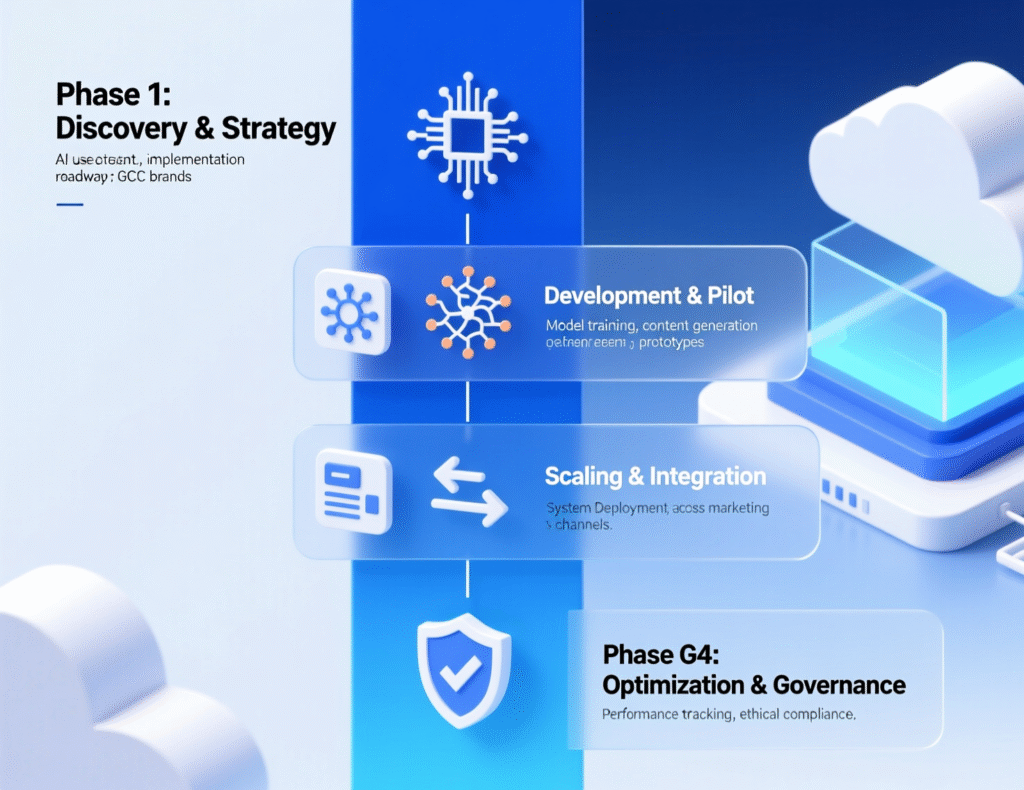
Instead of a single “big AI project”, successful GCC organisations follow a path:
Audit current content, tools and risks.
Run pilots in one or two teams (e.g., Saudi ecommerce, Dubai tourism, Doha events).
Deliver workshops and training for marketers, copywriters and legal/compliance.
Scale via long-term partnerships that keep you aligned with evolving GCC regulations and technologies.
If you’re leading marketing, communications or digital in KSA, UAE or Qatar, now is the right moment to move from AI curiosity to clear, governed action. Mak It Solutions helps GCC brands design Arabic-first, AI-augmented content strategies that respect culture, regulation and data residency.
Whether you need a quick readiness audit, a pilot in Riyadh or Dubai, or a full GCC-wide implementation roadmap, our team can support you end-to-end. Reach out to Mak It Solutions to explore how generative AI content creation in the Middle East can safely accelerate your campaigns, not your risks. ( Click Here’s )
FAQs
Q : Is AI-generated Arabic content allowed under Saudi media and advertising rules?
A : Yes, AI-generated Arabic content can be used in Saudi Arabia, but it must still comply with existing media, advertising and sector-specific rules. For example, financial campaigns remain subject to SAMA guidance, and government-related messaging must align with official communication standards and Vision 2030 priorities. The key is that regulators care about what is published, not whether a human or AI drafted it. Brands in Riyadh and Jeddah should maintain strong human review processes and, when in doubt, consult legal or compliance experts before publishing sensitive AI-generated content.
Q : Do GCC regulators require brands to label or disclose AI-generated content?
A : Today, there is no single unified GCC rule mandating AI-content labels across all sectors, but transparency is increasingly encouraged, especially for sensitive domains. Some regulators and government entities in KSA, UAE and Qatar have started exploring guidelines on synthetic media, deepfakes and AI-generated communications. As best practice, brands should consider labelling AI-generated content for financial, health, Islamic or political topics, particularly in Saudi and Qatar. This protects consumer trust and positions the brand as proactive, not reactive, as future regulations emerge.
Q : Can Saudi or UAE companies host AI content platforms outside local data centres?
A : Many Saudi and UAE companies still use global AI tools hosted outside the GCC, particularly for non-sensitive marketing content. However, for regulated industries such as banking, government, telecom or health, local data residency is increasingly preferred or required. KSA entities influenced by SAMA, SDAIA or NDMO often push for KSA or at least GCC-region hosting (e.g., AWS Bahrain), while UAE organisations consider TDRA, ADGM and DIFC expectations. The safest approach is to classify your data, then choose hosting locations accordingly and document your decisions in internal governance policies.
Q : How accurate is generative AI today with Gulf Arabic compared to Modern Standard Arabic?
A : Most mainstream AI models are noticeably stronger in Modern Standard Arabic than in Gulf Arabic dialects such as Saudi, Emirati, Qatari, Kuwaiti, Bahraini and Omani variants. They may produce understandable text, but with awkward phrasing, mixed dialects or inconsistent terminology. This can be acceptable for internal drafts, but risky for public-facing campaigns in Riyadh, Dubai or Doha. Accuracy improves when you fine-tune prompts, use Arabic-first tools, and maintain human editors who are native speakers of the target dialect. In sensitive contexts, treat AI output as a draft, never a final version.
Q : Are there specialised generative AI content agencies in Riyadh, Dubai or Doha for Arabic brands?
A : Yes, a growing number of agencies and consultancies in Riyadh, Dubai and Doha specialise in combining generative AI with Arabic content expertise. They typically offer strategy, tool selection, workflow design and managed services tailored to GCC sectors like fintech, government, tourism, logistics and sports. Mak It Solutions, for example, focuses on GCC markets and helps brands align AI-powered Arabic content workflows with regulators such as SAMA, TDRA and QCB, as well as national visions like Saudi Vision 2030 and Qatar’s Smart Nation initiatives. Partnering locally can dramatically reduce trial-and-error.