

Shopify Development Services for Growth-Ready Brands
Shopify Development Services for Growth-Ready Brands
Shopify Development Services for US, UK & EU Brands
Shopify development services are end-to-end strategy, design, development, integration and optimization services for Shopify and Shopify Plus stores, aimed at boosting revenue and performance. For scaling ecommerce brands in the US, UK, Germany and wider EU, a specialized Shopify development partner combines UX, custom apps, systems integrations and compliance to turn Shopify into a predictable growth platform.
Introduction
Customer acquisition costs (CAC) keep rising across Meta, Google and TikTok, while ecommerce margins are under pressure. For most brands in New York, London, Berlin or Amsterdam, the next big revenue unlock is not “more traffic” but higher conversion rates, stronger AOV and better lifetime value from the visitors you already have.
That’s where Shopify development services come in. For scaling DTC and B2B ecommerce brands in the USA, UK, Germany and wider EU, they turn Shopify from “a template with apps” into a tailored growth engine: strategy-led builds, custom apps, deep integrations, compliant data flows and ongoing CRO. Global ecommerce sales are expected to pass around $6 trillion in 2024, so every marginal improvement in conversion has outsized impact.
Shopify itself now powers a significant share of US ecommerce and has enabled merchants to generate well over $1 trillion in revenue worldwide. In this environment, brands increasingly prefer working with certified Shopify partners and specialist agencies that have shipped complex builds for clients from San Francisco to Manchester and Munich teams that can go beyond theme tweaks to architect scalable, compliant commerce systems.
What Are Shopify Development Services?
Core Definition for Modern Ecommerce Brands
For modern ecommerce brands, Shopify development services cover everything it takes to plan, design, build and grow a Shopify or Shopify Plus store: strategy, UX and UI design, frontend and backend development, integrations (ERP/CRM, 3PL, payments), performance optimization and ongoing support.
A freelance Shopify developer is often ideal for lightweight theme tweaks or a small app. A Shopify expert agency brings a full team strategists, UX designers, developers, QA and CRO specialists—to handle complex builds, migrations and multi-market operations. A Shopify Plus partner typically focuses on higher-volume merchants and enterprise needs like SSO, advanced discounts, complex multi-store architectures and custom checkout experiences.
A Shopify development services agency plans, designs, builds, integrates and optimizes Shopify or Shopify Plus stores so ecommerce brands can launch faster, convert better and stay compliant in their target markets.
Shopify and Shopify Plus become the core of your ecommerce stack, usually surrounded by marketing tools, analytics, ERP/CRM, CDP, search and personalization platforms in a composable architecture.
Service Types Across USA, UK, Germany & Europe
While the fundamentals are similar, the emphasis of Shopify development services shifts slightly by region:
USA
Focus on performance and growth marketing alignment: tight integration with ad platforms, first-party data capture, post-purchase funnels and sometimes headless commerce with Shopify for brands needing lightning-fast React/Next.js frontends.
UK
Strong emphasis on design and brand expression, Shopify Plus for fast-scaling DTC brands, and integrations with open banking and accounting tools such as Xero and Sage for clean finance operations.
Germany/EU
Heavy focus on DSGVO/GDPR compliance, correct VAT handling, OSS (One-Stop Shop) regimes, localized legal pages (Impressum, Widerrufsrecht, Datenschutz), data residency and multilingual experiences across EU markets.
Typical deliverables include:
Net-new store builds and redesigns
Replatforming and migrations from WooCommerce, Magento, BigCommerce, Shopware or custom platforms
Custom Shopify app development
Complex integrations (ERP, CRM, WMS, PIM, 3PL, accounting)
Ongoing retainers for support, CRO and experimentation
Standard Shopify vs Shopify Plus vs Headless Shopify
As a quick rule of thumb:
Standard Shopify
Great for early-stage DTC and simpler B2B catalogs; you get a robust checkout, app ecosystem and theming layer with relatively low complexity.
Shopify Plus
Ideal once you hit higher revenue, multiple markets/stores or complex promotion logic; you unlock more automation, advanced discounts, staff accounts, API limits and checkout customization.
Headless Shopify (e.g., React / Next.js frontend)
Becomes relevant when you need highly custom UX, multi-property frontends, or extreme performance and content flexibility, often as part of composable commerce.
Enterprise retailers often combine Shopify Plus with headless frontends, SSO, granular roles/permissions, multi-store setups and SLAs for uptime and performance.
Shopify Solution & Store Development Services
Strategy-Led Shopify Solution Development for B2C & B2B
Shopify solution development goes far beyond “install a theme and upload products.” It starts with understanding your ICPs, buying journeys and funnel stages, then designing a Shopify architecture that fits.
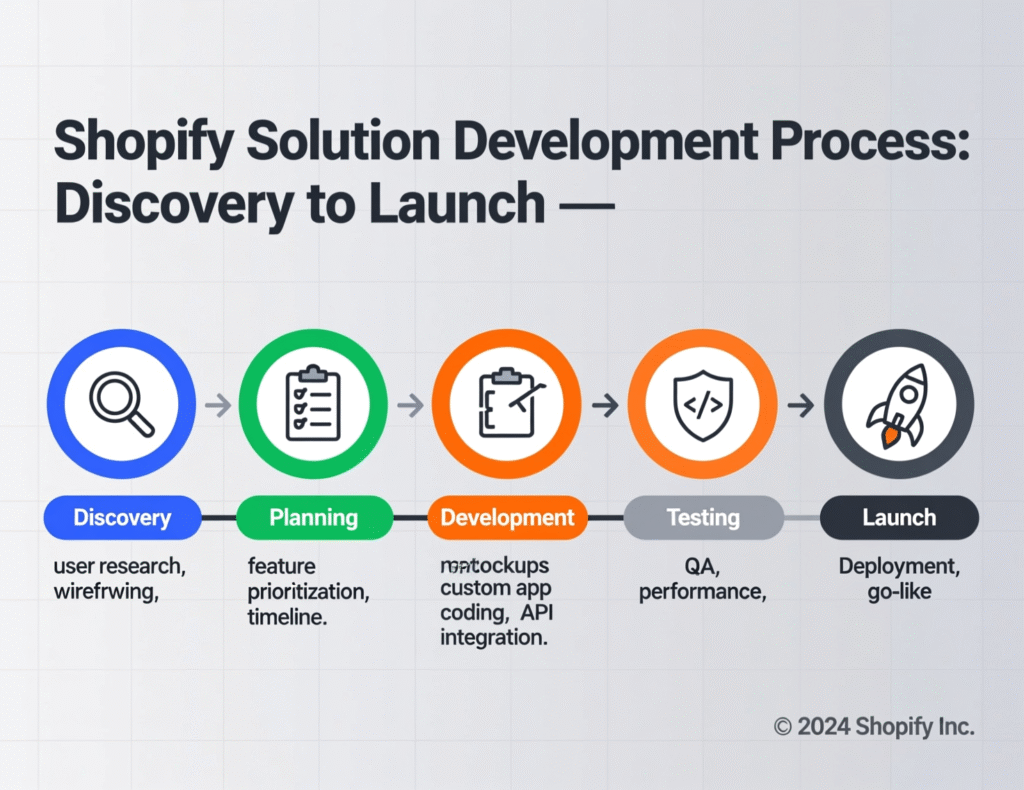
A good Shopify solution development company for B2B brands in USA or Europe will run discovery on:
Catalog complexity: variants, configurable products, bundles, kits, subscriptions
B2B requirements: net terms, VAT handling, tiered pricing, customer-specific catalogs, quote workflows
Operational constraints: warehouses, 3PLs, ERP/CRM integrations, tax automation
For complex B2B catalogs and manufacturer scenarios (for example, “Shopify Entwicklung und ERP Integration für Hersteller in Deutschland”), b2b Shopify ecommerce solutions or headless commerce with Shopify might be recommended to keep performance and UX high while integrating deeply with internal systems.
Design, Theme Customization & Store Development Services
Shopify store development services usually combine UX design, theme customization and custom components. You might choose between:
A fully custom theme, tailored to your brand and UX requirements
A premium theme customization, where a strong base theme is extended with custom sections and apps
Key Shopify theme customization services typically include:
Optimized PLPs and PDPs (filters, sizing guides, trust signals, mobile-first layouts)
Intuitive navigation and search, especially for larger catalogs
CRO-focused features like product bundles, one-click upsells, cross-sells, UGC and reviews
Subscription flows (e.g., ReCharge, Loop), loyalty modules and referral mechanics
Migration & Replatforming from Legacy Platforms
Many brands arrive at Shopify via migration and replatforming projects from WooCommerce, Magento, BigCommerce, Shopware or custom stacks.
Common geo-specific considerations:
USA
State-by-state tax complexity, often solved via tools like Avalara or TaxJar integrated into Shopify, plus 3PL integrations across USPS, UPS and FedEx networks.
UK (post-Brexit)
VAT and customs rules for EU shipments, IOSS numbers, and updated shipping tables for carriers like Royal Mail and DPD.
Germany/EU
VAT, OSS declarations, legally compliant invoices, and mandatory pages like Impressum and Widerrufsrecht. Many brands also require Sprachversionen (DE/EN/FR/ES) and localized content for Berlin, Paris, Barcelona or Stockholm.
You’ll often see searches like “Shopify migration to Shopify Plus from Magento in USA” or “migrate from WooCommerce to Shopify with UK agency” these projects involve robust data migration (products, collections, customers, orders), SEO redirects, and careful cutover planning.
Micro-answer for this H2 (end-to-end view)
End-to-end Shopify solution development typically runs from strategy and solution architecture, through UX/UI design and theme or headless build, into integrations, QA and compliance checks, launch support and then ongoing CRO and maintenance retainers.
Custom Shopify App & Integration Development
Custom Shopify App Development for Unique Use Cases
Custom Shopify app development is needed when off-the-shelf apps can’t handle your specific workflows or compliance constraints.
Typical use cases include:
Subscription ecommerce with complex rules, membership tiers or gated content
B2B portals with customer-specific pricing and order workflows
Multi-vendor marketplaces and curated marketplaces
Sophisticated loyalty and rewards programs
Custom pricing logic (e.g., dynamic volume discounts for wholesale)
Advanced fulfillment rules (split shipments, made-to-order, drop-shipping logic)
Regional examples
USA
Custom Shopify app development for subscription ecommerce in US, membership programs, and bespoke loyalty mechanics tied to mobile apps.
UK
Custom Shopify app development for marketplaces in the UK, plus payment flows using local acquirers and accounting exports optimized for Xero or Sage.
Germany/EU
Apps for compliant invoice generation, multilingual content management and marketplace synchronisation that respect local tax rules (e.g., USt, OSS) and DSGVO.
Shopify API & Systems Integration Services
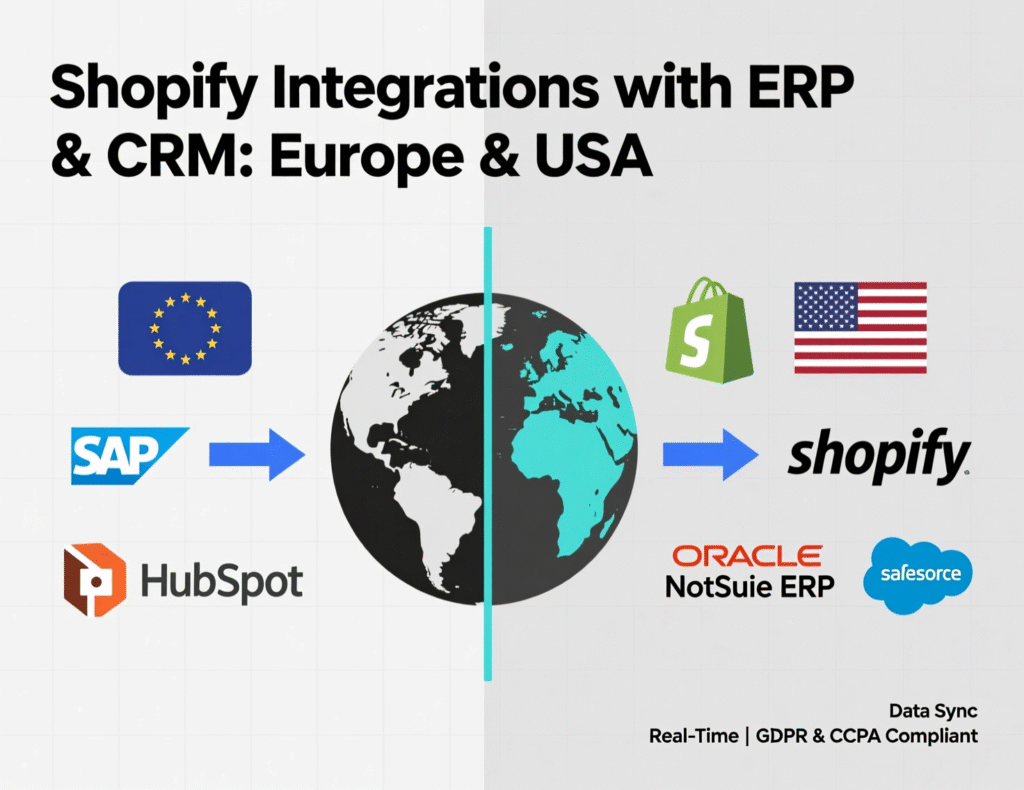
When brands talk about Shopify integrations with ERP and CRM, they’re usually referring to bespoke work using Shopify’s REST and GraphQL APIs.
Typical Shopify API integration services include:
ERP integrations: SAP, Microsoft Dynamics, NetSuite
CRM and marketing automation: HubSpot, Salesforce, Klaviyo, Braze
Accounting: Shopify integration with Sage and Xero accounting in UK, plus DATEV or other EU-specific tools
PIM, WMS and OMS integrations for large catalogs and multi-warehouse fulfillment
These Shopify ERP / CRM integrations keep product, inventory, pricing and customer data in sync so your finance, operations and marketing teams all work from one source of truth.
Fulfillment, 3PL & Payment Integrations Across Regions
Operational excellence depends on clean logistics and payments.
For logistics, Shopify development services often connect:
Germany/EU
DHL, DPD, Hermes, GLS
UK
Royal Mail, DPD, Hermes and local 3PLs
USA
USPS, UPS, FedEx and regional 3PL networks
On the payments side, you may need:
Open banking and local wallets in UK/EU
Klarna, Sofort, Giropay, iDEAL and other local methods
BNPL/fintech tools that may themselves be under BaFin or FCA oversight in Germany/UK
Any app or integration touching payments or sensitive data must respect PCI DSS requirements and, increasingly, SOC 2 style controls for vendors.
Micro-answer for this H2
Custom apps and integrations are critical because they automate manual processes, connect Shopify to your core systems and ensure payments, taxes and fulfillment run reliably at scale without them, enterprise Shopify setups quickly become fragile and hard to grow.
Shopify Plus, Headless & Enterprise-Grade Ecommerce
When to Upgrade from Shopify to Shopify Plus
You should consider Shopify Plus when:
Revenue and order volume stress standard Shopify limits
You manage multiple regions, currencies or brands
You need complex promotion logic and scripts
You have larger internal teams needing granular roles and workflows
Searches like “Shopify Plus development agency” or “Shopify Plus migration services” often come from retailers planning global rollouts. A Shopify Plus agency USA might focus on multi-store setups across North America, while a Shopify Plus agency London or Shopify Plus Agentur in Germany will be used to dealing with UK-GDPR, PECR, DSGVO and EU tax rules.
Enterprise Shopify Ecommerce & Headless Architectures
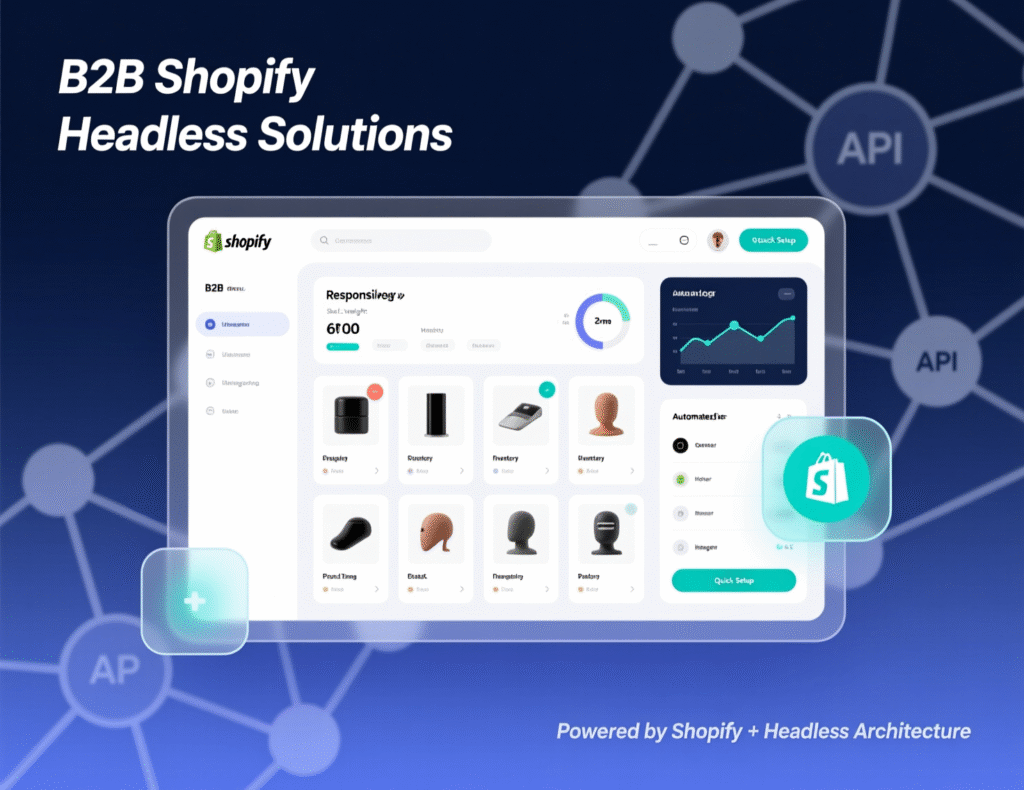
At the upper end, you see enterprise Shopify ecommerce development with composable, headless stacks:
Shopify or Shopify Plus as the commerce engine
Headless frontend, e.g. headless Shopify development using React or Next.js
Best-of-breed tools: headless CMS, onsite search, personalization, CDP, marketing automation
For US brands, you might see headless Shopify development using React for US ecommerce brands to meet performance and design demands. In the EU, the search might be headless Shopify agency EU for multi-country storefronts running on one backend.
Enterprise builds require strong governance: SOC 2–aligned SaaS vendors, SSO (Okta, Azure AD), role-based access control and performance SLAs.
Compliance, Tax & Data Protection for Enterprise Brands
Enterprise Shopify environments must respect:
GDPR/DSGVO in the EU, governing data processing, consent and data subject rights
UK-GDPR/PECR for UK brands, particularly around cookies and direct marketing
BaFin oversight for fintech, BNPL or financial-service brands operating in Germany
HIPAA implications for US health-related verticals
NHS/NHSX guidance for digital health tools in the UK
A strong Shopify Plus partner helps design compliant data flows and consent UX: cookie banners, preference centers, legal copy, data retention policies and DPA-compliant processor relationships.
Micro-answer for this H2
Standard Shopify development focuses on getting a single store live quickly, while Shopify Plus and enterprise solutions add multi-store architectures, deeper integrations, governance, security and compliance layers suitable for large, multi-market retailers.
Ongoing Shopify Support, CRO & Performance Optimization
Maintenance, Technical Support & Store Management Services
Shopify maintenance and support covers the day-to-day technical health of your store. Typical Shopify store management services on a retainer include:
Theme and app updates, security patches and app audits
Uptime monitoring and performance checks
Bug fixes and issue triageVersion control and deployment pipelines
Backups and rollback plans
Task queues for marketing and product teams
You’ll see offerings like a Shopify support agency USA, a Shopify support agency London, or “Shopify Wartung & Support” in Germany, all referring to similar retainers adapted for local time zones and compliance expectations.
Conversion Rate Optimization & Performance Tuning
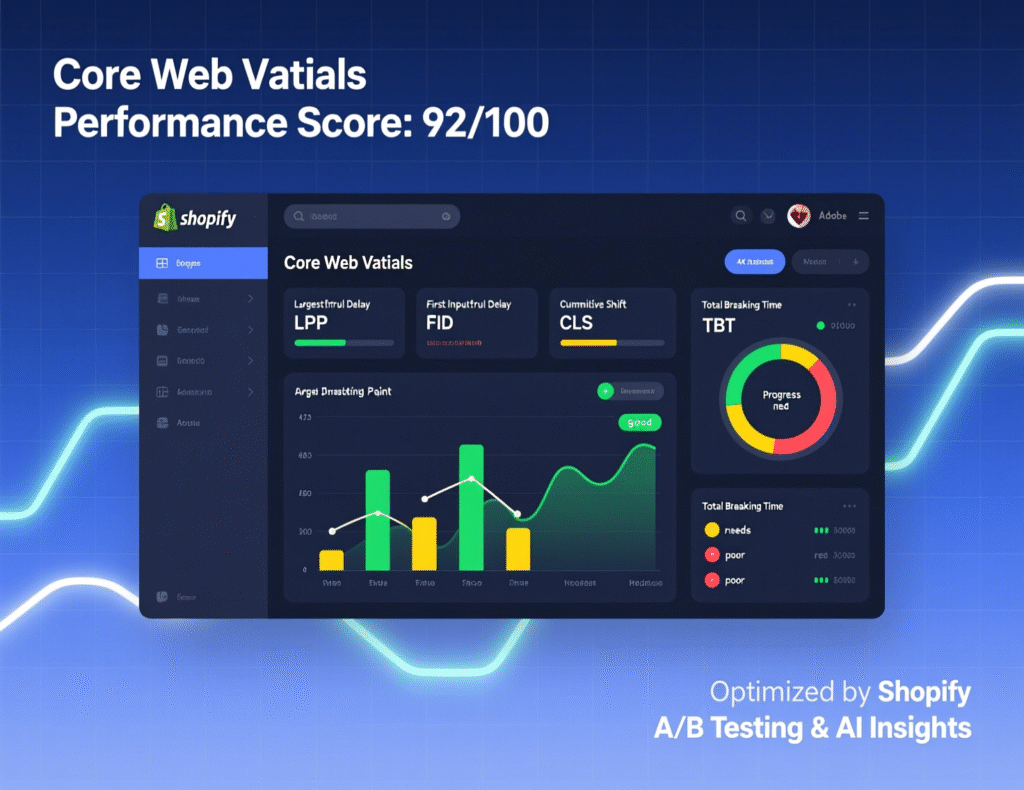
Shopify conversion rate optimization services and Shopify performance optimization focus on turning more visitors into customers and making every session faster and smoother.
That typically includes:
A/B testing of PDP layouts, cart and checkout flows, navigation and offers
Improving Core Web Vitals with theme refactoring, image and font optimization and better use of CDNs
Optimizing search and merchandising, particularly on PLPs
Tight integration with analytics tools for funnel insights
Mobile is critical: mobile commerce sales alone are projected at around $2 trillion globally in 2024, with mobile driving a majority of ecommerce traffic. Key KPIs usually monitored include conversion rate, AOV, LTV, bounce rate and checkout drop-off.
Scaling Into New Markets: Multilingual & Multi-Currency
If you’re expanding into new markets, you’ll need Shopify shop development with multilingual setups for EU markets and multi-currency support (EUR, GBP, USD, CHF, SEK and more).
Core challenges include
Localized content, imagery and product positioning for each country
Correct tax rules per market (VAT, OSS, state taxes)
Local shipping methods and carriers, from DHL and GLS in Germany to UPS/USPS in the US
Local payment methods (Klarna, Sofort, Giropay, iDEAL, etc.)
For B2B, you might need “Shopify Lösung für B2B Ecommerce mit Nettorechnung in der EU”, with net terms, invoice-based payments and localized legal copy.
Micro-answer for this H2
Ongoing CRO and support retainers outperform one-off builds because they let your Shopify store evolve with customer behavior, new markets and changing regulations instead of freezing in time after launch.
Process, Timelines & Pricing in the USA, UK & Germany
How a Shopify Development Project Typically Works
For most brands, Shopify solution development follows a clear step-by-step process from discovery through launch:
Discovery & Strategy
Understand your brand, ICPs, funnels, catalog, operations and compliance constraints.
Solution & Architecture Design
Map out tech stack, apps, integrations and data flows.
UX/UI Design
Create wireframes and high-fidelity designs for key templates (home, PLPs, PDPs, cart, checkout).
Development
Build or customize the theme or headless frontend, integrate apps and external systems.
QA & Compliance Checks
Test across devices, browsers and markets; review GDPR/DSGVO, UK-GDPR and payment compliance.
Launch & Hypercare
Cut over, monitor, fix issues and support marketing pushes.
Optimization & Retainer
Move into CRO experiments, enhancements and ongoing support.
This applies whether you’re in Austin, London or Munich; only the integrations and compliance layers vary by region.
Typical Pricing Models & Ranges by Region
When people ask, “How much does professional Shopify solution development typically cost in the USA, UK, and Germany, and what factors affect pricing?”, the honest answer is: it depends heavily on scope, complexity and region, but there are common patterns.
Most agencies use some combination of:
Fixed-scope projects
For clearly defined builds and migrations
Time & materials
For iterative or experimental work (often for headless)
Retainers
For ongoing support, CRO and roadmap delivery
Hybrid
Fixed build + post-launch retainer
Indicatively (without exact numbers), you can think in low / mid / high tiers:
USA
Typically higher day rates, especially for headless commerce and deep integrations. Enterprise Shopify Plus builds with React frontends often sit in the high tier.
UK
Strong mid-market; London agencies often mix fixed projects with monthly retainers, especially for growing DTC brands.
Germany
Moderate rates but more time invested in documentation, approvals and compliance reviews, often increasing project duration.
Risk, Compliance & Quality Assurance Before Launch
Before going live, solid risk, compliance and QA is non-negotiable:
Multi-device and cross-browser testing
Performance and load tests, especially for big drops or campaigns
SEO checks: redirects, sitemaps, metadata, structured data
Analytics and event tracking validations (GA4, server-side tracking, pixels)
Legal checks: GDPR/DSGVO and UK-GDPR consent, cookie banners, privacy policies, terms
PCI DSS considerations for payment providers and custom apps
Multi-store tests for EU-wide brands (e.g., Germany, France, Spain, Netherlands, Nordics)
Micro-answer: main pricing drivers (bullet list)
Key factors that drive Shopify solution development pricing across USA, UK and Germany include:
Scope and feature depth
Catalog and integration complexity (ERP/CRM/3PL)
Design and UX ambition (standard vs headless)
GEO coverage (single vs multi-country)
Timeline urgency (standard vs fast-track)
Ongoing support and CRO retainer requirements
How to Choose the Right Shopify Development Partner
Evaluating Shopify Expert Agencies vs Freelancers vs In-House
On Reddit or Quora you’ll often see questions like “is it worth hiring a Shopify developer?” or “freelancer vs agency vs in-house dev team.”
A freelancer can be perfect for small theme tweaks or one-off components when your risk is low.
An in-house dev makes sense once Shopify is mission-critical and you have enough roadmap to keep them busy full-time.
A Shopify expert agency or Shopify Plus development partner is ideal when you need multi-disciplinary skills (strategy, UX, dev, integrations, CRO, compliance) and you want proven processes and governance.
Signals of a good partner include strong case studies, references in your vertical (e.g., fashion, beauty, B2B manufacturing), GEO experience across US/UK/Germany/EU and technical depth in headless and integrations.
Must-Have Criteria for US, UK & EU Projects
When evaluating partners, ask region-specific questions.
US
Experience with state tax, 3PL networks, retail media and growth marketing integration.
UK
Familiarity with UK-GDPR, PECR, post-Brexit shipping and tax, and open banking payment options.
Germany/EU
Comfort with DSGVO, VAT/OSS, BaFin considerations where fintech/BNPL is involved and industry-specific constraints (e.g., healthcare and public sector).
Your checklist should also include
Certified Shopify partners or strong Shopify App Store track record
Security and compliance understanding (PCI DSS, SOC 2, HIPAA where relevant)
Ability to collaborate with internal dev/marketing teams on Git, CI/CD and analytics
How to Brief a Shopify Development Company
To get accurate proposals, you’ll want a clear Shopify development brief or RFP. Include
Business goals, KPIs and success metrics
Current tech stack and integrations (ERP, CRM, WMS, PIM, analytics, ad platforms)
Catalog size and complexity
Content and localization needs (US/UK/German/EU storefronts)
Compliance constraints (GDPR, UK-GDPR, PCI, any health/financial regulations)
Timelines, budget range and internal team resources
Encourage stakeholders to document requirements for each market New York vs London vs Berlin often need different payment, tax and content strategies. Then invite shortlisted partners to challenge and refine the solution.
Micro-answer for this H2
A specialized Shopify development partner is usually better than relying on off-the-shelf themes because they design a store around your specific funnels, integrations and compliance needs, rather than forcing your brand to fit a generic template that may not scale with growth.
FAQs
Q : Do I need Shopify Plus for my ecommerce brand, or is standard Shopify enough?
A : You don’t automatically need Shopify Plus just because your brand is growing. Standard Shopify is usually enough for early-stage DTC and smaller B2B brands with straightforward catalogs, a single main market and basic promotion rules. Shopify Plus becomes worth considering once order volume is high, you’re operating multiple stores or regions, or you need complex discounting, automation and advanced checkout control. If you’re unsure, a Shopify expert agency can run a short discovery to estimate the ROI of staying on standard plans versus moving to Plus and potentially headless commerce.
Q : How long does it take to build a custom Shopify store with integrations for US, UK and EU markets?
A : Timelines depend on scope, but you can think in ranges. A relatively simple Shopify build using a premium theme and light integrations might take 4–8 weeks from discovery to launch. A fully custom or headless build with ERP/CRM, 3PL and multi-store localization for US, UK and several EU countries often runs 12–20+ weeks, especially if legal and compliance reviews are involved. Parallel work on content, photography and SEO can speed things up. Strong project management, clear requirements and fast feedback loops are the biggest levers for hitting timelines.
Q : Can a Shopify agency help with migrating our product data, customers and orders from Magento or WooCommerce?
A : Yes, most Shopify agencies handle full migrations from Magento, WooCommerce, BigCommerce, Shopware and custom platforms. This usually includes extracting structured data, cleaning and mapping it into Shopify’s model, then running test imports for products, collections, customers and orders. They’ll also design redirect maps to preserve SEO, configure new tax and shipping rules and coordinate a cutover window with your internal teams. For complex B2B or subscription setups, they may combine Shopify’s APIs with custom scripts or migration apps to bring across contracts, price lists and subscriptions with minimal disruption.
Q : What should be included in a Shopify development brief or RFP to get accurate proposals?
A : A strong brief should cover your business model, target markets and main KPIs, plus the gaps in your current stack. Include details about catalog size, variants, bundles and subscriptions, as well as required integrations (ERP, CRM, WMS, PIM, marketing tools). Outline compliance requirements—like GDPR/DSGVO for EU, UK-GDPR for the UK or HIPAA for US health-related brands—alongside any design direction or brand guidelines. Finally, add desired timelines, budget range and who will own content and operations internally. The clearer your brief, the more realistic and comparable agency proposals will be.
Q : How do Shopify agencies typically work with in-house marketing and product teams during a project?
A : Good Shopify agencies treat your in-house teams as core collaborators rather than “clients to hand work off to.” Marketing and product teams usually join discovery workshops, provide input on funnels and UX, and co-own backlog prioritization. Agencies often set up shared tools like Slack, Jira, Trello or Asana for daily communication and task tracking. Your team can handle content entry, merchandising and campaign planning while the agency focuses on architecture, development and QA. After launch, ongoing CRO and experiment roadmaps are usually co-created so everyone is aligned on KPIs and future features.
Key Takeaways
Shopify development services cover strategy, UX, development, integrations, compliance and ongoing optimization not just theme tweaks.
Regional nuances matter: US projects often prioritize performance and headless, UK work leans into brand and open banking, while Germany/EU demand rigorous GDPR/DSGVO, VAT and legal compliance.
Custom apps and Shopify integrations with ERP and CRM turn Shopify into a true business platform, automating finance, inventory and operations.
Shopify Plus and headless architectures are best suited to fast-growing or enterprise retailers that need scalability, governance and multi-market flexibility.
Ongoing support and CRO retainers keep your store evolving as CAC, customer behavior and regulations change, delivering better ROI than one-off builds.
Choosing the right Shopify expert agency, with GEO-specific compliance knowledge and technical depth, is crucial for de-risking complex builds and migrations.
If you’re planning a new Shopify build, a migration from Magento or WooCommerce, or a multi-market rollout across the US, UK and EU, now is the right time to get your architecture and compliance foundations right. The team at Mak It Solutions can help you scope a strategy-led Shopify solution, from discovery and UX to custom apps, integrations and CRO retainers. Share your goals, markets and current stack, and we’ll come back with a clear plan for your next stage of Shopify growth. ( Click Here’s )