
Prompt Engineering Skills Every Worker Needs in 2025
Prompt Engineering Skills Every Worker Needs in 2025

Prompt Engineering Skills: How to Talk to AI at Work (US, UK, Germany & EU)
Prompt engineering skills are the ability to give clear, structured instructions to tools like ChatGPT, Gemini or Claude so they consistently return accurate, safe and useful answers. In practice, that means combining your domain expertise with repeatable prompt patterns, constraints and workflows you can apply to everyday tasks across US, UK and European workplaces.
Introduction
For many knowledge workers in New York, London, Berlin or Amsterdam, “how you talk to AI” is becoming as fundamental as email, Excel or PowerPoint. Generative AI is now embedded into Microsoft 365, Google Workspace, Salesforce, Notion, Slack and countless SaaS platforms, and most employees already use it at least occasionally for work. Surveys in 2024–2025 suggest that around 75% of global knowledge workers have tried generative AI tools, with usage climbing quickly.
Prompt engineering is the skill of structuring instructions so tools like ChatGPT, Gemini or Claude reliably produce useful, safe outputs. It’s less about secret “magic prompts” and more about repeatable habits: setting a role, clarifying context, giving examples, stating constraints, and iterating.
In this article we’ll unpack.
What prompt engineering skills really are
How to talk to AI like a pro at work (even if you’re not technical)
Real job demand and salary signals in the US, UK, Germany and wider EU
How to build AI prompting skills fast — for individuals and teams
What Are Prompt Engineering Skills, Really?
Prompt engineering skills are the ability to design clear, structured instructions for large language models (LLMs) so they understand your intent, respect constraints (tone, length, compliance) and return reliable results you can use at work.
From “Talking to AI” to a Real Workplace Skill
Media in the US, UK, Germany and across the EU increasingly describe “prompt experts” as people who know how to talk to AI, not just coders. Research on prompt engineer job postings finds a distinct skill mix: AI knowledge, prompt design, strong communication and creative problem-solving — different from classic data science roles.
In a New York consulting firm, that might look like a strategist who can turn messy client notes into a series of prompts that generate slide outlines, talking points and risks. In a London NHS trust, it’s an operations manager who can ask an LLM to summarise a policy for frontline staff without leaking patient data. In Berlin or Paris, it may be a product owner who uses AI to draft requirements and FAQs in German, French and English.
Across these contexts, prompt engineering is a workplace communication skill that sits between language, critical thinking and digital literacy.
Key Components of Strong Prompts
Strong prompts tend to share a few core building blocks:
Role / persona
“You are a senior HR business partner in a German bank under BaFin supervision.”
Context
“We’re updating a remote-work policy for staff in Berlin, Munich and Frankfurt.”
Objective
“Draft a one-page summary for non-technical managers.”
Format
“Use headings + bullet points, maximum 400 words.”
Constraints
“Avoid legal jargon, align with GDPR/DSGVO and UK-GDPR, no new commitments.”
Examples
“Here’s a previous memo our leadership liked…”
Office-friendly examples
Summarise this NHS report for a non-technical manager in London; highlight 3 key risks and 3 patient-impact points.
Draft a BaFin-compliant customer email in German explaining new PSD2/Open Banking security checks for our Frankfurt clients.
Rewrite this slide in US English for an executive audience in Austin; keep it under 80 words per slide.
Examples of Good vs. Bad AI Prompts
US marketing example
Bad
“Write ad copy for our SaaS product.”
Better
“You are a senior B2B copywriter in a San Francisco SaaS company. Write three 50-word LinkedIn ads for mid-market CFOs in the US, focused on reducing cloud spend by 20%. Use a confident but not hypey tone, and end each ad with a clear CTA.”
UK policy example
Bad:
“Explain this data protection policy.”
Better
“Act as a UK data protection officer. Explain this policy to NHS nurses in Manchester in plain English, 300 words max. Focus on what they must do and must not do with patient data under UK-GDPR and GDPR. Use bullet points.”
Germany/EU RegTech example
Bad
“Summarise EU banking regulation.”
Better
“You are a compliance analyst in a BaFin-regulated bank in Berlin. Summarise this European Central Bank and EU Commission guidance into a 1-page briefing for German relationship managers. Emphasise what changes for SME clients and where they must collect additional consent. Write in German, but keep regulatory terms precise.”
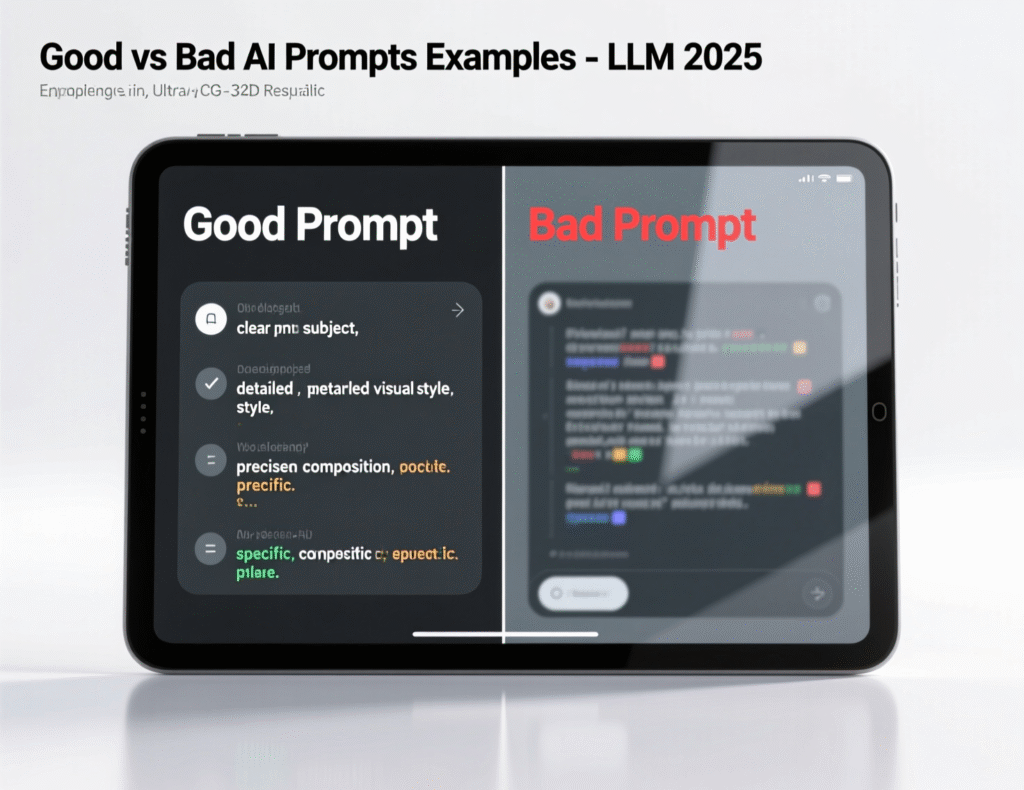
In each case, the “engineered” prompt gives the model a job, audience, constraints and a format so the output is much closer to “paste into your document” quality.
How to Talk to AI Like a Pro at Work
You talk to AI effectively by giving it clear roles, concrete tasks, examples and constraints and by iterating based on the output rather than accepting the first answer.
Prompt Patterns for ChatGPT, Gemini, Claude & Co.
You don’t need hundreds of prompts; you need a few reusable patterns:
Coach
“You are a presentation coach. I’m a product manager in Dublin. Help me turn this messy outline into a 10-minute talk for a non-technical audience.”
Editor
“You’re an editor at a London business magazine. Improve clarity and flow of this article, but keep my voice. Suggest 3 headline options.”
Analyst
“Act as a senior data analyst in a Seattle fintech. Read this table and propose 3 hypotheses for why churn is higher in Spain and the Netherlands.”
Role-play a stakeholder
“Pretend you’re a cautious CIO at a Barcelona hospital group. Push back on my proposal to use generative AI, asking tough questions about GDPR, HIPAA and SOC 2.”
Marketers, product managers, consultants and analysts can reuse these patterns in tools they already use from Office and Google Workspace to AI-powered BI platforms.
Prompt Engineering Skills for Non-Coders
You do not need a computer science degree to be good at prompt engineering. The most important ingredients are:
Clarity of thinking
Understanding of your domain (HR, finance, healthcare, marketing, ops)
Willingness to test and refine
In a US corporation, a HR partner might use AI prompting to create competency frameworks, interview guides and training outlines. In the UK public sector, NHS teams might use prompts to draft patient letters or staff briefings checked carefully by humans before sending. In the German Mittelstand, operations managers might prompt AI in German and English to generate work instructions for Industrie 4.0 equipment while staying within DSGVO constraints.
Everyday AI Prompting Workflows
A simple everyday workflow for a remote worker in Seattle, London, Berlin or Amsterdam:
Research
Ask the AI to outline key concepts and risks, with links to authoritative sources.
Draft
Give the AI your audience, objective and constraints; get a rough draft.
Refine
Ask for improvements (“shorter”, “more examples”, “less jargon”, “align with PCI DSS”).
Localise
Generate variants for US, UK and German/EU audiences (language, currency, spelling, regulatory references).
Review
Apply human judgement, especially for legal, financial, medical or HR topics.
Used this way, generative AI can cut time for drafting and summarisation tasks by 20–40% while improving consistency.

Are Prompt Engineering Skills Really in Demand?
Yes. Job ads in the US, UK, Germany and across Europe increasingly mention “AI prompting” or “prompt engineering skills”, even when the role isn’t titled “Prompt Engineer”.
From Niche Role to Common Requirement
In US tech hubs like San Francisco, Seattle, New York and Austin, employers now add “experience with LLMs / AI prompting” to descriptions for marketing managers, analysts, product managers and consultants. Analyses of AI skills requirements show that mentions of AI skills in job postings have roughly tripled compared with two years ago.
For six-figure roles, some recruiters predict a 50% increase in demand for AI skills, including prompt engineering, within the next few years. Candidates who can demonstrate real generative AI productivity gains not just “used ChatGPT” often command salary premiums or faster promotions.
AI Skills on CVs and Job Specs
In the UK and wider EU, job specs across finance (Open Banking/PSD2), healthcare (NHS and private hospital groups) and consulting now mention
Experience working with generative AI tools (ChatGPT, Gemini, Copilot, Claude)
Ability to design and refine prompts for LLMs
AI literacy and comfort with AI-augmented workflows
European policy initiatives explicitly call for broad AI literacy and skills development, not just specialist data scientists, as part of the EU’s digital strategy.
Prompting Skills in a Regulated, Multilingual Context
On the deutscher Arbeitsmarkt, German organisations operate in a tightly regulated, multilingual environment. Banks under BaFin oversight, insurers in Frankfurt and Industrie 4.0 manufacturers in Munich and Hamburg increasingly want people who can
Prompt AI in German and English
Understand DSGVO/GDPR and data residency requirements
Work safely with sensitive financial or industrial data
Here, “responsible prompt engineering” includes knowing what not to paste into public models and when to use more controlled platforms (for example, private instances on AWS, Azure or Google Cloud).Prompt Engineering Jobs, Salaries & Career Paths
Prompt engineer roles can command strong salaries today, but long-term most workers will combine prompting skills with another profession rather than hold a purely “Prompt Engineer” title.
What Does a Prompt Engineer Actually Do?
A dedicated prompt engineer typically
Designs and maintains prompt libraries for recurring tasks
Tests LLM behaviour, edge cases and failure modes
Tunes prompts for different tools and models
Aligns prompts with compliance frameworks such as GDPR/DSGVO, UK-GDPR, HIPAA, PCI DSS and SOC 2
-
Works with product, support or operations teams to embed AI into real workflows
If your organisation is exploring AI search, RAG and copilots on internal data, prompt engineers often partner with data and cloud teams — for example, alongside AI search and RAG experts or cloud hosting specialists.
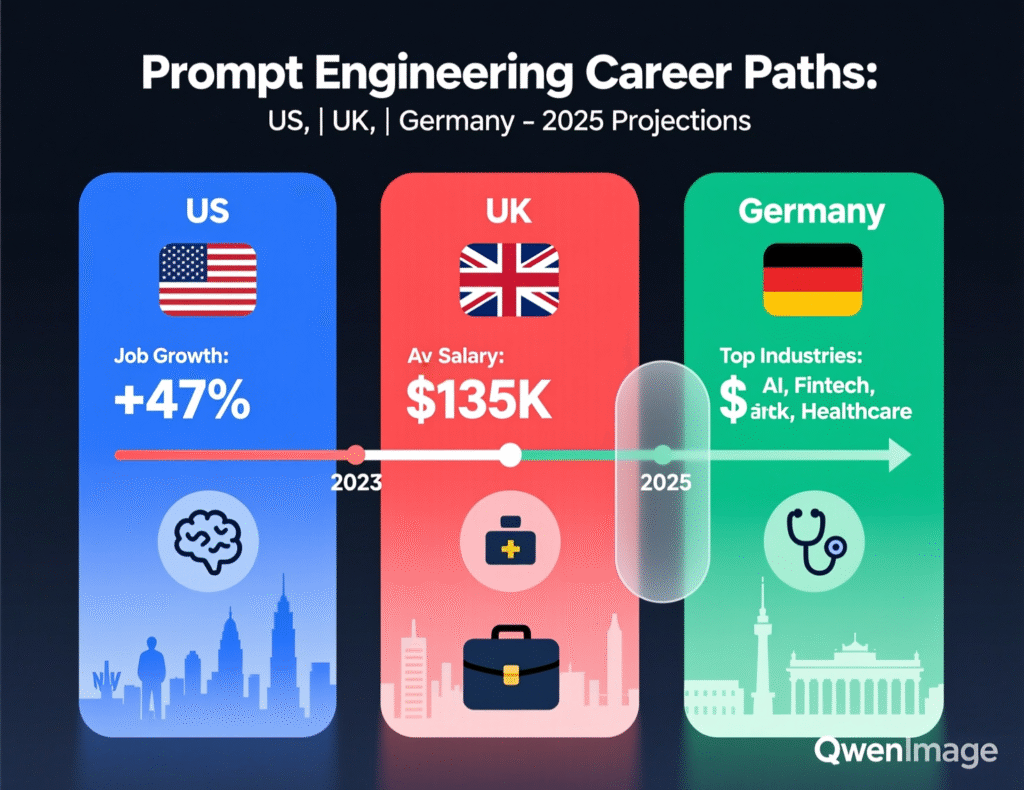
Salaries in the US, UK, Germany & EU
High-level (non-binding) patterns.
United States
Top-end prompt engineer roles in places like Silicon Valley or Seattle can be very well-paid, especially when combined with software engineering or ML.
United Kingdom
London roles tend to offer strong but slightly lower base pay than US peers, often with hybrid titles like “AI Engineer / Prompt Specialist”.
Germany & EU
Berlin and Munich roles are competitive, sometimes with slightly lower cash but strong benefits, stability and training budgets.
In practice, compensation depends heavily on what prompt engineering is paired with: software development, data science, product, legal, finance, healthcare, etc.
Prompt Engineer vs. Software Engineer vs. AI-Savvy Knowledge Worker
Pure prompt engineer
Good short-term opportunity, but role definitions are still evolving and may narrow to more technical or platform-specific work.
Software engineer with AI skills
Strong long-term path; prompting blends with coding, architecture and MLOps.
AI-savvy knowledge worker
For most professionals (marketing, HR, finance, legal, operations), this is the sweet spot: you remain a [job title] but become the person who gets 20 40% more done by pairing AI with your expertise.
For many people, the most resilient option is to keep your core profession but add prompt engineering as a key differentiator.
Is AI Prompting the New Digital Literacy?
Prompt engineering skills are emerging as a core form of AI literacy similar to how Office and email became mandatory digital skills for the US, UK and EU workforce.
From Excel & PowerPoint to “How You Talk to AI”
In the 1990s and 2000s, typing, email and basic Excel became baseline skills. Today, being able to delegate work to an LLM safely and clearly is heading in the same direction.
Across New York, London, Berlin and Barcelona, white-collar employees already use AI for drafting, summarising and analysis; adoption has roughly doubled in recent years, and around two-thirds to three-quarters of surveyed workers say they’ve used AI at work.
Industries Where Prompt Skills Matter Most
Prompt engineering is especially valuable in:
Marketing & customer support – content, FAQs, chatbots
HR – job descriptions, policies, performance reviews
Legal & compliance – first-draft summaries, clause comparisons (always lawyer-reviewed)
Healthcare – patient letters, non-clinical summaries (e.g. NHS admin teams)
Finance & banking – reports, risk summaries, PSD2/Open Banking communications
Software & product – specs, user stories, documentation
Major platforms like Apple, Microsoft, Google Cloud and AWS are weaving assistants and copilots into their ecosystems which means AI prompting shows up everywhere without you buying a standalone “AI product”.
Risks of Ignoring Prompt Engineering Skills
If you ignore prompt engineering:
Your productivity may lag peers who use AI effectively
Your CV may start to look dated within a few years
You risk being boxed into repetitive, low-value tasks that are easiest to automate
For employers across the US, UK, Germany and the wider EU, this is why “AI literacy” and generative AI training programmes are now on the HR and L&D roadmap.
How to Build Prompt Engineering Skills Fast
You can build solid prompt engineering skills in weeks by combining guided experimentation with structured learning (courses, playbooks, internal training) and real on-the-job practice.
A 30-Day Self-Study Roadmap
Fundamentals
Learn basic LLM concepts, data privacy, and why prompts work the way they do.
Practice simple prompts: summarise, rewrite, explain like I’m 12, bullet-point lists.
Try tasks related to your job: emails, reports, meeting notes.
Patterns & Workflows
Use coach, editor, analyst and stakeholder role-play patterns daily.
Build simple workflows: research → outline → draft → refine → localise (US vs UK vs German/EU).
For German/EU work, practice bilingual prompts (English + German or French).
Compliance & Guardrails
Learn the basics of GDPR/DSGVO, UK-GDPR, HIPAA and PCI DSS relevant to your sector.
Practise prompts that avoid personal data and rely on fictional or anonymised examples.
Experiment with enterprise AI tools if your organisation offers them.
Portfolio & Metrics
Create 3–5 mini-projects: improved client email templates, policy summaries, or localisation flows.
Track time saved or quality improvements (e.g. fewer review cycles).
Document prompts and outcomes as a mini portfolio.
Choosing Courses, Certifications & Internal Training
When picking a prompt engineering course or corporate training:
Look for LLM-agnostic content (ChatGPT, Gemini, Claude, Azure OpenAI, etc.).
Prefer case-study-based material with examples from your industry.
Check that it covers compliance scenarios (NHS, BaFin, PCI DSS, SOC 2, EU data residency).
For enterprises in the US, UK and EU, combine external courses with internal playbooks tailored to your data and tools.
Showcasing AI Prompting Skills on Your CV & LinkedIn
On your CV and LinkedIn
Describe concrete use cases: “Reduced time to draft client proposals by ~30% by building AI-assisted templates.”
Mention specific tools: ChatGPT, Gemini, Claude, Microsoft Copilot, Azure OpenAI, Google Cloud Vertex AI.
Highlight metrics: time saved, quality improvements, error reduction.
For managers, showcase how you rolled out AI playbooks or training across teams.
A small internal prompt library or a private portfolio (screenshots, redacted outputs) can go a long way in interviews.
Building AI Prompting Capability Across Teams
Organisations should treat prompt engineering as a shared capability: set policies, provide training, and align prompts with security and compliance frameworks.
Governance, Compliance & Risk Management
Key considerations for US, UK, German and EU organisations:
Regulations
GDPR/DSGVO, UK-GDPR, HIPAA (for healthcare), PCI DSS (for payments), SOC 2 (for SaaS), BaFin rules for financial data.
Data handling
Anonymise data before using public tools; prefer private instances with clear data-retention policies.
Data residency
Use EU/EEA or UK regions on AWS, Azure or Google Cloud where data locality matters.
If you want a deeper dive into generative AI security, governance and “shadow AI” risks, pairing prompting initiatives with a clear security framework is essential. Makitsol+1
Training Playbooks for US, UK & EU Teams
HR and L&D teams can
Run AI literacy workshops with role-specific examples (marketing, HR, finance, operations).
Provide multilingual materials (English, German, French, Spanish).
Offer curated prompt libraries per department, not one giant generic document.
Align with broader AI strategies and skills programmes in Europe and beyond.
Measuring ROI of Prompt Engineering Skills
Measure value with KPIs like:
Time saved on drafting and summarisation tasks
Fewer review cycles or rework
Higher employee satisfaction and reduced burnout
Faster turnaround for clients or internal stakeholders
You might find, for instance, that a London consulting team saves several hours per week on proposals, a Berlin operations team accelerates SOP updates, and a New York analytics team produces more “executive-ready” summaries with the same headcount.

Key Takeaways
Prompt engineering is a core AI literacy skill closer to “how you brief a colleague” than to coding.
Employers in the US, UK, Germany and across the EU are rapidly adding AI prompting expectations into ordinary roles, not just specialist titles.
Most workers will benefit more from being an AI-savvy [job title] than from chasing a narrow “Prompt Engineer” label.
You can build useful prompting skills in 30 days with structured practice, basic compliance awareness and a few reusable patterns.
Organisations get the best ROI when they combine governance, training and practical playbooks, not just buying tools.
Mak It Solutions can help you design secure, high-impact generative AI workflows that respect global regulations and your local context.
If you’re ready to turn “I’ve tried ChatGPT a few times” into a practical, career-relevant skill set, now is the time. Start with a 30-day roadmap, then layer on structured training and better tools.
Mak It Solutions works with teams across the USA, UK, Germany and wider Europe to design AI-ready workflows, prompt libraries and governance frameworks. Reach out to explore a scoped workshop or pilot project tailored to your industry and compliance needs. ( Click Here’s )
FAQs
Q : Do I need coding experience to learn prompt engineering skills?
A : No. You don’t need to write a single line of code to become strong at prompt engineering. The core skills are clarity in how you describe tasks, understanding your domain (for example HR, finance or healthcare), and the ability to review and refine AI outputs. Technical colleagues may handle integration work, while you focus on giving the model the right instructions and constraints.
Q : How advanced do my prompt engineering skills need to be for non-tech roles like marketing or HR?
A : For most marketing, HR, operations or customer-success roles, you only need intermediate prompting skills: being able to set a role, give context, request a format and iterate safely. You don’t need to understand model internals. What matters is that you can consistently get better drafts, summaries and ideas from AI, while staying inside your organisation’s security and compliance guardrails.
Q : Are prompt engineering skills still valuable if AI tools become more “automatic” over time?
A : Yes. Even as AI tools feel more automatic, someone still has to frame the question, choose examples, set guardrails and judge quality. As more routine prompts get embedded into products, the value shifts toward people who can design workflows, policies and higher-level prompt patterns across tools and departments. Think of it less as “knowing specific hacks” and more as AI literacy and systems thinking.
Q : Which industries in the US, UK and Germany value AI prompting skills the most?
A : The strongest demand today is in technology, professional services, finance, marketing and customer support but healthcare, HR and operations are catching up quickly. In the US, digital-first companies and SaaS providers lead. In the UK, financial services, the NHS and consulting firms are active. In Germany and DACH, regulated industries like banking (under BaFin), insurance and Industrie 4.0 manufacturers look for people who can prompt AI responsibly in German and English.
Q : How can small businesses in Europe upskill their teams in prompt engineering without a big training budget?
A : Small businesses don’t need massive programmes. Start with short internal workshops based on real tasks (customer emails, invoices, proposals), using free or low-cost AI tools. Create a shared document of tested prompts, highlight “do’s and don’ts” for GDPR/DSGVO, and encourage staff to track time saved. Over time, you can add targeted external courses or bring in a specialist partner for a compact training series rather than a large-scale programme.