


Phishing Awareness Training in the Middle East
Phishing Awareness Training in the Middle East
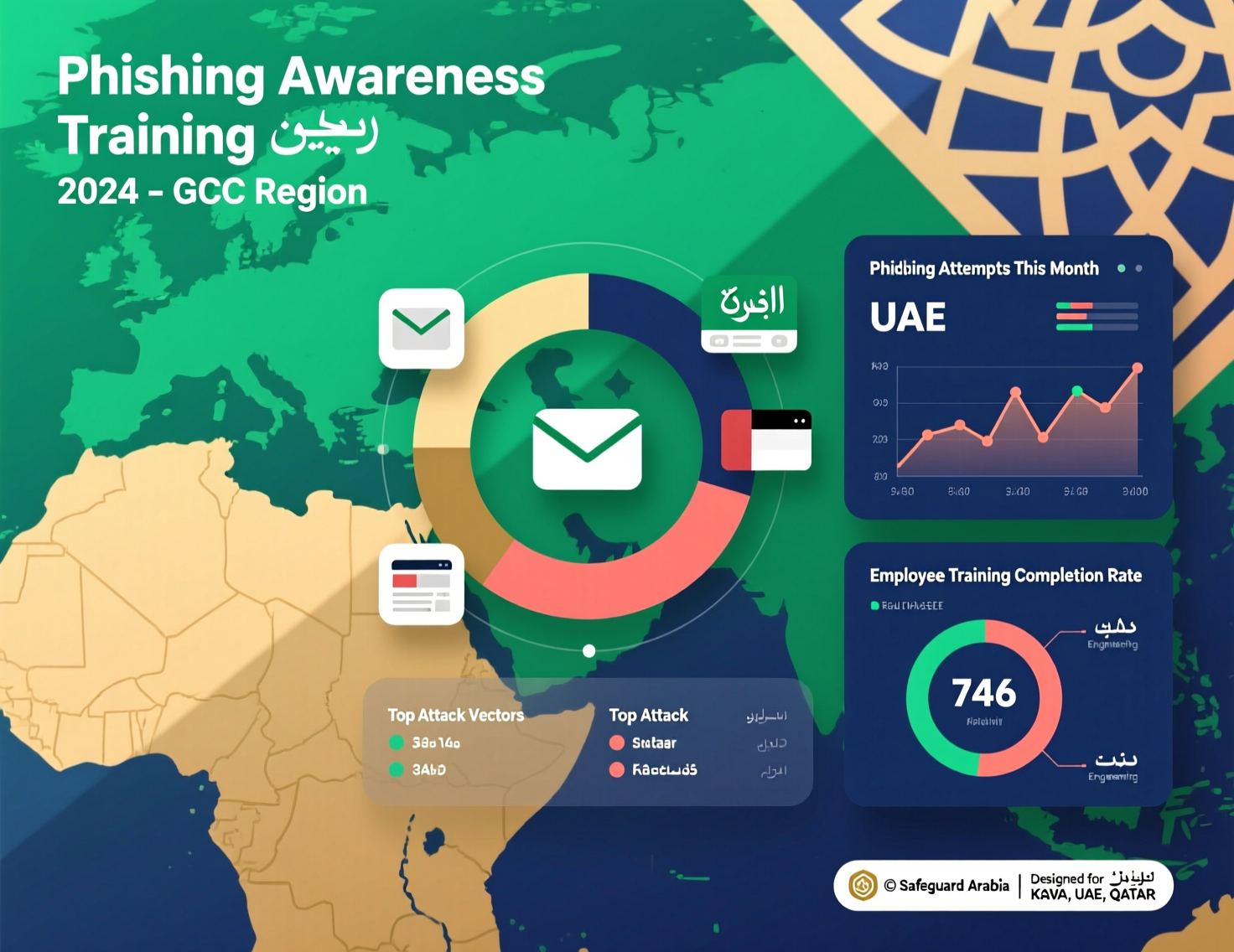
Phishing Awareness Training in the Middle East: Protect KSA, UAE & Qatar
Effective Middle East phishing awareness training means continuous, Arabic English, role-based education and simulated phishing campaigns that turn employees into a real human firewall. For KSA, UAE and Qatar organisations, it must be regulator-aligned (SAMA, NCA, UAE PDPL, NCSA/QCB), locally hosted where needed, and measured by reduced click rates and higher reporting over time.
Introduction
Phishing is still the easiest way attackers break into companies in Riyadh, Dubai and Doha not by exploiting firewalls, but by tricking people. Whether it’s a fake SAMA update, a spoofed UAE Pass message or a “QCB security alert”, one convincing email can bypass millions of riyals of security tools. Regionally active groups like MuddyWater continue to use tailored phishing and social engineering across Middle Eastern governments, energy and telecoms.
If you’re a CISO, IT leader, HR, compliance or risk owner in KSA, UAE or Qatar, you’ve probably seen “awareness days” that look great on a slide but don’t change real behaviour. Middle East phishing awareness training needs to go far beyond that: it should be continuous, localised and tightly aligned with GCC regulators.
In the sections that follow, we’ll walk through why employees still fall for phishing, what modern phishing awareness training in the Middle East should look like, how SAMA, NCA, UAE PDPL, NCSA and QCB shape your program, the KPIs that matter, and a practical rollout plan for building a human firewall across the GCC.
Why Middle East Employees Still Fall for Phishing Emails.
The phishing reality for KSA, UAE and Qatar companies.
Banks, government entities and oil & gas operators in Riyadh, Jeddah, Dammam, Dubai, Abu Dhabi and Doha remain high-value targets for regional and state-linked attackers. They use spear-phishing and social engineering to deliver malware, steal credentials or start business email compromise (BEC) fraud often via Arabi English mixed content that looks like genuine banking alerts, HR announcements or government messages.
In financial services, SAMA-regulated banks in KSA and QCB-regulated banks in Qatar see waves of phishing that mimic online banking, digital wallets and local campaigns warning about fraud, sometimes even piggy-backing on official national awareness messages. Critical infrastructure and oil & gas in the GCC face similar campaigns disguised as vendor notices, logistics updates or maintenance tickets.
Why one-off annual awareness sessions don’t change behavior.
Many organisations still rely on a single “Cyber Security Awareness Day” with slide-heavy, lecture-style training. It satisfies an audit, but it doesn’t change behaviour. There are no phishing email examples for employees to practice on, no simulated phishing campaigns for staff, and no follow-up coaching for repeat clickers.
Without micro-learning, metrics or realistic simulations, employees forget what they heard within weeks. For GCC enterprises under SAMA CSF or NCA Essential Cybersecurity Controls, this “annual event” mindset is increasingly out of step with expectations for ongoing social engineering awareness training and internal campaigns.
People, language and culture: specific GCC behavior drivers.
In KSA, UAE and Qatar, culture matters as much as technology. Many teams work across Arabic and English, plus languages like Urdu, Hindi or Tagalog yet training content is often only in English, or poorly translated. Hierarchical structures mean staff may feel they must respond quickly to any email that looks like it comes from a senior manager or regulator, even if something feels off.
High volumes of email, Microsoft Teams messages and WhatsApp groups for work also create fatigue. Behind the scenes, attackers exploit this with highly localised lures that reference Saudi Vision 2030 projects, Dubai government initiatives or Qatar infrastructure programs knowing that busy staff rarely stop to verify before clicking.
What Effective Phishing Awareness Training in the Middle East Looks Like.
Effective phishing awareness training in the Middle East is continuous, role-based and simulation-driven, with content and UX built from day one for Arabic and English teams. Instead of one-time workshops, GCC organisations run ongoing cybersecurity awareness programs that combine short learning modules, realistic phishing simulations and coaching aligned to SAMA, NCA, UAE PDPL and NCSA/QCB expectations.
Core pillars of a GCC-ready phishing awareness program.
For a Saudi bank in Riyadh, a UAE ministry in Abu Dhabi or a Qatar oil & gas operator in Doha, a modern program usually includes.
Continuous micro-learning short 3–7 minute modules rather than long webinars.
Role-based content for finance, HR, call centres, front-office staff and executives.
Recurring simulations that start simple and grow more sophisticated over time.
This kind of Saudi phishing awareness training for company staff educates people where risk is highest, from treasury and procurement to customer service and branch operations.
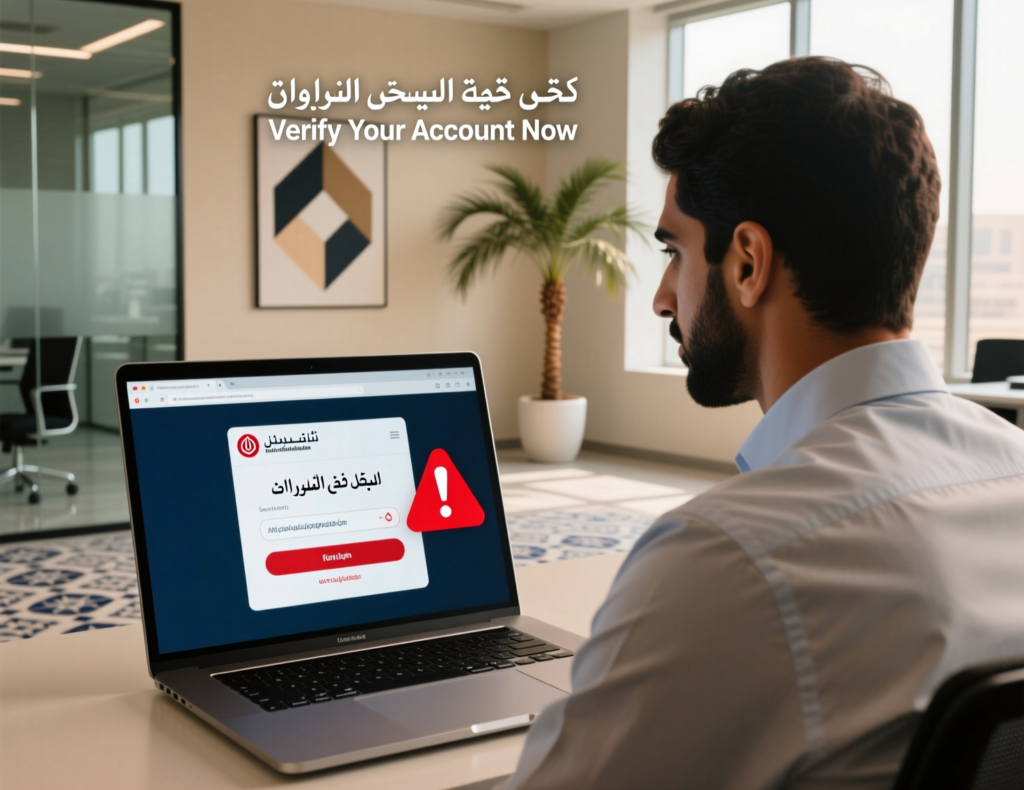
Arabic + English UX and culturally relevant scenarios.
In reality, “Arabic subtitles” are not enough. Employees in Riyadh or Dubai should see interfaces, voice-overs and phishing templates that reflect their daily life: messages spoofing SAMA, TDRA, UAE Pass, local banks, delivery apps, telecom operators or NCSA-branded campaigns.
This is where a GCC human firewall program to stop phishing emails looks very different from a generic global rollout especially when your workforce spans nationals, expats and contractors across KSA, UAE and Qatar.
Mapping training to different GCC roles and departments.
Finance teams might see lures about bogus supplier invoices or VAT refunds; HR teams get fake recruitment platforms or payroll updates; call centres see customer-support themed phishing; executives see highly targeted “board” or M&A lures. In Riyadh, Dubai and Doha, branch staff and front-line employees also need mobile-first modules because they may check email on phones more than laptops.
Over time, this role-based approach supports real human firewall and behaviour change in security, because people see themselves and their daily risks in the content.
Phishing Awareness & Simulation Programs for GCC Companies.
Designing simulated phishing campaigns for KSA, UAE and Qatar.
Most GCC organisations start with low-difficulty simulations once a month, then move towards more advanced campaigns targeting specific departments or regions. You might run Saudi-themed lures referencing SAMA or local tax authorities, UAE-themed campaigns about PDPL or Emirates ID, and Qatar-themed simulations around World Cup legacy projects or NCSA alerts.
Balancing global templates with Arabic and GCC-specific lures is key employees must recognise themselves in the scenarios.
What to look for in a phishing simulation and awareness platform in the GCC.
When shortlisting platforms or managed services, GCC leaders usually evaluate:
Multi-country deployment (KSA, UAE, Qatar) from a single console.
Data residency options in AWS Middle East (Bahrain), Azure UAE Central, and GCP Doha or other local data centres, to satisfy regulators and internal policies.
Arabic + English content libraries and UX, not just translated captions.
Reporting by regulator or sector (SAMA, NCA, UAE PDPL, QCB / NCSA).
If you’re already working with Mak It Solutions on web development services or Middle East cloud architectures, you can often integrate phishing platforms directly into your existing Microsoft 365 or Google Workspace environment. (makitsol.com)
Sector-specific simulations for banks, government and critical infrastructure.
Riyadh fintech startup
SAMA-aligned lures mimicking online banking support or PCI DSS reminders.
Dubai e-commerce brand
Campaigns focused on fake payment gateways, delivery scams and account-takeover alerts, linked to secure mobile app development and checkout flows.
Doha SME in logistics or health
Localised messages about customs clearance, medical records or cloud access issues, hosted in the Doha region to keep data in-country.
These scenarios help employees see how phishing connects to real GCC business processes, not just abstract “IT threats”. For more strategic vertical context, Mak It’s GCC oil & gas cybersecurity and GCC cybersecurity startups guides provide deeper sector examples.
SAMA, NCA, UAE PDPL and QCB Expectations.
Note.
This section provides general information, not legal or regulatory advice. Always confirm details with your legal, risk and compliance teams and the latest regulator guidance.
Saudi and UAE regulations increasingly expect continuous, documented employee awareness programs, not just checkbox training. SAMA CSF, NCA Essential Cybersecurity Controls and UAE PDPL all refer to ongoing staff awareness, data privacy, and social engineering topics making phishing awareness training in the Middle East a core compliance control, not a “nice to have”.
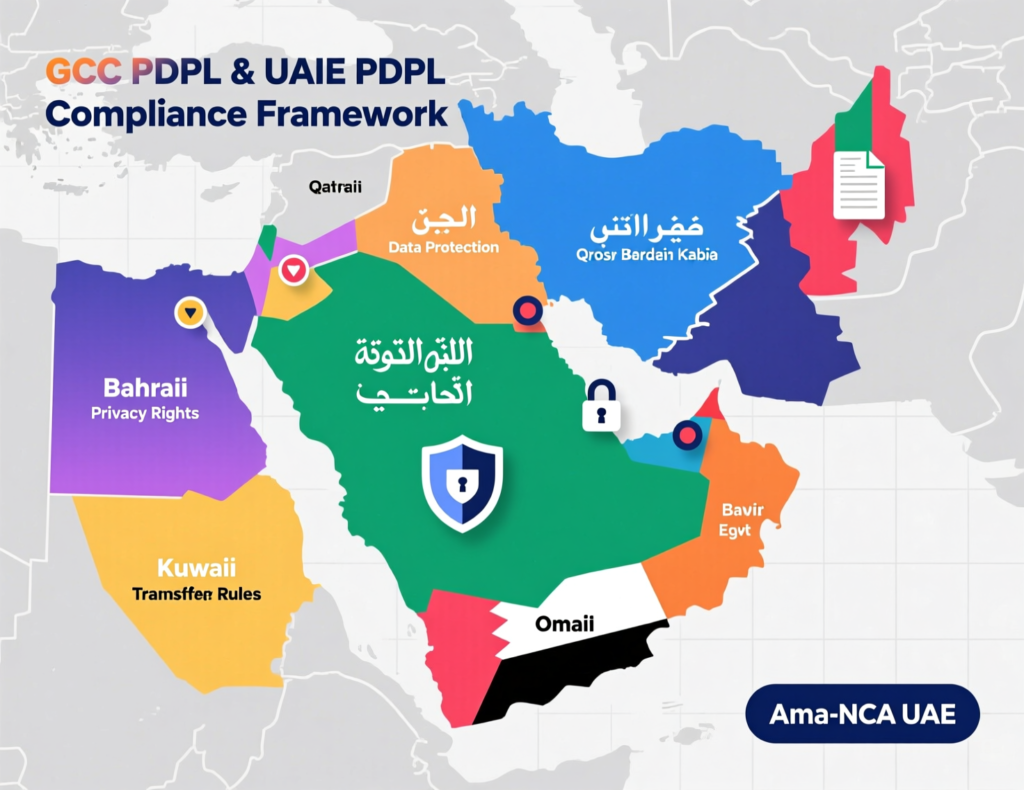
Saudi Arabia SAMA CSF, NCA controls and NDMO guidance.
Under SAMA’s Cyber Security Framework, regulated entities must maintain structured awareness and training aligned to risk, with evidence for auditors and maturity assessments.NCA’s guidelines and awareness kits further push entities to run periodic awareness campaigns, including phishing and social engineering content for all personnel. NDMO guidance on data management complements this with expectations on how staff handle and classify data included in phishing simulations.
United Arab Emirates UAE PDPL, TDRA and sector regulators
UAE PDPL and sector guidance (for example from the Central Bank of UAE and free zone authorities) emphasise regular, role-based privacy and security awareness training, including phishing and safe data handling. TDRA’s broader digital services oversight also makes phishing against government portals and telecom services a priority topic. Training content should therefore include scenarios about misuse of Emirates ID, UAE Pass, telecom OTPs and online banking in Dubai and Abu Dhabi.
Qatar NCSA and QCB expectations for awareness.
Qatar’s NCSA and QCB run national campaigns on information security and data privacy, highlighting phishing, spoofing and online fraud as key risks for banks and citizens. For Doha-based banks and critical infrastructure, documented phishing simulations and awareness metrics are a powerful way to demonstrate culture change during inspections or license renewals.
Turning regulatory requirements into a structured awareness roadmap.
A practical way to align with regulators is to map each requirement to a concrete activity:
SAMA / NCA control → quarterly simulated phishing + annual mandatory module.
UAE PDPL clause → privacy and data handling micro-lessons with social engineering examples.
NCSA / QCB expectations → Qatar-specific campaigns plus dashboards showing improved metrics.
A managed service, like Mak It’s broader human-centred cyber awareness work across GCC, can help keep this mapping current as rules evolve.
How GCC Organizations Reduce Phishing Click Rates Over Time.
For Qatar companies, success in phishing simulations means lower click rates, faster reporting and fewer repeat offenders over time while maintaining trust and psychological safety. The same metrics matter across KSA and UAE: leadership should see evidence that behaviour is changing, not just that “training was completed”.
KPIs that matter for KSA, UAE and Qatar teams.
Common KPIs include.
Click rate on simulated phishing emails.
Report rate (how many staff use the “report phishing” button).
Repeat offenders who click multiple times without reporting.
Time-to-report from first delivery to first user report.
Segmenting these by country, city (Riyadh, Dubai, Doha), department and role gives you a realistic picture of where additional social engineering awareness training is needed.
Example maturity journey for a GCC bank or government entity.
Consider a hypothetical GCC retail bank.
Month 0
28% click rate, <2% report rate, almost no management visibility.
Month 6
After monthly simulations and micro-learning, click rate drops to 15%, report rate reaches 12%; country managers in KSA, UAE and Qatar see their own dashboards.
Month 12
Click rate stabilises below 8%, report rate above 20%; repeat offenders get one-to-one coaching instead of punishment.
Similar journeys are possible for ministries, regulators and logistics or health providers that invest in the right cybersecurity awareness program for organizations.
Using results to coach, not punish.
In Riyadh, Dubai and Doha, public shaming or disciplinary action for “repeat clickers” can quietly kill your reporting culture. Instead, high-risk users should receive targeted coaching, short refreshers and manager support. HR, IT and compliance teams should agree that metrics feed into development plans and performance dialogue not blame.
This “coach, don’t punish” approach is especially important in cultures where job security and reputation are sensitive. It also aligns with Mak It’s broader view on human-centred cyber awareness across the GCC.
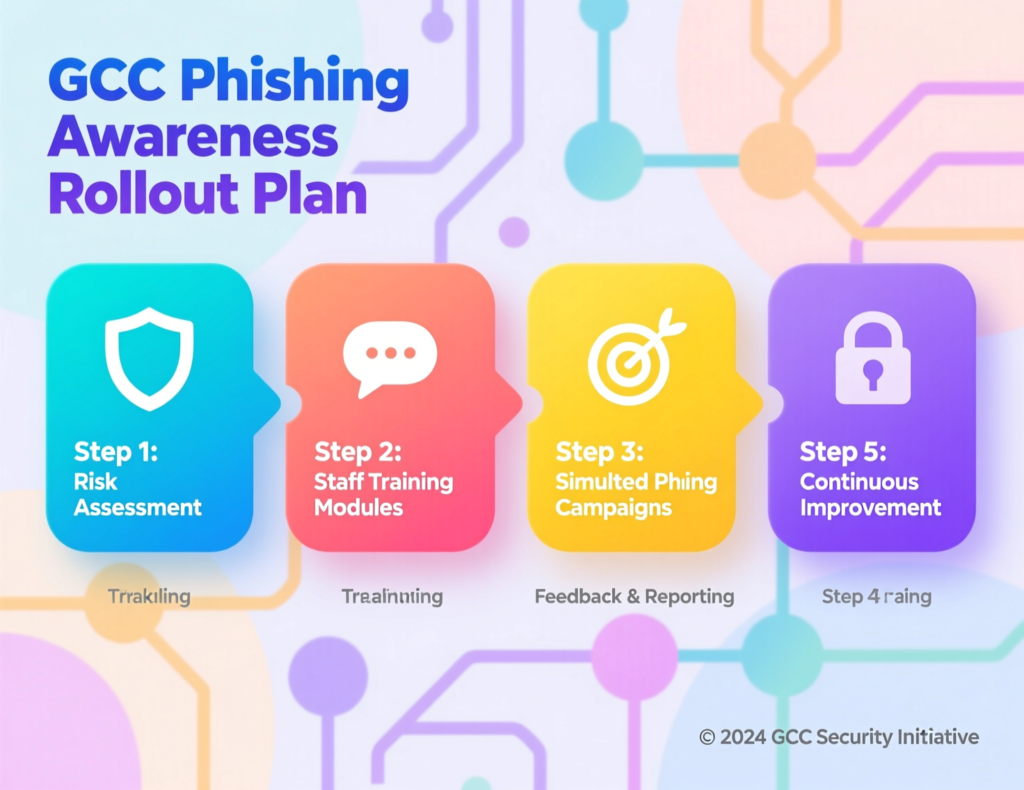
How to Roll Out a GCC-Ready Phishing Awareness Program
Rolling out Middle East phishing awareness training works best as a 12-month program, not a one-off project. Here’s a simple framework for KSA, UAE and Qatar leaders.
Assess risk and stakeholder buy-in in KSA, UAE and Qatar.
Map high-risk business units (treasury, procurement, customer contact centres, government services), critical systems and applicable regulators (SAMA, NCA, NDMO, UAE PDPL, TDRA, NCSA, QCB). Identify champions in HR, IT, compliance and business lines for Riyadh, Dubai and Doha so that the program feels owned locally, not just imposed by “head office”.
Design a 12-month awareness and simulation calendar
Build a calendar that mixes.
Onboarding modules for all new hires.
Monthly simulated phishing campaigns.
Quarterly deep-dive topics (BEC, ransomware, data privacy, WhatsApp scams).
Plan country-specific content: SAMA/NCA-themed templates in KSA, PDPL/TDRA-themed lures in UAE, NCSA/QCB-aligned scenarios in Qatar.
Select the right partner or platform and run pilots.
Shortlist partners that support Arabic, GCC data residency (AWS Bahrain, Azure UAE, GCP Doha or local DCs), rich reporting and integration with your email systems. Pilot with one business unit in Saudi, one in the UAE and one in Qatar to prove value, collect feedback and fine-tune difficulty before scaling across the group.
Operationalize continuous improvement.
Every quarter, review KPIs, update templates for new scams (including AI-generated phishing and generative-AI-driven deepfake lures), and share progress with leadership and boards.Tie results into your wider cyber maturity roadmap and, where relevant, your GCC data protection and cloud strategies. (makitsol.com)
To Sum Up
Ultimately, Middle East phishing awareness training is no longer about “running a course”. It’s about building a continuous, localised, regulator-aligned culture where employees from Jeddah to Dubai to Doha pause, think and report before they click.
For KSA, UAE and Qatar organisations, the upside is clear: fewer incidents, stronger regulator relationships, and more resilient digital channels for banking, government, logistics, health and e commerce. The companies that win will be those that treat people as their first line of defence and invest accordingly.
If you’re wondering whether your current awareness program would impress a SAMA, NCA, UAE PDPL or QCB auditor, you’re not alone. Mak It Solutions already helps GCC organisations design human-centred cyber awareness initiatives, from strategy to execution.
Book a conversation with our team to benchmark your phishing resilience, explore GCC-ready simulations and align training with your cloud, data and app strategies. Together, we can turn your people into a truly regional human firewall. ( Click Here’s )
FAQs
Q : Is phishing simulation allowed under SAMA and NCA rules for Saudi companies?
A : Yes. Neither SAMA nor NCA forbids simulated phishing; in fact, both emphasise regular staff awareness and testing as part of a robust cyber security posture. SAMA’s Cyber Security Framework expects regulated entities to maintain ongoing awareness aligned to risk, while NCA’s Essential Cybersecurity Controls and awareness kits explicitly focus on employee campaigns across national entities. Saudi companies should ensure simulations are well-governed, clearly documented, respectful of employees and part of a wider security awareness program linked to Saudi Vision 2030 digital transformation goals.
Q : How often should UAE companies run phishing awareness training and simulations for employees?
A : Most UAE organisations run some form of phishing awareness every month, with a structured simulation at least every quarter and shorter nudges in between. UAE PDPL and broader data protection guidance recommend regular, role-based privacy and security awareness, including examples of phishing and social engineering that could expose personal data. In practice, many Dubai and Abu Dhabi companies combine annual mandatory e-learning with monthly simulated phishing campaigns and periodic deep-dives for high-risk teams such as finance, contact centres and IT support.
Q : Do Qatar banks need Arabic-language phishing awareness content to satisfy QCB and NCSA expectations?
A : While QCB and NCSA do not mandate a specific language, Qatar’s national awareness campaigns and workshops clearly target Arabic-speaking citizens and staff, especially around phishing, spoofing and financial fraud. For banks with mainly Arabic-speaking customers and frontline teams, Arabic-first phishing awareness content is therefore a practical way to show regulators that messages are understood. Many Doha-based institutions offer bilingual (Arabic–English) modules and simulations so both local and expat employees can fully engage.
Q : Can one phishing awareness program cover KSA, UAE and Qatar without breaking data residency rules?
A : Yes, but it must be designed carefully. Many GCC groups use a single awareness and simulation platform, while segregating data per country and hosting it in compliant regions such as AWS Bahrain, AWS UAE, Azure UAE Central or GCP Doha, depending on internal policies. Policies should define what data (names, email addresses, results) can be stored where, and how reports are shared with KSA, UAE and Qatar leadership. When in doubt, work with legal and regulators early to validate your architecture.
Q : What budget range do mid-sized GCC companies typically allocate per employee for phishing awareness training?
A : Budgets vary widely, but many mid-sized GCC companies allocate the equivalent of a few US dollars per employee per month for awareness and simulated phishing often bundled into a larger security or IT training budget. The key is to view phishing awareness as part of broader investments in cloud, data protection and cyber resilience, not a standalone cost. For example, organisations evaluating cloud providers for KSA, UAE and Qatar or strengthening GCC data protection programs often budget awareness and training alongside SOC and cloud-security tooling, aligning with initiatives like Saudi Vision 2030 and Qatar National Vision 2030.