


IoT in Desert Agriculture: Saudi, UAE and Qatar
IoT in Desert Agriculture: Saudi, UAE and Qatar
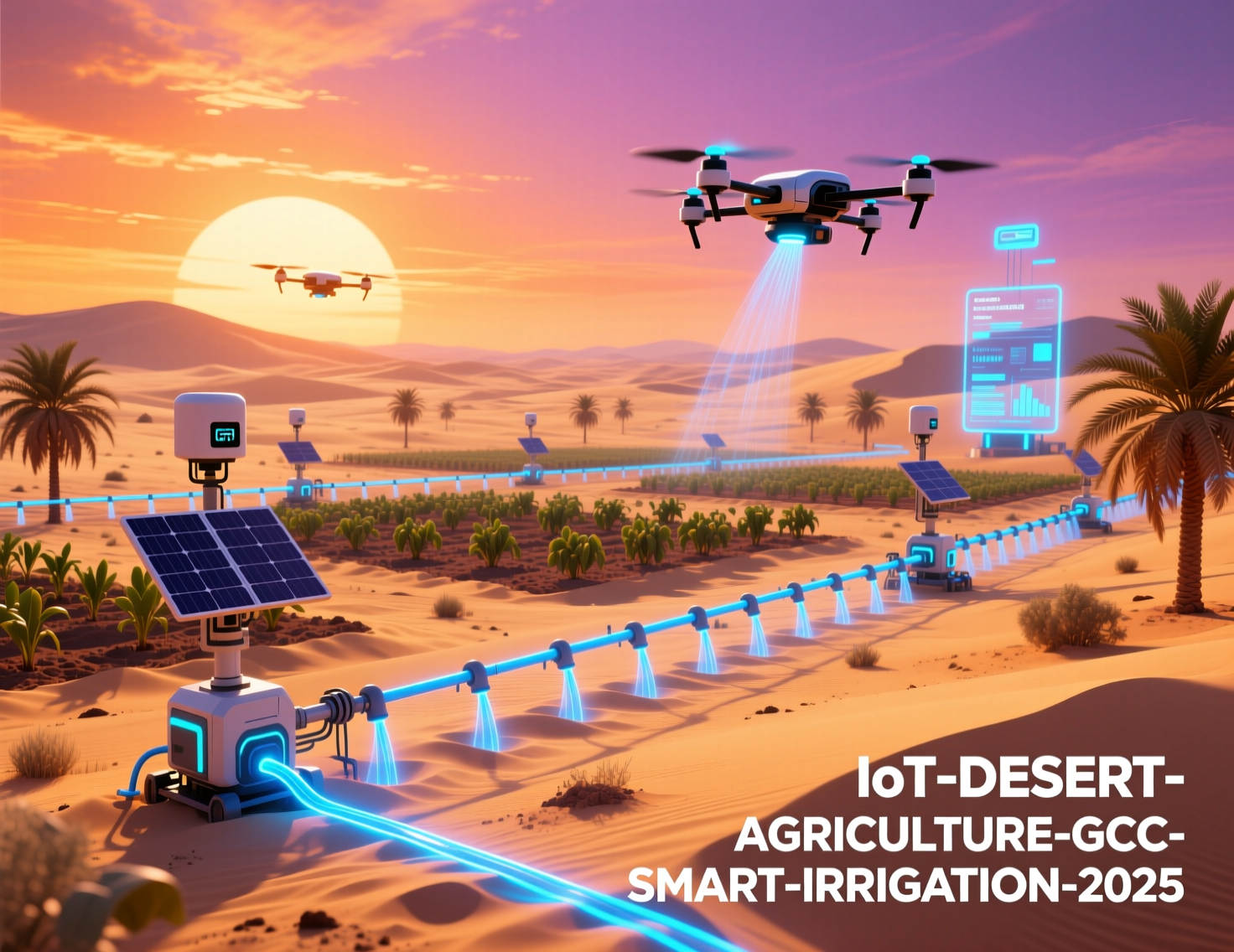
IoT in Desert Agriculture for GCC Food Security
IoT in desert agriculture uses connected sensors, smart irrigation and data analytics to grow more food with less water in harsh GCC climates. For decision-makers in Saudi Arabia, the UAE and Qatar, it turns water-stressed desert land into predictable, efficient and investable food production assets.
Introduction
IoT in desert agriculture gives GCC governments and agribusinesses a practical way to protect food security while using every drop of water wisely. By combining precision farming in arid regions with real-time data, farms in Riyadh, Dubai and Doha can reduce waste, stabilise yields and de-risk investments.
In some of the world’s most water-stressed countries, food demand keeps rising while climate risks intensify. That’s why Saudi Arabia, the UAE and Qatar are moving from subsidising traditional farming to backing technology-enabled production that can be measured, optimised and scaled.
From Water Stress to Food Security in Saudi, UAE and Qatar
Saudi, UAE and Qatar rank among the world’s most water-stressed countries, yet their populations and food demand are rising fast. National strategies now prioritise replacing a portion of food imports with local production supported by technology, rather than relying on more groundwater extraction or subsidies alone.
IoT gives ministries and project owners hard numbers on water use, yields and energy consumption. Instead of debating assumptions, they can track progress against food security and climate resilience targets in near real time.
How IoT Turns Harsh Deserts into Productive Farms
IoT devices monitor soil moisture, salinity, micro-climate and energy use, then automatically adjust irrigation and climate controls. Instead of guessing, farmers run data-driven agriculture for water scarcity: irrigating only when needed, protecting crops from heat spikes and planning harvests using live dashboards.
Over time, this creates a digital record of how each field or greenhouse behaves under different conditions. That history becomes the foundation for AI-driven irrigation management and better decision-making at farm and ministry level.
Who This Guide Is For in Riyadh, Dubai and Doha
This guide is written for ministries, municipal authorities, agribusiness leaders, project owners, investors and technology buyers across Riyadh, Jeddah, Dubai, Abu Dhabi and Doha. It helps you understand the technology, regulations, financing paths and practical steps to launch real IoT projects on farms and in greenhouses.
Whether you are modernising a family date farm in Al-Qassim or structuring a large CEA cluster in Abu Dhabi, the same principles apply: start with clear water and yield KPIs, respect local regulations and build an architecture that can scale.
What Is IoT in Desert Agriculture?
Direct answer: IoT-based desert agriculture connects field sensors, pumps, meters and greenhouses to cloud platforms so Saudi and UAE farms can track soil, weather and water use in real time and automate irrigation to save water. It replaces manual checks and rough schedules with precise, AI-driven irrigation management tuned to each crop.
Core Building Blocks.
At field level, smart sensors for crop and soil monitoring measure moisture, EC, temperature, humidity and pressure on pumps and valves. Connectivity (LoRaWAN, NB-IoT, 4G/5G, satellite) sends this data to IoT platforms, where dashboards, alerts and analytics recommend actions or trigger automation rules.
Good platform design keeps things simple for operators: clear maps of fields and greenhouses, traffic-light alerts, recommended irrigation durations and exportable reports for management or regulators.
GCC-Specific Challenges.
In the Gulf, hardware must survive 50°C heat, saline water, dust and sandstorms. Equipment needs IP-rated enclosures, robust power options and reliable connectivity despite remote locations.
Systems also have to work with limited on-farm IT staff, so interfaces must be visual, support Arabic and run on simple mobile apps that supervisors in Al-Qassim, Al Ain or Al Khor can use with minimal training. The more intuitive the UX, the easier it is to embed SOPs and reduce human error.
Why Saudi, UAE and Qatar Are Prioritizing IoT for Food Security
Saudi Vision 2030, UAE food security strategies and Qatar’s National Food Security Programme all emphasise local production, water efficiency and technology adoption. IoT in desert agriculture fits directly into these agendas by turning subsidies and infrastructure spending into measurable water savings and yield gains.
For policymakers, IoT projects create a feedback loop: ministries can see which crops, regions and technologies deliver the best results, then refine future support programmes accordingly.
Water-Smart Irrigation
Direct answer: IoT smart irrigation systems use soil moisture sensors, weather data and automated valves to water date palms and fodder crops only when needed, often cutting water use by 25–40% in Saudi Arabia and Qatar while maintaining or improving yields.
Smart Irrigation for Date Palms and Fodder Crops in Riyadh and Al-Qassim
On date farms around Riyadh and Al-Qassim, sensors in palm basins feed moisture data to gateways that control drip lines block by block. Fodder producers can track water cost per tonne of alfalfa, then adjust schedules to reduce pumping hours while keeping root zones in the safe moisture band.
In practice, this means fewer night-time field visits to manually adjust valves and less guesswork during heatwaves. Teams can review irrigation logs after a dust storm or power cut and correct issues before they damage yields.
IoT Drip and Pivot Irrigation in UAE and Qatar Desert Farms
In Abu Dhabi and Al Ain, IoT retrofits on centre-pivot systems adjust speed and nozzle output according to soil moisture maps and wind. Qatar dairy and fodder farms near Doha and Al Khor use smart drip lines and fertigation to dose nutrients precisely, cutting salinity build-up and chemical waste.
Over time, these systems help farmers understand which fields respond best to drip, pivot or hybrid approaches, and where investment in better filtration or pressure control delivers the strongest payback.
Water Savings, Yield Uplift and Energy Reduction in GCC Projects
For GCC investors, the ROI story combines lower groundwater extraction, reduced diesel or electricity for pumps, fewer field visits and better yields. Dashboards can show Riyadh or Doha project sponsors key KPIs such as cubic metres of water saved per hectare, yield uplift and payback period in seasons, not years.
For ministries and financiers, this level of transparency supports performance-based contracts, smart subsidies and PPP models where returns depend on real efficiency gains.
Smart Greenhouses and Hydroponics in UAE, Saudi and Qatar
Climate-Controlled Greenhouses in Abu Dhabi, NEOM and Doha
Climate-controlled greenhouses in Abu Dhabi and Sharjah automatically balance cooling pads, fans and shading based on IoT climate sensors. In NEOM pilot projects, advanced controlled-environment agriculture in hot climates is being tested to grow high-value vegetables, while Doha greenhouses optimise CO₂ and lighting to stabilise winter and summer production.
This controlled environment allows producers to target premium retail and horeca segments with consistent quality, rather than treating desert farming as a high-risk, low-margin activity.
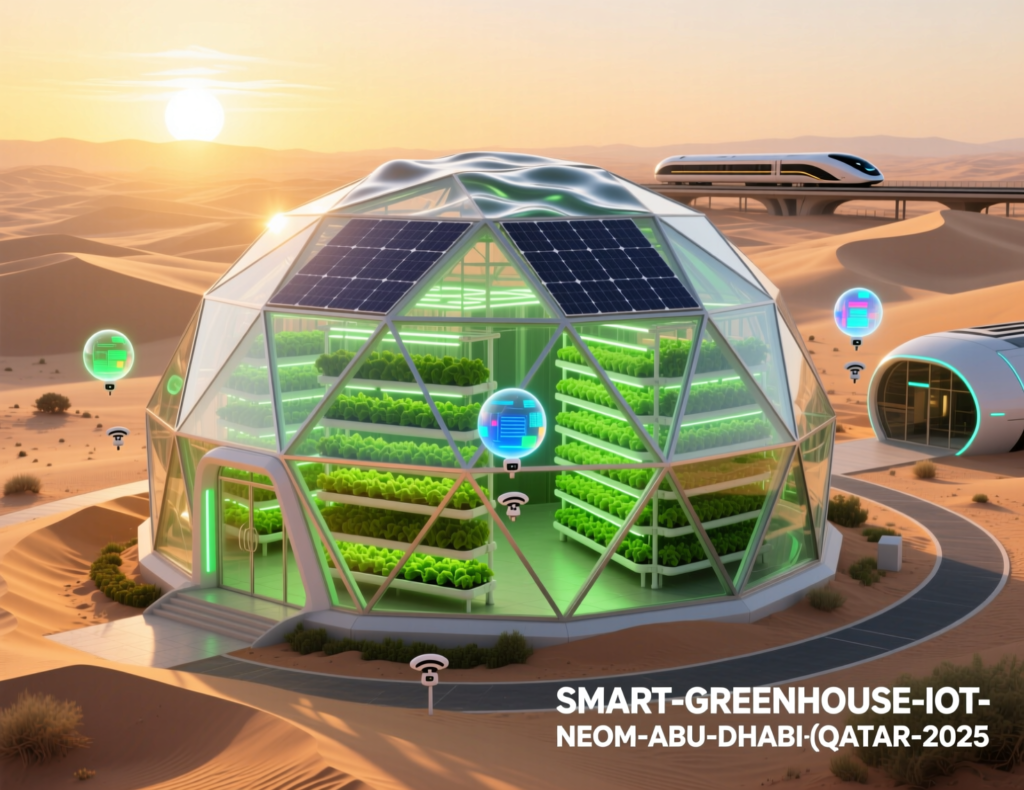
Hydroponic and Vertical Farming with IoT Monitoring in the Gulf
Hydroponic and vertical farms in Dubai, Riyadh and Doha rely on IoT to monitor pH, EC, temperature and nutrient circulation 24/7. These systems support AI-driven irrigation management, where algorithms adjust nutrient recipes and flow rates, turning small footprints into high-output, high-quality production for retail and horeca.
Because many of these farms are close to city centres, fast data and remote monitoring are crucial to avoid crop loss in case of equipment failure or power fluctuations.
Arabic-First UX and Worker Training for Smart Greenhouse Operations
Because many greenhouse workers are non-technical, interfaces must use icons, Arabic labelling and colour-coded alerts. GCC operators increasingly pair IoT platforms with custom web dashboards and mobile apps built by partners like Mak It Solutions to simplify operations and embed SOPs into the tools workers already use.
Short training sessions, simple checklists and clear escalation rules help teams react quickly when alerts appear whether it’s a chiller fault in Abu Dhabi or a CO₂ issue in Doha.IoT Platforms, Connectivity and Data Residency in the GCC
Direct answer: UAE and Saudi agribusinesses typically connect farm IoT devices over licensed networks regulated by TDRA and Saudi telecom laws, then host data in national or regional clouds that comply with NDMO and local data residency standards. This keeps sensitive operational and geolocation data within approved jurisdictions.
Choosing Connectivity.
LoRaWAN is ideal for battery-powered sensors across large pivots; NB-IoT and LTE-M use existing mobile networks but require coverage. In very remote Saudi and Oman deserts, satellite backhaul is often the only option.
In the UAE, connectivity choices must align with TDRA rules for telecoms and IoT-specific services, which require registration and licensing for providers. For project owners, working with partners who already understand these rules speeds up approvals and reduces compliance risks.
Data Residency and Governance:.
Saudi’s National Data Management Office (NDMO), under SDAIA, sets standards requiring many categories of data to remain within KSA and comply with strict governance and security controls. That’s why many Saudi agribusinesses choose national or KSA regions of hyperscalers, while UAE projects often rely on Azure UAE Central or other local cloud zones under TDRA oversight.
Qatar projects can use GCP Doha or local sovereign clouds to keep operational data within Qatari jurisdiction. Agribusiness CIOs increasingly treat farm IoT data as part of their broader enterprise data estate, not as a side project.
Cybersecurity, Identity and Arabic Interfaces for Farm IoT Platforms
CIOs and CISOs increasingly demand identity-aware IoT platforms with role-based access, MFA and audit trails. GCC farms are integrating IoT dashboards with business intelligence tools and secure web portals, often delivered via web development services and business intelligence services to give management a single, secure view of operations.
Arabic interfaces, clear permission models and integration with existing identity systems (such as corporate SSO) help large agribusiness groups manage dozens of farms and sites without losing control over who sees what.
GCC Government Programs, Financing and Agritech Investment
Vision 2030, UAE Food Security Strategy and Qatar National Food Security Programme
Saudi Vision 2030, the UAE National Food Security Strategy and Qatar’s National Food Security Programme all prioritise smart farming, local production and technology partnerships. These policies create demand for precision farming in arid regions and make IoT in desert agriculture a government-backed, not fringe, innovation.
For project owners, this means IoT investments can often be positioned as direct enablers of national KPIs, not just farm-level efficiency projects.
Role of SAMA, QCB, ADGM and DIFC in Financing Agritech and Farm IoT
SAMA and QCB encourage fintech, digital payments and innovative financing, which can be applied to “pay-as-you-grow” smart irrigation models and equipment leasing. ADGM and DIFC act as regional hubs where agritech VCs, project finance and insurance players structure cross-border investments into NEOM greenhouses, Abu Dhabi CEA clusters and Doha hydroponic facilities.
By combining IoT data with financing structures, investors can monitor performance and de-risk portfolios across multiple farms and jurisdictions.
Grants, Subsidies and PPP Models for Smart Irrigation and Greenhouses
Across Riyadh, Dubai and Doha, projects often blend government subsidies, low-interest loans, PPP structures and private capital. IoT makes these schemes easier to justify because water savings, yields and emissions reductions are measurable and can be reported to ministries and investors via digital dashboards and data-driven marketing reports.
For many GCC stakeholders, the question is no longer “Should we use IoT?” but “How do we design funding models that reward verified performance?”
How to Launch an IoT Desert Agriculture Project in the GCC
Assess Farm Readiness, Water Costs and Existing Infrastructure
Start by mapping water sources, cost per cubic metre, current irrigation hardware and staff digital skills. A Riyadh date farm, an Al-Qassim fodder grower or an Al Ain dairy farm can work with consultants and technology partners such as Mak It Solutions’ services team to baseline water use, energy spend and current yields.
This assessment should also cover connectivity options, data ownership expectations and any regulatory constraints that may shape architecture choices.
Design a Pilot in Saudi, UAE or Qatar with Clear KPIs and Data Policies
Next, define a 1–2 season pilot on a small but representative area: for example, 20 hectares of pivots near Jeddah, a cluster of greenhouses in Abu Dhabi or a hydroponic unit outside Doha. Set KPIs for water savings, yield uplift and payback, and agree data ownership and residency rules aligned with NDMO, TDRA or QCB guidance.
Keep the pilot narrow but rigorous: choose crops, fields and partners that can deliver meaningful lessons and credible numbers for future expansion.
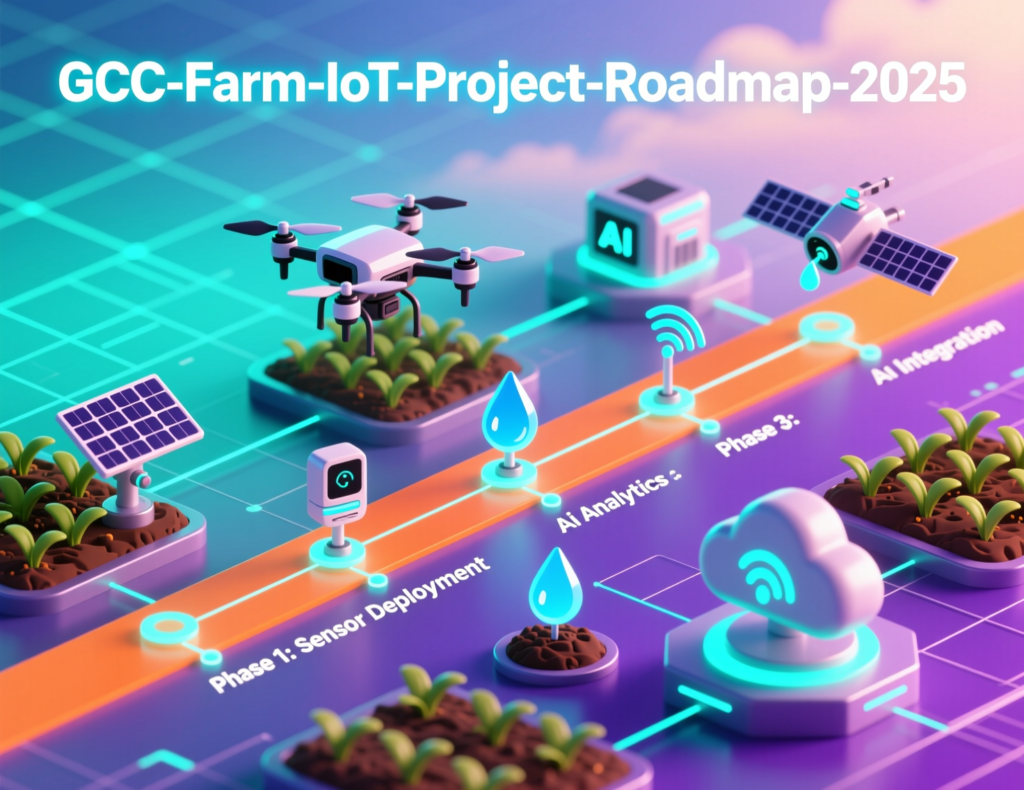
Select Partners, Platforms and Local Integrators, Then Scale Up
Finally, select hardware vendors, IoT platforms, connectivity providers and local integrators with GCC references. Combine field hardware with custom dashboards, mobile apps and integrations for example using React Native app development, mobile app development services and SEO services to support both operations and market access.
Once the pilot hits targets, expand field by field using the same architecture. Document lessons learned, refine SOPs and use your data history to negotiate better financing and supply contracts.
The Future of Smart Farming in the Arab Desert
Predictive Irrigation, Digital Twins and Robotics in GCC Farms
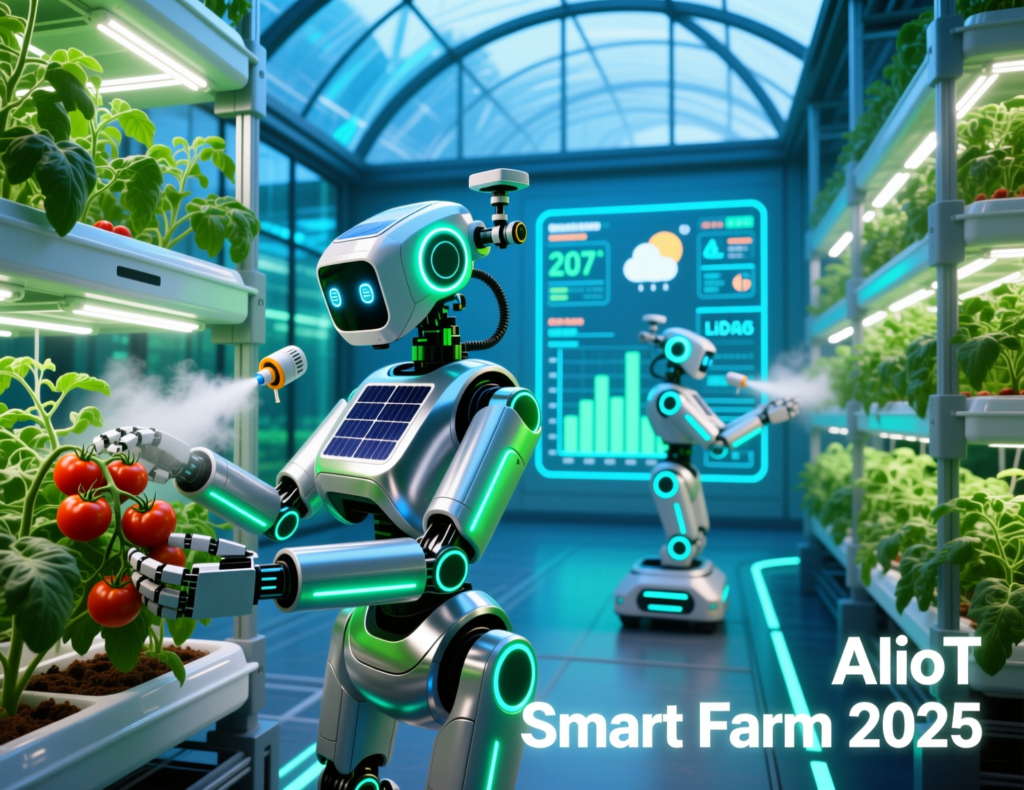
The next wave is AIoT: AI models trained on multi-season farm data will predict irrigation needs, optimise harvest windows and simulate scenarios via digital twins of farms. Robotics for weeding, scouting and greenhouse handling will increasingly rely on this live IoT data layer.
For GCC stakeholders, this means the investments made today in sensors, connectivity and platforms will power tomorrow’s automation, not just today’s dashboards.
How Retail, Logistics and Government Benefit from Smarter Food Systems
Smarter farms support GCC retail and logistics with predictable volumes, traceability and better shelf life. IoT extends beyond the farm into cold-chain tracking, reefer monitoring and warehouse optimisation, where the same data principles apply and can be visualised through advanced web design and UX and e-commerce solutions.
As supply chains become more data-rich, regulators can design more targeted interventions, and retailers can differentiate on freshness, transparency and sustainability.
Key Takeaways
For Saudi, UAE and Qatar decision-makers, IoT in desert agriculture is no longer a pilot topic but a strategic lever for food security and climate resilience. Start small, respect regulations, choose partners who understand GCC realities and treat data as the new irrigation water for your food system.
If you’re planning a smart irrigation, greenhouse or hydroponic project in Riyadh, Dubai or Doha, you don’t need to design the architecture alone. The team at Mak It Solutions can help you turn policy goals and investment ideas into real dashboards, apps and IoT integrations tailored to GCC regulations and climates. Book a consultation to review your current landscape, define a realistic pilot and roadmap, and build a practical, data-driven blueprint for desert agriculture that actually scales. ( Click Here’s )
FAQs
Q : Is IoT-based smart irrigation allowed for government-subsidized farms in Saudi Arabia and the UAE?
A : Yes. Most subsidy and support schemes in Saudi Arabia and the UAE focus on saving water and boosting productivity, and IoT smart irrigation directly supports those goals. As long as farms comply with local water abstraction rules and telecom regulations, ministries usually welcome smart systems and may even prioritise them in grants or PPPs. For Saudi projects, alignment with Vision 2030 water and agriculture programmes is key, while UAE farms should consider TDRA rules for IoT connectivity and device approvals.
Q : What is the typical cost range of a smart greenhouse system in Dubai or Riyadh for small and mid-sized farms?
A : Costs vary widely by technology level, crop and climate control, but a basic IoT-enabled greenhouse can start from a modest structure with sensors and automated irrigation, scaling up to fully climate-controlled CEA facilities with advanced cooling and fertigation. For small and mid-sized farms around Dubai or Riyadh, the realistic path is to start with core automation — irrigation, climate monitoring, simple fertigation and then add layers like computer vision or robotics later. Financing via banks regulated by SAMA or through UAE development programmes can smooth CAPEX into manageable payments over several seasons.
Q : Do GCC regulations require farm IoT data to stay inside local cloud regions in Saudi, UAE or Qatar?
A : In Saudi Arabia, NDMO standards and related frameworks strongly encourage or require many categories of data, especially government or critical data, to remain within national borders or approved KSA clouds. In the UAE and Qatar, data residency is more sector-specific, but large agribusinesses increasingly choose local regions such as AWS Bahrain, Azure UAE Central or GCP Doha to simplify compliance and latency. It’s best to treat farm IoT platforms as part of your overall data governance strategy, aligning them with national data policies instead of running them as isolated IT projects.
Q : Can small family farms in Al-Qassim, Al Ain or Al Khor realistically adopt IoT, or is it only for mega-projects like NEOM?
A : Small farms can absolutely benefit, especially from low-cost soil moisture sensors, basic gateways and simple mobile apps that reduce over-irrigation. In Al-Qassim, Al Ain or Al Khor, many families already use smartphones and messaging apps, so moving to simple dashboards and alerts is a natural step. The key is to avoid over-engineering: start with one field or greenhouse, use rugged hardware, and rely on local integrators or cooperatives rather than building everything alone. Mega-projects like NEOM help push the technology frontier, but the same principles can be applied affordably at smaller scale over time.
Q : How long does it usually take for a GCC farm to see ROI from IoT smart irrigation or greenhouse investments?
A : Most GCC farms that implement focused IoT smart irrigation or greenhouse automation see early results within one or two growing seasons, especially in reduced water and energy bills. Full payback for hardware and integration often falls in the 2–5 year range depending on crop value, water tariffs, energy prices and financing terms. Projects that align with national strategies, use robust data to prove savings and tap into programmes shaped by Saudi Vision 2030 or UAE food security initiatives are more likely to access favourable funding and achieve faster ROI.
I’ll immediately take hold of your rss feed as I can not to find your e-mail subscription hyperlink or newsletter service. Do you have any? Please let me realize in order that I may just subscribe. Thanks.