


WebAssembly vs JavaScript: Is This the Future of Web?
WebAssembly vs JavaScript: Is This the Future of Web?
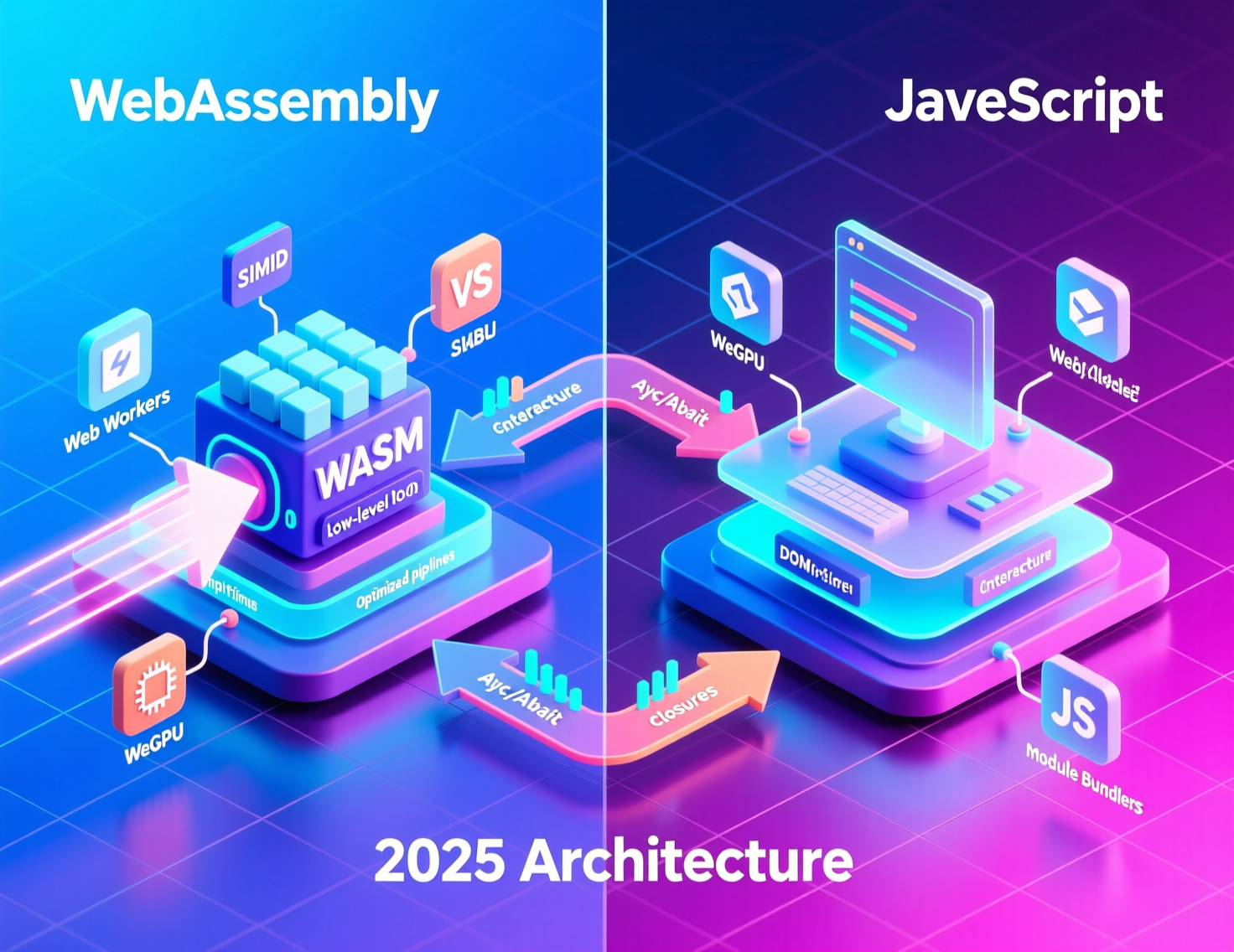
WebAssembly vs JavaScript in 2025: Performance Showdown
WebAssembly vs JavaScript is not a winner-takes-all decision. WebAssembly shines on CPU-heavy, latency-sensitive or security-critical code, while JavaScript still powers most UI and everyday web flows. In 2025, high-performing teams in the US, UK and EU increasingly run WebAssembly modules alongside JavaScript/TypeScript rather than replacing them outright.
If you’re a JavaScript or TypeScript developer, it’s hard to ignore the “WebAssembly vs JavaScript” noise and the occasional “JS is dead” hot take. The short answer for teams in the US, UK, Germany and across the EU: WebAssembly won’t replace JavaScript, but it will sit alongside it in more and more serious web, edge and AI stacks.
Think of WebAssembly (Wasm) as a high-performance co-processor. JavaScript keeps doing what it’s great at UI, business logic, rapid iteration while Wasm handles the CPU-intensive, latency-sensitive and security-critical parts of modern apps.
WebAssembly vs JavaScript
Most teams don’t need to choose WebAssembly or JavaScript they choose WebAssembly and JavaScript. WebAssembly excels at CPU-bound workloads and safe, portable execution, while JavaScript remains the default for everyday frontends, Node.js APIs and rapid product work.
WebAssembly vs JavaScript in 2025
Here’s the 20-second comparison for tech leads.
Performance
WebAssembly
Near-native execution for many CPU-heavy workloads (math, ML, codecs, simulation).
JavaScript
Highly optimized JIT engines (V8, SpiderMonkey, JavaScriptCore) make typical web apps “fast enough”, especially when network and DOM dominate.
Portability
WebAssembly
Compile Rust, C, C++, Go and more into portable wasm binary modules that run in browsers, edge runtimes and servers under the same sandbox model.
JavaScript
Ubiquitous in browsers and supported across Node.js, Deno, Bun and serverless platforms.
Developer Experience
Web Assembly
Strong for teams that already use systems languages, but debugging and tooling are still maturing compared to JS. MDN and the W3C Web Assembly Community Group are closing that gap.
JavaScript
Massive ecosystem (NPM, React, Vue, Svelte, Next.js) and hiring pool; excellent for product teams in London, New York, Berlin or Amsterdam.
Ecosystem & Tooling
Web Assembly
Rapid growth in runtimes (WasmEdge, Wasmtime), edge platforms (Cloudflare Workers, Fastly Compute@Edge, Fermyon) and browser features (WASI, component model).
JavaScript
Mature bundlers (Vite, Webpack, esbuild), frameworks, and monitoring/APM ecosystem.
Browser Support
Web Assembly 1.0 is supported by ~99% of tracked browsers as of 2024. )
JavaScript, obviously, is universal.
Is Web Assembly the future of web development or just a niche tool?
Web Assembly has quietly moved from “niche experiment” to mainstream building block. Chrome telemetry suggests that the share of websites using wasm has grown to around 4.5% of Chrome page loads, up roughly another percentage point in 2024.
High-profile apps Figma, AutoCAD Web, Zoom, Google Meet, and even payment players like Visa and American Express use Web Assembly somewhere in their stack.
In practice.
For US SaaS teams in San Francisco or Seattle, Wasm is often used for in-browser editors, AI filters, analytics engines and offline-friendly tooling.
In the UK, London fintechs experiment with wasm modules for pricing engines and client-side encryption.
In Germany and wider EU markets, it shows up in BaFin-regulated trading tools and GDPR-sensitive data processing at the edge.
It’s not “the replacement” for JavaScript but it is part of the future stack.
When should you choose Web Assembly vs JavaScript?
You can think in three modes.
JS only
Typical SaaS dashboards, marketing sites, CRUD apps, mobile-first web, most internal tools.
React/Next.js + Node.js is fine; apply good performance practices and you’re done.
JS + Wasm (most common in 2025)
There’s a specific, measurable hotspot: a risk engine, image pipeline, crypto routine, or on-device AI inference.
You keep UI and orchestration in JavaScript/TypeScript, then call into a small wasm binary module for the heavy lifting.
Wasm-first
You’re building a portable engine to run across browser, edge and server: e.g., a simulation kernel, trading engine, or proprietary AI runtime.
JavaScript becomes a thin shell around a wasm binary that also powers microservices in a Web Assembly edge runtime such as Wasm Edge.
What Is Web Assembly and How It Works Alongside JavaScript
Web Assembly is a compact binary instruction format designed to run code from languages like Rust, C, C++ or Go at near-native speed in the browser and beyond. JavaScript still orchestrates the DOM, frameworks like React and Vue, and most business logic, while Web Assembly handles performance-critical functions.
How WebAssembly runs in modern browsers.
Under the hood.
Your Rust/C++/Go code is compiled into a wasm binary module with linear memory and a small, well-defined instruction set.
Browsers like Google Chrome, Mozilla Firefox, Apple Safari and Microsoft Edge download that .wasm file and use streaming compilation to compile as bytes arrive, then execute it in a sandboxed environment.
The sandbox prevents direct access to the host OS or DOM; everything goes through explicit imports/exports.
Standards are coordinated by the W3C WebAssembly Community Group and Working Group, with MDN Web Docs and webassembly.org providing the primary reference for developers.
WebAssembly, WASI and the browser sandbox explained for JavaScript developers
The WebAssembly System Interface (WASI) extends Wasm beyond browsers. Instead of letting modules touch arbitrary syscalls, WASI exposes a capability-based set of APIs for I/O, clocks, randomness, networking and files.
The direction of travel.
Browser.
Wasm is sandboxed; it can only call into APIs the JS host exposes.
Edge / server.
WASI gives wasm modules a portable, sandboxed abstraction for files, sockets and OS resources.
Component model.
Emerging standards make it easier to compose wasm components and share them between runtimes.
For you as a JS dev, the important mental model is: Wasm modules can run in many environments, but they always live in a sandbox and talk to the outside world through explicit capabilities.
JavaScript and WebAssembly working together in real apps
In a typical React, Vue or Svelte app.
JavaScript loads a wasm binary via WebAssembly.instantiateStreaming() or, increasingly, as an ES module once the ESM integration lands in browsers. ([MDN Web Docs][6])
The wasm module exports functions like priceOption(), renderFrame(), or runInference().
JavaScript.
Passes data into wasm via numbers, typed arrays, or shared linear memory.
Calls the exported function.
Uses results to update the DOM, React state, or send data back to the server.
This JavaScript and WebAssembly working together pattern lets you keep your entire UI and routing in Next.js/Node.js while gradually offloading expensive logic to wasm.
WebAssembly vs JavaScript Performance in Real Web Apps
WebAssembly modules can significantly outperform JavaScript on CPU-bound tasks, but in many everyday apps the difference is minimal because the bottleneck is network, database or DOM, not raw computation. Benchmarks consistently show wasm ahead of JS on integer math, recursion and ML workloads, often by multiples in controlled tests.
Why developers say WebAssembly offers near-native performance compared to JavaScript
Key reasons.
WebAssembly uses a low-level, statically typed instruction set that maps more directly onto CPU instructions than JavaScript.
Browsers can compile wasm with ahead-of-time or highly optimized JIT compilers, avoiding many of the de-optimisations JavaScript engines have to do for dynamic types.
Studies across Chrome, Firefox, Edge and Safari show wasm implementations consistently outrunning equivalent JS for numerical algorithms, ML inference and encryption in many synthetic benchmarks.
In practice, you’ll see the biggest wins for.
Numerical simulations and scientific visualisation.
Cryptographic operations (with caveats around AES instructions).
Video, image and audio processing.
In-browser ML inference (for example, ONNX or custom CNNs).
When JavaScript is still “fast enough” and the simpler choice
JavaScript remains a great default for.
Typical SaaS dashboards, CRUD apps, admin consoles and content sites.
Tools where latency is dominated by HTTP calls (to AWS, Azure, GCP) rather than CPU.
Most internal tools in US/UK/EU enterprises, especially when built with React/Next.js + Node.js.
Modern JS engines V8 (Chrome/Node.js), SpiderMonkey (Firefox) and JavaScriptCore (Safari) apply aggressive JIT optimizations and inlining. For many frontends, better Core Web Vitals come from reducing bundle size, optimizing network requests and tuning rendering, not from rewriting everything into wasm.
If Lighthouse is screaming about Largest Contentful Paint, you’re more likely to benefit from better SSR/ISR (see Mak It Solutions’ take on server-side rendering vs static generation) than from micro-optimised wasm.
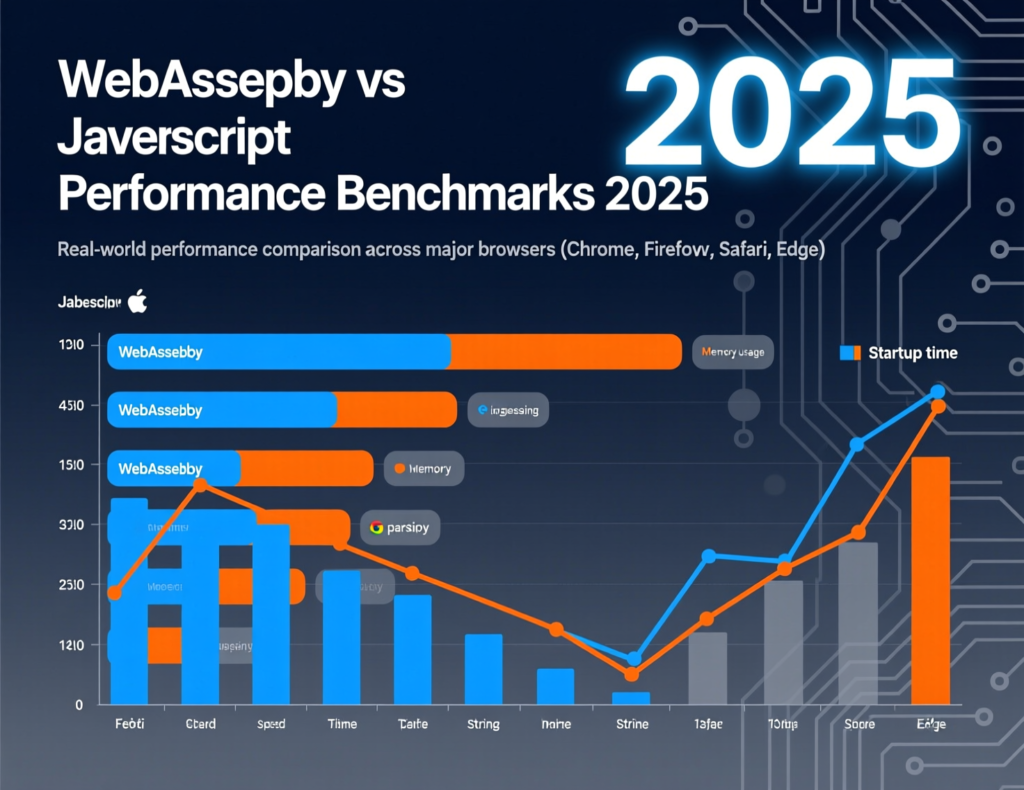
WebAssembly vs JavaScript performance benchmarks in 2025
Recent research and independent benchmarks show a fairly consistent pattern.
Across a range of numerical algorithms and ML workloads, wasm implementations often run 2–10× faster than equivalent JavaScript, depending on the browser and runtime.
Compared to optimized native binaries, wasm in the faster runtimes can sit within ~2–3× of native performance on many tests, with outliers for AES cryptography.
At the same time, crossing the JS/Wasm boundary and serializing data introduces overhead that can erase gains if you call wasm for tiny operations in tight loops.
For webassembly vs javascript performance benchmarks 2025, the takeaway is
Use WebAssembly for hot paths you can batch into fewer, heavier calls. Don’t sprinkle it everywhere like seasoning.
When to Use WebAssembly vs JavaScript.
The apps that benefit most from WebAssembly instead of pure JavaScript are computation-heavy, latency-sensitive or security-critical especially when you must keep data in the browser or at the edge for GDPR/HIPAA/PCI reasons. Standard content and CRUD apps usually stay in JavaScript.
What types of web applications benefit most from WebAssembly instead of pure JavaScript?
Strong candidates include.
Fintech calculations & trading dashboards
Real-time pricing, risk analytics, Monte Carlo simulations—especially for BaFin-conform fintech apps in Frankfurt or Munich where every millisecond matters.
3D, AR/VR and CAD tooling
Complex geometry, physics and rendering loops that would otherwise melt JS, even with WebGL/WebGPU.
Gaming and interactive media
Game engines ported from C++/Rust into wasm for near-native performance in the browser.
Video & image editing tools
Codecs, filters, computer vision (face detection, OCR).
In-browser AI inference
ONNX Runtime Web, Transformers.js, WebLLM pipelines where keeping data on-device matters for privacy in regulated sectors. ([Makitsol][10])
If your product pitch includes phrases like “real-time risk”, “on-device AI”, or “high-fidelity simulation”, you should at least prototype WebAssembly.
How US, UK, German and EU teams are using WebAssembly
United States (New York, San Francisco, Seattle)
Browser-side AI inference for HIPAA-sensitive health data, so PHI never leaves the device.
PCI DSS-aware payment flows running wasm for tokenization or fraud scoring before hitting APIs.
SOC 2-oriented SaaS platforms embedding wasm to isolate untrusted plugins.
United Kingdom (London, Manchester)
Open Banking and PSD2-driven fintechs using wasm for client-side signing and encryption, while the FCA and ICO push for stronger security baselines.
NHS-aligned digital tools experimenting with wasm for offline-capable, privacy-preserving analytics at the point of care.
Germany & wider EU (Berlin, Munich, Frankfurt, Amsterdam, Dublin)
BaFin-regulated brokers using wasm in browser-based trading terminals to meet latency SLAs and reduce back-and-forth with servers.
GDPR/DSGVO-sensitive data processing happening in WebAssembly at EU edge locations (e.g., Frankfurt, Amsterdam) so personal data stays within EU boundaries.
If you’re literally Googling “webassembly vs javascript für BaFin konforme fintech apps”, the pattern in 2025 is to keep UI and orchestration in TS/React and move the risk/pricing kernels into wasm.
Decision framework.
Ask four questions.
Where is the bottleneck?
Network, database, or DOM → optimize JS and architecture first.
CPU → consider wasm.
What languages does your team know?
Mostly JS/TS → start with small wasm modules; maybe hire one Rust/C++ specialist.
Strong Rust, C/C++ or Go → wasm becomes an attractive shared runtime.
What are your compliance and data-residency constraints?
HIPAA / NHS / GDPR / BaFin / PCI DSS → wasm at the browser or edge can help process sensitive data closer to users while staying in-region. ([EUR-Lex][15])
Where will this code run?
Only browser → JS + wasm is enough.
Browser + edge + cloud → consider a wasm-first core compiled to WASI, hosted in a WebAssembly edge runtime and reused from Node.js or serverless.
WebAssembly for Edge, Serverless and AI
WebAssembly is reshaping edge computing and serverless by offering lightweight, secure, language-agnostic compute that starts in milliseconds and scales across hundreds of locations. This makes it a strong fit for APIs and AI inference close to users in the US, UK, Germany and EU.
How WebAssembly is shaping the future of edge computing and serverless platforms
Modern edge platforms increasingly centre on wasm.
Cloudflare Workers run wasm alongside JS/TS at more than 300+ edge locations.
Fastly Compute@Edge compiles your code to WebAssembly and runs it on a globally distributed network.
Fermyon Spin builds serverless WebAssembly apps that you can deploy to Fermyon Cloud.
WasmEdge positions itself as a high-performance WebAssembly edge runtime, with claims of up to 100× faster startup and 1/100 container size.
Academic work in 2024–2025 compares wasm workloads to containers and unikernels and finds:
Much smaller images and lower cold-start latency for many wasm use cases.
Trade-offs for I/O-heavy or complex workloads where containers can still win.
For US and EU teams already using AWS Lambda, Azure Functions or Google Cloud Functions, wasm offers a way to.
Run the same component in browser, edge, and cloud.
Mix languages (Rust analytics, Go routing, JS glue) under a common sandbox.
WebAssembly runtimes vs Docker containers
At a high level.
WebAssembly runtimes
Very fast startup, tiny footprints.
Strong sandboxing and capability-based access.
Great for multi-tenant edge APIs, feature flags, and per-request business logic.
Docker containers
Full OS environment; bigger images and slower cold starts.
Mature ecosystem around Kubernetes, observability, and stateful workloads.
Papers benchmarking wasm vs containers at the edge show AoT-compiled wasm images up to 30× smaller and cold-start latency reductions of around 10–20% compared to containerized functions in some scenarios. e is:
Kubernetes for long-running services.
Docker containers for heavy, stateful workloads.
WebAssembly edge runtimes for ultra-fast, multi-tenant request handlers, policy engines, or AI filters.
Compliance & data-locality for US, UK, Germany & EU workloads
Compliance frameworks increasingly expect you to prove where code runs and how data flows.
GDPR/DSGVO & UK-GDPR push EU and UK organisations to keep personal data within specific jurisdictions and minimise sharing.
HIPAA in the US sets strict obligations for PHI security and privacy.
PCI DSS and the PCI Security Standards Council govern how cardholder data is processed and secured.
Using wasm at edge locations (San Francisco, New York, London, Frankfurt, Amsterdam, Dublin, Seattle) gives architects a finer-grained lever:
Process data locally in a wasm function.
Send only redacted or aggregated results back to central clouds.
Demonstrate data residency and reduced PHI/card-data exposure to auditors.
For more on this pattern, see Mak It Solutions’ deep dives on edge vs cloud computing for AI workloads and cloud cost optimization, which often intersect with these data-locality decisions.

Will WebAssembly Replace JavaScript? Future of Web Development
WebAssembly is very unlikely to replace JavaScript for everyday web development. JavaScript and TypeScript are deeply integrated into browser APIs, UI frameworks and the mental models of millions of developers, so the trend is towards hybrid stacks, not replacement.
Why WebAssembly won’t completely replace JavaScript for everyday web development
Reasons JavaScript isn’t going anywhere.
Every browser ships with a mature JavaScript engine and APIs for DOM, events, storage and media. WebAssembly still relies on JS for DOM access.
Frameworks like React, Vue, Svelte, Next.js, Angular and Remix are all JS/TS first.
Tooling, documentation, debugging and hiring are simply easier today in JS/TS.
For most product teams in London, Berlin, New York or Madrid, TypeScript + React remains the default and that’ll stay true for years.
How modern stacks combine JavaScript, TypeScript, WebAssembly and WASI
A common 2025 architecture.
Browser
React/Next.js SPA/MPA in TypeScript.
A small set of wasm binary modules for.
Financial engines.
AI inference via WebGPU/WebAssembly.
Edge
Cloudflare Workers / Fastly Compute / Fermyon Spin using wasm components compiled to WASI.
Shared business logic compiled once and reused in browser and edge.
Server
Node.js, Deno or serverless runtimes hosting APIs.
Optional wasm runtimes (WasmEdge, Wasmtime) for sandboxed plugins or customer-defined logic.
This JS/TS + wasm + WASI combo is how you future-proof web stacks without throwing away your existing JavaScript investment.
Career roadmap for US, UK, German & EU developers
A practical roadmap.
Get very good at JS/TS fundamentals
Async patterns, performance profiling, and frameworks like React/Next.js or Vue (see Mak It Solutions’ Next.js, Vue.js and front-end development services for the kind of projects where this matters).
Learn how WebAssembly fits into that world
Understand wasm binary modules, the JS API, and simple integration patterns.
Pick one systems language
Rust is the most popular choice for wasm today; C/C++ and Go are strong options too.
Follow the ecosystem
Keep an eye on WASI, component model progress and edge runtimes in EU/US clouds.
You don’t need to become a hardcore Rust engineer to stay employable. But having one or two real wasm projects on your CV will stand out for roles in Berlin, Dublin, London or Austin.
Getting Started with WebAssembly for JavaScript Developers
The easiest way for a JavaScript developer to get started with WebAssembly is to keep the UI in JS/TS, then move one performance-critical function into WebAssembly using Rust, C++ or Go. You compile that module and call it from React or Node.js as a small, well-isolated experiment.
How JavaScript developers can get started with WebAssembly using Rust, C++ or Go
A simple path.
Rust + wasm-bindgen
Use wasm-pack to compile Rust to wasm and generate JS bindings.
Great ergonomics and strong tooling.
C/C++ via Emscripten
Compile existing libraries to wasm with emcc, exposing C functions as exports.
Go’s wasm support
Compile Go code with GOOS=js GOARCH=wasm, then include it in the browser or a compatible runtime.
Start with something tiny.
A pricing function.
An image processing filter.
A small ML model in the browser.
Integrating WebAssembly into React, Node.js and popular frameworks
In a React/Next.js app.
Put my-module.wasm in public/ or serve it via a CDN.
Load it with WebAssembly.instantiateStreaming(fetch("/my-module.wasm"), imports).
Wrap exports in a small TypeScript module so your components can call await wasmFns.calculate().
In Node.js or serverless functions:
Use WebAssembly.instantiate() on the .wasm binary you load from disk, S3, or a config store.
For edge (Cloudflare Workers, Fastly Compute), follow their wasm runtime docs to deploy modules efficiently.
Mak It Solutions already helps teams wire these pieces together in web development with AI copilots, serverless architecture use cases and edge vs cloud AI workloads, so you don’t have to reinvent everything yourself.
Pilot projects, platform selection and how we can help
Good first pilots for teams in the US, UK, Germany or EU.
A wasm-based risk or pricing calculator embedded into an existing React dashboard.
A browser-side AI filter (e.g., image classification) that keeps customer data local.
A small feature running in a wasm edge runtime on Cloudflare Workers, Fastly Compute or Fermyon to test latency in New York, London, Frankfurt and Dublin.
From there, you can evaluate whether deeper integration (e.g., WASI components shared between browser, edge and server) makes sense. If you want a second pair of eyes, Mak It Solutions can help with architecture reviews, proofs-of-concept and implementation.

Key Takeaways
WebAssembly vs JavaScript is not an either/or choice modern stacks combine them, with JS/TS for UI and orchestration and wasm for CPU-intensive or security-sensitive code.
Performance wins are real but targeted: wasm modules shine in numerical, ML and media workloads, but typical SaaS and CRUD apps gain more from better JS, caching and rendering strategies.
Edge and serverless platforms increasingly standardise on WebAssembly, giving you a single portable binary that can run in browsers, on Cloudflare Workers, Fastly Compute, Fermyon and wasm-based microservices.
Compliance and data residency pressures (GDPR, UK-GDPR, HIPAA, PCI DSS, BaFin, NHS) make wasm at the edge attractive for processing sensitive data locally in US, UK and EU regions.
For your career, doubling down on JS/TS plus learning the WebAssembly model and a systems language (Rust, C++ or Go) is a strong bet for roles in high-performance web, fintech and AI across US/UK/Germany/EU markets.
If you’re wondering whether WebAssembly belongs in your stack or where it would actually move the needle in the WebAssembly vs JavaScript decision this is a great moment to experiment.
Mak It Solutions can help you identify the one or two high-impact hotspots where wasm plus JavaScript will deliver measurable performance, security or compliance gains.
Share your current architecture or a shortlist of candidate features, and we’ll help you design a small, low-risk pilot on the right mix of browser, edge and cloud platforms for your US, UK or EU users.( Click Here’s )
FAQs
Q : Do I really need WebAssembly if my stack is already React and Node.js?
A : Not always. If your React + Node.js stack feels fast, your Core Web Vitals are healthy and you’re not doing heavy number-crunching in the browser, you may not need WebAssembly at all. Start by fixing obvious web performance issues—bundle size, caching, SSR/ISR before reaching for wasm. WebAssembly makes sense once you’ve identified a specific CPU-bound hotspot (such as pricing, ML, or imaging) where JS optimizations aren’t enough.
Q : Is learning Rust mandatory to use WebAssembly effectively as a JavaScript developer?
A : Rust is popular for WebAssembly because of its safety guarantees and excellent tooling, but it’s not mandatory. Many teams get value from wasm by compiling existing C/C++ libraries with Emscripten or using Go’s wasm support. As a JS/TS developer, your first step is understanding how to load and call wasm modules from JavaScript; you can collaborate with a Rust/C++/Go specialist for the low-level code.
Q : Can WebAssembly help improve Core Web Vitals or overall frontend performance for my site?
A : WebAssembly can help improve perceived performance when your bottleneck is pure computation in the browser for example, rendering large charts, running simulations or applying complex filters. But for many sites, Web Vitals are dominated by network, render and script size. In those cases, you’ll get better results from smarter bundling, image optimization, SSR/ISR and CDN strategies, possibly combined with edge-side wasm for APIs rather than wasm in the browser UI.
Q : How secure is WebAssembly compared to JavaScript and traditional native code?
A : WebAssembly runs inside a strict sandbox: modules can’t access the OS, file system or network unless the host explicitly grants capabilities (via JS APIs in the browser or WASI on the server/edge). That gives it a smaller, more auditable attack surface than many native binaries and even some JS integrations. However, wasm doesn’t magically fix insecure business logic, and low-level languages can still introduce memory issues if you’re not careful, which is why Rust and sandbox-oriented runtimes are so popular.
Q : Which browsers, devices and environments fully support WebAssembly in 2025?
A : As of 2024 data, around 99% of tracked browsers support WebAssembly 1.0, including current Chrome, Firefox, Safari and Edge versions on desktop and mobile.Beyond the browser, WebAssembly runs in many edge and server environments, including Cloudflare Workers, Fastly Compute, Fermyon Spin, WasmEdge and other runtimes used inside Kubernetes and serverless platforms.