


Ecommerce in the GCC: Inside the Riyadh–Dubai Boom
Ecommerce in the GCC: Inside the Riyadh–Dubai Boom

Ecommerce in the GCC: Inside the Riyad Dubai Boom
Ecommerce in the GCC is being reshaped by young, mobile-first shoppers in Saudi Arabia, the UAE and Qatar who expect fast delivery, Arabic-first experiences and trusted payments. To win them, brands must localise marketplaces, payments, logistics and customer support for each country while staying compliant with KSA, UAE and Qatar regulations.
Introduction
Ecommerce in the GCC is no longer a side channel it is becoming the main engine of digital retail transformation in the Middle East. Recent estimates put the GCC ecommerce market in the hundreds of billions of dollars, growing at double-digit rates through 2033, as Saudi, UAE and Qatar shoppers shift spend from malls to mobile.
In other words, the biggest shifts in retail behaviour in Riyadh, Dubai and Doha are now happening on screens, not just in malls and the brands that adapt fastest will capture the new demand.
From malls to mobile carts in Riyadh, Dubai and Doha
In Riyadh, Jeddah and Dammam, weekend mall trips are now paired with late-night ordering from Noon or Amazon.sa. In Dubai, Abu Dhabi and Sharjah, shoppers compare prices on their phones while standing inside physical stores, then order for same-day delivery. In Doha, many residents still love luxury malls, but they increasingly buy via apps linked to GCC warehouses or cross-border sites.
The GCC shopper pain point: convenience, trust and Arabic-first journeys
For Arab shoppers, the big pain points are still: “Will my order arrive on time?”, “Is this seller real?” and “Can I read everything in Arabic?” Convenience, trust and an Arabic-first, mobile-first shopping experience matter more than endless catalogue size. When those are missing, buyers quickly default to the biggest marketplaces or drop off to WhatsApp and Instagram sellers.
What this guide covers for Saudi, UAE and Qatar decision-makers
This guide gives decision-makers in Riyadh, Dubai, Abu Dhabi and Doha a clear view of ecommerce in the GCC: what drives growth, how shoppers behave, which marketplaces dominate, and how payments, delivery and regulation actually work. Then we move into a practical playbook for launching or optimising your GCC ecommerce with concrete steps and examples you can act on.
What is driving the boom in ecommerce in the GCC?
The boom in ecommerce in the GCC is driven by young, mobile-first consumers, strong logistics and payments infrastructure, and governments that actively push digital economies under Vision 2030 and similar programs. Add in post-COVID habit changes and social commerce, and online retail in Saudi, UAE, Qatar, Kuwait, Bahrain and Oman is compounding at well over 15% a year.
Demographics and mobile-first Arab youth across KSA, UAE and Qatar
Saudi Arabia, the UAE and Qatar all have young, highly connected populations, with high smartphone penetration and long daily social media usage. That youth cohort drives fashion, beauty, electronics and food delivery spend, and expects frictionless apps not desktop websites. For many in Riyadh or Dubai, their “first shop” is a mobile marketplace, not a physical store.
Post-COVID habits, AI search and social commerce in the Arab world
COVID normalised grocery and pharmacy orders online, and those habits stuck. Now, AI-enhanced search and product discovery inside marketplaces, plus TikTok, Snapchat and Instagram influencers, push a new wave of social commerce in the GCC. Shoppers in Jeddah or Doha might discover a product on Reels, then purchase via marketplace or even WhatsApp/DM within minutes.
Ramadan, shopping festivals and seasonal peaks in GCC online demand
Ramadan, Eid, Dubai Shopping Festival, Saudi National Day offers and World Cup-style events all spike ecommerce traffic. Retailers that plan flash promotions, Arabic creative and extra last-mile capacity for these peaks can capture a disproportionate share of annual revenue – especially in grocery, gifting, modest fashion and electronics.
How online shopping habits are changing in Saudi, UAE and Qatar
GCC cross-border ecommerce growth, new payment methods and mature marketplaces are reshaping daily habits. Shoppers mix price hunting, brand loyalty and convenience: they browse across channels, then buy wherever checkout feels safest and quickest.
How Saudi consumers shop online today in Riyadh, Jeddah and beyond
Saudi shoppers increasingly start on marketplaces, then move to brand.com stores for better bundles or loyalty. Mada, Apple Pay and BNPL services have reduced reliance on cash on delivery, especially among Riyadh and Jeddah youth, while families still value clear return policies and Arabic customer support.
Why UAE shoppers rely on marketplaces for fashion, electronics and grocery
In Dubai and Abu Dhabi, Amazon.ae, Noon and Carrefour Online dominate everyday baskets, from iPhones to baby milk. High competition and same-day delivery windows mean UAE shoppers expect tracking links, time-slot deliveries and instant chat support. Many brands combine strong marketplaces with optimised brand sites – often built with specialised web development services to support omnichannel retail strategies in Saudi and UAE together.
Qatar and wider GCC cross-border online shopping behavior
Doha consumers rely heavily on cross-border platforms such as Amazon, Noon, Carrefour and luxury sites that ship via Qatar airports. They are comfortable paying online but sensitive to customs fees and delivery uncertainty. Similar patterns appear in Kuwait, Bahrain and Oman, where shoppers frequently order from Saudi and UAE sites and expect transparent duties and realistic delivery ETAs.

What are the main online marketplaces in Saudi, UAE and Qatar?
The main online marketplaces in Saudi, UAE and Qatar are Noon and Amazon (with country-specific sites), supported by regional players like Jarir, Extra, Carrefour, Lulu and specialist fashion platforms. For brands, these marketplaces offer instant reach but also intense competition and fees – which is why many pair them with owned ecommerce sites and apps.
Key Saudi platforms.
In KSA, Noon and Amazon.sa dominate general merchandise, while Jarir and Extra lead in electronics. Salla-powered stores and social-first boutiques fill niches like abayas, beauty and home décor. Noon, backed by Saudi PIF, is positioning itself as a regional champion with heavy investment in fulfilment and logistics across Riyadh and beyond.
Top UAE marketplaces: Amazon.ae, Noon, Carrefour, Namshi and DubaiStore
UAE shoppers spread their spend across Amazon.ae, Noon, Carrefour, Namshi (fashion) and DubaiStore, which showcases local SMEs. These platforms offer Arabic/English interfaces and fast delivery in Dubai, Abu Dhabi and Sharjah. Brands that want control over UX often build their own store on Shopify, WooCommerce or custom stacks, partnering with teams like Mak It Solutions for end-to-end ecommerce and web development.
Qatar options and GCC cross-border platforms like Carrefour, Lulu, Amazon and Noon
In Qatar, Carrefour and Lulu Hypermarket apps are key for grocery, while many residents order from Amazon or Noon warehouses in neighbouring countries. As GCC cross-border ecommerce growth accelerates, shoppers expect clear shipping times to Doha and straightforward access to Qatari-friendly payment gateways such as QPay and NAPS-backed solutions.
Payments, delivery and trust in GCC online shopping
Payments, delivery and trust are where ecommerce in the GCC is won or lost. Even the best UX fails if the card is declined, cash on delivery is mishandled, or returns are painful.
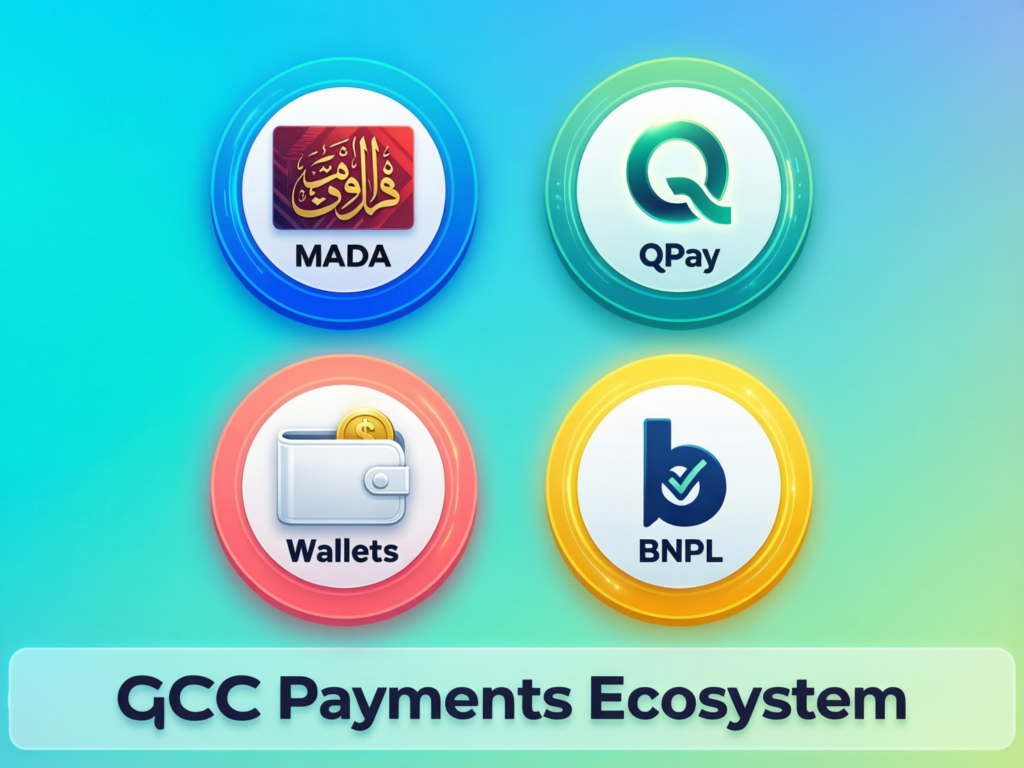
Cash on delivery vs cards, wallets and BNPL in Saudi, UAE and Qatar
Cash on delivery still exists, especially outside major cities, but its share is shrinking as card adoption, Mada in KSA, local wallets and BNPL grow. In the UAE and Qatar, shoppers are comfortable saving cards and using mobile wallets but only if gateways feel secure and clearly aligned with regulators like SAMA, TDRA and QCB.
Last-mile delivery, same-day promises and logistics realities across the GCC
Same-day or next-day delivery in Riyadh, Dubai and Doha is becoming standard for big platforms, supported by sophisticated last-mile fleets and dark stores. Smaller brands usually plug into aggregators or 3PLs, or build progressive web apps, often with specialist mobile app development to support courier tracking and push notifications.
Returns, refunds and reviews.
Marketplaces win trust because they offer clear refund policies, dispute resolution and visible reviews. Shoppers are wary of stand-alone sites with vague policies or no Arabic support. This is where strong UX, transparent policies and technical foundations including SEO-friendly architectures and indexing controls can make a small brand feel “as safe as Amazon”.

Regulation, data and compliance for ecommerce in KSA, UAE and Qatar
Behind the scenes, ecommerce in the GCC is shaped by data protection, payment regulation and digital identity frameworks. Ignoring them can block licences, payment onboarding or even lead to fines.
Saudi ecommerce rules, SDAIA/NDMO and PDPL data residency expectations
In KSA, the Personal Data Protection Law (PDPL), overseen by SDAIA and guided by the National Data Management Office (NDMO), sets strict rules on how personal data of Saudi residents is collected, stored and transferred. In many cases, data should stay within the Kingdom or be transferred only under specific safeguards. (SDAIA) For ecommerce, that often means using Saudi or GCC cloud regions and designing architectures that can honour data residency for example hosting customer data in AWS Bahrain while mirroring workloads in Azure UAE Central or GCP Doha.
UAE TDRA, e-activity approvals, UAE Pass and government portals
The UAE’s Federal Decree-Law on modern technology-based trade and TDRA rules require many online sellers to hold appropriate commercial licences and, in some cases, TDRA NoC for e-activities. Identity systems like UAE Pass streamline verification and login across government and private portals. For serious UAE digital retail projects, aligning with TDRA guidance on security and ecommerce is essential, and official resources at TDRA are a key reference.
Qatar Central Bank, QPS/QPay gateways and consumer protection
Qatar Central Bank (QCB) supervises national payment schemes such as NAPS and gateway frameworks like QPay and QPS.For ecommerce in Doha, that means working with QCB-approved acquirers, complying with local AML/CFT rules and ensuring card data is processed through certified gateways. Free zones like QFC, and in the wider GCC ADGM and DIFC, often host regional fintechs providing compliant payment and BNPL rails used by merchants across the region.
How can brands localise ecommerce for GCC shoppers?
Brands in KSA, UAE and Qatar can localise ecommerce for GCC shoppers by designing Arabic-first UX, offering local payment and delivery options in each country, and building a compliant, cloud-ready tech stack. The goal is a seamless, mobile-first shopping experience that feels “from here”, not copy-pasted from another market.
Designing Arabic-first, bilingual UX for Saudi, UAE and Qatar users
Start with Arabic as a first-class language, not an afterthought. That means right-to-left layouts, clear Arabic product descriptions, and content tuned to Ramadan, Eid and local modesty norms (for example, the best UAE online shopping website for abayas and modest fashion needs specific filters). Many brands use WordPress or headless builds so they can manage bilingual content efficiently.
Localising payments, delivery options and customer support by country
In Saudi, offer Mada, local wallets and cash on delivery in key regions; in the UAE, prioritise cards, Apple Pay and quick courier options; in Qatar, integrate QPay/NAPS-compatible gateways and realistic delivery times. Customer support should blend Arabic/English live chat and WhatsApp, with SLAs adjusted for Ramadan and public holidays. Well-planned digital and SEO programmes help drive qualified traffic into these tailored journeys.
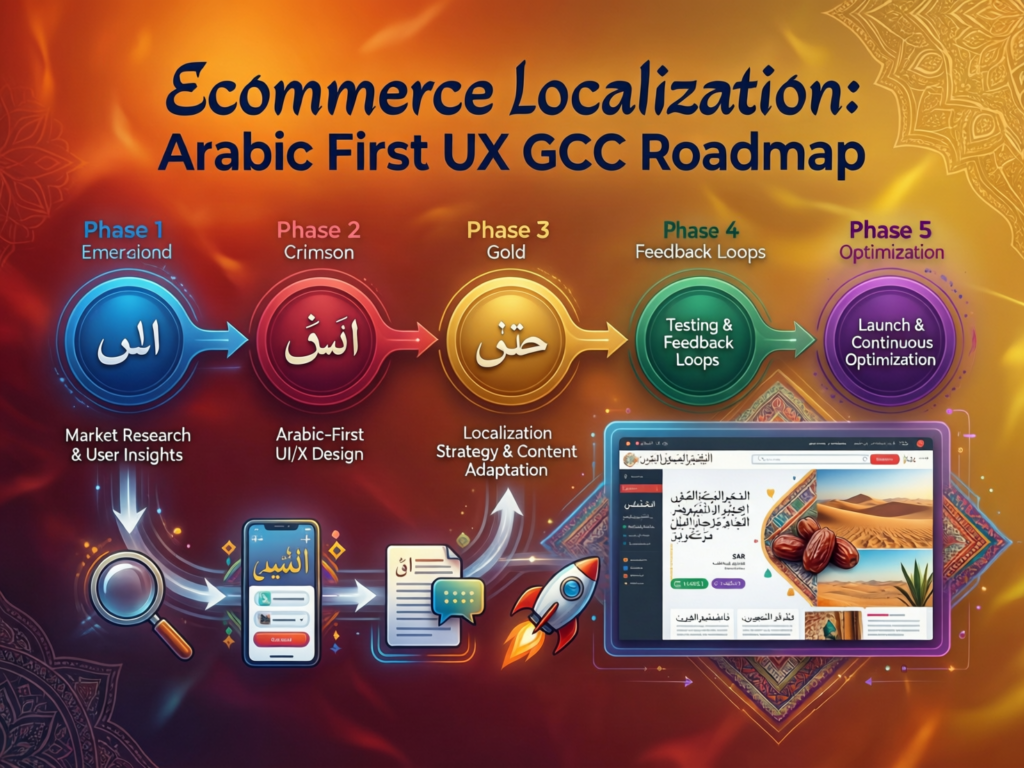
Step-by-step roadmap to launch or optimise ecommerce in the GCC
Clarify markets and models
Decide which countries (KSA, UAE, Qatar, plus Kuwait/Bahrain/Oman) you will serve, and whether you lead with marketplaces, brand.com or both.
Choose your tech stack
Pick ecommerce, CMS and hosting with GCC-ready performance and data residency options; consider partners experienced in GCC-focused web builds.
Secure licences and payment gateways
Align with PDPL, TDRA and QCB requirements, then onboard to local acquirers and wallets.
Design Arabic-first UX and content
Localise copy, imagery, filters and size guides for Saudi, UAE and Qatar shoppers.
Build logistics and returns flows
Integrate 3PLs, set clear SLAs for Riyadh, Dubai and Doha, and publish transparent return policies.
Launch, test and optimise
Track conversion, NPS and repeat rates; A/B test prices, bundles and social commerce campaigns; iterate by market.
Real-world examples include a Riyadh fintech startup building PDPL-compliant card onboarding flows, a Dubai fashion brand replatforming its store and app with mobile-first UX, and a Doha SME using GCC cloud regions and QPay to keep payments local while selling across Saudi and UAE.
What ecommerce in the GCC means for retailers, fintechs and governments
Key takeaways for retailers and marketplace sellers in Riyadh, Dubai and Doha
For retailers and marketplace sellers, ecommerce in the GCC means thinking regionally but executing locally. Success comes from combining strong marketplace operations with well-built owned channels, tailored to each city’s expectations on delivery, pricing and language.
Opportunities for fintech, logistics and government digital programs
Fintechs can plug gaps in BNPL, cross-border wallets and SME payment onboarding; logistics providers can innovate in same-day delivery, cold chain and returns; governments can use digital programs to push financial inclusion and consumer protection. Vision 2030 in Saudi and similar agendas in the UAE and Qatar already prioritise digital trade and smart logistics as strategic sectors.
Where GCC ecommerce is heading next and how to stay compliant and competitive
Looking ahead, expect more AI-driven personalisation, headless architectures and omnichannel retail strategies that blend malls, apps and social commerce into one experience. To stay competitive, brands need strong foundations compliant data governance, resilient architectures and Arabic-first design and the right partners to keep evolving with the region.
If you’re planning or scaling ecommerce in the GCC especially in Saudi Arabia, the UAE or Qatar you don’t have to figure it out alone. Mak It Solutions can help you audit your current stack, design Arabic-first journeys and architect data-compliant, GCC-ready platforms. Reach out to explore a tailored roadmap for your brand from marketplace integration to custom web and app development built around real shoppers in Riyadh, Dubai, Abu Dhabi and Doha.( Click Here’s )
FAQs
Q : Is cash on delivery still common for online shopping in Saudi Arabia?
A : Yes, cash on delivery (COD) is still used in Saudi Arabia, especially outside major cities and in certain age groups. However, its share is shrinking each year as Mada cards, mobile wallets and BNPL services grow rapidly, encouraged by Vision 2030 and the Kingdom’s push toward a cash-lite society.For ecommerce brands, the best approach is hybrid: offer COD where it materially boosts conversion, while nudging repeat customers toward Mada and digital wallets for smoother, lower-risk fulfilment aligned with SAMA payment modernisation.
Q : Do I need a special ecommerce licence to sell online in Dubai or Abu Dhabi?
A : In most cases, yes you’ll need a valid trade licence that covers your activity, plus, for many models, a TDRA NoC for e-activity. Whether you sell via your own website, mobile app or social channels, authorities treat it as regulated ecommerce, even if fulfilment happens from home. Some merchants choose free zones like ADGM or DIFC for holding structures, then obtain local on-shore licences for operations. It’s important to check your exact business model with a UAE adviser before launching paid campaigns or marketplace stores.
Q : How secure are Qatar payment gateways like QPay or QPS for online shopping?
A : Gateways operating under Qatar Central Bank oversight, such as those integrated with NAPS and QPay, must follow QCB’s standards for security, settlement and consumer protection. For shoppers, this typically means card data is handled by PCI-DSS compliant processors, with strong encryption and dispute mechanisms. As a merchant, you remain responsible for securing your own website or app and using certified plugins or SDKs. Aligning your setup with QCB guidance – and testing thoroughly is essential before promoting heavily in Doha or via QFC-based fintech partners.
Q : Can shoppers in Kuwait, Bahrain and Oman easily order from Amazon.sa or Amazon.ae?
A : Yes, many shoppers in Kuwait, Bahrain and Oman regularly order from Amazon.sa, Amazon.ae and Noon, but experience varies. Cross-border ecommerce from Saudi and UAE into these markets is growing fast, helped by GCC customs arrangements and regional logistics hubs.However, customers still face longer delivery windows, occasional customs surprises and limited eligibility for same-day deals. For brands, it’s worth checking each marketplace’s country-level shipping programmes and, eventually, considering local stocking or partnerships as cross-border order volumes justify it.
Q : What are the data residency requirements for hosting an ecommerce website serving Saudi customers?
A : Under Saudi Arabia’s PDPL and related NDMO data governance standards, personal data of Saudi residents is subject to tight controls on processing and cross-border transfers.In practice, many organisations either host data inside the Kingdom or in nearby GCC regions (such as AWS Bahrain) with clear legal bases, contracts and technical safeguards. If your ecommerce platform targets Saudi consumers, you should map where customer data lives, how it moves between systems, and under which PDPL transfer grounds you operate, then document this in your privacy notices and contracts.