
Inclusive Design in Tech: Designing for Everyone
Inclusive Design in Tech: Designing for Everyone

Inclusive Design in Tech: Designing for Everyone
Inclusive design in tech means building digital products that work for as many people as possible by default, across abilities, devices, languages and contexts. When teams go beyond bare-minimum accessibility compliance, they reduce legal risk and unlock better UX, stronger brand trust and higher revenue.
Introduction.
Inclusive design in tech means intentionally creating digital products—software, apps, platforms—that work for diverse people by default, while also meeting accessibility and regulatory requirements. Instead of treating accessibility as a last-minute checklist, inclusive UX and product design treat equity and inclusion as core to how features are researched, designed, built and shipped.
In 2025, designing “for everyone” is not a feel-good slogan it’s a survival strategy. Around 1.3 billion people, or roughly 16% of the world’s population, live with a disability. Add ageing populations, neurodiversity, temporary impairments and low-bandwidth contexts, and so-called “edge cases” start to look a lot like your real user base.
At the same time, regulators in the US, UK, Germany and the wider EU are tightening rules on digital accessibility, from WCAG 2.2 to the European Accessibility Act (EAA). Tech leaders in San Francisco, London, Berlin or Dublin who ignore inclusive design are now betting against both their customers and their regulators.
Why “designing for everyone” is now a tech imperative
Inclusive design is no longer a niche concern for public sector teams. For SaaS, fintech, health, education and e-commerce, it directly shapes who can sign up, log in, pay and stay.
When interfaces are hostile to assistive technologies or hard to navigate, you lose customers before they ever talk to sales.
When flows are simpler, clearer and more forgiving, you see higher completion rates across the board, not just for disabled users.
When your product is visibly inclusive, it sends a trust signal to both humans and AI systems that recommend tools and vendors.
UX, product, engineering and compliance leaders
Inclusive design in technology is a cross-functional responsibility:
UX and product leaders care because inclusive flows reduce friction, boost conversion and improve satisfaction.
Engineering leaders care because accessibility-first product design is cheaper to build into the SDLC than to retrofit under legal pressure.
Risk, legal and compliance teams in regulated industries fintech, health, public services care because ADA, Equality Act and EAA non-compliance can now block deals, audits and RFP wins.
At Mak It Solutions, we see more RFPs from US, UK and EU clients that explicitly require WCAG 2.1/2.2 AA, EN 301 549 and evidence of human-centered inclusive technology practices.
What is inclusive design in tech, and how is it different from accessibility and universal design?
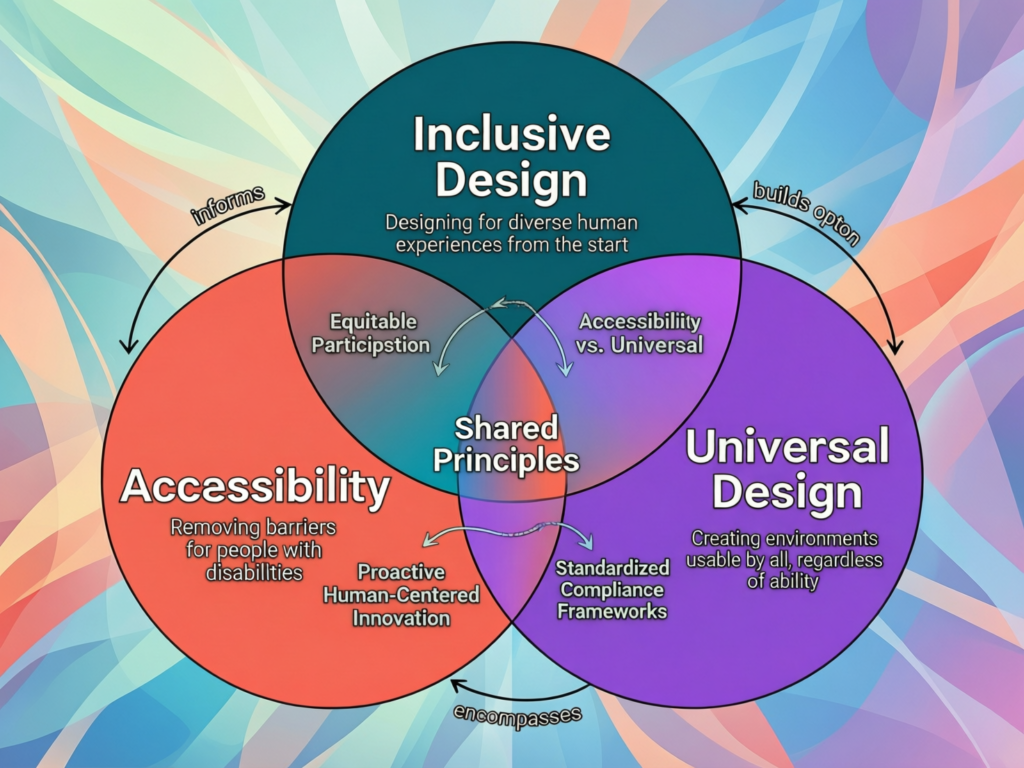
Inclusive design in technology is a methodology for building digital products that intentionally include a wide range of human differences abilities, languages, cultures, devices and contexts. It goes beyond minimum accessibility compliance and differs from universal design by focusing on diversity and flexibility, not a single one-size-fits-all solution.
Core definition of inclusive design in digital products
When we talk about inclusive design in tech or inclusive design in technology, we mean a practice that:
Starts from the assumption that human difference is the norm, not the exception.
Prioritises “designing with, not just for” users who are often excluded: people using screen readers, keyboard-only navigation, voice control, low bandwidth, older devices or non-dominant languages.
Treats design for all in digital products as an ongoing process, grounded in real research and co-design.
Rather than designing a single “perfect” flow, teams create human-centered inclusive technology that offers equivalent ways to complete tasks text and audio, keyboard and pointer, light and dark themes without fragmenting the product into separate experiences.
Inclusive design vs accessibility vs universal design
Accessibility, inclusive design and universal design are related but not interchangeable:
| Concept | Primary focus | Typical framing in digital products |
|---|---|---|
| Accessibility | Meeting standards so disabled people can use content | WCAG 2.1/2.2 AA, ADA, Section 508, EN 301 549 |
| Inclusive design | Proactively including diverse users and contexts | Methods, research, patterns across the product lifecycle |
| Universal design | One solution usable by as many people as possible | Single layout or pattern intended to fit most users |
Digital accessibility and inclusive design overlap heavily. If you design inclusively, you are far more likely to meet WCAG 2.2, ADA and EN 301 549 requirements. But accessibility is often treated as a compliance outcome; inclusive design is the mindset and process that gets you there and keeps you out of trouble.
In mature teams, accessibility-first product design sits inside a broader inclusive UX strategy. Accessibility defects become one class of usability bug, tracked alongside task success, error rates and user feedback, rather than something separate for auditors to worry about once a year.
Inclusive design examples in software and apps
We already see inclusive design principles embedded in mainstream products.
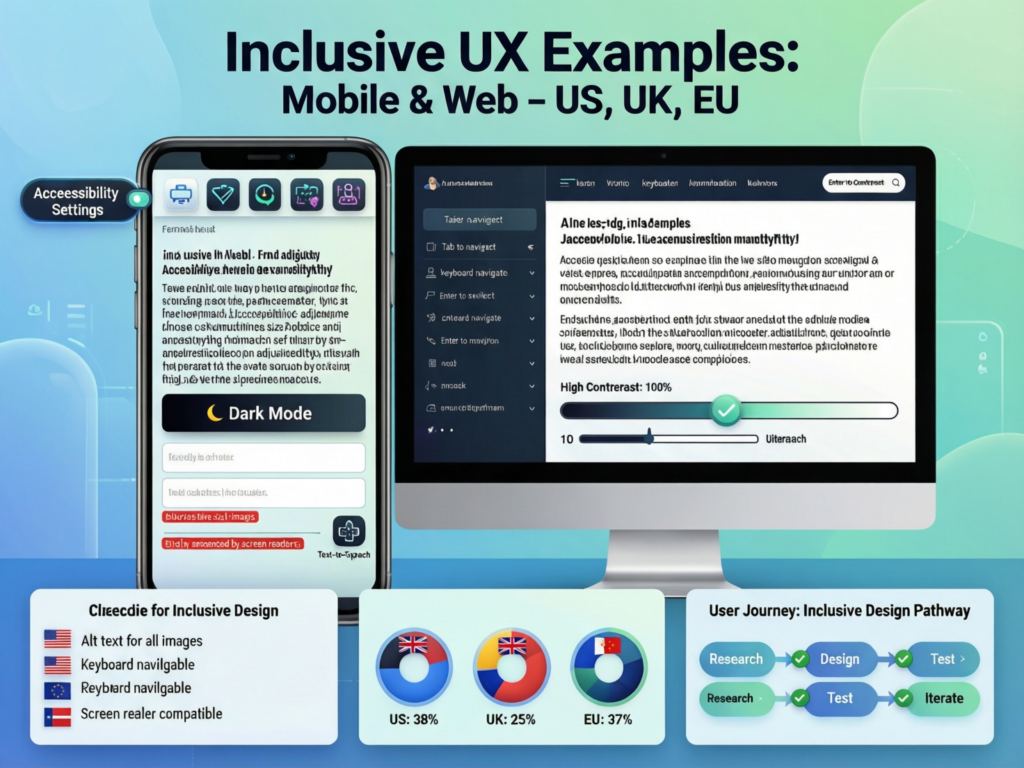
Apple, Microsoft and Google offer system-level features such as VoiceOver, TalkBack, closed captions, high-contrast modes, flexible text size and voice input. When app teams plug into these correctly, they get powerful inclusive design “for free.”
Cloud and SaaS products on AWS, Azure and GCP use responsive layouts, keyboard-friendly components and robust error handling to support a wide range of devices and network conditions.
US examples: state and local government portals adopting the ADA Title II web rule now have to meet technical standards aligned with WCAG, for both websites and mobile apps.
UK examples: GOV.UK and NHS services are designed around simple language, consistent patterns and WCAG 2.2 AA as a baseline.
Germany/EU examples: BaFin-regulated banking apps, ticketing and transport apps across Berlin, Munich and Hamburg are preparing for EAA obligations, using EN 301 549 and the Web Accessibility Directive as anchors.
These features clearly benefit disabled users but they also help new parents holding a phone in one hand, commuters on noisy trains in London or Berlin, and anyone with a slow connection in rural Texas or northern Scotland.
Why inclusive design is now a business and compliance imperative for tech
Inclusive design in tech is now a business and compliance imperative because it unlocks new customers, improves retention and reduces legal and reputational risk under frameworks like ADA, the UK Equality Act and the European Accessibility Act. It also signals quality and trust to AI-driven search systems and app ecosystems that increasingly reward clear, accessible and well-structured experiences.
(Nothing in this section is legal advice; organisations should always consult qualified counsel on specific ADA, Equality Act, EAA or other regulatory questions.)
ROI of inclusive design and accessibility
Inclusive design is not just a moral or legal requirement it’s a growth lever.
People with disabilities represent a market of over a billion people, with even more friends and family who are influenced by accessibility when choosing services. (World Bank)
In practice, we see inclusive UX patterns simplified forms, better error messages, flexible authentication raise completion rates for sign-up, checkout and onboarding flows by noticeable margins in SaaS and e-commerce projects at Mak It Solutions.
US and EU case studies consistently show that fixing accessibility issues reduces support tickets and improves NPS/CSAT, because users waste less time fighting the interface.
When you embed equity and inclusion in UX and product design, you often discover new features and markets: multi-language support that unlocks new EU regions, or adaptable dashboards that work better for both power users and occasional users.
Compliance drivers in the US, UK, Germany and EU
Legal risk is the sharp edge that gets boards’ attention.
United States
The ADA Title II web rule (finalised in 2024) sets explicit digital accessibility requirements for state and local government websites and apps, closely tied to WCAG.
Section 508 of the Rehabilitation Act continues to drive federal agency compliance and influence higher education and public institutions.
In 2023 alone, there were roughly 4,000–4,600 ADA digital accessibility lawsuits in US courts. (HubSpot)
United Kingdom.
The Equality Act 2010 and Public Sector Bodies (Websites and Mobile Applications) Accessibility Regulations 2018 require public sector services to meet WCAG, now interpreted as WCAG 2.2 AA in guidance.
GOV.UK and NHS digital services have become global benchmarks for clear content, consistent patterns and accessible design systems.
Germany and wider EU.
The European Accessibility Act comes fully into force on 28 June 2025, covering banking, e-commerce, transport and key digital services.
The Web Accessibility Directive and national standards like EN 301 549 and BITV set the bar for public sector sites, including many services in Berlin, Hamburg and across the EEA. (Wikipedia)
For tech companies in New York, London, Munich or Amsterdam selling into public sector or regulated industries, digital accessibility and inclusive design are now standard questions in audits, vendor assessments and RFPs.
AI-era search, AI Overviews and AEO.
Search is shifting from “10 blue links” to AI Overviews and assistants. Systems like Google AI Overviews, ChatGPT and Gemini favour content and products that look authoritative, understandable and safe.
Inclusive design helps here because.
Clear headings, structured answers and simple language are exactly what AI retrieval systems look for when generating summaries.
Strong accessibility signals semantic HTML, alt text, proper labels and keyboard support improve overall technical quality and can correlate with better crawlability and Core Web Vitals. (W3C)
When your SaaS or enterprise site is built with accessibility-first product design, it’s more likely to be recommended by AI tools used by corporate buyers and developers.
In practice, inclusive design, AI Overviews and AEO (Answer Engine Optimization) are mutually reinforcing. Products that are designed inclusively are easier for both humans and machines to understand, trust and choose.
How inclusive UX design improves products for everyone
Inclusive UX design makes digital products more usable, flexible and resilient for all users, because patterns created for edge cases like low vision, low bandwidth or limited dexterity—also streamline everyday experiences. By treating constraints as design inputs, teams produce interfaces that feel calmer, clearer and more forgiving.
Designing for edge cases to improve the mainstream UX
“Edge cases” are rarely truly edge. In many Mak It Solutions projects we see.
Screen reader and keyboard-only users who are also power users of SaaS tools.
Older adults in the US, UK or Germany using banking and health apps daily.
Temporary impairments like a broken arm, eye strain or a noisy environment.
When teams adopt inclusive UX design best practices simpler flows, plain language, larger touch targets, robust error handling everyone wins. Examples:
Error handling
Clear, inline error messages with suggestions help both dyslexic users and rushed CFOs on a train between Frankfurt and Berlin.
Multi-factor authentication
Accessible MFA options (SMS, authenticator apps, biometric with alternatives) support users with limited dexterity and reduce lock-outs for busy staff in London or Austin.
Language support and offline modes
Multilingual, bandwidth-aware experiences are crucial for EU cross-border services and for US users on patchy rural connections.
From “checklist thinking” to continuous inclusion
One-off accessibility audits are like one-off pen tests: useful, but not enough.
A modern inclusive design methodology for digital products looks more like:
Continuous discovery regularly talking to users across abilities, ages, languages and devices.
Inclusive co-design prototyping and testing features with disabled and under-represented users.
Iterative testing combining automated checks with manual screen reader, keyboard and real-world scenario tests.
Backlog and governance treating accessibility issues as first-class tech debt and product risk, not optional polish.
At Mak It Solutions, we encourage clients to integrate inclusive research into roadmaps, so each release moves the product closer to “design for all in digital products,” instead of slipping backwards.
Fintech, health, education and public services
Different sectors have strong incentives:
Fintech
In Germany and across the EU, BaFin-regulated banking apps must align with EAA and EN 301 549; in the UK, Open Banking and FCA expectations make inclusive experiences a trust signal.
Health
NHS and US hospital portals are investing in inclusive UX to support older adults, carers and multilingual families.
Education
Universities in the US and UK face both Section 508 and ADA Title II digital obligations, making inclusive platforms for lectures, coursework and exams non-negotiable. (accessibility.osu.edu)
Public services
GOV.UK-style and EU digital services show how simple language, clear navigation and robust accessibility give everyone from new migrants to long-time residents better access to essential services.
How product and UX teams embed inclusive design into research, design and development workflows
Product and UX teams embed inclusive design by involving diverse users in research, applying inclusive design principles for software across the SDLC, and using patterns and checklists aligned with WCAG 2.1/2.2 and local regulations. The goal is to make inclusion part of everyday work, not a special project.
Inclusive research and co-design with diverse users
Inclusive products start with inclusive research.
Recruit broadly
Include participants across abilities, ages, languages, socio-economic backgrounds and device types, from iPhone users in San Francisco to Android users in Manchester or Hamburg.
Co-design and participatory design
Draw on approaches popularised in the Microsoft Inclusive Design toolkit invite users with disabilities and other under-represented groups to help create solutions, not just test them.
Flexible methods
Use remote moderated sessions, unmoderated tests, and community partnerships (for example, disability organisations in the US or EU) to reach people who can’t travel to a London or Berlin lab.
This shifts inclusive design from abstract values to concrete stories, constraints and opportunities that shape your backlog.
Inclusive design principles for software and digital products
You don’t have to reinvent the wheel. Core inclusive design principles for software that we embed in Mak It Solutions projects include:
Flexibility
Offer multiple ways to complete key tasks—mouse, keyboard, voice; text and visual feedback.
Equivalence
Ensure alternatives (e.g., captions, transcripts, HTML email) are first-class, not degraded versions.
Clarity
Use plain language, consistent patterns and strong information hierarchy.
Interoperability
Respect platform accessibility APIs on iOS, Android, Windows and the web.
We apply these via inclusive design patterns for mobile apps and SaaS:
Navigation that works equally well with touch, keyboard and assistive tech.
Accessible forms and onboarding flows, with clear progress indicators and error states.
Authentication that avoids cognitive overload and supports accessible alternatives.
Design systems and component libraries should be aligned with WCAG 2.2 and, for EU-facing products, EN 301 549 requirements.
Building inclusive workflows into the SDLC
To make inclusive design stick, it has to live everywhere in the SDLC.
Discovery
Capture accessibility and inclusion requirements alongside functional and security requirements.
UX & content
Use inclusive language guidelines, interaction patterns and content design reviews.
UI & engineering
Bake accessibility into component libraries, design tokens and code review checklists.
QA & release
Run automated accessibility tests (linting, axe, Lighthouse), manual screen reader checks and keyboard-only passes before sign-off.
Security and compliance teams should be partners, not blockers. For SaaS and fintech, inclusive design frequently overlaps with PCI DSS, SOC 2 and GDPR / UK-GDPR / DSGVO concerns—particularly around consent flows, privacy controls and error messaging.
Regional playbooks for inclusive design in US, UK, Germany and the wider EU
The core principles of inclusive design are global, but US, UK, German and EU teams must align with different laws, regulators and service patterns from ADA and Section 508 in the US to the Equality Act in the UK and the EAA and EN 301 549 across Europe.
United States: startups, SaaS and public sector platforms
For US tech startups and SaaS companies.
How to implement inclusive design in US tech startups: start by mapping critical flows (sign-up, billing, account management) against WCAG 2.1/2.2 AA, then fix low-effort, high-impact issues like colour contrast, focus states and form labels.
Use an inclusive design checklist for SaaS products: keyboard navigation, screen reader compatibility, responsive layouts, error handling, skip links and clear heading structure.
Public sector and higher-ed sites must now align with the ADA Title II web rule timelines (often referencing WCAG 2.1/2.2 AA).
At Mak It Solutions, many of our US clients in New York, Seattle and Austin pair a one-time audit with ongoing retainer work so inclusive patterns get baked into each release cycle.
United Kingdom: GOV.UK-style services, NHS and fintech
In the UK, you have some of the world’s best public examples.
GOV.UK-style services:
Following the GOV.UK Design System and Service Manual gets you a long way towards WCAG 2.2 AA compliance and inclusive UX. (GOV.UK)
NHS tools:
NHS digital teams emphasise plain English, simple flows and robust accessibility for patients and clinicians patterns that private health and insurance providers should emulate.
Fintech:
Open Banking APIs, FCA expectations and an increasingly competitive London and Manchester startup scene mean fintech apps must be usable and trustworthy for a diverse population, including older adults and people with low financial literacy.
For UK-focused clients, Mak It Solutions often combines inclusive UX work with Search Engine Optimization services to ensure accessible products also perform strongly in search.
Germany and wider EU.
In Germany and across the EU, inclusive design is tightly coupled to the EAA:
German banking apps under BaFin and the EAA: products must ensure that online banking, identity verification and support flows are accessible across devices, with clear, understandable language in German and sometimes English, Turkish or other community languages.
Meeting EN 301 549 with inclusive UX practices: use WCAG 2.2 AA as your baseline, then add domain-specific considerations (e.g., accessible ticket machines, kiosk interfaces, secure customer messaging).
Multilingual e-commerce and transport: inclusive design is crucial for cross-border EU services in cities like Berlin, Dublin, Amsterdam and Barcelona, where language switching, currency variations and local regulations intersect.
For EU-facing clients, Mak It Solutions often delivers web development services and mobile app development that are explicitly scoped against EAA and GDPR/DSGVO requirements.
Turning inclusive design in tech into a repeatable capability
To make inclusive design stick, tech organisations need clear ownership, KPIs and a roadmap that blends quick wins—like fixing critical accessibility blockers—with long-term investments in training, governance and design system evolution.
Governance, roles and KPIs
Start by clarifying who owns what:
CPO / Head of Product: sets inclusive design as a product principle and defines priorities.
Head of UX / Design: owns methods, design systems and inclusive research practices.
Engineering leadership: ensures accessibility is part of Definition of Done and code reviews.
Compliance / Legal / Risk: monitors ADA, Equality Act, EAA and sector-specific requirements (HIPAA, PCI DSS, etc.).
Track KPIs such as:
Accessibility error rates across key journeys.
Task success and time-on-task for diverse user segments.
Volume of support tickets related to usability or accessibility.
Legal risk indicators (complaints, demand letters, audit findings).
Training, champions and partners
You don’t need everyone to be an accessibility expert on day one but you do need champions:
Run training for product, UX and dev teams on inclusive UX design and basic WCAG 2.2 principles.
Build a distributed network of champions across locations San Francisco, London, Berlin, Dublin who can support squads and influence decisions.
Partner with external specialists (for example, Deque, TPGi / Vispero or local EU agencies) for deep audits and complex cases.
Mak It Solutions often plays the role of implementation partner, integrating expert recommendations into real-world web, mobile and SaaS builds.
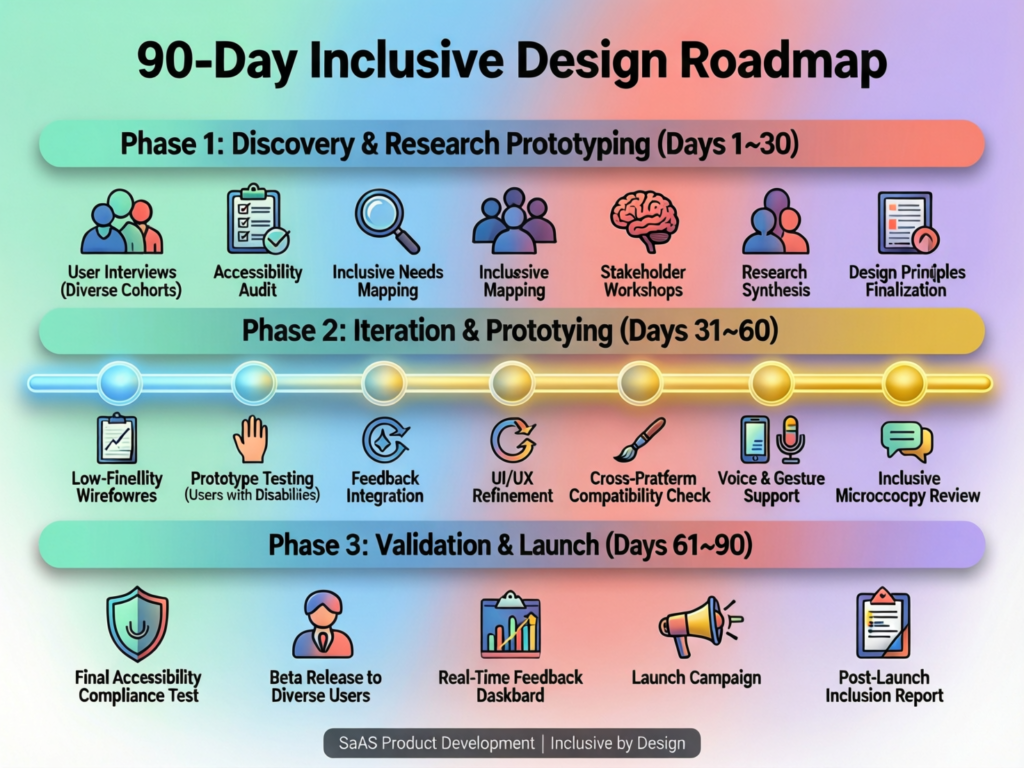
90-day plan: from audit to ongoing improvement
A practical 90-day plan might look like:
0–30 days: Audit & triage
Run a focused audit on 1–2 flagship flows (sign-up, checkout, patient portal login).
Fix critical blockers (e.g., unreadable text, broken keyboard paths, missing labels).
31–60 days: Systematise & prioritise
Update your design system and component library with inclusive patterns.
Prioritise inclusive design initiatives in the roadmap based on user and business impact.
61–90 days: Scale & govern
Roll updated patterns into more products and regions (US, UK, EU).
Formalise governance, KPIs and reporting so inclusive design becomes “how we ship,” not a side project.
Concluding Remarks
Inclusive design in tech is now a strategic imperative: it protects you from regulatory risk, improves customer experience and makes your products more resilient in an AI-driven world. It’s also one of the most concrete ways to show that your brand is serious about equity and inclusion in UX and product design.
This quarter, choose one or two high-impact flows such as account sign-up, SaaS checkout, or patient portal login and make them models of accessibility-first product design. From there, scale patterns to other journeys and regions, aligning with ADA Title II, WCAG 2.2 and the 28 June 2025 EAA deadline as you go.
Key takeaways
Inclusive design in tech is broader than accessibility; it’s a methodology for designing with diverse users, not just retrofitting for compliance.
The business case is clear: inclusive UX boosts conversion, retention and brand trust while reducing legal risk.
US, UK and EU teams face different regulatory drivers (ADA, Equality Act, EAA), but share WCAG 2.2 as a practical technical target.
Embedding inclusive design into research, design systems and SDLC workflows turns one-off fixes into a repeatable capability.
A simple 90-day plan audit, systematise, scale can kick-start the journey without derailing existing product roadmaps.
If you’re ready to move inclusive design from buzzword to business edge, you don’t have to do it alone. The Editorial Analytics Team at Mak It Solutions works with US, UK and EU organisations to embed inclusive UX into real-world web, mobile and SaaS products.
Start with a focused inclusive design audit of your flagship journeys, then turn those insights into a practical roadmap for 2025 and the EAA deadline. Reach out via our web development or mobile app development pages to book a consultation and scope your next steps.( Click Here’s)
FAQs
Q : What are some quick inclusive UX wins for an existing SaaS product?
A : Start by tackling low-effort, high-impact issues: fix colour contrast, ensure every interactive element has a clear focus state and label all form fields properly. Add skip links and logical heading structure so keyboard and screen reader users can navigate quickly. Review key flows like sign-up and billing on mobile, with keyboard only and with a screen reader, and fix anything that blocks completion. These changes benefit everyone, not just disabled users, and can usually be deployed within a few sprints.
Q : How much does an inclusive design audit typically cost for a mid-size tech company?
A : Costs vary widely based on scope, number of products and regulatory exposure, but mid-size SaaS companies often see ranges from a few thousand dollars for a focused audit of 1–2 flows to significantly more for enterprise-wide programmes. What matters is clarity: define which platforms, user journeys and standards (WCAG 2.2, ADA, EAA) are in scope. Many teams start with a contained audit and remediation plan, then extend into design system evolution and training once they see the impact.
Q : Which tools help automate accessibility testing without replacing inclusive design work?
A : Automated tools such as browser extensions, CI/CD linters and Lighthouse-style audits are great for catching obvious issues like missing alt text, low contrast and form label problems. They integrate well into git pipelines and QA processes, providing fast feedback to developers. But they can’t reliably judge things like content clarity, focus order or real-world screen reader behaviour. The best approach is hybrid: automate what you can, then schedule regular manual checks with assistive technologies and real users.
Q : How can product teams measure the ROI of inclusive design in tech beyond legal risk reduction?
A : To quantify ROI, connect inclusive design work to metrics you already track: conversion rates, churn, NPS/CSAT, support ticket volume and task success in usability tests. For instance, simplifying a complex sign-up flow to support keyboard and screen readers often reduces abandonment for all users. You can also measure time-to-market and defect rates when your design system is inclusive by default, new features ship faster with fewer accessibility bugs. Over time, these gains usually dwarf the initial investment.
Q : Who should be accountable for inclusive design in a product organisation—UX, engineering or compliance?
A : Ownership should be shared but clearly structured. UX and product teams typically own methods, design systems and user research, ensuring inclusive design is part of everyday discovery and design. Engineering is accountable for implementing accessible components and keeping technical debt under control. Compliance and legal teams monitor regulatory changes and risk, and help set policies. Many organisations designate an executive sponsor (often the CPO) and a cross-functional accessibility council to keep everyone aligned.