


Platform Engineering vs DevOps for Modern Teams
Platform Engineering vs DevOps for Modern Teams
Platform Engineering vs DevOps for Modern Teams
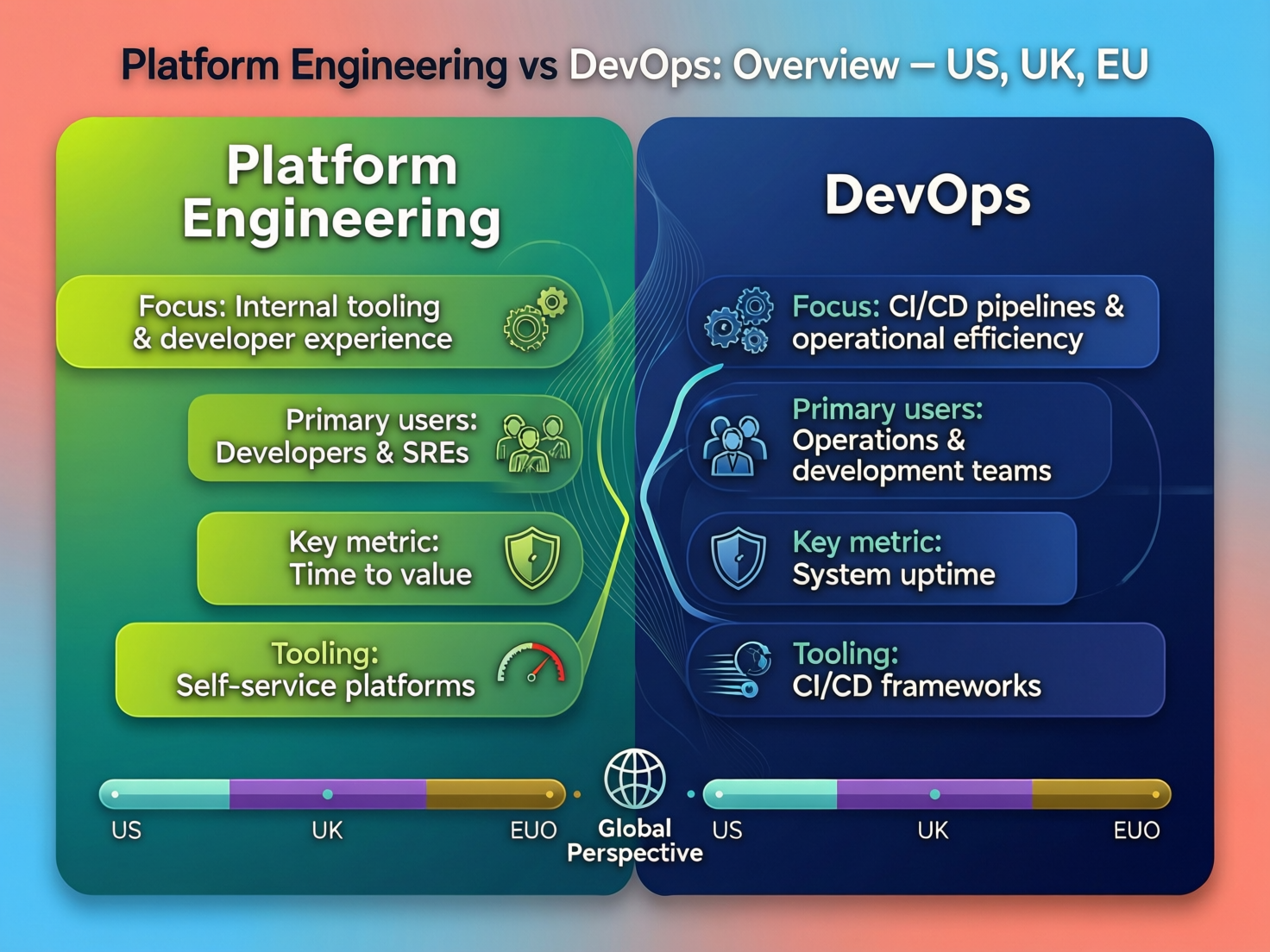
Platform engineering vs DevOps isn’t about “DevOps is dead”. It’s about giving DevOps teams a reusable internal developer platform (IDP) with golden paths, self-service infrastructure and secure defaults. In modern US, UK and European organisations, DevOps defines how teams work, while platform engineering builds the shared platform product that lets those teams ship faster, safer and at scale.
Early, direct answer: DevOps is the operating model; platform engineering is the product that encodes it. If you have multiple teams repeatedly rebuilding pipelines, Terraform and security controls, you’re ready to treat the platform as a product instead of adding yet another “DevOps squad”.
Introduction
If your leadership is debating platform engineering vs DevOps, it usually means one thing: you’ve hit the limits of “just add another DevOps squad”. Tool sprawl, duplicated Terraform modules, fragile pipelines and compliance headaches are now blocking velocity across US, UK and European teams.
Platform engineering isn’t a replacement for DevOps; it’s how organisations with many product teams scale DevOps safely, by treating the underlying platform as a product. In this guide, we’ll clarify what platform engineering is (and isn’t), how it relates to DevOps and SRE, what an internal developer platform (IDP) looks like in practice, and when a US, UK or EU company should actually stand up a platform team instead of simply hiring more DevOps engineers.
What Is Platform Engineering vs DevOps, Really?
Clear definitions for busy leaders
Platform engineering is the discipline of building and operating an internal developer platform (IDP) that gives teams self-service infrastructure, golden paths and secure-by-default templates. DevOps is the culture and set of practices that connect development and operations so software can be delivered faster and more reliably.
Put simply: DevOps is how teams work; platform engineering is what they use. DevOps spans every squad in a New York fintech or London SaaS scaleup, while the platform team in a Berlin bank or NHS-scale system builds the shared product those squads deploy onto.
DevOps is already mainstream. One recent analysis shows adoption growing from around 33% of companies in 2017 to roughly 80% by 2024. Platform engineering builds on that maturity rather than replacing it.
How platform engineering, DevOps and SRE fit together
In a healthy organisation, platform engineering vs DevOps vs SRE is a question of focus, not competition:
Product / feature teams own business features and customer outcomes.
DevOps defines how those teams build, test and release CI/CD, trunk-based development, observability practices.
Platform engineering builds the IDP and golden paths that encode those practices into self-service workflows.
SRE focuses on reliability for critical services, error budgets and incident response.
The AEO view
Platform teams enable DevOps and SRE by standardising the underlying platform, so every team gets the same secure, compliant, paved road instead of inventing infrastructure from scratch.
In practice, that might look like.
A central platform team in Frankfurt managing Kubernetes clusters, deployment workflows and policy-as-code.
Feature teams in Munich or Amsterdam owning their services, but using platform-provided templates and pipelines.
An SRE group partnering with the platform team on reliability features (SLIs/SLOs, capacity automation) and with product teams on incident reviews.
Is platform engineering the new DevOps or just a buzzword?
Platform engineering is best understood as the next phase of DevOps at scale, not a “DevOps is dead” replacement. When you have dozens of squads across San Francisco, London and Berlin all reinventing CI/CD and infrastructure, an internal platform becomes the practical way to encode good DevOps into reusable products.
It stops being hype when.
You have clear “customers” (your internal development teams).
The platform has a product mindset (roadmap, metrics, feedback loops).
You can show measurable developer experience (DX) improvement: faster lead times, fewer security incidents, happier engineers.
It is just a buzzword when a three-team startup in Austin or Manchester copies FAANG diagrams, spins up three clusters, five GitOps tools and a “platform guild” that nobody asked for. For small teams, solid DevOps practices and a simple cloud setup usually beat an over-engineered “platform”.
Platform Engineering vs DevOps in Practice
Ownership, scope and operating model
At a high level, DevOps teams tend to own pipelines, environments and changes for their product, while platform teams own shared capabilities as an internal product.
AEO angle
Platform engineering is most useful when several product teams keep repeating the same infrastructure tasks, like bootstrapping services, wiring monitoring and satisfying the same PCI DSS or GDPR controls.
A simple comparison:
| Aspect | DevOps teams | Platform teams |
|---|---|---|
| Primary customer | Their own product team | All engineering teams |
| Scope | CI/CD, infra-as-code, environment for an app | Shared IDP, golden paths, infra & security abstractions |
| Lifecycle | Follows product roadmap | Product roadmap for the platform itself |
| Typical scale | 1–5 teams | 5–50+ teams across US, UK & EU |
For a large US enterprise or a BaFin-regulated German bank, pushing every team to build its own pipelines quickly becomes unmanageable. A platform team exists to stop that duplication.
Developer experience.
An internal developer platform (IDP) acts as a developer experience (DX) platform: a single place where engineers can create services, request environments, deploy, roll back, and hook in logging and security without opening infrastructure tickets.
Key concepts you’ll hear.
Golden path / paved road the recommended, opinionated way to build a service (e.g., “Next.js + Postgres + Kubernetes + GitOps, with built-in observability”).
Self-service infrastructure on-demand creation of environments, databases, queues, using guardrailed workflows.
Secure-by-design defaults TLS, secrets management, IAM, network policies baked into templates.
Gartner and others report that around 58–60% of organisations now see developer experience as critical for productivity and software quality. Developer-experience research also shows how small improvements add up: one well-known study calculated that saving just two hours per week per developer in a 200-engineer organisation can be worth the equivalent of 10 full-time developers.
Platform engineering is where you harden those golden paths and DX improvements so DevOps gets easier, instead of just adding more tools to the pile.
When platform engineering replaces, complements or fails vs DevOps
Most of the time, platform engineering complements DevOps; it rarely replaces it.
Three rough scenarios.
DevOps-only
1–2 teams, early-stage startup in Austin or Dublin.
A small DevOps group can manage infra, pipelines and SRE-lite duties.
A full platform team would be overkill.
DevOps + platform engineering
Scaleups and enterprises in New York, London, Berlin or Amsterdam with 5+ product teams.
Shared concerns (security, audit, costs) and complex compliance (GDPR/DSGVO, UK-GDPR, HIPAA, PCI DSS) justify a central platform.
DevOps remains embedded in teams; the platform team builds the IDP they all use.
Platform initiatives that fail
No product mindset: platform treated as a one-off project.
No executive support or funding for ongoing improvements.
Over-engineering: internal platform more complex than using AWS, Azure or Google Cloud directly.
In other words, platform engineering vs DevOps is a “both/and” question once your organisation and risk profile reach a certain size.
Internal Developer Platforms & Tooling Choices
What is an internal developer platform (IDP)?
An internal developer platform (IDP) is the product that a platform engineering team builds: a self-service layer on top of cloud/Kubernetes, CI/CD and security controls.
Common components include.
Service templates (e.g., Node/Java/.NET microservice blueprints).
Environment management (ephemeral preview envs, staging, production).
Deployment workflows (GitOps, blue/green, canary).
Observability (logging, metrics, traces wired in by default).
Policy-as-code (guardrails for secrets, network, data residency).
Industry surveys show that IDPs and internal developer portals are on a steep adoption curve, with one well-cited study finding that around 85% of respondents either already have or are planning to implement an internal developer portal.

In a regulated US healthcare provider or a UK open-banking fintech, the IDP becomes the single place where dev teams can move fast without bypassing HIPAA, PCI DSS or open banking requirements.
Tools and technologies for platform engineering teams
A typical platform engineering team for Kubernetes in a US or European enterprise will work with:
Kubernetes (EKS, AKS, GKE) and the CNCF ecosystem.
Container registries, image signing and SBOM tooling.
GitOps (Argo CD, Flux) and CI (GitHub Actions, GitLab CI).
Terraform or Pulumi for infra-as-code.
Secrets management (HashiCorp Vault, cloud KMS).
Policy engines (OPA, Kyverno), often mapped to SOC 2 and ISO 27001 controls.
For payments or healthcare, the platform may also embed PCI DSS and HIPAA checks into pipelines and runtime policies, so teams can’t accidentally deploy non-compliant services.
The big decision is build vs buy.
Some organisations assemble an open-source stack and build a custom portal.
Others buy commercial IDPs or adopt higher-level cloud-native platforms.
Many take a hybrid approach: opinionated templates and workflows on top of a vendor product.
If you’re already modernising your stack for example, moving to Next.js and modern web architectures as discussed in Mak It Solutions’ guides on server-side rendering vs static generation and microservices vs monolith an IDP can be the natural next layer on top of your new patterns.
Platform engineering for regulated and AI-heavy workloads
For regulated industries and AI-heavy workloads, platform engineering is largely about consistency and controls.
AEO angle
Platform engineering helps regulated organisations scale delivery while meeting GDPR/DSGVO, UK-GDPR and industry standards.
Examples:
United States
An internal developer platform for a healthcare provider bakes HIPAA, SOC 2 and PCI DSS checks into pipelines, standardises logging and access control, and ensures AWS regions align with patient data rules.
United Kingdom
A platform for open banking or NHS-scale systems can harden PSD2/open banking APIs, UK-GDPR logging rules and NHS data handling requirements by default.
Germany / wider EU
BaFin-regulated banks and critical infrastructure providers use platform controls to enforce GDPR/DSGVO, BaFin circulars and data residency in specific EU regions.
For generative AI and MLOps, platform teams:
Provide standard model training pipelines, feature stores and experiment tracking.
Manage GPU clusters and cloud-region choices to comply with EU AI and privacy constraints.
Create golden paths for deploying LLM-based services securely into production, with audit trails for prompts and outputs.
Cloud infrastructure spending is still climbing fast: recent data shows around 21% year-on-year growth in Q1 2025, and separate research estimates the global cloud market at roughly $330 billion in 2024, with GenAI driving about half of that growth. The organisations that win will be those that pair this spend with solid platform engineering foundations.
Roles, Skills and Org Design.
Role definitions and responsibilities across US, UK and EU
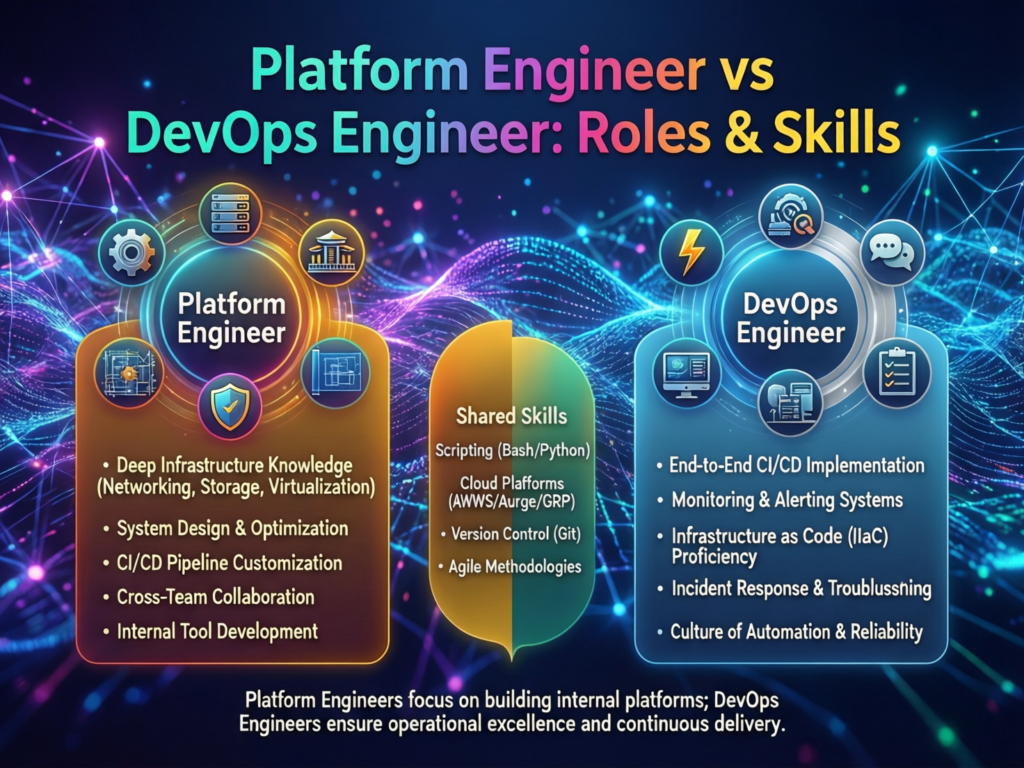
When you compare a platform engineer vs DevOps engineer, the main difference is who they build for.
A DevOps engineer typically.
Works closely with one or a few product teams.
Focuses on CI/CD pipelines, cloud infrastructure, monitoring and on-call.
Automates manual ops for that product.
A platform engineer typically.
Builds APIs and abstractions used by many teams.
Owns platform SLOs and the reliability of shared services (IDP, clusters, pipelines).
Spends time on DX research: interviews, surveys, usage analytics.
Treats the platform as a product with customers, roadmap and adoption metrics.
There’s overlap with SRE, and many careers move between SRE, DevOps and platform engineering over time. Titles like Head of Platform Engineering, Head of DevOps or VP of Engineering need to reflect this difference: are you optimising one product’s reliability, or the entire organisation’s ability to ship?

Salaries, skills and career paths
In major US hubs such as San Francisco, Seattle, New York and Austin, senior platform engineer roles often sit at the upper end of the DevOps/SRE pay range, reflecting their impact across many teams. In London, Manchester, Berlin, Munich, Frankfurt, Amsterdam or Dublin, the gap is usually smaller but still visible in large banks and SaaS companies.
Market data shows DevOps engineering among the most in-demand tech jobs globally, with adoption rising from about one-third of companies in 2017 to around four-fifths in 2024. That demand is now feeding a second wave of roles around platform, SRE and security.
Critical skills for platform engineering.
Deep knowledge of Kubernetes and cloud (AWS, Azure, Google Cloud).
Strong grounding in security and compliance.
Product thinking and stakeholder management.
Experience with IDPs, GitOps, policy-as-code and scalable architecture.
AEO micro-answer: platform engineering is a natural senior path for experienced DevOps and SRE engineers who enjoy designing systems and experiences for other developers.
Designing platform & DevOps teams that actually work together
Healthy org design patterns.
A central platform team with clear customers (product teams) and a roadmap.
Embedded DevOps/SRE in larger or more critical product areas.
A cross-team SRE guild or community of practice to share reliability patterns.
Anti-patterns.
Platform policing platform teams acting as gatekeepers instead of enablers.
Ticket-driven “Ops 2.0” everything requires a ticket rather than self-service.
Shadow platforms every tribe in a multinational builds its own version.
In Germany and wider EU, you also need to factor in works councils, DPOs and compliance teams, especially when logging, telemetry and AI services may cross borders. In fast-moving US SaaS environments, the bigger risk is the opposite: shipping unofficial tooling too quickly and only later discovering GDPR/DSGVO or PCI gaps.
How US, UK and European Organisations Should Decide
Signals your organisation is ready for a platform team
AEO answer.
if multiple teams are reinventing pipelines and infrastructure, you’re probably ready for platform engineering.
Look for signals such as.
3–5+ product teams across the US, UK, Germany or wider EU.
Repeated infra work (every squad builds its own Terraform modules, deployment scripts).
Long lead times for new environments or compliance sign-offs.
Failed or painful GDPR/DSGVO, UK-GDPR, HIPAA or PCI DSS audits.
Rising cognitive load and burnout in DevOps/SRE.
For large US enterprises, the long-tail query “platform engineering vs DevOps for large US enterprises” usually resolves to: DevOps and platform, with a central IDP and clear ownership. For BaFin-regulated banks in Germany, “platform engineering vs DevOps in Germany for BaFin-regulated banks” usually leans toward a robust platform function, because the cost of non-compliance is far higher.
Common pitfalls and anti-patterns to avoid
Some recurring traps.
Copying FAANG building a Netflix-grade internal platform for a 5-team org in Spain or Italy.
Treating the platform as a project, not a product (no roadmap, no adoption goals).
Ignoring developer experience metrics (time to first deploy, NPS, number of teams actively using the platform).
Underestimating GDPR/DSGVO and UK-GDPR implications: shipping logs to non-EU regions, over-collecting telemetry, or using AI services without data protection assessments.
Mak It Solutions’ work on IT cost optimisation and human-centred change management in tech often starts by looking at how many tools and platforms are in play, then rationalising around a smaller, well-run core. The same approach applies here.
A pragmatic roadmap from DevOps to platform engineering
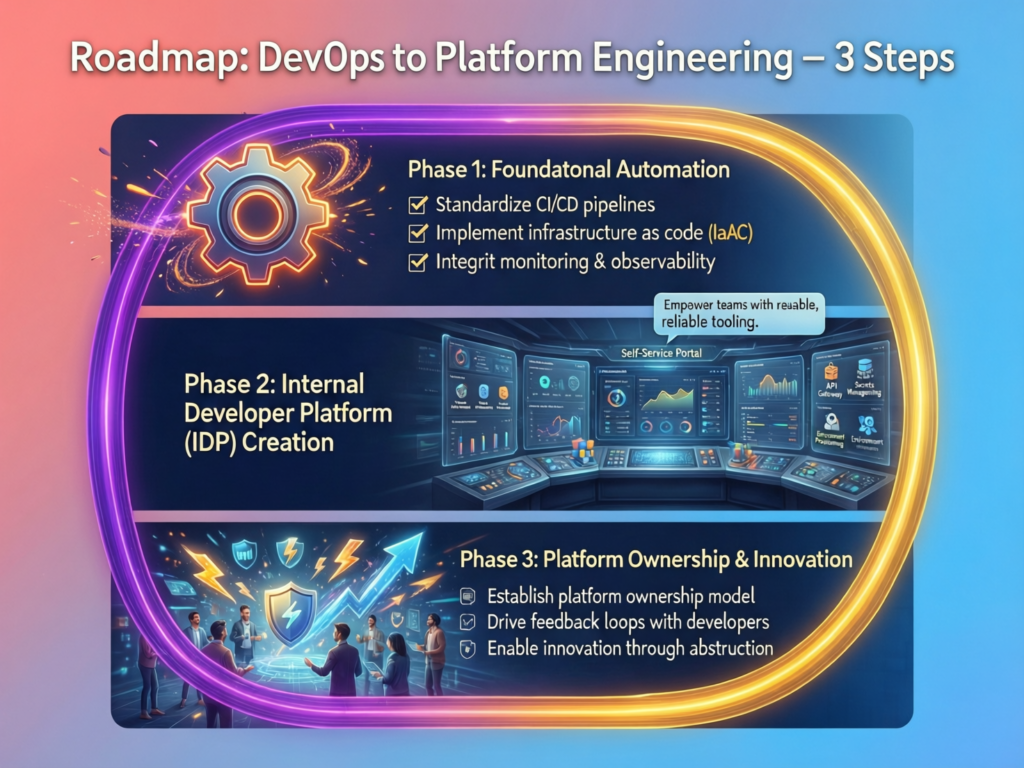
A simple, phased roadmap
Stabilise DevOps practices and CI/CD
Standardise branching, testing and deployment patterns across teams.
Fix obvious reliability issues before adding more layers.
Standardise golden paths / paved roads
Agree on recommended stacks (e.g., modular monolith vs microservices)
Create shared templates for services, pipelines and observability.
Formalise the platform team and IDP
Give a small group ownership of the IDP, its roadmap and DX metrics.
Start with one or two teams in New York or London as pilot customers, then roll out to Berlin, Amsterdam or Dublin.
This roadmap will look different for a US scaleup, a UK public sector body or a German automotive giant, but the principles hold: fix the basics, standardise patterns, then productise the platform. If you’re unsure where you sit, a short “platform readiness” assessment can quickly surface gaps.
Key takeaways
DevOps remains the foundation of modern software delivery in the US, UK and Europe. Platform engineering doesn’t replace DevOps; it makes DevOps sustainable at scale.
Platform teams build the IDP and golden paths that remove cognitive load and embed security and compliance.
IDPs and portals are becoming the norm, with multiple surveys showing strong adoption and plans to roll them out in the majority of larger organisations.
Regulated and AI-heavy workloads benefit most, because platform controls make GDPR/DSGVO, UK-GDPR, HIPAA and PCI DSS constraints manageable.
For many DevOps and SRE engineers, platform engineering is an attractive next step, not a competing discipline.
If you’re wrestling with platform engineering vs DevOps decisions across your US, UK or European teams, you don’t have to figure it out alone. The Mak It Solutions team works every day with organisations navigating modern architectures, cloud migrations and compliance-heavy environments.
Share your current stack, team structure and top three pain points, and we’ll help you sketch a practical DevOps-to-platform roadmap: where an IDP makes sense, what to standardise first, and which tools to double down on or retire. When you’re ready, you can also book a focused workshop to align engineering, security and leadership around the same platform strategy.( Click Here,s )
FAQs
Q : How big should your engineering organisation be before you invest in a platform team?
A : There’s no hard rule, but a dedicated platform team usually makes sense once you have at least 3–5 product teams and can see them repeating the same infrastructure and compliance work. Below that size, solid DevOps practices and a few well-chosen tools are often enough. Once you’re operating across multiple regions (for example, New York, London and Berlin) with shared security and regulatory needs, an internal platform starts to pay for itself quickly through reduced duplication and easier audits.
Q : Should SREs sit in the platform engineering team, the product teams, or separately?
A : It depends on your scale and risk profile. In many organisations, SREs partner closely with the platform team on shared reliability tooling (SLIs/SLOs, incident tooling) but are embedded with critical product teams to stay close to user impact. Some enterprises also run a small central SRE function focused on global practices and training. The key is clarity: SREs should not be a “ticket queue”; they should be reliability partners who use the platform as their main toolbox.
Q : How do you measure ROI on an internal developer platform in a regulated industry?
A : Start with a mix of DX metrics and business/compliance outcomes. Track time to first deploy, lead time for changes, change failure rate and the number of teams actively using the platform. Then connect those to outcomes: fewer production incidents, faster onboarding for new teams, shorter audit cycles for GDPR/DSGVO, HIPAA or PCI DSS, and reduced cloud or tooling costs through consolidation. Over 12–24 months, these often dwarf the initial platform team investment, especially in large US and EU enterprises. (This is not financial advice; always consider your own context and constraints.)
Q : What skills should a Head of Platform Engineering have compared to a Head of DevOps?
A : A Head of DevOps typically focuses on culture, practices and enabling teams to own their services in production. A Head of Platform Engineering needs those skills plus a strong product mindset: roadmap design, stakeholder management, “what’s in the platform” decisions, and experience building large-scale shared systems. Both roles benefit from hands-on experience with cloud, Kubernetes and security, but the platform leader must be comfortable saying “no” and prioritising features that maximise impact across many teams.
Q : How can small startups avoid over-engineering their platform while still preparing for growth?
A : Early-stage startups in places like Austin, Dublin or Madrid should avoid building a full internal platform. Instead, pick a small, opinionated stack (for example, a modular monolith on a single cloud), adopt good DevOps basics (CI/CD, observability, on-call) and document a lightweight golden path. As you grow past 3–5 teams, you can gradually extract shared modules and automation into more formal platform services. Think of it as evolving a platform from real usage, not importing a FAANG blueprint on day one.
[…] helps clients design secure, data-driven architectures, from business intelligence services to platform engineering for AI-heavy workloads. Explore our web development and mobile app development services to turn […]