


Do You Need a Computer Science Degree to Work in Tech
Do You Need a Computer Science Degree to Work in Tech

Do You Need a Computer Science Degree to Work in Tech
You do not strictly need a computer science degree to work in tech in the US, UK, Germany or wider EU, especially for roles like frontend, product, QA, support, many data roles and parts of DevOps. A CS degree still helps for some software engineering, research and visa routes, but employers increasingly care more about your real skills, portfolio and experience than the exact title on your diploma.
Introduction
“Do you need a computer science degree to work in tech?” is one of the most common questions people in the US, UK, Germany and across Europe ask when they’re thinking about switching careers or choosing a university path. It can feel like you’re permanently locked out if you didn’t pick “Informatik” at 18, or if life simply took you in another direction.
Reality is more flexible but also more nuanced. In places like San Francisco, New York, London, Berlin and Amsterdam, you’ll see plenty of job ads that either don’t mention a degree or explicitly say “degree or equivalent experience”. At the same time, some visas (like H-1B in the US or certain EU Blue Card routes) still assume a formal qualification for the easiest path.
This guide gives you a straight answer and then breaks things down by region (US, UK, Germany, wider EU) and by path (degree, bootcamp, self-taught, hybrid). By the end, you’ll be clearer on whether a CS degree makes sense for you, and what to do next if you don’t have one.
Do You Need a Computer Science Degree to Work in Tech?
Most tech roles in 2026 do not strictly require a computer science degree, especially in product-driven companies and startups. What matters more is your ability to ship, collaborate and keep learning but degrees still matter in some corners of the market, and for some immigration routes.
Short Answer for the US, UK, Germany & EU
No, you don’t strictly need a computer science degree to work in tech in the US, UK, Germany or wider EU especially for roles like frontend, product, QA, support, many data positions and parts of DevOps. CS or “Informatik” degrees still help for highly competitive software engineering tracks (e.g., big tech backend roles), research/ML positions and some visa or regulated-domain paths, but they are increasingly one route rather than the gatekeeper.
Across all these regions, there are thriving communities of self-taught developers, bootcamp graduates, career-changers and people with “non-tech” degrees who now work in software, data, cloud and product.
Degrees vs Skills: How Employers Really Decide
When hiring managers review candidates, they rarely think “degree = hired, no degree = rejected”. Instead, they ask.
Can you ship real projects?
Live apps, GitHub repos, case studies, dashboards or internal tools you’ve built matter more than perfect transcripts.
Can you solve problems?
Through coding challenges, whiteboard or pair-programming interviews, and practical take-home tasks.
Can you collaborate?
Remote teams across New York, London, Berlin and Dublin need people who can communicate clearly and work asynchronously.
A computer science degree is just one signal for these things. A strong portfolio, thoughtful LinkedIn profile, open-source contributions, plus credible references can send an equally strong (or stronger) signal especially if you target skills-based employers and modern SaaS companies, like those Mak It Solutions often partners with on complex web and mobile projects.
If you want to see the kinds of systems modern teams build, explore how we approach Next.js development and Webflow projects for global clients.
Who This Guide Is For (Students, Career-Changers, Self-Taught)
This guide is designed for three groups.
Students deciding between a CS degree, a coding bootcamp or going self-taught.
Career-changers in the US/UK/Germany/EU with non-CS degrees (business, design, humanities, engineering, healthcare) who want to move into software, product, data or DevOps.
Self-taught developers wondering if they’re “legit” enough to apply for software jobs without a formal degree.
Wherever you are on that spectrum, you can design a credible tech path if you’re deliberate about skills, portfolio and regional constraints.
Where a Computer Science Degree Still Matters in 2026
A computer science degree isn’t dead weight it’s just no longer the only key. It still has real value in some roles, companies and visa situations, especially in Europe.
Roles That Still Prefer or Require CS (and Why)
Some roles and employers still lean heavily toward candidates with CS or closely related degrees:
Backend/platform engineering at big tech
Teams at Google, Apple, AWS, Microsoft and similar companies hire many self-taught engineers, but degree holders still dominate in some new-grad pipelines and lower-risk teams (e.g., payment infrastructure, core services)
Highly specialized areas
Compilers, operating systems, low-latency trading, advanced research/ML, cryptography and embedded systems often expect stronger foundations in algorithms, math and systems design.
Regulated domains
Fintech: especially BaFin-supervised institutions in Germany and PCI DSS-heavy payment providers.
Healthtech: US HIPAA, UK NHS environments, EU GDPR/DSGVO-sensitive data.
Enterprise B2B SaaS with SOC 2 expectations or strict security review.
Many job ads say “degree in computer science or equivalent experience”. The language has softened, but a relevant degree can still push you to the top of the CV pile for these roles — especially if you’re early in your career and lack experience.
Is a Computer Science Degree Worth It for Software Engineering?
A CS degree can be worth it when.
You want deep foundations in algorithms, data structures, operating systems and distributed systems.
You’re targeting campus recruiting pipelines into big tech or large consultancies.
You want access to internships, research labs and alumni networks.
But the trade-offs are real: 3–4+ years of study, significant tuition in the US/UK, and the opportunity cost of not working full-time. In the US, CS grads still command higher-than-average starting salaries at large employers, but the gap narrows when you compare them to experienced bootcamp or self-taught engineers with strong portfolios.
Regionally.
US
A recognized CS degree helps for H-1B sponsorship and top new-grad programs, but many fast-growing startups and mid-size SaaS companies prioritize skills and experience.
UK
A Russell Group CS degree can still open doors in London/Manchester consultancies and banking/fintech, yet employers increasingly talk about “skills-based hiring” and are relaxing degree filters.
Germany/EU
“Informatik” degrees remain common in more formal corporate environments, but the IT Fachkräftemangel (skilled worker shortage) means companies are far more open to non-traditional paths especially in Berlin, Munich, Hamburg, Amsterdam and Dublin. In 2024, estimates suggested roughly 149,000 IT jobs were unfilled in Germany alone.
AEO micro-answer.
A CS degree is most financially and strategically “worth it” if you want access to top new-grad pipelines, specialized engineering roles or easier visa routes — and you can afford the time and money. If your priority is simply “break into tech and start earning”, a high-intensity bootcamp or self-taught path plus a strong portfolio may offer better ROI.
When a Degree Helps With Visas and Work Permits (EU Blue Card, US/UK Routes)
Degrees still matter when you want to move between countries.
EU Blue Card (Germany & EU)
Traditionally, the EU Blue Card has targeted “highly qualified” workers with degrees, but reforms now let IT specialists qualify with 3+ years of relevant professional experience in the last seven years instead of a degree, as long as they meet salary thresholds.
Germany IT Specialist Routes
Germany offers IT specialist visas where three years of recent IT experience can substitute for a degree, but having a recognized qualification still simplifies the paperwork.
UK Skilled Worker Visa
The UK Skilled Worker route focuses more on job skill level, salary and sponsorship than your actual degree, but many sponsored roles are mapped to “degree-level” occupation codes, and recent proposals explicitly push skilled worker visas towards graduate-level roles.
US H-1B
For H-1B, the default assumption is a US bachelor’s degree or equivalent in a “specialty occupation” like software engineering though equivalent experience and foreign qualifications can sometimes be counted.(USCIS)
Think of a CS degree as a mobility multiplier: you can work in tech without it, but if you know cross-border work is a long-term goal, it may smooth immigration in Europe, the UK and US.
Alternative Paths Into Tech Without a CS Degree
You don’t have to wait three or four years to start working. There are proven paths into tech that focus on portfolio, certifications and experience instead of formal degrees.
Self-Taught Software Engineer Without a Degree (Portfolio-First Route)
The self-taught route is very real especially for frontend, full-stack, DevOps and data-adjacent roles.
A practical self-taught roadmap.
Pick a focus
Frontend (React, Next.js), backend (Node/Laravel), data (analytics, BI), QA or DevOps.
Use credible online resources
Platforms like freeCodeCamp, university MOOCs and vendor courses (AWS, Azure, Google Cloud).
Build 3–5 portfolio projects aligned to real business problems.
A small SaaS dashboard for a fictional B2B tool.
A healthcare appointment app simulating HIPAA-aware flows.
A fintech budgeting app that hints at PCI DSS and Open Banking awareness.
A GDPR-friendly analytics dashboard that avoids leaking personal data.
Hiring managers often compare “portfolio vs computer science degree” for software jobs: a weak CS graduate with no real projects will lose to a self-taught developer who can demonstrate, ship and explain real systems.
If you’d like inspiration for what “real” apps look like, explore our web development and SaaS work or how we approach mobile app development for global clients.
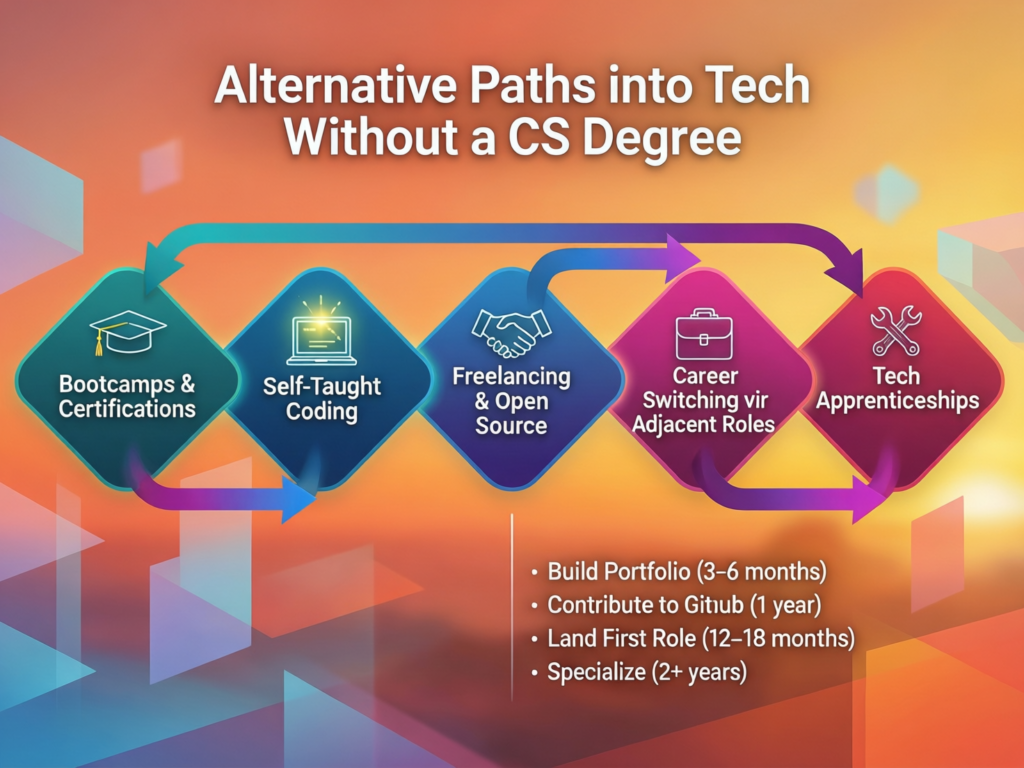
Coding Bootcamp vs Computer Science Degree (US/UK/Germany/EU)
Bootcamps shine when you want speed and job-focused training/
3–9 months of intensive learning.
Strong focus on employability: Git, agile, pair programming, job search support.
Employer networks in hubs like San Francisco, New York, Seattle, Austin, London and Berlin.
CS degrees shine when you care about:
Research, deep theory or long-term flexibility (e.g., switching between ML, security and systems).
Campus recruiting into FANG-style employers or large consulting firms.
A more “classic” academic path.
Regional nuance.
US
Major in-person bootcamps cluster around SF, NYC, Seattle and Austin; many now support hybrid/remote models.
UK
Government-backed digital skills bootcamps and apprenticeship schemes let you learn while working, often with employer co-funding.
Germany/EU
“Umschulung” and “Weiterbildung” programs, as well as employer-sponsored training, give career-changers structured paths into IT.
AEO micro-answer (bootcamp vs CS vs self-taught)
Choose a CS degree if you want long-term academic depth, easier research routes and big-tech new-grad pipelines.
Choose a bootcamp if you want to switch careers fast and are ready for a 3–9 month sprint focused on job-ready skills.
Choose self-taught if you need full flexibility on time and budget and are disciplined enough to design your own curriculum and portfolio.
Apprenticeships, Part-Time Study & Career-Change Programs
If you’re nervous about all-in bets, hybrids reduce risk.
UK
Software engineering apprenticeships and degree apprenticeships let you work while studying, often with London or Manchester-based employers. NHS-linked healthtech and Open Banking fintechs frequently use these routes to grow talent.
Germany
Dual study (“Duales Studium”) programs combine university with on-the-job experience; many larger Mittelstand firms in Munich, Hamburg and Frankfurt support these.
US/EU
Part-time CS or IT degrees, online universities, and conversion masters (e.g., MSc Computer Science for non-CS grads) let you keep earning while reskilling.
These mixed paths let you earn while you learn, avoid full-time tuition and still collect formal credentials that help with visas and senior roles later.
Skills Over Degrees.
The biggest shift of the last few years is simple: skills-based hiring is no longer just a buzzword.
Skills-Based Hiring in US, UK, Germany & Europe
Many employers say they’re moving beyond degree filters and a growing number actually are. Surveys suggest that roughly 70–80% of employers globally experimented with skills-based hiring by 2023–2024, up from around 55–60% in 2022.
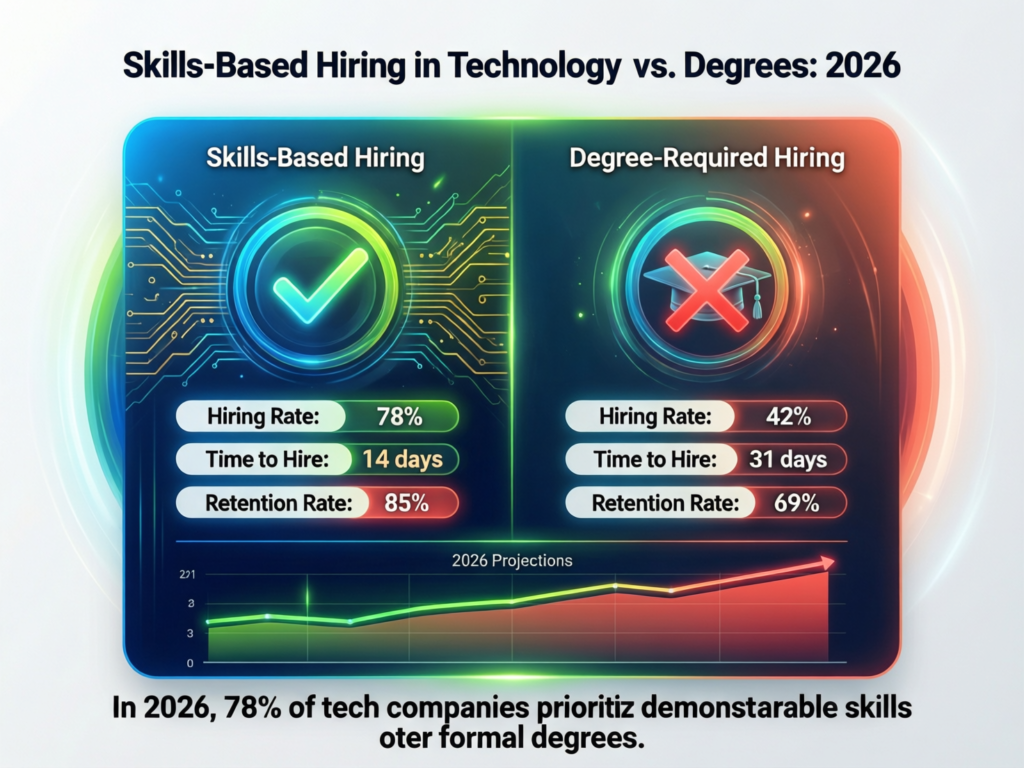
In practice.
US
High-growth startups and many large tech companies (including Google and IBM) have removed formal degree requirements for some roles and use skills assessments instead.(Business Insider)
UK
London tech employers and consultancies are under pressure to fill roles despite tighter immigration rules, making them more open to non-traditional candidates with strong portfolios.
Germany/EU
Chronic Fachkräftemangel (skilled worker shortages) in IT means many companies now prioritize experience, certifications and language skills over formal degrees. In 2023, hundreds of thousands of skilled positions across Germany remained unfilled.E
What Hiring Managers Actually Look For Instead of a CS Degree
When employers say “degree or equivalent experience”, they usually mean.
Strong portfolio
GitHub repos, live demos, case studies that clearly explain your role, stack and impact.
Evidence of fundamentals
Comfort with data structures and algorithms (shown via interview performance, LeetCode-style prep, or bootcamp curricula).
Practical experience
Internships, freelancing, open-source contributions, hackathons, internal tools at your current job.
Communication & collaboration
Ability to work asynchronously in distributed teams across time zones (e.g., US–Europe).
Security and compliance awareness
Basic understanding of GDPR/DSGVO, UK-GDPR, HIPAA, PCI DSS and SOC 2 if you’re touching user data or payments.
This is exactly how we evaluate candidates internally at Mak It Solutions when we scale project teams for web or mobile engagements: your ability to own features and communicate clearly beats a line on your degree certificate.
How AI Tools Are Changing Entry-Level Tech Jobs
AI has changed the junior job landscape in three big ways.
Fewer pure “copy-paste” roles
Many simple bug-fixing or CRUD-only positions are shrinking as AI handles boilerplate code and basic refactors. Some estimates show entry-level roles in certain markets (including parts of the UK) dropping by around a third since late 2022.
Higher expectations for juniors
New hires in the US, UK and EU are increasingly expected to own small features end-to-end, from implementation to tests, documentation and basic observability.
AI collaboration is a core skill
Knowing how to prompt tools like ChatGPT or GitHub Copilot, validate suggestions, write tests and keep security in mind is now part of being job-ready not a cheat.
The upside: if you’re self-taught and already using AI to learn faster, you can be more competitive, not less, as long as you actually understand the code you ship.
Getting Hired Without a Degree.
Let’s get practical. Here’s how to approach the job market region by region.
Remote Tech Jobs and No-Degree SWE Roles
In the US, focus your search on:
Remote-friendly startups and scale-ups.
Many care more about shipping speed than pedigree.
Filters and keywords.
Search for “no degree required”, “equivalent experience” and “self-taught welcome” on job boards.
Sectors
Fintech (PCI DSS/Open Banking integrations)
Healthtech (HIPAA, HHS guidance)
Cloud/SaaS (AWS/Azure/GCP, SOC 2 expectations)
Companies like Google and IBM have publicly dropped degree requirements for some roles, and countless startups in Austin, Seattle and SF already hire self-taught engineers.
Back this up with a portfolio that looks like the systems these companies actually run think dashboards, SaaS features and cloud-native APIs, not just to-do apps.
United Kingdom: London Tech Jobs & Apprenticeships Without a Degree
In the UK, focus on.
London and regional hubs
London, Manchester and Birmingham all have strong demand for developers and data professionals.
Apprenticeships & digital skills bootcamps
Government-backed schemes allow you to train as a software engineer or data analyst while earning.
Keywords
Search for “junior developer no degree”, “apprentice software engineer”, “trainee developer UK”.
NHS-linked healthtech, London fintechs built on UK Open Banking APIs and digital consultancies all hire non-traditional candidates, particularly when they show an understanding of UK-GDPR and security basics.
Germany & Wider EU.
In Germany and the EU, Fachkräftemangel is your friend.
Many employers in Berlin, Munich, Hamburg and Frankfurt will hire IT specialists without an “Informatikstudium” if you have strong experience, relevant certifications and at least conversational German or excellent English.
Visa and Blue Card routes increasingly allow IT specialists with 3+ years of relevant experience to qualify without a degree, as long as salary thresholds are met.(Make It in Germany)
EU hubs like Amsterdam, Dublin and Paris also rely heavily on international tech talent, and many companies there already use skills-based hiring for developer and DevOps roles.
In regulated sectors, like BaFin-supervised fintechs or GDPR-heavy analytics tools, employers look for trust and compliance awareness as much as degrees. This is where building projects that show correct data handling or partnering with experienced teams like Mak It Solutions’ BI and data services can be a differentiator.
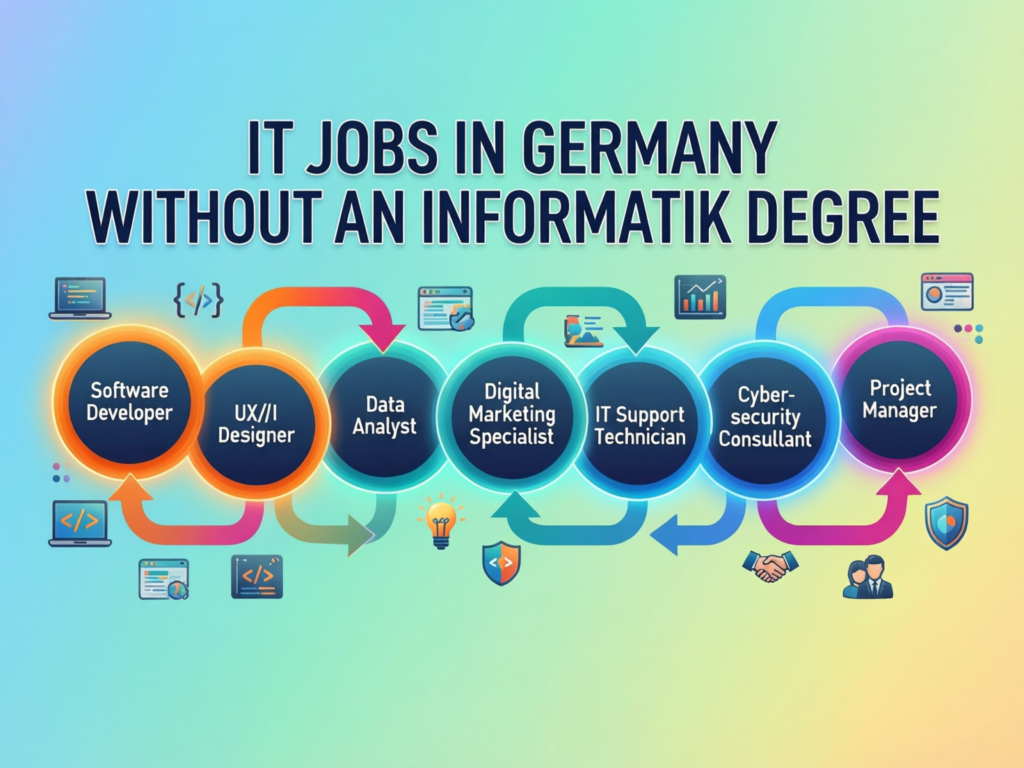
Practical Roadmap If You Don’t Have a Computer Science Degree
Here’s a concrete, 10-step action plan you can follow over 6–18 months.
Choose a Path and Build Core Skills
Choose your lane
Decide whether you’re aiming for frontend, backend, full-stack, data, DevOps, product or QA. It’s easier to start focused and then broaden out.
Follow a 3–6 month learning plan
Use a structured path: a bootcamp, a curated MOOC list, or a mix of vendor and community courses. For web work, learn HTML/CSS, JavaScript/TypeScript and at least one modern framework (e.g., React/Next.js). Guides like our piece on SSR vs Static Generation can help you understand real-world architecture decisions.
Learn fundamentals
Cover basic algorithms, data structures, HTTP, REST, SQL/NoSQL and cloud basics (AWS/Azure/GCP). You don’t need a full CS curriculum but you do need enough to not be lost in interviews.
Build a Portfolio, Credentials and Social Proof
Create 3–5 portfolio projects
Prioritize projects that map to US/UK/EU market needs (e-commerce, SaaS dashboards, internal tools, data pipelines). Host them on GitHub and deploy to production.
Add relevant certifications
Cloud certs (AWS/Azure/GCP), basic security or compliance courses (GDPR, HIPAA awareness, PCI basics) and vendor badges can signal seriousness especially in Germany/EU.
Build social proof
Contribute to open-source.
Write blog posts (you can even host them on a simple WordPress/Webflow site).
Speak at meetups or online events.
Be active on LinkedIn with short, technical posts.
Apply Smartly to US, UK, German & Remote Roles
Tailor your CV by region
US: concise resume, impact bullets, tech stack.
UK: CV with responsibilities, achievements and clean formatting.
Germany/EU: clear job titles, dates, technologies and languages; mention any certificates clearly.
Use the right job boards and filters
Search for “no degree required”, “equivalent experience”, “career change”, “junior developer”, “graduate software engineer” plus city names like London, Berlin, Dublin, Austin, NYC.
Network deliberately
Join local meetups in London, Manchester, Berlin, Munich, Paris, Amsterdam and remote-friendly Slack/Discord communities. Many hires never hit public job boards.
Track and iterate
Track applications, interviews and feedback. If you’re getting screening interviews but failing on systems questions, study fundamentals. If you’re not getting interviews, refine your portfolio and positioning — or consider professional help from agencies or partners like Mak It Solutions who understand how hiring managers think.
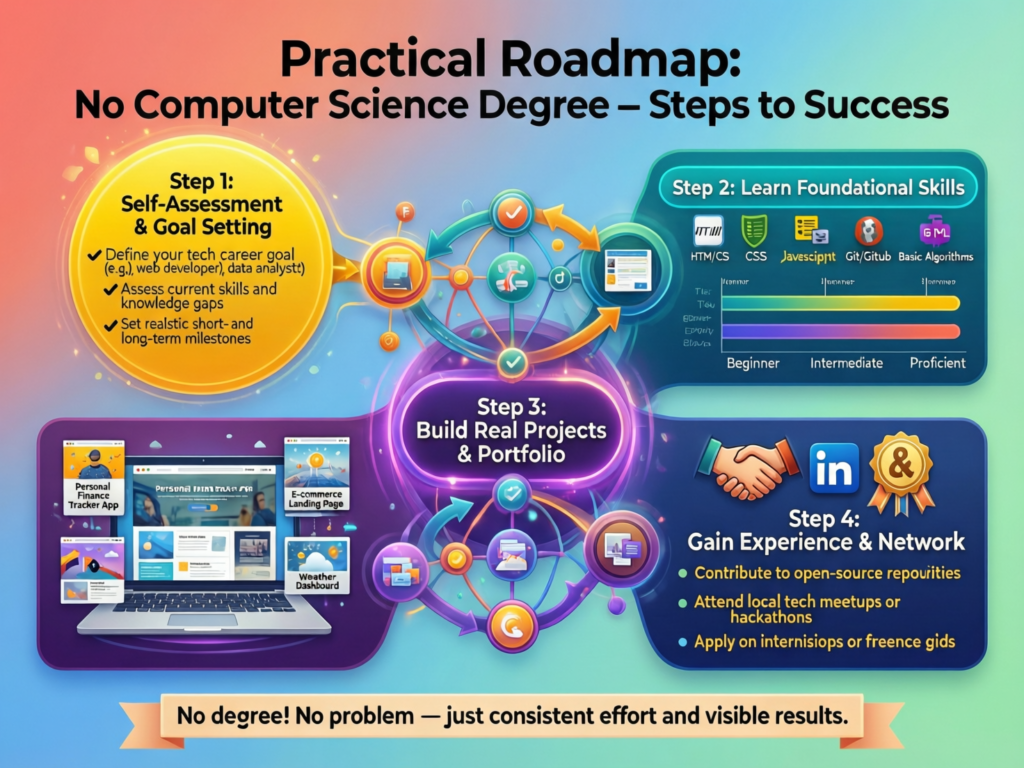
Concluding Remarks
You probably don’t need CS if…
You’re aiming for frontend, product, QA, many data roles or DevOps; you can commit to 6–18 months of focused learning; and you’re happy to start at a small company or startup.
You might want CS if…
You care about research, advanced ML, low-latency trading, OS/compilers, or long-term academic options; or you know you’ll rely heavily on visas like H-1B or traditional EU Blue Card routes.
You can choose a hybrid if…
You prefer earning while learning, want employer sponsorship or need to balance family/financial obligations with part-time degrees, apprenticeships or conversion masters.
Final Advice for US, UK, Germany & EU Readers
There is no single “correct” path only the path that fits your goals, time, finances and risk tolerance. In 2026, employers in the US, UK, Germany and across Europe are more open than ever to non-traditional candidates, but the bar for skills continues to rise.
If you don’t have a computer science degree to work in tech, treat that not as a defect but as a constraint to design around. Build the right skills, choose the right projects, and be intentional about where and how you apply.
Key Takeaways
You do not strictly need a computer science degree to work in tech in the US, UK, Germany or EU, especially for frontend, product, QA, data and many DevOps roles.
CS degrees still help for specialized engineering, some big-tech tracks and visa mobility (H-1B, certain EU Blue Card scenarios).
Employers are rapidly adopting skills-based hiring, but you must back it up with a strong portfolio, fundamentals and communication skills.
Alternative routes self-taught, bootcamps, apprenticeships and hybrid study can deliver faster ROI if you’re focused.
Region-specific tactics (US remote roles, UK apprenticeships, Germany/EU IT specialist visas) can significantly improve your odds.
A clear 10-step roadmap (skills → projects → credentials → targeted applications) matters more than the letters on your degree.
If you’re planning a no-degree path into tech and want your portfolio, architecture choices and data workflows to look “enterprise-ready”, you don’t have to figure it out alone.
Mak It Solutions works with startups and enterprises across the USA, UK, Germany and Europe on real-world web, SaaS, mobile and analytics projects. Explore our services, and if you’d like guidance on what to learn or build next, reach out via our contact page for a friendly, no-pressure conversation.
FAQs
Q : Can I switch into software engineering in my 30s without a computer science degree?
A : Yes. Many engineers in the US, UK, Germany and EU switch into software in their 30s or even 40s with no CS degree. What matters is whether you can show recent, relevant skills and a portfolio of projects that look like real work ideally built with modern stacks, cloud platforms and good security hygiene. If you’re patient, consistent and realistic about starting at junior or mid-level roles, age becomes far less important than your ability to deliver.
Q : Do big tech companies like Google or Apple actually hire self-taught developers?
A : They do, but competition is intense. Companies like Google, Apple, Microsoft and IBM have all hired self-taught engineers and have relaxed degree requirements for some roles, especially when candidates have strong portfolios, open-source contributions and excellent interview performance. However, many of their new-grad programs still lean towards candidates with CS or related degrees, so as a self-taught developer you’ll usually have better odds targeting experienced-hire, startup or partner roles first.
Q : Is it harder to get into data science or machine learning without a CS degree?
A : Generally, yes but it’s not impossible. Data science and ML roles in Europe and North America often expect strong math, statistics and programming backgrounds, which many CS or STEM degrees provide. As a non-CS candidate, you’ll need to compensate with focused learning (ML/DS courses, linear algebra, probability), hands-on projects (end-to-end ML pipelines, real datasets) and possibly a conversion master’s or specialized bootcamp. Many data-adjacent roles analytics engineering, BI development, data platform work are more accessible and can be stepping stones into full data science.
Q : What counts as “equivalent experience” when job ads say a degree is optional?
A : “Equivalent experience” usually means several years of doing comparable work at a professional level. For software and data roles, that can mean 2–5+ years of full-time development, a mix of freelance and salaried roles, plus a portfolio that clearly shows your impact. Certifications, significant open-source contributions and strong references can also support your case. For visas like the EU Blue Card and Germany’s IT specialist routes, countries sometimes explicitly define this as three or more years of relevant experience at a level comparable to a university degree.
Q : How can I prove my coding skills to employers if I’ve never worked in tech before?
A : If you’re pre-experience, your portfolio is your proof. Build 3–5 substantial projects, host them on GitHub, write clear READMEs, and deploy at least some of them so hiring managers can click around. Add automated tests, simple observability (logs/metrics), and short case studies describing the problem, your decisions and trade-offs. Participating in hackathons, contributing to open-source, earning cloud or security certifications, and writing technical blog posts all add credibility especially if you can walk through them confidently in an interview.