

Quantum Computing for Business: How to Get Ready
Quantum Computing for Business: How to Get Ready

Quantum Computing for Business: How to Get Ready
Quantum computing for business has moved from sci-fi slides to real board conversations in 2025. Between optimistic vendor roadmaps and firm government warnings, CIOs and CISOs in the US, UK, Germany and across the EU are wrestling with a simple question: do we move now, or wait until the tech matures?
The honest answer: you can’t afford to wait on security and data, even if you’re still exploring use cases. The smart move is to treat quantum as a gradual shift—tighten your cryptography, protect long-lived data, and start small, focused pilots so you’re ready when sector-specific quantum advantage arrives.
Quantum computing for business means using quantum processors alongside classical cloud and IT systems to tackle complex optimization, simulation and machine-learning problems that are currently too slow or expensive. To get quantum-ready before 2030, enterprises should assess cryptographic and data risks, plan and fund a post-quantum cryptography (PQC) migration, build internal awareness, and run small pilots with trusted partners instead of waiting for a single “Q-day” moment.
What Is Quantum Computing for Business Decision-Makers in 2025?
For business leaders in 2025, quantum computing is best understood as a specialized accelerator that sits next to your cloud and high-performance computing stack not a replacement for it. Done well, it stretches what’s possible in optimization, simulation and AI without forcing you to rip out existing systems.
Plain-Language Definition for Executives
Quantum computing for business decision-makers is the use of qubits, which can exist in multiple states at once (superposition) and be linked together (entanglement), to explore many possible solutions in parallel. That’s what makes quantum especially promising for route optimization, portfolio construction, molecular simulation and certain machine-learning workloads.
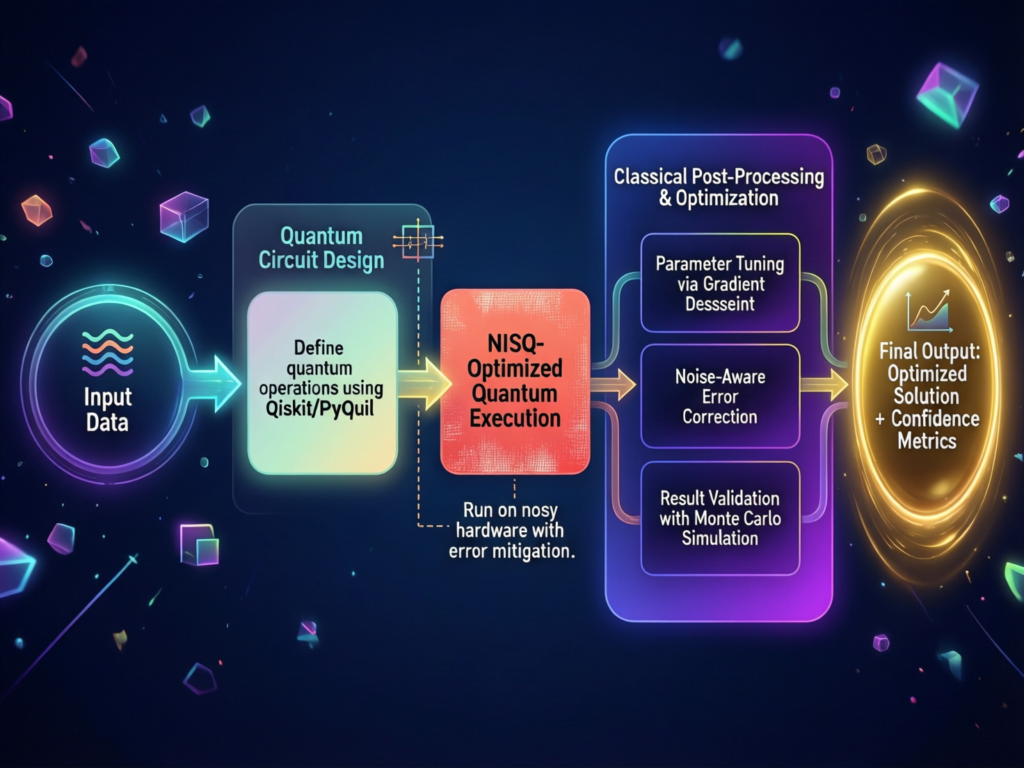
The key point for executives: enterprise quantum workloads will run as hybrid quantum-classical workflows, orchestrated from your existing cloud and data platforms. Even in IBM’s latest roadmaps, quantum systems are positioned as specialized co-processors integrated into classical environments, not stand-alone replacements.
From NISQ Era to Quantum Advantage
Today we are in the NISQ era (noisy intermediate-scale quantum), where machines have tens to low thousands of qubits, but they’re error-prone and hard to scale. In practical terms, that means carefully chosen pilots are possible now, but you should not expect immediate, universal “speedups” across your IT portfolio.
Quantum advantage is reached when a quantum system delivers a clear, repeatable benefit over the best classical alternative for a meaningful real-world task—such as better risk-adjusted performance in a trading strategy, or significantly more accurate logistics planning. Recent roadmaps from IBM suggest useful, advantage-level applications in specific sectors within a few years, with broader transformation emerging into the 2030s.
For a CIO in New York or London, the right mindset is: act as if advantage may arrive faster than expected, but invest in learning and resilience rather than betting on a precise date.
High-Value Quantum Computing Business Applications by Sector
Most experts expect early enterprise quantum advantage in a few domains.
Finance portfolio and asset-liability optimization, risk modeling, Monte Carlo simulations, option pricing and fraud detection in complex transaction networks.
Logistics & supply chain vehicle routing, warehouse slotting, multi-echelon inventory optimization and network resilience scenarios for retailers and manufacturers.
Healthcare & pharma molecular simulation for drug discovery, protein folding, trial cohort optimization and, longer-term, elements of personalized medicine.
If you operate a bank in London, an insurer supervised by BaFin in Frankfurt, or a healthcare provider handling NHS-linked patient pathways, these are exactly the domains where early pilots can support your existing strategy rather than sit in a lab.
What Does It Mean for a Company to Be “Quantum-Ready”?
Being quantum-ready in 2025 doesn’t mean owning a quantum computer; it means your organization can respond quickly and safely as quantum capabilities mature. That includes your security posture, your data assets and your innovation pipeline.
Working Definition of Quantum Readiness
Quantum readiness is the combination of awareness, risk assessment, prioritized use cases, talent and partnerships, and crypto-agility across your estate. A quantum-ready enterprise understands which data and systems are at risk from future quantum attacks, has started migrating to quantum-safe encryption, and is running or planning targeted pilots often via cloud-based quantum services rather than taking a wait-and-see stance.
You can think in three simple levels, inspired by Palo Alto Networks.
Quantum curious tracking the topic, maybe a small lab experiment, but no formal roadmap.
Quantum-ready structured assessments, crypto-agility, PQC pilots and governance in place.
Quantum-leading funded portfolio of pilots, executive sponsorship and measurable KPIs tied to quantum value.
The Five Pillars of Quantum Readiness for Business
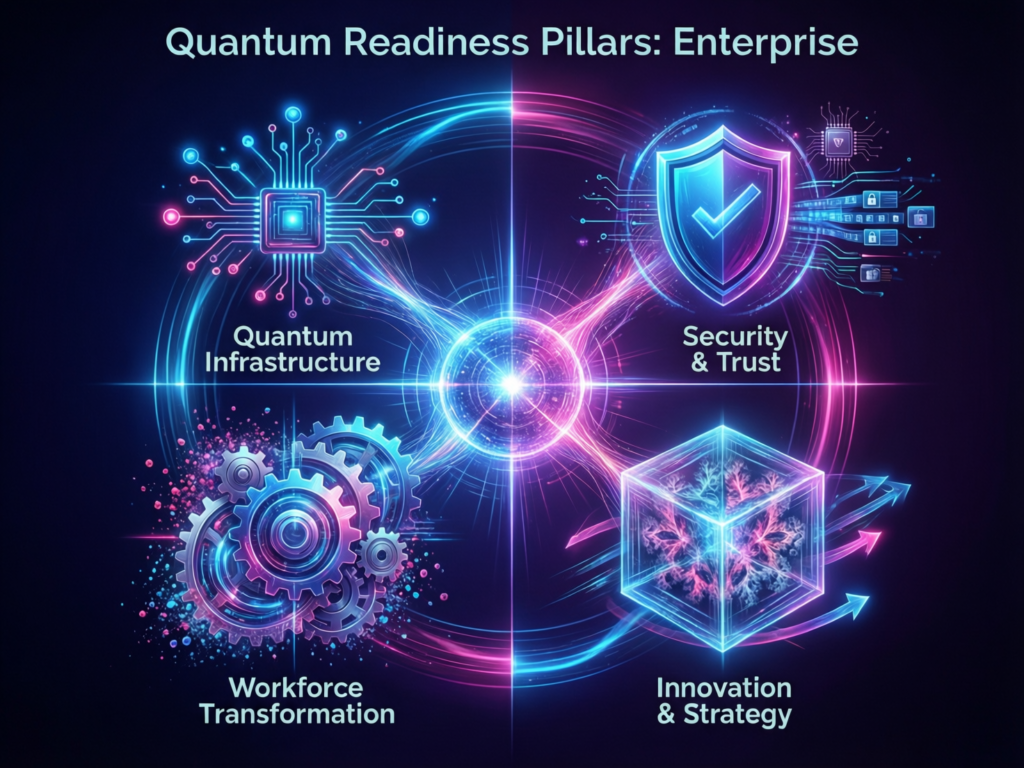
A practical maturity model for quantum readiness can be organized into five pillars.
Governance & Risk clear ownership at board and executive level (CIO, CISO, Chief Risk Officer), with reporting on quantum risk and opportunity.
Security & Cryptography inventory of cryptographic assets, crypto-agility patterns and a roadmap for quantum-safe encryption and key management.
Data & Workloads mapping of long-lived, high-value data and candidate optimization/simulation workloads.
Technology & Cloud ability to consume NISQ-era services via public cloud, API gateways and existing DevOps pipelines.
Talent & Ecosystem upskilling architects and security engineers, while partnering with specialized consultancies and cloud providers.
Each pillar will usually be led by different internal owners CISO for cryptography, CIO/CTO for workloads and cloud, and line-of-business leaders for use-case prioritization.
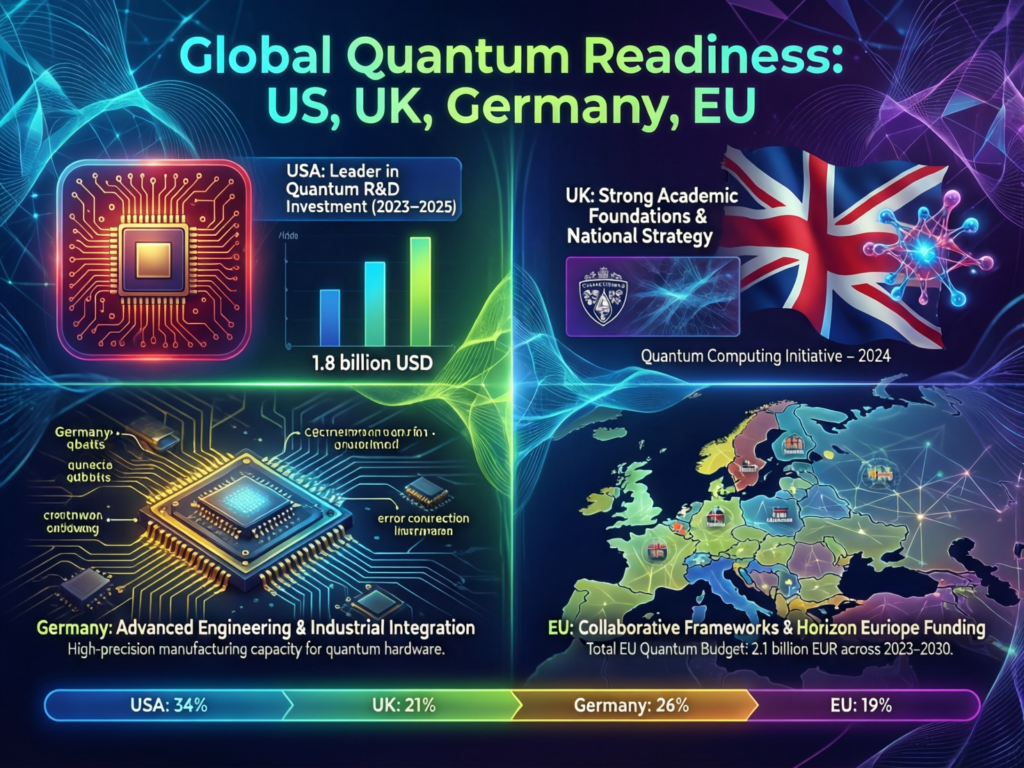
Quantum Readiness in Practice US, UK, Germany, EU Benchmarks
Recent quantum readiness index research from IBM Institute for Business Value shows that many enterprises expect quantum to materially affect their industry before 2030, yet only a minority report mature quantum-safe security programs.In some sectors, quantum now accounts for roughly 10 15% of advanced R&D budgets up from low single-digit percentages just a few years ago.
At a regional level.
United States more vendor-led, with early pilots anchored in major cloud ecosystems and federal guidance from the National Institute of Standards and Technology (NIST).
United Kingdom strong public investment and guidance from the National Cyber Security Centre (NCSC), especially around PQC timelines.
Germany and the wider European Union driven by industrial champions (automotive, manufacturing) and regulatory programs like NIS2 and DORA, with supervisors such as BaFin increasingly aware of quantum-related operational risk.
For US, UK, German and wider EU enterprises, “getting quantum-ready” in 2025 is less about buying hardware and more about security, data governance, pilots and talent.
Why Businesses Must Start Preparing Before 2030
The biggest reason to start now is simple: data you encrypt today may need to stay confidential well past 2035, but attackers can already copy it. Waiting until a large-scale machine exists is too late.
The “Harvest-Now, Decrypt-Later” Quantum Threat
The “harvest-now, decrypt-later” (HNDL) threat describes attackers intercepting and storing encrypted traffic today with the aim of decrypting it later once cryptographically relevant quantum computers (CRQCs) exist.
This is especially serious for long-lived data such as.
health records from a New York hospital group or NHS trust
financial histories and trading archives
government, defense and critical-infrastructure telemetry
Recent academic work shows that HNDL creates a temporal cybersecurity risk: even if CRQCs only arrive in the 2030s, data exfiltrated in the mid-2020s could become readable at that point.
Why 2025–2030 Is the Planning Window
Guidance from bodies like the NCSC and NIST is converging on a clear message: organizations should complete discovery and planning this decade to avoid a rushed, fragile migration later. (NCSC)
Typical high-level milestones look like.
By ~2028 have a cryptographic inventory and understand where quantum-vulnerable algorithms (like RSA and ECC) are used.
By ~2030–2032 pilot and begin rolling out PQC in high-value, long-lived systems, aligned with regulations like NIS2 and DORA for EU operators.
By ~2035 aim to complete migrations for the most sensitive environments.
Given the lead times for vendor coordination, compliance approvals and core-system changes especially in regulated sectors—2025–2030 is exactly the planning and pilot window for banks, insurers, critical-infrastructure operators and public bodies.
Why Quantum Matters Most for Security-Sensitive Industries
Quantum risk is concentrated in sectors with highly sensitive, long-lived data and strict regulation.
Finance cross-border payments, interbank messaging and trading systems often have 10–20-year confidentiality requirements and fall under NIS2, DORA and local rules (e.g., BaFin circulars)
Healthcare medical records in systems connected to the NHS or large hospital chains need to stay private for the life of a patient.
Government & critical infrastructure communications, control systems and citizen data have long retention periods and can be attractive HNDL targets.
At the same time, these industries may be early winners of quantum computing for business, with optimization and simulation use cases that directly impact cost, resilience and outcomes.
Quantum Cybersecurity and Post-Quantum Cryptography for Enterprises
If you remember one concrete action from this article, make it this: start your post-quantum cryptography program.
What Is Post-Quantum Cryptography for Businesses?
Post-quantum cryptography (PQC) refers to new families of public-key algorithms designed to resist attacks from quantum computers, standardized so they can replace today’s RSA/ECC-based schemes. In 2024, NIST finalized three Federal Information Processing Standards FIPS 203, 204 and 205 covering key encapsulation and digital signatures that are believed to be secure against quantum adversaries.
For enterprises, the crucial detail is that PQC runs on classical hardware and software stacks. You don’t need a quantum computer; you need to integrate these algorithms into existing protocols, libraries, HSMs and applications, much like any other major crypto upgrade. Guidance from organizations such as the Cloud Security Alliance and Cloudflare emphasizes hybrid deployments that combine classical and PQC mechanisms during the transition.
Building a Quantum-Safe Encryption Migration Roadmap
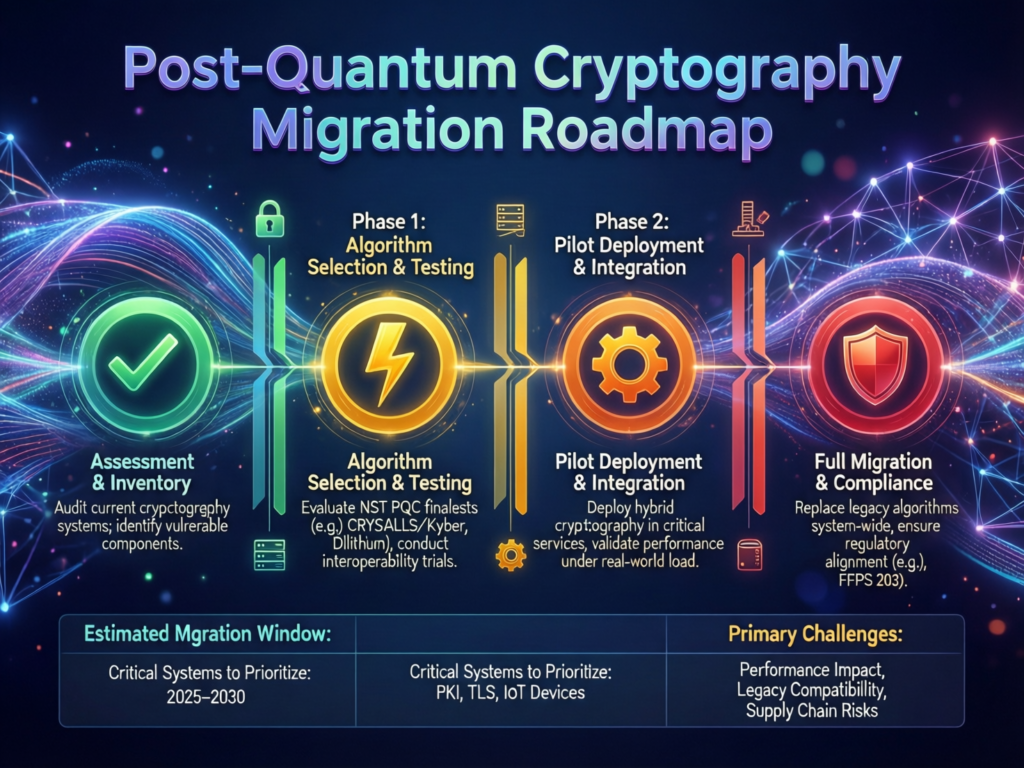
How should CISOs and CTOs plan a phased roadmap for migrating to quantum-safe encryption? A workable pattern for large US, UK, German and EU enterprises is a five-phase approach.
Discovery inventory where and how cryptography is used: TLS endpoints, VPNs, databases, messaging, mobile apps, IoT, vendor products and embedded systems.
Risk triage prioritize long-lived and high-impact systems, such as core banking, electronic health records, or cross-border data exchanges between London and Berlin.
Crypto-agility design refactor architectures so algorithms and key sizes can be swapped without rewriting entire systems; support “dual-stack” (classical + PQC) modes where possible.
Pilot PQC test NIST-selected algorithms in non-critical or internal flows, measure performance impact and ensure interoperability with partners.
Scale & compliance roll out to critical services in line with regulations (NIS2, DORA, GDPR/DSGVO, UK-GDPR, HIPAA, PCI DSS, SOC 2) and sector guidance.
Many enterprises now treat quantum-safe programs as a board-level risk-reduction initiative, not just an IT upgrade. Recent surveys show a growing share of security leaders reporting that quantum-safe migration is either funded or under active planning, even though full implementations remain rare.
Governance, Compliance and Board Reporting
Boards should view PQC migration as an investment in resilience, trust and regulatory readiness, not a purely defensive cost. Reporting should connect quantum-safe workstreams directly to obligations under frameworks like GDPR/DSGVO, UK-GDPR, HIPAA (for US health sectors), PCI DSS (for payments) and operational-resilience standards.
For example, a bank headquartered in Berlin may need to demonstrate to BaFin and EU supervisors that it has assessed quantum risk to payment and trading platforms and is aligned with NIS2 and DORA expectations. In the US, regulators and agencies increasingly signal that quantum-safe transitions should be underway well before 2030.
How to Run a Quantum Readiness Assessment in the US, UK, Germany and Wider Europe
A quantum readiness assessment gives you a structured answer to the question, “Where are we today, and how should we prioritize?” It’s also the foundation for answering board queries like “how should US enterprises prepare for quantum computing in 2025?”
Step-by-Step Quantum Readiness Assessment Checklist
To run a quantum readiness assessment across US, UK, German and wider European operations, follow this practical checklist.
Scope critical assets identify high-value systems and data (payments, trading, EHRs, control systems, crown-jewel IP).
Map regulatory exposure note where NIS2, DORA, GDPR/DSGVO, UK-GDPR, HIPAA, PCI DSS or sector guidance apply.
Audit cryptography catalogue protocols and libraries, focusing on RSA/ECC usage and long-lived keys or certificates.
Evaluate vendor dependencies check which cloud, SaaS and infrastructure vendors have published quantum-safe roadmaps.
Rate internal skills assess whether your architects, security engineers and data teams understand NISQ-era quantum computing and PQC basics.
Shortlist use cases identify 2–4 realistic optimization or simulation pilots per business unit.
Many organizations start with a workshop-style engagement, delivering a one-page heatmap and a 12 24-month action plan.
GEO-Specific Considerations US vs UK vs Germany vs EU
Geo-specific factors will shape your assessment and roadmap: (NIST)
United States
PQC standards are issued by NIST, and federal agencies are moving toward mandated timelines. Sector regulators in finance and healthcare may reference these standards in future guidance.
United Kingdom
The NCSC provides detailed recommendations on crypto-agility and PQC migration, with particular emphasis on critical infrastructure and public-sector networks.
Germany & European Union
Industrial and financial hubs like Berlin, Munich and Frankfurt operate within an EU-wide framework (GDPR, NIS2, DORA). National bodies such as BaFin will expect banks and insurers to track quantum risk as part of digital operational resilience.
For multinational groups, it’s usually easiest to adopt the strictest applicable posture (often EU-aligned) and apply it globally, rather than maintaining divergent standards.
When to Bring in Quantum Strategy & Cybersecurity Partners
You should consider external partners when.
You operate in multiple jurisdictions (e.g., US, UK, EU) with overlapping but different regulations.
You manage large legacy estates (mainframes, custom cryptographic implementations, older HSMs).
You have cross-border data flows between centers like New York, London and Berlin that need consistent quantum-safe policies.
Independent readiness assessments, sector benchmarks and co-innovation pilots (for example, with a cloud provider’s quantum lab) can dramatically accelerate learning and de-risk early projects.
Specialist consultancies such as Mak It Solutions can connect this strategy work with practical delivery across web, data analytics and mobile platforms for US, UK, German and EU clients, drawing on their [services portfolio] and experience with [unstructured data analytics for US, UK and EU enterprises].
From Roadmap to ROI Building Quantum-Enabled Use Cases and Partnerships
Once your risk and PQC foundations are in place, the exciting question is: where does quantum create real business value first?
Prioritizing Quantum Computing Business Use Cases with Real ROI
Start by aligning quantum computing for business pilots with pain points you already measure: cost per route, VaR metrics, R&D cycle times, energy usage. Candidates include:
Optimization workloads portfolio optimization, transport routing, production planning.
Risk scenarios faster Monte Carlo simulations for stress testing.
R&D simulations chemistry, materials and process design in manufacturing. (IBM)
In the NISQ era, the most realistic pattern is hybrid quantum-classical workflows: quantum circuits handle small but complex sub-problems, while classical systems manage data pre-processing, orchestration and post-processing. This is how many cloud-based quantum services expose their APIs today.
Cloud, Ecosystem and Vendor Choices for Quantum Computing for Business
Most organizations will first access quantum capabilities through cloud platforms and ecosystem labs rather than buying hardware. When evaluating providers, your checklist should include.
Data residency & compliance can workloads remain in US, UK or EU regions that meet your GDPR and sectoral obligations?
Integration with DevOps support for your existing CI/CD, observability and incident-management tools.
Security posture roadmaps for PQC support, HSM integration and secure connectivity (for example, providers already using hybrid PQC key agreements in TLS connections).
Ecosystem & references case studies in your sector, access to research partners and training programs.
Some infrastructure leaders, such as Cloudflare, are already rolling out post-quantum key agreements across huge volumes of internet traffic, demonstrating that at-scale PQC is practical well before general-purpose CRQCs arrive.
Launching Your Quantum Readiness Program
From here, a realistic action plan for a US, UK, German or EU enterprise looks like:
Assess run a quantum readiness assessment, focusing on long-lived data and regulatory exposure.
Secure launch your PQC and crypto-agility roadmap, anchored in NIST and NCSC guidance.
Experiment identify a small number of high-value NISQ-era pilots using cloud-based quantum and hybrid workflows.
Scale build repeatable patterns, governance and reporting so quantum becomes part of your broader digital-transformation journey.
Mak It Solutions can help you connect strategy to execution bridging quantum-safe security, web development services, business intelligence services and mobile app development services across the US, UK, Germany and the wider EU. If you’re unsure where to begin, you can always for a focused discovery conversation.
Note
Nothing in this article is financial, investment or legal advice. Always consult qualified advisers and your own risk and compliance teams before making decisions.
Key Takeaways
Quantum computing for business is real but incremental expect sector-specific advantage in optimization, simulation and ML, not a single global “flip.”
Quantum readiness is broader than hardware it spans governance, cryptography, data, cloud platforms and ecosystem partnerships.
HNDL makes 2025–2030 critical long-lived data encrypted today may be exposed by future CRQCs, so PQC planning can’t wait.
PQC runs on classical systems NIST-standardized algorithms (FIPS 203/204/205) can be piloted now via existing libraries and cloud providers.
Assessments are your starting point a structured quantum readiness assessment clarifies priorities across US, UK, German and EU operations.
ROI comes from targeted pilots focus early efforts on optimization, risk and R&D scenarios where hybrid quantum-classical workflows can prove value.
If you’re responsible for technology, security or risk in a US, UK, German or EU organization, now is the time to move from curiosity to readiness. Start with a focused quantum and PQC assessment, then build a pragmatic roadmap that protects long-lived data and seeds a handful of high-value pilots.
Mak It Solutions can work with your teams to design a quantum readiness program, connect it to your existing cloud and data projects, and help you brief your board with clear, non-hyped next steps drawing on experience fromand related work such as their quantum computing in the Middle East article.( Click Here’s )
FAQs
Q : How much budget should enterprises allocate to quantum readiness between 2025 and 2030?
A : Most enterprises don’t need a separate, massive “quantum line item” yet. Instead, fold quantum readiness into existing security, cloud and data programs, earmarking budget for cryptographic inventory, PQC pilots and one or two strategic use cases. Recent surveys suggest quantum already represents roughly 10–15% of advanced R&D budgets in some sectors, but most organizations can start with a low single-digit percentage of their security and innovation budgets and scale as clarity and regulation increase.
Q : Which industries are likely to see return on investment from quantum computing for business first?
A : Early ROI is most likely in finance, logistics and supply chain, and parts of healthcare and pharma. These industries combine complex optimization and simulation problems with strong data and regulatory drivers, making them ideal candidates for hybrid quantum-classical workflows. For example, a London bank optimizing intraday liquidity or a Berlin automotive supplier improving production schedules can both benefit from quantum-inspired optimization. As tools mature, energy, telecoms and advanced manufacturing in the US and EU are also expected to see value.
Q : What is the difference between quantum-safe encryption and post-quantum cryptography in practice?
A : In practice, post-quantum cryptography (PQC) refers to specific standardized algorithms, like those codified in NIST’s FIPS 203/204/205, that are designed to resist quantum attacks on public-key cryptography. Quantum-safe encryption is a broader term covering all measures that remain secure in a quantum future, including PQC, crypto-agility, key-management changes and, in some niches, quantum key distribution. For most enterprises, “going quantum-safe” primarily means integrating PQC into existing protocols, products and services while planning for future algorithm updates.
Q : Can SMEs in the US, UK and EU benefit from quantum computing, or is it only for large enterprises?
A : SMEs absolutely can benefit, but they will typically consume quantum indirectly via cloud platforms, SaaS tools and industry solutions, rather than building their own quantum teams. For example, a mid-sized US logistics firm might use a route-optimization SaaS that quietly adopts quantum-inspired algorithms, or a UK manufacturer might rely on a cloud chemistry engine enhanced with quantum solvers. The more urgent priority for SMEs is PQC readiness ensuring that their cloud providers, payment processors and security vendors have clear quantum-safe roadmaps and that contracts reflect those expectations.
Q : How do cloud platforms (e.g., AWS, Azure, Google Cloud) help businesses experiment with quantum computing safely?
A : Major cloud platforms offer managed access to NISQ-era devices and quantum simulators through SDKs and web consoles, often with built-in sample notebooks for optimization, ML and chemistry. This means you can prototype hybrid quantum-classical workflows without managing hardware or low-level control software. They also integrate quantum services with existing IAM, logging and policy controls, and several providers are piloting hybrid PQC key agreements to protect connections by default. For most US, UK and EU enterprises, this is the safest route to experiment: start small, keep data residency in compliant regions, and lean on your cloud provider’s PQC roadmap.
[…] Organizations reviewing this exposure can incorporate it into broader quantum-computing readiness planning. […]