
Smarter Enterprise Search in Arabic for GCC Teams
Smarter Enterprise Search in Arabic for GCC Teams
Smarter Enterprise Search in Arabic for GCC Teams
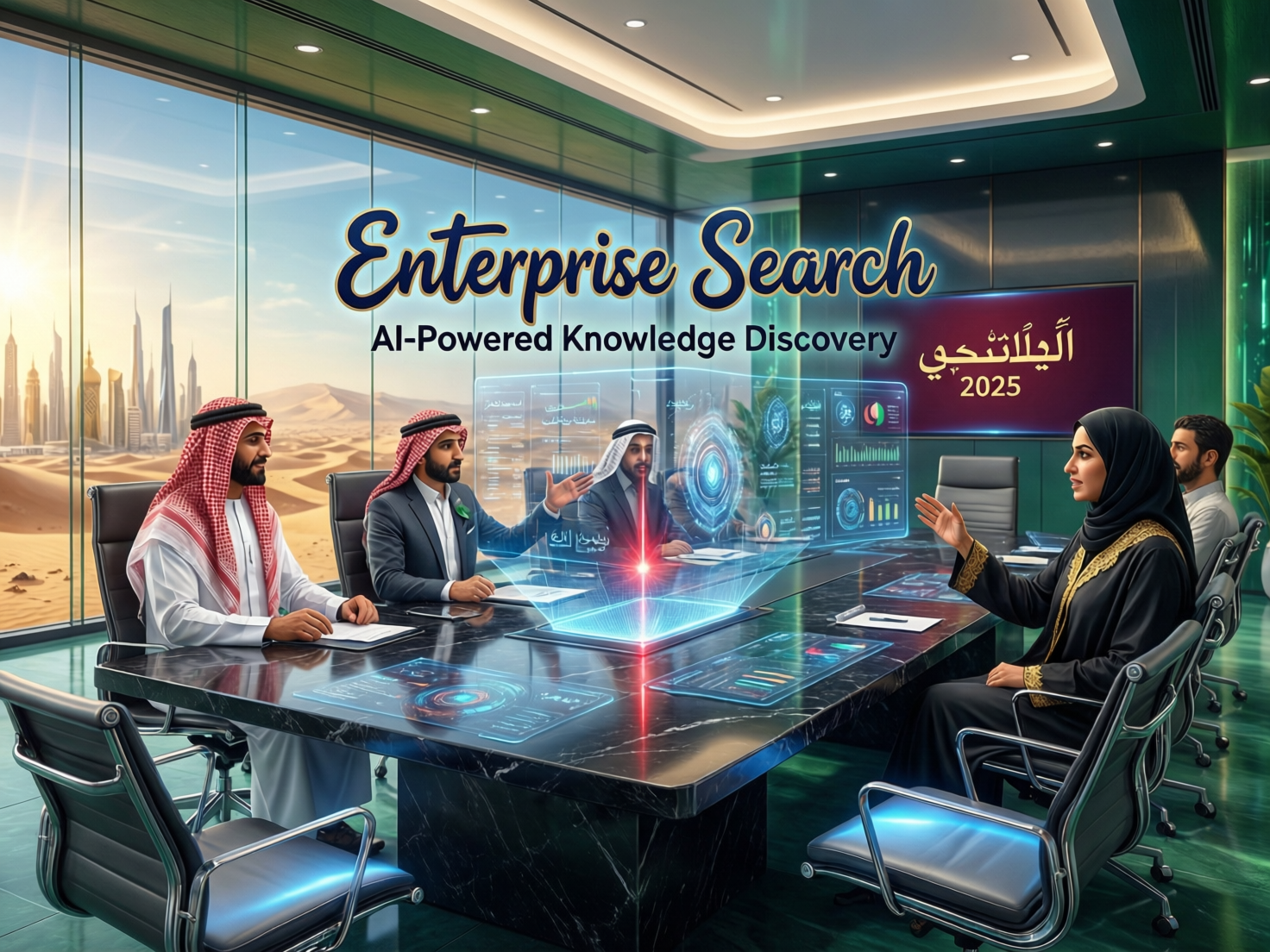
Enterprise search in Arabic is an AI-powered internal search layer that understands Arabic morphology, mixed Arabic English content, and internal PDFs so employees can ask questions in natural Arabic and get precise answers. For GCC organizations in Riyadh, Dubai, Abu Dhabi, Doha and beyond, it turns scattered Arabic policies, contracts, and emails into a secure, compliant knowledge base that respects Saudi, UAE, and Qatar data residency rules.
Introduction
Walk into a boardroom in Riyadh, Dubai, Abu Dhabi, Doha, Jeddah or any major GCC capital and you’ll hear the same question: why is it still so hard to find one specific Arabic policy or contract clause? Behind the scenes, teams are still scrolling through shared drives, WhatsApp screenshots, and old email threads.
Across Saudi Arabia, the United Arab Emirates, Qatar, Kuwait, Bahrain, and Oman, thousands of Arabic PDFs, scans, contracts, and circulars are buried in SharePoint, file servers, DMS, email, and ticketing tools. Generic search only does basic keyword matching; it cannot handle Arabic morphology, diacritics, or mixed Arabic English content.
Enterprise search in Arabic solves this by combining Arabic NLP for enterprise documents, connectors, and retrieval augmented generation (RAG) so staff can ask questions in Arabic and instantly get answers grounded in your internal content. This guide walks through architecture, tools, compliance, and deployment models so GCC CIOs can move from PoC slides to a production-grade, GCC-ready solution.
What Is Enterprise Search in Arabic?
Enterprise search in Arabic is an internal search and Q&A layer designed specifically for Arabic and mixed Arabic English content across your enterprise systems. Unlike “normal” search, it uses Arabic language models, embeddings, and RAG to understand meaning, not just exact keywords, while respecting your access controls and data residency rules.
From keyword search to Arabic AI search
Traditional keyword search simply matches exact words. For Arabic, this breaks quickly: the same root can appear with many prefixes and suffixes, different spellings, and optional diacritics. Mixed interfaces where employees search in Arabic but documents include English product names or legal terms make it even harder.
Modern Arabic AI enterprise search uses Arabic language models for enterprise plus embeddings to understand roots, synonyms, and morphology. A RAG layer then pulls the most relevant passages and generates an answer in Arabic, citing the underlying policy or contract instead of just dumping a document list.
How Arabic enterprise search is different from “normal” enterprise search
Arabic brings its own set of hard problems.
Arabic OCR for low-quality scans and stamps on PDFs from older ministries.
Right-to-left UX in portals and chatbots, especially when mixing Arabic with English names, IBANs, or product codes.
Mixed encodings and fonts in legacy systems used by Saudi ministries, UAE government portals, and Qatar banks.
A generic enterprise search tool that isn’t tuned for these realities will miss critical documents or rank them poorly. That’s why GCC organizations now look for knowledge base search in Arabic as a distinct capability.
Core components of modern Arabic enterprise search
A modern stack typically includes.
Connectors & indexing for SharePoint, file servers, DMS, email, and ticketing tools.
Arabic OCR and PDF text extraction for scans and legacy PDFs.
Arabic NLP & embeddings for semantic understanding across Arabic and English.
Vector database + BM25 hybrid search for precise and recall-friendly retrieval.
RAG layer to generate natural-language answers in Arabic grounded in your internal knowledge.
Relevance tuning & analytics so teams can improve results over time.
For many GCC organizations, this becomes the foundation for Arabic AI assistants across portals, intranets, and support desks.
Why GCC Organizations Need RAG for Arabic Internal Documents
Saudi and UAE companies increasingly need RAG for Arabic internal documents because keyword search simply cannot cope with long PDFs, mixed languages, and complex policy wording. Saudi-compliant Arabic RAG for internal documents lets staff ask questions in Arabic and receive concise, grounded answers instead of opening 20 PDFs and guessing.
Limits of legacy keyword search for Arabic policies and procedures
Think about HR policies, procurement manuals, and compliance circulars stored as Arabic PDFs across ministries in Riyadh, banks in Dubai, or logistics groups in Doha. Call centers and back-office teams manually search PDFs, scroll, take screenshots, and forward to colleagues. It’s slow, error-prone, and risky when regulations change.
Legacy keyword search.
Fails when employees search using different forms of an Arabic word.
Returns long documents instead of the specific answer.
Struggles with scanned circulars sent as images.

How Arabic RAG improves accuracy for PDFs, scans, and mixed-language files
With Arabic OCR and PDF text extraction, your system first converts scans into clean searchable text. Then, embeddings and hybrid search retrieve the most relevant passages across Arabic and English.
The retrieval + generation (RAG) layer answers the question say and responds in Arabic with a short answer plus links to the underlying policy. That answer is based only on your internal content, not the public internet.
Business impact for CIOs and Chief Data Officers in KSA, UAE, and Qatar
For CIOs and CDOs in Saudi Arabia, the UAE, and Qatar, RAG-based enterprise search in Arabic means:
Faster decisions for government and fintech teams handling new circulars.
Fewer compliance mistakes for banks, insurers, and telecoms responding to regulator queries.
Better employee self-service in HR, shared services, and e-commerce operations.
This is exactly the type of initiative highlighted in many GCC digital programs and in guides like Mak It Solutions’ own article on web development trends in the Middle East for KSA and UAE.
Architecture of Arabic RAG for Enterprise Search
High-level RAG architecture for Arabic PDFs and internal docs
A typical high-level design looks like this.
Data sources
SharePoint, file servers, DMS, email archives, ticketing tools, and internal portals across Riyadh, Dubai, and Doha.
Ingestion & normalization
Arabic text extraction, OCR, de-duplication, language detection, and access-control mapping.
Embedding & indexing
Break documents into chunks, generate embeddings, and store them in a vector database alongside classic indexes.
RAG runtime
On each query, combine vector and keyword retrieval, then send top passages to the Arabic language model to generate an answer.
If you already have modern portals built by partners like Mak It Solutions through their web development services, this architecture can be integrated rather than rebuilt from scratch.
Choosing Arabic embeddings, vector databases, and hybrid search
For GCC enterprises, key design choices include.
Arabic-focused language models (on-prem or in GCC cloud regions) for high quality on internal text.
Hybrid BM25 + vector search so exact legal phrases or product codes still rank correctly.
Vector DB placement: on-prem for central banks and regulators, or private GCC cloud for commercial entities.
The same thinking appears in Mak It Solutions’ guidance on server-side rendering vs static generation you mix approaches for performance and control.
Integrating Arabic enterprise search into portals, intranets, and chatbots
The real value emerges when you embed enterprise search in Arabic inside.
Employee portals (for HR and IT self-service)
Service desks and ITSM tools.
Internal Arabic AI assistants and chatbots.
For example, a Riyadh HQ with branches in Dubai, Abu Dhabi, Doha, Kuwait City, Manama, and Muscat can present a single Arabic chatbot that respects each user’s role and location while answering from local policies and procedures.
Implementation & Tools for Enterprise Search in Arabic
Evaluating Arabic AI enterprise search tools vs building in-house
CIOs in Saudi Arabia and the UAE often compare.
Microsoft ecosystem (SharePoint, Azure Cognitive Search, M365 Copilot extensions).
Elastic and OpenSearch with Arabic analyzers and custom RAG layers.
Specialized Arabic search vendors and custom solutions built by partners like Mak It Solutions.
Building from scratch gives maximum control but slower time-to-value and higher risk on Arabic NLP for enterprise documents. Choosing a platform and extending it much like selecting between WordPress, Webflow, or Wix—is usually faster for GCC organizations.
Key features to look for in an Arabic enterprise search solution
Your checklist should include.
High accuracy on Arabic PDFs, scans, and mixed Arabic English content.
Strong Arabic UX: right-to-left support, Arabic error messages, and mobile-friendly interfaces (where mobile app development services may be relevant).
Secure RAG chat for internal documents with full logging and redaction.
Fine-grained access control (SSO, roles, departments, regions).
Support for on-prem, private cloud, and GCC data centers.
Example deployment patterns for Saudi, UAE, and Qatar organizations
Saudi government entities.
In-country hosting, integration with national ID / SSO, alignment with SAMA and NDMO data policies, often on-prem or private cloud.
UAE banks and insurers.
Private environments aligned with TDRA, ADGM, and DIFC governance, often running in UAE data centers with strict segregation.
Qatar banks / telecoms.
Architectures that align with Qatar Digital Government and QCB expectations while leveraging local or nearby regions (such as GCP-style Doha regions).
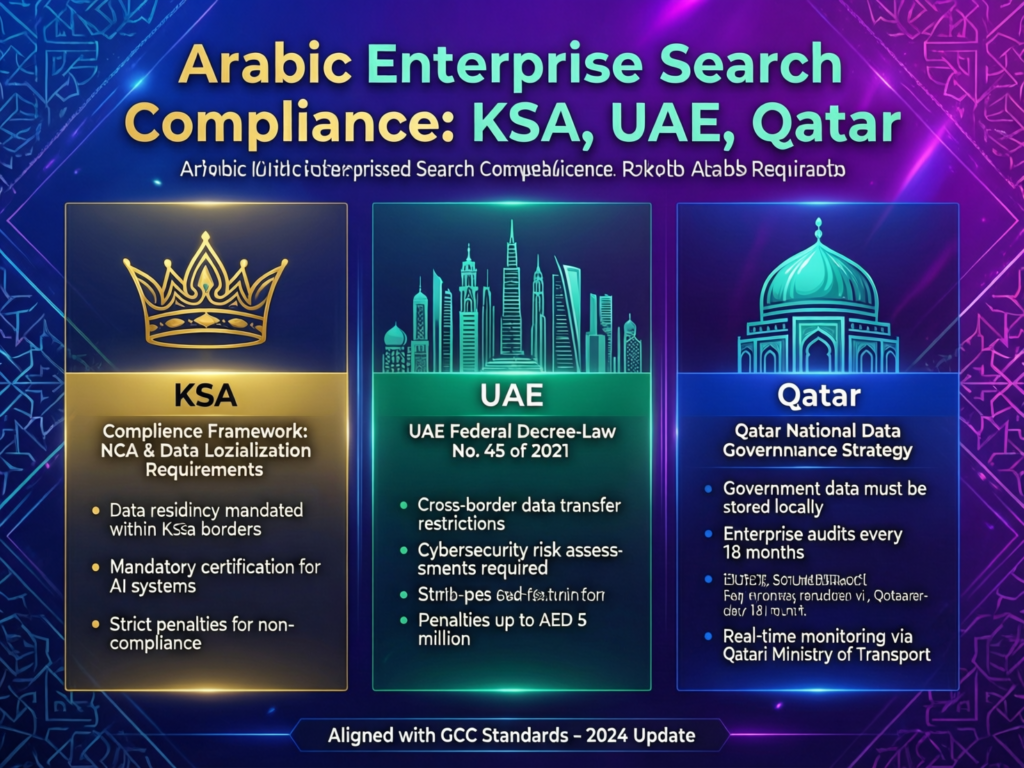
Compliance, Security & Data Residency for Arabic Enterprise Search
GCC banks and regulators can safely use Arabic AI enterprise search by keeping data within approved jurisdictions, enforcing role-based access, encrypting data in transit and at rest, and ensuring that RAG models do not train on or leak confidential customer data. The search layer becomes an internal reader of documents, not a data exporter.
Mapping Arabic AI search to Saudi SAMA and NDMO requirements
In Saudi Arabia, SAMA and NDMO expectations typically include:
Data residency inside KSA for regulated workloads.
Detailed logging and auditability of every search and answer.
Segregated environments for different entities or departments.
An on-prem or single-tenant private-cloud deployment of Saudi-compliant Arabic RAG for internal documents can align with these requirements while still giving teams fast, AI-assisted access to policies, contracts, and procedures.
TDRA, ADGM, and DIFC considerations for UAE deployments
In the UAE, TDRA guidance and free-zone frameworks from ADGM and DIFC shape where you can host data and how you segment tenants. Many regulated UAE entities choose:
Hosting in Abu Dhabi or Dubai data centers with local backups.
Single-tenant setups for banks and insurers.
Clear separation between production data and any non-production AI experimentation.
Secure architectures for GCC banks and regulators using Arabic AI search
For GCC banks and regulators, secure design often includes:
Network isolation: private subnets, VPNs, or direct connectivity from branches.
Private cloud + role-based access to the Arabic knowledge base.
Strict controls aligned with QCB and similar regulators in the region.
Working with a partner that understands both compliance and engineering like Mak It Solutions with its search engine optimization services and technical implementation experience helps ensure AI search doesn’t break existing governance.
Real Use Cases & ROI of Arabic Internal Document Search
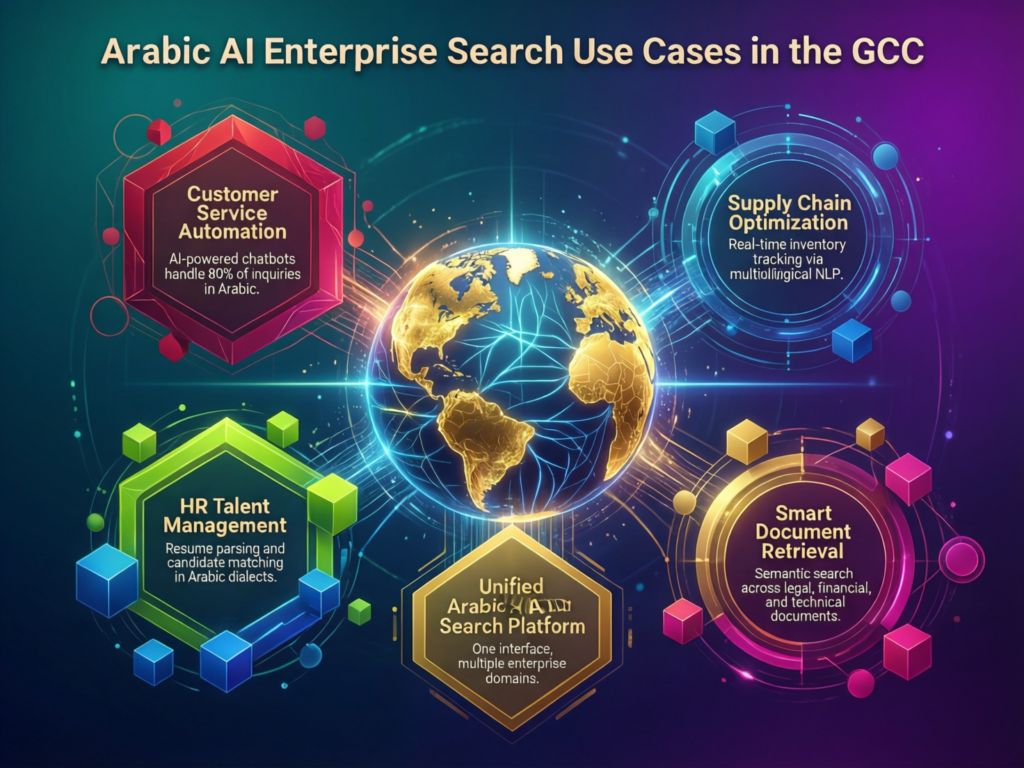
Government and public sector.
Ministries and regulators in Riyadh, Dubai, and Doha manage thousands of Arabic circulars and regulations. With enterprise search in Arabic, case officers can instantly find the latest clause instead of hunting through email threads or shared folders.
This improves turnaround times for licenses and approvals, reduces interpretation errors, and boosts citizen satisfaction supporting initiatives tied to Saudi Vision 2030 and national digital agendas across the GCC.
Banks, fintechs, and insurers across GCC
For banks, fintechs, and insurers, Arabic AI enterprise search covers compliance manuals, open banking guidelines, Shari’ah governance frameworks, and product documentation. When a new circular from SAMA or QCB arrives, it’s ingested, indexed, and immediately discoverable through RAG.
Teams responding to regulator queries can ask in Arabic, get a grounded answer, and export a set of supporting references. This directly reduces regulatory risk and the time needed to prepare responses.
Shared services, HR, and call center knowledge bases
Shared services centers in Jeddah, Abu Dhabi, and Doha often handle HR, finance, and IT tickets for multiple countries. With Arabic enterprise search.
HR portals surface the exact policy paragraph in Arabic.
Call center agents answer common questions without escalating.
Ticket volume drops while first-call resolution and NPS improve.
Mak It Solutions has seen similar patterns in large portal projects, where strong information architecture and search go hand-in-hand with good indexing controls.
On-Prem, Private Cloud, and GCC Data Centers
On-prem Arabic enterprise search for highly regulated entities
On-prem remains attractive for central banks, defense, and critical infrastructure. You get maximum control over data flows, network boundaries, and hardware. The trade-offs are higher CapEx, longer provisioning times, and more responsibility for monitoring and upgrades.
For some entities, an on-prem RAG engine that reads from existing DMS and file servers is the cleanest path to a compliant deployment.
GCC cloud regions.
For many enterprises, GCC cloud regions offer a balanced option:
AWS Middle East (Bahrain), Saudi and UAE Azure regions, and Doha-style GCP regions allow in-region hosting.
You can still meet data residency rules while using managed vector databases, storage, and monitoring.
Aligning your deployment with national data laws is similar to aligning web platforms with regional requirements, as in Mak It Solutions’ comparison of Shopify vs WooCommerce for regulated merchants.
Deciding between single-tenant and multi-tenant setups
Single-tenant: banks, telecoms, and regulators that need complete isolation, custom upgrades, and separate encryption keys.
Multi-tenant: regional groups that want lower costs and shared infrastructure but still strict logical separation.
The right choice depends on regulatory classification, internal risk appetite, and long-term upgrade plans. A good partner can map these decisions into a practical architecture, just as they would when designing complex e-commerce and portal platforms.
Concluding Remarks
Enterprise search in Arabic is no longer a “nice to have” IT feature. For GCC organizations, it’s a strategic capability that underpins compliance, efficiency, and employee experience across Saudi Arabia, the UAE, Qatar, and the wider region.
If you’re a CIO or CDO, your short checklist is:
Data sources: where your Arabic content lives today.
Compliance: SAMA / NDMO / TDRA / ADGM / DIFC / QCB alignment.
Hosting: on-prem vs GCC cloud regions.
Arabic NLP quality: accuracy on your real documents.
With the right architecture and partner, you can move from pilot chatbots to a production-grade, GCC-ready Arabic enterprise search layer that genuinely changes how your teams work.
If you’re responsible for digital, data, or compliance in Riyadh, Dubai, Abu Dhabi, Doha, or anywhere across the GCC, you don’t have to design this alone. Mak It Solutions can help you assess your current content, design a Saudi- and UAE-compliant RAG architecture, and integrate enterprise search in Arabic into your portals, apps, and workflows.
Reach out via our web development services or mobile app development pages to book a consultation, or explore more technical deep dives in our blog section. Together, we can turn your scattered Arabic documents into a strategic, searchable asset.( Click Here’s )
FAQs
Q : Is enterprise search in Arabic allowed under Saudi SAMA and NDMO data rules?
A : Yes there is nothing in SAMA or NDMO guidance that prohibits enterprise search in Arabic, as long as you design it correctly. The key is that your RAG system must keep regulated data inside approved Saudi environments, enforce role-based access controls, and log every query and answer for audit. You also need to ensure models are not training on or sending data outside KSA without explicit approval. With on-prem or Saudi-hosted private cloud and proper encryption, Arabic AI search can comfortably fit within SAMA and NDMO expectations.
Q : How can UAE government entities host Arabic AI enterprise search inside the country?
A : UAE government entities can host Arabic AI enterprise search on infrastructure located in Abu Dhabi or Dubai data centers that comply with TDRA policies and any sector-specific guidance. Practically, this often means running the vector database, RAG service, and language models inside a UAE cloud region or government cloud, integrated with existing national ID and SSO solutions. Network access is restricted to government networks or VPNs, and all logs remain in-country. Many entities work with experienced partners who understand TDRA, ADGM, and DIFC considerations when designing these environments.
Q : What are the main challenges with Arabic OCR and scanned documents for GCC enterprises?
A : For GCC enterprises, Arabic OCR struggles with low-resolution scans, stamps, handwritten notes, and legacy fonts commonly found on older government circulars and contracts. Documents may mix Arabic and English, different font encodings, and skewed pages from physical archives. This affects recognition quality and therefore search relevance. A good enterprise search in Arabic pipeline uses specialized Arabic OCR models, pre-processing (deskewing, contrast), and post-correction to clean the text. It also flags low-confidence pages for manual review, which is especially important for regulated sectors like banking and healthcare in Riyadh, Dubai, and Doha.
Q : Can Qatar banks use Arabic RAG search if their core systems are still on-prem?
A : Yes, Qatar banks can absolutely deploy Arabic RAG search while keeping core banking systems on-prem. A common pattern is to mirror relevant policies, procedures, and selected transactional logs into a secure internal knowledge base hosted in a Qatari data center, while core ledgers remain untouched. The RAG engine then reads from this curated layer only. As long as the architecture aligns with QCB data protection expectations strong segmentation, encryption, and audit trails banks can offer powerful Arabic search for staff without exposing core systems directly to AI components.
Q : How long does it typically take for a GCC organization to deploy enterprise search in Arabic across SharePoint and file servers?
A : Timelines vary, but many GCC organizations see a first production rollout in 8–12 weeks. The fastest paths start with a limited scope such as HR and compliance documents in SharePoint and a few key file shares then expand to more systems. Critical steps include content inventory, connector setup, Arabic OCR tuning, RAG configuration, and security reviews with compliance teams. In Saudi Vision 2030 programs and similar UAE/Qatar digital initiatives, this kind of phased approach is common: launch a usable Arabic search experience quickly, then iterate on quality and coverage quarter by quarter.
[…] Arabic AI voice agents across phone, WhatsApp and […]