
Serverless Computing for SMEs in Saudi Arabia (Guide)
Serverless Computing for SMEs in Saudi Arabia (Guide)

Serverless Computing for SMEs in Saudi Arabia (Guide)
Serverless computing for SMEs in Saudi Arabia means running apps on fully managed, pay-per-use cloud services instead of renting and maintaining servers, so you only pay when your code actually runs. In 2026, it’s ideal for GCC businesses with spiky or unpredictable traffic, like ecommerce, campaigns and APIs, but less suitable for heavy, always-on legacy systems.
Introduction
For many owners, serverless computing for SMEs in Saudi Arabia sounds like yet another cloud buzzword right up until the bill doubles after a Ramadan campaign. Across Saudi Arabia, the United Arab Emirates, Qatar and the wider GCC, SMEs are under pressure to hire leaner teams, launch more digital services and stay aligned with Vision 2030 and similar national agendas.
In simple terms, serverless lets GCC SMEs ship apps faster, scale automatically and pay only for what they actually use, instead of renting idle servers all month. It fits best when workloads are bursty, modern and API-driven; it’s less suitable for always-on, low-change legacy systems and databases. Teams that want support with architecture and rollout often bring in the Mak It Solutions team to reduce trial-and-error.
The 2026 reality for SMEs.
In 2026, a typical SME in Riyadh, Dubai or Doha might run a mix of WordPress sites, custom booking apps and mobile APIs. Many still sit on oversized VPS or VMs “just in case,” so servers stay idle 70–80% of the time while bills keep climbing. Add new digital mandates in Saudi Arabia and Qatar, and IT often feels like a cost center instead of a growth enabler.
Quick answer.
Serverless is usually a “yes” when you have unpredictable traffic, event-driven workflows, multiple micro-APIs or seasonal spikes (Ramadan, National Day, back-to-school, big sales). It’s often a “no” for long-running jobs, huge monoliths you can’t refactor or ultra-low-latency systems that must sit near on-prem hardware.
How this guide is tailored to KSA, UAE, Qatar and wider GCC
This guide is written for GCC realities: Vision 2030 in Saudi Arabia, free-zones and fintech sandboxes in the United Arab Emirates, and digital-government initiatives in Qatar, plus cross-border SMEs in Kuwait, Bahrain and Oman. We’ll talk about local regulators, data-residency, AWS Bahrain, Azure UAE Central and GCP Doha, not just theory. When you’re ready to move from ideas to implementation, our cloud and IT services can help translate this guidance into an actual roadmap.
What Is Serverless Computing for SMEs (in 2026)?
Plain-English explanation: what “serverless” really means for your business
“Serverless” doesn’t mean there are no servers; it means you don’t manage them. Cloud providers like Amazon Web Services (AWS), Microsoft Azure and Google Cloud Platform run, patch and scale infrastructure for you. You deploy functions or cloud-native microservices for SME applications, and the platform starts them on demand as requests arrive.
Q: What is serverless computing and how can Saudi SMEs start using it in 2026?
A: It’s a pay-per-use cloud pricing model where you deploy small functions or APIs instead of full servers, and the platform handles scaling. Saudi SMEs can start by moving one API or internal process to serverless on a KSA-aligned cloud region and monitoring costs and performance for 90 days.
Serverless vs traditional hosting and VPS for SME apps in GCC
With a VPS or VM, you pay monthly whether traffic is zero or 100,000 users. With serverless and event-driven architecture for small businesses, you pay per invocation and execution time. For many SMEs in Jeddah or Kuwait City, that means no more overnight “burn” just to keep a CVM online.
When serverless is the wrong choice.
Serverless is a poor fit for always-on ERP systems, huge reporting jobs that run for hours or ultra-low-latency trading engines. Migrating a 15-year-old monolith from a local data center in Bahrain directly into function-as-a-service (FaaS) vs PaaS for SMEs can be painful and risky. In such cases, a mix of containers, VMs and limited serverless is usually more realistic.
If you’re unsure where to draw the line, specialised web development services for SMEs from Mak It Solutions can help you map existing workloads to the right mix of serverless, containers and VMs.
When Is Serverless Perfect for SMEs? Triggers, Patterns & Rules
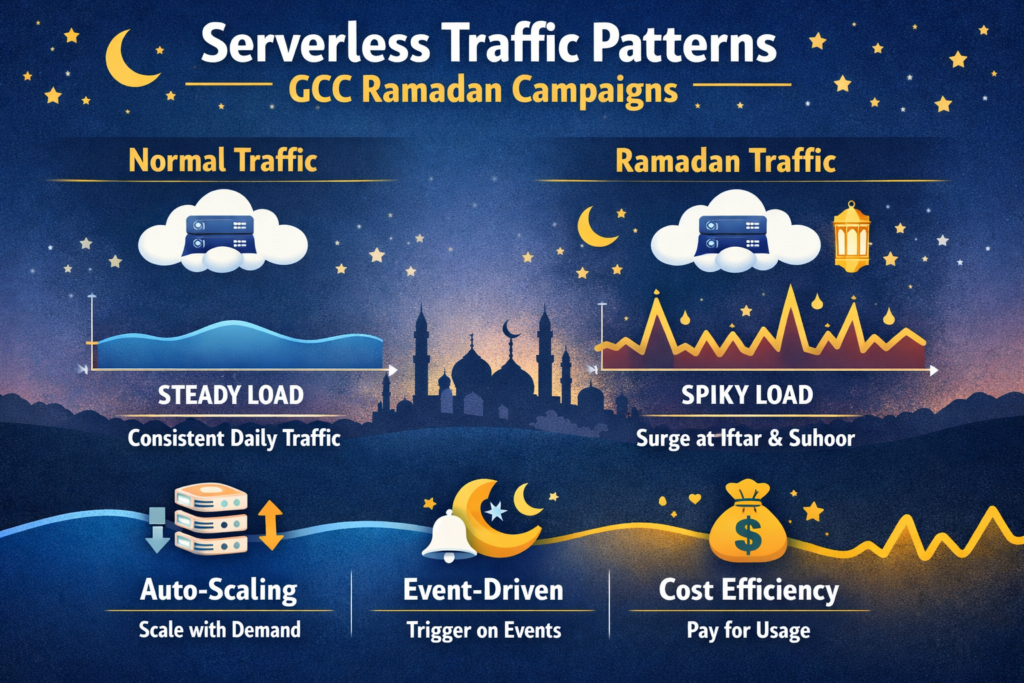
Traffic patterns where serverless wins: seasonal, Ramadan peaks, flash sales, campaigns
If your traffic is quiet most of the month but explodes during Ramadan offers, Saudi National Day or Dubai Shopping Festival, autoscaling serverless workloads for unpredictable traffic is ideal. For a Riyadh ecommerce SME, Lambda-style scaling can absorb viral influencer campaigns without late-night resizing or emergency hardware upgrades.
Ideal workloads.
Great fits include ecommerce checkout flows, booking APIs, WhatsApp or SMS notification engines and back-office automation (for example, nightly reconciliation with SADAD Payment Solutions). These are short-lived, event-driven architecture for small businesses scenarios where execution time is measured in seconds, not hours.
Simple decision checklist.
Ask yourself.
Is our traffic unpredictable or seasonal?
Can we break this work into small functions or micro-APIs?
Are we building new features rather than just lifting legacy servers into the cloud?
Do we need fast time-to-market more than deep control of every server?
Are our compliance needs manageable on major cloud providers?
Do we want to reduce day-to-day ops work for our team?
Can we start with one non-critical workload as a pilot?
If you answered “yes” to most of these, serverless deserves a serious pilot in your next quarterly plan.
GCC Serverless Use Cases.
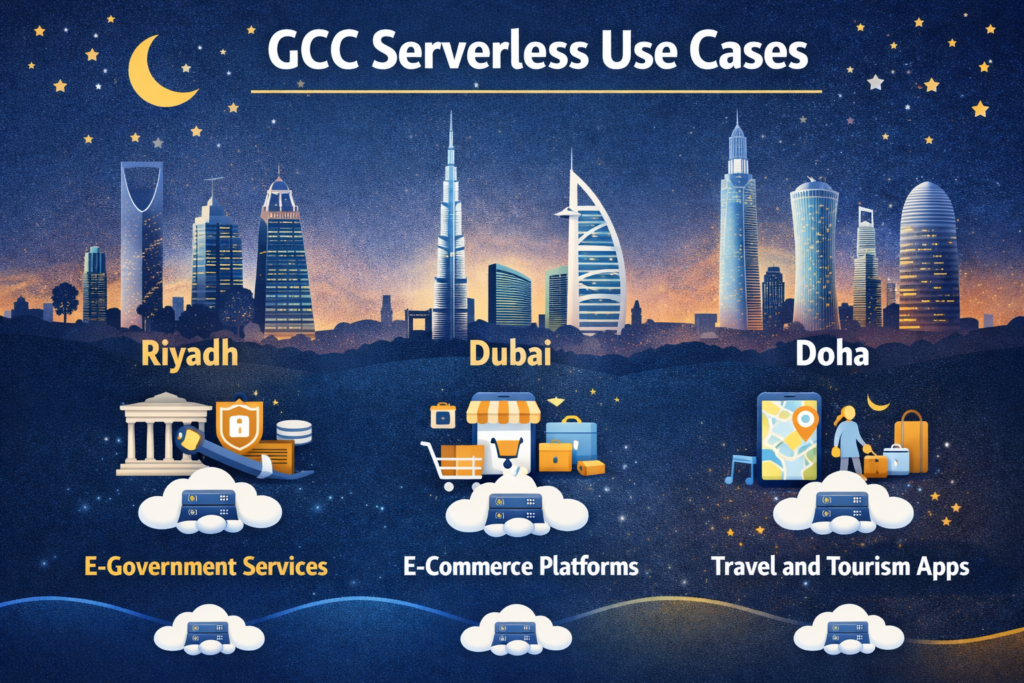
KSA examples: ecommerce stores, booking platforms and family businesses going serverless
A family-run fashion store in Riyadh can use serverless APIs for cart, payments and order tracking, while the marketing site stays on traditional hosting. A logistics SME in Jeddah might build a serverless tracking API that integrates with SMS gateways and customs systems, keeping infrastructure light while still compliant with Open Banking Saudi Arabia integrations.
UAE startups and fintechs.
In Dubai and Abu Dhabi, fintechs in Dubai International Financial Centre (DIFC) or Abu Dhabi Global Market (ADGM) often run open-banking APIs and AI-powered scoring engines on serverless. They combine hyperscalers with local players like G42 and du to build resilient, low-ops stacks while meeting sandbox timelines. Many lean teams partner with Mak It Solutions to move from prototype to regulator-ready production without over-hiring.
Qatar scenarios.
For a Doha-based SME, serverless backends can integrate Qatar Digital ID (QDI) login, Qatar Central Bank (QCB)-regulated payment providers and telco partners such as Ooredoo. A small services marketplace in Doha can stay lean but still connect to government portals and local gateways, similar to SMEs in Kuwait or Oman that need to stitch together multiple local services.
Compliance, Security & Data Residency for Serverless in GCC
High-level map of GCC rules: financial, data protection and digital-government standards
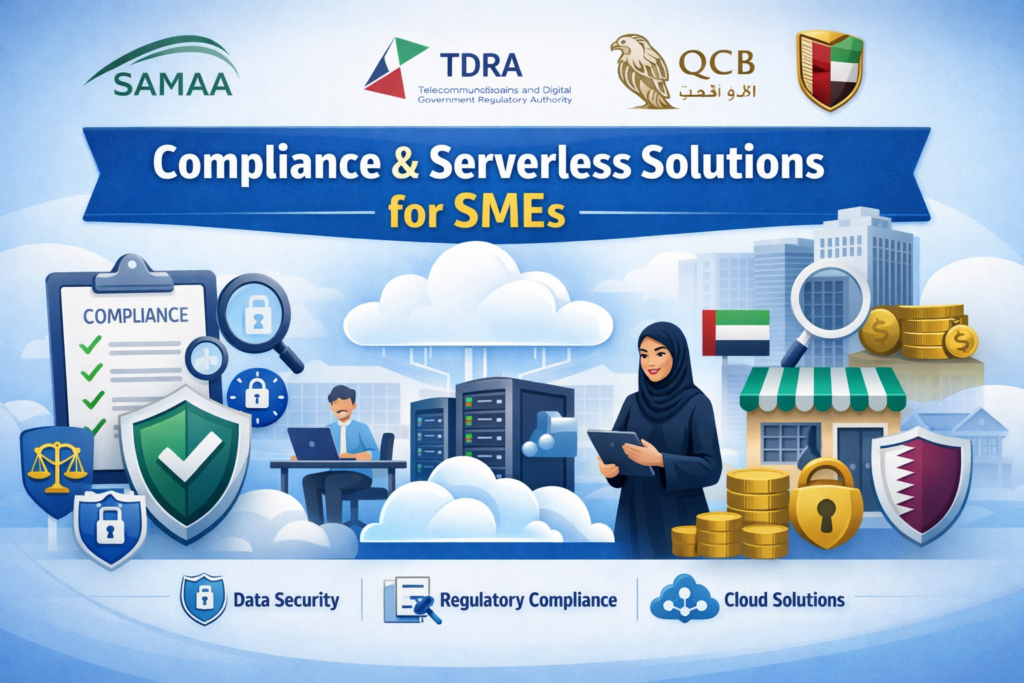
Fintech and gov-linked SMEs must handle Saudi Central Bank (SAMA) rules, National Data Management Office (NDMO) data-classification policies, UAE’s Telecommunications and Digital Government Regulatory Authority (TDRA) cloud guidance and QCB regulations. That’s why serverless computing for SMEs in KSA under SAMA rules must be designed from day one with data-residency, encryption and access controls in mind.
For SAMA guidelines, see: https://www.sama.gov.sa
For TDRA UAE cloud guidance, see: https://www.tdra.gov.ae
How serverless supports logging, audit trails, PCI-DSS and regulator-ready reporting
Modern serverless platforms integrate natively with centralized logging, SIEM and encryption key management. That makes PCI-DSS, bank-grade audit trails and UAE Pass or QDI login logs easier to maintain than on a self-hosted VPS. Instead of digging through ad-hoc log files, you can ship ready-made compliance reports to auditors and regulators.
Common mistakes SMEs make with compliance on cloud and how to avoid regulator trouble
Typical mistakes include storing production data in test accounts, using non-regional services that break data-residency rules or skipping basic IAM design. SMEs should align to NDMO and TDRA checklists, involve a partner like STC Solutions or Mobily early, and document responsibilities between in-house teams and the cloud provider. This is also where a regional partner such as Mak It Solutions can help translate regulator language into concrete technical guardrails.
This section is general information, not legal advice. Always review designs with your internal compliance and legal teams.
Comparing Costs.
Pay-per-use explained: from idle servers to event-driven billing
With serverless, you pay for the compute time used per request, plus a small cost for API gateway and storage. That’s it no 24/7 VM sitting idle “just in case.” For many SMEs, especially ecommerce and booking platforms, this pay-per-use cloud pricing model maps directly to revenue events.
Sample monthly bills: small app in KSA, UAE and Qatar on serverless vs VPS
Imagine a small booking app used by clinics in Saudi Arabia, United Arab Emirates and Qatar. On a fixed VPS, you pay the same amount whether you get 1,000 or 50,000 bookings. On serverless, a quiet month is cheap; a high-traffic month costs more but directly follows usage, especially when running across AWS Bahrain, Azure UAE Central and GCP Doha regions.
Q : When is serverless cheaper than traditional hosting for GCC small businesses?
A : It’s usually cheaper when traffic is low-to-medium most of the time with short, spiky peaks. If your app is constantly busy and CPU-heavy, reserved or spot VMs may still win.
Avoiding bill shock: limits, alerts and picking the right memory/runtime settings
Cost surprises mostly come from unbounded loops, mis-configured memory or unexpected integrations. Set account-level budgets and alerts, throttle high-risk APIs, and tune memory/runtime to realistic values. For multi-country ecommerce across KSA, Kuwait and Bahrain, this discipline keeps serverless predictable for CFOs and finance teams.
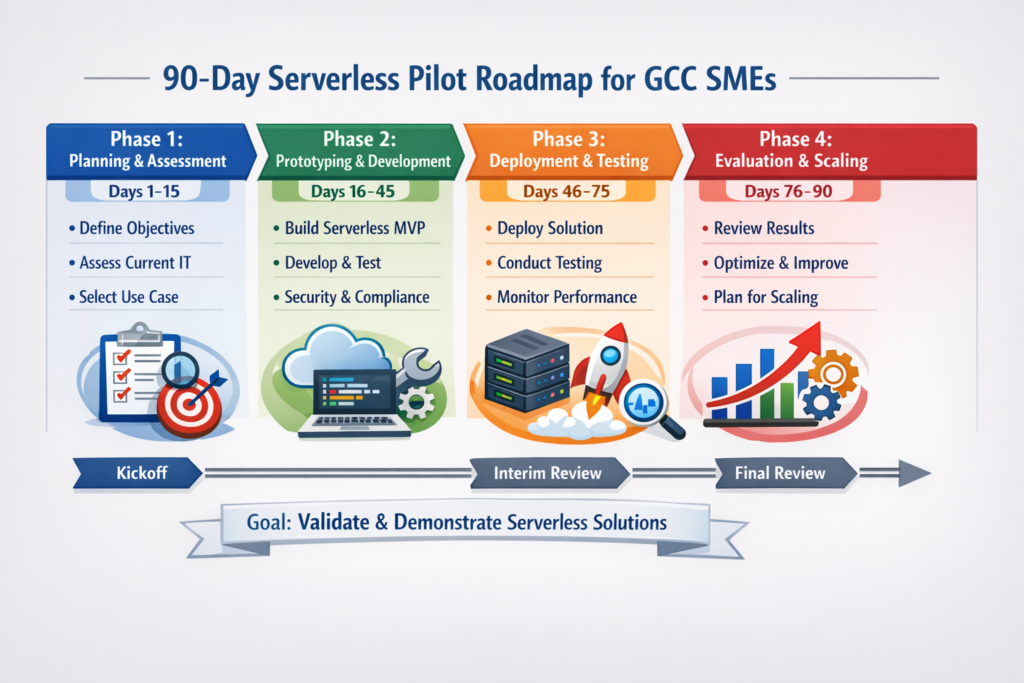
Planning a 90-Day Serverless Pilot for GCC SMEs
Pick the right first workload and cloud platform for your region
Start with one workflow: an internal report, notification engine or public API. Select a region-aligned platform: AWS in Bahrain, Azure UAE Central for Abu Dhabi/Dubai workloads or GCP Doha for Qatar. Compare the best serverless platform for startups in UAE (AWS vs Azure vs GCP) with local partners like STC Solutions, du or Ooredoo, or lean on our cloud and IT services if you prefer a guided pilot.
Architecture, security and compliance checklist for your pilot
Design a simple event-driven architecture for small businesses: API gateway → functions → managed database or queue. Apply principle of least privilege, encryption at rest and in transit, and map data classes to NDMO/TDRA rules and any SAMA/QCB guidance that applies. Document where data is stored to ensure data residency compliant serverless hosting in Saudi & UAE before you write production code.
Go-live, monitoring and “rollback” plan so business risk stays low
Launch the pilot with feature flags and clear success criteria: latency, error rates and monthly cost. Set up dashboards and alerts, and keep your previous VPS or PaaS on standby for a clean rollback if needed. This keeps conservative stakeholders from health, government or fintech sectors comfortable with experimentation while you gather real-world numbers over 90 days.
Q: How do fintech and regulated SMEs in KSA, UAE and Qatar keep serverless workloads compliant?
A: Use regional cloud regions, strong IAM, encryption, centralized logging and clear mapping to SAMA, TDRA and QCB rules, plus periodic reviews with your compliance team or an external partner. Document responsibilities in writing so there is no ambiguity when auditors ask how controls are implemented.
Should Your SME Go Serverless in 2026?
Quick recap: SMEs that benefit most from serverless in GCC
The best candidates are GCC SMEs launching new digital products, APIs or mobile backends with variable traffic: ecommerce, logistics, health booking and fintech. They want less ops, faster releases and easier scaling across Riyadh, Dubai, Abu Dhabi and Doha, without hiring a large infrastructure team.
Who should stay with VMs, hybrid or on-prem for now
If you run huge legacy ERPs, custom hardware integrations or strict low-latency trading engines, staying on VMs or a hybrid cloud/on-prem setup may be safer in 2026. You can still move non-critical workloads (notifications, reporting, small APIs) to serverless step-by-step and learn with minimal risk.
Next steps.
Ask your team or partner:
Which 1–2 workloads can we pilot on serverless in the next 90 days?
What are our regulator constraints (SAMA, TDRA, QCB, NDMO)?
How will we monitor spend, performance and security from day one?
Which Mak It Solutions services can help us architect, build and manage this with minimal risk?
If you’re an SME owner or tech lead in KSA, UAE, Qatar or the wider GCC and still unsure, you don’t have to decide alone. The team at Mak It Solutions can review your current stack, model serverless costs and design a safe 90-day pilot that fits your sector and regulator expectations. Explore our core IT and cloud services or reach out for a tailored GCC serverless roadmap today.
FAQs
Q : Is serverless hosting allowed for Saudi fintech apps under SAMA and NDMO guidelines?
A : Yes, serverless hosting can be used for Saudi fintech apps as long as you follow Saudi Central Bank (SAMA) and National Data Management Office (NDMO) requirements. That means using approved regions, encrypting sensitive data, enforcing strict IAM and ensuring logs and backups stay within allowed jurisdictions. Many controls—like audit trails, key management and network policies—are easier with managed serverless services than with self-hosted VMs. Always validate your design with compliance officers and refer to official SAMA circulars before going live.
Q : Can a UAE-based startup keep customer data inside the country when using serverless services?
A : A United Arab Emirates startup can keep data inside the country by choosing UAE-based regions (like Azure UAE Central) and services that comply with TDRA requirements. Serverless functions can run close to your users while databases and storage remain in the same jurisdiction. You should also document data flows, use private networking options and regularly review provider compliance reports. For fintechs in DIFC or ADGM, align designs with local guidance and get legal sign-off before processing production financial data.
Q : Is serverless a good option for small family businesses in KSA and Kuwait with low monthly traffic?
A : For a small family business in Saudi Arabia or Kuwait with low but spiky traffic, serverless is often ideal. You avoid paying for an oversized VPS that sits idle most of the month and instead pay only for actual visits, bookings or orders. Simpler architectures like static frontends plus serverless APIs mean fewer ops tasks and faster feature releases. However, if your current shared hosting is very cheap and stable, a gradual migration starting with one API or feature is usually safer.
Q : How do Ramadan campaigns and seasonal offers affect serverless costs for ecommerce stores in Dubai and Jeddah?
A : Ramadan, White Friday and seasonal offers can generate huge traffic spikes for ecommerce brands in Dubai and Jeddah. With serverless, your backend scales automatically, so you don’t need to pre-buy servers just for peak days. Costs will rise during campaigns but correlate with real transactions, which finance teams usually prefer. To stay in control, set budgets and alerts, test load beforehand and optimize functions to run efficiently. This approach aligns well with digital-commerce goals in Saudi Vision 2030.
Q : What is the best way for Qatar SMEs to connect serverless backends with local payment gateways and QDI login?
A : For Qatar SMEs, a common pattern is to build a serverless API layer that integrates Qatar Digital ID (QDI) for login and QCB-approved payment gateways for checkout. Functions handle authentication callbacks, token validation and payment webhooks, while sensitive data stays in regional databases. Using providers like Ooredoo for connectivity and GCP Doha for compute helps keep latency low and data residency clear. Always confirm exact compliance expectations with QCB and your payment provider before going live.
[…] these issues are common in Saudi Arabia, the UAE, and […]