


Arabic Web Design Guide: GCC Trust, Speed & SEO
Arabic Web Design Guide: GCC Trust, Speed & SEO
Arabic Web Design Guide: GCC Trust, Speed & SEO
If you want better results in Saudi Arabia, the UAE, and Qatar, Arabic web design cannot be treated like a translation layer. An Arabic-first web strategy means building for native RTL behavior, faster mobile use, stronger trust signals, and clearer Arabic search visibility from day one.
For GCC brands, that shift matters because users decide quickly. If the experience feels awkward, slow, or English-first, trust drops before the offer even has a chance.
Why Arabic-First Web Design Matters in 2026
Many GCC businesses invest in polished websites and still struggle with bounce rates, weak lead quality, or low conversions from Arabic traffic. Usually, the issue is not the brand or even the offer. It is the experience.
An Arabic-first website is designed around how Arabic-speaking users actually read, navigate, and evaluate trust. That includes.
Right-to-left page structure
Arabic-friendly typography
Mobile-first layouts
Clear forms and labels
Local trust cues
Search-friendly Arabic content
A translated website changes the words. An Arabic-first website changes the journey.
That difference is especially important in Saudi Arabia, the UAE, and Qatar, where users often expect digital experiences to feel locally built rather than mirrored from English pages.
What Arabic Web Design Really Means in the GCC
Arabic-first vs. translated websites
A translated site may look bilingual, but it still feels English-led underneath. Menus, form fields, CTAs, breadcrumbs, and page hierarchy often reveal that immediately.
Arabic web design works differently. It treats Arabic as a primary experience, not a secondary version. That means content flow, visual emphasis, and interaction design all respect Arabic reading behavior from the start.
Why native RTL journeys matter
Users in Riyadh, Jeddah, Dubai, Abu Dhabi, and Doha are used to smooth mobile experiences. They expect clarity, speed, and professionalism, especially when a website asks them to compare services, submit personal details, or make a payment decision.
In practice, brands lose trust when the Arabic version feels like an afterthought. Even small issues can hurt performance:
Misaligned form fields
Reversed sliders or carousels
Icons pointing the wrong way
Weak Arabic spacing
Mixed-direction content blocks
English logic dominating Arabic pages
These problems rarely trigger complaints. They simply reduce confidence.
How Arabic UX affects trust and conversions
Strong Arabic UX improves more than readability. It also supports.
Higher engagement
Better form completion
Lower bounce rates
Stronger trust in regulated sectors
Cleaner search visibility in Arabic
For fintech, healthcare, e-commerce, and public-sector-adjacent brands, this is often where conversion gains begin.
Why RTL UX Is Critical for GCC Websites
Navigation and hierarchy in Arabic interfaces
RTL design is not just a flipped layout. Good Arabic UX creates a natural information flow from the right side of the screen, with headings, actions, and supporting content arranged in a way that feels intuitive.
That means.
Right-aligned navigation where appropriate
Clear visual hierarchy in Arabic headings
Balanced CTA placement
Easy-to-scan mobile sections
Breadcrumbs and icons that match RTL logic
Arabic typography matters too. Fonts need enough line height, spacing, and contrast to stay readable on smaller screens.
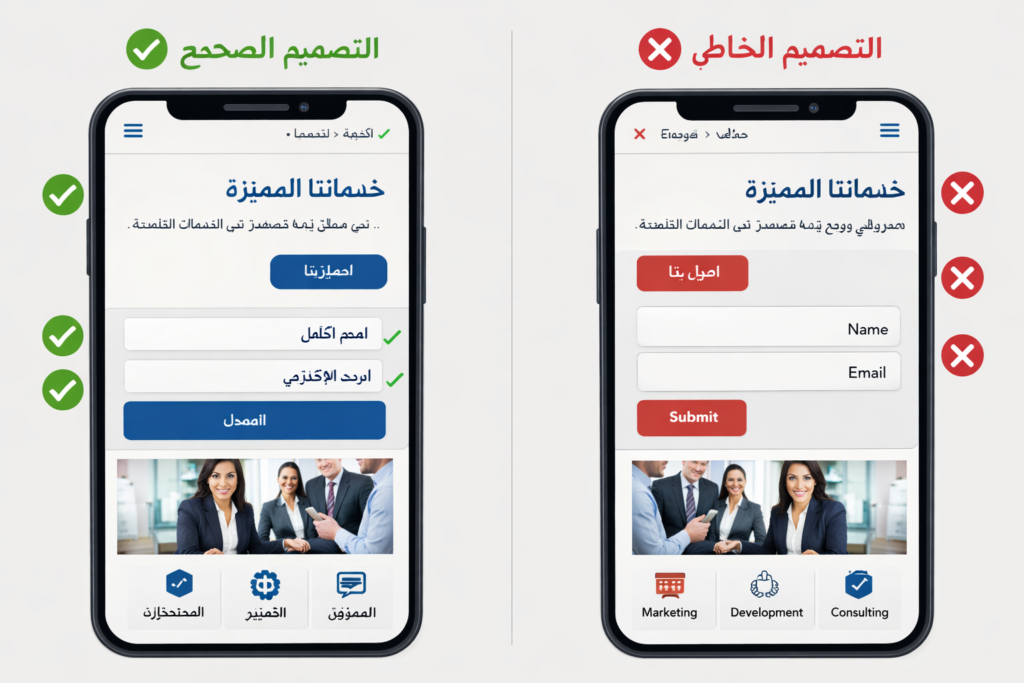
Common RTL mistakes that hurt results
Some of the biggest problems on GCC landing pages are surprisingly basic.
Left-heavy layouts on Arabic pages
Cramped Arabic text inside Latin-style containers
Bilingual pages with inconsistent structure
Checkout steps that change direction between languages
Legal or trust content pushed into unclear sections
A Riyadh fintech page can lose credibility fast when disclosures feel hidden or poorly translated. A Dubai retail site can see drop-offs when filters, cart actions, or payment flows feel inconsistent across Arabic and English.
Bilingual UX patterns that work
The best bilingual websites do not force both languages into the exact same structure. They keep the same brand identity while adapting the experience by audience.
That often means.
Arabic-first landing pages for high-intent keywords
Localized form labels and consent copy
Separate content flow for Arabic and English pages
Consistent trust messaging across both journeys
For UAE brands in particular, this balance matters because local and international audiences often visit the same website with very different expectations.
How Speed and Mobile Performance Shape Arabic Web Design
Across the GCC, many user journeys begin on mobile and end on mobile. That is true for e-commerce, services, logistics, healthcare discovery, and high-intent lead generation.
A slow Arabic page does more than frustrate the user. It weakens trust.
Why mobile-first performance matters
If the page loads poorly on a phone, users may never reach the offer. This is even more important in markets where people compare options quickly and make snap decisions based on clarity and responsiveness.
Core Web Vitals still matter
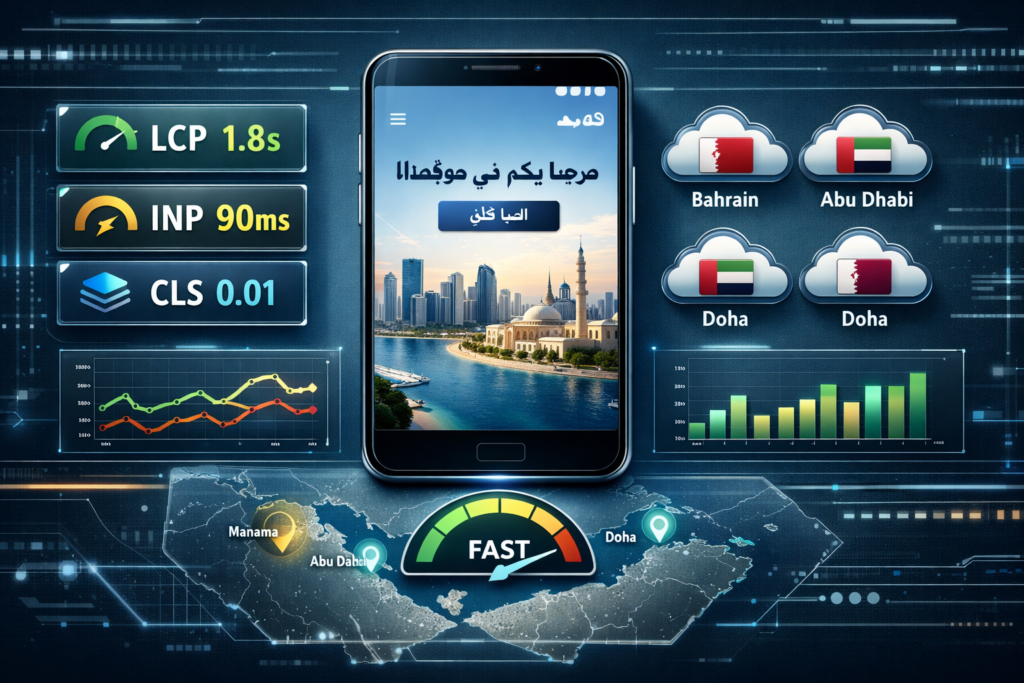
LCP, INP, and CLS remain useful performance signals because they shape the user’s first impression.
LCP shows how quickly the main content appears
INP reflects how responsive the page feels
CLS measures layout stability
Arabic pages can struggle here when heavy hero sections, unoptimized fonts, popups, or banners shift the layout after load.
How to improve Arabic landing page speed
You do not need to strip the site down to make it fast. The goal is cleaner performance without harming UX.
Start with the basics.
Compress oversized hero images
Remove unused scripts and plugins
Preload Arabic fonts carefully
Avoid heavy sliders that break RTL behavior
Simplify above-the-fold mobile sections
Test Arabic pages separately, not just English ones
From a practical business point of view, infrastructure choices can matter too. Brands with regional hosting or data-residency priorities may also consider cloud options closer to GCC markets such as Bahrain, Abu Dhabi, or Doha.
GCC Trust Signals and Compliance Cues for Arabic Websites
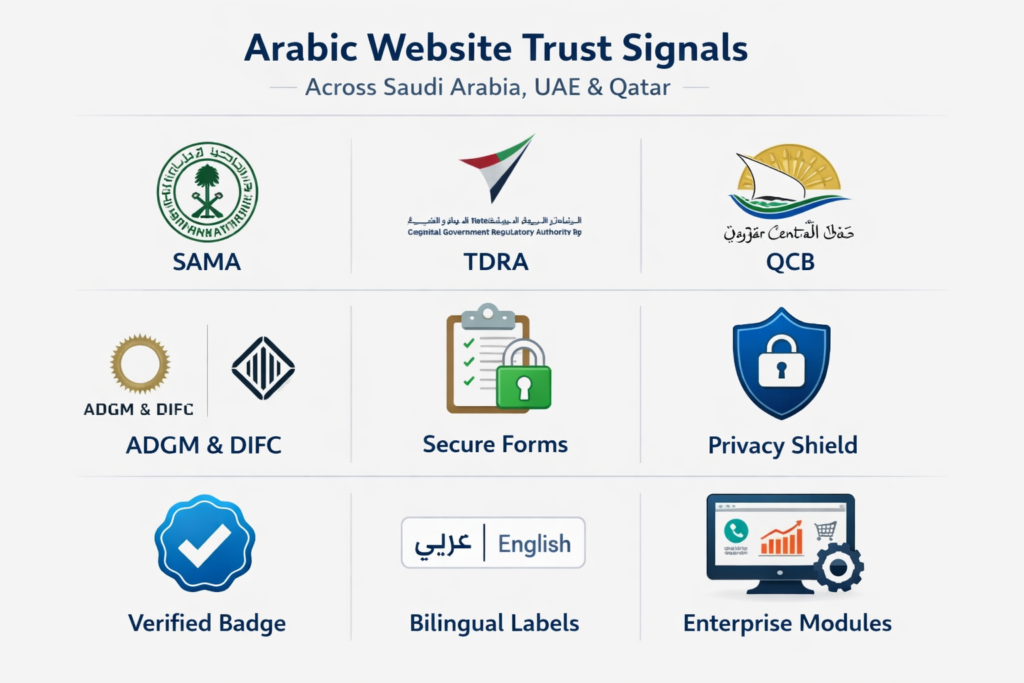
Trust is not built by design polish alone. In Saudi Arabia, the UAE, and Qatar, users often look for signals that a brand is legitimate, careful, and locally aware.
Saudi Arabia.
For Saudi-facing websites, trust usually comes from clarity. Users respond better to.
Clear Arabic product or service descriptions
Visible contact information
Straightforward privacy and consent wording
Confident, readable form language
Strong handling of personal data expectations
This is especially important in finance, health, and enterprise services, where credibility matters as much as convenience.
UAE.
In the UAE, strong trust often comes from a combination of smooth bilingual UX and visible institutional credibility.
For many Dubai and Abu Dhabi brands, that includes:
Consistent Arabic and English experiences
Clean legal and compliance messaging
Professional onboarding or contact flows
Trust cues that reduce perceived risk in high-value services
Qatar.
In Qatar, digital trust is often strengthened by simplicity. Users tend to respond well to websites that feel controlled, authoritative, and easy to understand.
That means.
Concise Arabic copy
Fewer distracting UI elements
Clear legal language
Secure-looking service flows
Strong support visibility
For fintech and other regulated sectors, a restrained interface often performs better than an over-designed one.
Arabic SEO and AEO for GCC Search Visibility
Arabic web design supports SEO more than many teams realize. Search performance improves when the site structure, heading logic, and localized content are clear enough for both users and search systems.
How Arabic UX supports Arabic SEO
Better Arabic UX can strengthen search performance by improving.
Page clarity
User engagement
Heading structure
Market-specific relevance
Internal linking pathways
If the Arabic page is easier to read and navigate, it is also easier for search engines to interpret.
Why AEO matters now
Answer Engine Optimization matters because search experiences increasingly pull direct answers into AI summaries, featured answers, and other extractive results.
To improve your chances, make sure your page does the following early.
Answers the main question clearly
Defines the topic in simple language
Uses helpful headings
Connects the topic to relevant local entities where appropriate
That is one reason Arabic-first pages often outperform translated pages. They are easier to understand at a glance.
Localizing metadata and internal links
For GCC markets, metadata should feel local too. Use Arabic-friendly titles, natural meta descriptions, and internal links that match user intent.
Examples of useful internal destinations include.
Web development services
Front-end development services
Mobile app development services
E-commerce solutions
Cloud security and cybersecurity resources
Related GCC digital strategy content
The goal is not just crawlability. It is guiding the user to the next logical step.
Best Arabic Web Design Approaches by Market
Saudi Arabia: trust-first and Arabic-heavy
Saudi brands often perform best with Arabic-dominant experiences, especially in fintech, healthcare, government-adjacent services, and large enterprise environments.
The emphasis is usually on.
Arabic clarity
Trust-heavy messaging
Privacy confidence
Strong mobile UX
Compliance-aware structure
UAE: elegant bilingual execution
UAE brands usually need a more balanced bilingual model. In cities like Dubai and Abu Dhabi, local and international audiences often overlap, so both language paths need to feel polished and intentional.
The strongest UAE websites combine.
Smooth Arabic and English journeys
High-end visual presentation
Fast conversion paths
Strong mobile usability
Qatar: focused and credibility-led
Qatar websites often do better when they stay sharp, clear, and credible. Rather than adding too many visual elements, the better approach is usually a tighter user journey with stronger authority signals.
How to Build an Arabic-First Web Strategy That Converts
A strong Arabic web strategy is not built in isolated parts. Design, content, performance, SEO, and trust all need to support each other.
Start with audience and intent
Study what Arabic-speaking users in Saudi Arabia, the UAE, and Qatar actually want from the page. Look at intent, mobile behavior, hesitation points, and trust concerns by market.
Prioritize Arabic UX from the start
Do not design in English and “fix” Arabic later. Build around.
RTL navigation
Arabic typography
Form logic
CTA placement
Mobile readability
Local trust language
Align speed, SEO, and compliance early
These should not be separate projects. A page that ranks but feels untrustworthy will underperform. A compliant page that loads slowly will also struggle.
Measure by region
Track performance by market, not just by overall traffic. Useful metrics include.
Leads and enquiries
Form completion rate
Bounce rate
Core Web Vitals
Arabic organic visibility
Mobile behavior by region
In practice, each market may need a different priority. A Riyadh fintech startup may focus on compliance-led clarity. A Dubai e-commerce brand may care more about bilingual mobile checkout. A Doha SME may prioritize trust and data confidence first.
Concluding Remarks
Arabic web design is not a translation task. It is a growth system.
For brands targeting Saudi Arabia, the UAE, and Qatar, an Arabic-first web strategy improves how users experience the site, how quickly they trust it, and how easily they find it through Arabic search. When RTL UX, speed, trust, and SEO work together, the website feels locally built, and that is usually where better conversion starts.( Click Here’s )
FAQs
Q : Is Arabic web design different from simple website translation in Saudi Arabia?
A : Yes. Translation changes the language, but Arabic web design changes the experience itself. In Saudi Arabia, users often respond better when the layout, forms, trust messaging, and page flow feel native to Arabic rather than copied from an English-first website.
Q : Do UAE businesses need bilingual Arabic-English website structures to rank better?
A : In many cases, yes. UAE businesses often serve both Arabic-speaking and international audiences, so distinct Arabic and English journeys can help with both discoverability and conversion. The key is thoughtful localization, not duplicate pages with swapped text.
Q : What trust signals should a Qatar fintech website include in Arabic?
A : A Qatar fintech website should focus on clarity, legitimacy, and simplicity. That usually means clear Arabic product explanations, visible support details, accurate legal language, and secure-looking onboarding flows that reduce hesitation.
Q : How can Riyadh companies improve RTL UX without rebuilding the full website?
A : They can start with high-impact fixes such as navigation direction, form alignment, Arabic spacing, CTA placement, breadcrumb order, and mobile readability. This often improves performance before a full redesign is needed.
Q : Which matters more for GCC websites: Arabic SEO or Core Web Vitals?
A : Neither should be treated as separate. Arabic SEO helps people find the page, while Core Web Vitals help them stay, trust it, and convert. The best results usually come from combining both.
[…] Arabic UX Design Really Means in GCC […]