

Multilingual SEO in Saudi & UAE: Avoid Duplicates
Multilingual SEO in Saudi & UAE: Avoid Duplicates
Multilingual SEO in Saudi & UAE: Avoid Duplicates
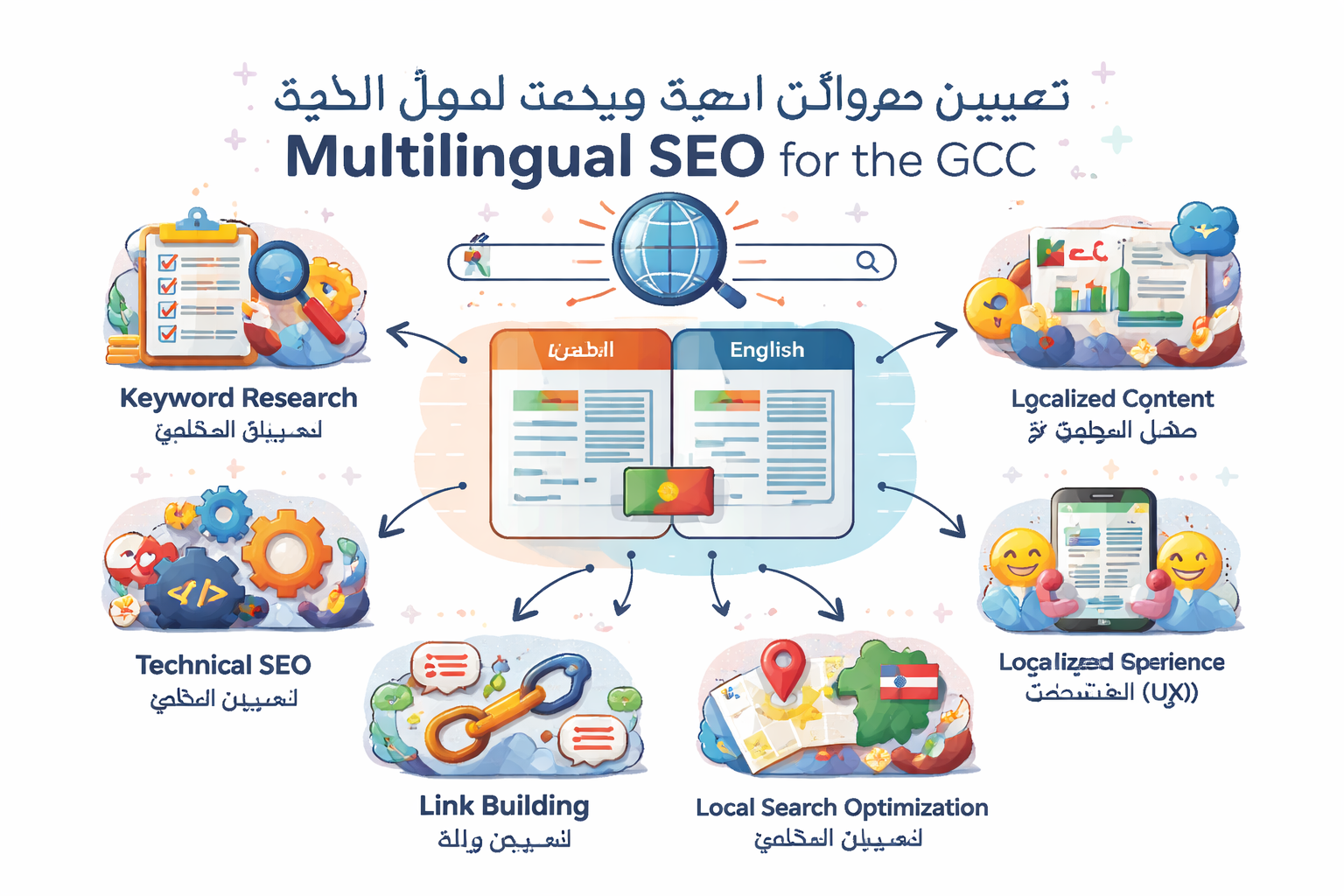
Arabic-English websites in the GCC often lose visibility after launch because the setup looks bilingual to users, but search engines still see mixed signals. Multilingual SEO for GCC works best when Arabic and English pages have separate URLs, correct hreflang annotations, and canonicals used only for true duplicates. For businesses targeting Saudi Arabia, the UAE, and Qatar, that structure reduces indexation confusion, protects local relevance, and creates a clearer experience for users searching in both languages.
The problem is common. A site launches with Arabic and English content, but both versions sit too close together technically. Pages share weakly differentiated copy, country folders add little local value, and canonical tags are used where hreflang should have done the job. Rankings slip, click-through rate softens, and the site underperforms in markets where trust and localization matter.
What Multilingual SEO Means for GCC Websites
Multilingual SEO is more than translation
Multilingual SEO is not just translating a page from English into Arabic.
It means aligning language, search intent, user experience, and market context. An Arabic page aimed at Riyadh users should not read like a direct translation of an English page written for a Dubai-based executive audience. The wording, trust signals, CTA style, and supporting examples should feel local.
Why Arabic-English structure matters in Riyadh, Dubai, and Doha
Search behavior is not identical across GCC markets.
In Riyadh, Arabic searches often carry stronger trust, compliance, and local-intent signals. In Dubai and Abu Dhabi, English may lead many B2B discovery journeys, while Arabic still matters for credibility, accessibility, and brand trust. In Doha, both languages often support the buying journey, especially for enterprise, regulated, and public-facing sectors.
That is why site structure matters as much as the content itself.
The business cost of weak language targeting
When Arabic and English versions are not properly separated, the result is usually diluted rankings, lower CTR, and weaker conversion paths.
For businesses investing in SEO services or web development services, this is not a minor technical issue. It directly affects discoverability, authority, and expansion across Saudi Arabia, the UAE, and Qatar.
Best Arabic-English Site Structure for Saudi, UAE, and Qatar
Subfolders vs subdomains vs ccTLDs
For most GCC businesses, subfolders are the strongest practical option.
A structure like /en/ and /ar/ is usually easier to manage, easier to scale, and better for consolidating domain authority. Subdomains can work, but they add operational complexity across analytics, governance, and SEO workflows. Country-code domains make sense only when each market operates almost like a separate business.
Here is the simple comparison:
| Structure | Best use case | Main advantage | Main drawback |
|---|---|---|---|
| Subfolders | Most GCC businesses | Easier management and shared authority | Needs disciplined structure |
| Subdomains | Large teams or separate infrastructure | Flexible operations | More complexity |
| ccTLDs | Fully separate country strategies | Strong local identity | Higher cost and maintenance |
Why separate Arabic and English URLs are the safest choice
Arabic and English pages should have their own crawlable URLs.
That gives search engines a clear map of the site and gives users a more consistent experience. It also reduces the risk of accidental duplication when teams reuse layouts across languages or markets.
Separate URLs make it easier to manage.
Hreflang relationships
Language-specific metadata
Localized internal linking
Market-specific landing pages
Analytics by language and region
That second model works only when country targeting reflects real local changes. Otherwise, a leaner Arabic-English structure is often the better choice, with localized landing pages for Riyadh, Dubai, Abu Dhabi, and Doha layered underneath.
This approach works especially well for e-commerce solutions and multilingual service websites that need to scale without creating unnecessary duplication.
Why Bilingual GCC Websites Trigger Duplicate Content Issues
Cloned templates create weak separation
One of the most common mistakes is cloning an English page, swapping the body text into Arabic, and assuming the page is now fully localized.
It usually is not.
If the same layout, metadata pattern, CTA logic, examples, and internal linking structure remain untouched, the page may still look too similar from an SEO point of view. That is where multilingual sites start sending confusing signals.
Thin localization weakens relevance
A translated page is not automatically a localized page.
If the Arabic version keeps English product labels, foreign examples, generic proof points, or awkward CTAs, it can feel thin rather than locally useful. In sectors like fintech, logistics, retail, and government-related services, real localization means adapting terminology, buyer concerns, trust elements, and examples for the target market.
Country folders can create a second duplication layer
A /sa/ folder and an /ae/ folder with nearly identical content do not create local relevance on their own.
They often create another layer of duplication.
Country folders should only exist when they reflect real local value, such as.
Pricing differences
Service availability
Sector-specific compliance language
Local case studies
Procurement expectations
Market-specific trust signals
Hreflang vs Canonical in Multilingual SEO
When to use hreflang
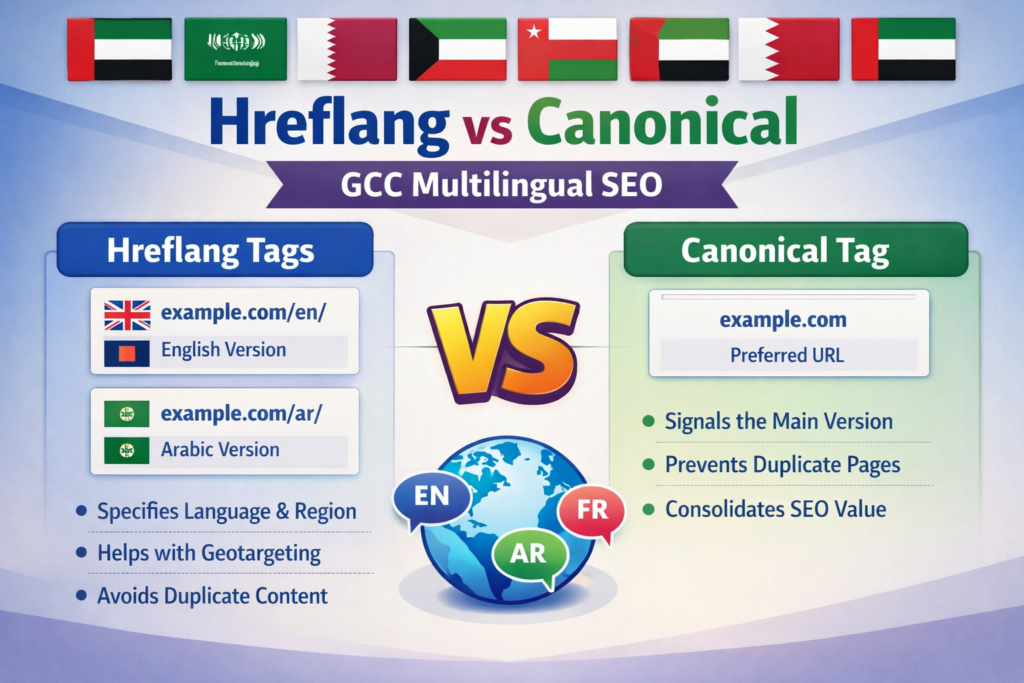
Use hreflang when Arabic and English pages serve the same purpose but target different language audiences.
That tells search engines the pages belong together without forcing one version out of the index. This is exactly what multilingual SEO for GCC needs in most bilingual setups.
Examples include.
Arabic and English service pages
Arabic and English product pages
Arabic and English location pages
Arabic and English onboarding pages
When to use canonical tags
Canonical tags are for true duplicates or near-duplicates that should consolidate ranking signals to one preferred URL.
They are not a replacement for language targeting.
That matters because many bilingual GCC websites mistakenly canonicalize Arabic pages to English pages, or vice versa, and then wonder why the intended local page struggles to rank.
A practical GCC example
A Riyadh fintech business can keep both /ar/merchant-onboarding/ and /en/merchant-onboarding/ live, connected with hreflang, while using canonicals only for duplicate parameter URLs or campaign variations.
A Dubai e-commerce brand promoting mobile app development services can follow the same model for Arabic and English landing pages. The key is simple: keep both language pages indexable when both deserve to rank.
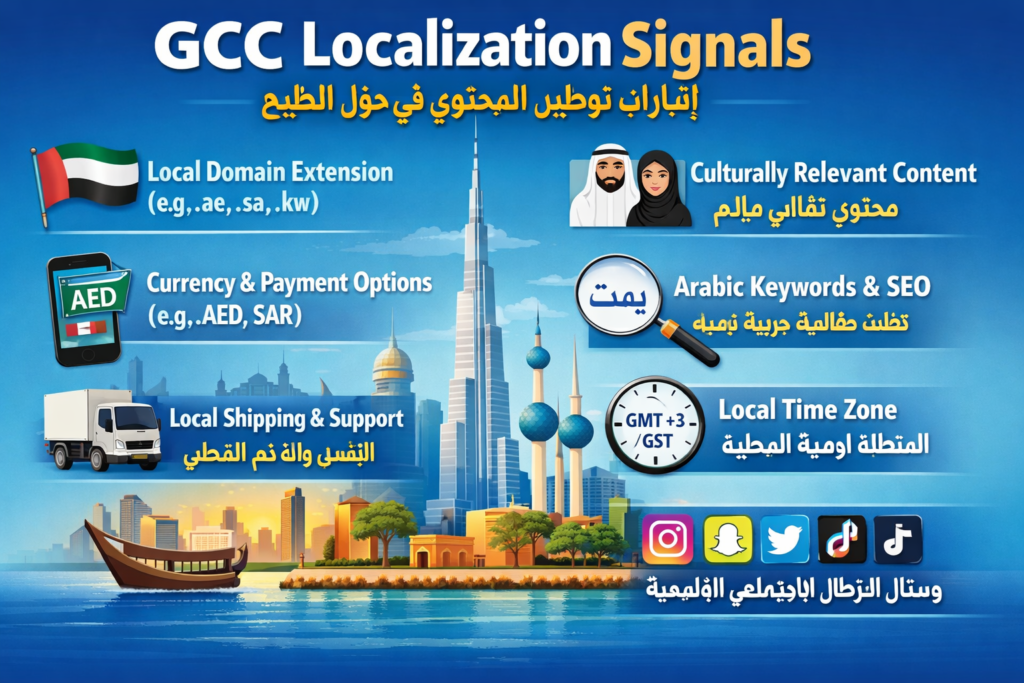
GCC Localization Signals That Improve Arabic-English SEO Performance
Arabic UX and RTL design affect performance
Localization is not just a content issue. It is also a UX issue.
Arabic UX should respect right-to-left reading behavior, natural CTA placement, familiar terminology, and content flow that feels native rather than retrofitted. Better engagement does not guarantee rankings by itself, but it supports relevance and usability in a way that weak bilingual pages rarely achieve.
Brands investing in digital marketing services should treat localization, UX, and SEO as one connected system.
Local landing pages need meaningful differences
A Riyadh page should feel like it was written for Saudi decision-makers.
A Dubai page may need sharper commercial language and bilingual clarity. An Abu Dhabi page in a finance context may need references relevant to ADGM or DIFC expectations. A Doha page may need stronger language around procurement, enterprise trust, or data residency.
Those are not cosmetic tweaks. They are part of what makes local pages worth indexing separately.
Industry language changes by sector
Different sectors require different localization depth.
Fintech: licensing, governance, onboarding trust
Retail: Arabic conversion flow, local product language, mobile UX
Logistics: regional routing, delivery clarity, operational terminology
Government and enterprise: accessibility, precision, policy alignment
From a practical business point of view, multilingual SEO for GCC improves when content reflects real market decisions instead of generic translation patterns.
Compliance and Trust Signals for Multilingual GCC Websites
Where regulated-market signals should appear
For regulated sectors, trust should not be hidden in the footer.
It should appear where users make decisions: product pages, service pages, onboarding journeys, and local landing pages. In Saudi Arabia, that may include references aligned with SAMA expectations for fintech. In the UAE, trust framing may connect more naturally with TDRA and sector-specific ecosystem signals. In Qatar, QCB-related context can matter for finance-facing content.
Why governance affects site structure decisions
Data handling, content governance, and regulatory sensitivity influence multilingual architecture more than many teams expect.
If the website serves enterprise, public-sector, fintech, health, or compliance-sensitive audiences, language separation and canonical control need extra care. One misconfigured Arabic page can weaken the version that should rank, or create avoidable ambiguity around availability, policy, or trust.
Stronger controls matter more in sensitive sectors
In fintech, health, and government-facing environments, multilingual SEO is not only about search visibility.
It is also about reducing legal, operational, and reputational ambiguity.
That is why bilingual architecture should be reviewed alongside technical SEO and governance, not as an afterthought. A useful related example is this guide on privacy by design for IoT in Saudi, UAE & Qatar.
Multilingual SEO Best Practices for Launching or Fixing an Arabic-English Site
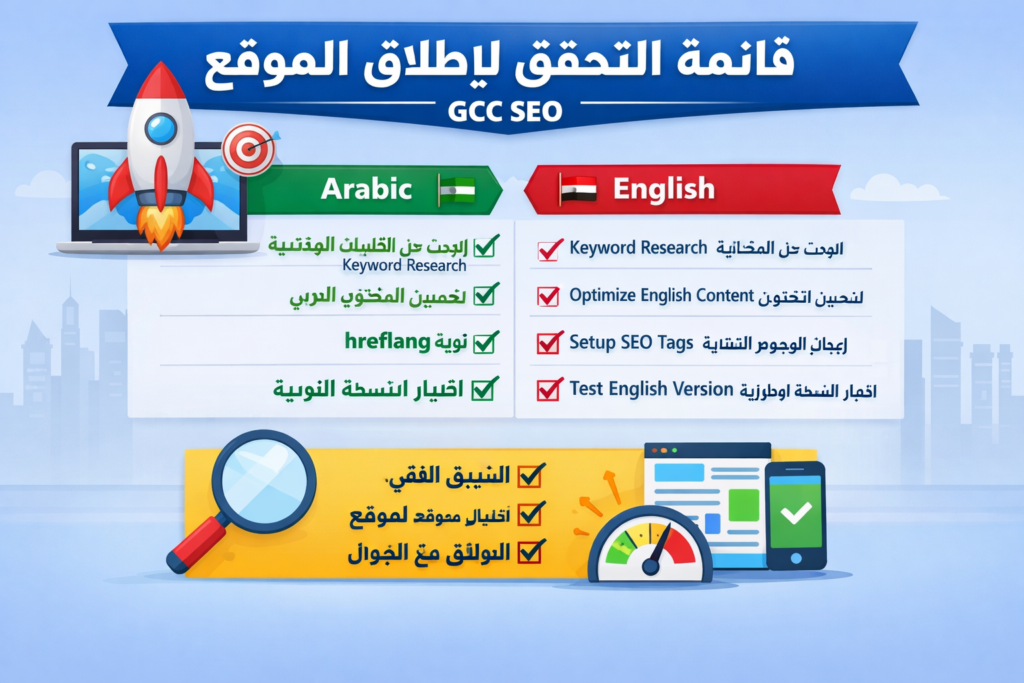
A practical launch checklist
When launching or repairing an Arabic-English website, start with the essentials.
Create separate URLs for Arabic and English pages.
Add reciprocal hreflang annotations between language variants.
Use canonical tags only for true duplicates.
Localize metadata, headings, CTAs, and internal links.
Review country folders for real local value.
Check Arabic UX, including RTL alignment and mobile flow.
Strengthen both language versions with internal links from the homepage and key service pages.
Monitor indexation, rankings, CTR, and conversions after rollout.
How to audit an existing bilingual site
A useful audit usually starts with these questions.
Are Arabic and English pages on separate URLs?
Are hreflang tags reciprocal and accurate?
Are canonicals pointing only to true duplicate pages?
Do Arabic pages feel fully localized or just translated?
Do country folders contain meaningful market differences?
Are internal links supporting both language paths clearly?
That audit often reveals that the site does not need more pages. It needs cleaner architecture.
What teams should monitor after launch
Once the rollout is live, monitor.
Indexed URLs by language
Rankings by market
Click-through rate by page type
Conversions by language path
Crawl and indexation anomalies
Underperforming localized pages
For GCC businesses, the strongest growth usually comes from clearer signals, better localization, and tighter technical discipline, not from publishing more thin market pages.
To Sum Up
Multilingual SEO for GCC is not complicated in theory, but it often breaks in execution. The safest setup is still the most reliable one: separate Arabic and English URLs, proper hreflang mapping, and canonicals reserved for true duplicates only. For businesses in Saudi Arabia, the UAE, and Qatar, that structure helps protect rankings, improve relevance, and create a more trustworthy bilingual user journey.( Click Here’s )
If your Arabic-English website is underperforming, the fix is usually structural before it is editorial. Mak It Solutions can review your bilingual architecture, hreflang setup, and localization model, then recommend a rollout plan built for GCC growth. Explore their SEO services or request a multilingual SEO audit through Mak It Solutions.
FAQs
Q : Should Saudi websites use /ar/ and /en/ folders for multilingual SEO?
A : Yes, in most cases folders are the safest and most scalable option for Saudi websites. They keep Arabic and English content clearly separated while preserving the authority of one main domain. That setup works best when each language version is properly localized, internally linked, and connected with hreflang.
Q : Is hreflang required for UAE Arabic-English business websites?
A : It is not always mandatory, but it is strongly recommended when a UAE business publishes Arabic and English versions of the same page. Hreflang helps search engines understand which language version should be shown to the right audience. That reduces confusion between English-led B2B discovery and Arabic-first local search behavior.
Q : Can Qatar companies translate English pages into Arabic without duplication risks?
A : Yes, but only when the Arabic page is treated as a real localized asset. It should have its own URL, metadata, internal links, and market-aware wording. The risk usually comes from thin translation and weak technical setup, not from translation itself.
Q : Which is better for GCC SEO: subfolders or subdomains?
A : For most GCC businesses, subfolders are the better option because they are easier to manage and usually stronger for shared authority. Subdomains can still work, especially for large organizations with separate teams or infrastructure, but they introduce more complexity than most regional businesses need.
Q : How do regulated industries in KSA and UAE handle multilingual website compliance?
A : They usually combine SEO structure with stronger governance. In practice, that means cleaner language separation, tighter canonical control, reviewed legal and policy copy, and localized pages that do not overstate approvals or market availability. For sensitive sectors, multilingual SEO supports both visibility and trust.