

Schema Strategy Guide for AI Search in 2026
Schema Strategy Guide for AI Search in 2026
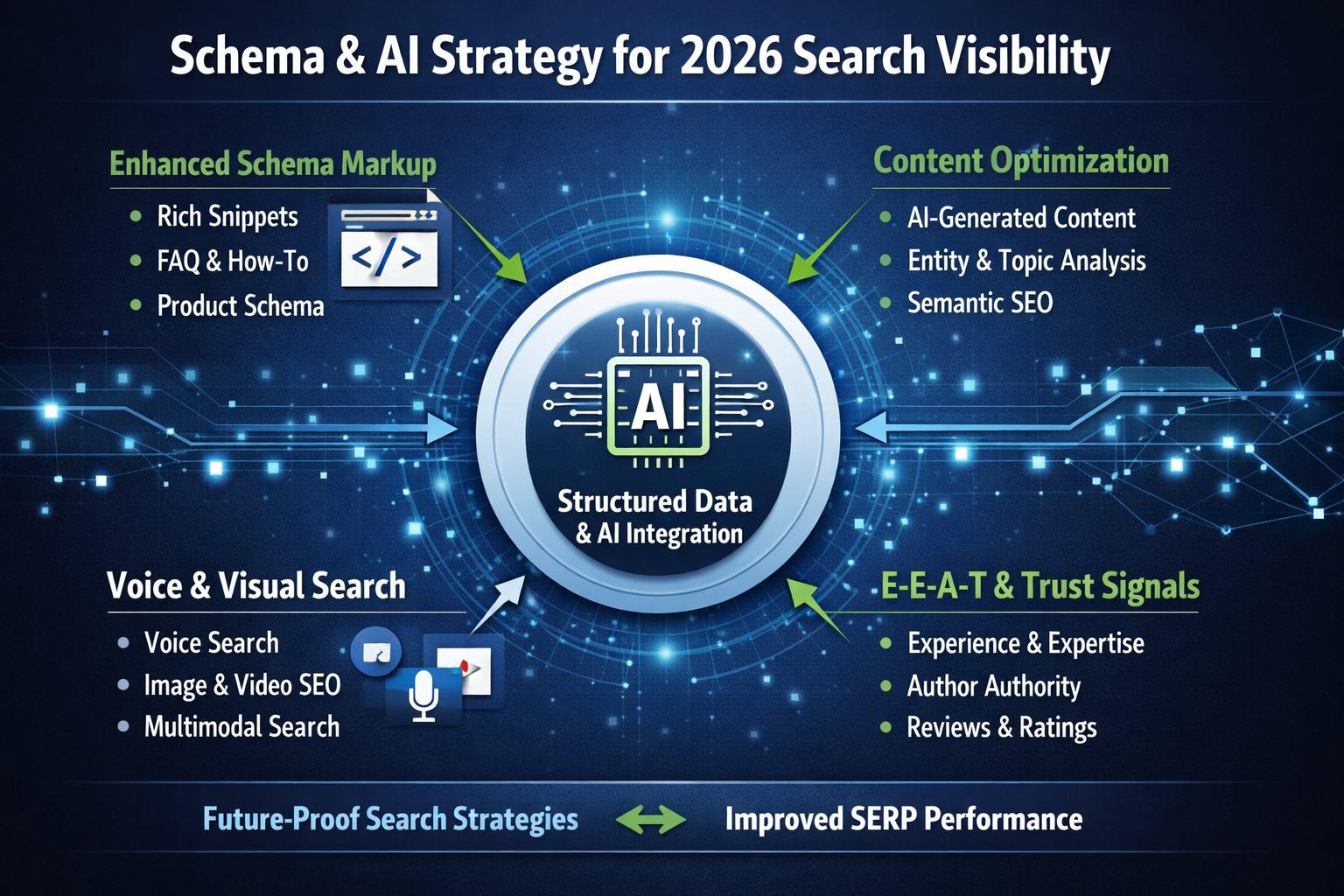
Schema Strategy Guide for AI Search in 2026
Schema strategy for 2026 is no longer a side task for plugins or a box to tick after publishing. It is part of how search engines and AI systems understand your brand, your services, and the relationships between the facts on your site.
The short version is simple: start with clear Organization markup, add Service markup to your money pages, and use FAQPage only where the questions are visible and genuinely helpful. That approach gives Google cleaner entity signals and gives answer engines more usable context to work with.
For brands targeting the US, UK, Germany, and the wider EU, that matters even more now. Google expanded AI Overviews to more than 200 countries and territories and more than 40 languages in May 2025, after saying in October 2024 that AI Overviews had already reached more than 1 billion monthly users. By May 2025, Google also said AI Overviews had scaled to over 1.5 billion users.
If your business sells expertise, software, consulting, healthcare services, or ecommerce support, the goal is not “more markup.” The goal is clearer meaning. That means your homepage should define who you are, your service pages should define what you offer, and your supporting content should answer real buyer questions in plain language. This final version was edited from the user-provided draft.
What a schema strategy means in 2026
A schema strategy is a plan for deciding.
Which entities matter most,
Which page types deserve markup first,
Which facts must stay consistent across the site,
And how your team will maintain that markup over time.
That is very different from dropping random Schema.org properties into a CMS.
Basic schema implementation is technical. Strategy is editorial and commercial. It decides how your homepage, service pages, about page, and FAQ sections work together to reinforce one clear brand entity.
Why schema still matters in AI search
Schema still matters because Google explicitly says it uses structured data it finds on the web to understand page content and gather information about the world more broadly. Rich results are never guaranteed, but structured data still helps machines interpret what a page is about and how entities connect.
In practice, that means structured data helps with.
Brand disambiguation,
Service clarity,
Stronger consistency across templates,
And cleaner answer extraction when your on-page copy is direct.
That last point matters for AEO. AI systems do not just reward markup. They reward pages that combine markup with obvious, concise answers.
Which schema types deserve priority first
For most service-led businesses, the smartest rollout looks like this.
Organization schema
Use this on the homepage and key brand pages to define your company name, logo, URL, contact details, and relevant profile links. Google’s documentation specifically supports Organization markup for helping search understand administrative and identity details.
Service schema
Use this on commercial pages where you are clearly offering a service. This is where you can reinforce what the service is, who it is for, and where it is offered.

FAQ Page schema
Use it only when the page contains visible, useful questions and answers. FAQ markup still has semantic value, but Google now limits FAQ rich results to well-known government and health sites. For most commercial brands, FAQ schema is for clarity, not for chasing a flashy SERP feature.
What changed with FAQ and How To markup
A lot of older schema advice is outdated.
Google says FAQ rich results are only available for well-known, authoritative government-focused and health-focused sites. That means most businesses should stop treating FAQPage as a shortcut to extra search real estate.
HowTo is even less attractive as a visibility play. Google announced that How-to rich results are deprecated. So if you still use HowTo, use it because the page genuinely teaches a process, not because you expect a visual boost in search.
That shift is why schema strategy for 2026 is less about decoration and more about machine-readable meaning.
A practical schema framework for business websites
A good framework starts with business goals, not schema names.
Ask what each page is supposed to do.
Generate leads
Build trust
Clarify the brand
Reduce objections
Support local discovery
Then match the markup to the job.
Here is a simple model.
| Page Type | Primary Goal | Recommended Schema |
|---|---|---|
| Homepage | Brand/entity clarity | Organization |
| Service page | Lead generation | Service |
| About page | Trust and identity | Organization |
| Contact/location page | Local relevance | Local Business when location matters |
| Support/FAQ page | Objection handling | FAQ Page if visible and useful |
| Tutorial page | Step-by-step education | How To only if the format truly fits |
Use JSON-LD as the default implementation format, then validate every important template with Google’s Rich Results Test and monitor issues in Search Console.
How to write FAQ content that helps both SEO and AEO
Your FAQ section should not sound like filler. It should resolve real buying friction.
Good FAQ answers usually follow this structure.
Answer the question in the first sentence.
Add one or two clarifying details.
Keep the wording plain.
Avoid hype, vague promises, or generic intros.
For example, a healthcare SaaS page in the US might answer whether deployment supports HIPAA-related security expectations. A UK consultancy page may need to address privacy handling under UK GDPR. A German or EU-focused page may need more direct wording around GDPR, data residency, or regulated-sector expectations. Official guidance from HHS and the ICO shows why clear safeguards and transparency language matter in those markets.
Organization vs. Local Business.
This is where many sites get messy.
Use Organization when your company is broader than one office or one city. That fits many SaaS firms, agencies, consultancies, and multi-market service businesses.
Use Local Business when location is central to how you sell, deliver, or get discovered. That fits local agencies, clinics, legal offices, and service providers with strong geographic intent.
If you serve multiple regions, start with one stable Organization entity first. Then add local markup only where the page truly represents a real operational location.
Localizing schema strategy for the US, UK, Germany, and EU
The structure can stay consistent across markets, but the trust layer should not.
US
For SaaS, healthcare, ecommerce, and local services, make your service definitions clear and avoid broad compliance claims. If you reference health data handling, the HIPAA Security Rule focuses on administrative, physical, and technical safeguards.
UK
For UK pages, consistent company identity and privacy wording matter. The ICO’s UK GDPR guidance emphasizes clear and concise information about how personal data is used, which makes transparency-heavy FAQ content and contact details more important.

Germany and the wider EU
For Germany and the EU, keep one core entity but localize service copy, compliance language, and FAQs by market. If cloud residency is part of your positioning, be specific. Microsoft says Azure provides 70+ regions globally, and AWS maintains multiple regions across Europe and other geographies, but infrastructure claims should only appear when they are directly relevant to your service delivery model.
Common schema mistakes that weaken trust
The biggest problems are usually not technical errors. They are credibility errors.
Avoid these.
Adding FAQ markup to questions that are not visible on the page,
Stuffing too many schema types onto one URL,
Using markup that does not match the real purpose of the page,
Inconsistent business details across templates,
And making compliance or trust claims that your page does not support.
Clean, accurate, boring consistency usually wins.

How to measure whether your schema strategy is working
Do not judge schema by markup volume.
Judge it by whether it improves.
Qualified organic traffic,
Click-through rate on key templates,
Assisted conversions,
Brand/entity clarity,
And structured-data health in Search Console.
Validation still matters. So does maintenance. When templates change, services change, or regional messaging changes, your markup needs to change too.

Wrapping It Up
The best schema strategy for 2026 is focused, not bloated.
Start with the pages that matter most. Define your organization clearly. Mark up your real services. Add FAQ Page only where it genuinely helps users. Then support all of that with answer-first copy, strong entity consistency, and localized trust signals for the markets you serve.
That is what makes schema useful now. Not because it looks clever in code, but because it makes your business easier for search engines and AI systems to understand.( Click Here’s )
FAQs
Q : Does schema strategy for 2026 still matter if rich results are limited?
A : Yes. Even when a page does not earn a visible rich result, structured data still helps Google understand content and entities more clearly. That makes it useful for SEO, AEO, and overall site consistency.
Q : Is Organization schema enough for a service business website?
A : It is the right starting point, but not the full solution. Your homepage can define the brand, while service pages should define the offer and FAQs should answer buyer questions where relevant.
Q : Should every service page have FAQ schema?
A : No. Add FAQ Page only when the questions are on the page and genuinely useful. For most brands, the semantic value matters more than the chance of a rich result.
Q : Can one schema framework work across the US, UK, Germany, and the EU?
A : Yes, at the framework level. Keep one core brand entity and one validation process, then localize the copy, FAQs, and trust signals by market.
Q : How often should schema be reviewed?
A : A quarterly review is a practical baseline for most growing businesses. Review sooner after redesigns, migrations, new service launches, or regional expansion.