


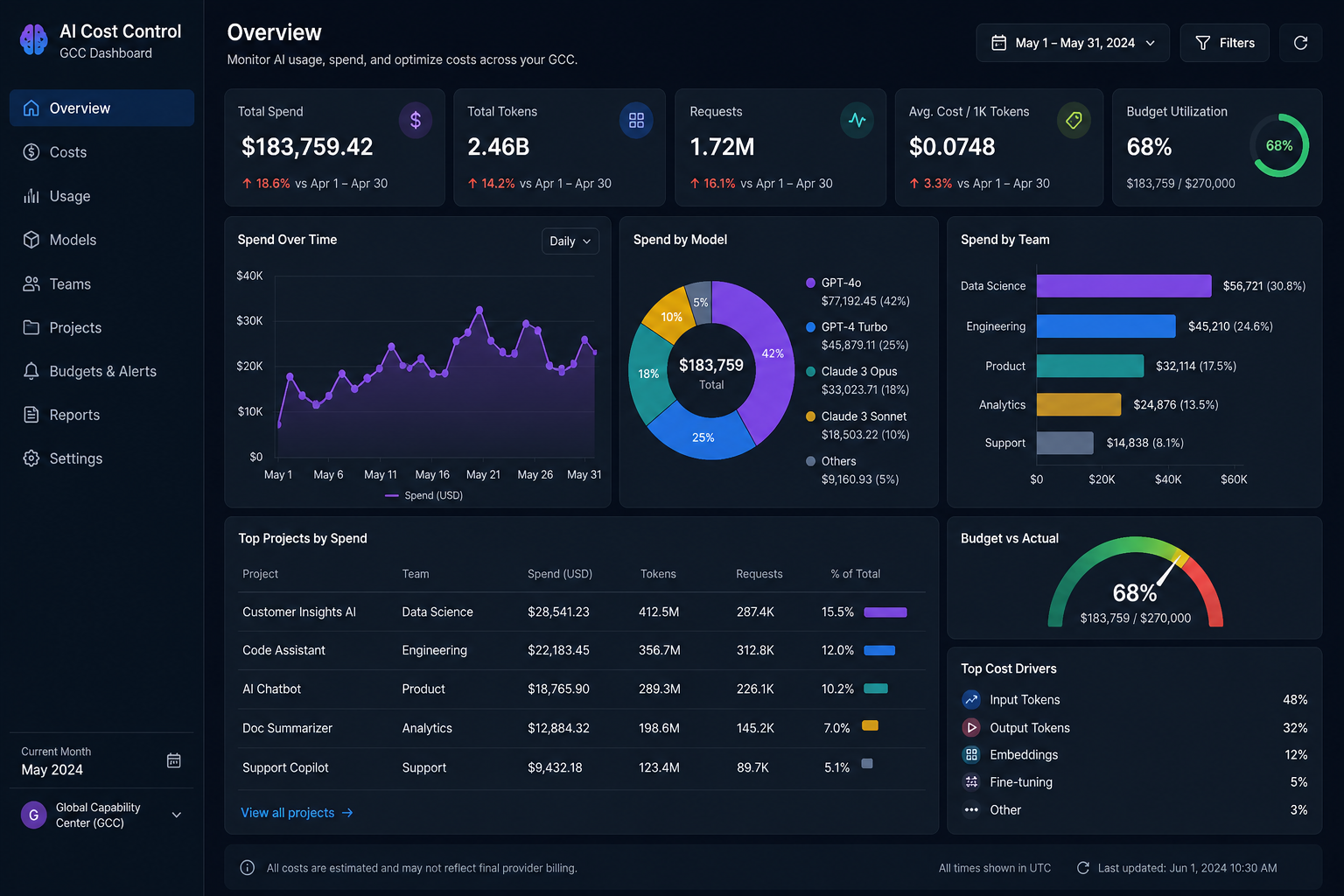
AI Cost Control GCC: Smarter AI Spend
AI pilots in Riyadh, Dubai, Abu Dhabi, and Doha are no longer just experiments. They are moving into customer support, fintech workflows, e-commerce personalization, document automation, and internal productivity tools. That shift is exciting, but it also brings a new problem: AI bills can rise quietly and quickly.
AI cost control GCC means tracking, forecasting, and optimizing AI spend across GPUs, cloud infrastructure, tokens, models, vector databases, and compliance-sensitive systems. For Saudi, UAE, and Qatar businesses, it helps reduce waste while supporting data residency, Arabic UX, regulated cloud adoption, and long-term AI growth.
For GCC companies, cost control is not only about cutting the bill. It is about building AI systems that are scalable, secure, and commercially practical. A Riyadh fintech, a Dubai e-commerce brand, and a Doha financial institution may all need different controls because cloud adoption is shaped by local regulators, data rules, and business risk.
SAMA’s cloud computing requirement, for example, says member organizations should define, implement, monitor, and periodically evaluate cybersecurity controls for hybrid and public cloud services.
What Is AI Cost Control for GCC Companies?
AI cost control GCC is the practice of measuring and reducing AI infrastructure costs without weakening performance, security, or compliance.
It covers.
GPU and inference costs
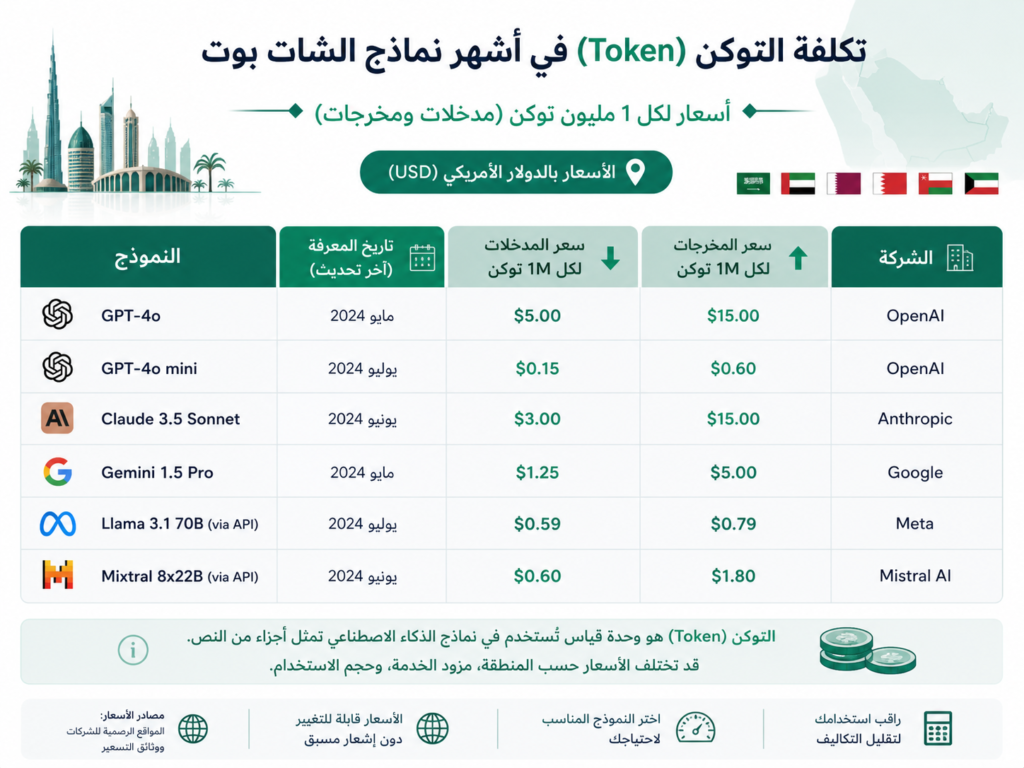
Cost per token
Model selection
Prompt and context design
Vector database usage
Observability and MLOps
Data pipelines
Cloud region planning
Compliance-sensitive hosting decisions
In simple terms, it helps teams answer one important question: Are we spending the right amount on the right AI workloads?
AI Cost Control vs Traditional Cloud Cost Optimization
Traditional cloud and web application planning usually focuses on compute, storage, databases, bandwidth, and backups.
AI workloads add a different layer of complexity. You also need to watch GPU utilization, model inference, embedding calls, long context windows, retry logic, prompt chains, vector search, and model-level usage.
That is why a normal cloud cost review is not enough for most production GenAI systems.
Why AI FinOps Is Becoming Essential in Saudi, UAE, and Qatar
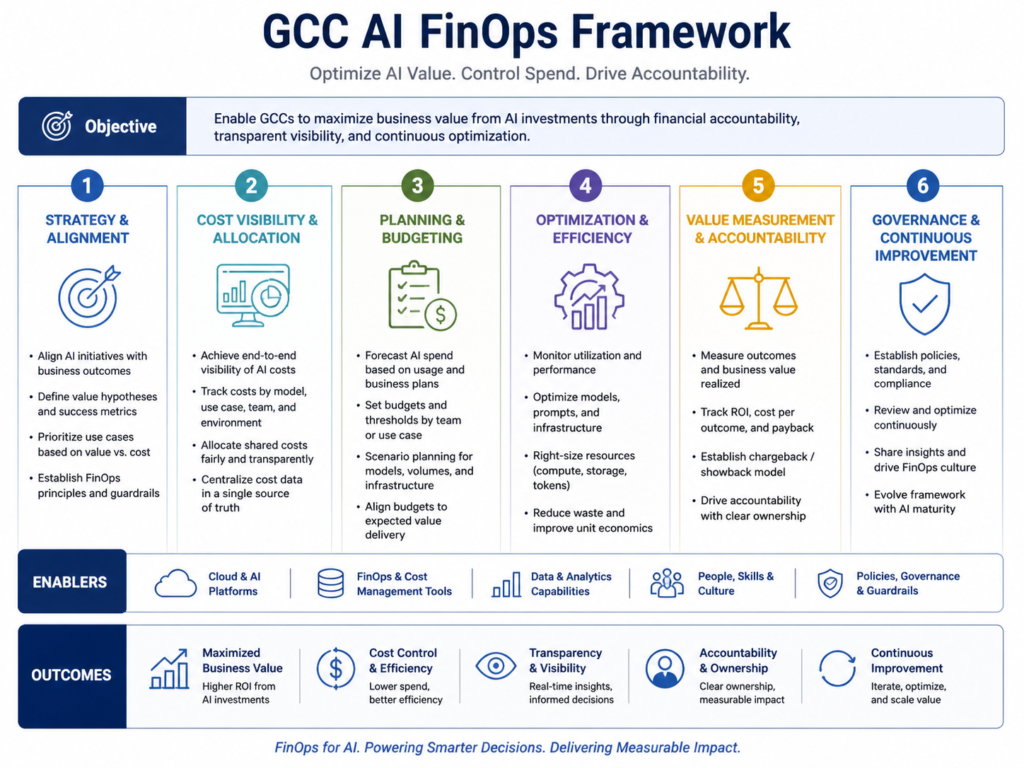
AI FinOps brings finance, CTOs, cloud teams, AI engineers, and product owners into one shared cost governance model.
Without that shared ownership, teams may launch GenAI features before anyone understands the true cost per conversation, GPU idle time, retrieval cost, or production-scale inference spend.
In practice, AI FinOps helps GCC teams move from “the AI bill looks high” to “this model, feature, department, or user journey is driving the cost.”
Key Metrics for AI Cost Control GCC
Strong AI cost governance tracks more than the total monthly cloud bill. Useful metrics include.
Cost per token
Cost per user session
Cost per AI feature
GPU utilization
Idle compute
Model-level spend
Retrieval and embedding cost
Chargeback and showback
AI ROI by business unit
For executive reporting, dashboards from business intelligence services can connect AI spend with revenue, productivity, support resolution time, or customer experience.
Why AI Costs Rise So Quickly in GCC Markets
GPU Scarcity and Overprovisioned AI Workloads
AI teams often reserve powerful GPUs for training, fine-tuning, or inference, then leave them underused outside peak hours.
That waste can be expensive. Right-sizing, workload scheduling, batch inference, autoscaling, and reserved or spot capacity can all help reduce idle compute.
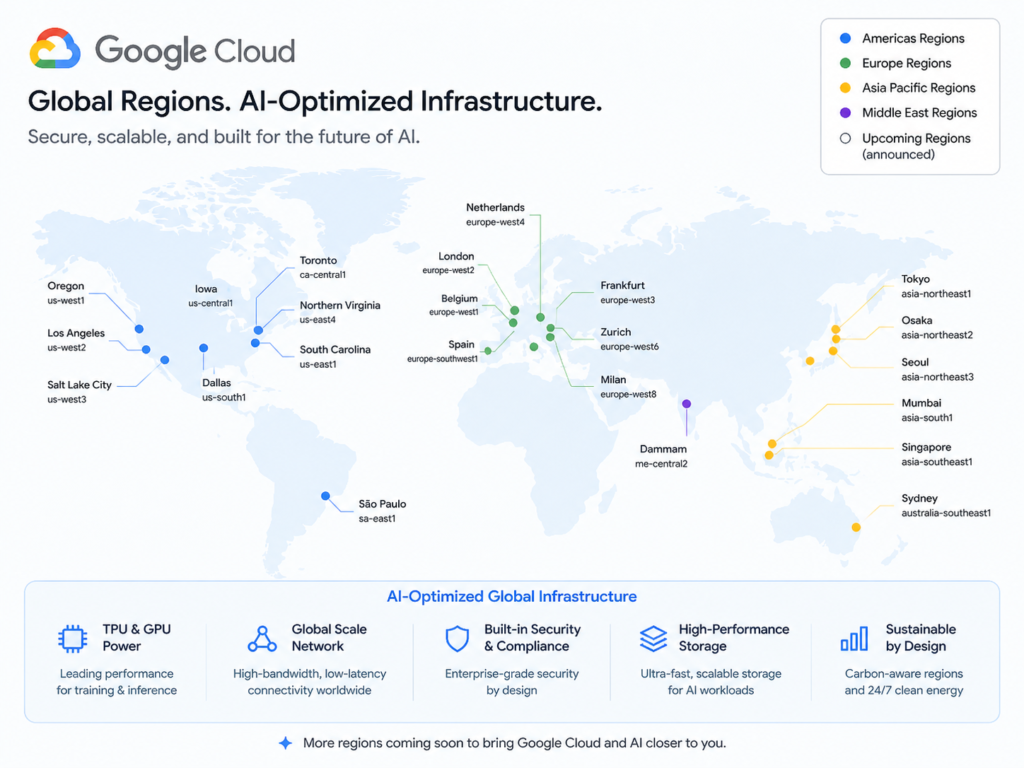
For GCC teams, cloud region choice also matters. AWS lists Middle East regions including Bahrain and UAE, while major cloud providers continue to expand regional infrastructure options for regulated and latency-sensitive workloads.
Arabic UX, Bilingual Chatbots, and Token Consumption
Arabic-English support can increase token usage because prompts often include bilingual context, retrieved documents, brand rules, policy instructions, and longer customer questions.
A bilingual chatbot serving customers in Jeddah, Dubai, or Doha may need more careful prompt design than an English-only bot.
To control token spend, teams should test real regional conversations, compress prompts, filter retrieval results, cache common answers, and set sensible response limits.
Cloud Bill Shock in Riyadh, Dubai, and Doha
AI bill shock often happens when a pilot becomes popular before the cost model is ready.
A Saudi startup may scale a customer support chatbot too quickly. A UAE retailer may add AI personalization to its e-commerce platform. A Qatar bank may automate document review with large context windows.
In each case, forecasting should happen before production launch, not after the first surprise invoice.
GCC Compliance Factors That Affect AI Cost Control
Saudi Arabia.
Saudi AI teams need to plan around data classification, hosting decisions, cybersecurity controls, and sector-specific expectations.
For regulated financial workloads, cloud use is not just a technical decision. It needs risk assessment, due diligence, policy controls, monitoring, and approval processes. SAMA’s cloud computing requirement specifically highlights defined, approved, implemented, monitored, and periodically evaluated controls for hybrid and public cloud services.
This matters for AI cost control because the cheapest architecture is not always the right architecture for regulated data.
UAE.
In the UAE, cloud governance is closely linked with digital trust and regulatory clarity.
TDRA’s Cloud Service Provider initiative is designed to gather information about cloud providers operating in or engaging with the UAE market, while strengthening transparency, trust, collaboration, and the regulatory framework for cloud services.
For Dubai and Abu Dhabi fintech teams, ADGM and DIFC expectations can also influence vendor governance, data handling, outsourcing controls, and audit readiness.
Qatar.
Qatar financial institutions should connect AI cost control GCC with QCB expectations.
QCB issued cloud computing regulations for the financial sector to support secure, risk-based cloud adoption. The requirements address governance of cloud usage, the cloud computing lifecycle, and operational security controls.
Qatar teams also have local cloud infrastructure options. Google Cloud announced its Doha region was open in March 2023, giving businesses in Qatar another regional option for cloud services and lower-latency workloads.
How to Reduce AI Infrastructure Costs in the GCC
Optimize GPU Allocation and Reduce Idle Compute
Start with visibility. Before changing vendors or models, understand where the money is going.
Useful actions include.
Track GPU utilization by workload
Shut down idle development environments
Schedule non-urgent jobs outside peak hours
Use autoscaling for inference endpoints
Move batch tasks away from always-on GPUs
Separate training, testing, and production budgets
Review reserved capacity before making long commitments
Small changes can produce meaningful savings, especially when teams are running multiple AI experiments at once.
Choose the Right Model for Each Use Case
Not every workflow needs the largest model.
Use smaller or specialized models for classification, extraction, routing, tagging, and repetitive tasks. Use premium models where deeper reasoning, complex support, or high-value decision support is genuinely needed.
Teams building AI features into mobile app development projects should test model quality against cost before launch. A model that performs slightly better may not be worth the extra spend for every user journey.
Control Token Usage with Prompt, Cache, and Context Design
Token usage is one of the easiest AI costs to overlook.
To reduce unnecessary spend.
Remove repeated prompt instructions
Limit retrieved documents to the most relevant context
Cap response length where possible
Cache common answers
Track token cost by feature
Monitor retries and failed requests
Test Arabic and English prompts separately
For Arabic UX, do not rely only on English benchmarks. Real Saudi, Emirati, and Qatari user conversations often reveal different prompt length, intent, and retrieval patterns.
AI Cost Control Use Cases Across GCC Industries
Fintech and Banking in Saudi, UAE, and Qatar
A Riyadh fintech can reduce AI cloud cost risk by tagging every model, tenant, environment, and product feature while staying aligned with SAMA expectations.
A Doha bank can forecast AI spend before expanding fraud detection, credit analysis, or document automation under QCB cloud governance requirements.
In regulated sectors, the goal is not simply to spend less. The goal is to spend wisely while keeping evidence, controls, and accountability in place.
Government and Smart City AI Workloads
Government AI often involves Arabic NLP, citizen services, document processing, call center automation, and strict data handling.
Here, AI cost governance should balance service availability with procurement-ready documentation, local hosting choices, and careful access control.
Cost savings are useful, but reliability and trust matter just as much.
Retail and Logistics AI in Riyadh, Dubai, and Doha
Dubai retailers may use GenAI for product discovery, product descriptions, and customer support. Logistics teams in Riyadh and Doha may use AI for route optimization, demand forecasting, and warehouse planning.
Pairing AI systems with digital marketing analytics helps connect spend to conversion, retention, customer satisfaction, and service quality.
Building an AI FinOps Framework for GCC Teams
Create Cost Ownership Across Finance, Cloud, and AI Teams
AI cost control GCC works best when every AI feature has a clear owner, budget, and measurable outcome.
A practical ownership model may include.
CFO or finance team for budget governance
CTO or CIO for architecture direction
Cloud team for infrastructure optimization
MLOps team for model monitoring
Product owners for feature-level ROI
Compliance team for regulated data decisions
When ownership is unclear, waste usually grows.
Forecast AI Spend Before Production Launch
Before moving from pilot to production, run usage simulations.
Estimate expected users, prompts per session, tokens per request, model mix, retrieval cost, GPU demand, monitoring cost, and support load.
For GCC markets, add Arabic-English testing, data residency review, vendor risk review, and compliance documentation into the planning stage.
Use Chargeback, Show back, and Tagging
Tagging is the foundation of AI cost visibility.
Useful tags include.
Department
Product
Model
Tenant
Cloud region
Environment
Customer segment
Experiment or production status
Showback gives teams visibility into their usage. Chargeback adds direct accountability when business units need to own their AI spend.
Choosing the Right AI Cost Control Partner in the GCC
What to Look for in an AI FinOps or Cloud Cost Partner
A strong AI cost control partner should understand more than cloud discounts.
Look for experience in.
GPU optimization
Cloud-native engineering
Model selection
Arabic UX patterns
FinOps reporting
Compliance-aware architecture
Executive dashboards
Secure AI deployment
Mak It Solutions’ SEO and AEO planning can also support visibility for AI-enabled products, especially when search, content, and automation are part of the growth strategy.
Saudi, UAE, and Qatar Evaluation Checklist
For Saudi Arabia, ask about SAMA awareness, data classification, and cloud control documentation.
For the UAE, check TDRA awareness, vendor governance, ADGM and DIFC sensitivity, and cloud-region planning.
For Qatar, confirm QCB familiarity, financial data handling, and Doha cloud infrastructure planning.
The right partner should help reduce waste without creating compliance gaps.
When to Run an AI Cost Audit
Run an AI cost audit before scaling GenAI, after a cloud bill spike, before committing to GPUs, or before entering regulated GCC markets.
A useful audit should review.
GPU utilization
Cost per token
Model selection
Prompt design
Retrieval and embedding cost
Cloud region usage
Tagging quality
Forecasting accuracy
Compliance-sensitive workloads
For broader architecture and delivery support, review Mak It Solutions services and related AI-ready capabilities.
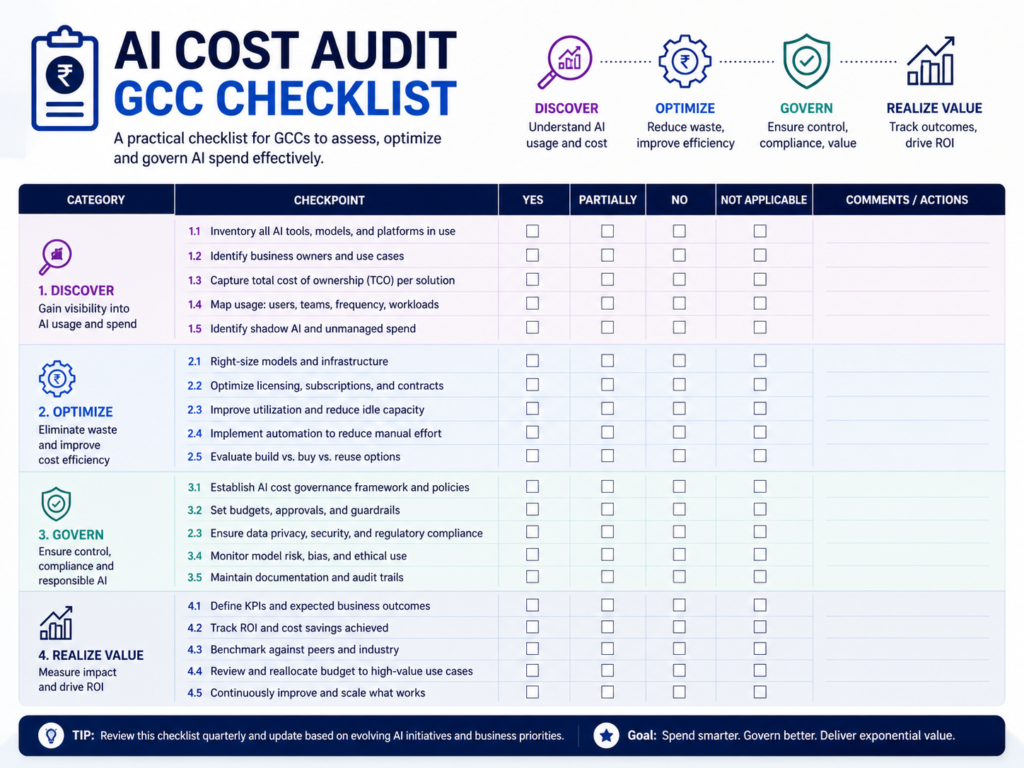
Last Words
AI cost control GCC is now a serious priority for Saudi, UAE, and Qatar teams moving from AI pilots to production systems.
The best approach is not to slow innovation. It is to make AI spend visible, measurable, and tied to business value. With the right model choices, token controls, GPU planning, tagging, and compliance-aware architecture, GCC companies can scale AI with more confidence.
Planning AI in Saudi Arabia, the UAE, or Qatar? Mak It Solutions can help review AI workloads, reduce cloud waste, improve token efficiency, and build a GCC-ready AI cost control strategy. Contact Mak It Solutions to request a consultation or custom AI FinOps roadmap.
FAQs
Q : What is AI cost control GCC?
A : AI cost control GCC is the process of tracking, forecasting, and optimizing AI-related spend for businesses in Gulf markets such as Saudi Arabia, the UAE, and Qatar. It includes GPUs, model inference, tokens, cloud regions, retrieval systems, and compliance-sensitive infrastructure.
Q : How can Saudi companies reduce AI cloud costs without compliance risk?
A : Saudi companies should reduce AI costs through governance, not shortcuts. Start with data classification, workload tagging, GPU monitoring, hosting decisions, and documented cloud controls. For SAMA-regulated workloads, cloud cybersecurity controls should be approved, implemented, monitored, and evaluated.
Q : Do UAE companies need AI FinOps before launching GenAI products?
A : Yes, especially when GenAI products will serve large user volumes or process sensitive data. UAE companies should estimate cost per session, token volume, model usage, support load, and vendor risk before launch. TDRA’s cloud initiatives also show the importance of transparency and trusted cloud governance in the UAE market.
Q : How should Qatar financial institutions manage AI infrastructure costs?
A : Qatar financial institutions should combine AI FinOps with cloud governance. That means forecasting workloads, tagging model spend, reviewing vendor risk, limiting access to financial data, and documenting security controls. QCB’s cloud computing regulations focus on governance, lifecycle controls, and operational security.
Q : Why can Arabic chatbots cost more to run?
A : Arabic chatbots can cost more because they often use bilingual Arabic-English prompts, longer context, localized retrieval, and policy instructions. GCC teams can reduce spend through prompt compression, caching, response limits, and real regional conversation testing.