


AI Security Checklist for WhatsApp Agents in GCC
AI Security Checklist for WhatsApp Agents in GCC
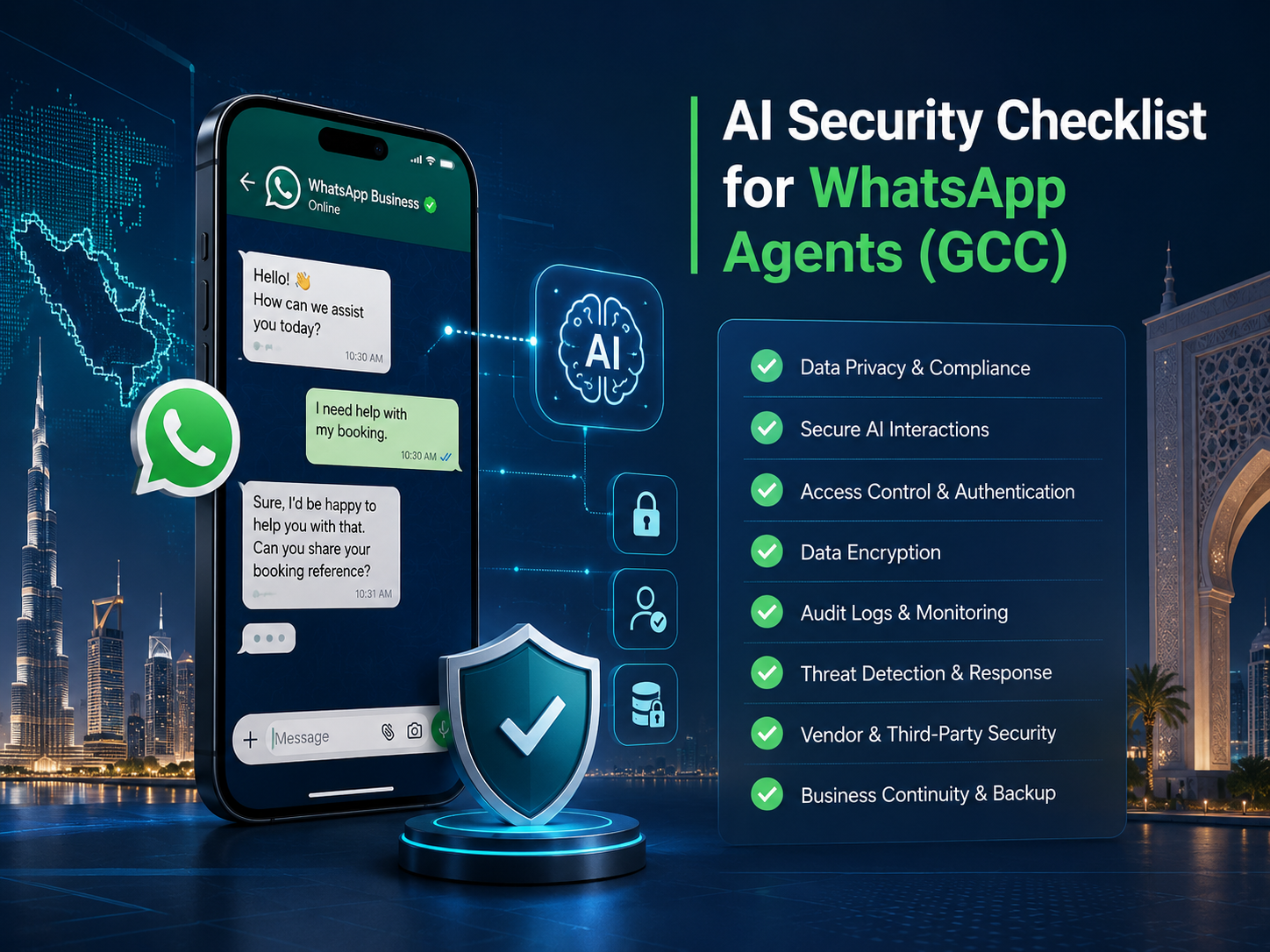
AI Security Checklist for WhatsApp Agents in GCC
GCC businesses are adopting WhatsApp AI agents quickly, but speed should not come at the cost of customer trust. An AI security checklist for WhatsApp agents helps teams protect conversations, reduce automation risks, and prepare for compliance expectations in Saudi Arabia, the UAE, and Qatar.
At its core, this checklist covers official WhatsApp Business setup, consent, access control, secure API integration, audit logs, human handoff, Arabic UX, and data residency. Before any WhatsApp AI agent goes live, these controls should be reviewed, tested, and documented.
What Is an AI Security Checklist for WhatsApp Agents?
An AI security checklist for WhatsApp agents is a practical control list used before launching AI-powered WhatsApp automation. It helps a business confirm that its agent is safe, compliant, monitored, and ready for real customer conversations.
A well-built WhatsApp AI agent can answer FAQs, qualify leads, check order status, collect support details, book appointments, and escalate sensitive cases. For example, a Dubai ecommerce brand may use it for returns, a Riyadh fintech may use it for onboarding support, and a Doha SME may use it for bilingual customer service.
The risk is that WhatsApp conversations often contain personal details: names, phone numbers, addresses, order history, complaints, and sometimes financial or health-related information. That is why security cannot be added later. It has to be part of the launch plan from day one.
Why WhatsApp AI Agent Security Matters in GCC
In Saudi Arabia, the UAE, and Qatar, businesses are expected to handle customer data carefully. This is especially important for regulated sectors such as fintech, banking, healthcare, logistics, and government-linked services.
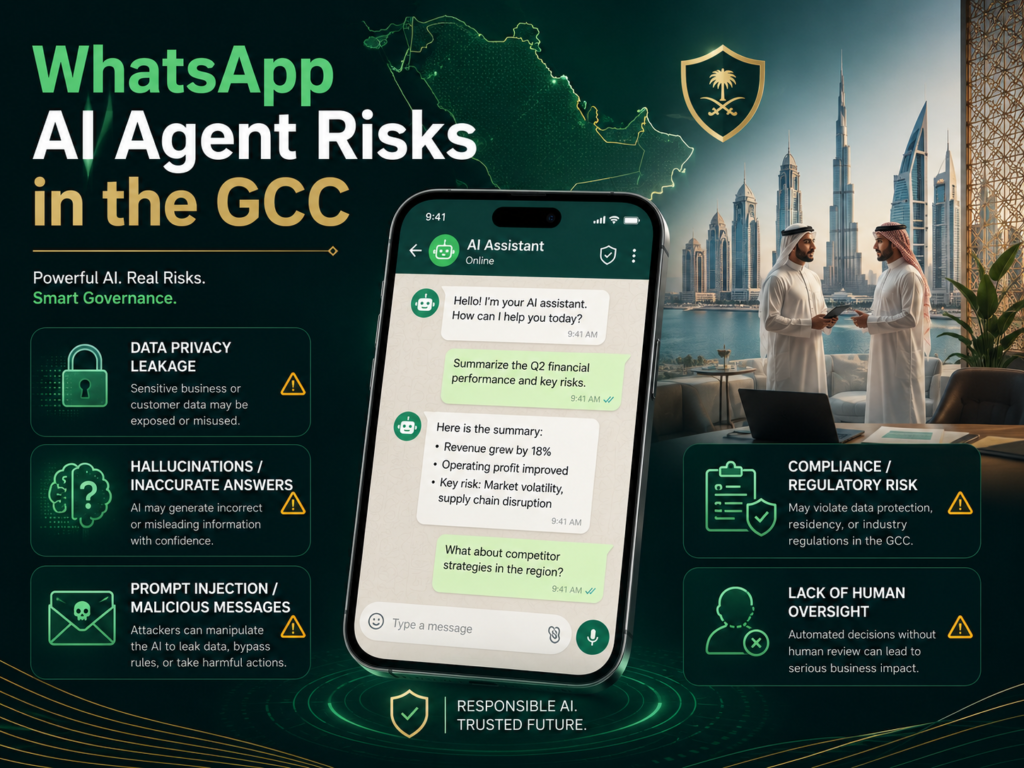
A weak WhatsApp automation setup can create serious problems, including.
Customer data leakage
Unsafe AI responses
Prompt injection attacks
Unofficial WhatsApp tool risks
Poor consent records
Missing audit logs
Unclear human escalation paths
In practice, the safest WhatsApp AI agents are not just fast. They are controlled, monitored, and limited to the data and actions they actually need.
Core Security Risks in WhatsApp AI Agents
Customer Data Leakage
The biggest risk is exposing customer data to the wrong system, vendor, staff member, or AI model.
Businesses should limit what the agent can access, mask sensitive fields, and avoid sending unnecessary personal data into prompts. Retention periods should also be defined clearly, especially when chat logs are used for training, analytics, or support review.
Prompt Injection and Unsafe Responses
Prompt injection happens when a user tries to trick the AI into ignoring instructions, revealing hidden rules, or taking actions it should not take.
For GCC businesses, prompt injection protection should include.
Strong system guardrails
Restricted tools and actions
Approved knowledge sources
Response filters
Human approval for sensitive topics
Financial, legal, medical, complaint-heavy, and identity-related conversations should never rely only on the AI agent.
Unofficial WhatsApp Tools
Avoid tools that rely on QR-code scraping, personal WhatsApp accounts, or unclear automation methods. These shortcuts can create account, compliance, and security risks.
Use the official WhatsApp Business Platform and keep the setup connected to a verified Meta Business environment. That makes governance, templates, webhooks, and business ownership easier to manage.
GCC Compliance Checks Before Deployment
Saudi Arabia.
Saudi businesses should map what personal data the WhatsApp AI agent collects, why it is collected, where it is stored, and who can access it.
Before launch, review.
Customer consent and notice language
Data retention rules
Cross-border data transfer controls
Access permissions
Audit logs
Vendor contracts
Escalation for regulated workflows
For fintech, banking, or payment-related use cases, SAMA-related governance expectations may require stronger controls and clearer audit evidence.
UAE.
UAE businesses should design WhatsApp journeys with consent, privacy, and opt-out discipline in mind.
A Dubai or Abu Dhabi company should avoid spam-like messaging, use approved WhatsApp Business methods, and clearly explain how customer data is used. DIFC and ADGM firms should also review their own data protection obligations before connecting WhatsApp automation to CRM, support, or financial records.
Qatar.
Qatar businesses should involve compliance early, especially in banking, fintech, insurance, and other sensitive sectors.
A Doha lender, payments startup, or logistics provider should define consent, access, data retention, hosting, and escalation rules before connecting a WhatsApp AI agent to CRM, KYC, or support systems.
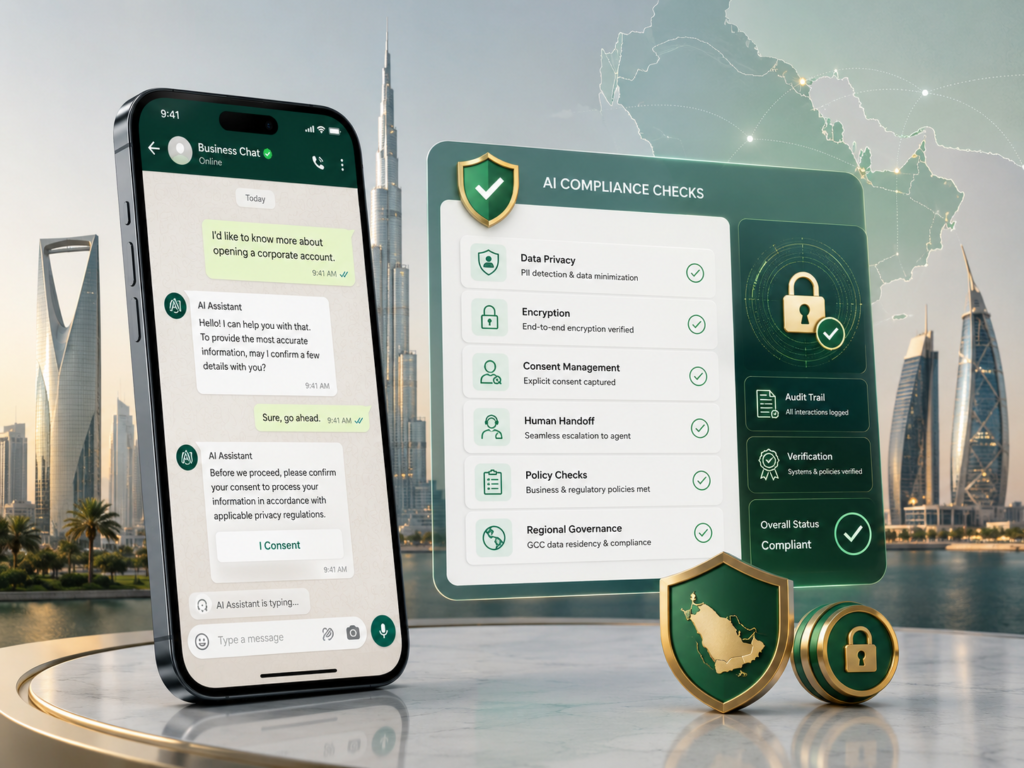
The AI Security Checklist for WhatsApp Agents
Use this AI security checklist for WhatsApp agents before launch.
Verify official WhatsApp Business Platform setup.
Document consent and customer notice flows.
Limit agent access with role-based permissions.
Secure APIs, webhooks, tokens, and secrets.
Add prompt-injection protection and response filters.
Keep audit logs for messages, actions, and escalations.
Add human handoff for high-risk requests.
Test Arabic, English, and mixed-language conversations.
Review hosting, retention, and vendor contracts.
Verify WhatsApp Business Platform and Meta Business Setup
Start with a clean Meta Business setup, verified ownership, approved templates, and documented message flows.
For secure backend logic, teams can use Mak It Solutions’ Python development services or web development services to connect WhatsApp automation with business systems safely.
Control Access, APIs, Webhooks, and Admin Permissions
Every admin account, API key, webhook endpoint, and AI tool should have a named owner.
Use least privilege. Do not let the agent access payment systems, health records, identity documents, or private customer history unless there is a clear business reason and a logged approval path.
Add Human Handoff and Escalation Rules
Human handoff protects both the customer and the business.
A Riyadh fintech can route lending complaints to compliance. A Dubai ecommerce brand can escalate angry return cases to support. A Doha SME can send legal, payment, or sensitive account questions to trained staff.
AI should handle routine tasks. People should handle judgment-heavy cases.
Data Residency, Hosting, and Arabic UX in GCC
Saudi Data Residency and Regional Hosting
For Saudi projects, review whether customer data should stay in-country or within approved regional infrastructure. Hosting choices should support privacy, resilience, latency, and internal compliance expectations.
This matters more when the WhatsApp AI agent handles customer identity, payments, complaints, or regulated-sector workflows.
UAE Cloud and Enterprise Procurement
UAE enterprises often ask about regional hosting, procurement, uptime, and integration with existing cloud environments.
Before launch, confirm where data is processed, where logs are stored, who can access them, and whether vendors can support UAE-specific business and compliance requirements.
Qatar Cloud Readiness
Doha businesses should consider latency, data residency, operational continuity, and sector-specific requirements.
A simple retail chatbot may have different hosting needs from a QCB-regulated financial workflow. The more sensitive the data, the stronger the hosting and governance review should be.
Arabic-First User Experience
Arabic UX is not just a translation task. It affects trust, clarity, and escalation quality.
A secure WhatsApp AI agent for GCC should handle.
Arabic
English
Arabizi or mixed-language messages
Local greetings and tone
Right-to-left formatting
Sensitive complaint wording
Clear fallback to human support
For many Riyadh, Dubai, and Doha customers, a respectful Arabic-first experience can reduce confusion and improve support quality.
Industry Use Cases for Secure WhatsApp AI Agents
Fintech and Banking
A Riyadh fintech should use masked data, strong access controls, audit logs, and human approval before allowing WhatsApp automation near onboarding, complaints, payments, or financial guidance.
This is not financial advice. Regulated businesses should always involve their legal, compliance, and risk teams before deployment.
Retail and Ecommerce
A Dubai ecommerce brand can use a secure WhatsApp AI agent for order tracking, return requests, delivery updates, and product questions.
For connected journeys, Mak It Solutions’ e-commerce development services and mobile app development services can support smoother customer experiences across WhatsApp, websites, and mobile apps.
Logistics and Government-Linked Services
A Doha logistics provider can automate delivery updates while keeping complaint escalation and audit logs in place.
For dashboards, reporting, and operational visibility, business intelligence services can help leaders monitor automation performance and risk.
How to Choose a Secure WhatsApp AI Agent Partner in GCC
The right partner should be able to explain how your WhatsApp AI agent handles data, security, integrations, Arabic UX, and compliance risk.
Ask these questions before signing.
Do you use the official WhatsApp Business Platform?
Where is customer data hosted?
How are prompts and logs protected?
Who owns the API keys and webhook endpoints?
Can we review audit logs?
How do you test Arabic and mixed-language conversations?
What happens when the AI is unsure?
How does human handoff work?
Red Flags to Avoid
Be careful with vendors that.
Use unofficial WhatsApp automation methods
Cannot explain data flows
Avoid compliance questions
Provide no audit trail
Do not test Arabic properly
Give the AI too much system access
Promise guaranteed compliance without review
Cheap shortcuts can become expensive during incidents, complaints, audits, or account restrictions.
Final Launch Checklist for Riyadh, Dubai, and Doha Teams
Before launch, confirm that your WhatsApp AI agent is secure, tested, and documented.
Your final review should include.
Official WhatsApp Business setup
Consent and customer notice language
Role-based access control
Secure webhook and API configuration
Token and secret management
Prompt-injection testing
Arabic and English QA
Human handoff rules
Audit logs
Hosting and retention review
Vendor contract review
For growth after launch, connect automation with digital marketing services and SEO services so the WhatsApp journey supports the full customer funnel.
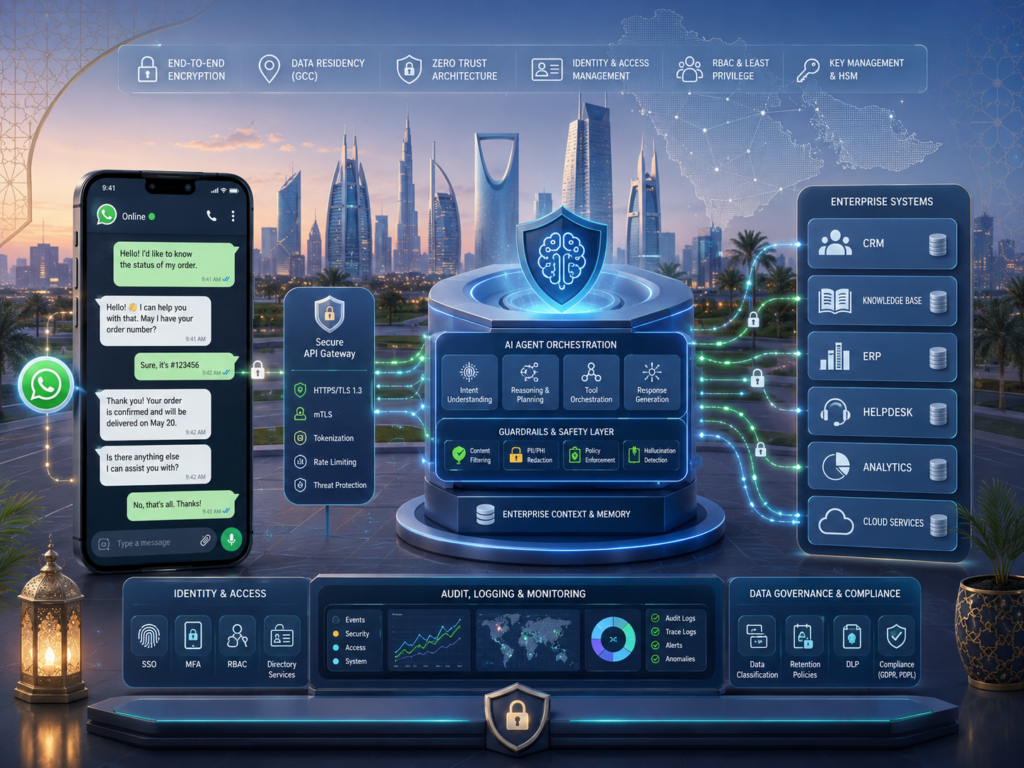
Concluding Remarks
An AI security checklist for WhatsApp agents gives GCC businesses a safer way to launch automation without losing control of customer data, compliance expectations, or brand trust.
Whether your team is in Saudi Arabia, the UAE, or Qatar, the goal is simple: use official WhatsApp infrastructure, protect sensitive data, add human handoff, test Arabic UX, and document every important control.
Ready to launch a safer WhatsApp AI agent for GCC customers? Contact Mak It Solutions to review your workflow, compliance risks, Arabic UX, and integration needs.
FAQs
Q : Is a WhatsApp AI agent allowed for Saudi businesses under PDPL?
A : Yes, Saudi businesses can use WhatsApp AI agents, but they should treat customer conversations as personal data when those chats identify or relate to individuals. Teams should define purpose, consent, access, retention, and transfer controls before launch.
Q : Do UAE companies need TDRA approval for WhatsApp AI automation?
A : Most UAE companies do not treat every WhatsApp AI agent as a separate telecom service, but they should still respect consent, customer privacy, and official WhatsApp Business methods. DIFC and ADGM firms should also review their own data protection obligations.
Q : Can Qatar businesses store WhatsApp chatbot data outside Qatar?
A : It depends on the sector, data type, contract, and regulatory expectations. A Doha retailer may have more flexibility than a regulated financial institution, but every Qatar business should review hosting, processor terms, customer notices, and transfer controls.
Q : What is the safest way to connect WhatsApp Business API with an AI agent in Dubai?
A : Use the official WhatsApp Business Platform, secure webhooks, encrypted transport, role-based access, protected secrets, logging, prompt-injection testing, and human handoff for sensitive cases.
Q : Should Riyadh ecommerce stores use Arabic-first WhatsApp AI agents?
A : Yes. Arabic-first WhatsApp AI agents can improve clarity, trust, and customer experience for Riyadh ecommerce stores, especially for orders, returns, delivery updates, and complaint handling.