


Ransomware Defense Playbook for SMEs in GCC
Ransomware Defense Playbook for SMEs in GCC
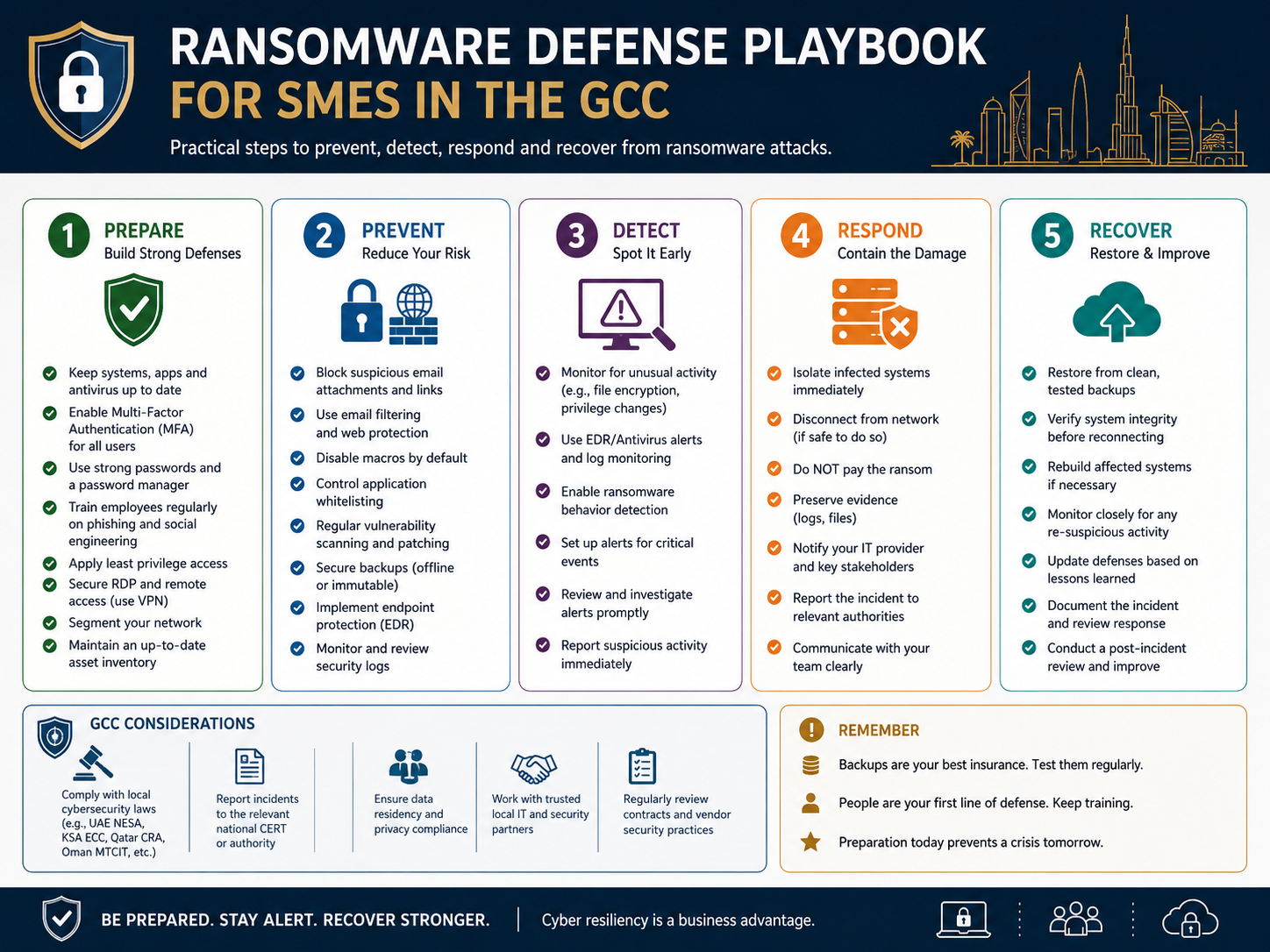
Ransomware Defense Playbook for SMEs in GCC
A ransomware defense playbook for SMEs is a practical plan that helps small and mid-sized businesses prevent attacks, respond fast, restore clean systems, and reduce downtime. For GCC businesses in Saudi Arabia, UAE, and Qatar, the playbook should cover email security, MFA, endpoint detection, protected backups, incident response, recovery testing, and local compliance awareness.
Ransomware does not only target large enterprises anymore. SMEs in Riyadh, Dubai, Abu Dhabi, Jeddah, and Doha now depend on cloud apps, online payments, WhatsApp-based sales, vendor portals, and remote access. These tools help businesses move faster, but they also create openings attackers can abuse.
A strong ransomware defense playbook for SMEs gives business owners and IT teams a clear path before panic starts. The goal is not just to “stop ransomware.” The real goal is to keep operations moving, protect customer trust, and recover safely if one bad email becomes a serious incident.
What Is a Ransomware Defense Playbook for SMEs?
A ransomware defense playbook for SMEs is a written and tested plan that explains what to protect, who takes action, how backups are restored, and who must be notified during an attack.
It turns cybersecurity from a vague checklist into a clear operating process.
Why SMEs in Saudi, UAE, and Qatar Need a Practical Playbook
Most SMEs do not have a full-time security operations center. A Riyadh fintech, a Dubai e-commerce store, or a Doha logistics company may depend on a small IT team or an external provider.
That is why the playbook must be simple. Everyone should know what to do, who to call, and which systems matter most.
Prevention, Response, and Recovery.
A good ransomware plan has three layers.
| Layer | What It Does | Examples |
|---|---|---|
| Prevention | Reduces the chance of an attack | MFA, patching, secure email, awareness training |
| Response | Limits damage during an incident | Isolate devices, disable accounts, escalate fast |
| Recovery | Restores clean operations | Tested backups, restore steps, business continuity plan |
Prevention matters, but recovery is just as important. In practice, many SMEs only discover their backup gaps after an incident. By then, every hour becomes expensive.
How a Playbook Differs from a Basic Cybersecurity Checklist
A checklist says, “Enable MFA.”
A playbook says who enables it, where it applies, how exceptions are approved, how alerts are reviewed, and what happens when ransomware is detected.
That extra detail makes the difference when teams are under pressure.
Key Ransomware Risks Facing GCC SMEs in 2026
Phishing, Arabic-English Email Scams, and Employee Awareness Gaps
Bilingual teams often receive invoices, HR files, supplier emails, courier notices, and bank alerts in Arabic and English. Attackers use this normal business flow to hide malicious links or attachments.
Train employees to slow down when they see urgency, payment changes, password reset links, or unexpected files.
Vendor Access, Remote Work, and Cloud Misconfiguration
A weak vendor account can become the doorway into your network. Remote desktops, cloud storage, admin dashboards, and shared drives should not be left open or loosely managed.
Use least privilege access, MFA, logging, and regular access reviews. Remove old accounts quickly, especially for former employees, temporary vendors, and inactive contractors.
Why Downtime Hurts Retail, Logistics, Fintech, and Government Suppliers
For a Jeddah retailer, ransomware can stop POS systems. For an Abu Dhabi logistics company, it can delay customs documents. For a Doha service provider, it can block customer records and invoices.
For SMEs serving banks, fintechs, healthcare groups, or government-linked clients, ransomware can also damage procurement confidence and audit readiness.
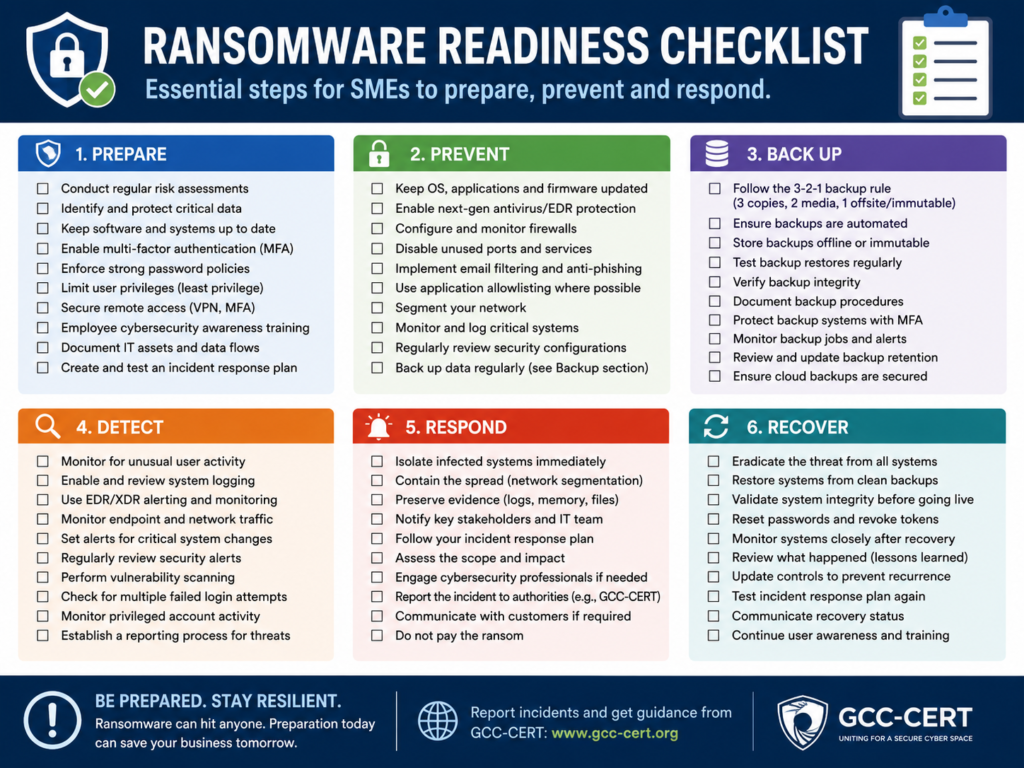
GCC Ransomware Defense Checklist for SMEs
Secure Email, Endpoint Detection, and Multi-Factor Authentication
Start with the basics that block the most common attack paths.
Use email filtering and attachment scanning.
Enable MFA for admin accounts, cloud apps, email, VPN, and finance systems.
Deploy endpoint detection and response on laptops, servers, and high-risk devices.
Patch operating systems, browsers, plugins, and business apps.
Restrict admin access to people who genuinely need it.
For secure application projects, Mak It Solutions’ web development services and back end development services can support stronger architecture and safer digital workflows.
Build Immutable Backups and Test Recovery Regularly
Backups are only useful if they can be restored.
Use the 3-2-1 model: keep three copies of important data, across two storage types, with one offline or immutable copy. Immutable backups are harder for attackers to change or delete.
Test restores monthly for critical systems. Document recovery time targets so leadership knows what can realistically come back first.
Create a Simple Escalation Plan Before an Attack Happens
Do not wait until systems are locked.
Your escalation plan should name.
Business decision-maker
IT or MDR contact
Legal contact
Cyber insurance contact
Bank or payment partner contact
Regulator or customer contact, where required
Store this plan outside the affected network. A printed copy or secure offline version can save time when email and shared drives are unavailable.
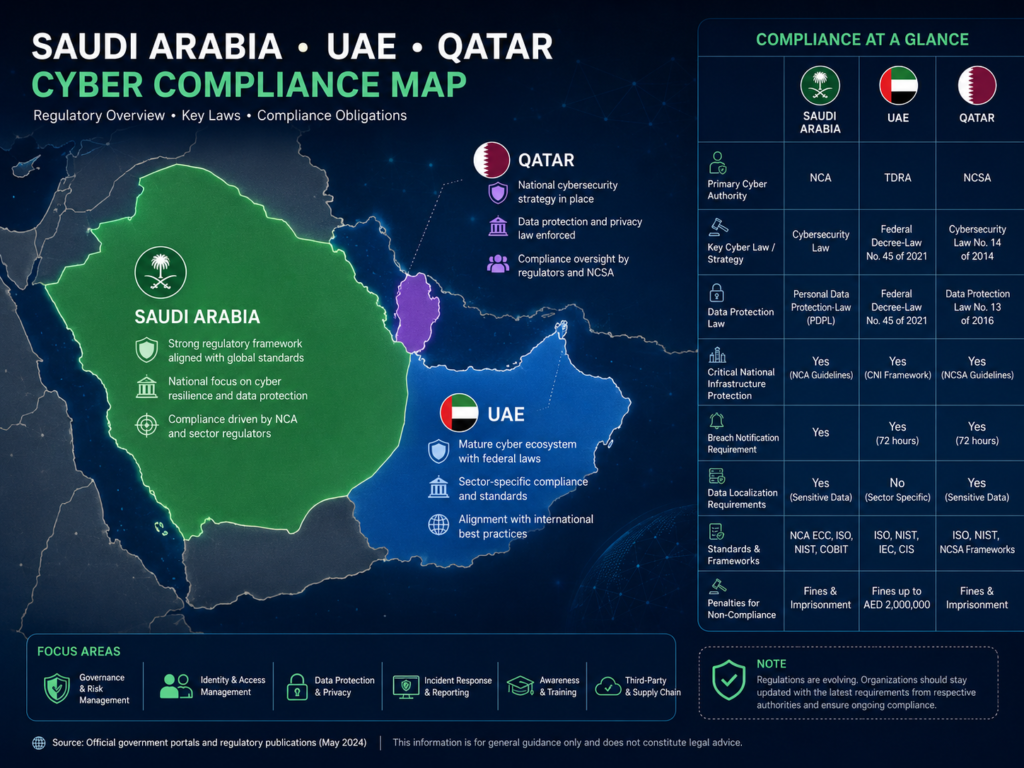
Compliance Considerations in Saudi, UAE, and Qatar
This section is general cybersecurity guidance, not legal advice. Regulated businesses should confirm obligations with qualified legal, compliance, and cybersecurity professionals.
Saudi Arabia.
Saudi SMEs serving banks, fintechs, government clients, or critical-sector supply chains should understand NCA and SAMA expectations.
The National Cybersecurity Authority lists Essential Cybersecurity Controls as ECC 2-2024, while SAMA’s Cyber Security Framework is designed to help member organizations manage cyber risks and assess maturity.
For SMEs, the practical takeaway is simple: build evidence. Keep records of access controls, backup tests, awareness training, incident response exercises, and third-party security reviews.
UAE.
UAE SMEs in Dubai, Abu Dhabi, Sharjah, DIFC, or ADGM should align cybersecurity with data protection, telecom, and sector expectations.
Customer-facing businesses should pay special attention to secure checkout, payment workflows, account protection, mobile app security, and customer data handling. Mak It Solutions’ mobile app development services and e-commerce solutions page can help teams design safer user experiences.
Qatar.
Qatar SMEs should pay attention to NCSA and QCB expectations, especially when working with finance, healthcare, or public-sector customers.
Qatar’s NCSA describes National Information Assurance certification as part of the National Information Security Compliance Framework, giving organizations a formal route to evidence compliance with national information security requirements.
Ransomware Incident Response Plan for SMEs
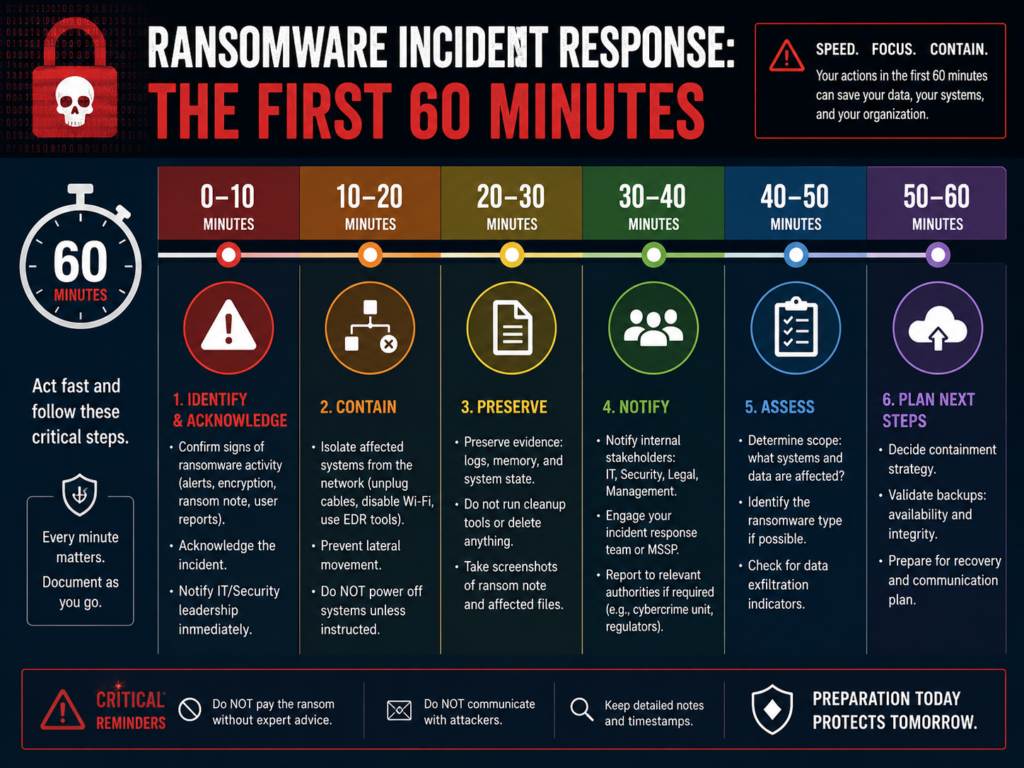
First 60 Minutes: Isolate, Preserve Evidence, and Escalate
The first hour is about containing damage.
Take these steps.
Disconnect affected devices from the network.
Disable suspicious accounts.
Preserve logs, screenshots, ransom notes, and alerts.
Contact your IT, MDR, or cybersecurity provider.
Avoid wiping systems before evidence is captured.
Start a decision log so every action is recorded.
Speed matters, but careless action can make recovery harder.
Who to Notify: IT Provider, Legal, Insurer, Regulator, and Bank
Notification depends on data type, industry, contract obligations, and local rules.
If payment credentials, bank access, customer records, or regulated data may be affected, escalate quickly. Banks and payment partners should be contacted early if there is any chance of transaction risk.
Why Paying the Ransom Should Not Be the Default Recovery Plan
Paying a ransom does not guarantee clean recovery. It may also attract repeat attacks and create legal, operational, or reputational risk.
The safer foundation is strong backup hygiene, tested recovery, endpoint detection, and a clear incident response process.
Managed Ransomware Protection Options in the GCC
MDR, SOC-as-a-Service, EDR, Backup, and Email Security
SMEs do not need to build everything internally.
Managed detection and response, SOC-as-a-Service, endpoint detection, secure backup, and email protection can give smaller teams enterprise-style coverage without the cost of a full in-house security department.
What to Look for in a GCC Cybersecurity Partner
Choose a partner that understands both technology and local business context.
Look for.
Fast escalation and response
Arabic-English phishing awareness training
Backup testing support
Compliance mapping
Clear reporting for management
Practical advice, not just tool dashboards
Local Support, Arabic Awareness Training, and Data Residency
Data residency and regional support matter in the GCC.
AWS launched its Middle East Bahrain Region with three Availability Zones, Google Cloud describes its Doha cloud region as having three zones, and Microsoft lists UAE regions as part of its global Azure infrastructure.
For SMEs, this means cloud choices should be reviewed alongside compliance, performance, backup location, and disaster recovery needs.
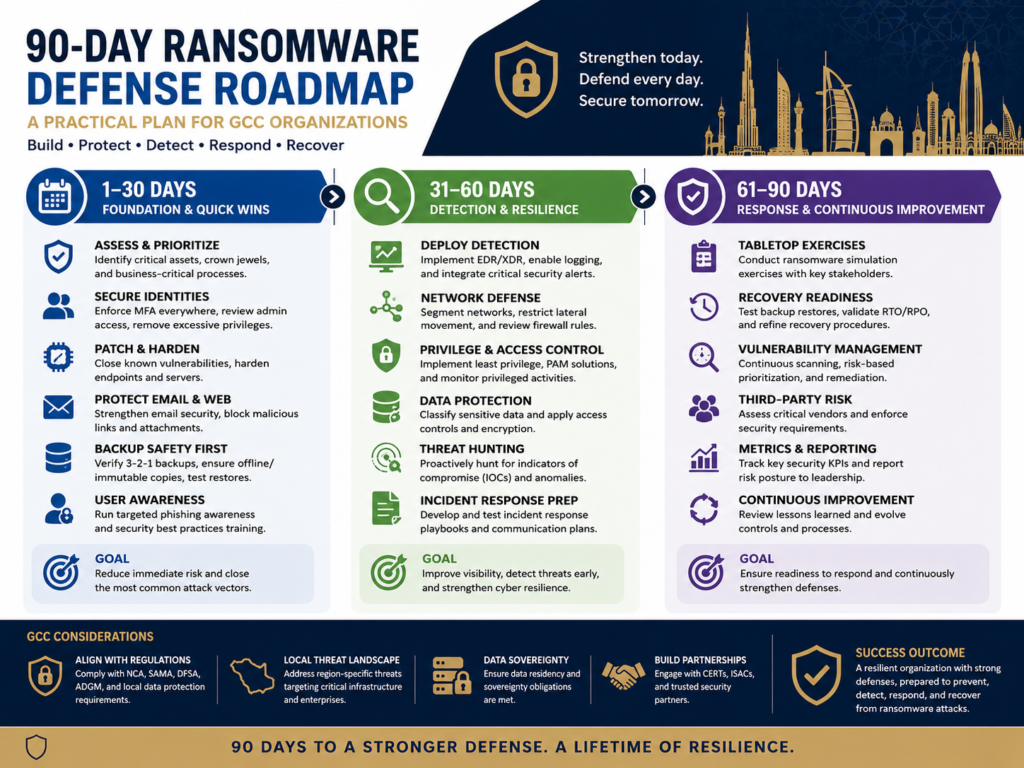
How to Build a 90-Day SME Ransomware Defense Roadmap
Risk Assessment, MFA, Backup Review, and Awareness
Start with visibility.
Map critical systems, user accounts, cloud apps, payment tools, and customer data. Then enable MFA, review backups, remove unused access, and run Arabic-English phishing awareness training.
Focus on the systems that would stop revenue, operations, or customer service if they went down.
Incident Response Plan, Tabletop Exercise, and EDR
Write a short incident response plan. Keep it practical.
Run a tabletop exercise with leadership, IT, finance, customer support, and operations. Walk through a realistic scenario: ransomware on a finance laptop, locked shared drive, or fake supplier payment request.
Then deploy EDR to high-risk devices and review alerts regularly.
Compliance Mapping, MDR Evaluation, and Recovery Testing
Map your controls against relevant expectations such as NCA, SAMA, TDRA, QCB, or NCSA, depending on your business and sector.
Then test restore speed. Can you recover your most important files, systems, and customer workflows without paying ransom?
Finally, evaluate whether MDR or SOC-as-a-Service is needed. If your team cannot monitor alerts or respond outside office hours, managed support may be worth it.
Final Recommendation
Every SME needs a minimum ransomware plan: MFA, patched systems, secure email, endpoint detection, protected backups, and a tested response process.
A ransomware defense playbook for SMEs is not just an IT document. It is a business continuity tool. It helps owners, managers, and technical teams make better decisions when pressure is high.
Upgrade from basic IT support to managed cybersecurity when you handle sensitive customer data, serve regulated clients, process payments, or cannot afford downtime. Mak It Solutions’ WordPress development, React development, PHP web development, and contact page can support secure digital growth.( Click Here’s )
Ready to build a GCC-ready ransomware defense playbook for SMEs? Contact Mak It Solutions to review your risks, strengthen your apps and cloud setup, and plan a practical cybersecurity strategy for Saudi Arabia, UAE, or Qatar.
FAQs
Q : Is ransomware protection required for Saudi SMEs working with banks or government clients?
A : Often, yes in practice. If a Saudi SME works with a bank, fintech, government supply chain, or critical-sector client, cybersecurity expectations can become part of procurement and audit readiness. SAMA and NCA expectations make ransomware protection especially important for regulated or high-trust environments.
Q : What is the best backup strategy for UAE small businesses against ransomware?
A : A UAE SME should use the 3-2-1 backup model: three copies, two storage types, and one offline or immutable copy. Backups should also be tested regularly because storage alone is not enough. A backup that cannot restore quickly is not a real recovery plan.
Q : How often should a Qatar SME test its ransomware recovery plan?
A : A Qatar SME should test key recovery steps at least quarterly and run a deeper restore test every six months. Businesses serving finance, healthcare, or public-sector clients should align testing with their contractual and regulatory expectations.
Q : Do GCC SMEs need a local SOC provider or can they use global tools?
A : They can use global tools, but local or region-aware support is valuable. A GCC-aware SOC understands Arabic-English phishing, regional working hours, data residency concerns, and compliance language across Saudi Arabia, UAE, and Qatar.
Q : How can Arabic-speaking employees be trained to detect ransomware phishing emails?
A : Use realistic GCC scenarios: fake courier messages, invoice changes, HR attachments, bank alerts, and Arabic-English supplier emails. Employees should learn to check sender domains, attachment types, payment requests, and urgency tactics before clicking or replying.