
Best Agentic AI Security Platform Guide
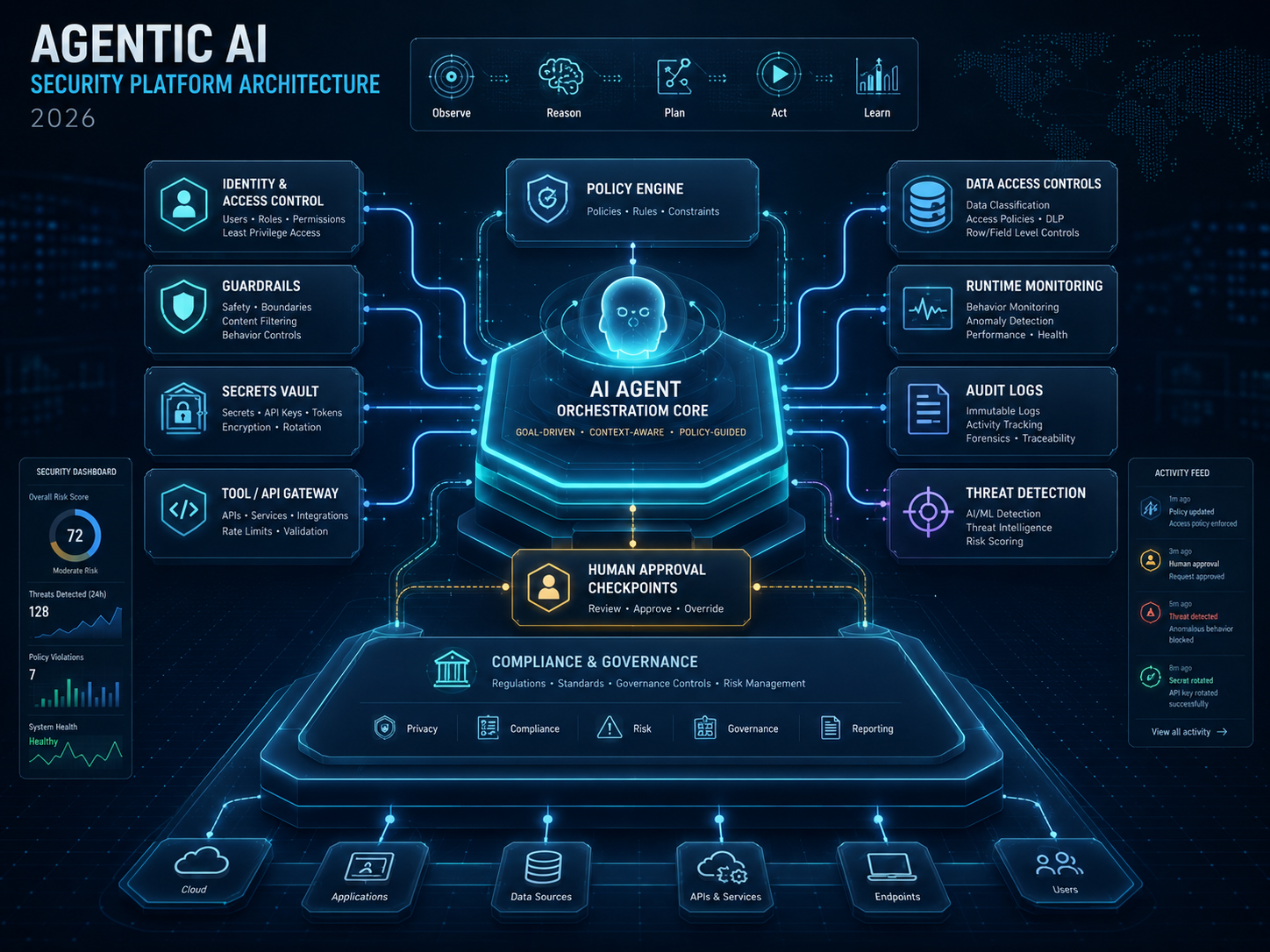
An agentic AI security platform helps enterprises secure autonomous AI agents that can access apps, call APIs, use MCP servers, and trigger workflows. In simple terms, it gives security teams control over what an AI agent can see, do, approve, block, and log.
For CISOs, SOC teams, IAM leaders, and compliance teams, the goal is not just “AI governance.” The real challenge is safer execution: making sure AI agents act within clear identity, access, policy, and audit boundaries.
Why Agentic AI Security Matters Now
AI agents are moving beyond chat assistance into real business workflows. A support agent may update CRM records. A finance agent may query payment data. A DevOps agent may call cloud APIs.
That shift creates a new security problem: agents do not just generate text; they act.
For teams in New York, London, Berlin, Austin, and San Francisco, the question is becoming urgent: how do you govern AI agents before they spread across SaaS, cloud, data, and customer-facing systems?
From AI Tools to Autonomous AI Agents
Traditional AI tools usually waited for a user prompt. Autonomous AI agents can reason through a task, retrieve context, call tools, and complete multi-step actions.
That makes them useful. It also makes them risky.
In practice, AI agents need security boundaries similar to service accounts, API users, bots, and robotic process automation. Without those controls, one small pilot can quietly turn into a web of unmanaged identities, permissions, and workflows.
What an Agentic AI Security Platform Does
An agentic AI security platform helps enterprises discover, govern, monitor, and control AI agents. It focuses on.
Agent identity and ownership
Access permissions
Runtime policy enforcement
Tool-call monitoring
Prompt injection protection
Audit logs
Compliance evidence
Incident response workflows
NIST describes the AI Risk Management Framework as voluntary guidance for managing AI risks across AI products, services, and systems. For agentic AI, that risk-management mindset needs to extend into runtime behavior, not just documentation.
What Is an Agentic AI Security Platform?
An agentic AI security platform is a security layer for autonomous AI agents that can access data, invoke tools, make API calls, and perform actions.
Unlike a general AI governance tool, it focuses on what agents are allowed to do before, during, and after execution.
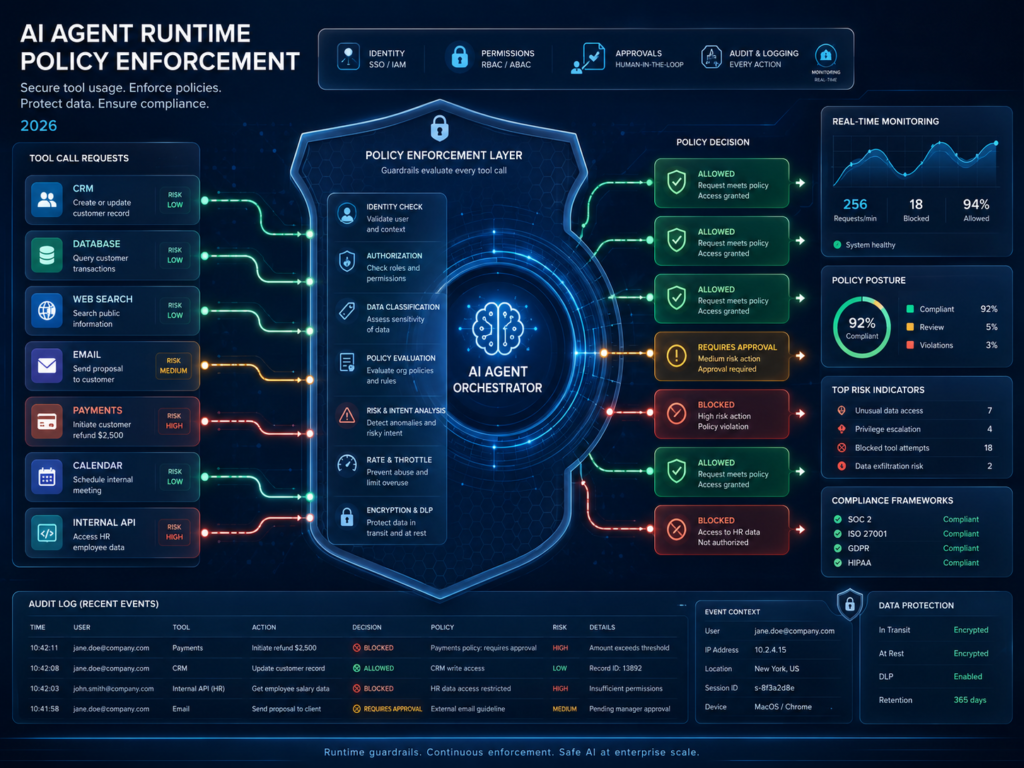
For example, a governance tool may document that an AI agent should not access sensitive payment data. An agentic security platform should help enforce that rule when the agent actually tries to query a payment API.
Core Capabilities.
A strong platform usually includes.
AI agent discovery
Non-human identity management
Least-privilege access controls
Runtime policy enforcement
Tool-call monitoring
LLM observability
Tamper-resistant audit logs
SIEM and SOAR integrations
Compliance reporting
For enterprises building secure AI-enabled products, this should complement custom software, cloud, and data engineering work such as Mak It Solutions web development services and business intelligence services.
How It Differs From Traditional AI Security
Traditional AI security often focuses on model risk, data leakage, prompt filtering, or governance documentation.
An agentic AI security platform focuses on autonomous behavior.
Which tools can the agent call?
What data can it touch?
When does it need human approval?
What happens if it receives a malicious prompt?
Can security teams reconstruct every action later?
That execution-level visibility is the real difference.
Key Security Risks for AI Agents in 2026
The biggest AI agent risks are unmanaged identities, excessive permissions, prompt injection, unsafe tool calls, and weak auditability.
These risks grow when agents connect to MCP servers, SaaS platforms, cloud consoles, internal APIs, and production databases.
Non-Human Identity Sprawl
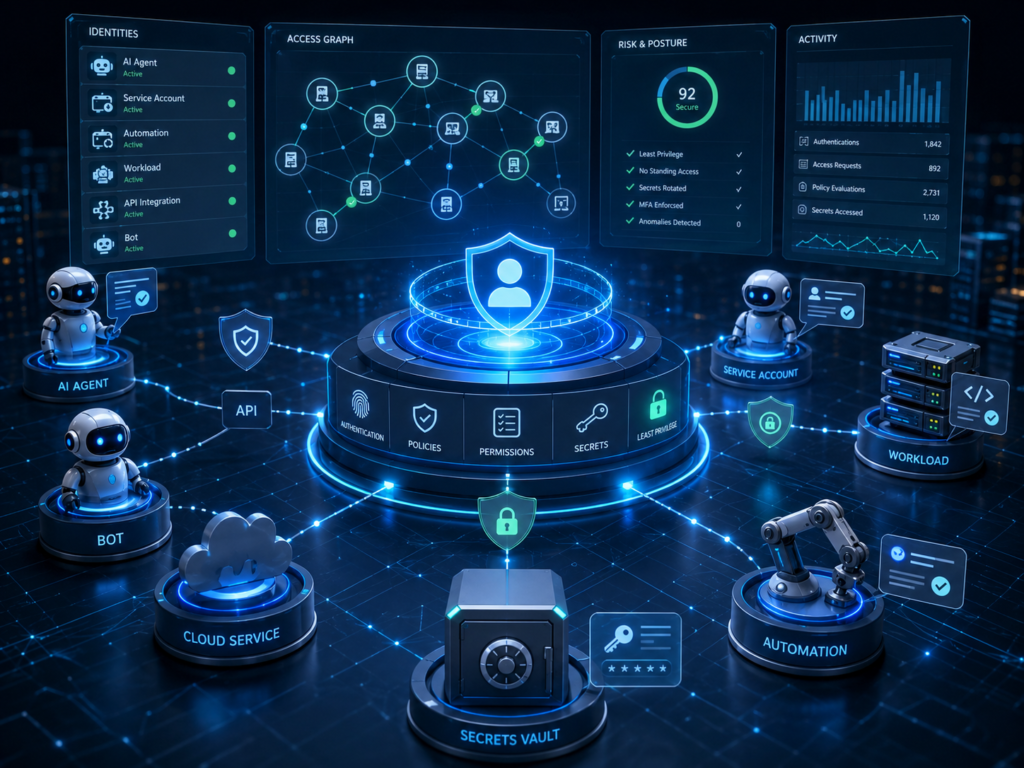
AI agents often behave like non-human identities. They may use service accounts, API keys, OAuth tokens, delegated user permissions, or workload identities.
Without governance, one pilot in Seattle or Manchester can become dozens of agents with standing access nobody reviews.
A practical platform should answer.
Who owns this agent?
Which identity does it use?
What systems can it access?
When was access last reviewed?
Can access be revoked quickly?
Prompt Injection and Unsafe Tool Use
Prompt injection can manipulate an AI agent into ignoring instructions, exposing data, or misusing tools.
The risk becomes more serious when the agent can take action. A bad prompt is one problem. A bad prompt that triggers a refund, changes permissions, sends an email, or modifies production code is another.
Runtime controls should block risky actions, require human approval for sensitive operations, and detect unusual tool-call chains.
MCP, API, SaaS, and Cloud Access Risks
Model Context Protocol adoption is making it easier for agents to connect with tools and data sources. That is useful, but every connector expands the attack surface.
MCP security should include scoped permissions, authentication, authorization, input validation, output filtering, logging, and revocation.
Must-Have Agentic AI Security Platform Capabilities
The best agentic AI security platform should combine identity governance, runtime controls, observability, and compliance evidence.
Runtime policy enforcement matters because it can stop unsafe behavior while the agent is acting, not after damage has already been logged.
AI Agent Identity Management and Access Control
Look for agent inventory, ownership mapping, authentication, access reviews, privilege mapping, and IAM integration.
A healthcare organization, for example, should prevent an AI agent from accessing electronic protected health information unless the use case is approved, access is limited, and activity is logged. HHS states that the HIPAA Security Rule requires administrative, physical, and technical safeguards to protect electronic protected health information.
Runtime Policy Enforcement and Tool-Call Monitoring
Runtime controls should evaluate high-risk actions such as:
Sending external emails
Changing permissions
Querying sensitive data
Creating support ticketsApproving refunds
Modifying code
Calling payment APIs
Accessing customer records
For SaaS teams, this can sit alongside secure React development services, Node.js/PHP backend services, and cloud-native application design.
LLM Observability and Incident Response
Strong platforms capture prompts, responses, retrieved data sources, tool calls, user approvals, errors, blocked actions, and downstream system changes.
SOC teams should be able to send events to SIEM tools, open incidents, reconstruct sessions, and prove what happened.
Good observability is not just about monitoring prompts. It is about tracing the full chain from user request to model reasoning, tool call, policy decision, and final business action.
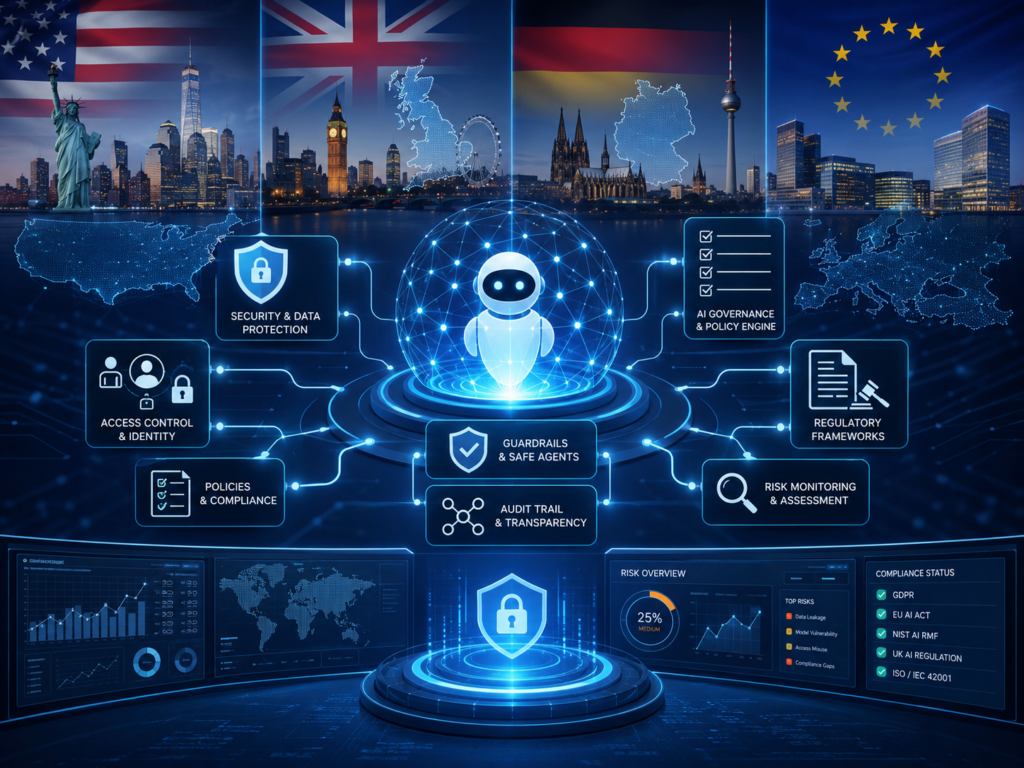
Compliance and Governance for the USA, UK, Germany, and EU
Agentic AI security should support auditability, access control, data minimization, human oversight, incident response, and risk documentation.
In Europe, it should also help prepare for GDPR, the EU AI Act, DORA, NIS2, BaFin expectations, and ISO 42001.
USA.
For US teams in New York, Austin, San Francisco, and Seattle, common concerns include SOC 2 controls, HIPAA safeguards, PCI DSS, FedRAMP alignment, SEC expectations, and FINRA recordkeeping.
PCI DSS is especially relevant when agents touch cardholder data, payment workflows, or e-commerce systems.
UK.
In London and Manchester, agentic AI security should support UK-GDPR accountability, FCA and PRA operational resilience, NHS data governance, Open Banking controls, and vendor risk management.
For UK buyers, privacy accountability and clear audit trails are especially important when AI agents process customer, patient, or financial data.
Germany and EU.
In Berlin, Munich, Frankfurt, Hamburg, Paris, Amsterdam, Dublin, and Zurich, buyers should consider GDPR/DSGVO, EU AI Act readiness, BaFin, BSI Germany, ENISA guidance, DORA, NIS2, ISO 27001, ISO 42001, eIDAS, and PSD2.
The EU AI Act entered into force on August 1, 2024, with key application dates phased in over time. The European Commission lists August 2, 2026 as a major applicability date, with exceptions.
DORA applies from January 17, 2025 and aims to strengthen ICT security and digital operational resilience for EU financial entities. ENISA also describes NIS2 as strengthening cybersecurity across the EU by setting higher standards for essential services.
ISO/IEC 42001 specifies requirements for establishing, maintaining, and improving an AI management system for organizations that provide or use AI-based products or services.
How to Compare Agentic AI Security Platforms
The right platform depends on your main risk: identity access, runtime behavior, compliance evidence, or full-stack AI security governance.
A bank in Frankfurt may prioritize DORA and BaFin evidence. A SaaS company in San Francisco may care more about API guardrails, SOC 2 logs, and developer workflow integration.
Questions CISOs Should Ask Vendors
Before buying, ask.
Can the platform discover all AI agents across SaaS, cloud, and internal apps?
Does it map agents to owners, identities, and permissions?
Can it enforce least privilege?
Does it monitor tool calls in real time?
Can it block or require approval for sensitive actions?
Does it support MCP security?
Can it detect prompt injection attempts?
Does it integrate with SIEM, SOAR, IAM, and ticketing tools?
Can it export audit evidence for compliance teams?
How does it handle data residency and regional compliance?
Identity-First vs Runtime-First vs Governance-First Platforms
Not every tool solves the same problem.
| Platform Type | Best For | Limitation |
|---|---|---|
| Identity-first | Non-human identity governance, access reviews, least privilege | May not deeply inspect runtime behavior |
| Runtime-first | Tool-call control, policy enforcement, unsafe action prevention | May need integration with IAM/GRC tools |
| Governance-first | Risk registers, policy mapping, audit readiness | May not enforce controls during execution |
| Full-stack | Broad agent security, monitoring, and compliance | Can require more planning and rollout effort |
Vendor Examples to Evaluate
Market examples include Protect AI, Prompt Security/SentinelOne, Entro Security, Veilfire, Hush Security, and C1.
Treat these as categories to evaluate, not automatic recommendations. Match the product to your architecture, compliance scope, deployment model, budget, and internal ownership.
Implementation Roadmap for Enterprise AI Agent Security
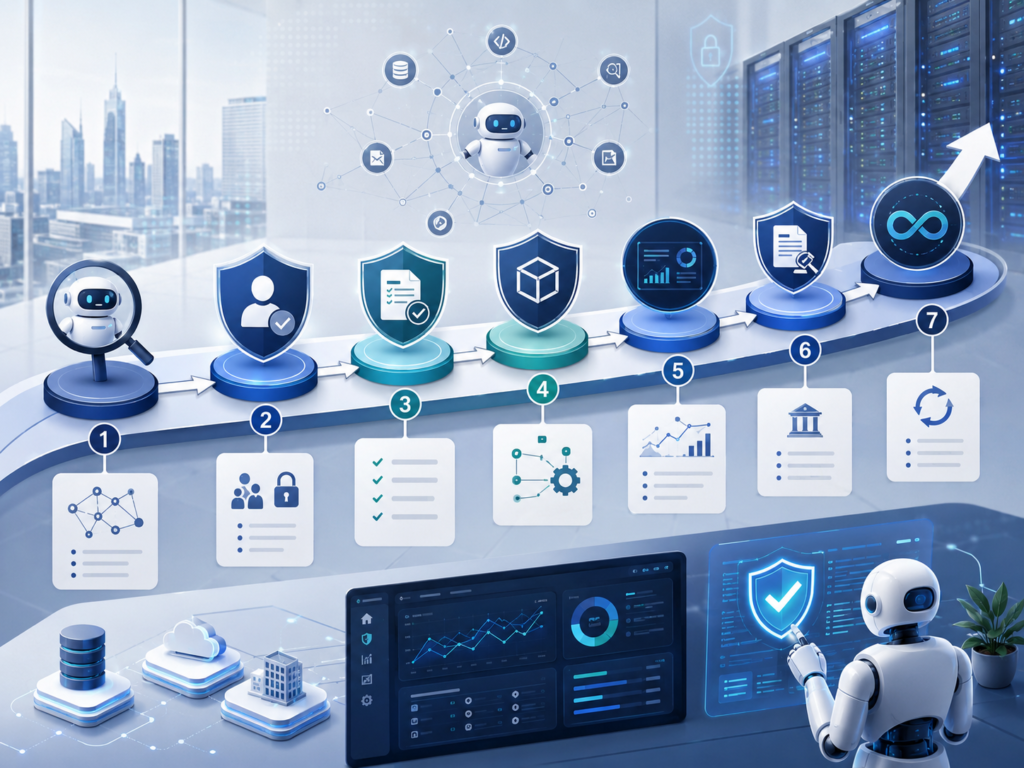
Enterprises should start by inventorying AI agents and their permissions, then enforce least privilege, monitor tool calls, and document controls for compliance.
This gives SOC, IAM, GRC, legal, and platform engineering teams a shared operating model.
Discover Agents, Tools, Identities, and Workflows
Create a register of.
AI agents
Agent owners
Models used
Tools and APIs
MCP servers
SaaS integrations
Data sources
Service accounts
Business workflows
Customer-facing actions
Include internal apps, automation scripts, customer support agents, AI copilots, and third-party AI features.
Apply Least Privilege, Runtime Policy, and Monitoring
Restrict each agent to the minimum data and tools required.
Add runtime policies for sensitive actions such as payment changes, production deployments, PHI access, financial approvals, and external communications.
Teams building custom dashboards or secure portals can pair this with React Native development, Angular development, or CodeIgniter development depending on the product stack.
Build Audit Trails for SOC, Legal, and Compliance Teams
Log prompts, outputs, tool calls, access decisions, approvals, blocked actions, and downstream system changes.
Make logs searchable, exportable, and aligned to SOC 2, ISO 27001, GDPR, UK-GDPR, HIPAA, PCI DSS, DORA, NIS2, and ISO 42001 evidence needs.
Concluding Remarks
An agentic AI security platform is becoming essential for enterprises scaling autonomous agents into production.
The right choice depends on your risk profile, regulatory scope, cloud stack, and operational maturity. Prioritize discovery, identity governance, runtime enforcement, MCP security, LLM observability, SIEM integration, audit evidence, and compliance mapping.
Before expanding agent deployments, assess where agents live, what they can access, and how actions are monitored. Mak It Solutions can help teams design secure AI-enabled SaaS, cloud, mobile, and analytics systems with practical governance built in.
Planning an AI agent rollout or worried your pilots are spreading faster than your controls? Explore Mak It Solutions services to start with a practical security and implementation discussion.( Click Here’s )
Key Takeaways
An agentic AI security platform secures autonomous agents that access data, tools, APIs, SaaS apps, and cloud workflows.
The highest-risk areas are non-human identity sprawl, excessive permissions, prompt injection, MCP exposure, and weak audit logs.
Runtime policy enforcement is essential because it can stop unsafe agent actions during execution.
US, UK, Germany, and EU buyers should map controls to SOC 2, HIPAA, PCI DSS, NIST AI RMF, UK-GDPR, GDPR, EU AI Act, DORA, NIS2, and ISO 42001.
Vendor selection should start with your dominant risk: identity, runtime behavior, compliance evidence, or full-stack AI governance.
Implementation should begin with agent discovery, least privilege, monitoring, and audit-ready evidence.
FAQs
Q : What is the difference between AI agent security and AI governance?
A : AI governance defines policies, ownership, risk documentation, model oversight, and compliance rules. AI agent security focuses on operational controls such as identities, permissions, runtime policies, tool-call monitoring, audit logs, and incident response.
Q : Do AI agents count as non-human identities?
A : Often, yes. AI agents may use API keys, service accounts, OAuth tokens, delegated user access, or workload identities. They should be governed with clear ownership, least privilege, access reviews, expiration rules, logging, and revocation.
Q : How does MCP security affect enterprise AI agents?
A : MCP security matters because MCP servers can connect agents to tools, files, databases, and enterprise workflows. Weak MCP controls may expose sensitive systems to prompt injection, excessive access, or unsafe tool calls.
Q : What audit logs should an AI agent security platform capture?
A : A strong platform should capture user requests, prompts, retrieved context, model responses, tool calls, API requests, access decisions, approvals, policy blocks, errors, data touched, and downstream system changes.
Q : Who should own agentic AI security?
A : Ownership should be shared. IAM governs identities and permissions. SOC monitors incidents. GRC maps controls to policies and regulations. Platform engineering implements secure agent architecture. The best model is one accountable AI security owner supported by a cross-functional review board.