

Cloud Security Misconfigurations in MENA
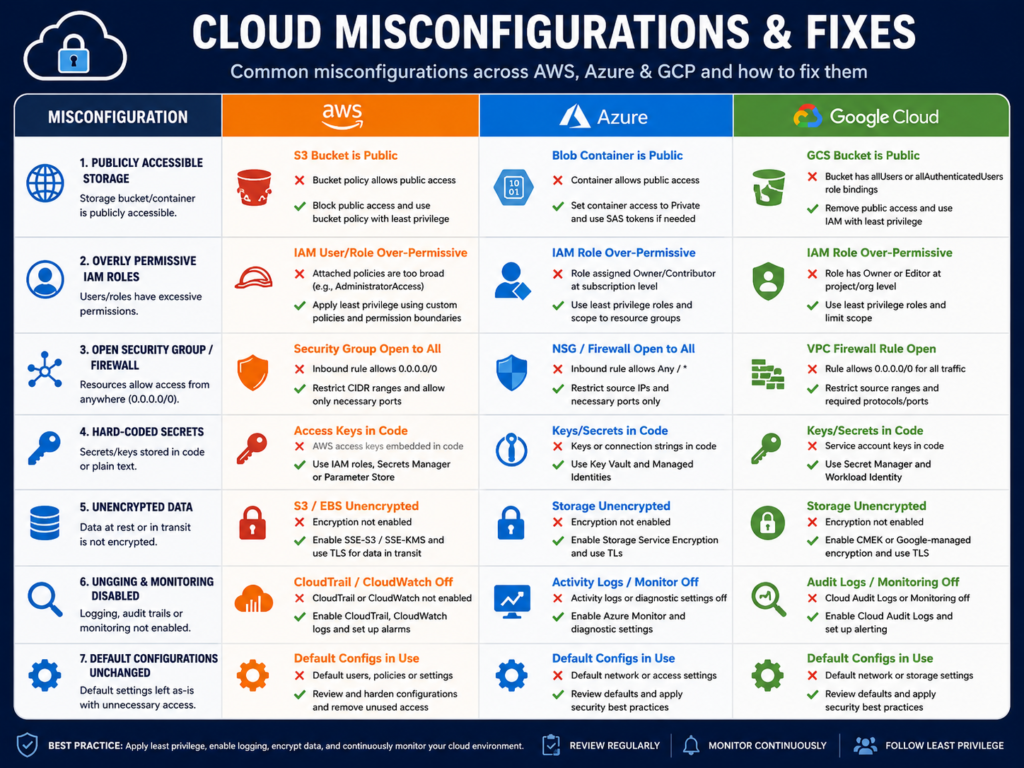
Cloud security misconfigurations can expose business data through simple setup mistakes: public storage, weak IAM, open ports, missing encryption, or disabled logs. For companies in Saudi Arabia, the UAE, and Qatar, fixing cloud security misconfigurations means more than ticking technical boxes. It also means proving control, protecting data residency decisions, and keeping audit evidence ready.
In practice, most cloud incidents do not start with an advanced attack. They start with one setting nobody reviewed.
What Are Cloud Security Misconfigurations?
Cloud security misconfigurations are unsafe or incorrect settings in cloud environments. They can affect storage, databases, identities, APIs, containers, backups, monitoring, and admin access.
Common examples include.
Public S3 buckets, Azure Blob containers, or GCP Cloud Storage
Databases exposed to the internet
Over-permissioned IAM roles and service accounts
Missing MFA for admin users
Disabled audit logs
Unencrypted backups
Open SSH, RDP, or database ports
Hardcoded secrets in code or CI/CD pipelines
For GCC businesses, the risk feels sharper because many teams now run multi-cloud workloads across AWS, Azure, and GCP while managing regulators, vendors, bilingual teams, and regional data expectations.
Why Cloud Security Misconfigurations Matter in the GCC
A cloud mistake in Riyadh, Dubai, Abu Dhabi, Doha, or Jeddah can quickly become a business problem.
A Saudi fintech may face pressure around access controls, logging, and evidence. A UAE e-commerce brand may need to show customer data is protected across apps, APIs, and vendors. A Qatar financial entity may need cloud governance aligned with QCB expectations.
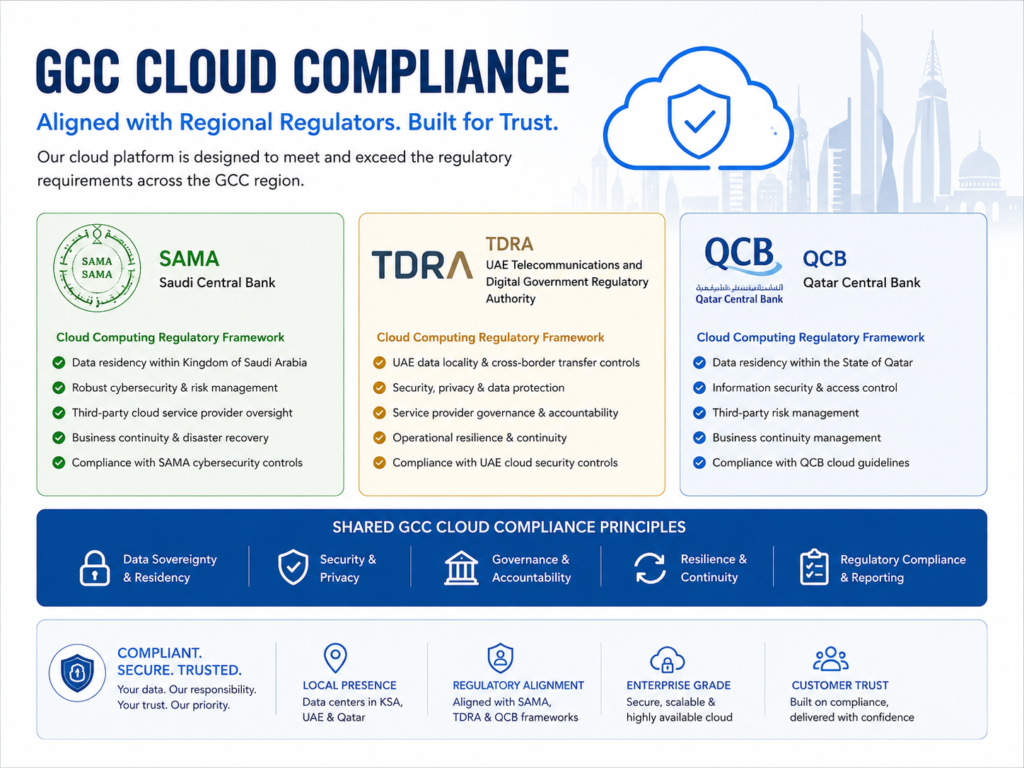
SAMA’s Cyber Security Framework expects banks in Saudi Arabia to assess cybersecurity maturity and identify weaknesses through gap assessment. TDRA’s cloud service provider initiative in the UAE focuses on transparency, trust, and a stronger regulatory framework for cloud services. Qatar Central Bank’s Cloud Computing Regulation applies to QCB-regulated entities using or planning cloud deployments, and it entered into force on 15/04/2024.
Top Cloud Security Misconfigurations to Fix First
Exposed Storage Buckets and Public Snapshots
Start with internet-facing data. Review S3 buckets, Azure Blob containers, GCP Cloud Storage, public snapshots, and backup repositories.
Check for.
Public read or write access
Anonymous access
Shared backup links
Old test buckets
Invoices, customer files, images, logs, or exports stored without restrictions
For retail, logistics, and healthcare teams, exposed storage can be especially damaging because these environments often hold customer records, shipment data, documents, and images.
Weak IAM and Over-Permissioned Roles
IAM mistakes are among the most dangerous cloud security misconfigurations because they give attackers room to move.
Apply least privilege across.
Human users
Developer accounts
Service accounts
Third-party vendor access
CI/CD pipelines
Production admin roles
Replace wildcard permissions with role-based access. Remove unused keys. Disable inactive accounts. Avoid permanent admin access where just-in-time privileged access can work.
Open Ports, Public APIs, and Insecure Admin Panels
Cloud teams should regularly review security groups, firewalls, load balancers, API gateways, and Kubernetes ingress rules.
Block unnecessary inbound access, especially.
SSH
RDP
Database ports
Internal dashboards
Admin panels
Development environments
Public APIs need authentication, rate limits, WAF rules, logging, and abuse monitoring. For mobile-first brands in Dubai and Riyadh, API security matters as much as app design.
Missing Encryption and Poor Key Management
Encryption should be standard for sensitive workloads, backups, databases, object storage, and traffic between services.
A practical key management setup should include.
Encryption at rest and in transit
KMS access controls
Key rotation
Separation of duties
Backup encryption
Clear ownership of keys and secrets
Azure lists Qatar Central in Doha, UAE Central in Abu Dhabi, and UAE North in Dubai, so GCC teams using Azure should document why each region is selected for sensitive workloads.
Disabled Logging and Weak Monitoring
Without logs, cloud teams cannot investigate incidents properly. They also struggle to prove what happened during an audit.
Enable and retain logs for.
Admin activity
IAM changes
Storage access
Database access
Network traffic
API calls
Security alerts
CI/CD actions
For government-linked, financial, and enterprise workloads, logs should be protected from deletion and stored in a separate, controlled location.
GCC Compliance Considerations for Cloud Misconfiguration Fixes
Saudi Arabia.
A Riyadh fintech or banking vendor should prioritize IAM, encryption, incident response, vendor controls, audit logs, and cloud evidence.
The key is not only “fixing the issue.” The team must also show what was found, who owned it, when it was fixed, and how the control will be monitored going forward.
UAE.
For UAE companies, especially in Dubai and Abu Dhabi, cloud governance should cover customer data, APIs, vendors, cross-border data flows, and audit trails.
A Dubai e-commerce or SaaS company should pay close attention to public storage, admin access, payment-related workflows, and third-party integrations.
Qatar.
For Doha financial teams, cloud configuration should be treated as governance work, not only engineering work. QCB’s regulation covers cloud arrangements for regulated entities and includes expectations around strategy, due diligence, risk controls, data protection, and governance.
That means CSPM reports, access reviews, encryption records, cloud registers, and provider due diligence can all support audit readiness.
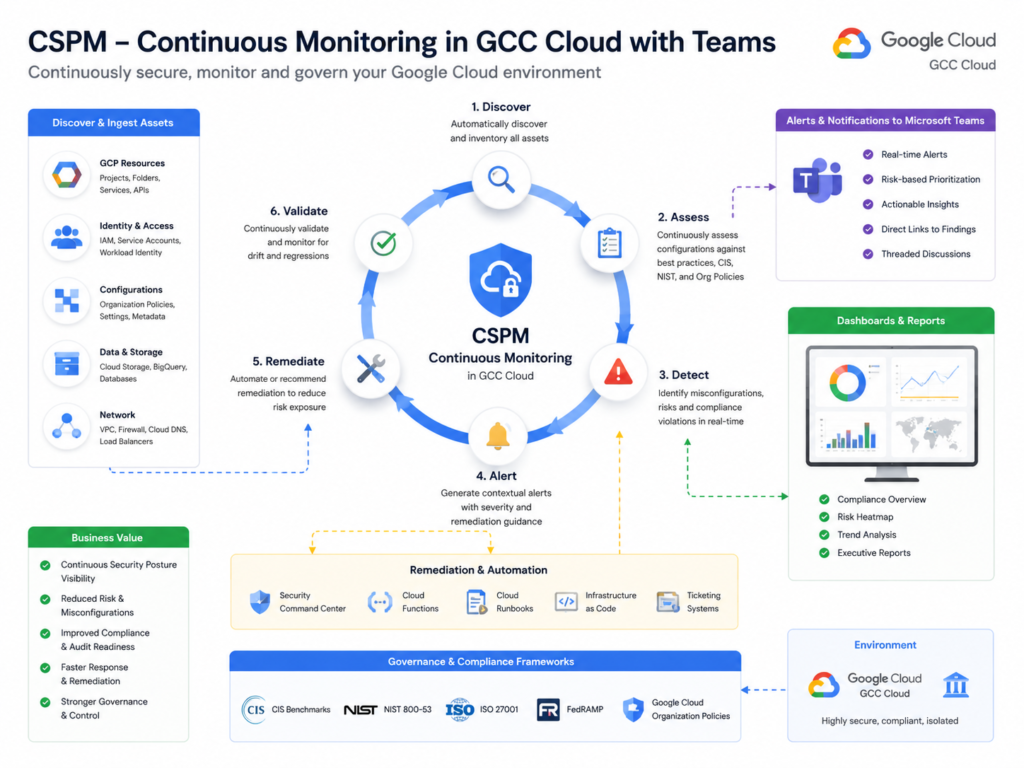
CSPM for Continuous Cloud Security Monitoring
Cloud Security Posture Management tools help detect risky settings before attackers or auditors find them.
A CSPM tool can flag.
Public storage
Open ports
Weak IAM
Disabled logging
Missing encryption
Risky Kubernetes settings
Unprotected backups
Non-compliant resources
Configuration drift
For GCC teams running AWS, Azure, and GCP together, CSPM gives security, compliance, and engineering teams one shared view of risk.
It also helps create remediation evidence: timestamps, owners, severity, fix status, and reports.
DevSecOps Practices to Prevent Repeat Mistakes
Fixing cloud security misconfigurations once is not enough. Teams need guardrails so the same mistakes do not return.
Use DevSecOps controls such as.
Infrastructure as Code scanning
Policy-as-code rules
Secure Terraform, Bicep, CloudFormation, and Helm templates
CI/CD approval gates
Secret scanning
Container image checks
Kubernetes policy controls
Drift detection
Security works better when teams understand it clearly. In GCC companies with Arabic and English-speaking staff, bilingual runbooks, security checklists, and training can reduce mistakes during deployments and incident response.
How to Prioritize the Top 30 Cloud Fixes
Not every cloud issue has the same urgency. Start with risks that are public, privileged, sensitive, or hard to investigate.
A practical top 30 cloud misconfiguration checklist should cover.
Public storage
Public snapshots
Exposed databases
Open SSH
Open RDP
Public admin panels
Unauthenticated APIs
Weak IAM roles
Wildcard permissions
Unused access keys
Missing MFA
Permanent admin roles
Unmanaged service accounts
Hardcoded secrets
Missing encryption
Poor KMS access control
Unprotected backups
Disabled audit logs
Short log retention
No alerting
Risky Kubernetes permissions
Public container registries
Insecure CI/CD runners
No IaC scanning
Weak WAF rules
Poor vendor access control
No incident runbook
No asset ownership
No remediation evidence
No continuous CSPM monitoring
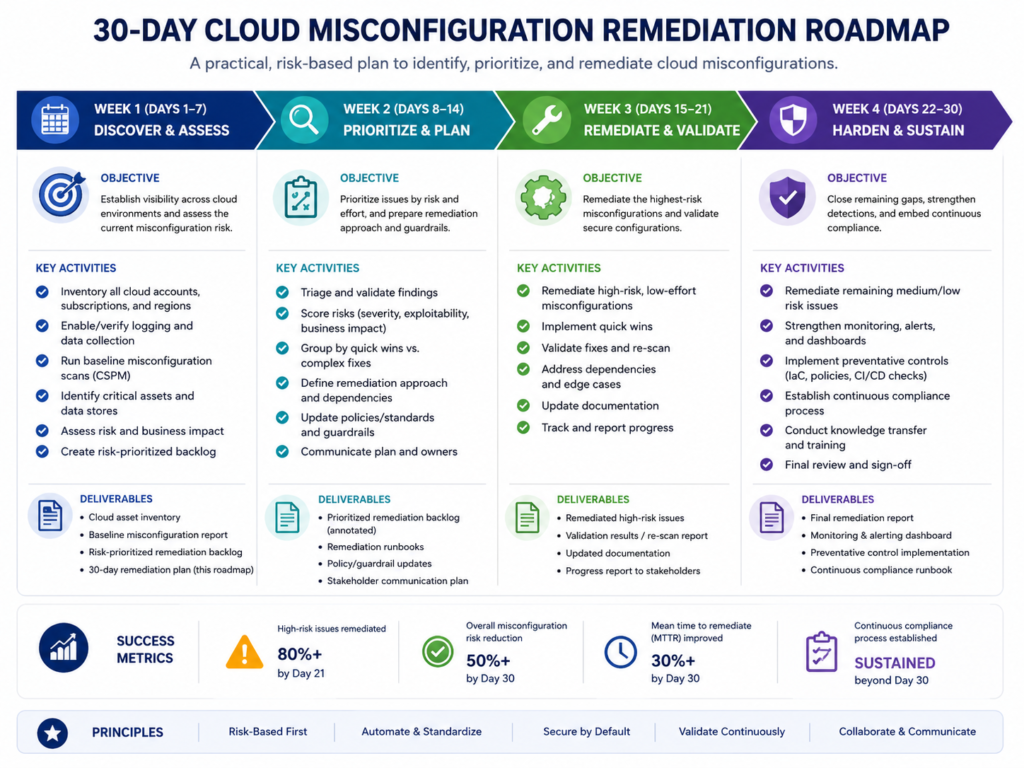
A 30-Day Roadmap to Fix Cloud Security Misconfigurations
Discover the Real Cloud Estate
Identify all cloud accounts, subscriptions, projects, owners, public assets, IAM admins, service accounts, sensitive data stores, and internet-facing services.
Fix Critical Exposure
Remediate public buckets, exposed databases, unused keys, missing MFA, dangerous security groups, and public admin panels.
Harden Core Controls
Enforce encryption, logging, backup protection, KMS restrictions, CI/CD guardrails, IaC scanning, and secure templates.
Prepare Evidence and Monitoring
Assign owners, document fixes, export reports, update cloud registers, and activate CSPM monitoring. Share progress with engineering, risk, compliance, and leadership.
Concluding Remarks
Cloud security misconfigurations are preventable, but only when teams treat cloud configuration as an ongoing business control. Mak it solutions
For Saudi, UAE, and Qatar companies, the strongest approach combines technical hardening, least privilege, encryption, logging, CSPM, DevSecOps, and regulator-aware documentation.
Need help fixing cloud security misconfigurations across AWS, Azure, or GCP in the GCC? Start with a focused cloud posture review, then build a practical remediation roadmap your engineering and compliance teams can actually follow.( Click Here’s )
FAQs
Q : Are cloud security misconfigurations common in Saudi enterprises?
A : Yes. Saudi enterprises often scale cloud quickly across fintech, logistics, government services, and e-commerce. Common issues include over-permissioned IAM roles, exposed storage, weak MFA, and incomplete logging.
Q : Which cloud misconfigurations create the biggest UAE compliance risk?
A : The biggest UAE risks usually involve public customer data, insecure APIs, weak admin access, missing logs, and poor vendor visibility. Dubai and Abu Dhabi businesses should also review cross-border data flows and cloud provider governance.
Q : Do Qatar banks need special controls for cloud configuration?
A : Yes. Qatar banks and QCB-regulated entities need stronger governance because QCB’s Cloud Computing Regulation applies to regulated entities using or planning cloud deployments. Access reviews, encryption, CSPM, due diligence, and audit evidence should be treated as core controls.
Q : How often should GCC companies audit cloud misconfigurations?
A : High-risk cloud settings should be monitored continuously. Formal reviews should happen at least quarterly, and fast-moving teams should review IAM, storage, APIs, logging, backups, and encryption after major releases.
Q : Can CSPM help Dubai and Riyadh teams prepare for cloud audits?
A : Yes. CSPM helps teams find misconfigurations, assign owners, track fixes, and export audit-ready evidence. It is especially useful for multi-cloud environments across AWS, Azure, and GCP.