


API Security Best Practices 2026 for Teams
API Security Best Practices 2026 for Teams
API Security Best Practices 2026 for Teams
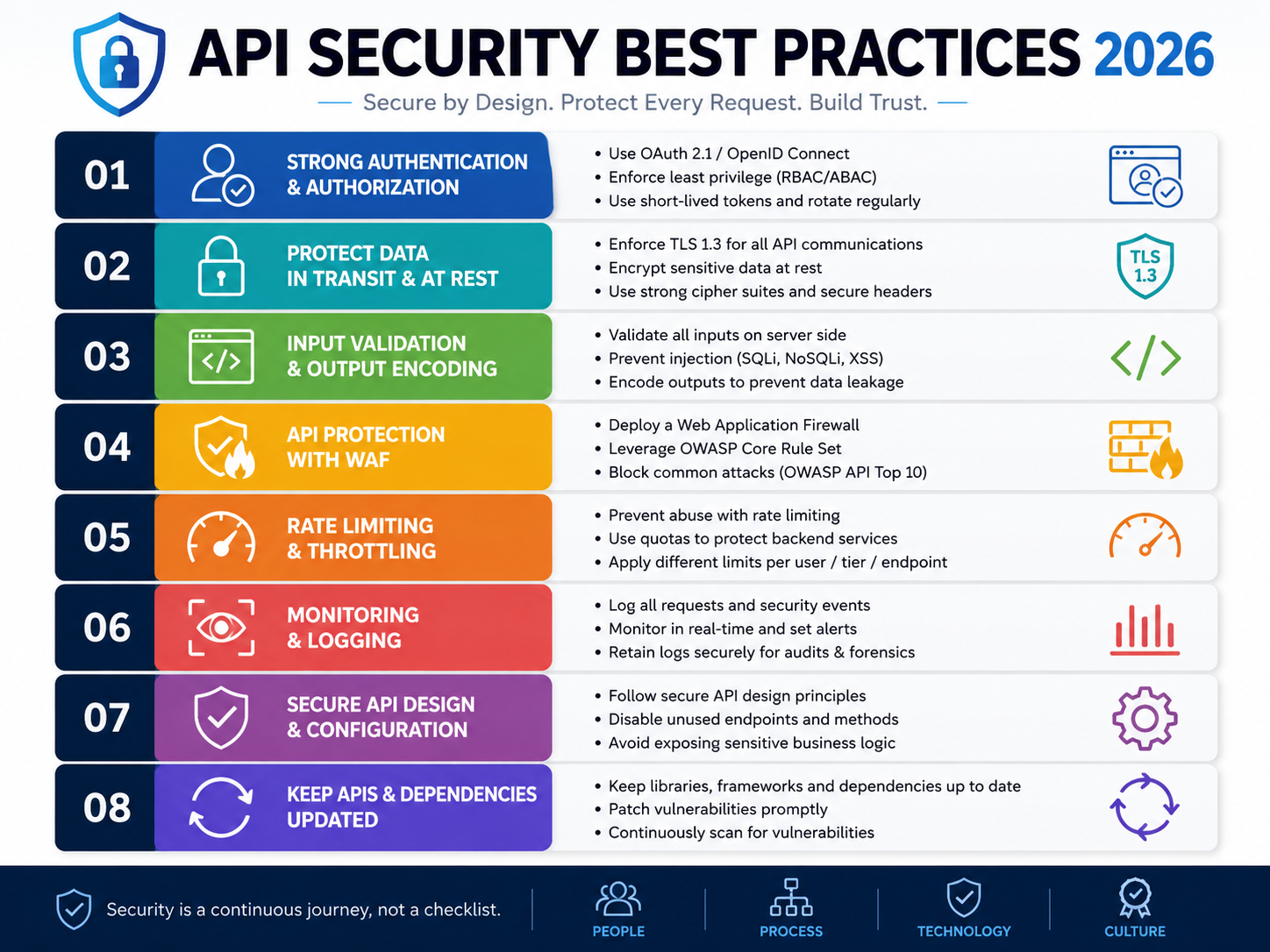
API security best practices 2026 help teams protect REST, GraphQL, mobile, partner, internal, and AI-connected APIs from abuse, data leakage, broken authorization, bots, and compliance failures. A strong API security program combines secure authentication, least-privilege authorization, rate limits, bot defense, runtime monitoring, tested OWASP controls, and audit-ready evidence.
For US, UK, Germany, and EU teams, API security is no longer just a gateway rule or a WAF setting. It is a lifecycle discipline: know every API, secure every identity and action, monitor live traffic, and prove that personal, payment, healthcare, and financial data is handled responsibly.
API Security Best Practices 2026 Overview
APIs now power SaaS platforms, mobile apps, AI agents, fintech workflows, healthcare portals, ecommerce checkout, analytics dashboards, and cloud integrations.
That also makes them a direct path into business logic. A weak login API can enable credential stuffing. A poorly protected checkout API can support fraud. A missing object-level authorization check can expose customer records.
Cloudflare’s API security reporting says successful API requests accounted for 57% of dynamic HTTP traffic it processed, and its machine learning discovery found 30.7% more API endpoints than customers self-reported. That gap is exactly why API inventory has become a security control, not just documentation.
What API Security Means in 2026
Modern API security protects.
Public APIs
Internal APIs
Partner APIs
Mobile APIs
GraphQL APIs
REST APIs
AI-connected APIs
Shadow or undocumented APIs
A practical framework covers secure design, authentication, authorization, input validation, rate limits, bot defense, runtime API security, monitoring, incident response, and compliance evidence.
The OWASP API Security Top 10 remains a useful risk map, especially for broken object-level authorization, broken authentication, unrestricted resource consumption, and improper inventory management.
API Authentication and Authorization Best Practices
API keys alone are not enough for modern SaaS, fintech, healthcare, ecommerce, and AI workflows. They often identify an app, not a user, and may lack expiry, rotation, scopes, and contextual risk checks.
Strong API security should answer four questions.
| Question | What It Means |
|---|---|
| Who is calling? | User, service, mobile app, partner, or machine client |
| What can they access? | Scope, role, tenant, object, and function permissions |
| Is the request safe? | Token validity, device risk, velocity, and behavior |
| Can we prove it later? | Logs, alerts, ownership, and audit evidence |
OAuth 2.0, OIDC, JWT, and API Key Hygiene
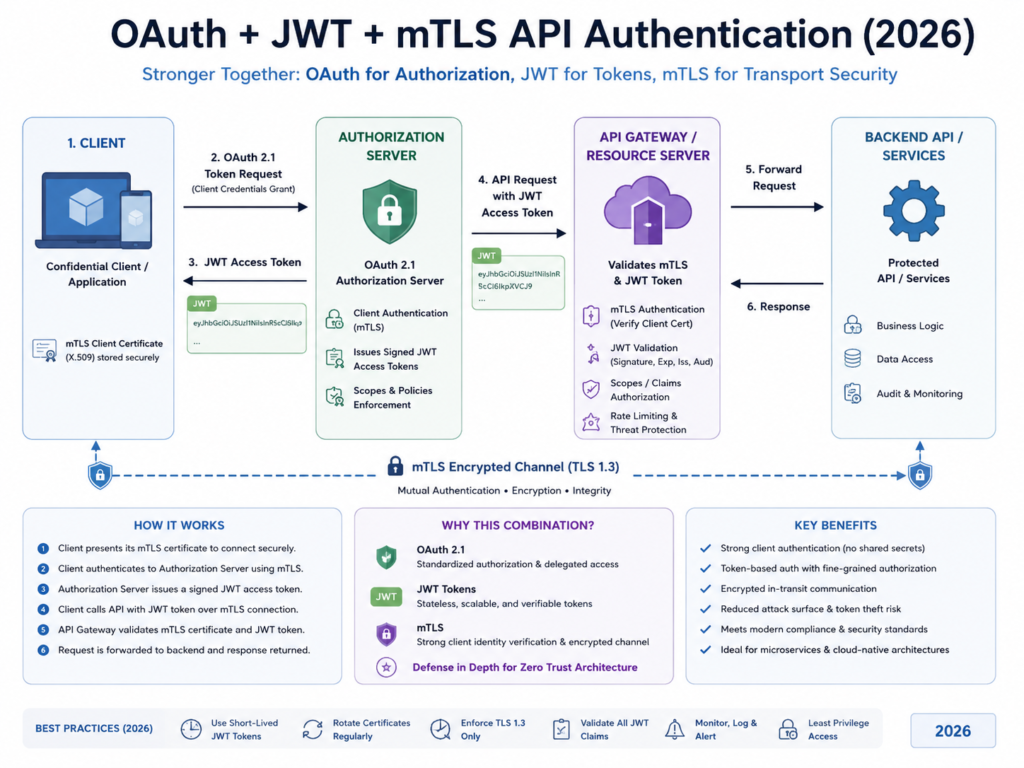
Use OAuth 2.0 for delegated access and OIDC for identity. JWTs should be short-lived, signed correctly, audience-bound, issuer-validated, and rejected when stale or suspicious.
IETF RFC 9700 describes current OAuth 2.0 security best practices and updates earlier OAuth threat guidance. OpenAPI also supports security schemes such as API keys, HTTP authentication, mutual TLS, OAuth 2.0, and OpenID Connect.
In practice, teams should.
Avoid long-lived static secrets where possible.
Rotate API keys and tokens on a defined schedule.
Store secrets in a proper secrets manager.
Use separate credentials for production, staging, and vendors.
Disable unused keys quickly.
Scan CI/CD pipelines and repositories for exposed secrets.
MTLS, Scopes, and Least Privilege
Use mTLS for high-trust machine-to-machine APIs, especially in fintech, healthcare, B2B SaaS, internal microservices, and service mesh environments.
Scopes should be narrow. Admin actions should be separated from user actions. Sensitive operations such as payments, exports, account lookup, patient search, or role changes should require stronger checks than low-risk read-only endpoints.
Least privilege is simple in theory: give each caller only the access it needs. The hard part is keeping that model updated as products, teams, and integrations change.
API Rate Limiting, Quotas, and Abuse Control
Rate limits protect availability, reduce scraping, slow credential attacks, and preserve fair usage for legitimate customers.
A single global rate limit is rarely enough. Better API rate limiting uses layers.
User
Token
IP address
Tenant
Endpoint
Region
Device or session
Risk score
Business action
Rate Limiting vs Throttling vs Quotas
Rate limiting blocks or delays traffic after a threshold. Throttling slows requests to protect performance. Quotas set longer-term limits, such as daily API calls per customer or monthly plan limits.
For example, a SaaS API in Austin may limit by tenant and plan tier. A fintech API in San Francisco may apply stricter limits to login, payments, and account lookup. A healthcare API handling ePHI should use careful thresholds around patient search and record retrieval.
Adaptive Rate Limits and 429 Responses
Adaptive rate limiting changes thresholds based on risk signals. A trusted user making normal requests may get more room. A new device making fast login attempts from unusual locations should face stricter controls.
Return clear 429 responses with retry guidance, but do not reveal enough detail for attackers to reverse-engineer your abuse logic.
For GraphQL, rate limit by query depth, complexity, resolver cost, and identity not only request count.
API Bot Protection and Runtime API Security
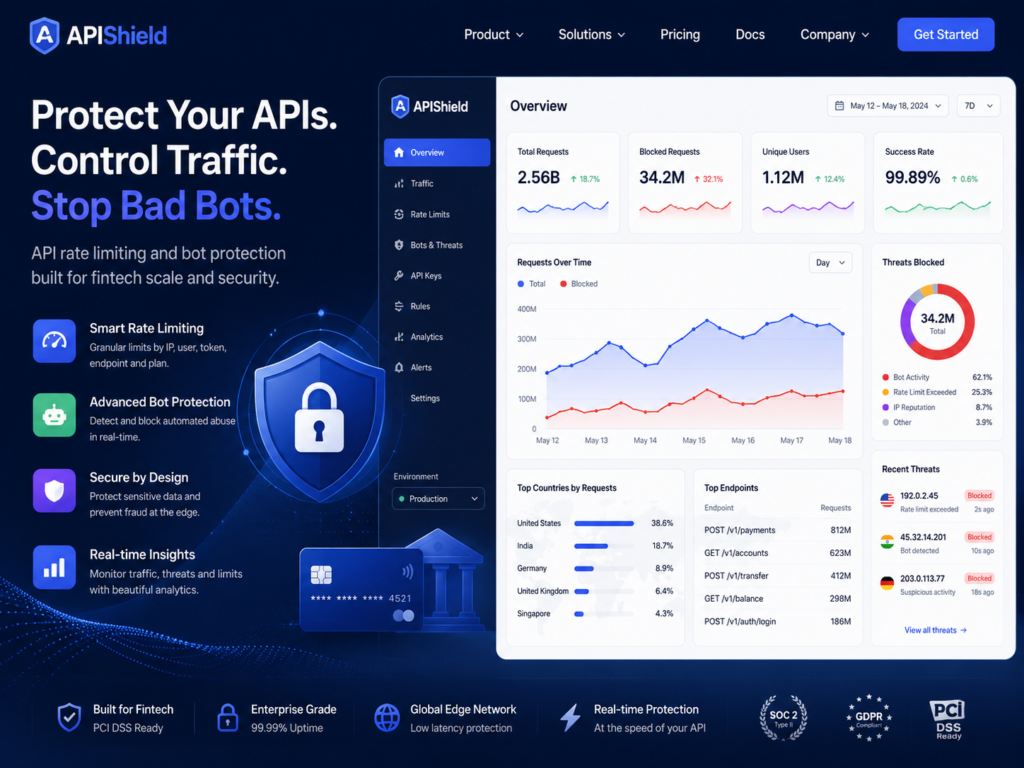
Rate limits slow abuse. Bot protection adds behavioral signals, device intelligence, anomaly detection, automation scoring, and traffic classification.
Bots commonly target.
Login APIs for credential stuffing
Checkout APIs for carding and inventory hoarding
Search APIs for scraping
Coupon APIs for abuse
Account APIs for enumeration
Data APIs for bulk extraction
Ecommerce teams using E-Commerce Services should treat cart, payment, inventory, coupon, and account APIs as high-value fraud surfaces.
IBM reported that the average global cost of a data breach reached USD 4.88 million in 2024, which is a strong reminder that API abuse is not only a technical issue; it can become a financial and operational issue quickly.
Runtime API Security Controls
A practical runtime stack usually includes.
API gateway policies
WAF rules
Bot management
API discovery
Sensitive data detection
Schema validation
Sequence analysis
Behavioral alerts
Centralized logging
Incident response playbooks
API gateways enforce routing, authentication, quotas, and policies. WAFs help block known attack patterns. Bot tools separate human, automated, and malicious traffic. Runtime API security tools help detect abuse patterns that static testing may miss.
Compliance, OWASP, and DevSecOps API Security Checklist
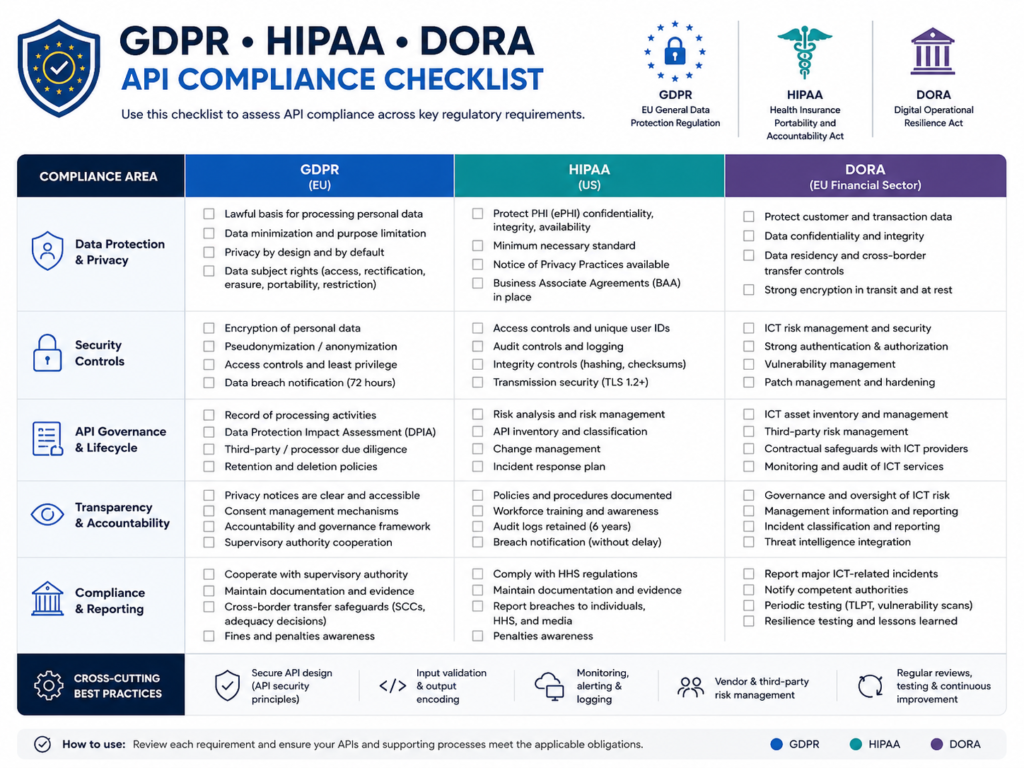
Compliance-ready API security means controls are documented, tested, monitored, and mapped to legal or industry requirements.
This section is practical security guidance, not legal advice. Regulated teams should confirm exact obligations with their compliance, legal, and security teams.
Key Compliance Areas for API Teams
US healthcare teams should account for HIPAA where APIs handle electronic protected health information. HHS states that the HIPAA Security Rule requires administrative, physical, and technical safeguards for ePHI.
Payment teams should consider PCI DSS where APIs store, process, or transmit cardholder data. PCI SSC published PCI DSS v4.0.1 in June 2024 as a limited revision with no new or deleted requirements.
EU financial entities should account for DORA, which entered into application on January 17, 2025. EIOPA describes DORA as applying to banks, insurers, investment firms, and other financial entities, while Bundesbank highlights ICT risk management, incident reporting, resilience testing, and ICT third-party risk management.
UK teams should align personal-data APIs with UK GDPR security expectations. The ICO states that organizations must process personal data securely using appropriate technical and organizational measures.
EU teams should also track NIS2. The European Commission describes NIS2 as a unified cybersecurity framework across 18 critical sectors in the EU.
DevSecOps Guardrails for APIs
API security works best when it is built into delivery, not added after launch.
Use DevSecOps guardrails such as.
Validate OpenAPI specs before deployment.
Require authentication definitions for sensitive endpoints.
Scan repositories for secrets.
Test BOLA, BFLA, and broken authentication.
Fuzz API inputs.
Run dependency checks.
Block insecure deployments.
Keep API inventories current.
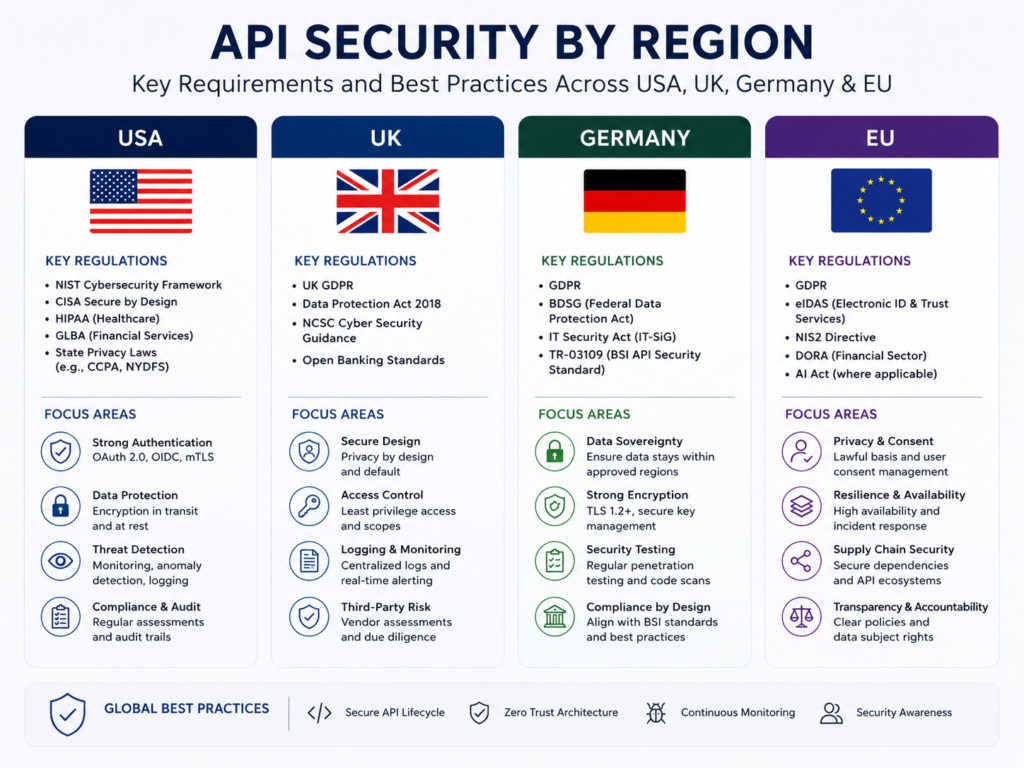
Regional API Security Priorities.
Regional requirements vary, but the pattern is consistent: protect sensitive data, prove access control, document risk decisions, and show incident readiness.
USA.
US teams in New York, Austin, and San Francisco often prioritize HIPAA, PCI DSS, SOC 2, state privacy expectations, customer security questionnaires, and fintech risk controls.
API evidence commonly includes.
API inventory
Access logs
Encryption practices
Penetration testing
Vulnerability scans
Incident response records
Vendor controls
Change approvals
UK.
UK teams in London and Manchester should align API controls with UK GDPR, FCA expectations, ecommerce fraud prevention, NHS data expectations where relevant, and Open Banking security patterns.
Open Banking UK’s security profile says the Open Banking API standard adopted FAPI 1 as its security profile, which is a highly secured OAuth profile from the OpenID Foundation.
Germany and EU.
Germany and EU teams in Berlin, Frankfurt, Munich, Dublin, Amsterdam, and Paris should account for DSGVO, BaFin expectations where relevant, DORA, NIS2, data residency, processor controls, and cloud-region decisions.
For multinational SaaS teams, the safest approach is to classify APIs by data type, customer region, business risk, and regulatory scope before applying controls.
API Security Best Practices 2026 Checklist
Use this checklist to turn API security best practices 2026 into a practical backlog.
Inventory public, internal, partner, mobile, REST, GraphQL, and shadow APIs.
Map every API to an owner, data class, authentication method, and compliance scope.
Replace weak static credentials with OAuth/OIDC, mTLS, short-lived tokens, and strong key rotation where appropriate.
Enforce object-level and function-level authorization on the server side.
Add layered rate limits, throttling, quotas, and bot protection.
Validate schemas, inputs, request size, response shape, and GraphQL complexity.
Monitor runtime traffic for unusual sequences, scraping, enumeration, and credential attacks.
Keep logs, test results, risk decisions, and control mappings ready for audits.
When to Use an API Gateway, WAF, Bot Protection, or Security Audit
Use an API gateway when you need centralized authentication, routing, quotas, transformations, and policy enforcement.
Use a WAF to reduce common web attack patterns.
Use bot protection when login, checkout, search, account, or data APIs face automation.
Use a security audit when you need independent evidence, architecture review, API testing, or compliance readiness.
Final Thoughts
API security best practices 2026 only work when they become part of daily engineering, not a one-time checklist.
Start with visibility. Secure authentication and authorization. Add rate limits and bot defense. Monitor runtime behavior. Then keep the evidence your customers, auditors, and regulators may ask for.
Mak It Solutions can help review API architecture, gateway policies, DevSecOps controls, backend systems, and compliance evidence across US, UK, Germany, and EU requirements. Start with Contact Mak It Solutions to scope a practical API security review.
FAQs
Q : What is the difference between API authentication and API authorization?
A : API authentication verifies who or what is making the request, such as a user, service, app, partner, or machine client. API authorization decides what that authenticated identity can do, such as viewing invoices, updating a profile, approving a payment, or exporting data.
Q : How often should API keys and tokens be rotated?
A : High-risk API keys and long-lived secrets should be rotated frequently, especially after staff changes, vendor changes, incidents, or suspected exposure. Many teams use 30-, 60-, or 90-day windows, but short-lived OAuth tokens are usually safer than static keys.
Q : Should every API endpoint have a separate rate limit?
A : Not always. Low-risk read-only endpoints may share a broader policy, but sensitive endpoints such as login, password reset, checkout, search, payment, export, and admin APIs should have stricter limits.
Q : How can teams detect shadow APIs?
A : Compare API gateway logs, WAF traffic, cloud load balancer logs, OpenAPI specs, code repositories, CI/CD deployment records, and runtime discovery tools. When undocumented APIs appear in traffic, assign an owner, classify the data, secure the endpoint, or retire it.
Q : What API security evidence do auditors usually request?
A : Auditors often request API inventories, data flow maps, access control policies, authentication settings, key rotation records, penetration test results, vulnerability scans, incident response evidence, logging samples, risk assessments, and control mappings to frameworks such as GDPR, UK GDPR, HIPAA, PCI DSS, SOC 2, DORA, or NIS2.
[…] It Solutions’ API security best practices similarly emphasize identity-aware, least-privilege […]
[…] organizations can incorporate cryptographic discovery into broader API security practices, particularly where authentication, mTLS, certificate management, and signing […]
[…] dependencies should also be reviewed using established API security practices, because vulnerable cryptography can sit inside application integrations that are easy to […]