


Security Awareness Training That Works
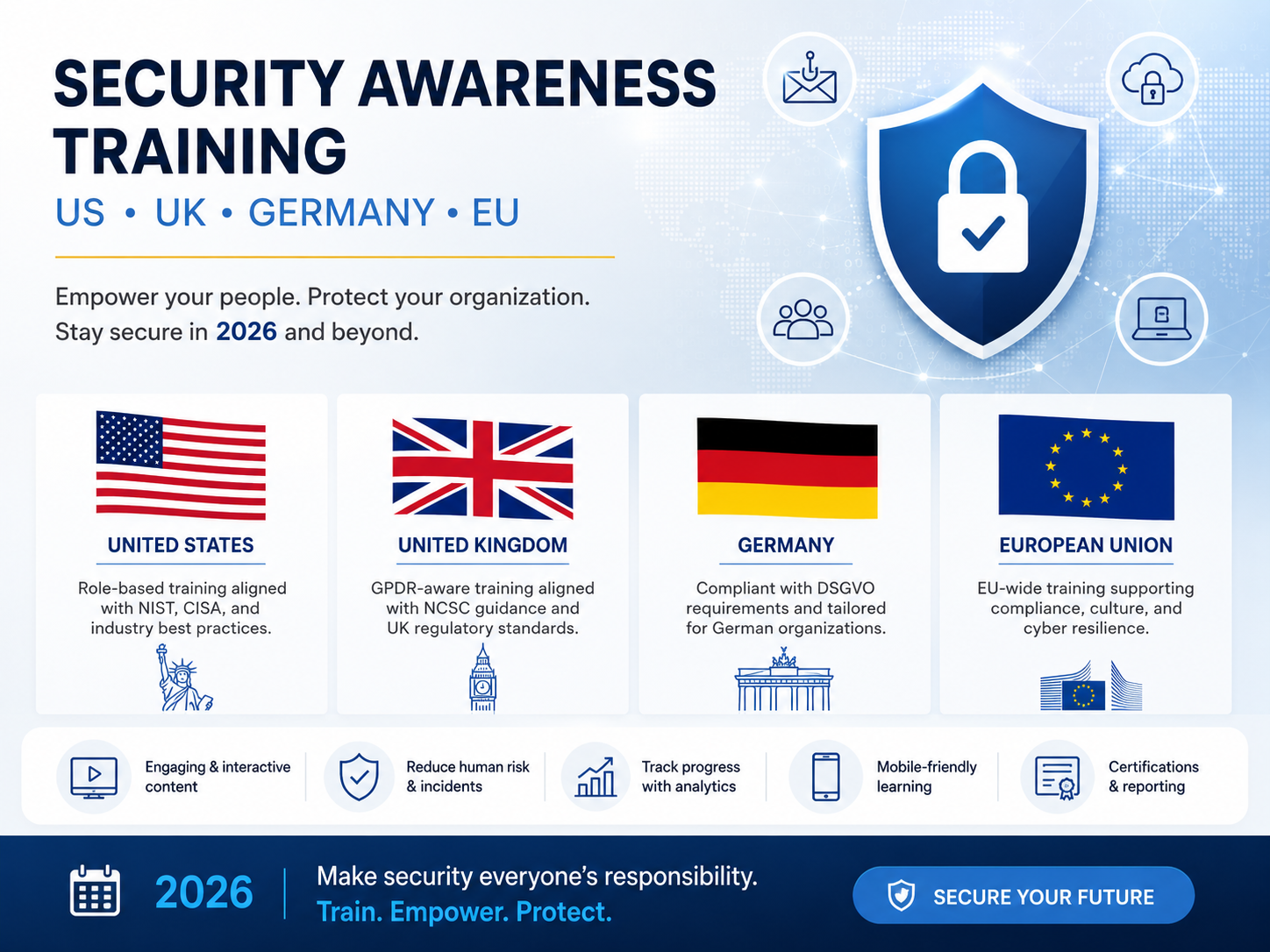
Security awareness training in 2026 needs to do more than tick a compliance box. It should help employees spot phishing, report suspicious activity, protect customer data and make safer decisions during real work.
The simple answer: security awareness training works when it changes behavior. The strongest programs combine role-based microlearning, phishing simulations, easy reporting, compliance mapping and human-risk metrics that show whether employees are becoming more resilient.
For teams in the USA, UK, Germany and the wider EU, this matters even more. Verizon’s 2026 DBIR notes that common breach causes still include human-linked issues such as social engineering, phishing and stolen credentials, alongside vulnerability exploitation. IBM’s 2025 report also puts the global average cost of a data breach at USD 4.44 million, so even small improvements in employee response can support a wider risk-reduction strategy.
What Is Security Awareness Training?
Security awareness training teaches employees how to recognize, avoid and report cyber threats. That includes phishing emails, fake login pages, suspicious QR codes, invoice fraud, credential theft, unsafe file sharing and poor data-handling habits.
Good training turns cyber hygiene into everyday behavior. Employees should not only know the policy; they should know what to do when a strange supplier request lands in their inbox or a fake Microsoft 365 page asks for their password.
For companies building SaaS platforms, apps or analytics systems, awareness training should sit beside secure software delivery. Mak It Solutions supports this broader security-by-design approach across business intelligence services, mobile app development and secure digital transformation.
Security Awareness Training vs Cybersecurity Awareness Training
Security awareness training and cybersecurity awareness training usually mean the same thing. Both focus on helping employees reduce human cyber risk.
A strong program covers password safety, MFA, phishing, social engineering, device security, data privacy, secure collaboration and reporting workflows. The difference is not the label; it is whether the training actually changes how people behave.
Why Employee Security Awareness Training Matters
Employees are often the first people to notice something suspicious. They may see a fake invoice, a strange Teams message, a suspicious login alert or a supplier request that feels slightly wrong.
When employees know how to report quickly, security teams can respond faster. That is why awareness training should be practical, calm and easy to apply.
Why Traditional Annual Training Falls Short
Annual training often fails because it measures attendance instead of behavior. A completed course does not prove that someone can recognize a convincing phishing email or challenge a fake payment request.
The real question is simple: are people making safer choices after the training?
Completion Rates Are Not Security Culture
A company can show full completion and still have weak security habits. Real culture appears when employees pause before clicking, report suspicious messages and follow data-handling rules even when nobody is watching.
Completion matters for evidence. But it should not be the main success metric.
Generic Training Ignores Role-Based Risk
Finance teams face invoice fraud and payment-change scams. HR teams handle payroll records, candidate data and sensitive employee information. Developers need reminders about secrets management, secure repositories and dependency risks.
Executives need spear-phishing, deepfake and account-takeover awareness. One generic course cannot serve all of these groups well.
Employees Need Continuous Reinforcement
People forget long courses quickly. Short, repeated lessons are easier to absorb and apply.
In practice, microlearning works best when it feels close to the employee’s actual work: a suspicious vendor email for finance, a fake CV attachment for HR or a token-leak scenario for developers.
How to Build Effective Security Awareness Training
Effective security awareness training combines role-based content, phishing awareness, clear reporting and measurable behavior change. The goal is not to scare employees. The goal is to make secure choices feel normal.
Use Role-Based Microlearning
Keep lessons short, focused and relevant. A New York fintech team may need PCI DSS, SOC 2 and wire-transfer fraud scenarios. A London SaaS company may need UK GDPR, phishing reporting and cloud-access training. A Berlin software team may need GDPR/DSGVO, supplier-risk and secure development reminders.
The more familiar the scenario feels, the more useful the training becomes.
Add Phishing Awareness Training and Simulations
Phishing simulations help employees practice before real attacks arrive. They should include email phishing, smishing, vishing, QR phishing and fake collaboration invites.
The point is not to embarrass people who click. The point is to teach pattern recognition and make reporting easier next time.
Measure Behavior, Not Just Course Completion
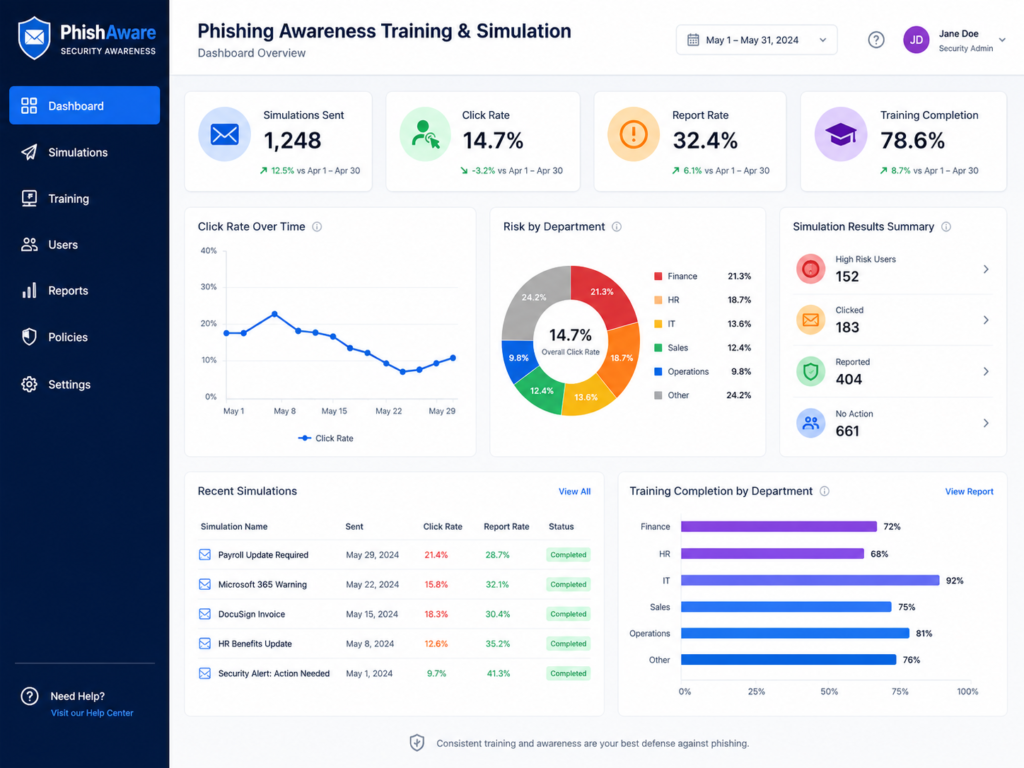
Useful security awareness metrics include.
| Metric | What it Shows |
|---|---|
| Phishing report rate | Whether employees report suspicious messages |
| Repeat-risk users | Who may need extra coaching |
| Time-to-report | How quickly threats reach the security team |
| Department trends | Which teams need more targeted support |
| Policy acknowledgements | Whether compliance evidence is complete |
These metrics give leaders a clearer picture than course completion alone.
Compliance-Ready Security Awareness Training by Region
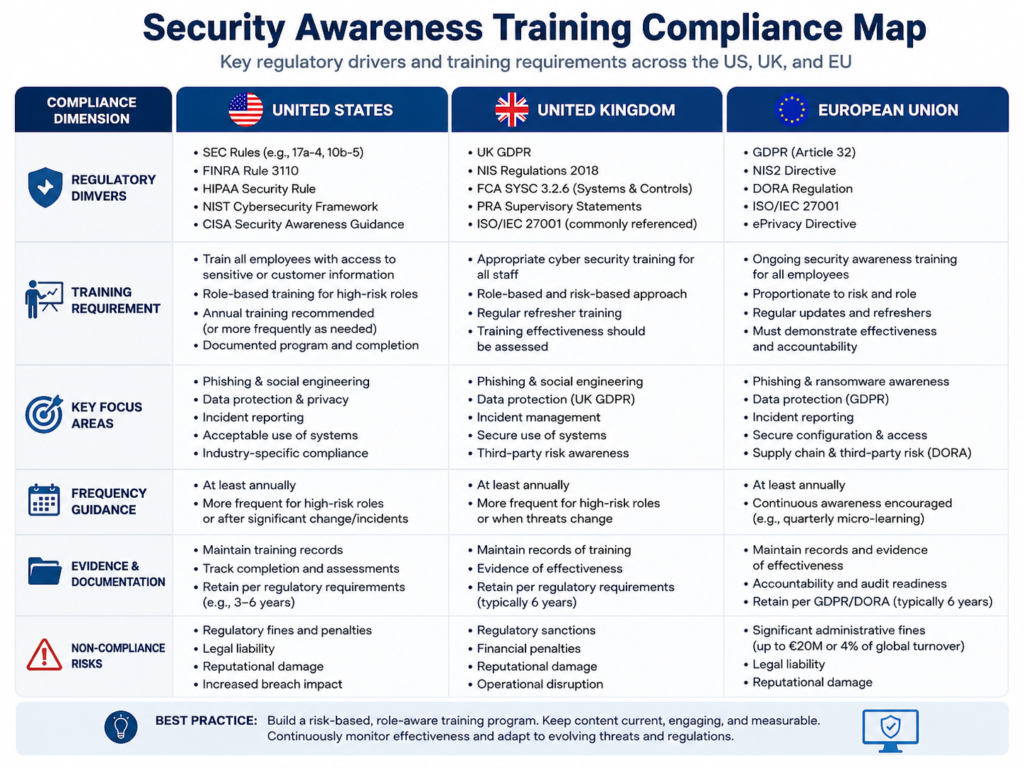
Security awareness training should match the region, industry and risk profile of the business. Most organizations need onboarding, annual refreshers and ongoing reinforcement. Regulated teams also need evidence such as training records, policy acknowledgements, simulation results and remediation actions.
USA.
In the USA, healthcare, SaaS, finance and payment businesses often map training to HIPAA, SOC 2, PCI DSS and NIST guidance. HHS states that regulated entities must train workforce members on security policies and procedures, while NIST SP 800-50 provides a lifecycle-based approach for awareness and training programs.
For a San Francisco health-tech company, this may include ePHI handling and phishing awareness. For an Austin SaaS vendor, it may mean SOC 2 evidence, secure cloud access and customer-data protection. For a New York fintech, payment fraud and account-takeover awareness are essential.
UK.
In the UK, awareness training should support UK GDPR accountability, ICO expectations and sector-specific risk. The ICO’s training and awareness toolkit includes induction and refresher training for staff on data protection and information governance.
A London fintech may need customer-data, phishing and incident-escalation training. A Manchester healthcare supplier may need NHS-style information governance and supplier-access awareness.
Germany and EU.
In Germany and the wider EU, training should reflect GDPR/DSGVO, NIS2, DORA, BaFin expectations, multilingual delivery and local workforce considerations. The European Commission says NIS2 establishes a cybersecurity framework across 18 critical sectors, while DORA has applied to EU financial entities since 17 January 2025.
A Berlin SaaS provider may need GDPR data-residency lessons. A Munich manufacturer may need supplier-risk and OT security awareness. A Frankfurt financial institution may need DORA, BaFin and operational-resilience scenarios.
Security Awareness Training for Phishing and Social Engineering
Phishing and social engineering need their own training stream because they exploit trust, urgency and routine. Employees need realistic practice with the messages, calls and approval requests they actually receive.
Make Simulations Helpful, Not Punitive
A good phishing simulation teaches employees what to look for. It should show warning signs, explain the safer action and make reporting feel simple.
Avoid shame-based leaderboards. They create fear and reduce reporting. A better approach is private coaching, team-level trends and clear improvement goals.
Cover Email, Phone, SMS and Collaboration Tools
Modern attacks do not stop at email. Employees may face vishing calls, smishing texts, fake LinkedIn requests, malicious Teams messages or fraudulent supplier portal links.
Training should cover the channels employees actually use every day.
Improve Threat Reporting Rates
Reporting should be one-click, judgement-free and fast. Employees should know where to send suspicious emails, how to report a fake call and what information the security team needs.
The easier reporting becomes, the more useful employees become as an early-warning layer.
Choosing a Human Risk Management Platform
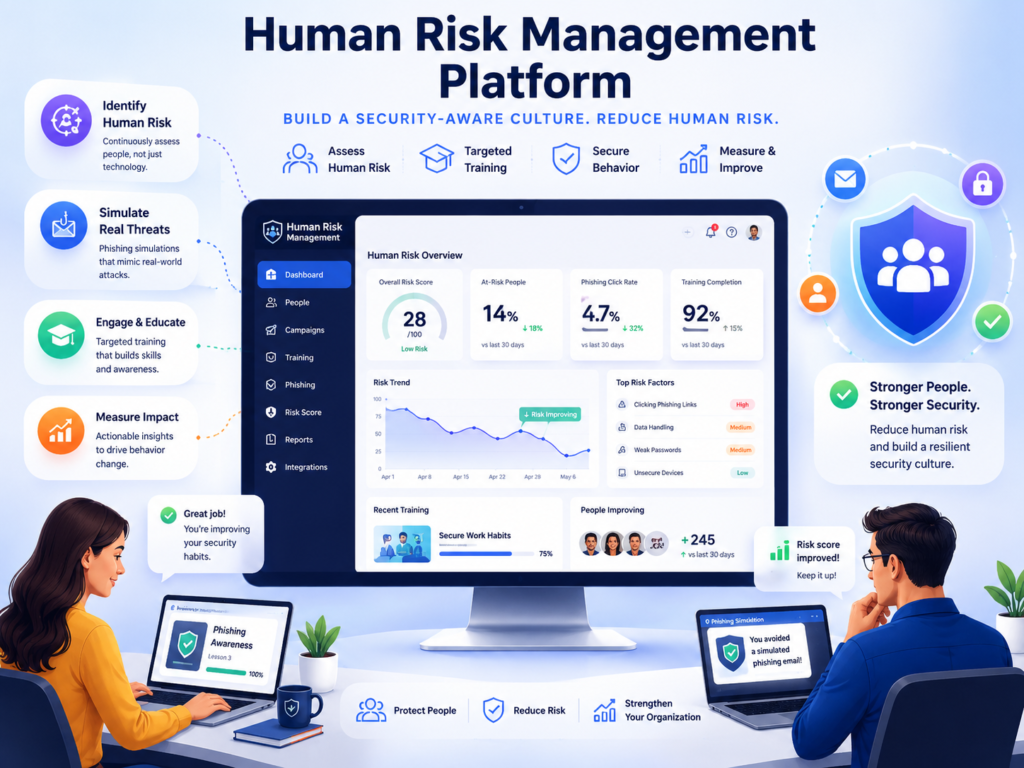
A human risk management platform helps teams train employees, run simulations, analyze behavior and prove compliance. The right platform should fit your workforce instead of forcing every role and region into the same generic course.
Key Features to Compare
Look for adaptive learning, microlearning, phishing simulations, analytics, localization, HRIS integration, SSO, LMS support, Slack or Teams nudges and compliance reporting.
For custom portals, internal dashboards or secure workflows, Mak It Solutions’ Next.js development services and front-end development services can support secure internal tooling.
Vendor Questions to Ask
Before buying a platform, ask.
Does it support regional compliance reporting?
Can content be localized for the USA, UK, Germany and EU teams?
Does it integrate with SSO, HR onboarding and your LMS?
Can it track reporting behavior, not only quiz scores?
Where is employee training and simulation data hosted?
How long are training and simulation records retained?
The best tool is the one your teams will actually use.
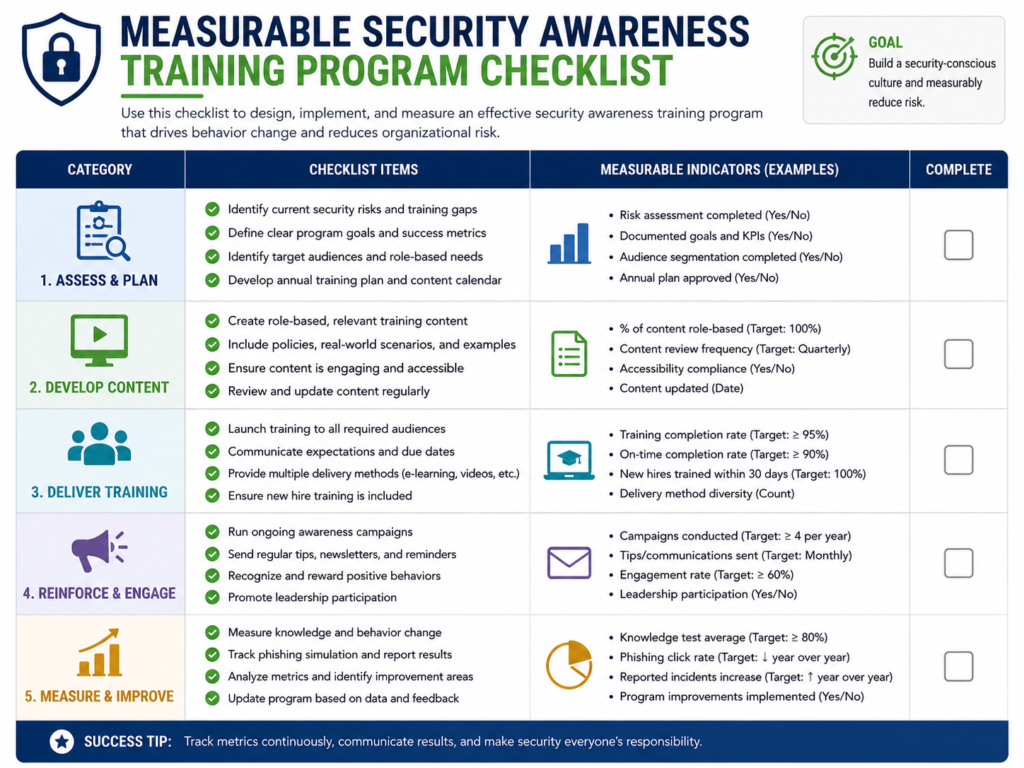
Final Checklist for a Measurable Program
Use this checklist before choosing content or software.
Define high-risk roles and departments.
Map training to HIPAA, PCI DSS, SOC 2, UK GDPR, GDPR, NIS2, DORA or BaFin where relevant.
Train new employees during onboarding.
Refresh core topics every year.
Add phishing simulations and one-click reporting.
Track behavior metrics, not just completion.
Localize content for USA, UK, Germany and EU teams.
Final Thoughts
Security awareness training works best when it is specific, measurable and easy to apply. Employees do not need fear-based lectures. They need realistic examples, simple reporting paths and role-based guidance that fits their daily work.
For businesses scaling software, cloud, mobile apps or analytics systems, human risk should be part of the wider security conversation. Mak It Solutions can help connect secure digital delivery with practical cyber-risk planning through React Native development, e-commerce development and SEO-friendly web services.
Need a practical way to reduce human cyber risk while scaling your digital systems? Start with the Mak It Solutions homepage or explore the blog library for more IT strategy guides.( Click Here’s )
FAQs
Q : How often should employees complete security awareness training?
A : Most organizations should train employees during onboarding, refresh core topics every year and reinforce key behaviors throughout the year. Regulated sectors may need more frequent updates when policies, systems or threats change.
Q : What should be included in a security awareness training program?
A : A strong program should include phishing awareness, password safety, MFA, data handling, device security, reporting workflows, social engineering and role-based scenarios. Finance, HR, IT, executives and developers should receive tailored content.
Q : Is phishing simulation training required for compliance?
A : Phishing simulation training is not always named as a strict legal requirement. However, it strongly supports compliance evidence because it shows whether employees can apply training in realistic situations.
Q : What is the difference between awareness training and human risk management?
A : Security awareness training teaches employees what threats look like and how to respond. Human risk management goes further by measuring behavior, identifying repeat-risk patterns and adapting training based on real employee actions.
Q : How do companies measure security awareness training effectiveness?
A : Companies can measure effectiveness through report rates, repeat-risk users, time-to-report, phishing resilience, policy acknowledgements and department-level trends. Completion rate is useful, but it should not be the only success metric.