


AI-Powered Cyber Attacks: The Defense Guide
AI-Powered Cyber Attacks: The Defense Guide
AI-Powered Cyber Attacks: The Defense Guide
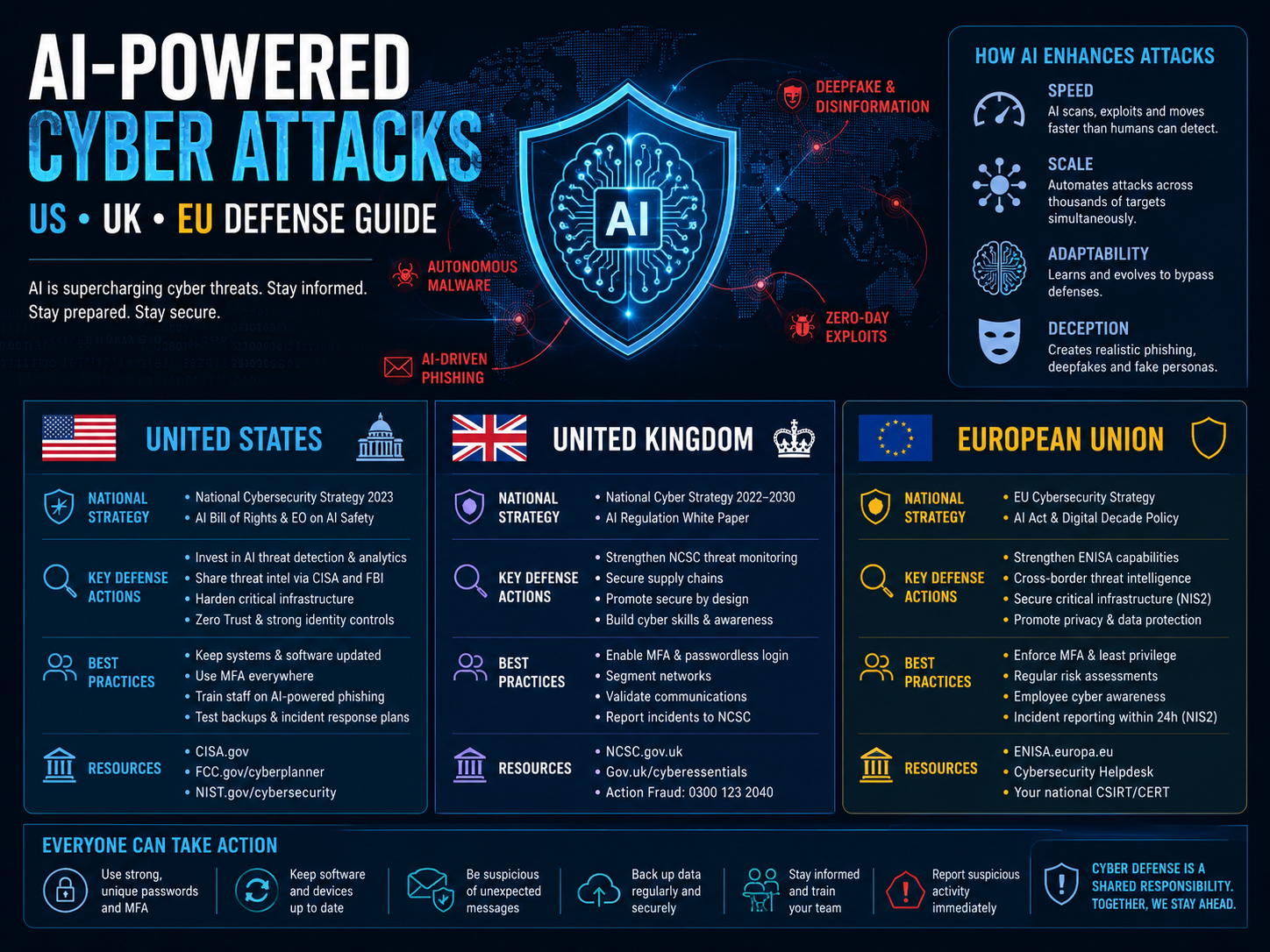
AI-powered cyber attacks are no longer a future risk. Attackers now use artificial intelligence to make phishing, fraud, reconnaissance, malware support, and stolen-data analysis faster, cheaper, and more convincing.
The best defense is not one magic AI tool. It is a layered security program built around strong identity controls, employee verification workflows, cloud visibility, AI-aware threat detection, incident response, and compliance-ready governance.
For teams in the US, UK, Germany, and the wider EU, this matters because AI is speeding up familiar attack methods while regulators are asking for better proof that security risks are managed. Microsoft’s 2025 Digital Defense Report says adversaries and defenders are both using AI to improve operations, and AI agents could help automate reconnaissance, vulnerability scanning, and exploitation at scale.
IBM also reported that the global average cost of a data breach in 2025 was USD 4.4 million, with 97% of organizations that reported an AI-related security incident lacking proper AI access controls.
What Are AI-Powered Cyber Attacks?
AI-powered cyber attacks are cyber threats enhanced by artificial intelligence. The goal is usually simple: move faster, personalize better, automate more tasks, or deceive people more effectively.
That can include.
AI-written phishing emails
Deepfake voice or video impersonation
Fake supplier or invoice messages
Automated reconnaissance
Malware coding assistance
Faster vulnerability research
Analysis of stolen documents, credentials, or payment data
The “AI” part is not always advanced or dramatic. A criminal may use a large language model to rewrite a phishing email in fluent English or German, summarize a leaked contract, scrape LinkedIn for executive context, or create a convincing fake helpdesk message.
The result feels human, but it scales like software.
AI-Powered vs AI-Driven Cyber Attacks
“AI-powered” usually means AI supports part of the attack. For example, it may help write messages, analyze stolen data, translate lures, or generate code snippets.
“AI-driven” suggests more autonomy. In that case, AI-enabled systems may help chain together reconnaissance, target selection, credential testing, exploitation, and evasion.
Most real-world threats today are still AI-assisted rather than fully autonomous. The direction, however, is clear: attackers are using automation to reduce effort and increase volume. The UK NCSC assesses that AI is already enhancing tactics such as reconnaissance, vulnerability research, social engineering, malware generation, and processing stolen data, with likely growth in impact through 2027.
How AI Phishing and Deepfake Social Engineering Work
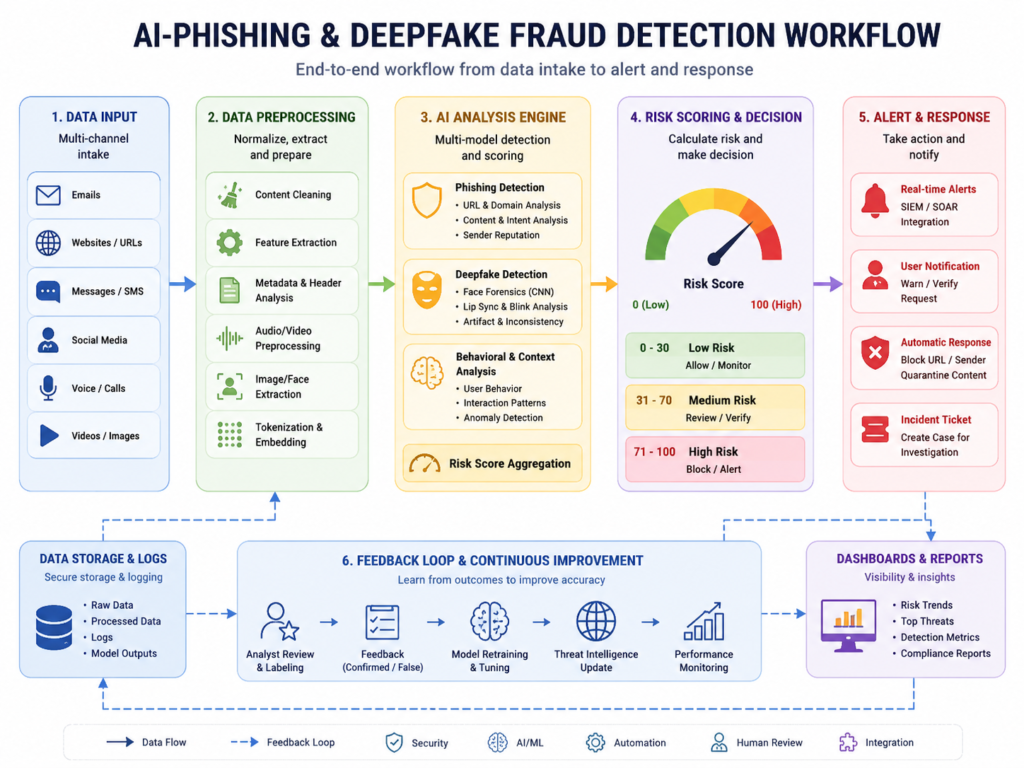
AI phishing is harder to spot because it removes many old warning signs. Poor grammar, strange formatting, and generic wording are no longer reliable clues.
Generative AI can create emails that match a company’s tone, refer to real projects, and sound like they came from an executive, vendor, recruiter, payroll team, or IT support desk.
Proofpoint reported that it detects an average of 66 million targeted business email compromise attacks every month, and noted that generative AI allows attackers to create more convincing messages across languages.
AI-Generated Phishing and Business Email Compromise
Traditional phishing often looked generic. AI-generated phishing can be specific.
An attacker can tailor a message to a finance manager in Manchester, a procurement lead in Frankfurt, a SaaS founder in San Francisco, or a healthcare administrator in New York.
Business email compromise is especially dangerous because it does not always need malware. The attacker may simply persuade someone to.
Change bank details
Approve a payment
Share a one-time code
Open a fake Microsoft, Google, AWS, payroll, or banking login page
Send sensitive files to a fake vendor account
This is why finance, HR, procurement, executive assistants, and IT helpdesk teams need extra protection. They sit close to the workflows attackers want to abuse.
Voice Cloning, Deepfakes, and Payment Fraud
Voice cloning and deepfake fraud use synthetic audio or video to impersonate trusted people.
A fake CFO voice may pressure an accounts payable team to release funds quickly. A deepfake executive video may ask an employee to bypass a normal vendor check. A cloned customer voice may attempt account takeover through support channels.
Microsoft notes that synthetic media, including voice cloning and deepfake videos, is already being used to target multinational companies and government organizations.
Human instinct is not enough here. Finance teams need process-based controls: callback rules, dual approvals, verified payment-change workflows, known communication channels, and escalation rules for urgent or unusual requests.
Generative AI Malware, Reconnaissance, and Vulnerability Discovery
AI-powered cyber attacks are not limited to phishing.
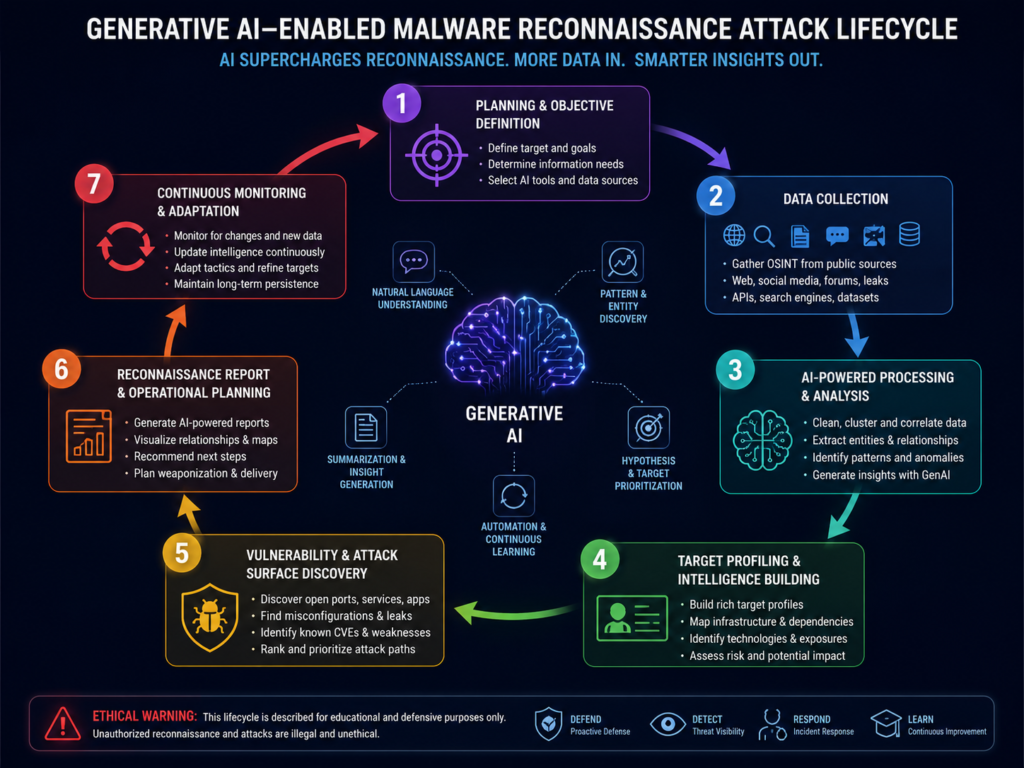
Attackers can use AI to speed up research, review exposed assets, explain vulnerabilities, draft scripts, rewrite malware logic, and sort stolen information. Microsoft warns that AI agents could allow threat actors to automate parts of the attack lifecycle, including reconnaissance, vulnerability scanning, and exploitation at scale.
AI-Assisted Reconnaissance
AI-assisted reconnaissance helps attackers learn about an organization before the first email is sent.
They may review job posts for technology stacks, scrape GitHub for exposed secrets, study employee profiles, map cloud services, or infer supplier relationships.
For US banks, UK critical infrastructure operators, German Mittel stand manufacturers, EU financial firms, and healthcare providers, this turns public information into targeted pressure.
The practical defense is to reduce unnecessary exposure, monitor the external attack surface, and test what attackers can learn before they use it.
Malware Coding Assistance and LLM Cybercrime Tools
Generative AI can help attackers draft scripts, debug code, modify malware behavior, and automate repetitive work.
The biggest near-term risk is not that every criminal becomes an elite malware engineer overnight. It is that less-skilled attackers can move faster and make fewer mistakes.
Security teams should assume attackers will use generative AI to improve social engineering, adapt payloads, and process stolen data. That makes security fundamentals more important, not less.
Key controls still matter.
Endpoint detection and response
Least privilege
Secure patching
Sandboxing
Network segmentation
Secure code review
Backup and recovery testing
Strong identity and access management
Regional Risk: USA, UK, Germany, and EU Compliance Pressure
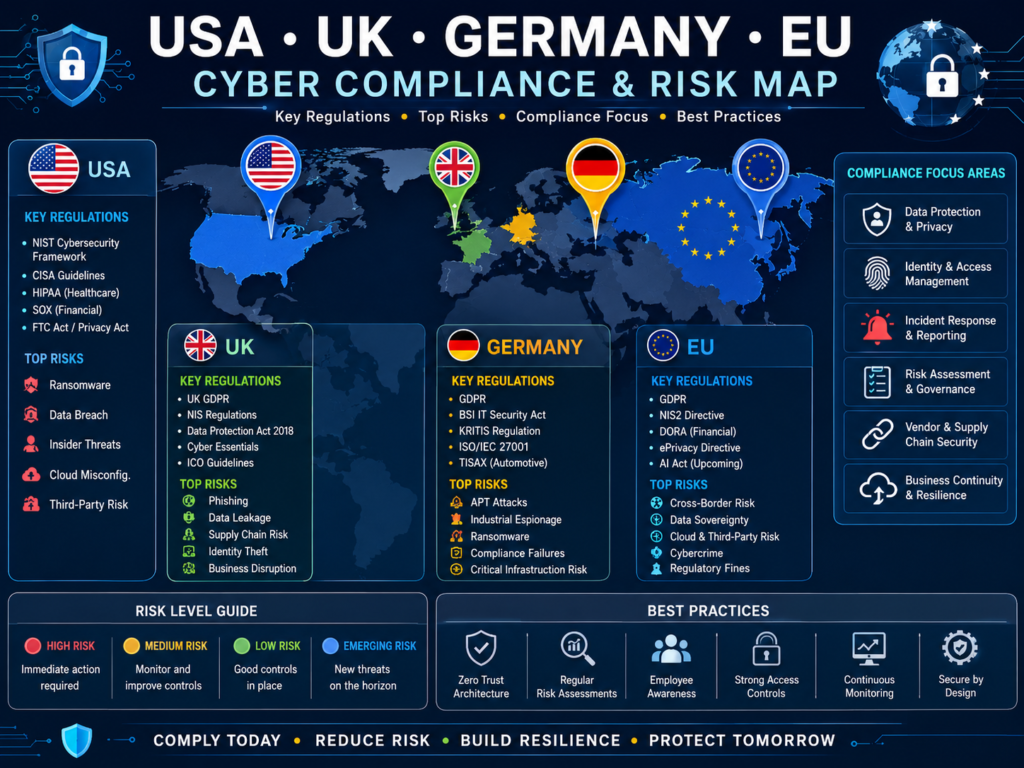
AI cyber risk is also a compliance issue.
Regulators do not expect organizations to stop every attack. They do expect reasonable risk assessment, access control, monitoring, incident response, vendor management, and evidence.
IBM’s 2025 report says 63% of organizations lacked AI governance policies to manage AI or prevent shadow AI. That gap can become a real problem when AI tools touch customer data, source code, contracts, payment records, health information, or regulated workflows.
US.
In the US, healthcare organizations must protect electronic protected health information under the HIPAA Security Rule. HHS says the rule requires administrative, physical, and technical safeguards for ePHI.
Banks, fintechs, SaaS companies, retailers, and service providers may also need to consider PCI DSS, SOC 2, ISO 27001, contractual security requirements, and state privacy obligations.
A hospital in New York or a fintech in Austin should prioritize phishing-resistant MFA, privileged access management, logging, backup recovery, vendor risk reviews, and payment verification controls.
UK.
UK organizations face AI phishing, ransomware, supplier compromise, and impersonation risk across the NHS, financial services, public sector, and critical infrastructure.
The ICO explains that the UK GDPR security principle requires appropriate technical and organisational measures, including risk analysis, policies, physical controls, technical measures, testing, and improvements.
For London and Manchester teams, practical controls include secure email configuration, identity monitoring, user-friendly MFA, supplier verification, incident runbooks, and board-level cyber reporting.
Germany and EU.
In Germany and the wider EU, AI-enabled threats intersect with GDPR/DSGVO, NIS2, DORA, BaFin expectations, BSI guidance, and sector-specific rules.
NIS2 aims to strengthen cybersecurity across the EU through a common framework for network and information systems. DORA entered into application on 17 January 2025 and applies to financial entities such as banks, insurers, and investment firms, with requirements around ICT risk, third-party risk, resilience testing, and incident reporting.
For Frankfurt, Munich, Berlin, Hamburg, Amsterdam, Paris, and Dublin operations, evidence matters. Prevention is important, but so is proving that controls exist, alerts are reviewed, incidents are handled, and suppliers are managed.
How to Detect and Defend Against AI-Powered Cyber Attacks
Organizations defend against AI-powered cyber attacks by reducing blind trust.
Do not blindly trust identities, emails, devices, vendors, payment requests, file links, cloud sessions, or executive instructions. Verify the action before the risk becomes real.
A good security program does not ask employees to “spot every fake.” It makes dangerous actions harder to complete without proper checks.
Strengthen Identity First
Identity is the easiest place to begin because many AI-powered attacks still aim to steal access.
Focus on.
Phishing-resistant MFA or passkeys where possible
Conditional access
Privileged access management
Service-account reviews
Device posture checks
Least privilege
Regular access reviews
Strong controls for non-human identities
For deeper planning, see Mak It Solutions’ [zero trust strategy resources] and [AI security monitoring guide].
Build Verification Into High-Risk Workflows
Awareness training helps, but process design protects better.
Add verification controls for.
Payment changes
Vendor onboarding
Payroll updates
Password resets
Executive requests
Sensitive data exports
New cloud admin access
Emergency procurement requests
Use callback rules, dual approvals, known communication channels, domain monitoring, secure ticketing, and escalation steps for urgent or unusual requests.
Improve AI Threat Detection
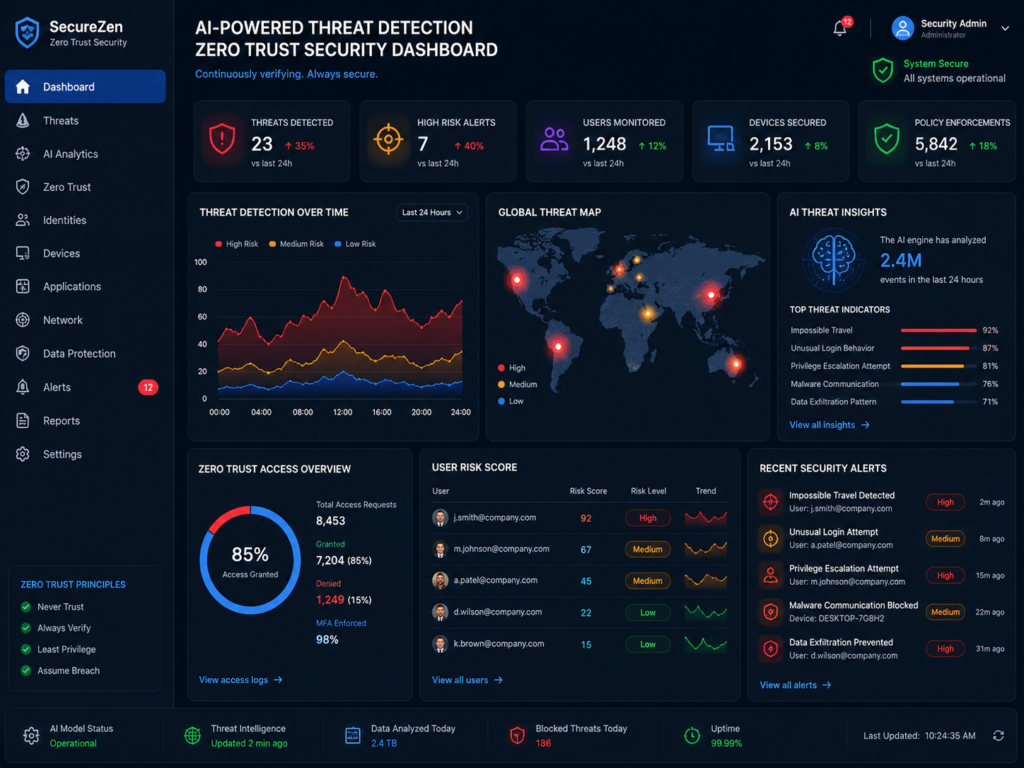
AI threat detection can help teams spot unusual logins, impossible travel, suspicious inbox rules, risky API behavior, abnormal downloads, endpoint changes, and cloud misconfigurations.
Tools from Microsoft Security, CrowdStrike, Darktrace, IBM, Proofpoint, and others can support detection. Still, architecture matters more than vendor names.
Connect email, endpoint, cloud, identity, SaaS, and data alerts into a shared investigation workflow. A detection tool is only useful if the right team sees the alert, understands the risk, and knows what to do next.
Mak It Solutions’ [business intelligence services] can also support risk dashboards for phishing reports, risky users, training gaps, incident trends, and compliance evidence.
Secure Cloud, SaaS, and Application Environments
Many AI-related risks sit inside cloud and SaaS workflows.
Teams using AWS, Microsoft Azure, Google Cloud, Microsoft 365, Google Workspace, Salesforce, GitHub, or other business platforms should review.
Admin permissions
API keys and tokens
Logging coverage
Data sharing rules
Public storage exposure
SaaS-to-SaaS integrations
Backup and recovery paths
Cloud workload identities
Sensitive data classification
For engineering-heavy teams, Mak It Solutions can support secure architecture through web development services Node.js development Python development and mobile app development services.
Test Resilience Before Attackers Do
AI-powered cyber attacks reward slow response. Testing helps teams move faster when pressure is real.
Run.
Phishing simulations
Deepfake payment-fraud drills
Incident response tabletop exercises
Backup recovery tests
Supplier compromise scenarios
AI red-team exercises
Cloud misconfiguration reviews
Keep evidence from each test. For regulated teams, the documentation may be as important as the technical fix.
Cyber Resilience Checklist for Boards, CISOs, and Compliance Teams
Use this checklist to turn AI cyber risk into practical action.
| Area | What to Check | Why It Matters |
|---|---|---|
| Identity | MFA, passkeys, admin rights, access reviews | Most attacks still target access |
| DMARC, SPF, DKIM, filtering, reporting buttons | AI phishing looks more believable | |
| Finance | Callback rules, payment-change approvals | Deepfake fraud targets money movement |
| Cloud | Logs, permissions, exposed storage, API keys | AI speeds up recon and abuse |
| Data | Classification, encryption, access control | Stolen data is easier to sort and exploit |
| Response | Playbooks, escalation, recovery tests | Speed limits breach impact |
| Compliance | HIPAA, PCI DSS, SOC 2, ISO 27001, UK-GDPR, GDPR/DSGVO, NIS2, DORA | Evidence supports audit and regulator readiness |
To Sum Up
AI-powered cyber attacks are making old threats faster, cheaper, and more convincing. The right response is not panic. It is disciplined cyber resilience across people, identity, cloud, applications, data, vendors, and compliance.
Start with the workflows where one convincing message could create real damage: payments, password resets, vendor changes, executive approvals, payroll updates, and sensitive data sharing.
Then strengthen identity, improve detection, test response, and keep evidence. That is how US, UK, Germany, and EU teams can reduce AI cyber risk without chasing every new security buzzword.
Planning to reduce AI cyber risk across your organization? Mak It Solutions can help scope a practical readiness assessment across identity, cloud, applications, analytics, mobile workflows, and compliance evidence. Start with the Mak It Solutions services team or request a focused consultation through the contact page.
FAQs
Q : What are AI-powered cyber attacks?
A : AI-powered cyber attacks are cyber threats that use artificial intelligence to increase speed, personalization, automation, or deception. Common examples include AI phishing, deepfake fraud, automated reconnaissance, malware support, and stolen-data analysis.
Q : Can AI-powered cyber attacks bypass traditional email security?
A : Yes, some can, especially when messages contain no malware, no suspicious attachment, and no obvious bad wording. AI-generated phishing can look like a normal vendor request, HR note, executive message, or SaaS alert. Email filtering should be combined with identity protection, email authentication, user reporting, payment verification, and behavior-based detection.
Q : Are small businesses at risk from AI-driven cyber attacks?
A : Yes. Small businesses may not be targeted by elite groups, but they can still face automated invoice fraud, credential phishing, fake supplier messages, and ransomware. The first priorities are MFA, backups, patching, secure email, staff training, and verified payment workflows.
Q : How do deepfake scams target executives and finance teams?
A : Deepfake scams impersonate trusted voices, faces, or communication styles. Attackers may clone a CEO’s voice, fake a video meeting, or send a convincing email that pressures finance staff to approve a payment quickly. The safest defense is independent verification, dual approval, known payment channels, and escalation rules.
Q : What is the first step to reduce AI phishing risk?
A : Start by mapping the workflows where a convincing message could cause real harm. For most organizations, that means payment changes, password resets, payroll updates, vendor onboarding, executive approvals, and sensitive data sharing. Once those are mapped, add verification rules, MFA, reporting buttons, targeted training, and monitoring.