
Best Document Workflow Management System for GCC
Best Document Workflow Management System for GCC
Best Document Workflow Management System for GCC
Contracts rarely move straight from drafting to signature. Across Riyadh, Dubai, and Doha, a single agreement may pass through procurement, legal, finance, and executive management—often using disconnected emails, spreadsheets, and downloaded attachments.
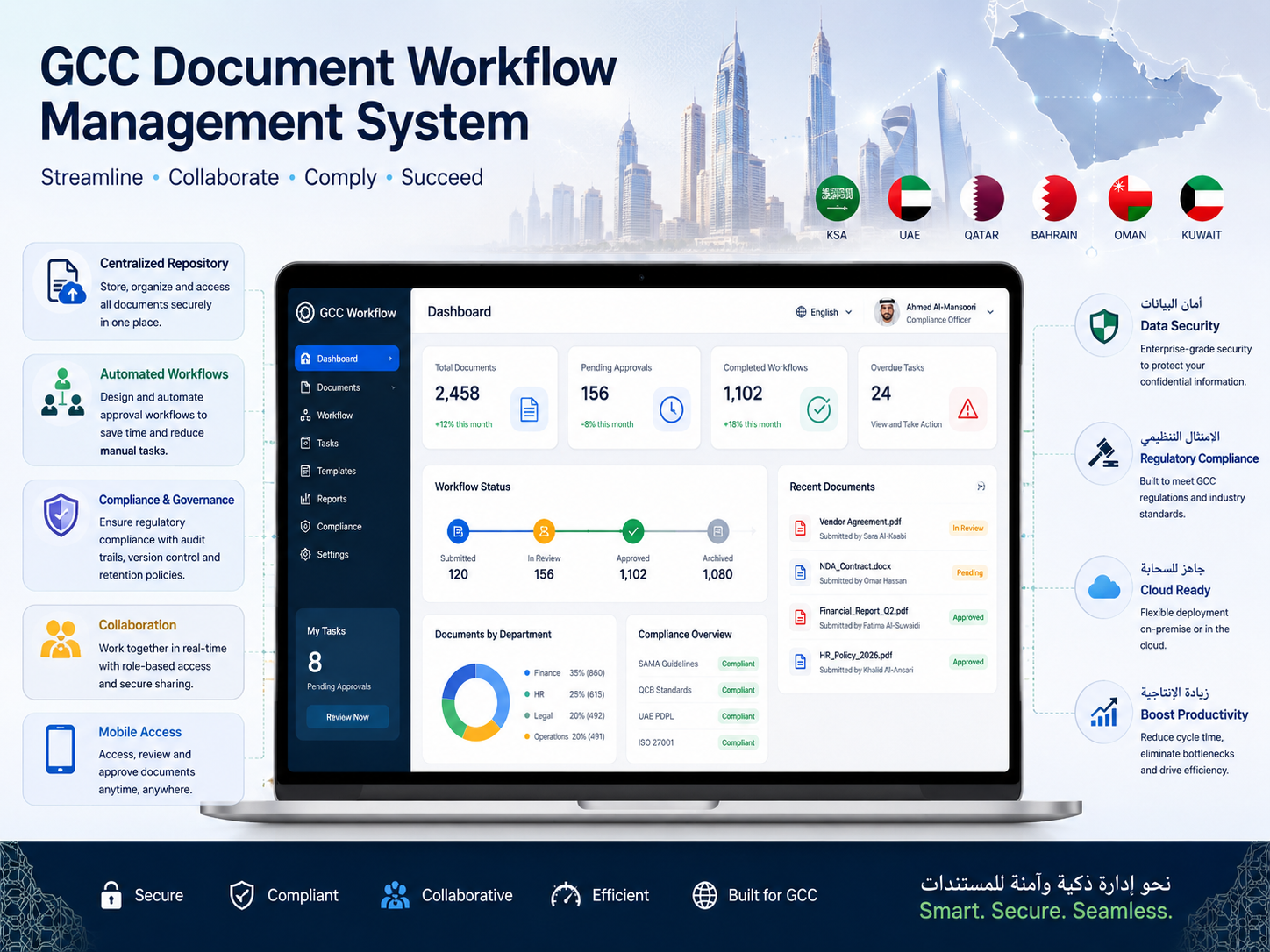
A secure document workflow management system brings those steps into one controlled environment. It manages how documents are created, reviewed, approved, signed, stored, retained, and audited while supporting regional requirements such as Arabic workflows, trusted digital identities, data residency, and country-specific compliance controls.
What Is a Document Workflow Management System?
A document workflow management system is software that controls a document throughout its complete business lifecycle. It does more than store files: it determines who can access a document, which approvals are required, when signatures can be applied, and what evidence must be retained.
For GCC organizations, this control is especially important when contracts involve bilingual versions, corporate stamps, regulated data, national identity services, or employees working across several countries.
The Complete Document Lifecycle Explained
A typical document lifecycle includes.
Document creation or upload
Classification and ownership assignment
Legal, financial, or operational review
Approval by authorized stakeholders
Electronic signature, digital signature, or organizational seal
Distribution to internal and external parties
Retention, archiving, and eventual approved deletion
Audit and evidence retrieval
The system should enforce the rules behind each stage rather than simply record that an action occurred.
Document Workflow System vs Document Management System
A traditional document management system mainly helps users store, organize, search, and retrieve files.
A document workflow management system adds process automation around those files, including.
Approval routing
Contract lifecycle automation
Permission controls
Deadlines and reminders
Delegated authority
Electronic signatures and seals
Version control
Audit accountability
Organizations deciding between an off-the-shelf platform and custom functionality can review Mak It Solutions’ build-versus-buy software framework.
Why GCC Organizations Need More Than Email Approvals
Email may appear convenient, but it creates serious control gaps.
It can be difficult to prove which Arabic or English version received approval, whether the signer had sufficient authority, or whether a scanned corporate stamp was copied and reused. Downloaded attachments may also continue circulating after a contract has been amended.
A controlled workflow gives employees one current version, one approval history, and one reliable record of who performed each action. It can also support secure mobile approvals for executives without weakening the audit trail.
Essential Document Workflow Management System Features
Configurable Approval Matrices and Authority Controls
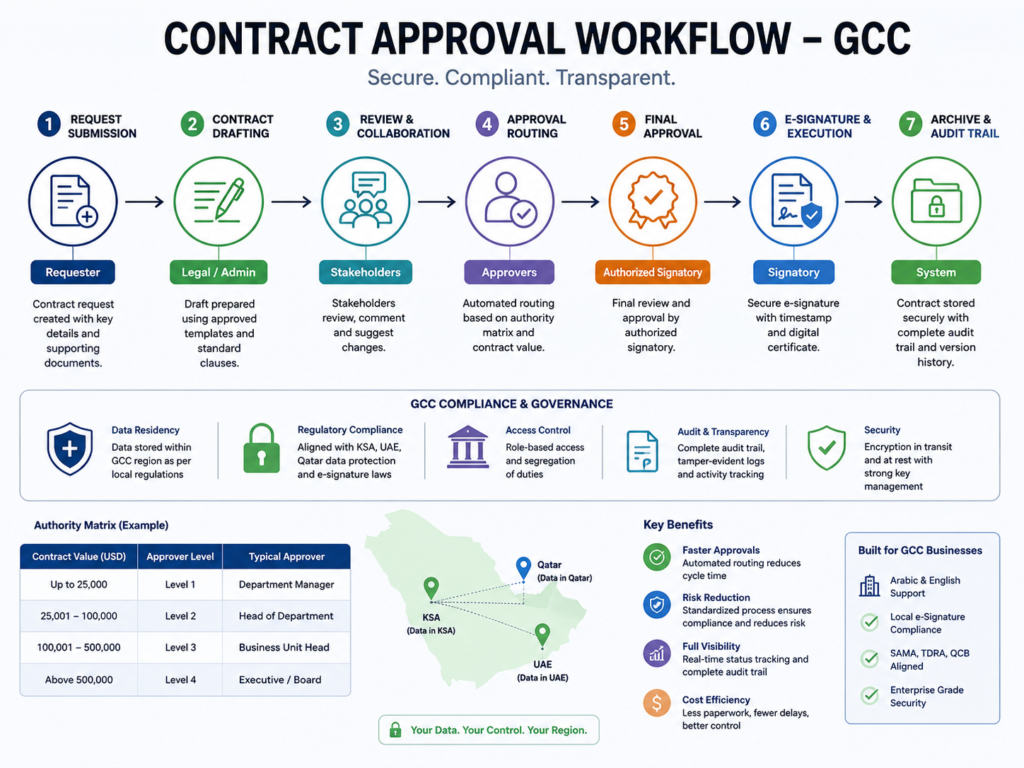
Strong approval matrix software should support both sequential and parallel reviews.
A supplier contract, for example, may require procurement approval first, followed by legal and finance review. Higher-value agreements may then be routed to a department head, chief financial officer, or chief executive.
Useful controls include.
Financial approval thresholds
Department-based routing
Temporary delegation
Separation of duties
Automatic reminders
Escalation rules
Rejection and resubmission paths
Signatory authority validation
These rules should be configurable without forcing administrators to rebuild the entire workflow whenever company policies change.
Electronic Signatures, Digital Signatures, and Seals
Not every electronic signing method provides the same level of assurance.
A typed name or uploaded signature image is different from a certificate-based digital signature. Similarly, a visual image of a company stamp is not automatically equivalent to a regulated electronic seal.
A secure platform should distinguish between.
Personal electronic signatures
Certificate-based digital signatures
Organizational electronic seals
Visual company stamps
Trusted timestamps
Identity-verification records
It should also preserve certificate status, authentication evidence, signer identity, and tamper-detection information where applicable.
Version Control, Audit Trails, and Secure Archiving
Every important change should leave a trace.
Essential controls include version history, role-based access, encryption, retention schedules, protected audit events, legal holds, and searchable archives. Users should be able to see which version was reviewed, what changed, and who approved it.
Audit records should not be editable by ordinary users. They should also be exportable when compliance, legal, or internal audit teams need evidence.
Mak It Solutions’ software supply-chain security guide covers complementary controls for protecting enterprise software platforms and their dependencies.
Saudi, UAE, and Qatar Compliance Requirements
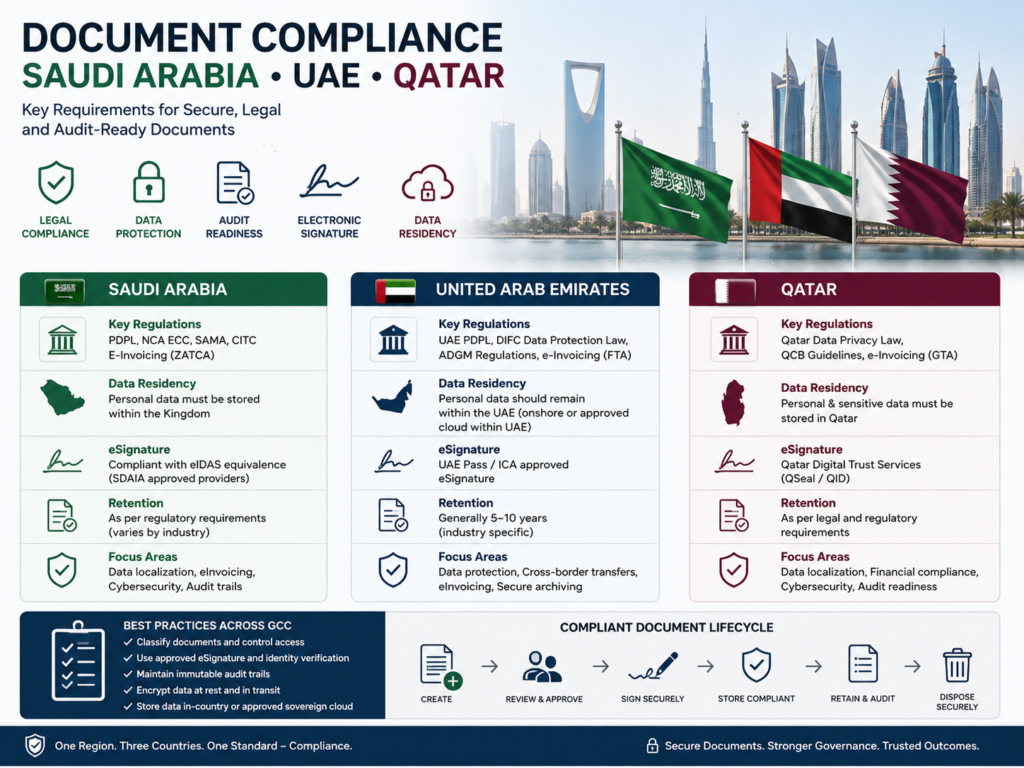
GCC compliance should not be treated as a single checklist. Saudi Arabia, the UAE, and Qatar have different identity frameworks, trust-service ecosystems, regulatory expectations, and data-governance requirements.
| Country | Key considerations |
|---|---|
| Saudi Arabia | DGA policies, PDPL, NDMO expectations, Nafath relevance, and sector-specific controls |
| UAE | TDRA trust services, UAE PASS compatibility, UAE Trusted List, and free-zone requirements |
| Qatar | CRA trust services, Tawtheeq, Tasdeeq, QCB requirements, and regulated recordkeeping |
Saudi Arabia.
Saudi deployments should consider Digital Government Authority policies, the Personal Data Protection Law, NDMO governance expectations, and the appropriate use of national identity services such as Nafath.
Nafath should not be added merely as a marketing feature. Its relevance depends on the transaction, the required identity-assurance level, connected government services, and applicable sector requirements.
Licensed digital trust services may also support signatures, seals, and trusted timestamps.
In practice, a Riyadh fintech could route a high-value supplier agreement through procurement, legal, and finance before verifying the authorized signatory and releasing the contract for execution. A SAMA-regulated business would also need to assess its wider security, authentication, audit, and technology-risk obligations.
UAE.
UAE buyers should examine whether a provider works with appropriate trust services, supports relevant UAE PASS scenarios, and appears within the applicable UAE trust framework.
Organizations should also check the TDRA UAE Trusted List rather than accepting a broad “UAE compliant” statement without supporting evidence.
ADGM and DIFC organizations may require additional jurisdiction-specific review. A workflow suitable for a general commercial contract may not automatically satisfy the requirements of a regulated financial, property, or cross-border transaction.
For example, a Dubai e-commerce business could verify an executive’s identity before approving a major logistics contract while retaining the identity event, approval history, and executed document in one record.
Qatar.
Qatar’s Communications Regulatory Authority maintains a regulated trust-services framework that can cover electronic signatures, seals, and timestamps.
Tawtheeq supports national authentication, while Tasdeeq is associated with document verification. Organizations in regulated financial services should also map their workflows against applicable Qatar Central Bank requirements.
A Doha financial institution may need to retain signer identity, internal approvals, signed versions, certificate evidence, and retention metadata for each relevant customer or business document.
Provider regulation remains important, but it does not replace the customer’s responsibility to configure permissions, retention rules, and approval authorities correctly.
Building a GCC-Ready Security and Deployment Model
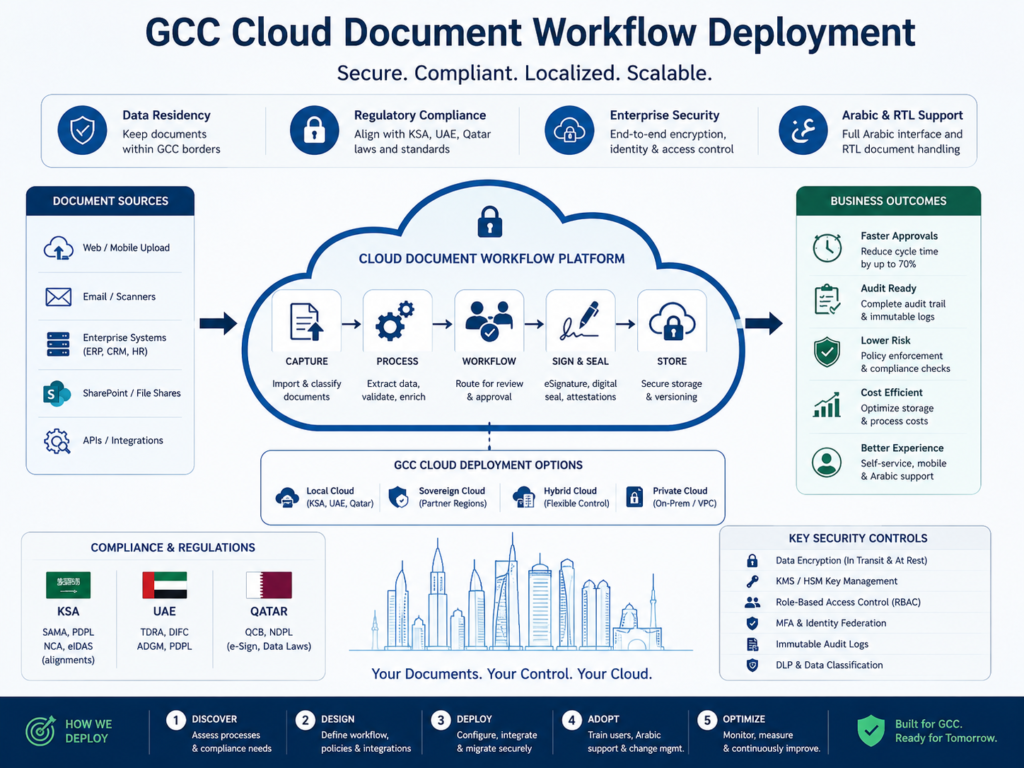
Data Residency, Sovereign Cloud, and Cross-Border Transfers
Data residency should be assessed separately for each country, workload, and document category.
Possible deployment models include.
Sovereign cloud
Regional public cloud
Private cloud
On-premise infrastructure
Hybrid deployment
Regional services may include AWS Bahrain, Azure UAE Central, or Google Cloud Doha. However, the availability of a nearby cloud region does not automatically prove that a proposed deployment meets every legal or regulatory requirement.
Buyers should review where primary data, backups, encryption keys, logs, and disaster-recovery copies are stored. They should also examine how support teams access production systems and whether data can be transferred across borders.
The GCC sovereign-cloud decision guide and GCC data-residency guide provide additional planning context.
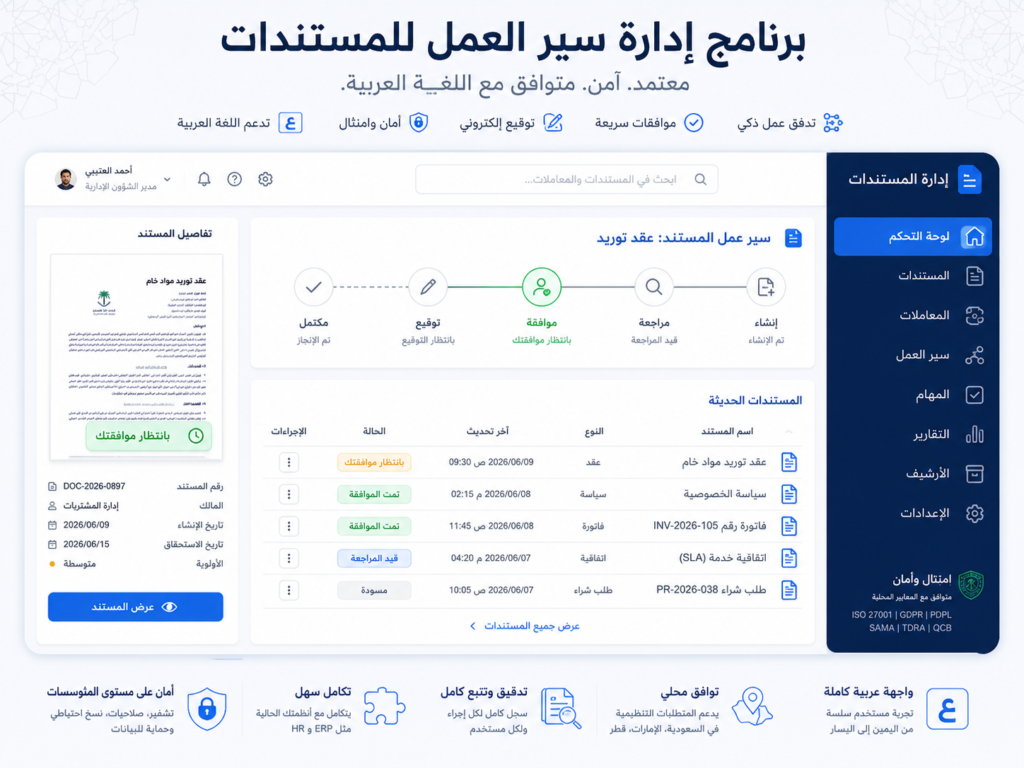
Arabic-English Workflows and Right-to-Left UX
Arabic support must extend beyond translating buttons.
Arabic-friendly document workflow software should support.
Right-to-left screens
Bilingual templates
Arabic names and identity matching
Hijri and Gregorian dates
Arabic search and metadata
Mobile approvals
Separate Arabic and English version histories
Clear identification of the legally governing version
When both language versions form part of the same agreement, they should remain connected within one controlled record. Translation changes, reviewer comments, and approvals should be traceable without forcing users to compare attachments from different email threads.
ERP, CRM, HRMS, and Identity Integrations
A document workflow rarely operates alone.
Organizations should look for secure APIs, webhooks, single sign-on, synchronized permissions, and integration audit logs. Common connections may include:
ERP and finance systems
Procurement platforms
CRM software
HRMS platforms
Microsoft 365
Enterprise identity providers
National authentication services
Digital trust-service providers
The system should record integration activity so administrators can see when information was created, changed, transmitted, or rejected.
Mak It Solutions’ API-first architecture guide explains how interoperable platforms can reduce integration bottlenecks.
GCC Use Cases by Department and Industry
Legal and Procurement Contract Workflows
Legal departments can use contract management software to control templates, clauses, reviews, amendments, renewals, and signatory validation.
Procurement teams can add supplier onboarding, value-based approval thresholds, counterparty access, and purchase-contract controls. Instead of chasing reviewers manually, they can see where a document is delayed and which action is required next.
Finance, HR, Operations, and Government Approvals
Finance teams can automate purchase orders, invoices, expense approvals, and budget-related documents.
HR teams can manage employment contracts, policy acknowledgements, and employee letters. Operations departments can control permits, incident reports, vendor authorizations, and maintenance approvals.
Government entities can apply similar controls to Arabic correspondence, internal resolutions, official approvals, and retained public-sector records.
Fintech, Retail, and Logistics Examples
A SAMA-governed fintech can retain evidence of who reviewed and approved a sensitive agreement.
A regional retailer can coordinate store-opening contracts across Riyadh, Dubai, and Doha while applying different approval thresholds by country or business unit.
A logistics company can manage shipment records, supplier authorizations, and service agreements through one digital transaction management platform.
Supporting capabilities may include business intelligence services for workflow reporting and back-end development services for secure integrations.
Costs, Implementation Timelines, and Business Value
What Determines Document Workflow Software Cost?
Pricing depends on the scope of the implementation rather than the software license alone.
Cost factors may include.
Number of users
Number and complexity of workflows
Storage requirements
Signature transactions
Trust-service fees
Identity integrations
Arabic localization
Data migration
Deployment model
Security testing
Training and support
Buyers should request a complete total-cost-of-ownership estimate that separates implementation costs, recurring fees, third-party services, and future expansion.
Typical Implementation Phases and Timeline Factors
Implementation usually includes requirements gathering, workflow design, platform configuration, integration, data migration, security testing, training, and controlled rollout.
Complexity tends to increase when the project includes on-premise infrastructure, several business units, legacy document archives, custom authority rules, or multiple national identity connections.
A phased rollout is often safer than launching every workflow at once.
Measuring ROI and Operational Improvement
The strongest business case is based on measurable operational change.
Useful metrics include.
Average approval time
Number of manual reminders
Rejected or returned documents
Use of outdated versions
Missed renewal dates
Audit-preparation effort
Paper and courier costs
Mobile approval adoption
Workflow exception rates
Dashboards can show where documents remain stuck and whether delays come from system design, unclear authority, or slow stakeholder action.
How to Select and Implement the Right GCC Platform
Map Documents, Risks, and Approval Authorities
Identify the documents that need control, their current routes, authorized signatories, financial thresholds, retention periods, bilingual requirements, and country-specific risks.
Do not begin by copying an inefficient email process into new software. Use the project to simplify unnecessary steps.
Evaluate Security, Compliance, and Local Fit
Request evidence rather than relying on generic compliance claims.
Evaluate:
Audit-trail integrity
Arabic and RTL usability
Identity integrations
Trust-service relationships
Data-residency options
Encryption and key management
Disaster recovery
Access governance
Saudi, UAE, or Qatar deployment experience
Legal, compliance, cybersecurity, and business teams should review the platform together.
Pilot One High-Value Workflow Before Scaling
Start with a supplier contract, employment agreement, purchase order, or another process that is important but manageable.
Measure processing speed, adoption, mobile usability, workflow exceptions, and audit completeness. The results will show which rules need adjustment before the platform expands across departments or countries.
Final Words
The best document workflow management system controls the complete document lifecycle not just storage or signature capture.
For GCC organizations, the platform should combine clear approval authority, Arabic usability, secure identity verification, reliable audit evidence, flexible deployment, and country-level compliance support.
The right approach is to start with one slow or high-risk process, define the required controls, and test the workflow under real business conditions before scaling.
Explore Mak It Solutions’ technology services and request a custom GCC workflow assessment for your Saudi, UAE, or Qatar operation.(Click Here’s )
Compliance requirements vary by country, sector, document type, and transaction. Organizations should validate legal, regulatory, retention, and electronic-signature requirements with qualified local professionals before implementation.
FAQs
Q : Is Nafath integration required for every Saudi contract workflow?
A : No. Nafath is not automatically required for every private-sector document or internal approval.
Its relevance depends on the document, identity-assurance level, connected government service, and applicable sector rules. Routine internal approvals may use enterprise single sign-on, while higher-risk transactions may require stronger identity controls.
Q : Can UAE companies use UAE PASS for every business document?
A : UAE PASS can support many identity-verification and signing scenarios, but not every document has the same execution requirements.
The transaction type, parties, regulator, jurisdiction, and required assurance level should be reviewed. Additional legal or compliance assessment may be needed for regulated financial, property, or cross-border documents.
Q : What should Qatar companies check when choosing a trust-service provider?
A : Companies should verify the provider’s regulatory status, certificate policies, electronic-seal capabilities, timestamping, incident procedures, identity-verification methods, and audit exports.
They should also test Arabic usability and map the proposed service against applicable QCB or sector-specific requirements.
Q : How should companies control Arabic and English contract versions?
A : Both versions should remain connected within one controlled document record.
The workflow should preserve translation updates, reviewer comments, approval stages, and version history. It should also identify which language version governs if the texts differ.
Q : Can one platform support different GCC retention rules?
A : Yes, provided the system supports configurable policies by country, regulator, business unit, and document category.
It should also support legal holds, approved deletion, evidence exports, and country-specific archives. Final retention schedules should be validated by qualified legal and compliance professionals.