
Content Authenticity for Arabic PR: GCC Guide
Content Authenticity for Arabic PR: GCC Guide
Content Authenticity for Arabic PR: GCC Guide
A polished Arabic press release can still create reputational problems if a quotation is mistranslated, an executive title is outdated, a visual has been altered, or an AI-generated claim cannot be traced to a reliable source. That is why content authenticity for PR/media in Arabic needs to be treated as part of the publishing workflow not as a final proofreading task.
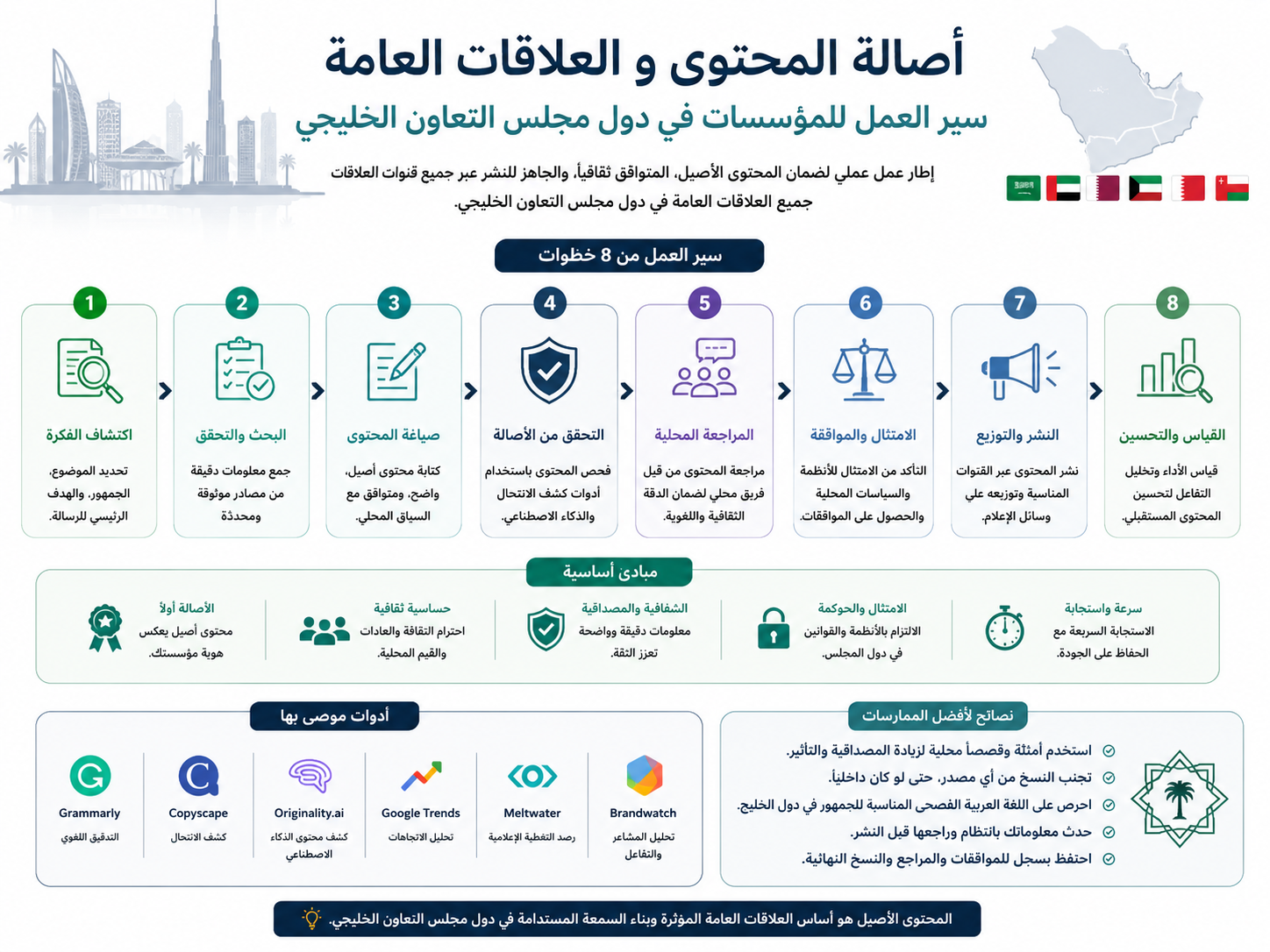
For communications teams in Saudi Arabia, the UAE, and Qatar, content authenticity means being able to trace and verify the source, evidence, quotation, Arabic translation, visual assets, approvals, and final published version. A practical workflow is simple: source → verify → localize → review → document → approve → publish and monitor.
What Content Authenticity Means in Arabic PR
Content authenticity goes beyond checking whether something was written by AI.
An authentic PR asset should allow your team to answer basic questions quickly.
Where did this claim come from?
Who approved this quotation?
Does the Arabic version preserve the original meaning?
Is the image or video genuine and licensed for use?
Has legal or compliance reviewed sensitive claims?
Which version was finally approved?
Can the published information be corrected if circumstances change?
That traceability becomes especially important when one announcement moves between English and Arabic teams or across Riyadh, Dubai, Abu Dhabi, Doha, and other GCC markets.
Why Arabic Localization Adds Another Verification Layer
English-to-Arabic PR is not just translation.
Names, titles, honorifics, dates, numbers, product descriptions, and regulatory terminology can all shift during localization. A sentence may be grammatically correct while still changing the meaning or strength of the original claim.
For formal GCC communications, clear Modern Standard Arabic will often be more appropriate than forced regional dialect. The wording can be localized for the audience, but the underlying facts and evidence should remain consistent.
Verify the Original Source Before Writing
Strong content authenticity for PR/media in Arabic starts before anyone drafts the Arabic copy.
Confirm the source behind every important claim
Separate:
First-party company information
Independent third-party evidence
Executive commentary
Regulatory information
Unverified working notes
Statistics, dates, announcements, product claims, and regulatory statements should have a traceable source.
If a writer cannot identify where a significant factual claim came from, it should not automatically move into the final release.
Verify quotations, names, and titles
Before publication, confirm.
Who supplied or approved the quotation
Whether it is a direct quote or translated quote
The executive’s current title
Approved Arabic spellings of personal and company names
Any required honorifics or official terminology
A small title or translation error can become much more visible once media outlets begin republishing the release.
Keep a simple evidence register
A lightweight register can include:
Claim | Source | Owner | Date checked | Arabic version | Reviewer | Status
Larger teams can connect the same approach with their business intelligence services and reporting workflows to improve traceability.
Authenticate Arabic Text and Translation
Arabic copy should be reviewed against the approved source—not merely against the writer’s interpretation of it.
Compare the two versions carefully
Check.
Numbers
Names
Dates
Quotations
Product or service descriptions
Financial or performance claims
Regulatory terminology
The Arabic version should communicate the same factual meaning as the approved master.
Review meaning, not just literal translation
A Riyadh announcement may use different contextual phrasing from a campaign aimed at Dubai or Doha. That is normal localization.
Changing the evidence is not.
Arabic editors should therefore have enough context to understand what the source is trying to communicate instead of translating individual words mechanically.
Escalate sensitive wording
Extra review is sensible for content involving.
Religion
Governments or public officials
Health
Finance
National identity
Privacy or personal information
Comparative advertising
Legal disputes
These areas can carry regulatory as well as reputational risk.
Check AI-Assisted Content and Media Assets
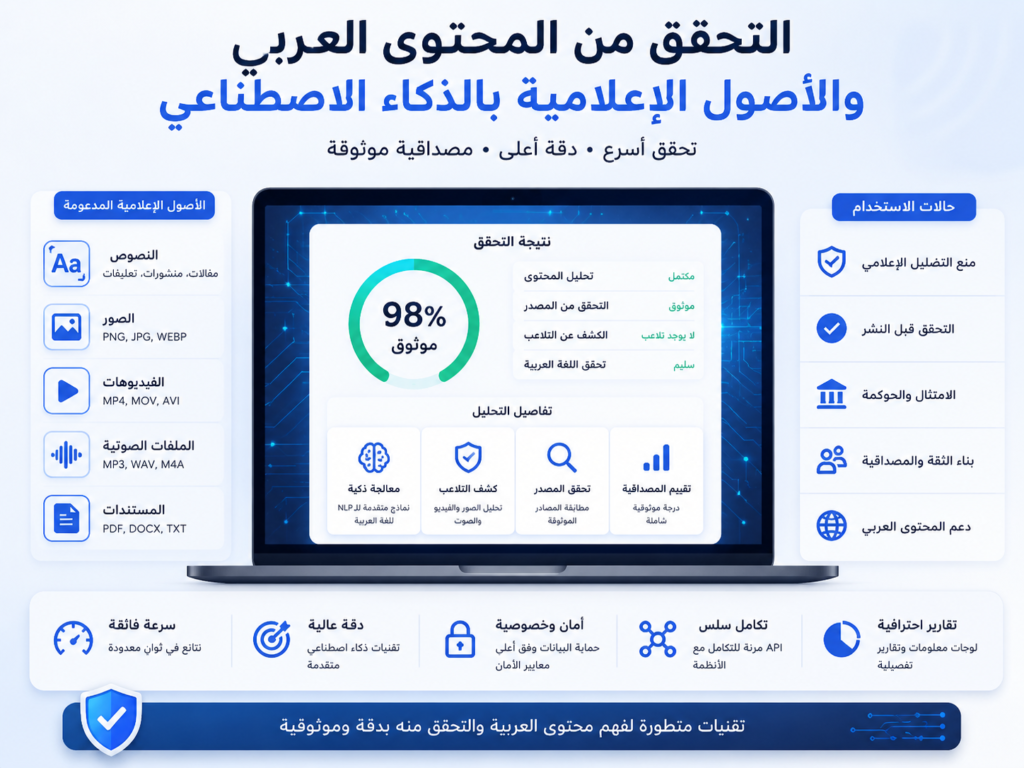
AI can accelerate PR workflows, but speed should not replace verification.
Treat AI detection as a clue, not proof
An AI detector cannot establish that a factual claim is true.
Instead, verify quotations, reports, statistics, sources, and regulatory claims independently. Organizations adopting generative AI can also formalize these controls through an AI governance policy.
A stronger workflow is:
AI-assisted draft → human fact-check → Arabic review → compliance review → authorized approval
Authenticate images, video, audio, and screenshots
Check the original asset where possible, along with:
Source identity
Context
Usage permission
Editing history
Approved final version
Teams producing graphic design and campaign material should also maintain controlled master assets rather than relying on files copied repeatedly through messaging apps or email threads.
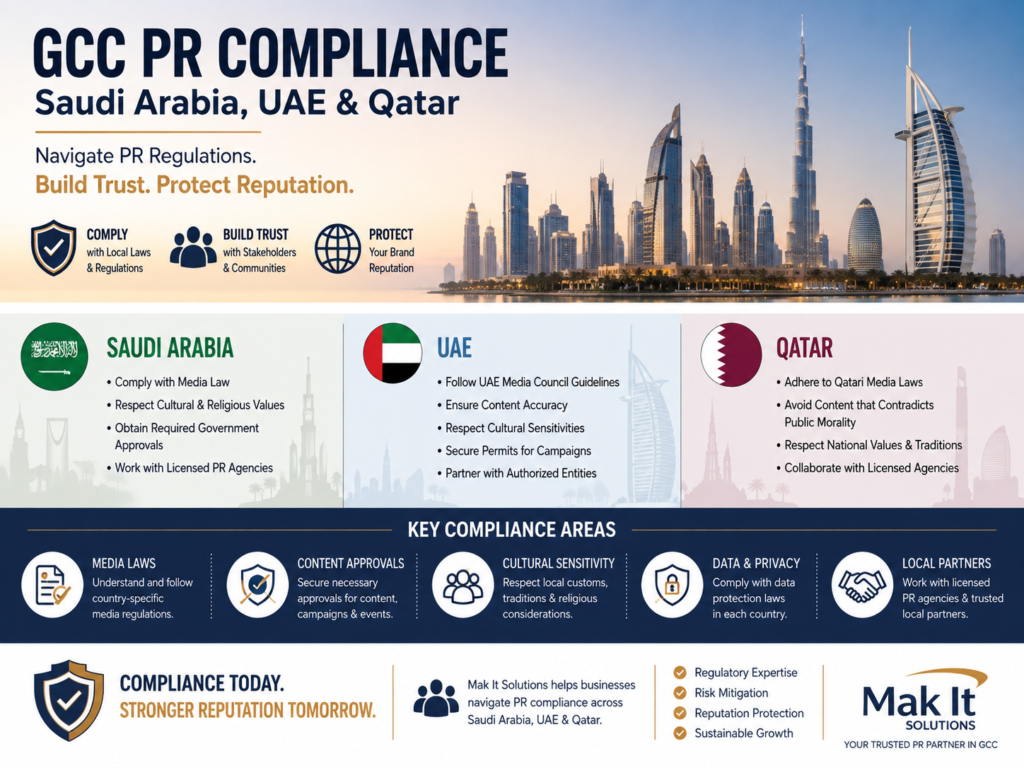
Apply GCC Compliance and Privacy Checks
Authenticity and compliance overlap, but they are not the same thing. The relevant review depends on the country, sector, channel, and type of content.
Saudi Arabia
Saudi Arabia’s General Authority of Media Regulation provides licensing and regulatory services across media activities, including press and electronic-media services.
For financial institutions, SAMA maintains specific rules governing advertising of financial products and services. Communications involving regulated financial claims should therefore pass through the relevant compliance function rather than being treated as ordinary marketing copy.
In practice, a Riyadh fintech should verify both the underlying financial claim and the regulatory context before distributing Arabic promotional content.
UAE
The UAE Media Council states that media individuals and institutions operating in the UAE must comply with national media-content standards.
That means a Dubai or Abu Dhabi communications team should determine which media requirements apply to the specific content and publishing activity rather than assuming every digital campaign follows exactly the same approval path.
For broader campaign operations, companies can connect editorial governance with controlled digital marketing services and publishing processes.
Qatar
Qatar’s Ministry of Culture provides licensing services covering publications and publishing activities, alongside related media and cultural services.
For Doha-based organizations, the appropriate check will depend on the type of publication and the organization’s sector. A regulated financial business, for example, may need an additional sector-specific review beyond its standard editorial approval process.
Compliance note: Regulatory requirements can change and may depend on the organization, activity, platform, and sector. Treat this workflow as an editorial governance framework, not legal advice, and confirm current requirements with the relevant regulator or qualified adviser before publication.
Build a Clear Arabic PR Approval Trail
Verification becomes much easier when every stage has an owner.
Assign editorial responsibilities
A practical approval chain might be:
PR writer → Arabic editor → subject expert → legal/compliance → authorized approver
Not every organization needs the same structure, but someone should be accountable for each checkpoint.
Version-control Arabic and English together
Keep bilingual files connected through:
Matching document IDs
Revision dates
Approval status
Named owners
Final-publish markers
This reduces the risk of an outdated Arabic release going live after changes have already been approved in the English master.
Preserve evidence of approval
Retain source documents, approved quotations, visual permissions, final copy, and relevant sign-offs.
Similar evidence-preservation principles are also useful when building broader GCC incident-response processes.
Publish Through Trusted Channels
Once the content has been approved, authenticity still depends on how it reaches the public.
Use identifiable official channels
Publish through controlled company websites, authenticated corporate profiles, and approved distribution partners.
This gives journalists, customers, and search engines a clear source to reference when different versions of a claim begin circulating.
Keep one authoritative version
Where practical, establish a canonical source page containing the latest approved information.
Good search engine optimization can also help legitimate source pages remain discoverable when people search for the announcement later.
Monitor and Correct Published Content
Publishing is not the end of the authenticity process.
Monitor Arabic coverage
Watch how important information is repeated by.
News websites
Aggregators
Social accounts
Influencers
Industry publications
Search and AI-generated summaries
Pay particular attention to quotations, figures, names, executive titles, and Arabic terminology.
Use a documented correction workflow
A useful process is:
identify → verify → approve correction → update owned channels → notify relevant publishers → archive the change
A central correction register can help teams working across Riyadh, Dubai, and Doha avoid fixing one market while leaving another version unchanged.
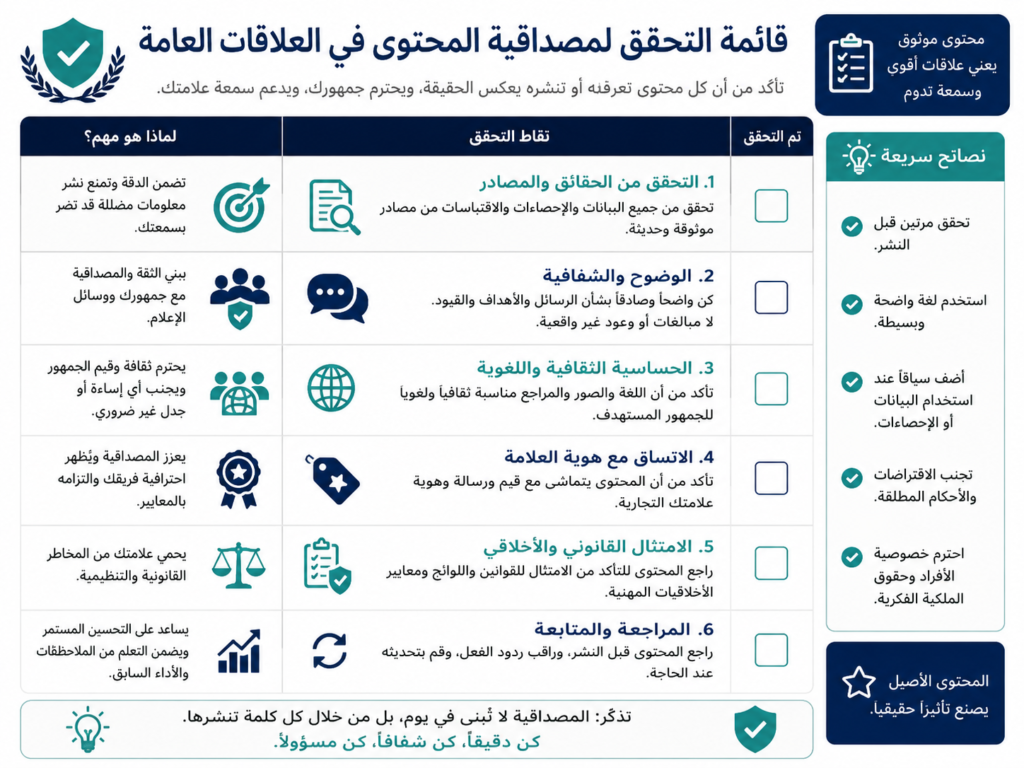
Arabic Content Authenticity Checklist for GCC Teams
Before drafting
Confirm.
Original source
Source ownership
Rights and permissions
Names and titles
Dates
Quotations
Statistics
Original media files
Before publication
Confirm:
Arabic meaning matches the approved source
Names and terminology are consistent
Important claims are supported
Visual assets are authentic and approved
AI-assisted claims have been human-verified
Relevant compliance review is complete
Correct version is approved
Final approver is recorded
After publication
Confirm.
Official source page is live
Coverage is being monitored
Final files are archived
Supporting evidence is retained
Corrections are documented
Outdated versions are controlled
Concluding Remarks
Strong content authenticity for PR/media in Arabic is built through traceability, not through one software tool or a final proofreading pass.
Verify the original source, protect the meaning during Arabic localization, check AI-assisted claims and media assets, apply the relevant GCC compliance review, preserve approvals, and keep monitoring after publication. When those controls become routine, communications teams can publish Arabic content with greater consistency and a much clearer audit trail.
Need help building a scalable Arabic-English publishing and governance workflow for Saudi Arabia, the UAE, or Qatar? Explore Mak It Solutions services or contact the team to discuss a GCC-focused approach to trusted publishing, digital governance, and communications.
FAQs
Q : How can Saudi PR teams verify Arabic press releases?
A : Start with the approved source, then confirm names, quotations, numbers, Arabic meaning, visual assets, and final authorization. Organizations operating in regulated sectors should add the appropriate compliance review before publication.
Saudi media activities may also fall within requirements administered by the General Authority of Media Regulation, while financial institutions need to consider SAMA requirements applicable to their advertising activities.
Q : Do UAE companies need human review for AI-generated Arabic PR?
A : Human review is strongly advisable. AI-generated copy can contain unsupported claims, incorrect citations, translation errors, or wording that changes the intended meaning.
The reviewer should check evidence, Arabic accuracy, cultural context, and final authorization. Organizations subject to UAE media requirements should also determine how the UAE Media Council’s content standards apply to their activity.
Q : How should Qatar teams verify translated executive quotations?
A : Compare the Arabic quotation with the approved original and focus on meaning rather than word-for-word similarity.
Confirm the executive’s identity, title, wording, and authorization. Where the activity involves publishing or related media services, teams should also review the applicable Qatar Ministry of Culture requirements.
Q : What records help prove content authenticity?
A : Keep the original sources, quotation approvals, bilingual versions, revision histories, visual permissions, reviewer records, compliance approvals, and final publication records.
The goal is simple: your team should be able to reconstruct how an important claim moved from source evidence to published Arabic copy.
Q : How can GCC brands reduce the spread of fake Arabic quotes or manipulated media?
A : Maintain a verified source library, restrict final approvals, preserve original media files, and publish through recognizable official channels.
When false or altered material appears, use a documented correction process rather than silently changing the original page. Consistency matters even more when misinformation moves between Saudi Arabia, the UAE, Qatar, and wider Arabic-language platforms.