
Arabic SEO for GCC Brands: Win Search & AI in 2026
Arabic SEO for GCC Brands: Win Search & AI in 2026
Arabic SEO for GCC Brands: Win Search & AI in 2026
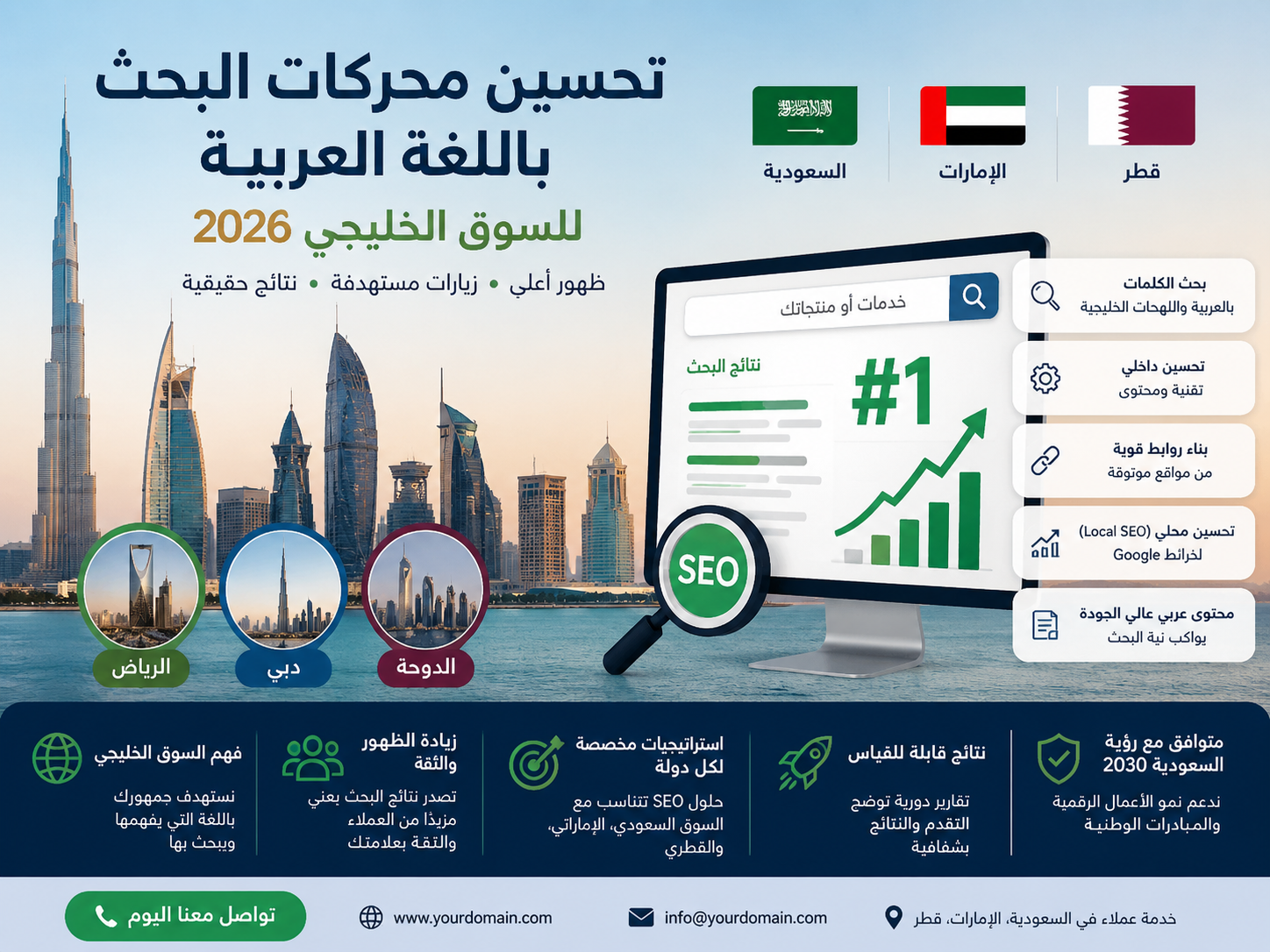
Arabic SEO in 2026 is no longer just about ranking Arabic pages in Google. GCC businesses also need content that can surface in direct answers, AI-assisted search experiences and generative recommendations.
For brands targeting Saudi Arabia, the UAE and Qatar, the strongest approach is straightforward: build a solid Arabic SEO foundation, localize it for each GCC market, structure content for AEO, and strengthen authority and entity signals for GEO.
Put simply: Arabic SEO → GCC localization → AEO → GEO.
What Is Arabic SEO in the GCC?
Arabic SEO is the process of optimizing Arabic or bilingual websites around real Arabic search intent, technical search requirements and the expectations of users in specific markets such as Saudi Arabia, the UAE and Qatar.
It goes well beyond translating an English page into Arabic.
How Arabic SEO Differs From English SEO
Arabic keyword research has more linguistic variation to account for. Users may search in Modern Standard Arabic, familiar Gulf terminology, English, transliterated words, or a mixture of Arabic and English.
That means literal translation can easily miss the way people actually search.
A stronger strategy combines regional keyword research with professional search engine optimization and localized customer journeys.
For example, a service that performs well with an English commercial keyword in Dubai may require a completely different Arabic phrase to capture similar intent in Riyadh.
Why Saudi Arabia, the UAE and Qatar Need Different SEO Signals
The GCC should not be treated as one uniform Arabic-speaking market.
A Riyadh audience may justify an Arabic-first landing page, while businesses in Dubai and Abu Dhabi frequently need smooth bilingual journeys. Doha may offer smaller but highly focused opportunities in particular sectors.
Localization can affect.
Keywords and terminology
Page titles and headings
Calls to action
Examples and use cases
Currency or location references
Arabic-English content balance
Trust and regulatory signals
The goal is not to create artificial differences. It is to make each page genuinely useful to the market it targets.
Why Arabic SEO Is the Foundation for AEO and GEO
SEO helps search engines discover, crawl and understand content.
AEO, or Answer Engine Optimization, makes that content easier to extract into concise answers.
GEO, or Generative Engine Optimization, strengthens the entities, authority, context and supporting information that generative systems can use when producing responses.
These disciplines work best together.
A technically weak Arabic website will not become competitive simply by adding FAQ sections or writing for AI tools. Search intent, site architecture, localization and credible content still come first.
How AEO and GEO Change Arabic Search in 2026
Search journeys are becoming less linear. A potential customer may encounter a business through a traditional organic result, a featured answer, an AI-generated summary or a recommendation built from multiple sources.
That changes how GCC brands should structure Arabic content.
What Is AEO for Arabic Search?
AEO focuses on answering specific questions clearly and quickly.
Useful AEO content typically includes.
Question-based headings
Short definitions near the top of a section
Concise answers before detailed explanations
Logical comparisons
Helpful lists and steps
Clear contextual terminology
Instead of making a reader search through several paragraphs for an answer, give the answer first and expand afterward.
What Is GEO and How Does It Help GCC Brands?
GEO focuses on making content understandable, credible and useful to generative systems.
For GCC businesses, this means creating strong topical and entity relationships rather than repeating a keyword excessively.
A financial-services article, for example, may naturally reference the Saudi Central Bank (SAMA), while relevant UAE content may refer to TDRA, DIFC or ADGM. Qatar-focused financial content may rely on Qatar Central Bank where appropriate.
The important word is relevant. Mentioning well-known organizations simply to create authority signals does not improve weak content.
Why GCC Businesses Need SEO, AEO and GEO Together
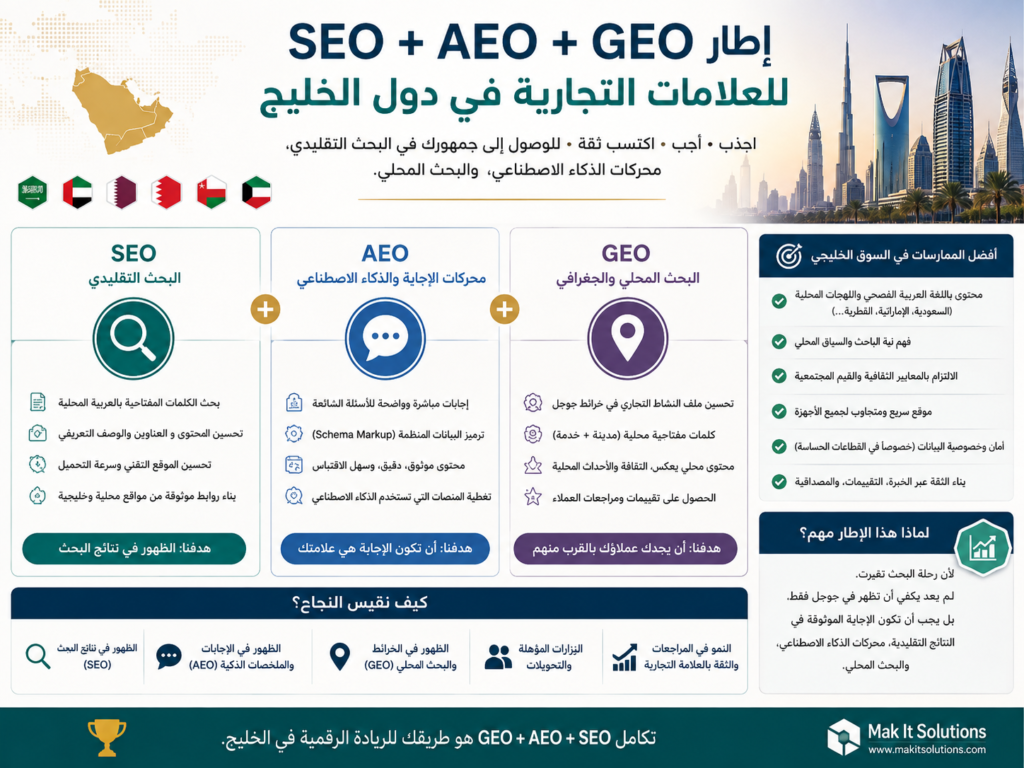
SEO, AEO and GEO solve related but different visibility problems.
A practical model looks like this.
| Layer | Primary Goal | What to Focus On |
|---|---|---|
| SEO | Search visibility | Keywords, crawling, internal links, technical health |
| AEO | Direct answers | Questions, concise explanations, structured content |
| GEO | Generative visibility | Entities, authority, sourcing and contextual depth |
Businesses can combine these layers with a broader digital marketing strategy instead of treating AI visibility as a separate shortcut.
How to Optimize Arabic Websites for Saudi Arabia, UAE and Qatar
Successful GCC SEO usually starts with localization at the market level, not with a single Arabic page copied across every country.
Build Country-Specific Arabic Keyword Research
Research Saudi Arabia, the UAE and Qatar independently.
Look beyond raw search volume and consider.
Local wording
Commercial intent
Arabic versus English usage
Competitor positioning
Location modifiers
Product or service terminology
Search-stage differences
A Saudi user and a UAE user may be looking for the same service while expressing that need differently.
Structure Bilingual Arabic-English Websites Correctly
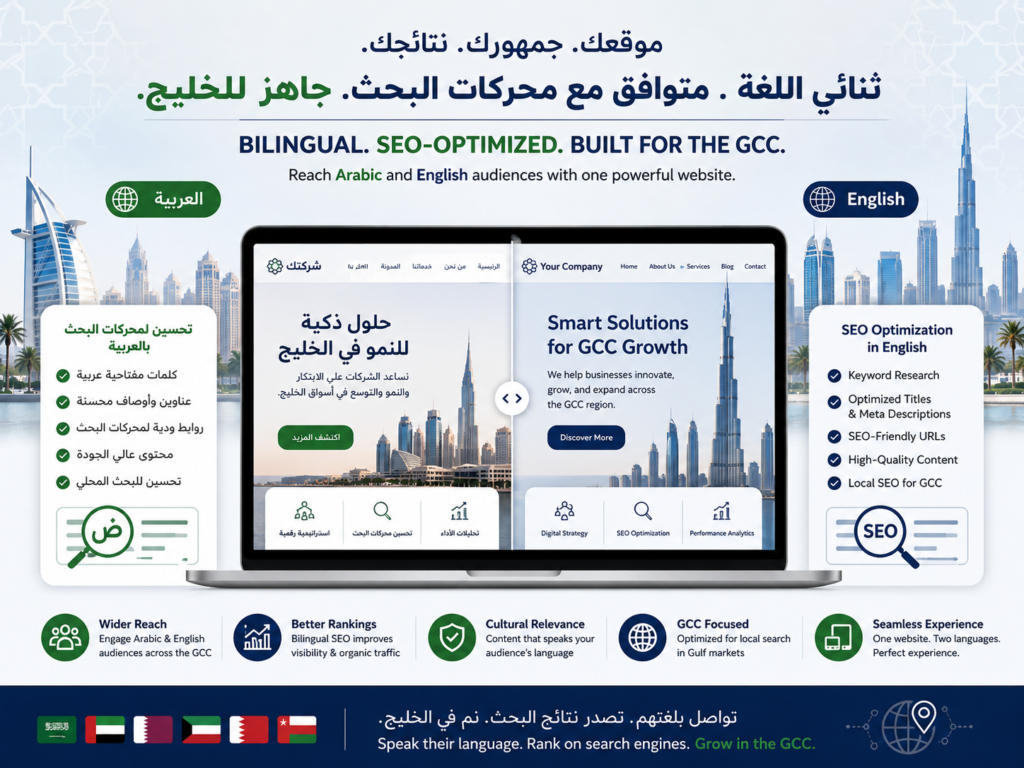
When Arabic and English versions genuinely serve different language audiences, distinct URLs can give both users and search engines clear destinations.
Depending on the website structure, relevant regional language annotations may include.
The implementation should also maintain appropriate canonical URLs, internal linking and consistent navigation.
Multilingual architecture often requires coordination between SEO and front-end development, especially when right-to-left layouts or language switching affect page structure.
Optimize Arabic UX Without Sacrificing Search Performance
Arabic pages should feel designed for Arabic users not like English interfaces with the text reversed.
Pay attention to.
Natural RTL navigation
Readable Arabic typography
Mobile spacing and alignment
Local calls to action
Clear language switching
Consistent Arabic forms and buttons
Fast page performance
For online stores, an SEO-friendly e-commerce setup can connect localization with product discovery and conversion.
GCC Trust, Compliance and Entity Signals for Arabic SEO
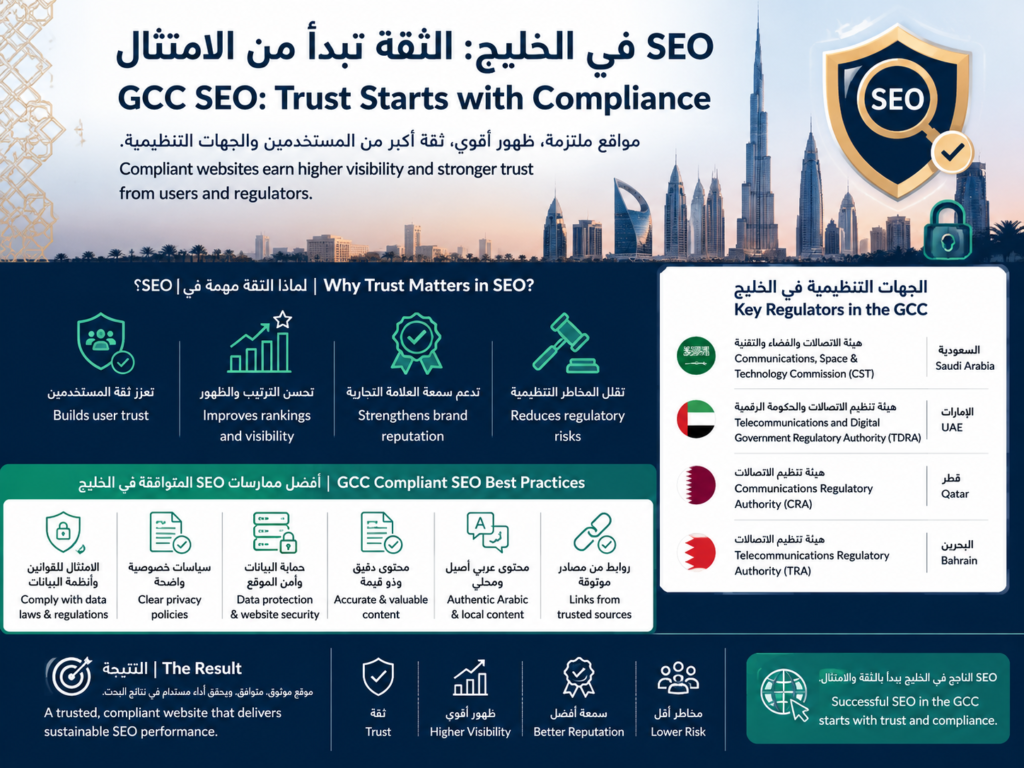
Trust matters in every niche, but it becomes especially important for finance, government, healthcare and other high-trust topics.
Saudi Arabia.
Saudi-focused content should use primary authorities when the subject requires them.
For financial or fintech topics, SAMA can provide regulatory context. Data, privacy or digital-governance content may also need to consider relevant Saudi authorities such as SDAIA or NDMO.
References should support the page’s actual subject rather than being inserted for SEO.
UAE.
UAE content may rely on different authorities depending on the industry.
Technology and digital-service topics can involve TDRA, while financial content may require information from DIFC, ADGM or other relevant official bodies.
The right source depends on the claim being made.
Qatar.
Qatar-focused content should demonstrate genuine local relevance.
For financial subjects, Qatar Central Bank can be an important primary source. For commercial pages, businesses should also use Qatar-specific services, terminology, examples and customer needs rather than publishing generic “Middle East” copy and changing only the city name.
How to Make Arabic Content Visible in Google and AI Answers
Optimizing for AI-assisted search does not require making every paragraph sound robotic or turning every section into a definition.
It requires clarity.
Write Direct Answers for Question-Based Searches
When a heading asks “What is Arabic SEO?”, answer it immediately.
Do not begin with a long history of search engines or a vague introduction.
A strong answer-first pattern is.
Give the direct answer.
Add context.
Explain why it matters.
Provide an example or next step.
This structure is useful for readers as well as search and answer systems.
Strengthen Entities, Structured Data and Topical Context
Structured data can help machines understand relationships, but schema should reflect visible content rather than compensate for missing information.
Useful signals may include.
Clear organization details
Relevant author or editorial information
FAQ content where appropriate
Consistent business entities
Accurate location information
Descriptive internal links
Original expertise and examples
E-E-A-T still comes from the substance of the page.
Create Content Worth Citing in Generative Search
Generic content is easy to reproduce and difficult to distinguish.
More valuable GCC content can include.
Original market observations
Expert commentary
Clear methodology
First-party business information
Primary regulatory sources
Attributed statistics
Market-specific examples
This matters particularly in regulated or high-trust industries.
Arabic SEO Use Cases Across GCC Industries
Fintech and Financial Services
A Riyadh fintech company can combine Arabic product education, localized terminology and relevant SAMA guidance.
Where regulatory testing or fintech programs are discussed, primary SAMA resources should be preferred over second-hand summaries.
Financial content should also avoid exaggerated claims or guaranteed outcomes. Regulatory requirements can change, so businesses should verify current guidance directly with the relevant authority.
Government, Retail and E-Commerce
A Dubai retailer may need both Arabic and English category journeys, particularly when serving a mixed local and international customer base.
Responsive web design services can support the user experience, but content localization still needs its own strategy.
The Arabic version should be useful on its own rather than functioning as a secondary copy of the English site.
Logistics and B2B Services
A logistics company serving Riyadh, Abu Dhabi and Doha may benefit from dedicated location-and-service combinations.
That approach allows each page to address relevant trade routes, service terminology and buyer expectations while keeping English content available for international procurement teams.
Building a GCC Arabic SEO Strategy for 2026
A good GCC strategy should prioritize markets based on commercial reality—not simply population size or a generic regional plan.
Prioritize Markets by Opportunity
If current keyword and business research points to Saudi Arabia as the strongest opportunity, deeper Arabic investment there may make sense.
The UAE may be particularly valuable for businesses that rely on bilingual commercial searches, while Qatar can reward more focused sector-specific positioning.
Before choosing a priority market, compare.
Search demand
Revenue potential
Competition
Existing customer base
Localization cost
Operational capability
Measure SEO, AEO and GEO Separately
Traditional rankings alone provide an incomplete picture.
A broader measurement framework can include.
Arabic organic rankings
Non-brand impressions
Local landing-page conversions
Arabic versus English engagement
Direct-answer visibility
Referral traffic from emerging search experiences
Branded search growth
Entity and citation visibility
Not every AI-generated mention can be measured perfectly, so avoid treating GEO reporting as an exact science.
When to Use an Arabic SEO, AEO or GEO Specialist
Specialist support becomes more valuable when a website has.
Multiple GCC markets
Arabic-English architecture
Technical SEO problems
RTL development requirements
Regulated content
Structured-data complexity
Large-scale localization
AI-search visibility goals
Where search journeys connect with mobile products, businesses may also need coordination with mobile app development.
Final Thoughts
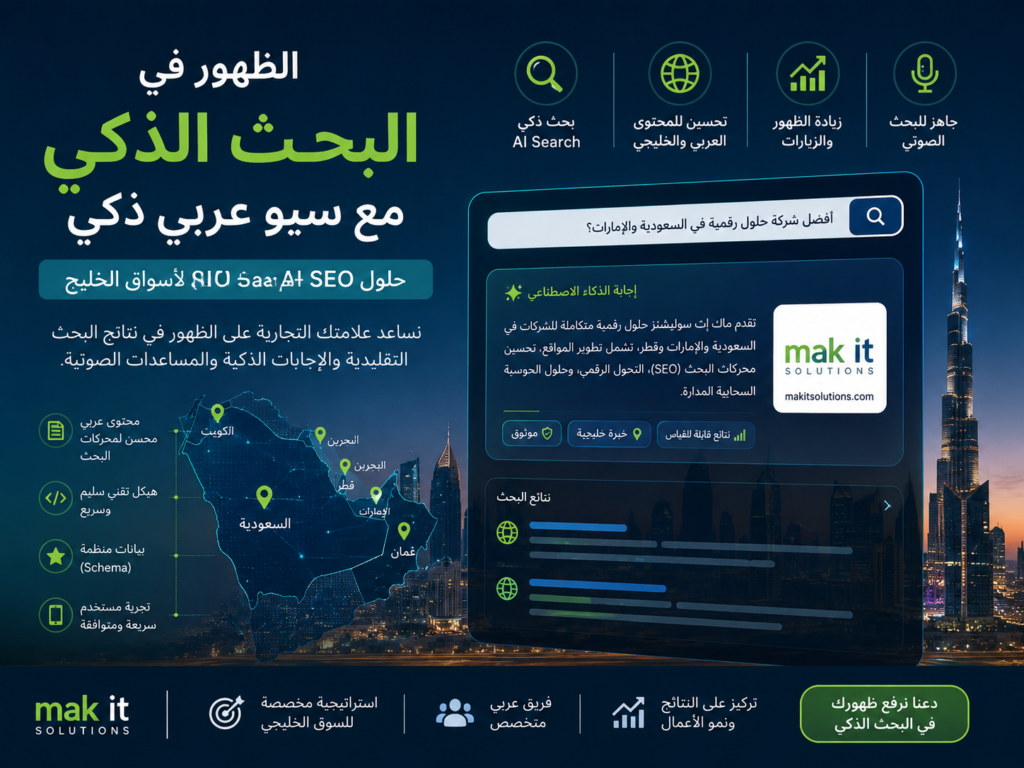
Arabic SEO in 2026 requires more than translated pages or repeated keywords. Businesses targeting Saudi Arabia, the UAE and Qatar need localized search strategies built around real user intent, strong technical SEO, bilingual usability and trustworthy regional signals. Adding AEO helps content answer questions clearly, while GEO strengthens authority, entity relevance and visibility across emerging AI-driven search experiences.
The most effective approach is to combine Arabic SEO, GCC localization, AEO and GEO as one connected strategy. By creating useful, credible and market-specific content, brands can improve discoverability, earn greater trust and build sustainable visibility across Google and generative search platforms. Mak it solutions
Want to find out where your Arabic and English search visibility is being lost?
Contact Mak It Solutions for a GCC-focused consultation covering Arabic SEO, AEO and GEO opportunities across Saudi Arabia, the UAE and Qatar.
FAQs
Q : Should Saudi businesses use Modern Standard Arabic or Gulf Arabic for SEO?
A : Usually, a deliberate mix works best. Modern Standard Arabic fits formal, educational, government and many financial topics, while familiar Saudi terminology can make commercial pages feel more natural. Keyword choices should be based on actual search intent rather than assumptions about dialect.
Q : Does a UAE website need separate Arabic and English URLs?
A : Separate URLs are generally useful when a business maintains distinct Arabic and English versions of the same experience. They give users stable language-specific destinations and make multilingual signals easier to manage. The Arabic pages should still be fully localized rather than treated as secondary translations.
Q : Does reflag help Arabic SEO in Saudi Arabia, UAE and Qatar?
A : Yes. Correct reflag implementation can help search engines understand the intended language or regional version of comparable pages. However, reflag does not replace keyword research, strong internal linking, appropriate canonicalization or useful localized content.
Q : Can Qatar businesses rank English content for Arabic-speaking customers?
A : Yes. Arabic-speaking customers may use English queries, especially for technology, B2B and international services. However, relying entirely on English may leave relevant Arabic demand underserved, so Doha businesses should evaluate both search journeys.
Q : Which GCC market should a business target first for Arabic SEO?
A : There is no universal answer. Saudi Arabia may offer the strongest opportunity for one business, while a Dubai-based company with established UAE demand may reasonably prioritize the UAE. Compare revenue potential, search demand, competition and operational readiness before investing.