
AI SEO in 2026: Win Google & AI Search
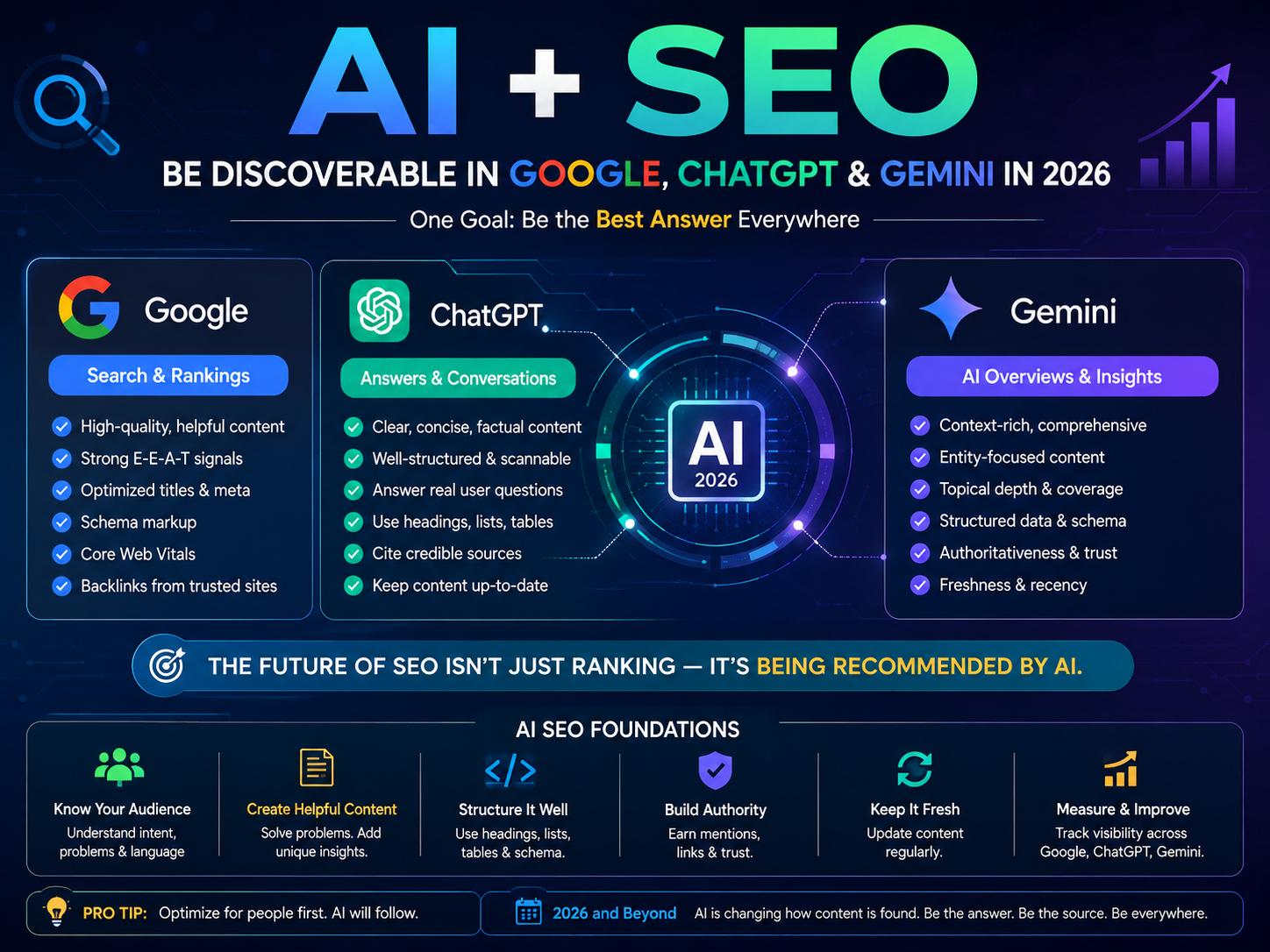
Search visibility is no longer just a race for ten blue links. AI SEO now means competing for organic rankings, direct answers, AI citations, brand mentions and visibility inside generative search experiences.
In practical terms, AI SEO combines proven search optimization with answer-focused content, stronger entity signals and citation-ready information. The goal is simple: make your pages easy for search engines to discover and trustworthy enough for systems such as Google AI Overviews, ChatGPT and Gemini to retrieve, understand and reference.
What Is AI SEO in 2026?
AI SEO in 2026 is the process of improving a website’s discoverability, authority, retrieval potential and visibility across both conventional search engines and AI-powered answer systems.
It does not replace traditional SEO. Instead, it builds on technical optimization, useful content, authority and search intent while making important information easier for AI systems to extract and interpret.
AI SEO, Traditional SEO and the Future of Search
The fundamentals still matter: crawlability, indexing, relevance, authority and useful content.
Google’s own guidance says established SEO practices remain relevant to its generative AI search experiences. That means businesses do not need to abandon conventional SEO or build an entirely separate strategy for AI search.
A stronger approach is to begin with proven SEO services and layer answer engine optimization and generative search visibility on top.
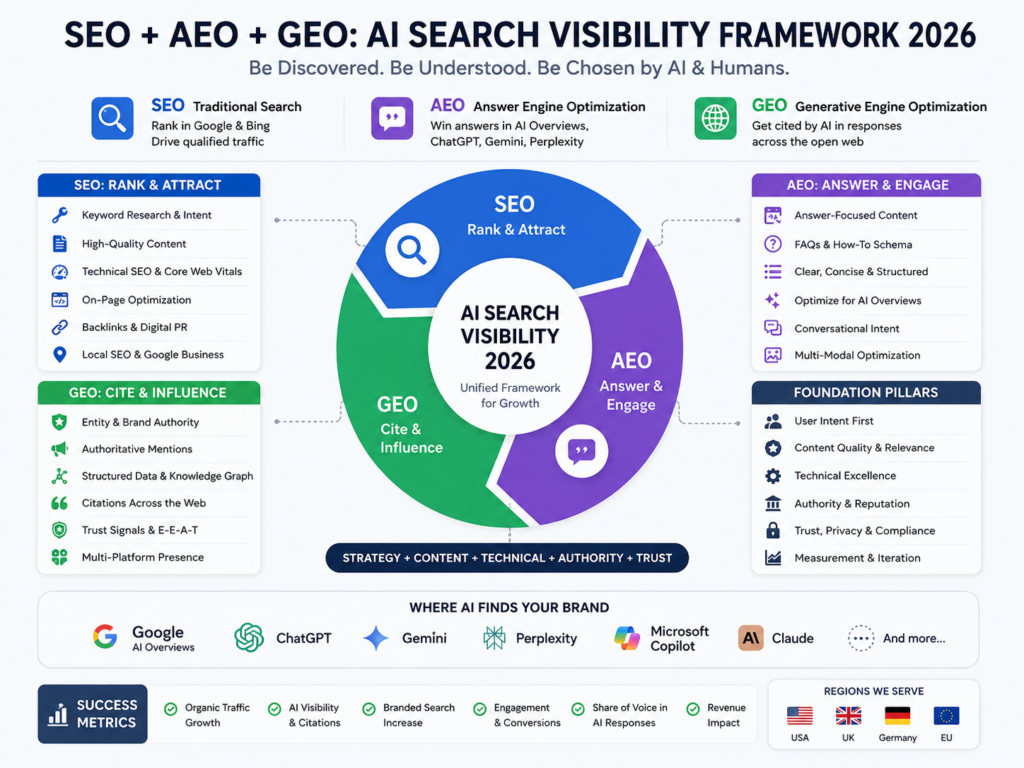
SEO vs AEO vs GEO.
The three concepts overlap, but each focuses on a slightly different part of search visibility.
SEO improves organic rankings, discovery and search visibility.
AEO makes clear answers easier to extract for question-based searches.
GEO focuses on earning visibility, mentions and citations inside generative responses.
Think of SEO as the foundation, AEO as answer formatting and GEO as expanding your visibility beyond the traditional search results page.
None of them works well in isolation. All three depend on relevant, understandable and trustworthy content.
Why Traditional SEO Still Powers Generative Search
AI systems still need accessible sources.
Crawlability helps them discover content. Indexing makes pages available for retrieval. Relevance helps connect a page with a query, while authority and trust determine whether the source is worth surfacing.
That is why E-E-A-T, topical authority, semantic structure, internal links and first-party expertise are more sustainable than chasing short-lived “GEO hacks.”
Google similarly recommends strong SEO and people-first content rather than special AI-only optimization or markup.
How Google AI Overviews and AI Mode Change SEO
Google AI Overviews and AI Mode shift part of the search journey from simply finding webpages to synthesizing information from multiple sources.
For marketers, that makes the quality of individual passages increasingly important. Ranking still matters, but so does whether a specific section clearly answers the question being asked.
How Google Selects Sources for AI Answers
A website does not necessarily need to hold the traditional #1 organic position to be useful in an AI-generated answer.
Generative search can evaluate individual sources and passages for a particular question or subtopic instead of simply reproducing the standard ranking order.
Google says its AI search experiences remain connected to its core Search index and quality systems.
By May 2025, Google reported AI Overviews reaching about 1.5 billion monthly users across more than 200 countries and territories. This figure should be verified against the latest Google reporting before publication.
How to Rank in Google AI Overviews With AI SEO
There is no guaranteed formula for earning an AI Overview citation, but several practices can improve your eligibility and usefulness.
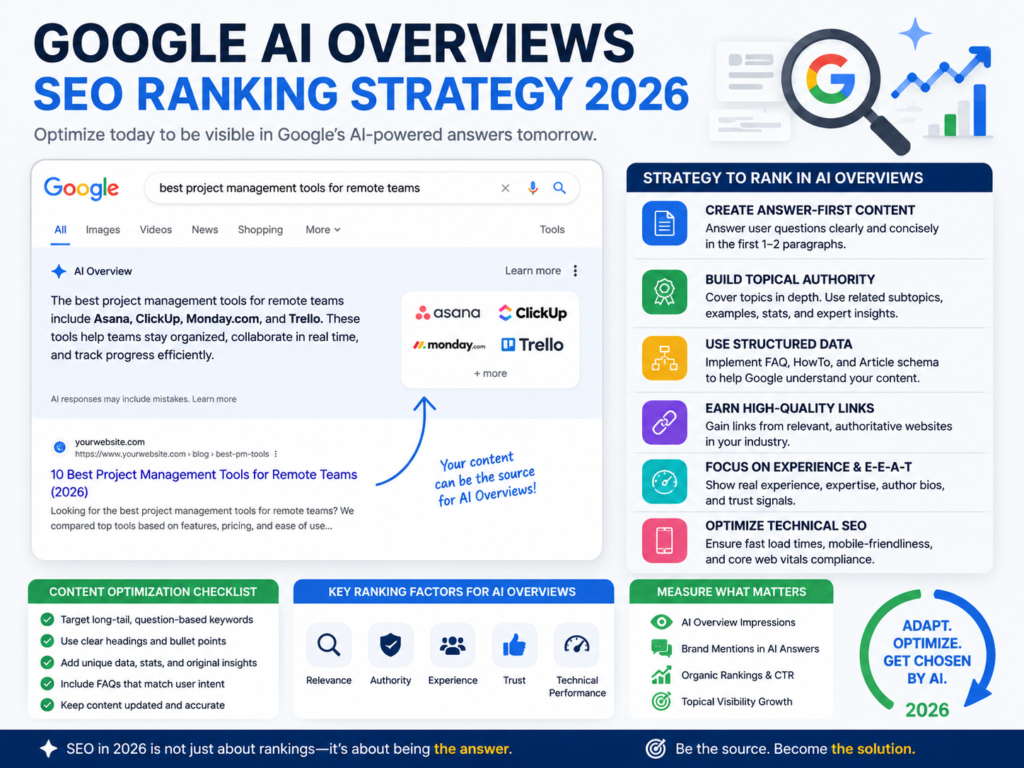
Answer the search intent clearly near the top of the relevant section.
Keep important pages crawlable and indexable.
Use descriptive H2 and H3 headings.
Support important claims with trustworthy evidence.
Build strong internal links between related topics.
Keep entities, authorship and brand information consistent.
Maintain sound technical SEO.
Technical checks should still include XML sitemaps, robots.txt, Core Web Vitals and Google Search Console.
Structured data from Schema.org can help search systems interpret entities and page relationships, although schema alone does not guarantee an AI citation.
Google also reported during 2025 that AI Overviews were driving roughly 10% more usage for relevant query types in major markets such as the United States. Because this is a time-sensitive platform metric, verify the latest figure before publishing.
From Zero-Click Search to Citation Visibility
A search that generates no immediate click can still create marketing value.
An AI citation or recurring brand mention may lead to greater awareness, branded searches, later direct visits and assisted conversions.
That means businesses should evaluate AI exposure as one part of a broader digital marketing strategy rather than judging success only by last-click traffic.
How to Optimize for ChatGPT, Gemini and AI Answers
ChatGPT, Gemini, Google and other AI products do not expose identical retrieval or citation systems.
Trying to reverse-engineer every platform independently can therefore become a distraction. A more durable strategy is to focus on qualities that benefit both users and machines: accessibility, precise answers, credible evidence and strong entity relationships.
Build Citation-Ready, Answer-First Content
Put the clearest answer immediately beneath question-led headings.
Then expand with supporting evidence, examples, context and relevant expertise.
For example, instead of spending several paragraphs introducing a topic before answering the query, give readers the useful answer first. Follow it with the detail they need to understand or act on it.
This improves readability while giving answer engines a self-contained passage that is easier to retrieve.
Strengthen Entity SEO and Topical Authority
AI SEO is not only about keywords. Search systems also need to understand who your brand is, what it specializes in and how its content connects.
Build topic clusters around subjects your company genuinely understands. Keep brand names, authors, services, industries and locations consistent across relevant pages.
Useful authority signals may include.
Expert authorship
Original research or first-party data
Independent earned mentions
Relevant backlinks
Clear organizational information
Consistent supporting content across related topics
Mak It Solutions’ technology blog can support this kind of broader topical footprint when articles are closely connected to the company’s core services and expertise.
Make Pages Easy to Retrieve, Understand and Trust
Maintain crawlable HTML, logical headings, descriptive internal links, accurate structured data, visible expertise and current source attribution.
For ChatGPT search specifically, OpenAI says OAI-SearchBot is used for search-related discovery and recommends allowing the crawler when publishers want eligible pages to appear in search results.
Visibility can still differ between ChatGPT, Gemini, Perplexity, Microsoft Copilot and Google because each product may retrieve, interpret and rank information differently.
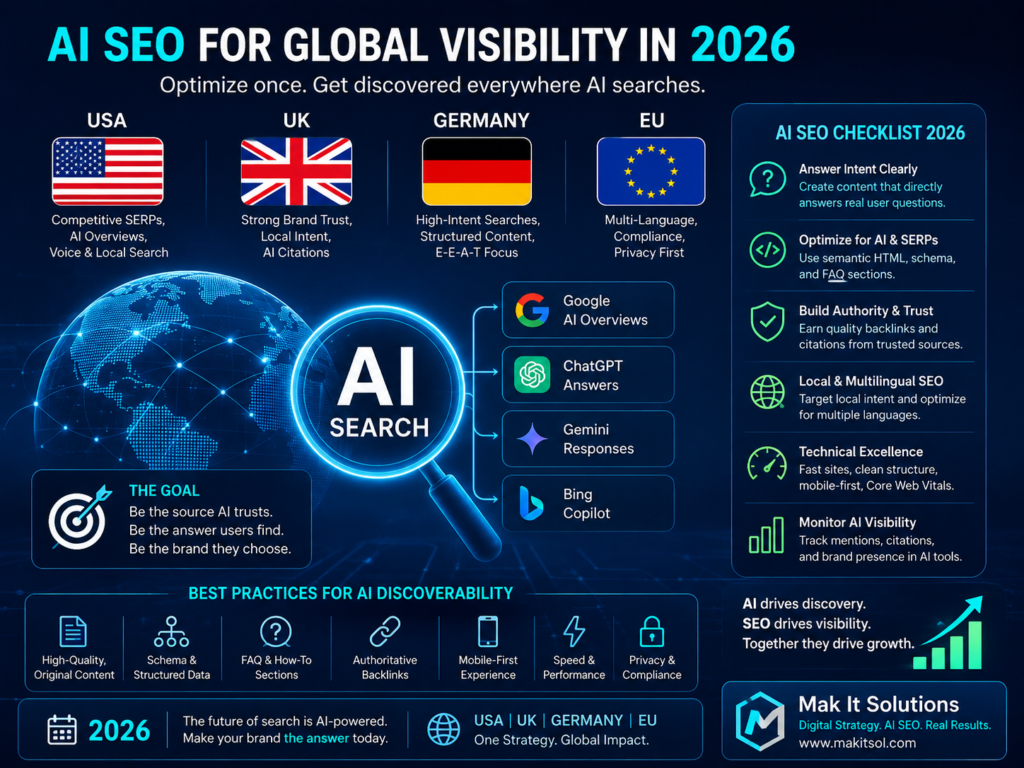
AI SEO Strategy for the USA, UK, Germany and EU
International AI SEO should account for language, local search intent, market competition, entities and regulation.
Simply translating one US page word for word is rarely enough.
USA.
In competitive markets such as New York, San Francisco and Austin, brands may compete with established publishers, large SaaS companies and enterprise domains.
Original expertise becomes especially valuable.
Depending on the niche, trust considerations may also include standards or regulations such as HIPAA, PCI DSS or SOC 2. These are not direct Google ranking factors, but they can influence how credible and appropriate a business appears to users evaluating sensitive services.
UK.
UK content should reflect natural local terminology instead of mechanically copying US wording.
That may mean using “optimize” where appropriate, considering searches around cities such as London and Manchester, and reflecting local expectations in regulated topics.
For health, finance and personal-data content, organizations such as the NHS and ICO—as well as frameworks including UK GDPR can shape what users expect from trustworthy information.
Germany and the EU.
German campaigns should research how people actually search in German.
Terms such as KI SEO, KI-Suche and SEO für KI Suche optimieren may be more useful than literal translations of English keyword lists.
Use hreflang correctly, keep entities consistent between language versions and account for GDPR/DSGVO, BaFin or data-residency requirements when they are relevant to the topic.
Eurostat reported that around 13.5% of EU enterprises with at least 10 employees used AI technologies in 2024, compared with about 8% in 2023. These figures should be checked against the latest Eurostat release before publication.
The same localization principle can extend to markets such as Paris, Amsterdam, Dublin, Austria and Switzerland.
How to Measure AI Search Visibility and GEO Performance
AI SEO cannot be measured properly with a traditional keyword-ranking report alone.
You still need organic rankings and traffic, but you should add AI visibility indicators and connect them to actual business outcomes.
Track AI Citations, Brand Mentions and Share of Answers
Monitor.
Citation frequency
Linked and unlinked brand mentions
Presence across priority AI engines
Share of answers across strategically important topics
Competitor citation frequency
Visibility by country and language
Segmenting matters. Strong English visibility in the USA should not hide weak performance across German-language queries.
Connect AI Visibility to SEO and Business Outcomes
AI visibility is more useful when connected with.
Organic rankings
Search impressions
Referral traffic
Branded search demand
Leads Assisted conversions
Revenue or qualified pipeline where measurable
Google has introduced reporting related to generative AI search experiences in Search Console, while Open AI says publishers can identify Chat GPT referral traffic through the utm_source=chatgpt.com parameter.
For businesses that need consolidated reporting, Business Intelligence Services can help connect search performance, AI visibility and commercial KPIs.
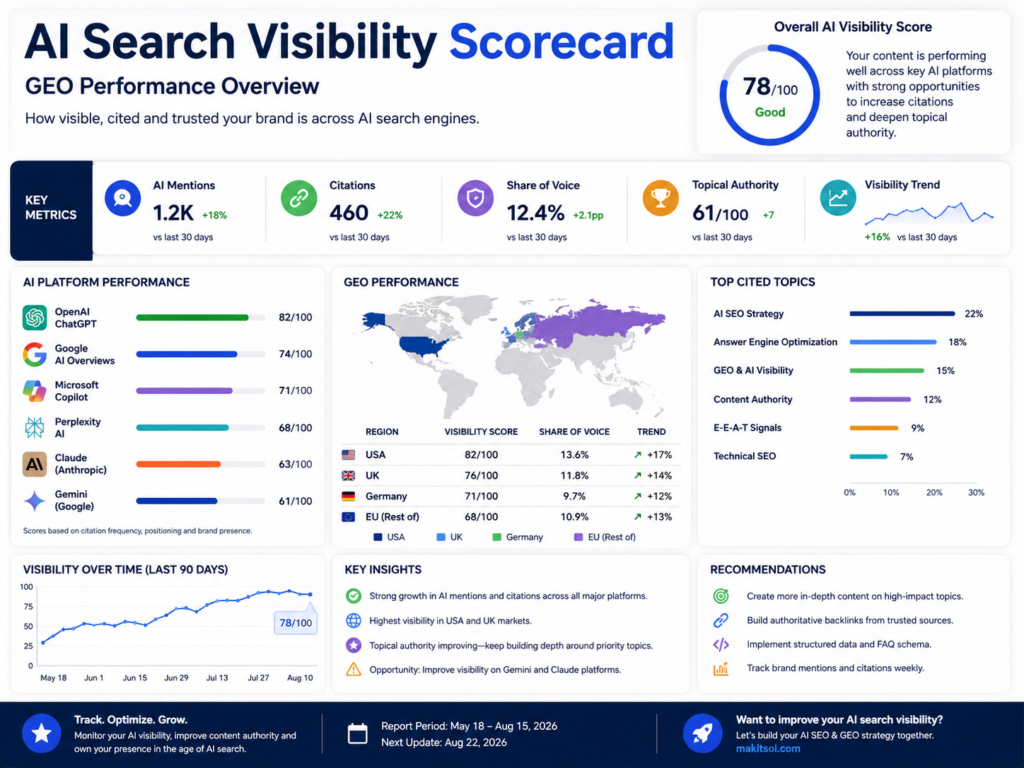
Build a USA, UK and Germany AI Visibility Scorecard
A monthly scorecard can make AI search performance easier to track.
Separate results by.
AI engine
Topic
Country
Language
Cited domain
Competitor
Brand mention
Referral or conversion outcome
The goal is not to create a misleading single “AI ranking.” Generative answers can vary, so trends across consistent query sets are more useful than one-off observations.
Build an AI SEO Strategy That Wins Beyond 2026
Sustainable AI visibility comes from creating assets that search engines, AI systems and users can repeatedly trust.
Prioritize SEO Fundamentals Before AI-Specific Tactics
Start with.
Technical SEO
High-intent content
Search intent alignment
Entity consistency
E-E-A-T
Internal linking
Earned authority
Then make important passages easier to extract through concise answers, descriptive headings and well-supported claims.
Businesses considering a wider implementation can review Mak It Solutions‘ technology services alongside their SEO strategy.
Create a 90-Day SEO + AEO + GEO Roadmap
A practical rollout can be divided into three stages.
Month 1 — Audit.
Review crawlability, indexing, technical issues, existing rankings and high-value pages.
Month 2 — Optimize.
Improve priority pages with answer-first sections and strengthen relevant topic clusters.
Month 3 — Build authority.
Improve entity consistency, pursue legitimate earned mentions and establish recurring AI visibility measurement.
Prioritize pages that already combine commercial value with some organic authority. Improving a strong existing asset is often more useful than publishing another near-duplicate page.
When AI SEO Services or Specialist Tools Make Sense
Specialist support can become useful when a business manages hundreds of pages, multiple markets, multilingual content, weak AI visibility or limited in-house SEO capacity.
When evaluating a provider, look beyond promises about “ranking in ChatGPT.”
Assess the full journey:
Google rankings → retrieval → answers → citations → authority → measurement
You can also learn more about the Mak It Solutions team before deciding whether external support is the right fit.
Outlook
AI SEO in 2026 is ultimately about making your business easier to discover, understand and trust wherever people search.
If you want to understand how your website currently performs across organic rankings, AI retrieval and citation visibility, contact Mak It Solutions to request a scoped AI SEO assessment for priority pages and markets across the USA, UK, Germany and EU.
Key Takeaways
AI SEO extends traditional SEO rather than replacing it.
Clear, evidence-backed answers improve AEO and citation readiness.
Technical crawlability and authority still support generative visibility. USA, UK, Germany and EU campaigns need genuine localization.
AI citations and brand exposure should be measured alongside traffic and conversions.
Sustainable results come from useful content, technical quality and trustworthy authority not AI-search shortcuts.
FAQs
Q : Does schema markup help websites get cited in AI-generated answers?
A : Schema markup can help search systems understand entities, relationships and page content, but it does not guarantee an AI citation.
Use accurate Schema.org markup alongside crawlable pages, clear answers and reliable evidence. Google also states that special AI-only markup is not required for its generative search features.
Q : Can a small business appear in AI Overviews without ranking #1?
A : Yes. AI-generated answers can surface a source because it is particularly relevant to a specific question or passage, even if it is not the first traditional organic result.
Small businesses should focus on niche expertise, specific customer questions, strong local or industry context and technically accessible content.
Q : Should old SEO content be updated for conversational AI queries?
A : Often, yes.
Instead of inserting artificial long-tail questions everywhere, update outdated facts, improve intent alignment, place concise answers under useful headings and strengthen supporting evidence.
Existing pages with backlinks and authority can be especially valuable candidates for updates.
Q : How often should businesses audit AI citation visibility?
A : A monthly review is practical for many active SEO programs.
Fast-moving publishers or highly competitive industries may monitor priority prompts more frequently. The important part is to keep the query set, engines and markets consistent enough to identify genuine trends.
Q : Is hreflang enough for AI SEO across Europe?
A : No.
Hreflang helps search engines identify language and regional variants, but European AI SEO also depends on localized terminology, search intent, evidence, entity consistency and relevant regional trust signals.
A German page aimed at Berlin or Munich should feel genuinely written for that market rather than reading like a literal translation of a US page.