

AI Agent Pricing: Smarter Models for 2026
AI Agent Pricing: Smarter Models for 2026
AI Agent Pricing: Smarter Models for 2026
AI agent pricing is changing the economics of SaaS because autonomous software can create far more value without requiring a paid seat for every person involved. In 2026, the practical choice is no longer simply “per user or enterprise plan.” Vendors increasingly need to decide whether to charge for access, usage, completed workflows, outcomes, or a combination of these models.
For most enterprise AI products, the strongest pricing model connects fees to measurable customer value while still protecting the vendor from variable inference, infrastructure, tool, and orchestration costs. Hybrid pricing often provides the most workable balance: predictable recurring revenue on one side and controlled usage or outcome charges on the other.
Gartner describes part of this disruption as agentic arbitrage: AI agents can complete tasks across multiple software systems while reducing the need for users to interact directly with each application. In July 2026, Gartner estimated that up to $234 billion of enterprise application spending could be exposed to this shift by 2030, representing roughly 20% of enterprise application SaaS spending.
What Is AI Agent Pricing in 2026?
AI agent pricing is the commercial model used to charge for autonomous or semi-autonomous AI software. Instead of relying only on user subscriptions, vendors can bill for consumption, tasks, workflows, successful resolutions, business outcomes, or hybrid combinations.
The goal is straightforward: customers should understand what they are paying for, while vendors must ensure that increasing agent activity does not quietly destroy gross margin.
The shift matters because AI adoption is already widespread. McKinsey reported that 65% of respondents in its early-2024 survey said their organizations regularly used generative AI in at least one business function.
Why Per-Seat SaaS Pricing Is Breaking Down
Per-seat pricing works well when employee count broadly reflects software usage. AI agents weaken that relationship.
One agent might update Salesforce, retrieve information from internal systems, trigger an ERP workflow, analyze documents, and create service tickets while only a small number of employees supervise the process.
That creates a simple commercial problem: a customer can automate significantly more work without buying significantly more seats.
For SaaS leaders, the value conversation therefore moves from “How many people need access?” toward “How much useful work does the software complete?”
How AI Agents Change Software Value Metrics
Useful AI monetization metrics can include.
Agent actions
Tasks completed
Workflows executed
Customer issues resolved
Transactions processed
Credits consumed
Compute or model usage
Revenue or cost-saving outcomes
Infrastructure also matters. Production systems using retrieval, orchestration, permissions, evaluation, and external tools create costs that traditional SaaS seat pricing was never designed to represent. Mak It Solutions’ guide to enterprise RAG architectures shows why the surrounding AI stack is part of the pricing equation.
AI Agent Pricing Models: Seat vs Usage vs Outcome vs Hybrid
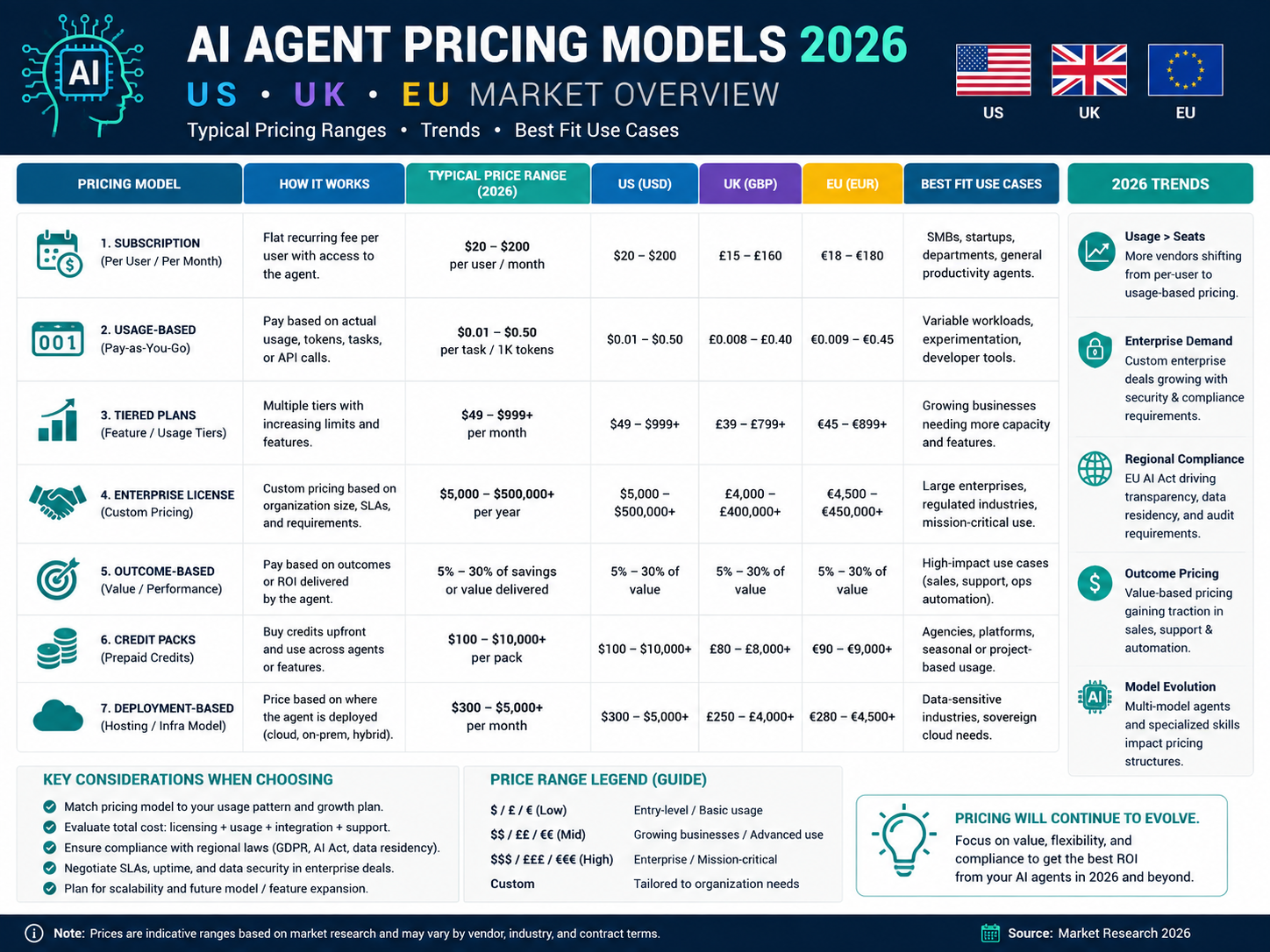
There is no single best AI agent pricing model. The right structure depends on workload predictability, customer value, cost variability, and how easily both sides can measure the billable unit.
| Pricing model | Best suited for | Main advantage | Main risk |
|---|---|---|---|
| Per-seat | Human-led copilots and stable teams | Predictable budgeting | Weak link between price and automation value |
| Usage-based | Variable, measurable agent workloads | Revenue follows consumption | Customer bills can become unpredictable |
| Outcome-based | Clearly attributable business results | Strong value alignment | Outcomes can be difficult to define |
| Hybrid | Enterprise deployments with mixed workloads | Predictability plus upside | More complex packaging |
Per-Seat and Subscription Pricing
Traditional AI SaaS pricing still makes sense for copilots, bundled assistants, stable employee populations, and tools where humans remain the primary users.
Procurement teams understand subscriptions. Vendors also gain predictable ARR.
The weakness is value capture. If an AI product automates substantially more work without increasing headcount, the customer receives more value while vendor revenue may remain flat.
Usage-Based AI Agent Pricing
Usage pricing can charge for tokens, credits, API calls, compute, agent actions, tasks, or workflows.
Its biggest advantage is economic alignment. If agent activity increases the vendor’s model and infrastructure bill, revenue can rise with it.
The customer-side problem is predictability. A workflow may suddenly use more reasoning steps, retrieval calls, retries, or third-party services than expected.
Strong consumption pricing therefore needs.
Clear billing meters
Usage dashboards
Budget alerts
Caps or approval thresholds
Transparent overage rules
Defined treatment of failed tasks and retries
Outcome-Based and Hybrid AI Pricing
Outcome-based pricing charges for something the customer already recognizes as valuable, such as a successful support resolution, qualified lead, processed invoice, completed workflow, or defined SLA result.
The model can be compelling when attribution is clear.
In practice, however, enterprise deployments often contain too many variables for pure outcome pricing. A hybrid model can be safer: combine a platform fee or minimum commitment with usage- or outcome-based charges.
The base protects recurring revenue. The variable component lets the vendor participate when automation creates more value.
How AI Agent Pricing Changes SaaS Unit Economics
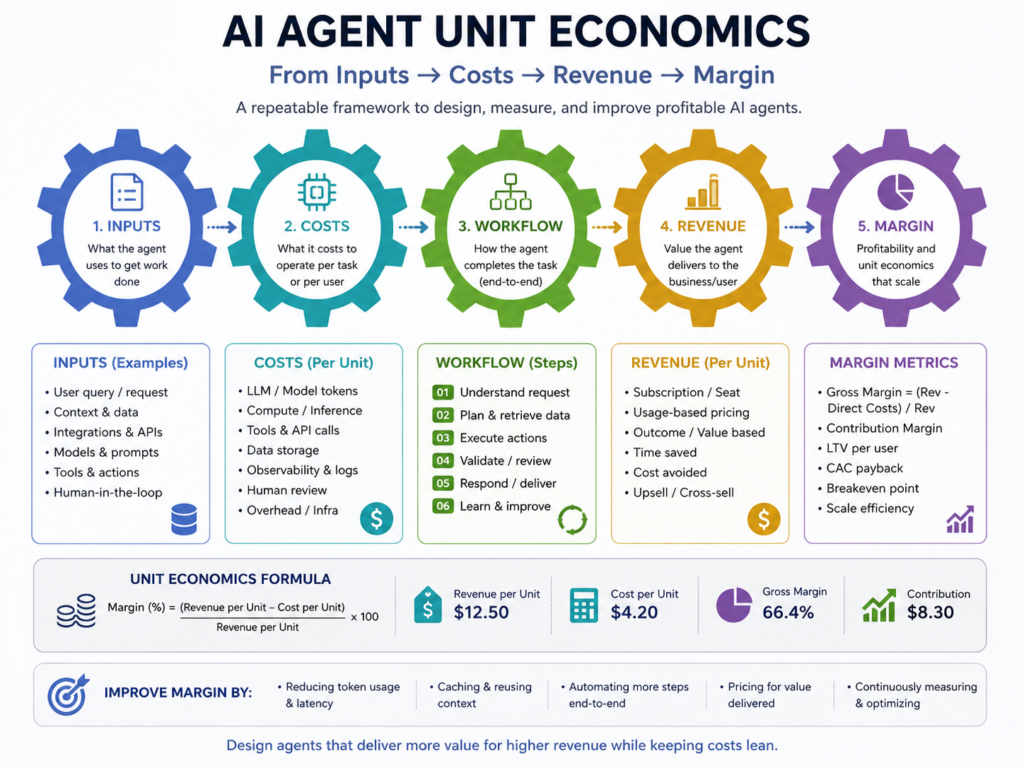
AI agents change SaaS unit economics because every additional workflow can generate inference, retrieval, API, orchestration, monitoring, and infrastructure costs.
That means vendors need to understand COGS below the account level.
Gartner reported that the worldwide enterprise software market reached approximately $899.9 billion in 2024, with cloud subscription revenue accounting for 60.1% of the market.
As AI becomes embedded in that software base, pricing and margin management become increasingly connected.
AI Inference Costs, COGS and Gross Margin
Agent COGS may include.
Model and reasoning calls
Retrieval and vector infrastructure
External APIs and tools
Memory and orchestration
Monitoring and observability
Cloud infrastructure
Retries and failed executions
Human review or escalation
Falling token prices do not automatically mean lower total workflow costs. More capable agents can also run longer processes, invoke more tools, and attempt more steps.
Teams can connect this telemetry with Business Intelligence Services to see workflow cost alongside customer profitability and business performance.
Measure Cost per Task, Workflow and Outcome
A useful unit-economics chain is.
Cost per task → cost per workflow → cost per successful outcome → customer gross margin
The final metric is what matters commercially.
A technically efficient workflow can still be a poor business if support overhead, retries, third-party APIs, or customer-specific infrastructure consume too much margin.
Protect ARR, NRR and Margin as Usage Expands
More AI usage is not automatically good SaaS economics.
Revenue can increase while gross margin deteriorates if autonomous workloads consume expensive models or tools faster than the pricing model captures those costs.
Common safeguards include minimum commitments, pricing floors, tiered overages, model routing, usage bands, budget controls, and account-level margin thresholds.
Broader Mak It Solutions services can also help connect AI architecture, analytics, and commercial reporting.
Which AI Agent Pricing Model Works Best for Enterprise Buyers?
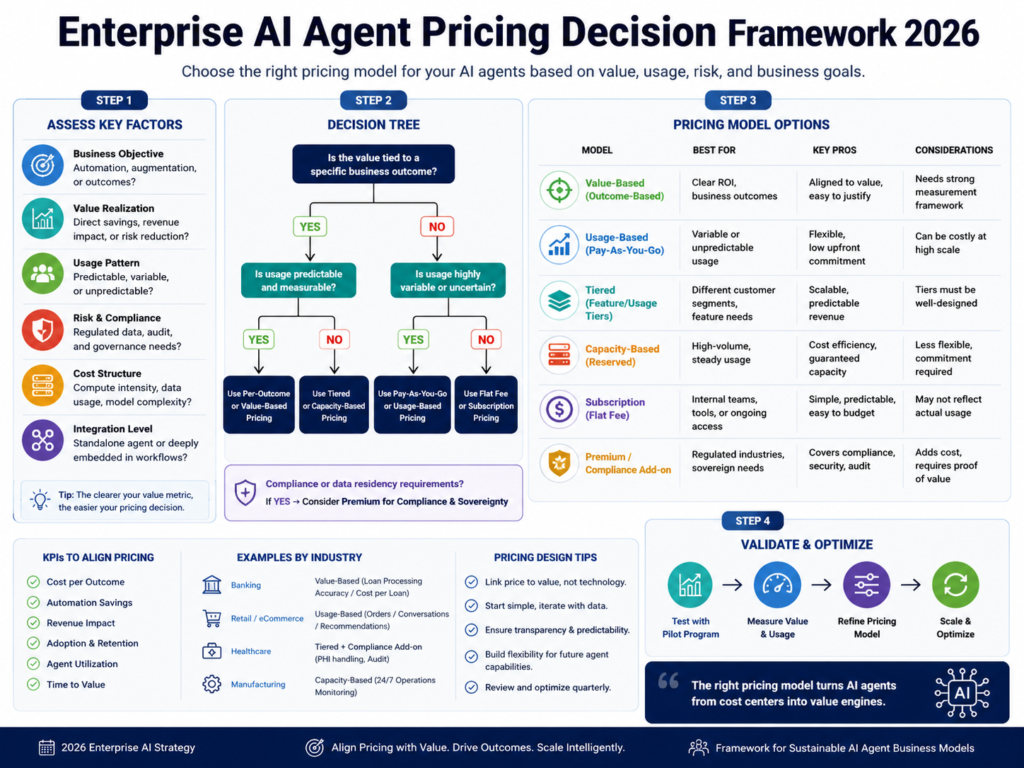
The best enterprise model balances three things: budget predictability, measurable customer value, and vendor margin protection.
A useful rule of thumb is.
Stable usage → subscription
Variable, measurable usage → consumption
Clearly attributable results → outcome pricing
Mixed enterprise workloads → hybrid pricing
Match the Pricing Metric to Customer Value
A billing metric becomes easier to defend when customers can connect it directly to something they care about.
“Cost per successful support resolution” is often easier for a business leader to evaluate than “cost per million tokens,” even if tokens remain the vendor’s internal COGS metric.
The commercial unit does not have to be identical to the technical cost unit.
Calculate AI Agent TCO and ROI Before Setting Price
AI agent TCO extends beyond inference.
Include implementation, integrations, retrieval infrastructure, support, governance, human supervision, compliance work, retried tasks, failed workflows, and organizational change.
Then compare that cost against measurable benefits such as.
Hours saved
Faster throughput
Lower handling cost
Revenue generated
Reduced error rates
Improved service capacity
Risk reduction
This produces a much more credible pricing discussion than focusing on model cost alone.
Add FinOps, Budget Caps and Pricing Governance
Enterprise AI pricing needs operational controls around it.
Useful measures include departmental budgets, token or credit limits, usage alerts, model-routing policies, spending approvals, cost attribution, and fallback rules.
The scale of AI spending makes this increasingly relevant. Gartner forecast worldwide generative AI spending of approximately $644 billion in 2025, up 76.4% from 2024.
For knowledge-intensive agents, governance should also extend to retrieval quality, access permissions, and auditability. Enterprise RAG guidance provides useful architectural context.
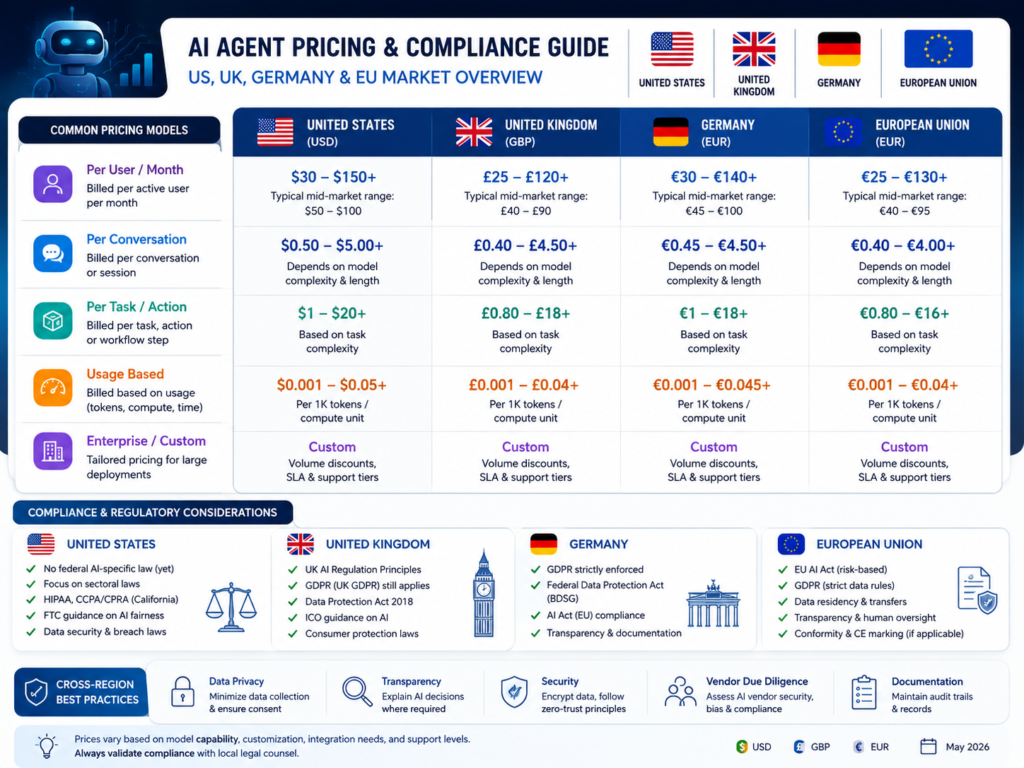
AI Agent Pricing in the US, UK, Germany and EU
AI agent economics may be global, but enterprise procurement is not.
Security, privacy, compliance, data residency, and contractual requirements can materially affect how an AI service is packaged and priced.
USA.
US buyers commonly focus on ROI, scalability, security controls, and integration with platforms such as Salesforce, Microsoft, ServiceNow, and enterprise data systems.
Depending on the workload, contracts may also need to address frameworks or regulations such as SOC 2 controls, CCPA/CPRA, HIPAA, or PCI DSS.
For regulated healthcare environments, the current HIPAA Security Rule requires covered entities and business associates to apply administrative, physical, and technical safeguards to protect electronic protected health information.
Secure agent deployments may also involve application-level engineering through Mak It Solutions web development services.
UK.
UK organizations particularly in finance, healthcare, and other regulated sectors often need predictable costs alongside privacy, transparency, governance, and meaningful human oversight.
The ICO’s AI and data protection guidance addresses areas including lawfulness, fairness, transparency, data minimization, security, accountability, and individual rights. Parts of that guidance are currently under review following changes to UK data-protection legislation, so procurement and compliance teams should confirm the latest requirements before deployment.
For buyers, an attractive usage rate does not compensate for weak controls or unclear accountability.
Germany and the EU.
German and wider EU buyers may evaluate GDPR/DSGVO obligations, the EU AI Act, data residency, auditability, resilience, and sector-specific requirements alongside pricing.
The EU AI Act entered into force on August 1, 2024 and became broadly applicable on August 2, 2026. Certain requirements applied earlier, while high-risk rules now have later timelines: Annex III high-risk systems are scheduled from December 2, 2027, and high-risk systems embedded in regulated products from August 2, 2028.
For EU financial entities, DORA has applied since January 17, 2025, adding another reason to consider operational resilience and ICT third-party risk when structuring agent deployments.
For German procurement teams, searches around KI-Agenten Preismodelle Deutschland, KI-Agent Kosten Unternehmen, and nutzungsbasierte Preise für KI Software naturally sit alongside SAP integration, Mittelstand procurement, sovereign infrastructure, and predictable enterprise commitments.
Sensitive workloads may also benefit from evaluating confidential computing architectures.
The Future of SaaS Pricing.
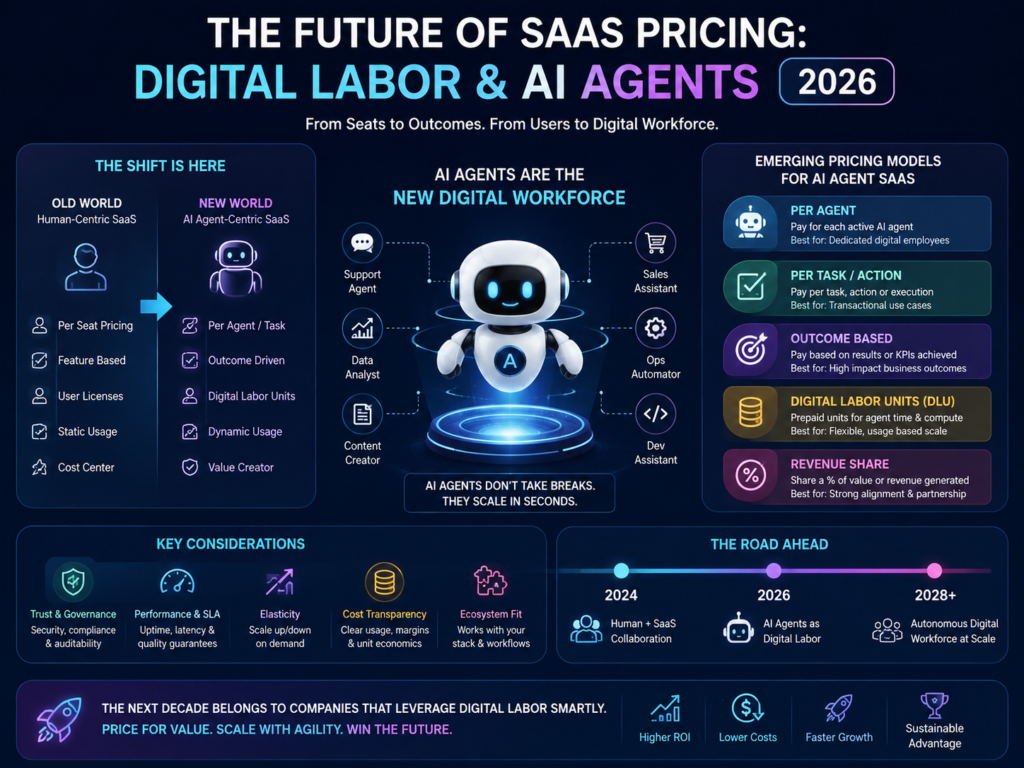
AI agents are unlikely to eliminate SaaS subscriptions. They are more likely to reduce the importance of the human seat as the default measure of software value.
As autonomous systems work across CRM, ERP, finance, customer service, analytics, and productivity tools, buyers can increasingly evaluate software around cost per business process, orchestration quality, reliability, and completed outcomes.
Customer-facing agent experiences may also extend into mobile app development, where AI becomes part of the product itself rather than a separate feature.
A 2026 AI Agent Pricing Roadmap for SaaS Leaders
Identify the value metric. Decide whether customers value access, tasks, workflows, resolutions, revenue, or another measurable outcome.
Measure workflow COGS.
Capture inference, tools, retries, infrastructure, and orchestration costs.
Test pricing architecture.
Compare subscription, usage, outcome, and hybrid approaches using real workload behavior.
Add governance.
Introduce spending limits, routing policies, audit logs, approvals, and margin thresholds.
Localize enterprise packaging.
Adapt commercial terms and controls to regional procurement and compliance requirements.
Monitor margin and ROI.
Track customer gross margin, ARR, NRR, usage growth, and customer outcomes.
To Sum Up
The strongest AI agent pricing strategy is not automatically the one with the most sophisticated meter. It is the model that customers can understand, procurement teams can budget, and vendors can operate profitably as autonomous usage expands.
If your AI product is still priced exactly like traditional seat-based SaaS, it is worth testing whether the billing metric still reflects the value customers actually receive.
Mak It Solutions can help map workflow architecture, integrations, analytics, governance requirements, and unit economics before you commit to a new pricing model.
Request a scoped consultation with Mak It Solutions.
Key Takeaways
AI agent pricing should increasingly reflect completed work and customer value rather than employee headcount alone.
Usage pricing can protect vendors from variable infrastructure costs, but customers still need predictable spending controls.
Outcome pricing works best when results are clearly defined and independently measurable.
Hybrid models often provide the strongest enterprise balance between recurring revenue and variable automation value.
Vendors should track cost per task, workflow, successful outcome, and customer gross margin.
Regional privacy, security, resilience, and AI requirements can materially affect enterprise packaging.
FAQs
Q : Do AI agent vendors charge for failed tasks and retries?
A : It depends on the pricing model. Token, API, compute, and credit-based plans may charge for resources consumed even when a task fails, while outcome-based contracts may charge only after a defined successful result. Enterprise contracts should state clearly how retries, failures, and excluded consumption are handled.
Q : How can enterprises control AI agent spending?
A : Use budgets, hard usage caps, spend alerts, model-routing policies, departmental chargebacks, and approval thresholds. Costs should also be attributed by workflow or business unit so unexpected consumption becomes visible before it materially affects the bill.
Q : What should an AI agent pricing contract define?
A : At minimum, define the billable unit, measurement method, included usage, overage rules, minimum commitment, treatment of retries and failures, reporting method, and service levels. For outcome pricing, both parties should also agree on exactly what qualifies as a successful outcome.
Q : Is token-based AI pricing suitable for large enterprises?
A : It can work for APIs and technical teams, but tokens are often too abstract for business owners. Vendors can use tokens internally to measure COGS while packaging customer pricing around credits, workflows, resolutions, or other business-friendly units.
Q : How should buyers compare AI agent pricing between vendors?
A : Normalize proposals around the same workload. Compare expected usage, workflow complexity, retries, implementation, integrations, support, minimum commitments, and success rates, then calculate total cost per successful outcome rather than comparing token prices alone.
[…] Is the Difference Between AI Agents and […]