


Non-Human Identity Security: AI Agent Guide 2026
Non-Human Identity Security: AI Agent Guide 2026
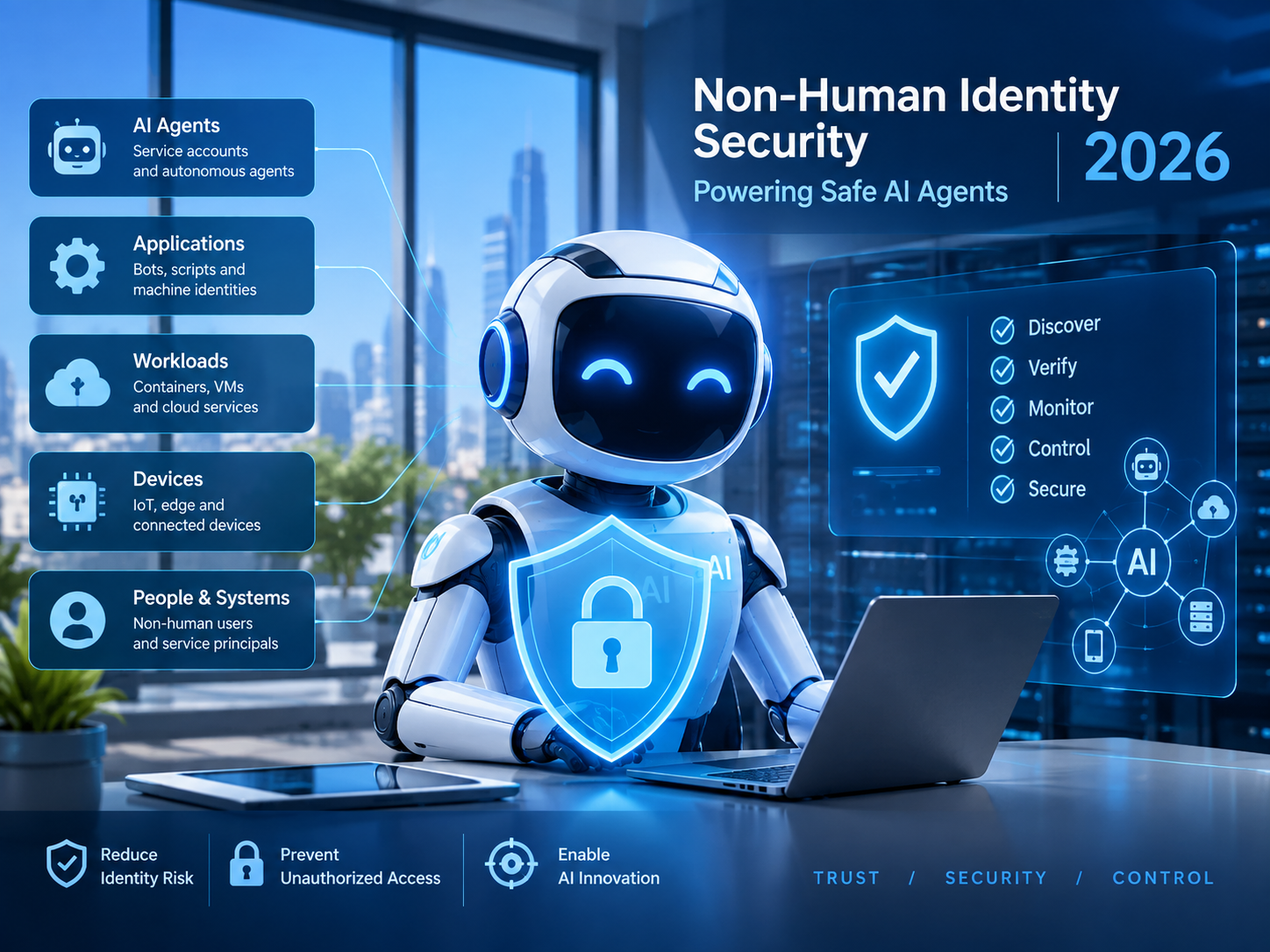
Non-Human Identity Security: AI Agent Guide 2026
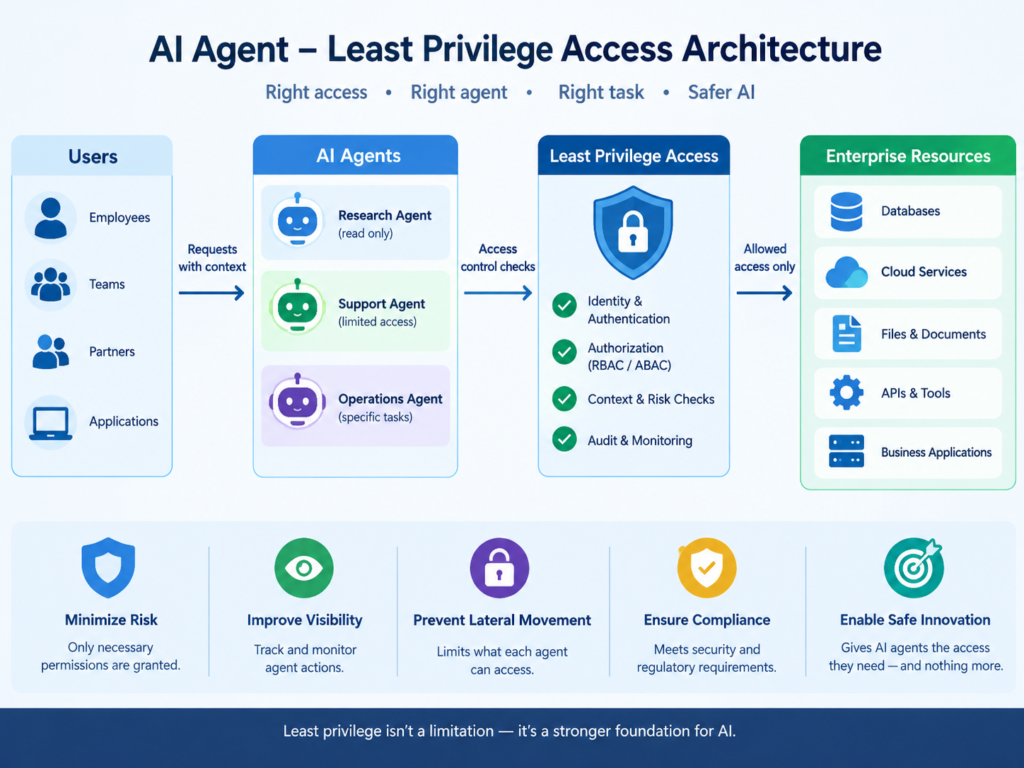
Each agent should receive only the authority required for its approved purpose, for only as long as that authority is needed. Mak It Solutions’ Zero Trust Strategy for AI-Era Security provides a complementary framework.
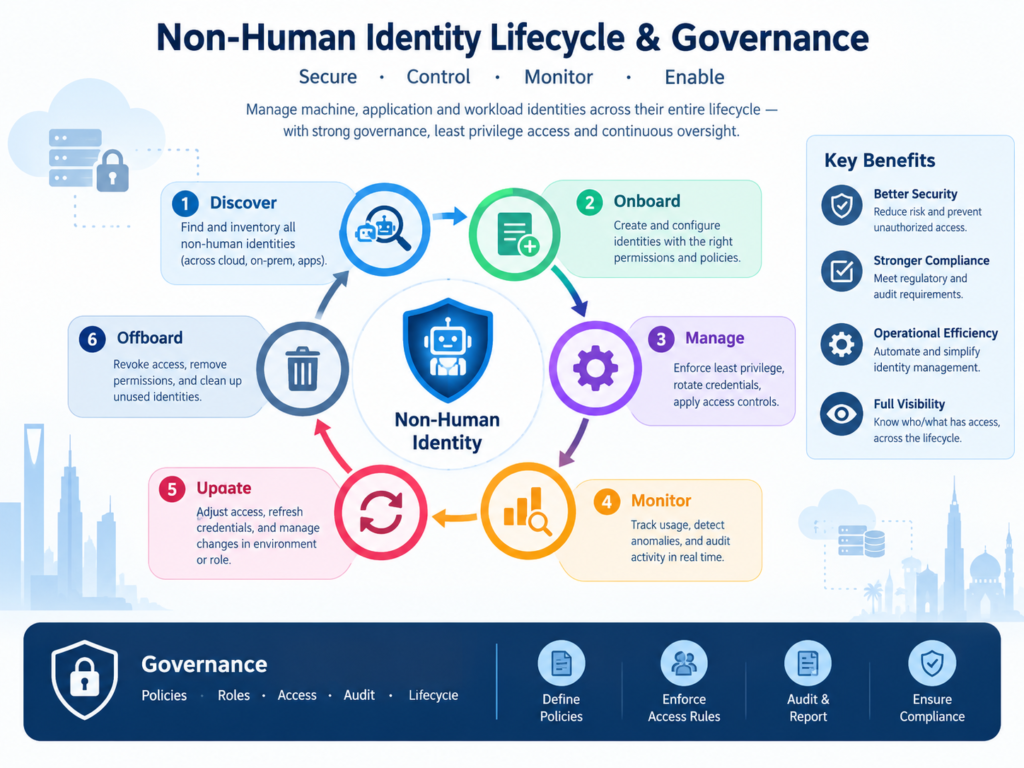
Discover and Register Every Agent
Start by finding what already exists.
The inventory should cover production agents, prototypes, shadow deployments, service accounts and connected tools. For each identity, record its owner, purpose, environment, privileges, data access and major dependencies.
That inventory should feed into IAM or IGA workflows so new machine identities do not sit permanently outside normal governance.
Authenticate Agents Without Permanent Secrets
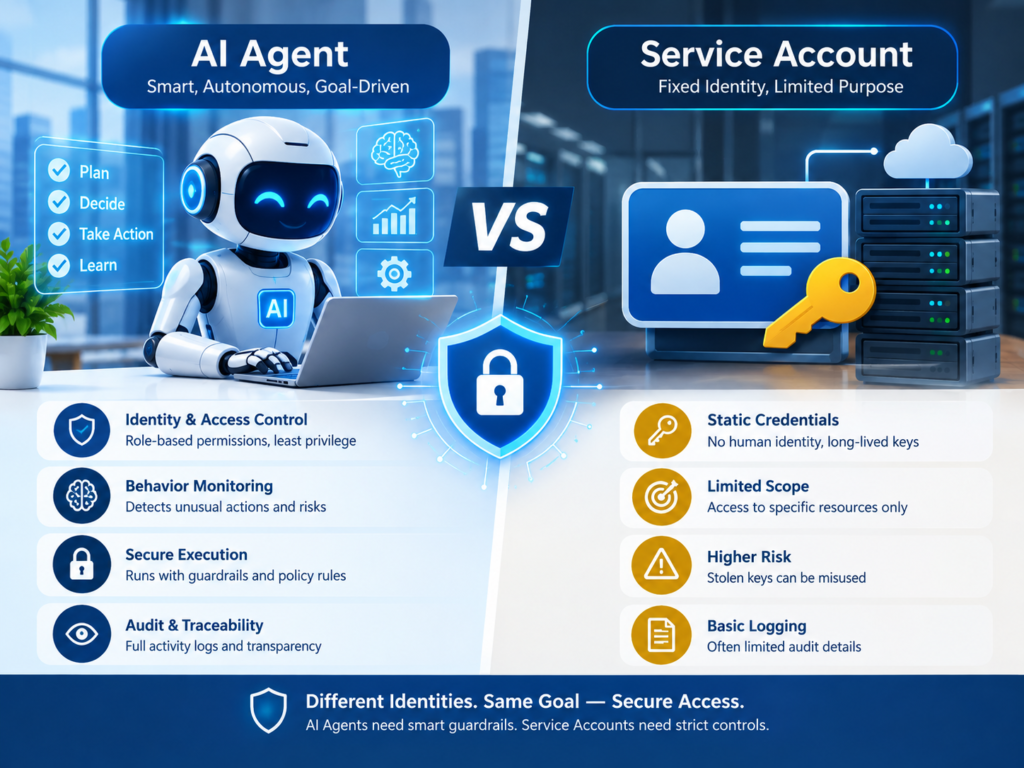
Where the platform supports it, prefer OAuth 2.0, OIDC, workload identity federation, service principals or token-exchange mechanisms over permanent API keys.
Short-lived credentials limit the useful lifetime of a stolen token and reduce the operational burden associated with rotating static secrets across cloud and SaaS environments.
Control Delegation and Agent-to-Agent Access
Authentication answers who the agent is. Authorization determines what it is allowed to do.
Use role-based or attribute-based policies to constrain access. When one agent invokes another agent, API, tool or MCP server, preserve the initiating identity, purpose and delegated scope wherever the architecture allows it.
A low-risk assistant should not be able to gain administrator-level capabilities simply because a downstream tool has broader permissions.
Manage the Full Non-Human Identity Lifecycle
Discovery is only the beginning. A complete non-human identity security program needs controls from creation through retirement.
Provision and Approve AI Agent Permissions
Before an agent receives production access, document its purpose, owner, entitlement requirements and approval path.
High-impact actions such as modifying payments, deploying to production or exporting sensitive datashould receive stronger authorization and separation-of-duties controls.
Monitor and Review Agent Activity
Monitor authentication events, permission changes, tool calls, abnormal behavior and privilege creep.
Access reviews should be risk-based rather than treated as an annual checkbox exercise. A privileged agent interacting with sensitive business systems deserves more scrutiny than a narrowly scoped background workload.
IBM reported in 2025 that 13% of surveyed organizations had experienced breaches involving AI models or applications. Of those affected, 97% reported lacking proper AI access controls.
That finding does not mean identity controls prevent every AI-related incident, but it does underline the importance of treating access governance as part of AI security from the start.
Expire Credentials and Revoke Retired Agents
Retirement should disable the identity, revoke active tokens, remove secrets, close delegated-access paths and update ownership records.
Orphaned machine identities are particularly risky because valid credentials may remain usable even after the original project, employee or business process disappears.
Secure AI Agents Across Cloud, SaaS and APIs
Non-human identity governance should follow an identity across its complete execution path instead of stopping at the boundary of one cloud provider.
Microsoft Entra, AWS IAM and Google Cloud IAM
Microsoft Entra ID, AWS IAM and Google Cloud IAM provide different mechanisms for workload identity, service principals, federation and policy-driven access.
Implementation details vary, but the security objectives remain consistent: unique identity, least privilege, temporary credentials, logging and reliable revocation.
Mak It Solutions’ cloud IAM security guide explores related architecture patterns.
SaaS, APIs, MCP Servers and Legacy Systems
A single agent workflow might move between Salesforce, ServiceNow, Workday, Microsoft 365, SAP, an API gateway and an older internal system.
Treat every connection as an authorization boundary.
When excessive permissions extend into cloud infrastructure, the cloud misconfiguration remediation guide provides additional guidance for AWS, Azure and Google Cloud environments.
Preserve Accountability Across Multi-Agent Workflows
If Agent A delegates work to Agent B, accountability should not disappear at the handoff.
Sensitive workflows should preserve enough context to reconstruct which identity initiated an action, what authority was delegated, what resource was accessed and which policy allowed the action.
That audit trail becomes increasingly important as multi-agent environments grow more complex.
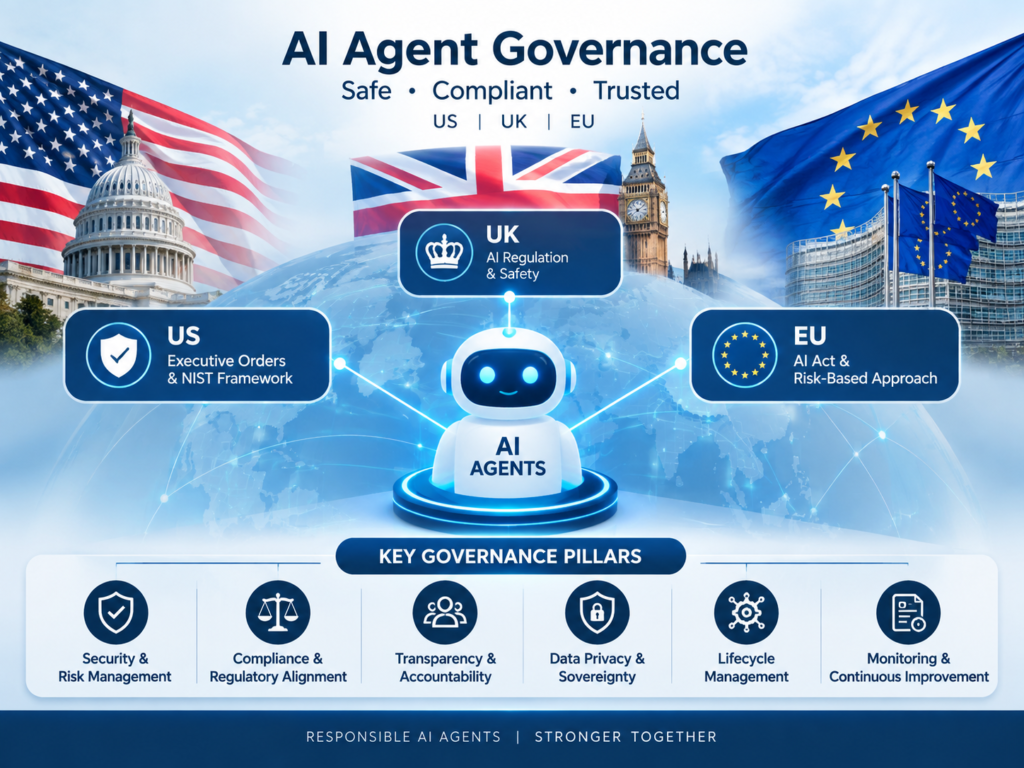
Non-Human Identity Security for US, UK and EU Compliance
Regulations rarely prescribe one exact architecture for AI-agent identity.
Strong NHI controls can, however, support broader requirements around access control, accountability, security, auditability and operational resilience.
US.
For enterprises in New York, San Francisco, Seattle, Washington DC and elsewhere in the US, NIST CSF 2.0 provides a useful structure for cybersecurity risk management.
NIST’s 2026 work on software and AI-agent identity makes the identity and authorization problem particularly relevant to organizations expanding agentic AI.
Healthcare organizations also need to consider HIPAA access, authentication and audit controls when agents interact with electronic protected health information. PCI DSS requirements become relevant when automated systems touch cardholder-data environments.
IBM’s 2025 Cost of a Data Breach findings put the global average cost of a breach at approximately $4.44 million, while the US average reached approximately $10.22 million.
UK.
UK organizations should align agent governance with broader UK GDPR accountability and security obligations.
For London financial firms, NHS environments and Open Banking ecosystems, that means being able to show who owns an automated identity, what it can access, why the access is justified and how activity is monitored.
Sector-specific expectations from bodies such as the FCA, PRA and NCSC may add further security and resilience considerations depending on the organization and use case.
Germany and the EU.
For enterprises in Berlin, Frankfurt, Munich and across the EU, nicht-menschliche Identitäten, KI-Agenten, Identitätsmanagement and Berechtigungen increasingly need to fit within existing privacy, cybersecurity and operational-resilience programs.
The EU AI Act, GDPR, NIS2 and DORA address different areas, but identity governance can provide useful evidence across them by documenting ownership, access boundaries, monitoring and control effectiveness.
Organizations should map agent permissions to the obligations that actually apply to their industry and systems rather than treating AI compliance as a separate security silo.
Building a Non-Human Identity Security Program in 2026
A workable program starts with visibility and ownership before moving into deeper automation.
Prioritize the Highest-Risk Identities First
Focus first on unknown identities, privileged agents, shared credentials, external integrations and automated systems with access to regulated or sensitive data.
For every important identity, security teams should be able to answer four practical questions.
Who owns it?
What can it access?
Why does it need that access?
How can its authority be revoked?
If those answers are unclear, the identity deserves investigation.
Evaluate AI Agent Governance Platforms by Control Coverage
Microsoft Entra, Okta, SailPoint, CyberArk and specialist platforms may all play a role depending on the existing architecture.
Evaluate them against actual control requirements rather than brand recognition. Useful capabilities include identity discovery, ownership workflows, permission analysis, cloud and SaaS integrations, lifecycle automation, access certification, policy enforcement and fast revocation.
Mak It Solutions’ Agentic AI Security Platform Guide covers additional evaluation criteria.
Measure Governance, Not Just Identity Volume
Useful metrics include the percentage of NHIs with confirmed owners, the number of long-lived credentials, orphaned identities, excessive permissions, review completion, agent coverage and mean time to revoke access.
Automation matters here. ISC2’s 2024 workforce research estimated a global cybersecurity workforce gap of approximately 4.8 million professionals, reinforcing the practical need to automate repetitive governance tasks rather than relying entirely on manual review.
Final Thoughts
AI agents should not gain enterprise-wide authority simply because experimentation moves faster than governance.
Before expanding autonomous-agent deployments in 2026, inventory your non-human identities and confirm that every production agent has a unique identity, accountable owner, bounded authority and tested revocation path.
If you need help translating those requirements into secure cloud, SaaS or AI architecture, explore Mak It Solutions services and request a scoped implementation discussion.
Key Takeaways
Give every production AI agent a unique identity, accountable owner and documented business purpose.
Replace permanent credentials with federation and short-lived tokens wherever practical.
Enforce least privilege across agent-to-API, agent-to-tool and agent-to-agent interactions.
Preserve identity and delegation context through multi-agent workflows.
Manage discovery, provisioning, monitoring, review and revocation as one continuous lifecycle.
Map NHI controls to relevant NIST, HIPAA, PCI DSS, UK GDPR, GDPR, NIS2, DORA and AI Act requirements.
Choose governance platforms based on coverage, automation, audit evidence and revocation capability rather than feature count alone.
FAQs
Q : How often should enterprises review non-human identity permissions?
A : High-risk non-human identities should be monitored continuously and reviewed more frequently than low-risk service accounts. Additional reviews should follow meaningful permission changes, ownership changes, new integrations or unusual activity.
Q : Who should own an AI agent identity inside an enterprise?
A : Every AI agent should have a named business or technical owner accountable for its purpose, permissions and retirement. Security teams can establish and enforce organization-wide policy, but operational ownership should stay with the team responsible for the workflow the agent supports.
Q : Should AI agents use API keys, OAuth tokens or workload identities?
A : Where supported, workload identity federation, OAuth 2.0 and other short-lived, scoped credentials are generally preferable to static secrets. Legacy integrations may still require API keys, but those keys should be narrowly scoped, securely stored, rotated and monitored.
Q : What are the warning signs of an orphaned non-human identity?
A : Common signs include missing ownership, permanent credentials, access unrelated to a current application, no clear deployment record and continued activity after the originating project has been retired. An identity whose business purpose cannot be validated should be investigated promptly.
Q : What should companies look for in an AI agent identity governance platform?
A : Prioritize automated discovery, ownership attribution, permission analysis, lifecycle workflows, cloud and SaaS integrations, access certification, policy enforcement and fast revocation. The platform should also provide evidence showing what an agent accessed, what authority it used and how security teams responded.