
Least Privilege for AI Agents: Zero Trust Guide
Least Privilege for AI Agents: Zero Trust Guide
Least Privilege for AI Agents: Zero Trust Guide
Autonomous AI agents can search systems, call APIs, update records, trigger workflows, and sometimes execute transactions without a person approving every step. That makes least privilege for AI agents a core security requirement, not simply another IAM best practice.
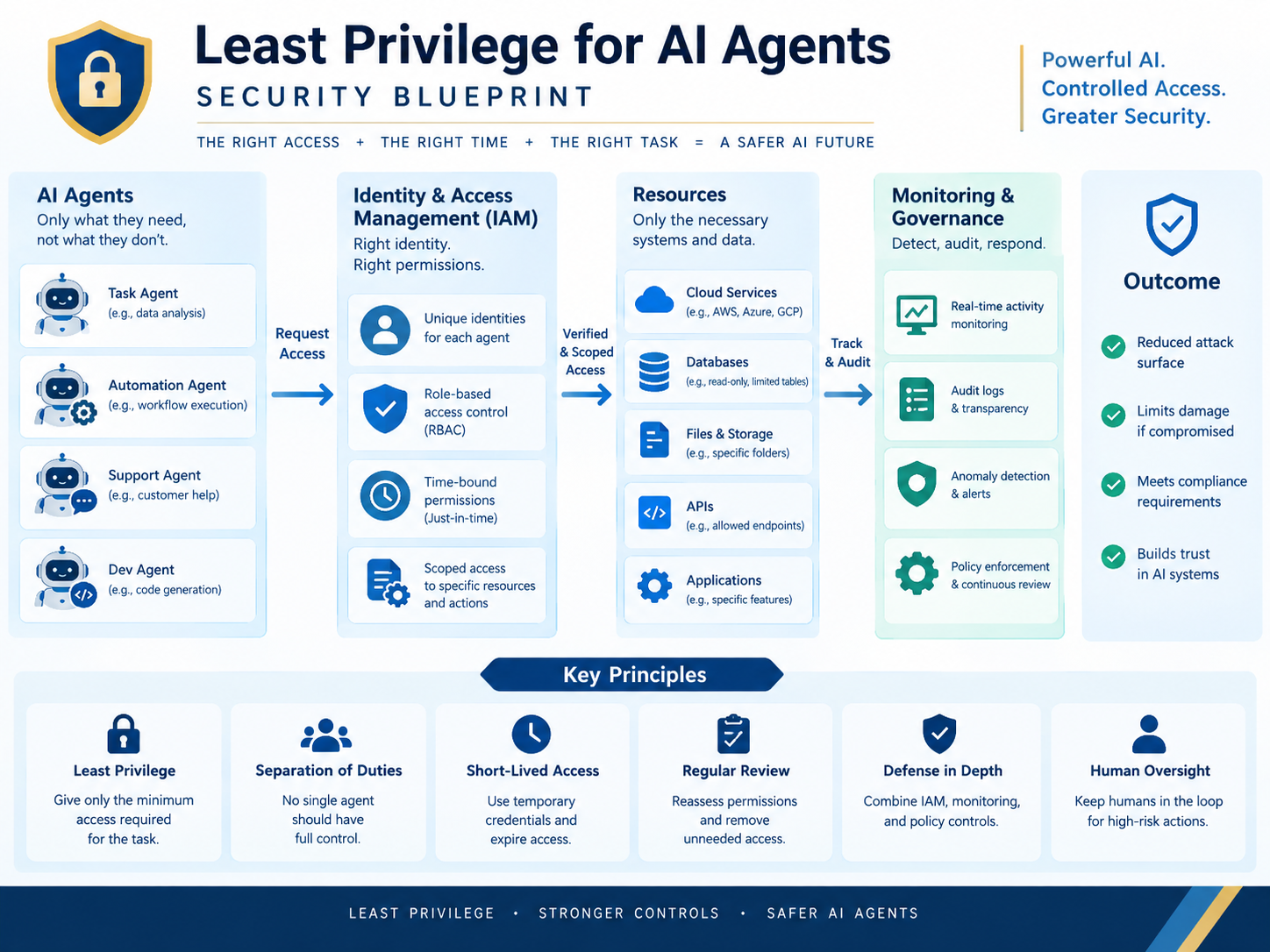
In practical terms, least privilege means giving an AI agent only the identity, permissions, tools, data access, and access time it needs for an approved task. Strong implementations combine unique agent identities, narrowly scoped authorization, short-lived credentials, human approval for consequential actions, continuous auditing, and Zero Trust controls.
As enterprises connect agents to CRM, ERP, cloud infrastructure, payment systems, healthcare platforms, analytics tools, and internal knowledge bases, those boundaries become increasingly important.
What Is Least Privilege for AI Agents?
Least privilege for AI agents means limiting each agent to the minimum identities, permissions, tools, data, actions, and access duration required to complete an approved task. Those permissions should be explicit, revocable, auditable, and tied to a defined business purpose.
How least privilege changes for autonomous AI agents
Traditional least privilege was designed mainly around employees, applications, and service accounts. Agentic systems introduce another actor: a software identity capable of selecting tools and carrying out multi-step actions.
A production AI agent therefore needs clear boundaries around five areas:
Who the agent is.
Which resources it can access.
Which tools it can invoke.
Which operations it can perform; and
How long elevated privileges remain valid.
Mak It Solutions’ AI Agent Identity Management Guide provides additional context for managing these non-human identities.
Why autonomous agents create a different access-control problem
AI agents can exercise delegated authority at machine speed. Prompt injection, a compromised tool, faulty reasoning, leaked credentials, or overly broad OAuth scopes can turn an ordinary workflow into an unauthorized action.
OWASP describes excessive agency as a risk in which an LLM-enabled system can perform damaging actions because it has unnecessary functionality, permissions, or autonomy.
That is why securing an agent requires more than authenticating it once. Authorization needs to follow the agent through each sensitive tool call, resource request, and operation.
Why Least Privilege Matters for Agentic AI Security
Least privilege reduces the blast radius when an AI agent receives a malicious instruction, exposes a credential, uses a compromised integration, or makes an incorrect decision.
The smaller the agent’s permission boundary, the fewer systems and actions are exposed when something goes wrong.
Prompt injection, excessive agency, and privilege escalation
Imagine one AI agent that can read customer data, alter production infrastructure, export records, and initiate payments through a single broad identity. A successful malicious instruction could potentially reach every one of those capabilities.
Microsoft’s 2024 Digital Defense Report said Microsoft Entra data showed more than 600 million identity attacks per day, with more than 99% categorized as password-based attacks.
For autonomous systems, model-level defenses therefore need to work alongside established identity, credential, and authorization controls.
The confused-deputy and credential-sprawl problem
Shared service accounts, static API keys, reused secrets, and oversized OAuth scopes weaken both security and accountability.
An AI agent can also become a confused deputy: an attacker persuades the agent to use legitimate authority for a purpose the organization never intended.
Verizon’s 2024 DBIR reported that stolen credentials had appeared in 31% of breaches over the previous 10 years.
Dedicated identities and tightly scoped permissions make it easier to attribute activity, revoke access, and limit what a compromised agent can do.
Zero Trust for AI agents
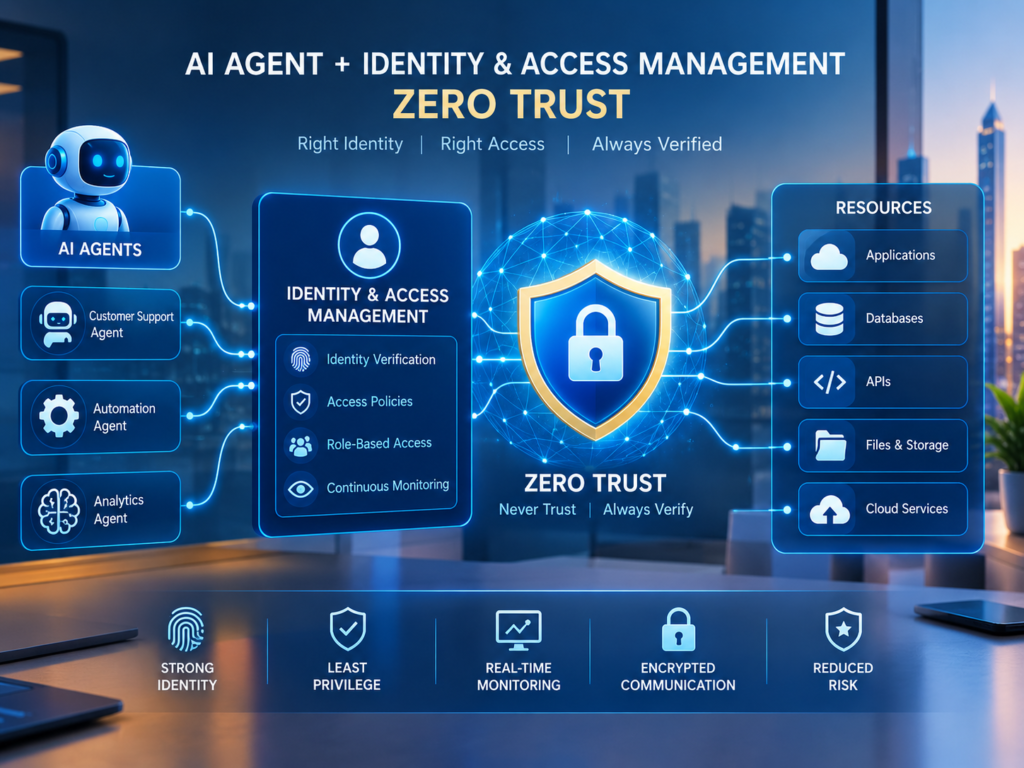
Zero Trust does not assume that an authenticated identity should receive broad or persistent trust. For AI agents, the useful question is not simply, “Is this agent authenticated?” but.
Is this agent allowed to perform this specific action on this specific resource under these conditions right now?
That approach fits NIST’s resource-centric Zero Trust model, where access decisions are made around individual resources rather than relying on implicit network trust.
Mak It Solutions’ Zero Trust Strategy for AI-Era Security explores the broader architectural model.
Build AI Agent Identity and Access Management
Give every AI agent a unique non-human identity
Every production AI agent should normally have its own dedicated, revocable workload or non-human identity instead of borrowing a human user’s credentials.
A unique AI agent identity gives security teams a reliable basis for ownership, attribution, policy enforcement, access review, incident investigation, and revocation.
Platforms such as Microsoft Entra and AWS IAM can help organizations separate agent identities from employee accounts and other workloads.
Use RBAC and ABAC to narrow permissions
Role-based access control, or RBAC, grants permissions according to a defined role.
Attribute-based access control, or ABAC, can narrow those decisions using context such as.
Customer tenant.
Data classification.
Region.
Environment.
Transaction amount.
Device or workload state; and
Risk level.
Combined, AI agent RBAC and ABAC can answer a much more useful security question: Which agent may perform which action on which resource under which conditions?
Match identity controls to the agent lifecycle
AI agent IAM should cover the entire lifecycle: provisioning, credential issuance, rotation, access review, suspension, revocation, ownership changes, and decommissioning.
Permissions that made sense during a pilot should not silently survive after the workflow, integration, or business owner changes.
For broader rollout planning, see the Enterprise AI Adoption Roadmap.
How to Control AI Agent Permissions and Tool Access
Do not give an agent blanket access to an application simply because it needs one feature inside that application. Scope authorization to the required tools, datasets, resources, and operations.
Scope tools, APIs, data, and actions independently
An agent that needs to search a CRM may require read access to selected customer fields. It does not automatically need permission to export the entire database, modify billing information, delete records, or administer the CRM.
Useful controls include OAuth 2.0/OIDC scopes, API gateways, MCP or tool-server policies, secrets managers, server-side authorization, and operation-level policy checks.
Mak It Solutions’ API Security Best Practices Guide covers scopes, authorization, API gateways, and credential controls in more detail.
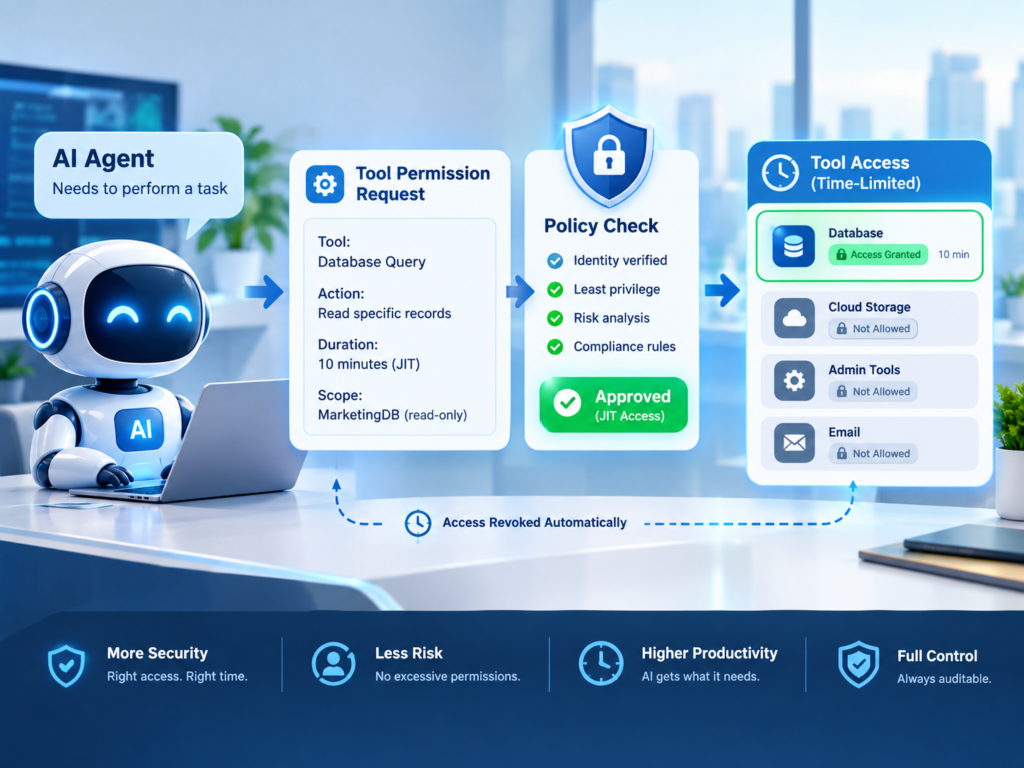
Replace standing privileges with short-lived and JIT access
Permanent elevated access creates unnecessary exposure.
Where the platform allows it, use temporary tokens, ephemeral credentials, session-bound authorization, and just-in-time access (JIT) instead of persistent administrative rights.
The objective is simple: grant elevated authority when the workflow requires it, then remove that authority when the task ends.
Keep consequential actions behind human approval
Not every AI-agent action should be fully autonomous.
Human approval is especially useful for payments, production changes, large exports, account deletion, IAM changes, privilege elevation, or other operations that are expensive or difficult to reverse.
A practical model is to automate routine, low-risk execution while introducing approval gates when the value, sensitivity, or potential impact crosses a defined threshold.
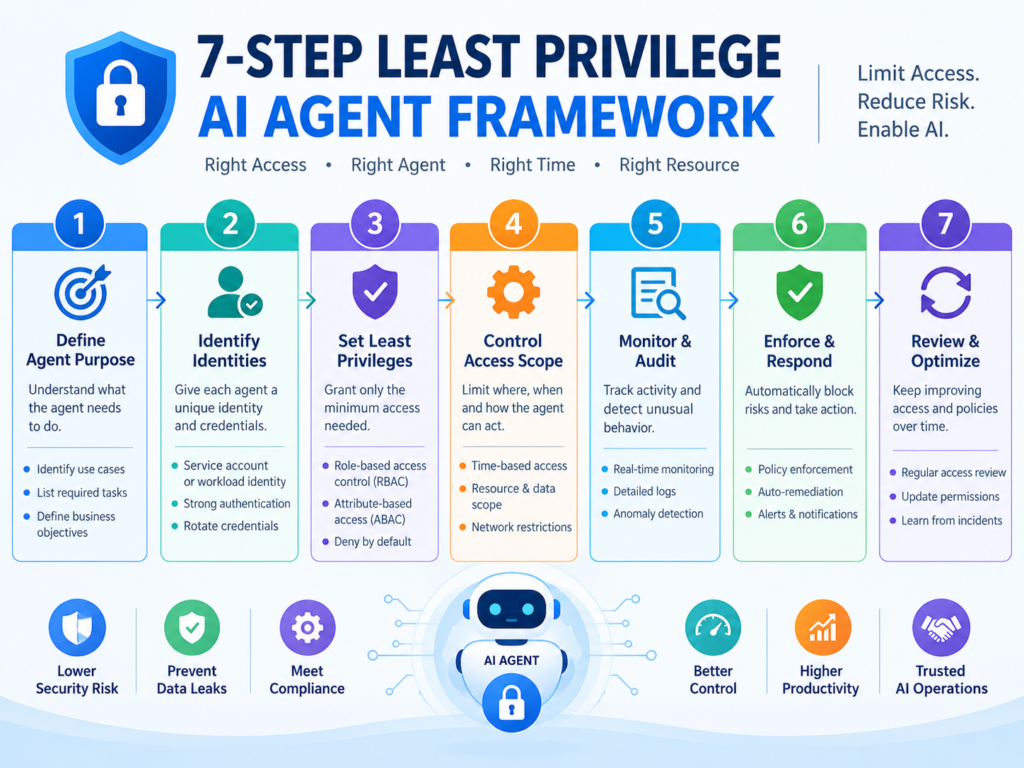
A 7-Step Least-Privilege Framework for AI Agents
A workable least-privilege model maps every AI agent to seven controls: identity, role, resource, action, duration, approval, and audit.
Identity.
Create a unique machine identity for every production agent.
Role.
Define the agent’s business purpose and authorized workflow.
Resource.
Specify which databases, APIs, applications, records, and tools it may reach.
Action.
Permit explicit operations such as read, draft, create, or update while denying unnecessary export, delete, payment, and administration capabilities.
Duration.
Make elevated permissions temporary and automatically expire them.
Approval.
Require human authorization when an action exceeds predefined risk, value, sensitivity, or scope thresholds.
Audit.
Record authentication events, policy decisions, permission changes, tool calls, approvals, failures, and final actions.
Example least-privilege policy for an enterprise AI agent
Consider a support agent serving customers in New York and London.
It may read selected CRM fields, search an approved knowledge base, and draft customer responses. It cannot export the entire customer database, modify IAM roles, initiate payments, or approve high-value refunds.
That distinction is important. The agent still has enough authority to deliver useful automation, but the most consequential capabilities remain outside its autonomous permission boundary.
The same model can support the architecture described in Mak It Solutions’ Enterprise AI Agents Guide.
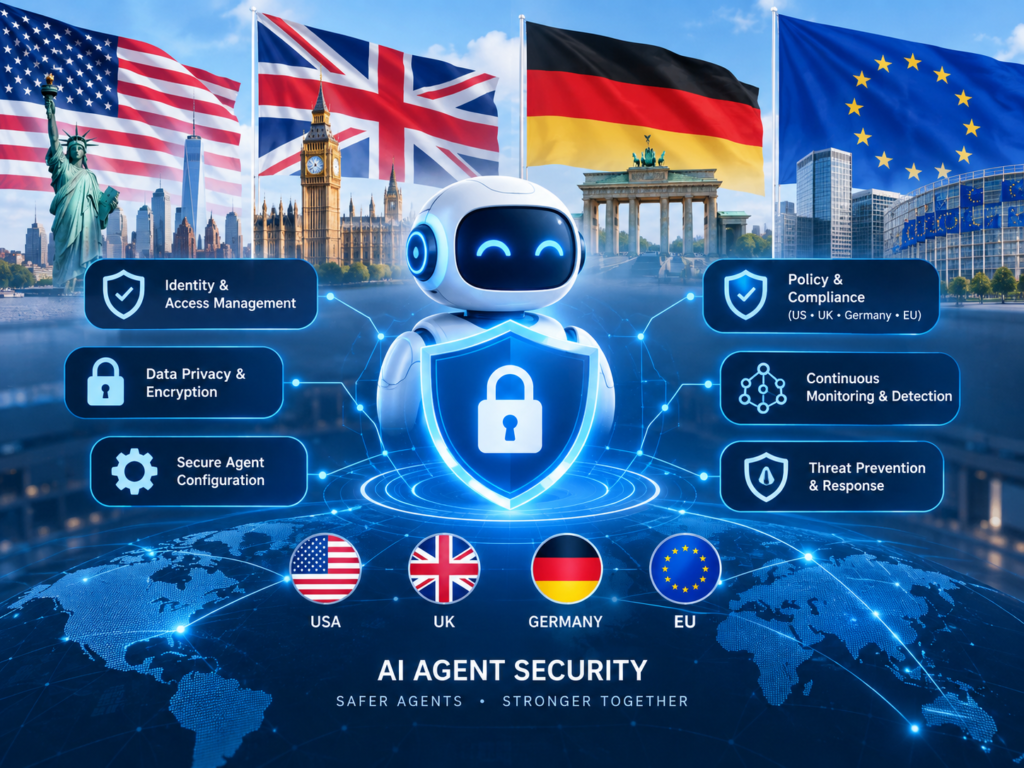
Least Privilege for AI Agents in the USA, UK, Germany, and EU
Least privilege is a security architecture principle, but its implementation should also reflect the regulatory environment in which an AI agent handles data or performs actions.
USA.
Requirements in the United States depend heavily on industry, data type, and contractual obligations.
A San Francisco SaaS provider may focus heavily on SOC 2 controls and enterprise Zero Trust. A New York healthcare workflow handling electronic protected health information may also need to address HIPAA Security Rule requirements for access control and system activity review.
IBM’s 2024 Cost of a Data Breach research put the global average cost of a data breach at USD 4.88 million, up from USD 4.45 million in 2023.
That figure does not measure AI-agent incidents specifically, but it illustrates why organizations should avoid giving automated identities unnecessary reach.
UK.
For London fintech companies, Manchester SaaS providers, NHS-related environments, and other UK organizations, an AI agent should be restricted to the personal information and actions required for its defined purpose.
The Data (Use and Access) Act 2025 amended parts of the UK’s data-protection framework rather than replacing the UK GDPR or Data Protection Act 2018. The ICO states that the Act’s provisions affecting data-protection law are now in force.
The ICO also continues to frame AI governance around areas such as accountability, security, lawfulness, fairness, transparency, and data protection by design.
Germany and EU.
For organizations operating in Berlin, Munich, Frankfurt, Paris, Amsterdam, Dublin, or elsewhere in the EU, the Least-Privilege-Prinzip für KI-Agenten should connect KI-Agent Berechtigungen, KI-Agent Zugriffsrechte, and KI-Agent Identitätsmanagement with GDPR/DSGVO obligations, sector requirements, data-location decisions, and internal governance.
The EU AI Act became generally applicable on 2 August 2026, although different provisions follow different application dates. Current EU guidance indicates later transition dates for certain high-risk AI requirements, including 2 December 2027 for specified Annex III high-risk use cases and 2 August 2028 for high-risk systems connected to regulated products under Annex I.
Financial organizations may also need to map AI-agent controls to relevant BaFin and EU financial-services requirements.
How to Operationalize and Audit Least Privilege at Scale
Log agent identities, permission changes, and tool calls
Centralize AI-agent events in your SIEM or observability stack.
A useful audit trail should allow investigators to connect a business request with the agent identity, authorization decision, API or tool invocation, affected data, approval event, and final action.
Continuously detect privilege drift
AI-agent permissions should not become permanent simply because nobody reviewed them.
Monitor for dormant permissions, stale credentials, unused tools, excessive OAuth scopes, duplicate agent identities, unexplained privilege increases, and identities without accountable owners.
Usage telemetry can also reveal permissions an agent has never exercised, giving teams a practical basis for removing unnecessary access.
What to evaluate in an AI agent security or IAM platform
When comparing platforms, look beyond basic authentication.
Relevant capabilities include non-human identity discovery, workload identity management, RBAC and ABAC, JIT authorization, credential rotation, tool-level policy enforcement, approval workflows, audit trails, SIEM integration, regional policy controls, and rapid revocation.
The architecture should support the complete security chain:
Autonomous AI Agent → Agent Identity → Least Privilege → RBAC/ABAC → Scoped Tool Access → Short-Lived Credentials → Human Approval → Auditability → Zero Trust
For API-heavy environments, Mak It Solutions’ API-First Architecture Guide can help teams define integration boundaries before granting agents production authority.
To Sum Up
Least privilege for AI agents works best when identity, APIs, tools, approval boundaries, credentials, and audit evidence are designed together from the beginning.
Adding those controls after an agent already has broad production authority is harder and riskier than defining the boundaries during architecture and deployment. ( Click Here’s )
Mak It Solutions can help organizations review AI-agent architectures, identify excessive permissions, and design a practical Zero Trust access model. A scoped AI-agent access and architecture assessment can provide a clear starting point before production autonomy expands.
Key Takeaways
Give every production AI agent its own accountable and revocable identity.
Apply RBAC and ABAC at the resource and action level rather than granting blanket application access.
Replace unnecessary standing privileges with short-lived or just-in-time authorization.
Keep payments, mass exports, IAM changes, production modifications, and other consequential actions behind appropriate approval controls.
Map AI-agent access policies to relevant frameworks and regulations, including HIPAA, UK GDPR, GDPR/DSGVO, PCI DSS, BaFin requirements, and the EU AI Act where applicable.
Continuously review agents for privilege drift, stale credentials, unnecessary scopes, and unused integrations.
FAQs
Q : Should AI agents use separate identities from human users?
A : Yes. Production AI agents should normally use dedicated non-human or workload identities instead of borrowing employee credentials. Separate identities improve attribution, revocation, lifecycle management, auditing, and policy enforcement.
Q : How often should AI agent permissions be reviewed?
A : Permissions should be monitored continuously where practical, with formal reviews triggered by workflow changes, new integrations, ownership changes, incidents, or decommissioning. Higher-risk agents generally require tighter review processes because privilege drift can increase their attack surface.
Q : Can an AI agent safely use OAuth tokens and API keys?
A : Yes, when credentials are narrowly scoped and properly protected. Prefer short-lived OAuth tokens, validated audiences, limited scopes, secure secrets storage, credential rotation, and automatic expiry. Avoid giving a single static API key broad access across unrelated systems.
Q : What is the difference between RBAC and ABAC for AI agents?
A : RBAC grants access according to a defined role, such as support-agent or invoice-reader. ABAC also evaluates context such as resource classification, tenant, region, environment, transaction value, or risk. Many enterprise architectures combine the two approaches.
Q : How can organizations detect an overprivileged AI agent?
A : Compare assigned permissions with actual tool and resource usage. Warning signs include unused administrator rights, wildcard scopes, dormant credentials, unrestricted exports, access to unrelated applications, and privileges the agent never exercises.