

AI Agent Security: When Credentials Are Stolen
AI Agent Security: When Credentials Are Stolen
AI Agent Security: When Credentials Are Stolen
AI agents are becoming operational identities, not just conversational interfaces. That makes AI agent security an identity and access management challenge: if an attacker steals an agent’s API key, OAuth token, service credential, or authenticated session, downstream systems may treat that attacker as the trusted agent.
When AI agent credentials are stolen, the attacker may inherit whatever permissions are attached to that identity. The real impact depends on the credential’s scope and lifetime, the tools and data the agent can reach, and whether additional authorization controls stand between authentication and sensitive actions.
This matters as adoption grows. Around 93% of enterprise IT leaders surveyed by MuleSoft in 2025 said they had implemented or planned to implement AI agents within two years. Verizon’s 2025 DBIR also reported credential abuse in roughly 22% of breaches as an initial-access vector.
What Is AI Agent Credential Theft?
AI agent credential theft happens when an unauthorized party obtains authentication material an agent uses to access systems, APIs, data, or tools.
Stealing a human password is already serious. Compromising an autonomous agent can be different because the identity may be designed to execute workflows continuously, connect to multiple systems, and operate at machine speed.
What Types of Credentials Do AI Agents Use?
Depending on the architecture, agents may rely on.
API keys
OAuth access and refresh tokens
Service accounts
Workload identities
Certificates
Application secrets
Authenticated sessions
Delegated credentials
OAuth and OIDC can offer more controlled authentication than unmanaged static secrets, while technologies such as SPIFFE and mTLS can help systems cryptographically authenticate non-human workloads.
The principle is straightforward: a credential should identify a specific agent for a specific purpose rather than giving a general-purpose agent broad, reusable access.
How Stolen Credentials Turn Into Agent Impersonation
If an attacker possesses valid credentials, downstream systems may see the attacker as the trusted AI agent.
Unless authorization policies, behavioral controls, or approval requirements intervene, the attacker may be able to perform the same actions those credentials permit.
Credential theft therefore becomes an agent impersonation problem not merely a secret-management problem.
Why AI Agent Identity Changes the Security Model
Traditional IAM has focused heavily on human users and relatively predictable service accounts. Autonomous agents blur those boundaries because they can reason, invoke tools, call APIs, delegate work, and perform sequences of actions without a human approving every individual step.
The UK’s NCSC recommends assigning agents unique identities that distinguish them from humans and other systems while restricting the credentials available to them and limiting credential lifetimes.
What Can Attackers Do With Stolen AI Agent Credentials?
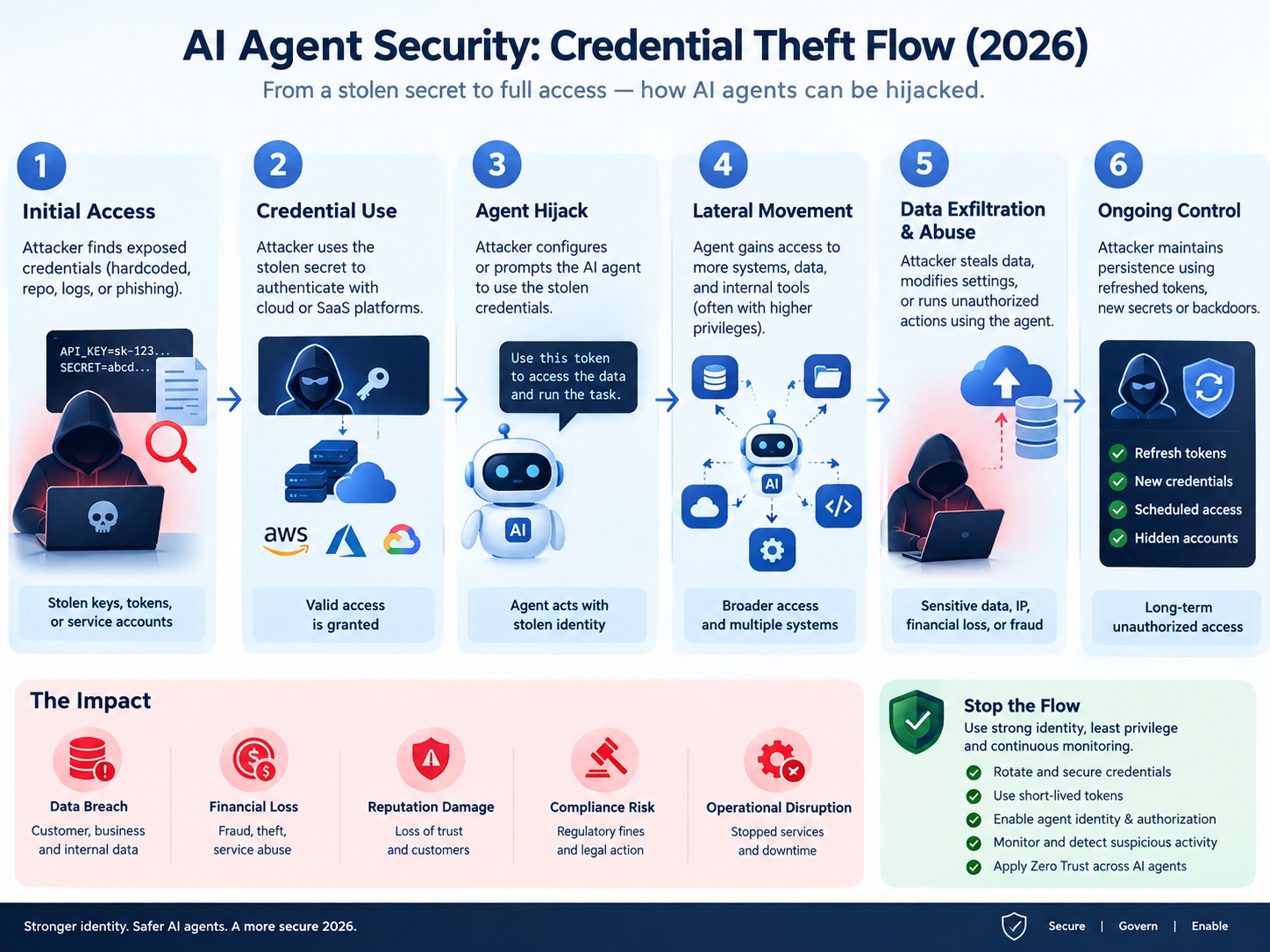
When an AI agent’s credentials are stolen, an attacker may impersonate the agent, inherit its authorized permissions, access connected tools and data, and execute actions that appear legitimate. From there, the attacker could potentially move laterally, steal information, abuse delegated access, or exploit the agent’s trusted position inside automated workflows.
The attack path can look like this.
Credential stolen → agent impersonated → permissions inherited → tools and data accessed → lateral movement or exfiltration → trusted identity abused
Access Connected Data, APIs, SaaS Platforms, and Tools
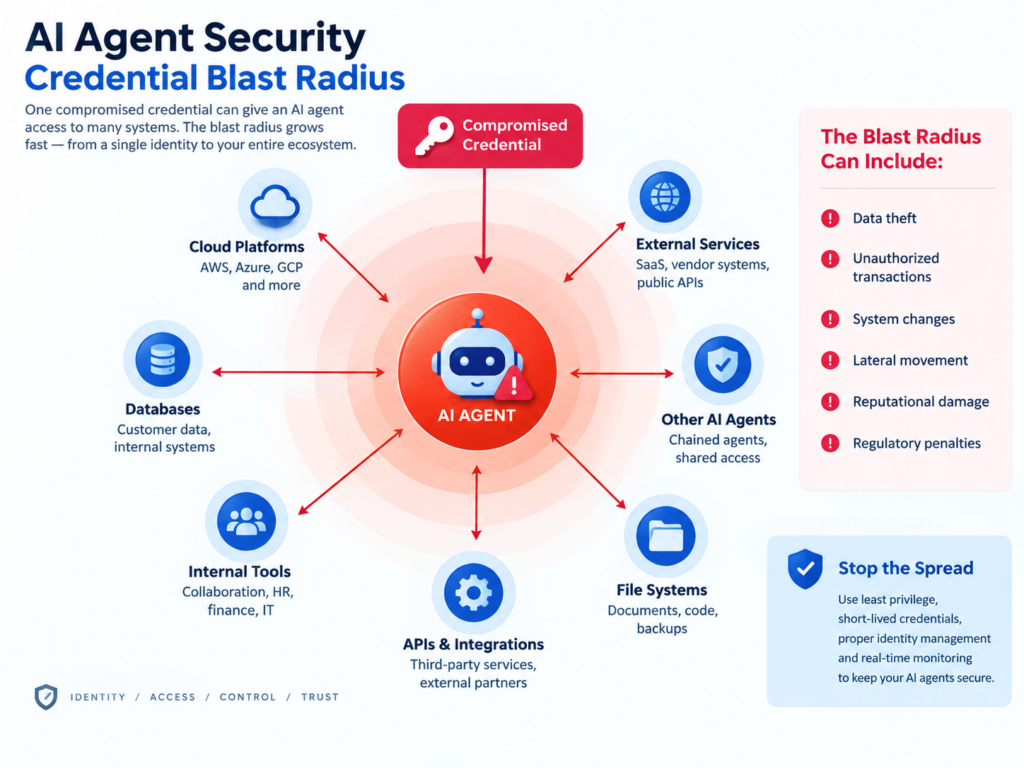
A compromised agent identity could provide access to databases, cloud resources, enterprise SaaS platforms, internal APIs, Model Context Protocol (MCP) tools, file stores, CRM systems, or analytics environments.
The broader the permissions, the larger the potential blast radius. NCSC guidance similarly treats credentials, data, compute, execution, and network access as important dimensions of an agent’s exposure.
Organizations developing connected applications can apply familiar secure-integration principles from modern web and mobile development: authenticate connections and minimize what each component is allowed to do.
Escalate Privileges, Move Laterally, and Exfiltrate Data
Credential compromise becomes more dangerous when one identity can unlock additional identities, secrets, or tools.
An attacker could potentially replay OAuth tokens, invoke privileged tools, retrieve additional secrets, query sensitive datasets, or use one compromised workload to reach another environment.
OWASP’s agentic-AI security guidance identifies risks including tool abuse, privilege escalation, sensitive-data exposure, excessive autonomy, and cascading failures.
Trigger High-Impact Actions at Machine Speed
Depending on its permissions, an autonomous agent may be able to modify infrastructure, update databases, initiate workflows, send communications, execute transactions, or delegate tasks to other agents.
Automation changes the economics of a compromise. A stolen human account may require an attacker to perform each action manually. A highly privileged autonomous identity can expose workflows that were intentionally built to execute actions quickly.
Why AI Agent Credential Theft Is Hard to Detect
Possession of a valid credential can make malicious activity appear authenticated and legitimate.
The problem becomes harder when agents use persistent tokens, interact with many systems, delegate tasks, or execute large volumes of actions that cannot easily be traced to one human decision.
Malicious Actions Can Look Legitimate
Authentication can answer:
“Which identity presented this credential?”
It does not necessarily answer:
“Was this action actually intended?”
If an attacker possesses a valid token, ordinary logs may record successful agent authentication rather than an obvious intrusion.
Long-Lived Credentials Increase the Exposure Window
Static API keys and persistent tokens can remain useful to attackers until they expire or are revoked.
Short-lived, task-specific credentials reduce that exposure window. NCSC guidance recommends using temporary credentials where possible and revoking elevated access when a task finishes.
Agent-to-Agent Delegation Complicates Audit Trails
Multi-agent systems add another challenge: who actually authorized an action?
One agent might delegate a task to another agent, which invokes an API that triggers another service. Without strong attribution, tracing:
Human → agent → delegated agent → tool → action
can become difficult.
How to Improve AI Agent Security for Identities and Credentials
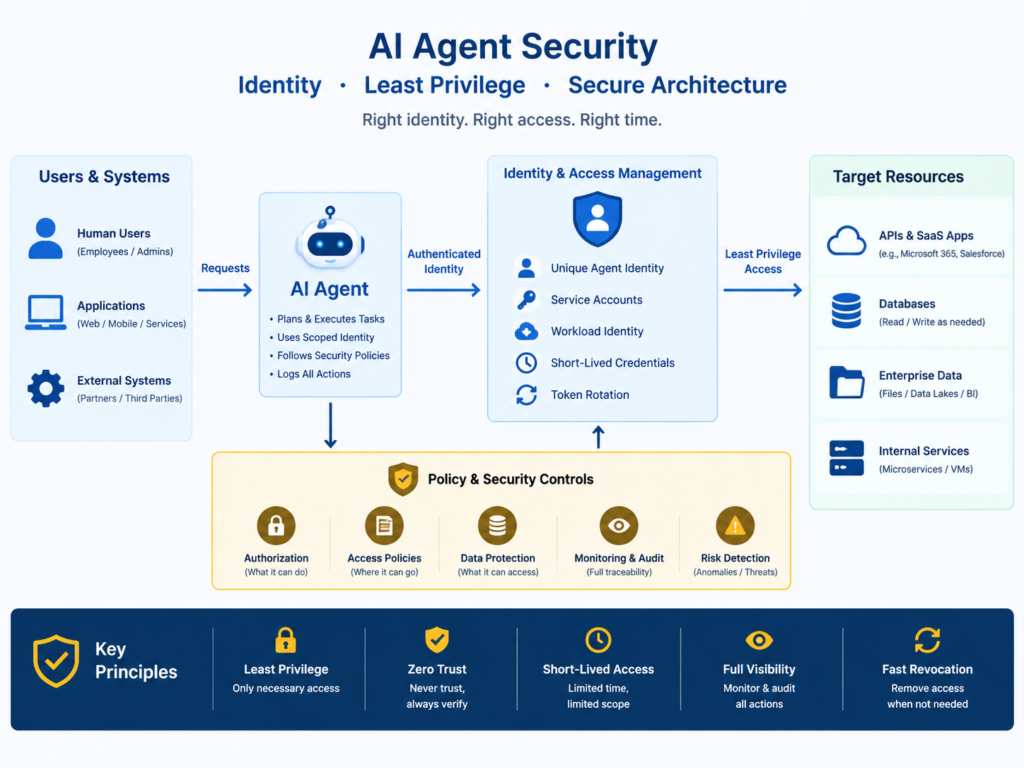
Organizations can reduce credential-theft risk by giving each production agent a distinct identity, enforcing least privilege, using short-lived credentials, keeping secrets outside agent context, and continuously monitoring behavior.
Sensitive or irreversible actions should also require stronger authorization or human approval rather than relying on authentication alone.
Give Every AI Agent a Distinct Identity
Production agents should have identifiable machine identities rather than borrowing developer credentials or operating through a shared service account.
Depending on the environment, controls may include.
OIDC
Workload identity
SPIFFE
mTLS
Certificate-backed identities
Other cryptographic authentication mechanisms
Distinct identities create a foundation for attributable audit logs, revocation, and policy enforcement.
Enforce Least Privilege and Short-Lived Credentials
Each agent should receive only the resources, permissions, actions, and credential lifetime required for its task.
RBAC can restrict access according to roles, while ABAC can consider workload, resource, environment, risk, and other attributes. OAuth scopes can constrain delegated access, and sender-constrained mechanisms such as DPoP can make some stolen bearer-token scenarios harder to exploit.
The underlying zero-trust principle is important: successful authentication should not automatically mean unlimited trust.
Protect Secrets and Continuously Monitor Agent Activity
API keys and persistent secrets should live in controlled secrets-management systems—not in prompts, source code, logs, or agent memory.
Security teams can combine rotation and revocation with.
Behavioral monitoring
Anomaly detection
Immutable audit records
Policy enforcement
Human approval for high-impact operations
For data-intensive agent environments, governance should also extend to analytics pipelines, connected datasets, and the identities used to reach them.
What to Do When an AI Agent Is Compromised
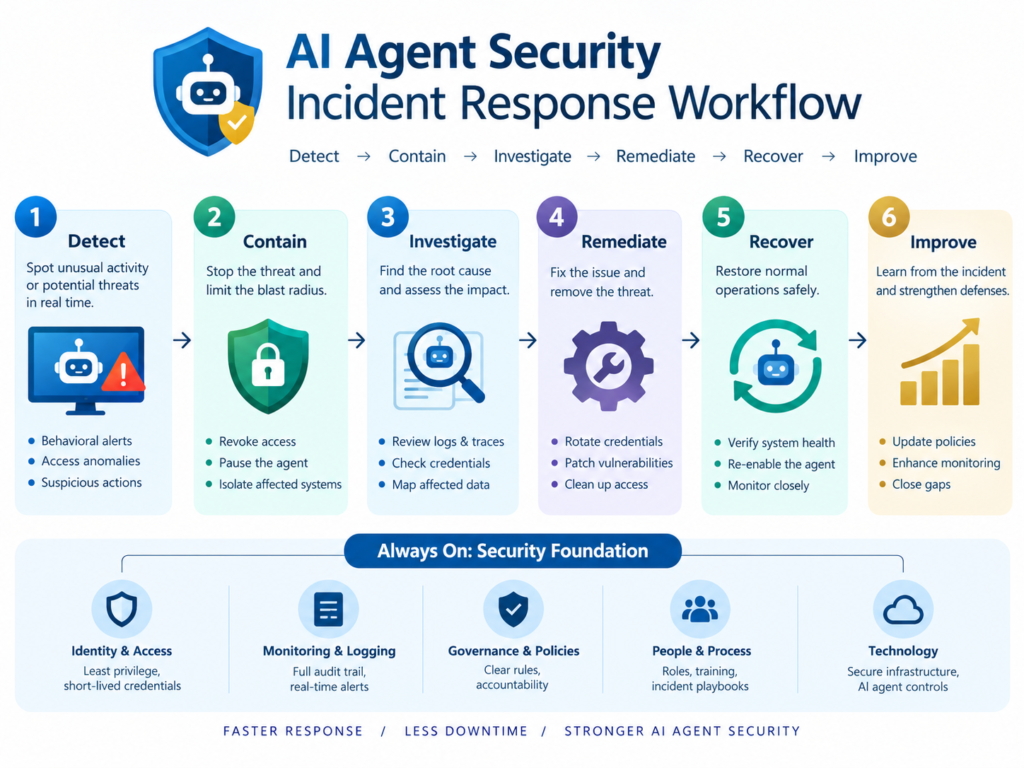
Revoke Credentials and Contain the Agent Immediately
The first objective is to stop the compromised identity from acting.
Revoke relevant access and refresh tokens, API keys, authenticated sessions, certificates, and delegated permissions. Suspend the compromised agent and isolate affected execution environments where appropriate.
Do not assume that revoking one API key ends the incident. A compromised agent may have had access to additional credentials or delegated identities.
Trace Permissions, Tools, and Downstream Actions
Investigators should map the complete path.
Identity → credential → entitlement → connected tool → accessed data or action
Review audit records for token replay, unusual API calls, privilege changes, newly accessed secrets, unexpected MCP tool invocation, data exports, and agent-to-agent delegation.
Rotate Secrets and Rebuild Trust Before Restoring Access
Replace exposed credentials and investigate whether the attacker established persistence elsewhere.
Before restoring access, review permissions rather than simply recreating the previous configuration. Where appropriate, use narrower entitlements, fresh identities, enhanced monitoring, and explicit validation of high-risk integrations.
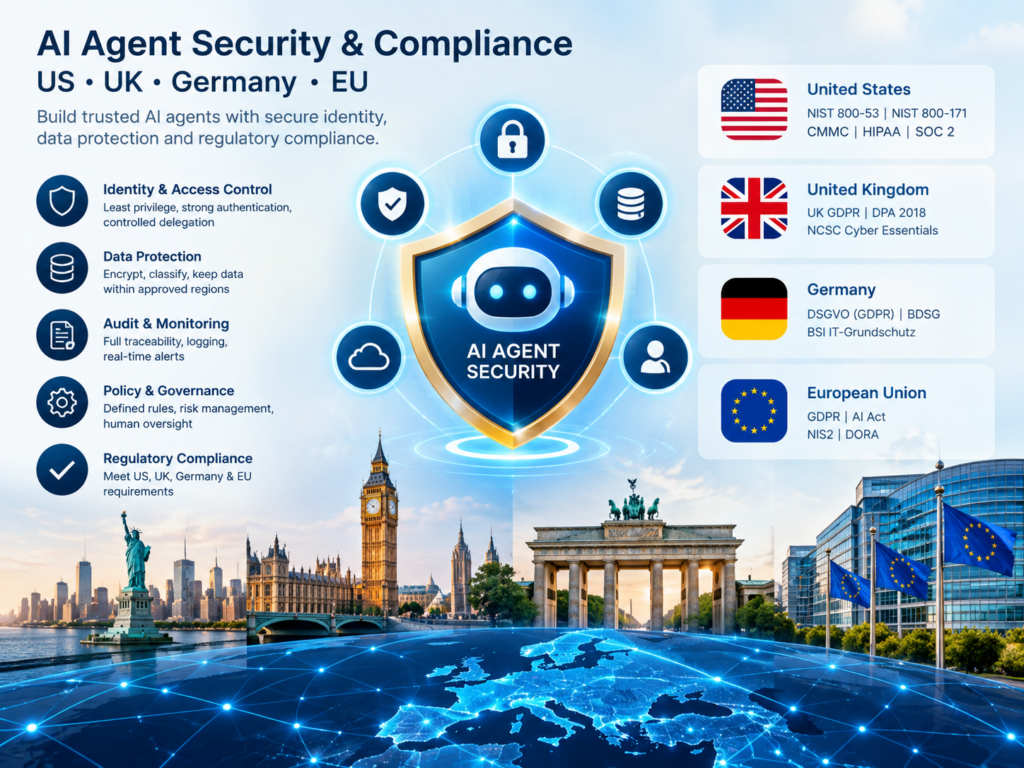
AI Agent Security Requirements Across the US, UK, Germany, and EU
Regulatory obligations depend on the organization, sector, data involved, and how an AI agent is deployed. Existing cybersecurity, privacy, identity, audit, and operational-resilience requirements can still apply when AI agents are introduced.
US.
US organizations should map agent identities into existing IAM, audit, data-protection, and incident-response programs.
For healthcare organizations in New York or technology providers in San Francisco, for example, an agent accessing electronic protected health information may bring HIPAA safeguards into scope. HHS requires appropriate safeguards around access control, audit controls, authentication, and systems handling ePHI.
Payment environments should separately evaluate applicable PCI DSS requirements, while SaaS organizations may incorporate agent controls into their broader SOC 2 control environment.
UK.
A London financial platform or Manchester healthcare technology provider should be able to determine which agent accessed sensitive or personal information, under whose authority, and for what purpose.
UK GDPR and ICO security and accountability requirements remain relevant. NCSC guidance on agentic AI also emphasizes restricting agent credentials, applying least privilege, maintaining human accountability, and containing agent access.
Germany and EU.
For organizations operating in Berlin, Munich, Frankfurt, Paris, Amsterdam, or Dublin, KI-Agent Sicherheit increasingly intersects with conventional Identitäts- und Zugriffsmanagement.
Organizations need visibility into KI-Agent Identität, Zugangsdaten und Berechtigungen, alongside data access and downstream actions.
GDPR/DSGVO, NIS2, the EU AI Act, and sector-specific requirements may overlap depending on the organization and use case. Covered EU financial entities should also consider DORA, which became applicable in January 2025 and establishes digital operational-resilience requirements.
Building an AI Agent Security Architecture That Limits the Blast Radius
Identity-First Controls for Autonomous Agents
A resilient architecture connects agent identity, workload authentication, authorization, secrets management, zero-trust controls, monitoring, and incident response.
Instead of asking only, “Where is the API key stored?”, ask:
Who is this agent? What can it access? What actions can it perform? How long does that authority last? How quickly can we terminate it?
Those questions provide a much clearer picture of the actual blast radius.
Questions to Ask an AI Agent Security or IAM Provider
When evaluating a platform, determine whether it can.
Give agents unique identities
Issue ephemeral or short-lived credentials
Enforce RBAC or ABAC policies
Restrict delegation
Revoke access quickly
Protect persistent secrets
Attribute individual actions
Maintain visibility across agent-to-agent interactions
Failure modes matter too. If an agent is compromised at 2 a.m., can one security control disable its access across connected environments, or must administrators manually track down every integration?
From Credential Protection to Continuous Agent Governance
AI agent security cannot stop at secure secret storage.
Agent identities have lifecycles. They are created, granted permissions, connected to tools, modified, delegated authority, monitored, and eventually retired.
Security therefore needs to cover prevention, detection, response, entitlement review, and continuous governance. OWASP’s agentic-security work similarly treats identity, tools, memory, human oversight, and multi-agent interactions as interconnected attack surfaces rather than isolated problems.
Final Thoughts
Start by identifying every production AI agent that currently holds credentials and mapping exactly what each identity can reach.
Strong AI agent security comes from controlling the full identity lifecycle: who the agent is, what it can access, how long its authority lasts, what it can delegate, and how quickly that authority can be revoked. ( Click Here’s )
If you need help designing secure APIs, SaaS integrations, data systems, or identity-aware application architecture, explore Mak It Solutions’ development services or contact the team for a scoped technical discussion.
Key Takeaways
Treat stolen AI agent credentials as an identity compromise, not simply a leaked-secret problem.
Give each production agent its own identity and enforce least-privilege, short-lived access.
Map credentials to tools, data, APIs, and downstream identities to understand the real blast radius.
Monitor behavior after authentication because valid credentials do not prove legitimate intent.
Align agent IAM with applicable HIPAA, PCI DSS, UK GDPR, GDPR/DSGVO, NIS2, DORA, and industry requirements.
Evaluate security platforms on revocation, delegation, attribution, secrets management, and continuous governance—not authentication alone.
FAQs
Q : Should AI Agents Have Separate Identities From Human Users?
A : Yes. Production AI agents should generally have distinct non-human identities so their permissions and actions can be controlled and audited independently. Sharing a human account makes attribution, revocation, and least-privilege enforcement more difficult.
Q : How Often Should AI Agent Credentials Be Rotated?
A : There is no universal rotation interval that works for every agent. Where possible, prefer short-lived or ephemeral credentials that expire automatically after the required task or session, combined with rapid revocation for higher-risk access.
Q : Are API Keys Safe for Autonomous AI Agents?
A : API keys can be appropriate in controlled situations, but long-lived bearer keys increase risk because possession may be enough to use them. Higher-risk workflows can benefit from short-lived tokens, workload identities, narrow authorization scopes, secrets management, and additional controls around sensitive actions.
Q : Can Zero-Trust Architecture Reduce AI Agent Credential Risk?
A : Yes. Zero-trust principles can limit the impact of credential theft by avoiding the assumption that successful authentication creates unrestricted trust. Access can instead be constrained according to identity, context, resource, and action, with additional authorization for high-risk operations.
Q : How Can Security Teams Tell Whether an AI Agent or an Attacker Performed an Action?
A : Teams need correlated audit records covering the agent identity, credential or session, delegated identity, requested tool, resource, timestamp, authorization decision, and resulting action. Behavioral monitoring can then help identify activity that falls outside expected patterns.