


Post-Quantum Cryptography: API Migration Guide
Post-Quantum Cryptography: API Migration Guide
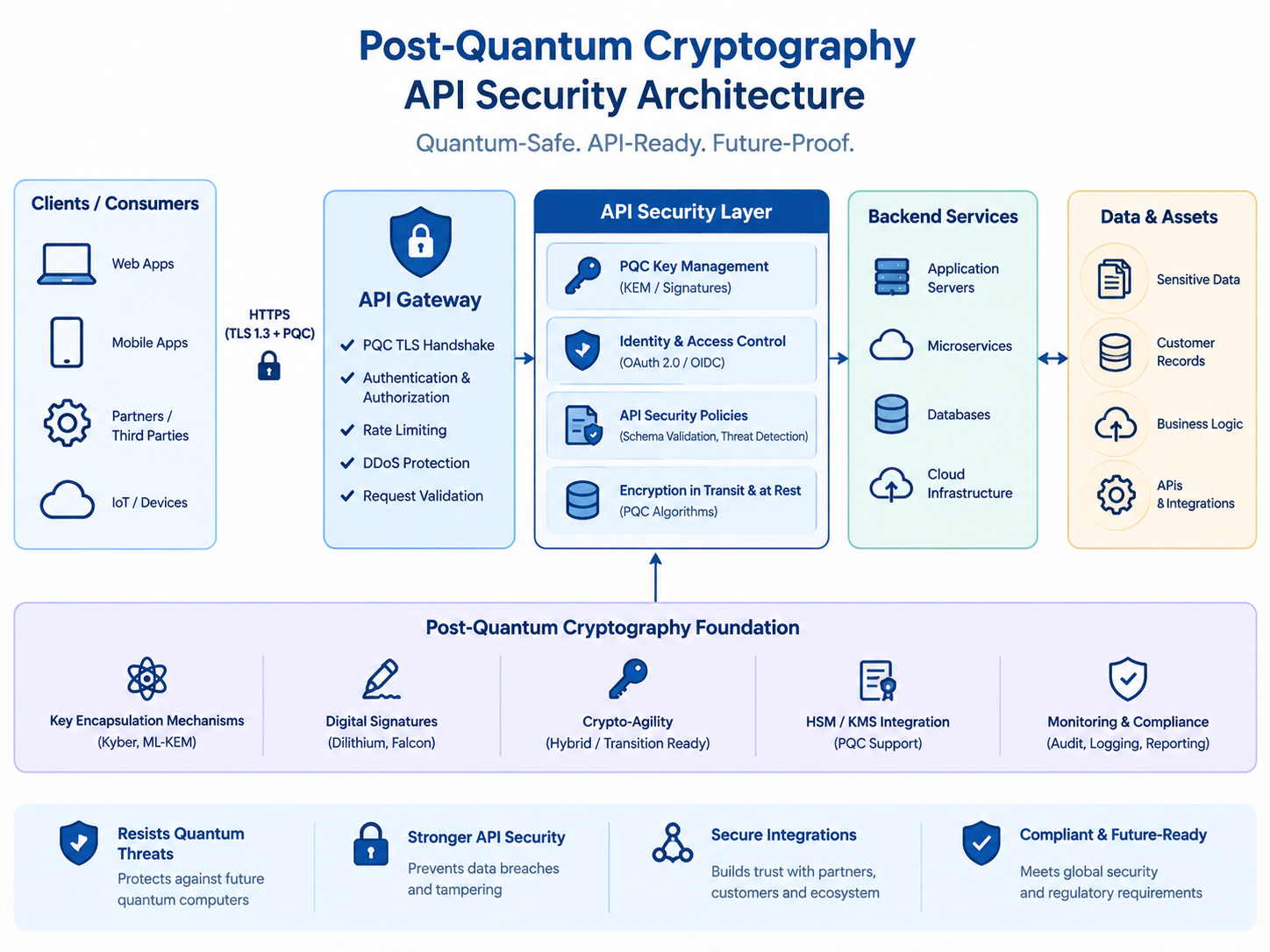
Post-Quantum Cryptography: API Migration Guide
Post-quantum cryptography is moving from a research topic into a practical API architecture concern. If your APIs rely on TLS, mTLS, PKI, RSA, ECC, JWT signatures, service identities, HSMs, or key-management systems, quantum-safe migration should already be part of your security roadmap.
The goal is not to replace every cryptographic algorithm overnight. API teams should first discover where quantum-vulnerable cryptography exists, improve crypto agility, test interoperability, and then migrate TLS, PKI, certificates, signing systems, and authentication infrastructure in controlled stages.
This matters partly because of the harvest-now-decrypt-later threat: encrypted traffic captured today could potentially be stored and decrypted in the future if sufficiently capable quantum computers become available.
In August 2024, NIST finalized three foundational post-quantum cryptography standards—FIPS 203, FIPS 204, and FIPS 205—giving organizations a concrete technical baseline for migration planning.
What Is Post-Quantum Cryptography for APIs?
Post-quantum cryptography for APIs means protecting communications, authentication, certificates, signatures, and key establishment with algorithms designed to remain secure against both classical and quantum attacks.
Today, APIs commonly depend on RSA and elliptic-curve cryptography across HTTPS certificates, TLS handshakes, mTLS, service-to-service authentication, JWT signing, certificate authorities, API gateways, and identity platforms.
A cryptographically relevant quantum computer could undermine the mathematical assumptions behind widely used public-key systems such as RSA, ECDH, and ECDSA. Symmetric encryption is affected differently, which is why the most urgent migration challenge is generally public-key cryptography rather than replacing every encryption primitive.
For broader API protections around OAuth, OIDC, JWT, mTLS, gateways, and inventory management, see Mak It Solutions’ API security best practices guide.
What Quantum-Safe API Security Actually Means
Quantum-resistant cryptography describes cryptographic techniques intended to withstand attacks involving quantum computers. Post-quantum cryptography, or PQC, usually refers to software-based algorithms that can run on conventional computing infrastructure.
During migration, organizations may also use hybrid cryptography, where classical and post-quantum mechanisms operate together.
This can be useful while browsers, API clients, gateways, libraries, certificate systems, and vendors reach different levels of PQC maturity.
Which API Components Are Most Exposed?
Start by reviewing.
TLS 1.3 termination points and reverse proxies
mTLS certificates and service identities
X.509 certificate infrastructure
PKI roots and intermediate certificate authorities
JWT signing and verification
OAuth 2.0 and OIDC identity infrastructure
API gateways and service meshes
HSMs and cloud key-management systems
Secrets-management platforms
Mobile, embedded, and partner API clients
CI/CD signing and deployment systems
Hidden dependencies matter too. Cryptography may be embedded inside SDKs, load balancers, SaaS products, cloud services, mobile apps, appliances, and third-party authentication systems.
Post-Quantum Cryptography Standards API Teams Need to Know
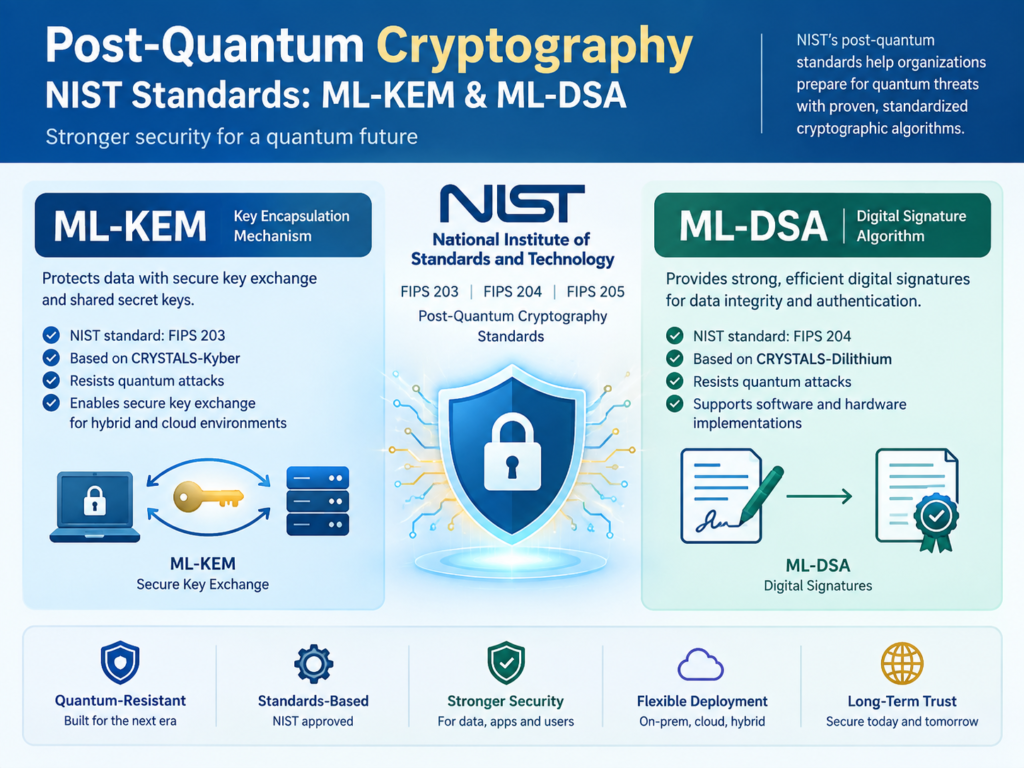
NIST’s finalized standards provide three major building blocks: ML-KEM for key establishment, ML-DSA for digital signatures, and SLH-DSA as a stateless hash-based digital-signature scheme.
ML-KEM and FIPS 203
FIPS 203 specifies ML-KEM, the Module-Lattice-Based Key-Encapsulation Mechanism derived from CRYSTALS-Kyber.
Its purpose is to help two parties establish a shared secret across a public channel, making it particularly relevant to future secure-session and TLS designs.
API teams should not treat ML-KEM as a simple configuration switch, however. Safe deployment depends on protocol standards, TLS-library support, infrastructure compatibility, and interoperability with real clients.
ML-DSA and SLH-DSA for Digital Signatures
FIPS 204 specifies ML-DSA, derived from CRYSTALS-Di lithium, while FIPS 205 specifies SLH-DSA, derived from SPHINCS+, for stateless hash-based digital signatures.
For API environments, these standards are relevant to certificate ecosystems, authentication infrastructure, code signing, identity platforms, document signing, and other systems that depend on public-key signatures.
Why PQC Is Not a Drop-In Algorithm Swap
Post-quantum algorithms have different key, ciphertext, and signature characteristics from many classical algorithms.
That can affect certificate-chain sizes, TLS handshake traffic, proxy limits, memory use, bandwidth, logging, HSM integrations, latency, and network behavior.
ENISA specifically emphasizes that PQC migration does not end with choosing an algorithm. Post-quantum systems still have to be integrated safely into existing protocols and infrastructure.
How to Prepare APIs for Post-Quantum Cryptography Migration
Why should developers prepare now? Because finding cryptographic dependencies and migrating enterprise infrastructure can take years.
The UK NCSC estimates that large organizations may need roughly 2–3 years for discovery, strategy, and initial planning, followed by another 2–3 years for early migration work.
Build a Cryptographic Inventory First
The first practical step is not buying a “quantum-safe” product. It is visibility.
Build an inventory covering algorithms, keys, certificates, libraries, TLS endpoints, gateways, HSMs, service meshes, JWT flows, identity providers, signing services, external connections, and the applications that own them.
Include production and staging systems, CI/CD infrastructure, mobile clients, partner integrations, backups, and long-lived hardware.
Data lifetime matters too. Information that must remain confidential for many years deserves earlier attention because of harvest-now-decrypt-later risks.
This same inventory discipline supports stronger cloud security configuration management.
Design for Crypto Agility
Crypto agility is the ability to replace, combine, configure, or retire cryptographic algorithms without rebuilding an entire application.
In practice, that means reducing hard-coded cryptographic assumptions and using centralized certificate lifecycle management, algorithm policies, automated rotation, abstraction layers, versioned client compatibility, and strong observability.
This aligns naturally with a broader Zero Trust architecture strategy, where machine and workload identities are continuously managed rather than permanently trusted.
Create a Quantum-Safe Migration Roadmap
A practical sequence is.
Discover → Classify → Prioritize → Test → Pilot → Deploy → Monitor
Prioritize systems based on sensitive-data lifetime, service criticality, external exposure, replacement difficulty, hardware dependencies, root-of-trust responsibilities, and operational impact.
At this stage, teams can evaluate PQC-ready PKI products, HSMs, API gateways, service meshes, cryptographic-discovery tools, and cloud platforms without prematurely locking the architecture to one vendor.
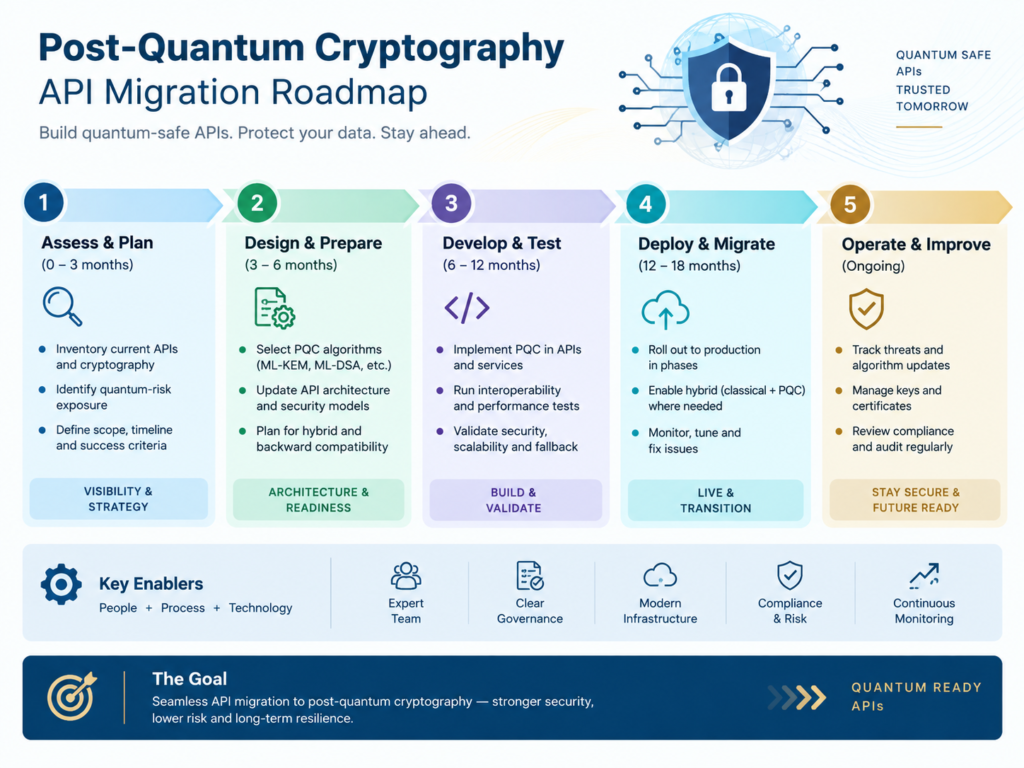
Migrating TLS, mTLS and API Authentication to PQC
Migration should begin in isolated test environments.
Introduce hybrid or PQC-capable mechanisms where mature protocol and vendor support exists, then test real gateways, clients, certificates, authentication flows, and monitoring systems before expanding deployment.
Rollback paths remain essential while classical and post-quantum ecosystems coexist.
Post-Quantum TLS and Hybrid Key Exchange
For TLS, test PQC and hybrid key establishment against the infrastructure that actually carries production traffic: reverse proxies, CDNs, API gateways, load balancers, service meshes, application servers, mobile clients, and observability systems.
Hybrid designs combine classical and post-quantum mechanisms during transition. ENISA has specifically discussed hybrid implementations as one approach to preparing systems before the wider ecosystem fully migrates.
mTLS, PKI and Certificate Lifecycle Challenges
mTLS migration cannot be separated from PKI.
Root and intermediate CAs, certificate profiles, enrollment systems, revocation, HSM support, service meshes, certificate rotation, trust stores, and automated renewal mechanisms all have to evolve together.
The UK NCSC highlights WebPKI as one of the more difficult migration areas because browsers, certificate authorities, roots of trust, transparency systems, revocation infrastructure, and clients all need to interoperate.
JWT, OAuth 2.0 and OIDC Considerations
OAuth 2.0 and OIDC are broader identity protocols, but the systems around them still depend heavily on cryptography.
Inventory JWT signing algorithms, identity-provider keys, JWKS endpoints, token-verification libraries, signing services, rotation processes, and downstream consumers.
A New York fintech, London SaaS provider, or Berlin healthcare platform cannot safely change one signing component if dozens of dependent applications reject the resulting signatures.
PQC Migration Challenges API Teams Should Test
Performance, Latency and Payload Size
Do not rely on algorithm benchmarks alone.
Measure TLS handshake latency, signature verification, CPU use, memory consumption, certificate size, connection establishment, bandwidth, gateway throughput, and tail latency under production-like workloads.
Small differences can become meaningful at API scale.
Legacy Clients and Backward Compatibility
Older mobile apps, embedded systems, partner SDKs, enterprise appliances, and long-lived infrastructure can become migration bottlenecks.
For mobile environments, cryptographic upgrades also need to align with OS support and application release cycles. Mak It Solutions’ mobile app development services provide additional context around those lifecycle dependencies.
Vendor, Library and HSM Readiness
Ask suppliers exactly which standardized algorithms they support and where that support operates.
Distinguish between experimental features and production-ready implementations. Verify hybrid-mode behavior, HSM firmware, key generation, certificate-authority support, cloud KMS capabilities, gateways, service meshes, and software libraries.
A “quantum-safe” label alone is not enough.
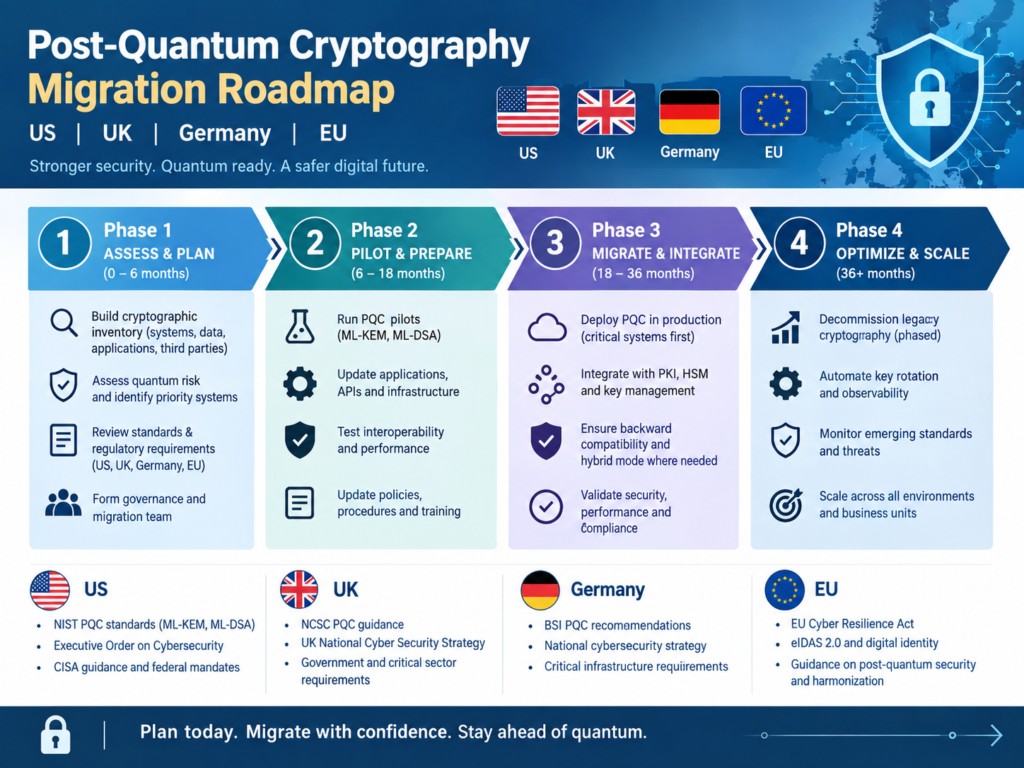
Post-Quantum Cryptography Requirements Across the US, UK and Europe
PQC migration is becoming increasingly shaped by national and regional cybersecurity guidance.
United States.
For US organizations, NIST’s FIPS 203, FIPS 204, and FIPS 205 form a central technical foundation for post-quantum migration. NIST published all three standards on August 13, 2024 and has continued its broader PQC standardization and migration work since then.
Frameworks such as HIPAA, SOC 2, and PCI DSS may still shape broader security and compliance requirements, but they should not be presented as proof that every organization must currently deploy one specific PQC algorithm.
United Kingdom.
The UK NCSC provides a clear migration timeline.
By 2028: complete discovery and assessment and build an initial migration plan.
By 2031: complete the highest-priority migration activities and establish a detailed route to full migration.
By 2035: complete migration across systems, services, and products, subject to limited exceptional technologies.
For London financial platforms, Cambridge technology companies, NHS-related environments, Open Banking infrastructure, and other organizations holding long-lived sensitive data, those dates turn PQC from an abstract concern into an architecture-planning issue.
Germany and the EU.
Germany’s BSI recommends prioritizing migration toward post-quantum mechanisms and highlights areas including crypto agility, hybrid solutions, protocol adaptation, and quantum-resistant key agreement.
BaFin’s 2025 risk guidance similarly tells financial organizations to identify quantum-vulnerable information and develop protection concepts with concrete implementation timelines, including consideration of post-quantum cryptography.
At EU level, Member States adopted a coordinated PQC implementation roadmap in June 2025. It calls for Member States to begin transitioning by the end of 2026, while high-risk use cases should move to PQC as soon as possible and no later than the end of 2030.
For Frankfurt banking, Munich SaaS, Berlin healthcare, or infrastructure spread across Amsterdam, Dublin, and Paris, PQC planning can therefore be connected with broader resilience and compliance work around DORA, NIS2, and GDPR/DSGVO without implying that those regulations independently mandate one specific post-quantum algorithm.
Practical Post-Quantum API Migration Checklist
Use this as a working architecture checklist.
Inventory RSA, ECC, ECDH, ECDSA, certificates, keys, and signing dependencies.
Identify information with long confidentiality requirements.
Map TLS, mTLS, API gateway, PKI, HSM, service-mesh, and identity dependencies.
Assign application and cryptographic ownership.
Identify hard-to-upgrade hardware and third-party systems.
Introduce cryptographic abstraction and configurable algorithm policies.
Test hybrid and PQC-ready architectures in isolated environments.
Benchmark latency, throughput, CPU, memory, certificate size, and bandwidth.
Validate client, partner, gateway, SDK, and monitoring compatibility.
Document rollback procedures before production deployment.
Assess supplier roadmaps against NIST-standardized algorithms.
Monitor regional PQC guidance as standards and implementations mature.
Cryptographic failures and compromised keys should also connect to an established cyber incident response process.
For sensitive workloads, PQC can also complement controls such as confidential computing, which addresses data-in-use risks that post-quantum cryptography does not solve by itself.
Final Thoughts
Post-quantum migration becomes far more manageable once you know where your cryptographic dependencies live, how long sensitive information must remain protected, and which systems are hardest to change.
Mak It Solutions can help teams assess API architecture, cryptographic dependencies, platform readiness, and migration risks before major tooling or infrastructure decisions are made. ( Click Here’s )
For most organizations, the sensible starting point is a scoped post-quantum cryptography readiness assessment, followed by controlled testing not a production-wide algorithm replacement.
Key Takeaways
Post-quantum cryptography migration begins with visibility, not algorithm replacement.
Inventory certificates, keys, algorithms, TLS endpoints, gateways, identity systems, libraries, HSMs, and suppliers.
ML-KEM, ML-DSA, and SLH-DSA provide standardized foundations, but protocol integration still requires careful engineering.
Treat TLS, mTLS, PKI, JWT, OAuth/OIDC infrastructure, and service identities as interconnected systems.
Crypto agility and hybrid approaches can make staged migration easier while client and vendor support develops.
Map technical plans to US, UK, German, and EU guidance without assuming every regulatory framework mandates a specific algorithm.
Evaluate vendors using standards support, interoperability, lifecycle management, performance evidence, and rollback capabilities not marketing claims alone.
FAQs
Q : Can post-quantum cryptography work with existing API gateways?
A : Yes, but support depends on the gateway, TLS stack, certificate infrastructure, deployment architecture, and client ecosystem. Some gateways may gain PQC capabilities through their underlying TLS libraries or managed platform updates. Test interoperability, certificate handling, payload sizes, monitoring, performance, and rollback behavior before production deployment.
Q : Do APIs need hybrid cryptography before full PQC adoption?
A : Not necessarily. A hybrid phase can be useful because it combines classical and post-quantum mechanisms while the ecosystem is still transitioning. Whether it makes sense depends on protocol support, information sensitivity, client compatibility, infrastructure, and applicable guidance.
Q : Will post-quantum cryptography make API requests slower?
A : It can affect performance, but the impact depends on the algorithm, implementation, hardware, certificate chain, network conditions, and workload. Larger keys, ciphertexts, or signatures may increase processing or network traffic, so benchmark real API workloads rather than relying solely on laboratory cryptographic tests.
Q : Which API certificates should security teams migrate first?
A : Prioritize certificates protecting critical systems, long-lived sensitive information, high-value machine identities, important external trust relationships, and infrastructure that will be difficult to upgrade later. Root and intermediate CA dependencies deserve early attention because PKI changes can require significant coordination.
Q : How can teams test whether a third-party API is PQC-ready?
A : Ask which NIST-standardized PQC algorithms or hybrid mechanisms the provider supports and whether the implementation is experimental or production-ready. Then test TLS and certificate interoperability, SDK compatibility, performance, key management, HSM integration, cryptographic agility, migration procedures, and rollback behavior.