

Business Data Quantum-Safe Encryption: GCC Priorities
Business Data Quantum-Safe Encryption: GCC Priorities
Business Data Quantum-Safe Encryption: GCC Priorities
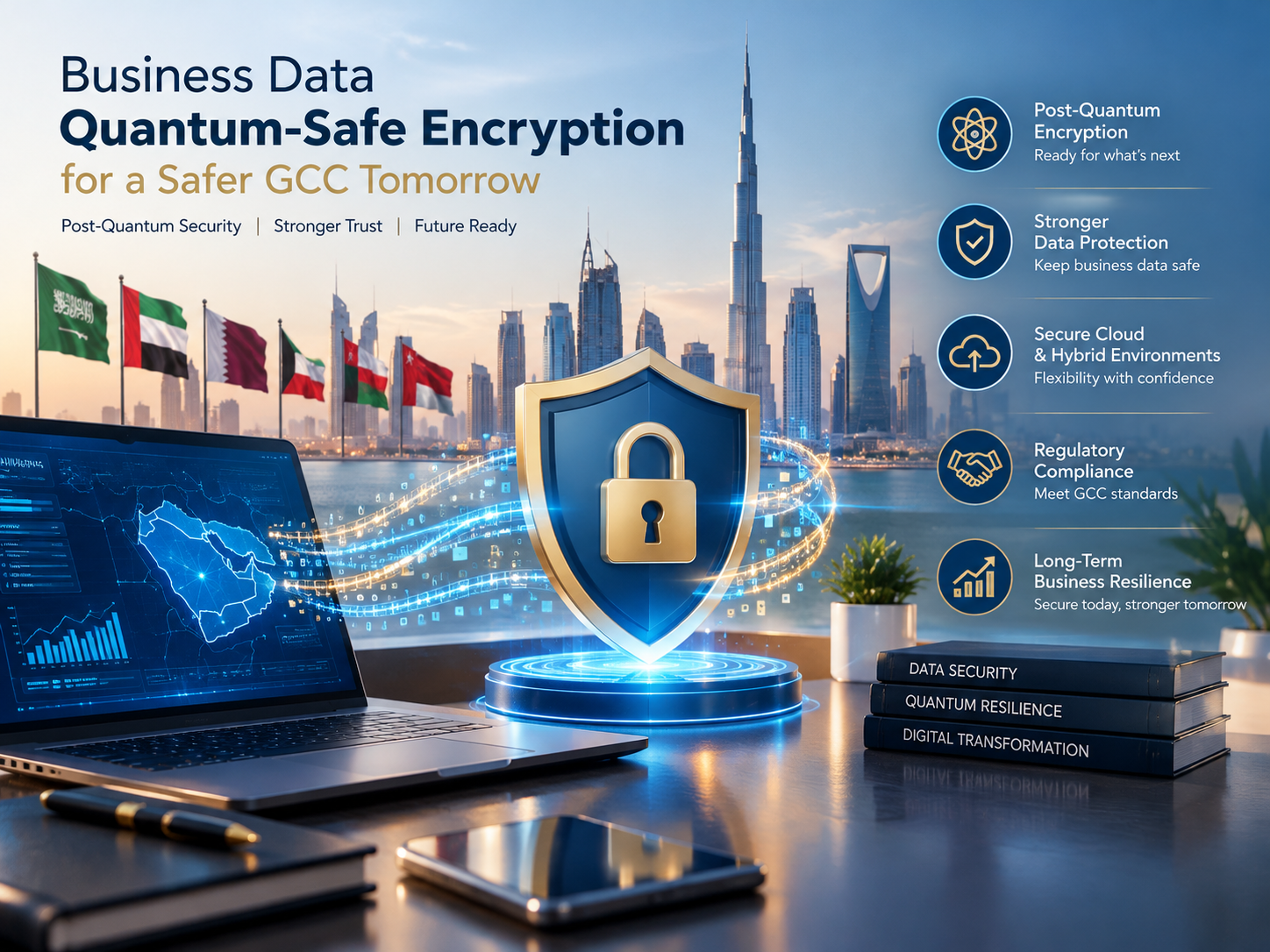
A confidential business record stolen today could become readable years from now. That’s why Business Data Quantum-Safe Encryption deserves attention from companies across Saudi Arabia, the UAE, Qatar and the wider GCC.
The immediate priority isn’t to replace every encryption system. It’s to identify sensitive information that must remain confidential for years, understand which cryptographic systems could become vulnerable, and plan a risk-based migration to post-quantum cryptography (PQC).
For banks in Riyadh, technology companies in Dubai and healthcare providers in Doha, this means protecting long-lived financial records, medical information, government data, intellectual property and critical digital identities before less sensitive assets.
With NIST’s first post-quantum cryptography standards finalized in 2024, organizations now have a clearer technical foundation for preparing their systems.
Why Business Data Needs Quantum-Safe Encryption
What Quantum-Safe Encryption Means for GCC Enterprises
Quantum-safe encryption refers to cryptographic protections designed to resist attacks from sufficiently powerful quantum computers.
Much of today’s digital security depends on public-key algorithms such as RSA and elliptic-curve cryptography (ECC). A cryptographically capable quantum computer could eventually compromise these mechanisms.
Post-quantum cryptography addresses this risk using mathematical approaches believed to withstand both conventional and quantum attacks.
The US National Institute of Standards and Technology (NIST) published three important standards in August 2024.
FIPS 203 (ML-KEM): Quantum-resistant key establishment.
FIPS 204 (ML-DSA): Quantum-resistant digital signatures.
FIPS 205 (SLH-DSA): Stateless hash-based digital signatures.
These standards support migration planning for secure communications, identity systems and sensitive business applications.
However, quantum readiness doesn’t mean abandoning every existing cryptographic tool. Properly implemented AES symmetric encryption, for example, does not face the same quantum threat as RSA and ECC.
How Harvest Now, Decrypt Later Threatens Sensitive Records
One of the most important quantum-related threats is known as harvest now, decrypt later (HNDL).
The idea is straightforward: attackers intercept and store encrypted communications today, hoping to decrypt them once more powerful quantum technology becomes available.
Consider encrypted financial agreements, medical records or government correspondence. Even if attackers cannot read those communications now, the information may still be valuable years later.
This makes confidentiality lifetime a central factor in migration decisions.
For related protection strategies, see our [internal link: Confidential Computing and Cloud Security in GCC] guide.
Why Data Retention Matters in Riyadh, Dubai and Doha
Not every business record needs the same level of protection.
A temporary operational message may lose its value quickly. A patient’s medical history, infrastructure design or confidential acquisition agreement could remain sensitive for decades.
GCC organizations should therefore examine.
How long information must remain confidential.
Whether encrypted communications could be intercepted.
Which public-key algorithms protect relevant systems.
How much damage future disclosure could cause.
Whether regulatory or contractual requirements affect retention.
The longer information must remain confidential, the stronger the case for assessing its quantum exposure early.
Which Business Data Needs Quantum-Safe Encryption First?
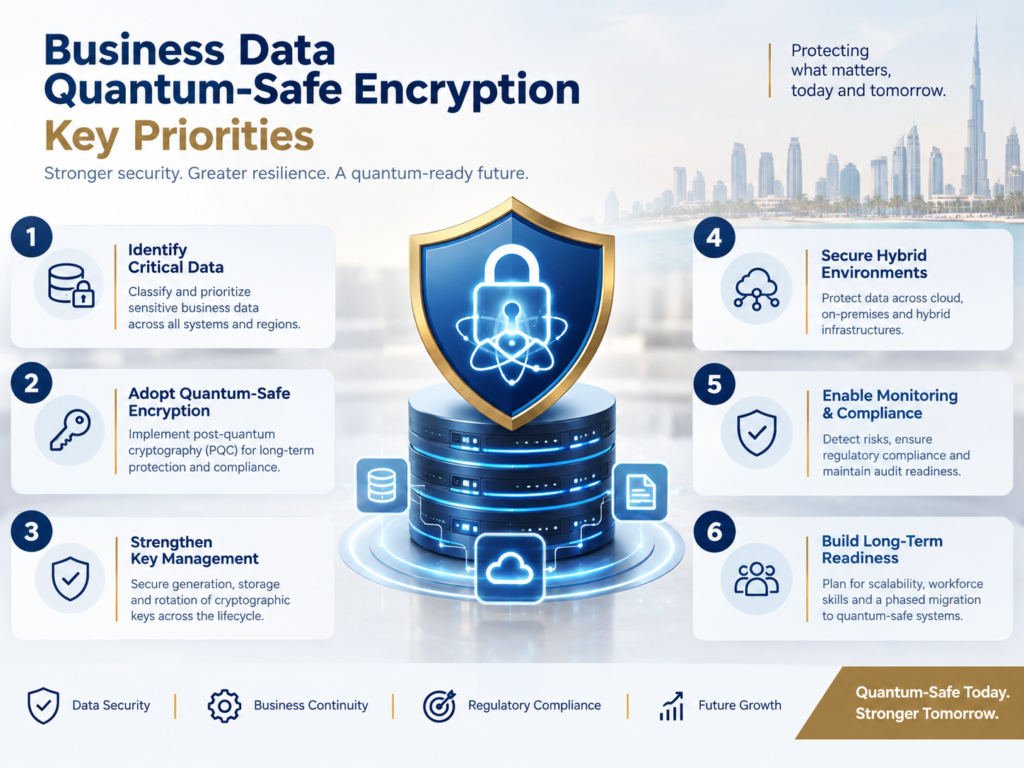
Business Data Quantum-Safe Encryption should begin with assets that combine long-term sensitivity, serious disclosure consequences and vulnerable cryptographic dependencies.
A practical way to organize this assessment is through critical, high-priority and risk-based categories.
Government Secrets, Health Records and Critical Intellectual Property
These are strong candidates for the earliest protection efforts when their exposure could cause lasting damage.
Examples include.
National security information and government communications.
Critical infrastructure plans and sensitive engineering designs.
Genomic information and long-term medical histories.
Proprietary algorithms, research and trade secrets.
Strategic intellectual property with enduring commercial value.
For example, a healthcare organization in Doha may retain patient records for decades. If sensitive communications are protected through quantum-vulnerable key exchange, those communication channels deserve early attention.
Likewise, a government contractor in Saudi Arabia may need to assess the encryption protecting restricted project documentation and infrastructure designs.
The objective is not simply to encrypt stored files again. Organizations must identify where vulnerable cryptography is used to establish keys, authenticate systems or protect information in transit.
Financial Data, Digital Identities and Cryptographic Keys
Financial information and enterprise trust infrastructure often require high-priority assessment.
Relevant assets include.
Banking communications and confidential financial transactions.
Payment integrations and sensitive financial agreements.
Public key infrastructure (PKI).
Digital certificates and signing systems.
Customer identity and authentication services.
Cryptographic key-management infrastructure.
A vulnerable identity or certificate system can affect numerous services, making its security significance greater than that of an isolated data repository.
For further context, see [internal link: AI Agent Identity Management].
CRM Systems, Internal Communications and Business Archives
Customer relationship management platforms, archived emails, internal messages and routine backups also deserve assessment.
However, their priority depends on what they contain and how long that information remains sensitive.
An ordinary marketing contact list may present less quantum-related risk than confidential legal correspondence or sensitive executive communications.
Importantly, these categories are not fixed. A CRM database containing protected medical details or highly sensitive customer information could move into a higher-priority group.
Business Data Protection Priority Matrix
| Priority | Data or system | Main reason |
|---|---|---|
| P0 — Critical | Government secrets, medical histories, infrastructure designs, strategic IP | Long-term confidentiality and severe disclosure impact |
| P1 — High | Financial records, digital identities, certificates, PKI | Sensitive information and shared trust dependencies |
| P2 — Risk-based | CRM data, internal messages, archives, backups | Exposure varies by content and retention |
This is an editorial prioritization framework, not an official GCC regulatory classification. Actual priorities should reflect each organization’s risk assessment.
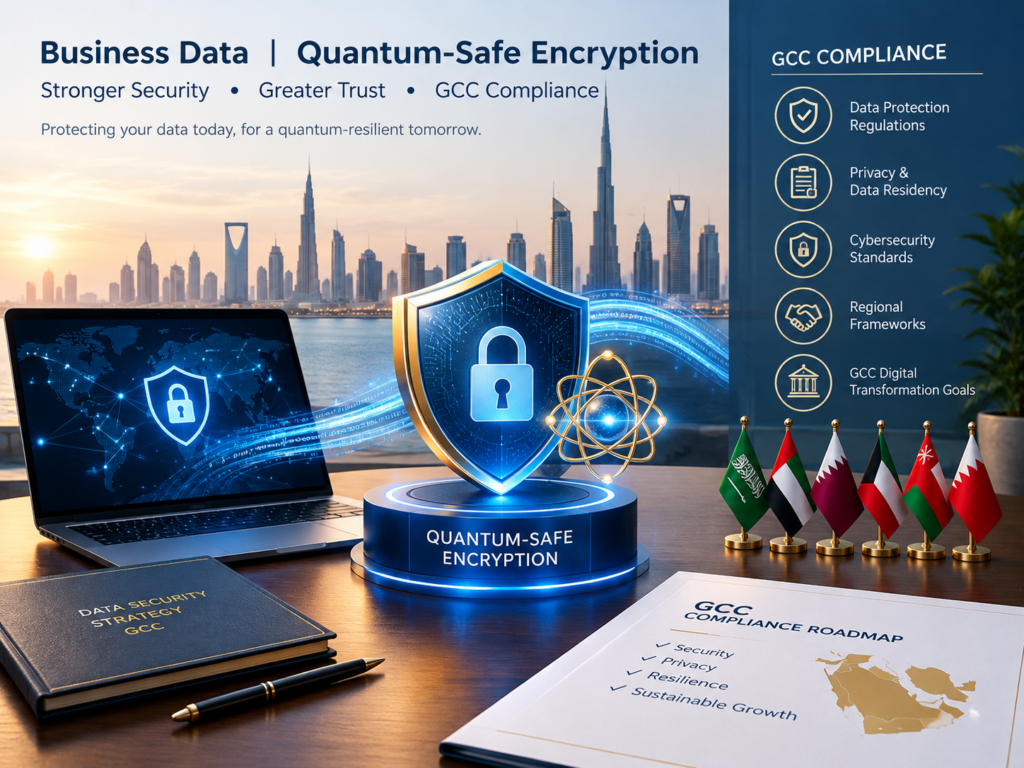
GCC Quantum-Safe Encryption Compliance: Saudi Arabia, UAE and Qatar
Quantum-safe migration is also becoming a governance and compliance consideration.
However, GCC countries do not operate under one uniform PQC regulation. Each organization must evaluate the requirements applicable to its location, industry and regulated activities.
Saudi Arabia.
Saudi Arabia has taken a significant step toward formal quantum-risk preparedness.
On August 27, 2026, the Saudi Central Bank (SAMA) issued Circular No. 482021280, Enhancement of Operational Resilience to Address Quantum Computing Risks.
The circular establishes important requirements for covered financial institutions:
By the end of Q4 2026: Ensure comprehensive and accurate procedures for identifying and classifying cryptographic assets, including sensitivity, migration priority and third-party dependencies.
By the end of Q1 2027: Complete enterprise-level quantum-risk assessments and develop plans to address identified risks.
Ongoing: Develop appropriate cryptographic resilience initiatives and monitor quantum risks through relevant governance committees.
These requirements do not establish a universal deadline for replacing every encryption algorithm.
Financial institutions should map assets to the data, systems and services they protect, assess vulnerable dependencies and develop appropriate migration plans.
Other Saudi organizations should also consider relevant National Cybersecurity Authority (NCA) controls and National Data Management Office (NDMO) governance requirements.
UAE.
The UAE’s National Encryption Policy addresses encryption controls for data at rest and in transit, key management, post-quantum cryptography and ongoing security monitoring.
For organizations in Abu Dhabi and Dubai, this provides an important reference when planning cryptographic modernization.
Businesses should examine.
Applicable national cybersecurity requirements.
Key ownership and cryptographic management.
Cloud and third-party service dependencies.
Sensitive data transfers and backup locations.
Sector-specific obligations.
Financial and technology businesses operating within the Abu Dhabi Global Market (ADGM) or Dubai International Financial Centre (DIFC) must also consider their respective regulatory frameworks.
The relevant requirements depend on the organization’s activities and legal status. A national encryption policy should not be interpreted as an identical deployment mandate for every UAE business.
Qatar.
Qatar’s National Cyber Security Agency (NCSA) provides a useful foundation for identifying sensitive information through its National Data Classification Policy.
The framework defines classification labels from C0 Public to C4 Top Secret.
| Classification | Description |
|---|---|
| C0 | Public |
| C1 | Internal |
| C2 | Restricted |
| C3 | Secret |
| C4 | Top Secret |
These classifications help organizations evaluate information sensitivity and protection requirements.
For example, a Doha financial institution may use classification results to identify confidential customer information, restricted agreements and sensitive communications.
It must then assess the cryptographic mechanisms involved, confidentiality lifetimes and potential business impact.
Financial institutions should also review relevant Qatar Central Bank (QCB) requirements.
Importantly, data classification does not automatically create a blanket requirement to deploy PQC across every system.
Quantum-Safe Encryption Use Cases Across GCC Industries
The highest-priority migration targets will differ between industries.
Banking and Fintech in Saudi Arabia and the UAE
Consider a Riyadh fintech provider that manages payment APIs, digital certificates and customer authentication.
Its initial assessment might identify RSA- or ECC-dependent connections supporting payment integrations and identity services.
A sensible approach would involve documenting those dependencies, reviewing vendor support and testing quantum-resistant key establishment in selected systems.
Similarly, Dubai banks should evaluate third-party payment platforms, cryptographic signing services and certificate infrastructure.
The goal is to reduce risk without interrupting essential financial operations.
Healthcare and Government in Qatar and Saudi Arabia
Healthcare organizations commonly manage information with long confidentiality lifetimes.
A Doha hospital, for instance, might prioritize protected patient communications and sensitive medical archives before less critical administrative records.
Saudi government contractors should likewise consider the cryptographic protections used for restricted exchanges, long-term contracts and sensitive project records.
Retail, Logistics and Critical Infrastructure Across the GCC
Quantum-risk planning also matters outside banking and government.
An Abu Dhabi logistics provider might depend on digital certificates to authenticate suppliers and secure commercial transactions.
In that environment, compromised authentication infrastructure could affect multiple business relationships.
Energy operators in Bahrain, Kuwait and Oman may need to evaluate industrial networks, long-lived infrastructure devices and third-party maintenance connections.
These systems can be difficult to upgrade, making early discovery valuable.
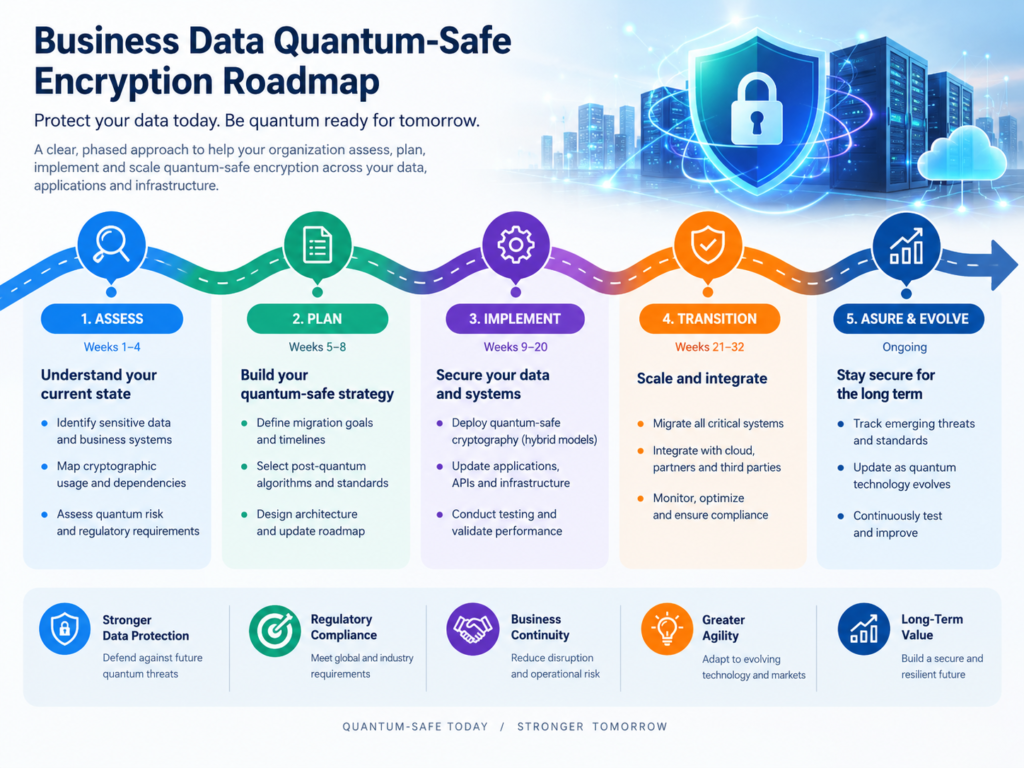
How to Start a Business Data Quantum-Safe Encryption Migration
A successful migration begins with understanding what needs protection, not purchasing new cryptographic products immediately.
Classify Sensitive Data and Its Confidentiality Lifetime
Start by identifying information that would cause meaningful harm if exposed in the future.
For each important dataset, record its business owner, sensitivity, retention requirements and potential exposure pathways.
Consider whether data is stored internally, transmitted between applications or shared with external partners.
This creates a foundation for risk-based decisions.
Inventory RSA, ECC, PKI and Vendor Dependencies
Next, identify where vulnerable public-key cryptography appears in the technology environment.
Include.
TLS connections, VPNs and secure communication services.
Digital certificates and enterprise PKI.
API authentication and signing mechanisms.
Cloud platforms and key-management services.
Legacy applications and connected devices.
External technology and infrastructure providers.
A cryptographic inventory should connect each mechanism to the business service and sensitive information it protects.
For additional architecture considerations, explore [internal link: GCC Cybersecurity Startups and Security Architecture].
Assess Risk and Pilot NIST-Aligned Solutions
Once the inventory is complete, rank migration candidates according to sensitivity, confidentiality lifetime, cryptographic exposure and operational dependencies.
Pilot suitable NIST-standardized mechanisms in controlled environments.
Testing should address interoperability, application performance, certificate handling, vendor compatibility and rollback procedures.
Organizations should also build crypto agility: the ability to replace cryptographic algorithms without redesigning entire applications.
Remember that post-quantum cryptography is different from quantum key distribution (QKD). They are separate technical approaches with different infrastructure requirements.
Plan Phased Deployment and Continuous Monitoring
After successful pilots, establish a deployment roadmap.
Sequence changes around business-critical systems, vendor readiness, regulatory obligations and potential operational disruption.
Maintain the cryptographic inventory as systems change and review new security guidance as PQC implementations mature.
A phased approach is generally more manageable than attempting an enterprise-wide replacement at once.
Cost, Timeline and Best Practices for GCC PQC Readiness
What Determines Quantum-Safe Migration Costs?
There is no reliable universal price for a quantum-safe migration.
Costs depend on.
The number and complexity of cryptographic assets.
Legacy software and hardware limitations.
Vendor support and licensing requirements.
Testing and interoperability needs.
Internal expertise and specialist assurance.
The scale of deployment and ongoing monitoring.
Discovery, pilot testing and full migration should be budgeted separately.
This helps organizations distinguish near-term readiness expenses from longer-term modernization investments.
How Long Should GCC Enterprises Plan For?
Migration timelines depend on system complexity, third-party dependencies and the organization’s existing security architecture.
A smaller business using modern cloud platforms may have fewer direct cryptographic dependencies to manage than a large bank operating legacy systems.
Rather than assigning an arbitrary deadline, organizations should define milestones for discovery, risk assessment, pilot testing, phased deployment and monitoring.
Applicable regulatory deadlines must be managed independently.
Arabic UX, Cloud Hosting and Data Residency
For businesses operating across the GCC, quantum readiness must fit into broader security and data-governance strategies.
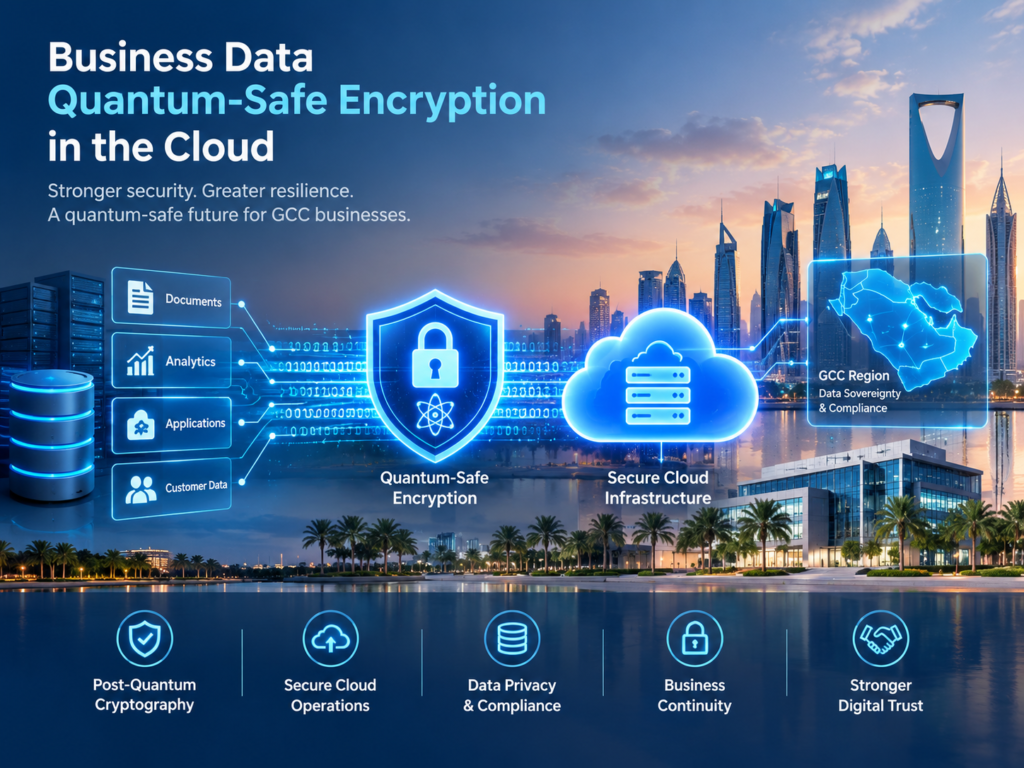
Regional cloud infrastructure, including AWS Bahrain, Azure UAE Central and Google Cloud Doha, may be relevant when assessing hosting and data residency.
However, regional hosting alone does not establish regulatory compliance.
Businesses should verify encryption-key ownership, backup locations, cross-border access and contractual obligations.
They should also test Arabic-language customer journeys, authentication flows and payment integrations after cryptographic changes.
Final Thoughts
Business Data Quantum-Safe Encryption is ultimately about protecting the information and digital trust systems that matter most.
For GCC organizations, the strongest starting point is a clear inventory of sensitive data, vulnerable cryptography and third-party dependencies.
Government records, healthcare information, financial communications, intellectual property and identity infrastructure often deserve early attention. Other assets should be prioritized according to their actual exposure and business importance.
The objective isn’t to replace everything overnight. It’s to establish a defensible, technically sound migration roadmap.
At Mak It Solutions, businesses can explore technology services and discuss the discovery, integration and infrastructure considerations involved in GCC quantum-readiness planning.
Ready to assess your organization’s technology priorities? Contact Mak It Solutions to discuss a tailored GCC technology consultation. Include qualified cryptography and regulatory specialists when evaluating technical PQC assurance and compliance obligations.
FAQs
Q : Do Saudi banks need to replace all AES encryption under SAMA guidance?
A : No. SAMA’s quantum-risk circular does not require the blanket replacement of existing AES implementations.
The primary migration concern involves quantum-vulnerable public-key mechanisms such as RSA and ECC. Covered financial institutions must ensure comprehensive cryptographic asset identification and classification procedures by the end of Q4 2026 and complete enterprise quantum-risk assessments by the end of Q1 2027.
Q : Can UAE businesses use quantum-safe encryption in Dubai cloud environments?
A : Yes. UAE businesses can implement compatible quantum-resistant cryptographic mechanisms in cloud environments, subject to vendor support and applicable security requirements.
However, hosting data in Dubai does not automatically establish regulatory compliance. Organizations should assess key management, backup locations, cross-border access and relevant national or financial-sector requirements.
Q : How does Qatar’s data classification policy support quantum-safe protection?
A : Qatar’s National Data Classification Policy provides categories ranging from C0 Public to C4 Top Secret.
These categories help organizations identify sensitive information. Migration priorities should then consider confidentiality lifetime, vulnerable cryptographic dependencies and disclosure impact.
Q : Are small businesses in Bahrain, Kuwait and Oman exposed to quantum-related risks?
A : Yes. Company size does not determine exposure to harvest now, decrypt later threats.
A fintech startup, healthcare provider or logistics company may handle information that remains sensitive for many years. Smaller organizations can begin by identifying critical data flows and reviewing the cryptographic services provided by their vendors.
Q : Should Dubai fintech startups prioritize digital certificates or customer databases?
A : Both deserve assessment, but their priority depends on risk.
Digital certificates and key-establishment infrastructure may support multiple applications, while customer databases may contain highly sensitive information requiring long-term confidentiality.
A combined data-classification and cryptographic-dependency assessment provides a stronger basis for choosing where to invest first.