


Cryptographic Asset Inventory: Essential GCC Guide
Cryptographic Asset Inventory: Essential GCC Guide
Cryptographic Asset Inventory: Essential GCC Guide
Encryption protects everything from online payments to confidential business records. But here’s a question many security teams struggle to answer: Do you know exactly where encryption is being used across your organization’s systems?
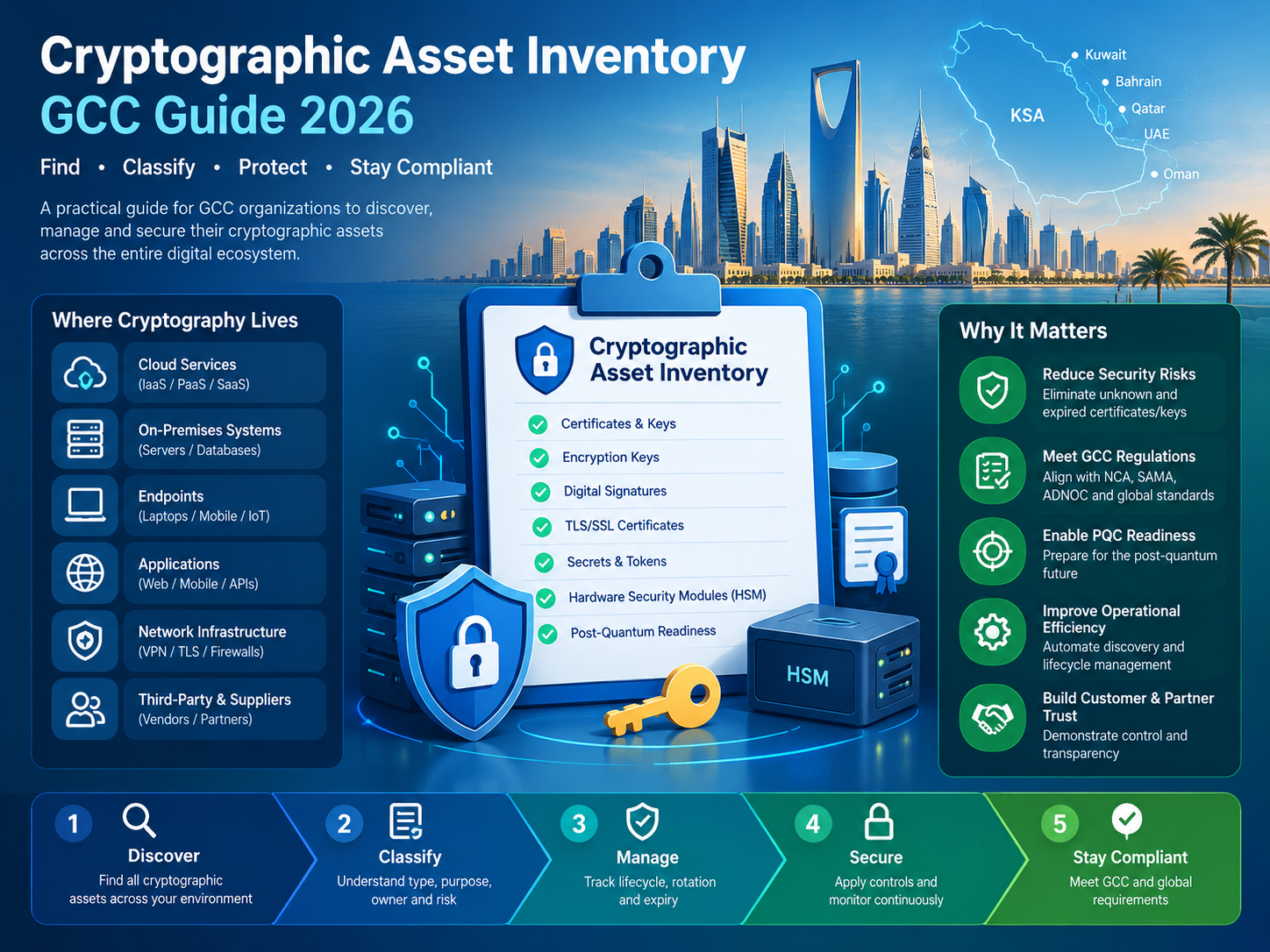
A cryptographic asset inventory is a centralized record of the encryption algorithms, digital certificates, cryptographic keys, software libraries, and security technologies used throughout an organization. It helps businesses identify security gaps, manage cryptographic dependencies, support compliance reviews, and prepare for post-quantum cryptography (PQC).
For enterprises in Saudi Arabia, the UAE, and Qatar, that visibility is becoming increasingly valuable as cybersecurity expectations evolve and organizations prepare for future quantum-computing threats.
The challenge isn’t simply finding encryption. It’s understanding what each cryptographic asset protects, who manages it, and what could happen if it becomes outdated or compromised.
Here’s a practical approach to building and maintaining an inventory that supports security operations, regulatory assessments, and long-term cryptographic resilience.
What Is a Cryptographic Asset Inventory?
A cryptographic asset inventory is a structured register of the cryptographic technologies used across an organization’s IT environment.
Unlike a traditional IT asset register, which tracks servers, devices, software, and infrastructure, a cryptographic inventory focuses on the mechanisms protecting data, identities, applications, and communications.
It records not only which cryptographic technologies exist but also where they operate, who owns them, and how they connect to business systems.
What Counts as a Cryptographic Asset?
Common examples include.
Encryption algorithms: RSA, AES, and elliptic-curve cryptography (ECC).
Digital certificates: TLS/SSL certificates used to secure websites, APIs, and network communications.
Cryptographic keys: Key metadata, ownership, rotation schedules, and secure storage references.
Public Key Infrastructure (PKI): Certificate authorities and certificate-management systems.
Hardware Security Modules (HSMs): Dedicated devices for protecting and managing cryptographic keys.
Cloud key-management services: Services that manage encryption keys across cloud environments.
Cryptographic libraries: Software components that implement encryption, hashing, and digital signatures.
An important security rule: Never store private keys, passwords, or secret key material directly in the inventory. Record secure references and custody information instead.
Why GCC Enterprises Need Cryptographic Visibility
Consider a financial services company in Riyadh that relies on encryption for payment processing, customer authentication, and banking integrations.
Its security team may understand the main applications but have limited visibility into the certificates, third-party libraries, and cryptographic configurations supporting those services.
A similar challenge can affect an e-commerce business in Dubai or a logistics company in Doha.
Without a reliable inventory, organizations may overlook expired certificates, obsolete algorithms, unmanaged encryption keys, or vulnerable dependencies.
A centralized record makes these risks easier to identify and address.
Cryptographic Asset Inventory vs. CBOM
A Cryptographic Bill of Materials (CBOM) identifies cryptographic components within software and their associated dependencies.
A cryptographic asset inventory provides a broader operational view. It connects cryptographic components to applications, business owners, environments, security risks, and remediation activities.
The two approaches complement each other, especially when organizations assess their readiness for post-quantum migration.
How to Build a Cryptographic Asset Inventory in 6 Steps
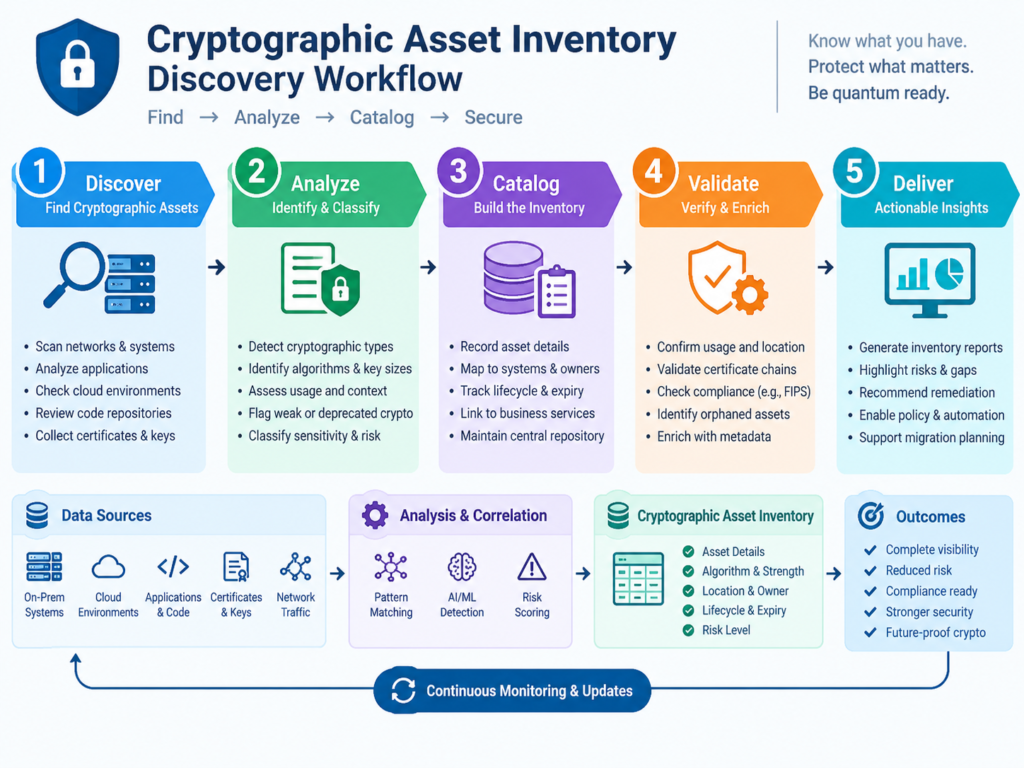
Building a reliable inventory requires more than running a certificate scan and exporting the results into a spreadsheet.
The process should combine automated discovery, technical validation, ownership records, and ongoing monitoring.
Define Your Inventory Scope and Ownership
Start by identifying which systems and environments must be included.
Prioritize business-critical applications, production infrastructure, cloud services, payment platforms, sensitive databases, and third-party integrations.
For each system, establish an accountable owner who can verify its cryptographic configuration and coordinate necessary updates.
Existing architecture diagrams, configuration management databases (CMDBs), and application documentation can provide a useful starting point.
Organizations maintaining custom applications can also review their web development services documentation to identify systems and security dependencies.
Beginning with high-priority infrastructure makes the discovery process more manageable.
Scan Networks, Applications, and Cloud Services
Once the scope is clear, begin identifying cryptographic assets through authorized discovery methods.
Useful approaches include.
TLS certificate scanning across approved network endpoints.
Authenticated infrastructure and configuration assessments.
Source-code and software dependency analysis.
Cloud key-management metadata discovery.
PKI and HSM configuration reviews.
For example, a Dubai financial technology company may discover certificates used by payment APIs that were missing from its existing asset records.
Application teams can also review their backend development processes to identify embedded cryptographic libraries and integrations.
Automated discovery improves coverage, but results still need validation. Not every tool can inspect every application, especially when cryptography is embedded in proprietary software or managed by external suppliers.
Validate Findings and Map Dependencies
Raw discovery results rarely provide a complete picture.
Security teams should remove duplicate entries, confirm algorithm configurations, identify affected applications, and reconcile findings with existing asset records.
Pay particular attention to third-party dependencies.
An application may rely on encryption controlled by a cloud provider, payment processor, or software vendor. These dependencies should be documented without treating externally managed assets as internally controlled systems.
The objective is to establish a trusted record that can support operational decisions.
What Should a Cryptographic Asset Inventory Contain?
An effective inventory needs enough detail to help security teams identify an asset, evaluate its exposure, and manage changes.
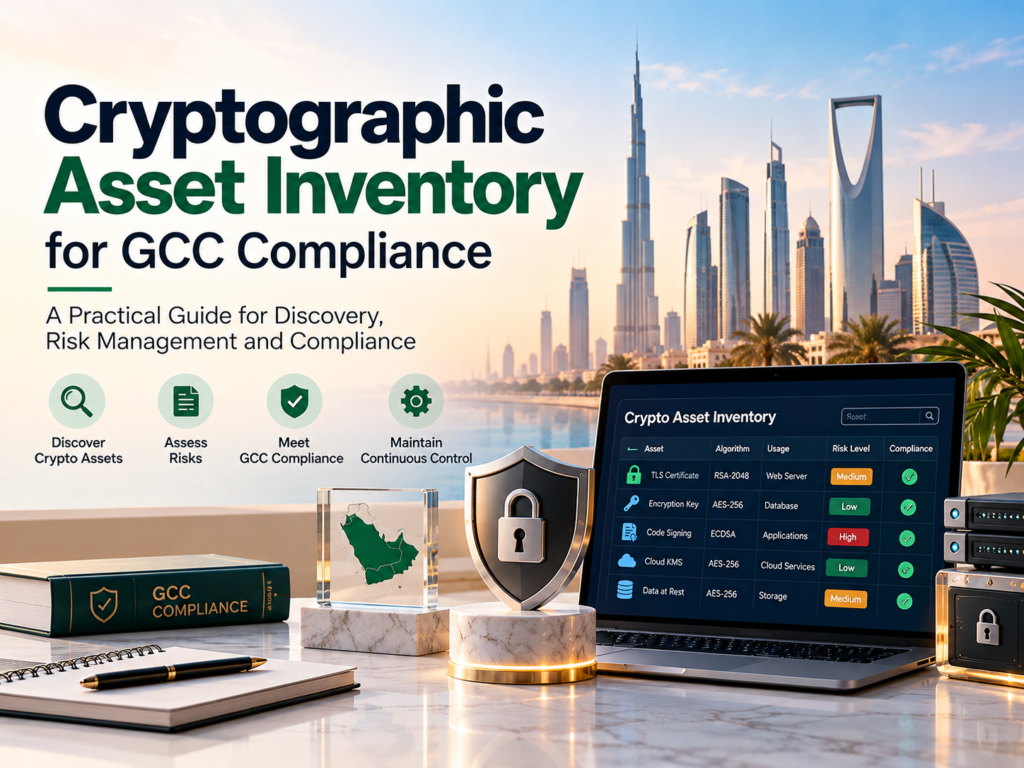
Essential Inventory Fields and Metadata
The following example illustrates a practical inventory record.
Illustrative example not a real organization’s security record.
|
Inventory field |
Example |
|---|---|
| Asset ID |
CRYPTO-001 |
| System |
Customer API |
| Cryptographic usage |
Digital signatures |
| Algorithm |
ECDSA |
| Curve |
P-256 |
| Certificate expiry |
30 June 2027 |
| Owner |
API Security Team |
| Environment |
Production |
| Data classification |
Confidential |
| Key custody |
Cloud KMS |
| Quantum exposure |
Review required |
| Last verified |
9 October 2026 |
Organizations can expand this template to include asset location, certificate issuer, software version, business criticality, approved configurations, and remediation status.
Managing Encryption Keys, Certificates, PKI, and HSMs
Cryptographic records should capture operational details such as certificate expiration, key rotation, revocation status, access permissions, and custody responsibilities.
Keep sensitive key material inside approved key-management or security systems.
The inventory should reference those systems rather than duplicate confidential information.
Creating a CBOM-Ready Inventory Template
To support software security and future PQC migration, include information about cryptographic libraries, versions, algorithms, and application dependencies.
Development teams using Node.js development services can incorporate software dependency checks into continuous integration and deployment workflows.
This helps organizations identify changes in cryptographic components before outdated records become a security problem.
How to Assess Cryptographic Risks and PQC Readiness
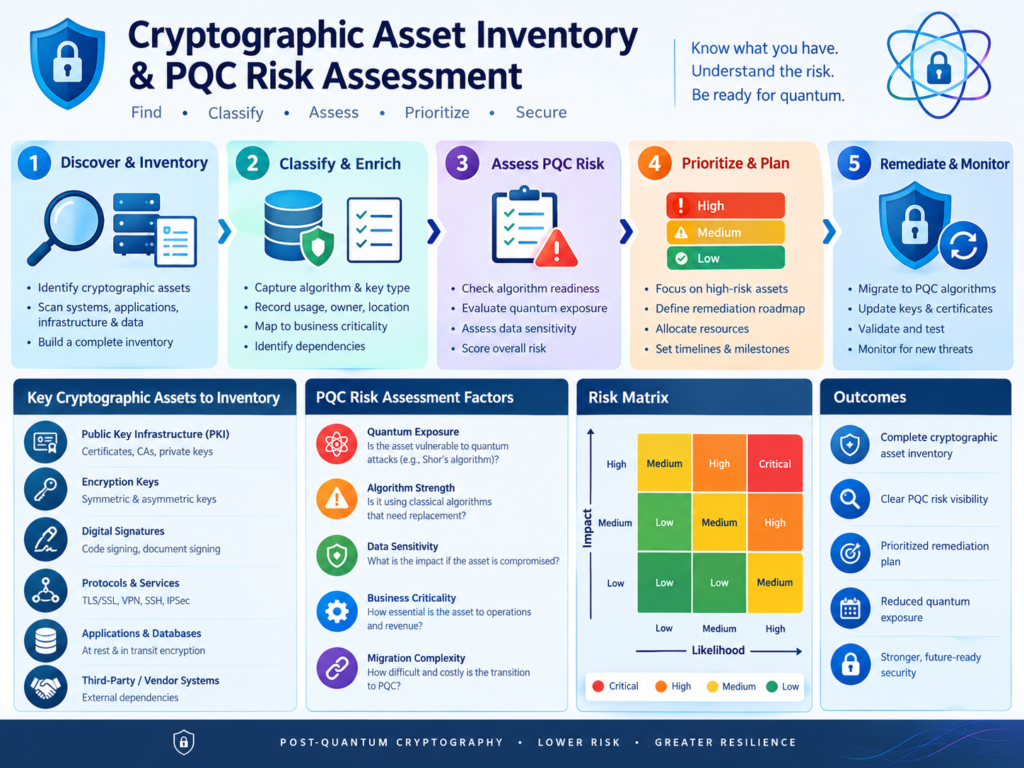
Creating an inventory is the starting point. The next challenge is understanding which cryptographic assets present the greatest risk.
Identify Legacy and Quantum-Vulnerable Algorithms
Public-key mechanisms such as RSA and elliptic-curve cryptography could become vulnerable to sufficiently powerful quantum computers.
Symmetric encryption methods, including AES, face different quantum-security considerations and should be assessed accordingly.
Organizations should also identify obsolete algorithms, unsupported libraries, weak configurations, and cryptographic implementations that no longer meet their security policies.
These findings help establish a realistic modernization roadmap.
Prioritize Assets by Sensitivity and Business Criticality
Not every cryptographic asset requires the same level of urgency.
Assessment factors should include data sensitivity, internet exposure, application criticality, information retention periods, and the complexity of replacing affected cryptographic components.
Illustrative GCC cryptographic risk-prioritization matrix
|
Business scenario |
Indicative priority |
|---|---|
| Riyadh banking payment API using exposed legacy cryptography |
High |
| Abu Dhabi government identity platform storing long-lived sensitive information |
High |
| Doha internal logistics application with restricted access |
Medium |
| Isolated test service without sensitive information |
Low |
These ratings are examples, not universal risk classifications. Actual priorities should reflect verified configurations, business impact, and organizational risk assessments.
Link the Inventory to Post-Quantum Migration
Post-quantum cryptography is an important consideration for organizations protecting sensitive information over long periods.
The US National Institute of Standards and Technology (NIST) has published post-quantum cryptography standards, including FIPS 203, FIPS 204, and FIPS 205.
These cover standardized mechanisms such as ML-KEM and ML-DSA.
A dependable inventory helps organizations locate quantum-vulnerable dependencies, assess compatibility, coordinate suppliers, and plan phased migration without unnecessarily disrupting critical services.
The UAE Cyber Security Council’s May 2026 Crypto Discovery Tool announcement also highlights growing regional attention to cryptographic discovery and quantum readiness.
For further context, read about post-quantum cryptography risks in financial services.
GCC Compliance Requirements for Cryptographic Inventories
Cybersecurity obligations vary across Saudi Arabia, the UAE, and Qatar.
A maintained cryptographic asset inventory can support audit evidence, technical oversight, and risk management. However, keeping an inventory does not automatically demonstrate compliance with every applicable requirement.
Saudi Arabia.
Saudi financial institutions should review applicable Saudi Central Bank (SAMA) cybersecurity requirements, including asset management and cryptographic controls.
The National Cybersecurity Authority (NCA) publishes National Cryptographic Standards addressing cryptographic mechanisms, PKI, and key-management considerations.
Organizations should also consider relevant National Data Management Office (NDMO) data-governance requirements when handling classified or sensitive information.
For Saudi businesses, the inventory can help connect cryptographic controls with accountable systems, data classifications, and documented security responsibilities.
UAE.
In the UAE, cryptographic governance should be considered alongside applicable national, sector-specific, and free-zone requirements.
Organizations may need to evaluate relevant guidance from the UAE Cyber Security Council and Telecommunications and Digital Government Regulatory Authority (TDRA).
Financial institutions operating within Abu Dhabi Global Market (ADGM) or Dubai International Financial Centre (DIFC) should separately assess the requirements applicable to their regulated activities.
The UAE Crypto Discovery Tool announcement provides additional context on the country’s cryptographic discovery initiative.
Qatar.
In Qatar, organizations should review relevant National Cyber Security Agency (NCSA) information-assurance requirements.
Financial institutions subject to Qatar Central Bank (QCB) oversight should also assess applicable sector-specific cybersecurity obligations.
A Doha-based enterprise can use its inventory to document certificate management, encryption dependencies, ownership, and remediation decisions.
GCC Regulatory Comparison
|
Country |
Relevant authorities |
Examples of supporting evidence |
|---|---|---|
| Saudi Arabia | SAMA, NCA | Cryptographic configurations, key governance records, asset ownership |
| UAE | Cyber Security Council, TDRA, ADGM/DIFC where applicable | Discovery logs, ownership records, cryptographic risk assessments |
| Qatar | NCSA, QCB where applicable | Certificate records, encryption protocols, key-management controls |
These examples are intended for planning and governance. Organizations should confirm their specific obligations against current regulatory publications and applicable sector requirements.
How to Maintain and Automate Your Inventory
An inventory loses value when it stops reflecting the organization’s actual infrastructure.
Applications change, certificates are renewed, suppliers introduce new dependencies, and cloud environments expand. Inventory maintenance must account for those changes.
Assign Owners and Establish Continuous Monitoring
Connect inventory management with existing PKI, cloud KMS, HSM, CMDB, and change-management processes.
Update records when cryptographic configurations, applications, certificates, keys, or service providers change.
Clear ownership helps ensure that security findings result in action rather than remaining unresolved in reports.
Evaluate Tools, Costs, and Implementation Timelines
Smaller organizations may begin with controlled spreadsheets and basic discovery scripts.
Larger enterprises with complex hybrid environments may benefit from specialized cryptographic discovery platforms, automated certificate management, and integration with existing security systems.
Implementation cost depends on infrastructure size, asset coverage, licensing, cloud integrations, available expertise, and ongoing operational requirements.
Mak It Solutions‘ business intelligence services may help organizations develop inventory reporting and visualization capabilities.
Specialized cryptographic discovery and security assessment requirements should be evaluated separately.
Measure Coverage and Establish Best Practices
Once the inventory is operational, evaluate its completeness and usefulness.
Useful performance indicators include.
Percentage of in-scope systems assessed.
Cryptographic assets with verified owners.
Certificates approaching expiration.
Unresolved weak or obsolete cryptographic configurations.
Assets awaiting remediation or PQC migration assessment.
Records requiring revalidation following infrastructure changes.
Begin with business-critical systems, then extend coverage to additional cloud environments, internal applications, and relevant supplier dependencies.
For related planning considerations, explore quantum-safe business data protection priorities in the GCC.
Common Cryptographic Inventory Mistakes to Avoid
Even a well-planned discovery project can produce unreliable results if essential governance practices are missing.
One common mistake is relying entirely on automated scanning. Tools can uncover valuable technical details, but they may miss embedded or externally managed cryptographic components.
Another is collecting large amounts of technical data without assigning ownership. An inventory becomes much more useful when each record connects to someone responsible for validating or maintaining it.
Organizations should also avoid storing sensitive key material in inventory documents, overlooking third-party dependencies, and treating the first discovery exercise as a completed project.
A practical inventory should remain accurate, secure, and connected to regular operational processes.
To Sum Up
A reliable cryptographic asset inventory gives GCC enterprises a clearer understanding of the encryption technologies supporting their operations.
It helps security teams detect outdated configurations, manage certificates and dependencies, prioritize remediation, and prepare for future post-quantum cryptography requirements.
For organizations in Saudi Arabia, the UAE, and Qatar, this visibility can also strengthen internal governance and support applicable regulatory assessments.
The most practical approach is to begin with critical systems, validate discovery results, establish ownership, and maintain the inventory as infrastructure evolves.
A cryptographic inventory shouldn’t become another forgotten spreadsheet. It should function as a living security record that supports informed decisions.
Planning to improve your application infrastructure, technology governance, or reporting capabilities?
Contact Mak It Solutions to discuss your organization’s GCC technology requirements and explore the integration, reporting, and specialist security capabilities needed for an effective cryptographic inventory initiative.
You can also explore our technology services to identify solutions that support your wider digital infrastructure strategy.
FAQs
Q : Which cryptographic assets should Saudi banks prioritize first?
A : Saudi banks should prioritize payment platforms, internet banking systems, digital identity services, certificates, key-management infrastructure, and HSMs. Third-party cryptographic dependencies should also be assessed. Priorities should reflect business impact, sensitive financial information, exposure, and applicable SAMA cybersecurity requirements.
Q : Can UAE enterprises automate cryptographic asset discovery across cloud environments?
A : Yes. UAE enterprises can use certificate scanners, cloud APIs, infrastructure assessment tools, and software dependency analysis to automate much of the discovery process. However, coverage depends on permissions, infrastructure complexity, and tool capabilities. Manual validation remains important, especially for externally managed cryptographic services.
Q : How often should Qatar organizations update their cryptographic inventories?
A : Qatar organizations should update their inventories whenever significant cryptographic changes occur, such as certificate renewal, key rotation, application deployment, or cloud migration. Periodic reviews should also follow internal risk policies and applicable NCSA or QCB requirements. There is no single review interval suitable for every organization.
Q : Can GCC enterprises use a spreadsheet instead of a cryptographic inventory platform?
A : Yes. A spreadsheet can provide a useful starting point for smaller environments or an initial discovery project. As infrastructure grows, automated platforms may offer stronger discovery coverage, integrations, audit trails, and change tracking. The best option depends on operational complexity, available resources, and governance requirements.
Q : How can UAE financial institutions prepare for quantum-safe migration?
A : UAE financial institutions should identify cryptographic dependencies using RSA, ECC, and other mechanisms potentially vulnerable to future quantum attacks. They should assess sensitive data retention, application compatibility, supplier readiness, and business continuity requirements. NIST-standardized post-quantum algorithms can inform a phased migration strategy, supported by testing and applicable regulatory reviews.