


Post-Quantum Cryptography Migration Roadmap: Act Now
Post-Quantum Cryptography Migration Roadmap: Act Now

Post-Quantum Cryptography Migration Roadmap: Act Now
Quantum computers capable of breaking today’s widely used public-key cryptography are not publicly known to exist. But for software vendors protecting sensitive customer data, waiting until that changes could make migration considerably harder.
A post-quantum cryptography migration roadmap helps software vendors identify vulnerable algorithms, assess long-term security risks, adopt quantum-resistant cryptographic standards, and upgrade applications without unnecessary disruption. The process covers cryptographic discovery, risk prioritization, architecture modernization, compatibility testing, and phased deployment.
For SaaS companies, the challenge reaches far beyond encryption libraries. APIs, digital certificates, authentication services, third-party SDKs, and customer environments may all depend on cryptography that future quantum computers could compromise.
The practical question is no longer whether vendors should prepare. It is where to start and how to make the transition manageable.
Why Software Vendors Need a Post-Quantum Cryptography Migration Roadmap
Software vendors rely on cryptographic systems that may remain embedded in products for years. Replacing them requires coordinated engineering work, especially when customers use different software versions or control parts of their infrastructure.
A structured roadmap gives teams time to identify dependencies, protect long-lived information, and introduce quantum-resistant capabilities as the technology ecosystem matures.
How Quantum Computing Threatens RSA and ECC
RSA and elliptic-curve cryptography (ECC) support many essential security functions, including digital signatures, authentication, and secure key establishment.
A sufficiently powerful, fault-tolerant quantum computer could use algorithms such as Shor’s algorithm to compromise the mathematical foundations of these systems.
That creates potential exposure across.
TLS connections and secure communications
Public key infrastructure (PKI)
Digital certificates and software signing
Enterprise authentication services
APIs and encrypted data exchanges
Symmetric encryption, including AES, faces a different quantum threat model. It does not require the same replacement approach as vulnerable public-key systems, although security parameters should still be reviewed.
Harvest Now, Decrypt Later: A Long-Term SaaS Risk
One of the most important reasons to begin planning is the harvest now, decrypt later (HNDL) threat.
An attacker may collect encrypted communications today and preserve them until future computing capabilities make decryption possible.
Consider a healthcare SaaS platform serving hospitals in New York or London. Patient information transmitted today may need to remain confidential for decades. Even if the systems are secure against current attacks, some encrypted communications could face future exposure.
Financial technology platforms, intellectual property repositories, and enterprise communication systems have similar concerns.
The wider financial consequences of cybersecurity failures are substantial. IBM’s 2024 Cost of a Data Breach Report recorded a global average breach cost of $4.88 million. That figure concerns data breaches generally, not quantum-related incidents, but it illustrates why long-term security planning deserves investment.
Why Software Dependencies Complicate Migration
Most commercial software depends on external components.
Cryptographic functions may be distributed across cloud services, SDKs, open-source libraries, hardware security modules (HSMs), and customer-controlled infrastructure.
Verizon’s 2024 Data Breach Investigations Report found third-party involvement in approximately 15% of breaches. The figure rose to 30% in its 2025 report, reinforcing the importance of understanding supplier dependencies. These statistics do not measure quantum attacks.
For software vendors, such dependencies introduce practical migration constraints. A new algorithm may work within the core application but fail in an older SDK, certificate system, or customer integration.
Teams already improving their backend architecture can use modernization projects to identify cryptographic dependencies and reduce future upgrade complexity.
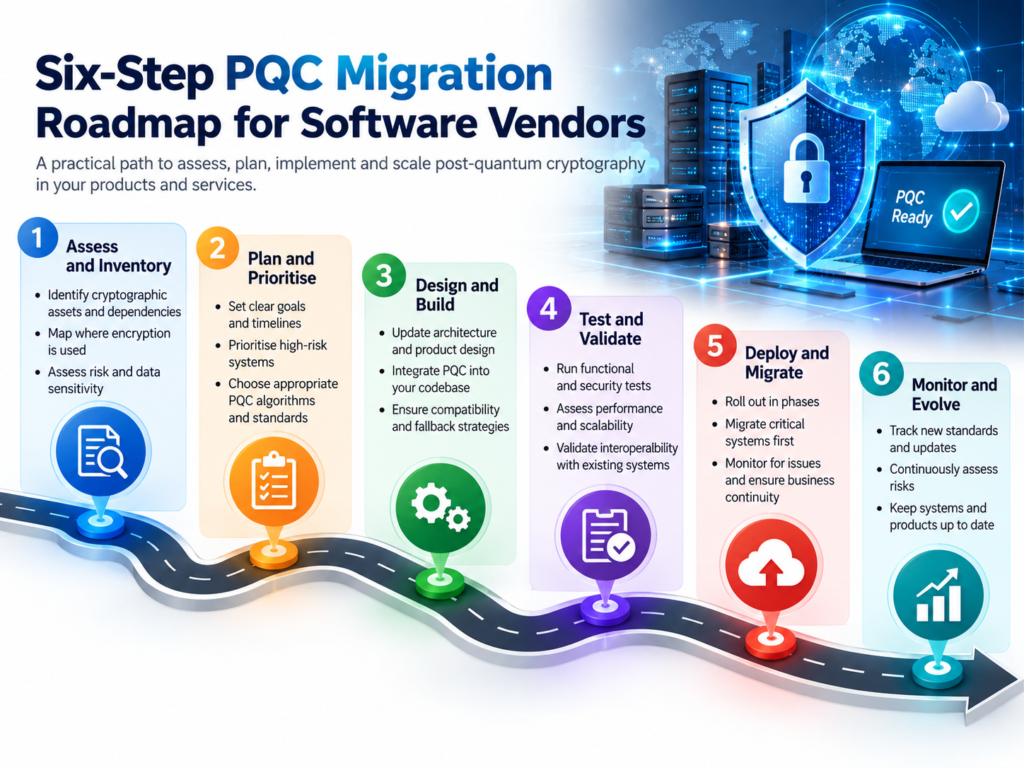
A Six-Step Post-Quantum Cryptography Migration Roadmap
A successful post-quantum migration does not begin with immediately replacing every RSA key or certificate.
It begins with understanding where cryptography is used, which systems face the greatest risk, and whether available implementations meet operational requirements.
Six-stage PQC migration framework
01
Inventory
Discover assets
02
Assess
Evaluate exposure
03
Prioritize
Rank systems
04
Design
Build for agility
05
Test
Validate compatibility
06
Deploy
Monitor releases
Inventory Cryptographic Assets
Start by documenting cryptographic mechanisms across applications, infrastructure, and dependencies.
Identify RSA and ECC implementations, certificates, authentication services, signing systems, encryption libraries, HSMs, and relevant external integrations.
Source-code scanning, runtime analysis, software bills of materials (SBOMs), and cryptographic bills of materials (CBOMs) can support discovery.
Record the purpose, owner, location, and upgrade dependencies of each relevant component.
Without an accurate inventory, migration estimates are likely to overlook hidden cryptographic dependencies.
Assess Quantum Exposure
Not every application faces the same level of quantum-related risk.
Evaluate cryptographic assets according to data sensitivity, confidentiality lifetime, algorithm exposure, application lifespan, and potential customer impact.
A SaaS platform handling medical records or confidential financial transactions may require earlier intervention than an internal application processing short-lived, non-sensitive information.
Risk assessments should also identify dependencies outside the vendor’s direct control.
Prioritize Critical Systems
Use assessment findings to establish a migration sequence.
Give early attention to systems that protect long-lived sensitive data, rely heavily on vulnerable public-key cryptography, or have substantial upgrade dependencies.
Security exposure matters, but business and engineering considerations also influence sequencing.
For example, an externally accessible enterprise API may be technically easier to update than a legacy signing service embedded in multiple customer products.
Both need a plan, but their deployment strategies may differ.
Design Crypto-Agile Architecture
Cryptographic agility allows software to support algorithm changes without extensive application redesign.
Instead of embedding cryptographic choices throughout business logic, vendors should use configurable, well-defined interfaces and maintainable libraries.
Evaluate suitable NIST-standardized mechanisms, including.
ML-KEM: Key establishment
ML-DSA: Digital signatures
SLH-DSA: Hash-based digital signatures
Standards-based hybrid approaches combining classical and post-quantum mechanisms may help during particular transitions. Such implementations should follow vetted protocol specifications rather than custom cryptographic combinations.
Teams maintaining enterprise web applications should coordinate cryptographic upgrades with broader architecture and dependency improvements.
Test Security, Performance, and Compatibility
Post-quantum algorithms introduce different key sizes, signature sizes, processing requirements, and integration considerations.
Before production deployment, test.
TLS 1.3 interoperability and connection performance
Certificate and signature handling
API and SDK compatibility
Mobile applications and legacy clients
HSM and cloud-provider support
Authentication failures and rollback behavior
Integrate relevant checks into CI/CD pipelines.
Performance measurements should reflect realistic customer environments rather than isolated demonstrations.
Deploy Incrementally and Monitor
Start in controlled environments, then expand deployment through pilots and carefully managed production releases.
Feature flags, staged release channels, customer upgrade windows, and documented rollback procedures help reduce operational risk.
Monitor deployment coverage, connection failures, authentication errors, performance changes, and unresolved compatibility issues.
Migration should remain an ongoing engineering program, with priorities updated as standards, products, and customer requirements evolve.
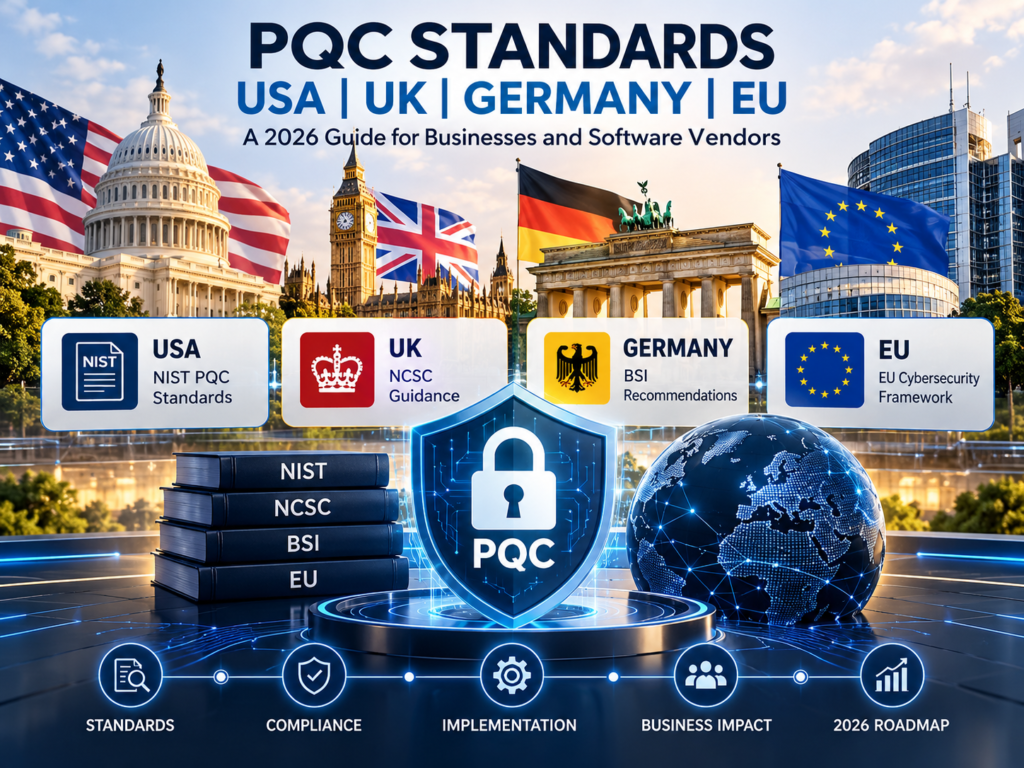
PQC Standards and Migration Guidance in the USA, UK, and EU
Software vendors serving international customers must consider both technical standards and regional security expectations.
Although the USA, UK, Germany, and wider EU share the goal of improving quantum resilience, their guidance and regulatory environments differ.
USA.
The US National Institute of Standards and Technology finalized three foundational post-quantum cryptography standards in August 2024.
|
Standard |
Algorithm |
Primary purpose |
|---|---|---|
| FIPS 203 | ML-KEM | Key establishment |
| FIPS 204 | ML-DSA | Digital signatures |
| FIPS 205 | SLH-DSA | Hash-based digital signatures |
These standards provide a technical foundation for selecting quantum-resistant mechanisms.
Software suppliers working with US federal customers should also assess relevant NIST transition requirements and CNSA 2.0 expectations where applicable.
For technical specifications and updates, consult the official NIST Post-Quantum Cryptography Project.
UK.
The UK’s National Cyber Security Centre (NCSC) has published a phased PQC migration timeline.
|
Target year |
Recommended milestone |
|---|---|
| 2028 | Complete discovery, risk assessment, and initial migration planning |
| 2031 | Complete highest-priority migration activities and refine the roadmap |
| 2035 | Complete migration across systems, services, and products |
These are NCSC planning targets, not universal statutory deadlines for every software company.
For London-based fintech vendors, healthcare software providers, and businesses serving public-sector customers, migration planning should account for customer security requirements and applicable UK data protection obligations.
Germany and EU.
Germany’s Federal Office for Information Security (BSI) publishes cryptographic recommendations relevant to quantum-resistant security planning.
At the EU level, Member States adopted a coordinated PQC implementation roadmap in June 2025.
The roadmap recommends that Member States begin transitioning by the end of 2026 and move high-risk use cases to PQC as soon as possible, no later than the end of 2030.
For SaaS vendors operating in Berlin, Frankfurt, or other European markets, broader security responsibilities may also involve.
GDPR data protection obligations
NIS2 cybersecurity risk-management requirements
DORA operational resilience requirements in applicable financial-sector contexts
BSI guidance and relevant national supervisory expectations
These frameworks do not universally mandate one specific PQC algorithm for every organization.
The European Commission’s PQC policy page provides the EU roadmap and related updates.
Common PQC Implementation Challenges for SaaS Vendors
The technical standards are only part of the transition.
Software vendors must also maintain availability, support existing customers, and coordinate upgrades across systems they do not fully control.
APIs, SDKs, Certificates, and Legacy Systems
Public APIs, software libraries, code-signing systems, and certificates may each require different migration schedules.
Some legacy clients may not recognize newer cryptographic mechanisms or handle larger cryptographic objects correctly.
An upgrade that succeeds on a modern server may therefore create compatibility problems for older customer applications.
Early dependency mapping and representative integration testing reduce the likelihood of these failures.
Crypto-Agility and Hybrid Cryptography
Crypto-agility is valuable because cryptographic standards and implementation guidance continue to develop.
Software teams should separate cryptographic operations from application business logic, document supported mechanisms, and maintain versioned interfaces where necessary.
Hybrid cryptography can provide transitional compatibility in supported protocols. However, it is not a substitute for proper implementation validation or standards compliance.
Multi-Tenant SaaS Deployment
Multi-tenant SaaS platforms add another layer of complexity.
One enterprise customer may be ready for upgraded cryptography while another relies on an older client or integration.
Controlled feature rollout, tenant-level monitoring, and clearly communicated migration windows help accommodate these differences.
Teams working on React-based SaaS products and frontend integrations should coordinate client compatibility testing with backend cryptographic changes.
PQC Migration Costs, Ownership, and Solution Selection
There is no reliable universal cost for migrating a SaaS application to post-quantum cryptography.
The budget depends on the number of cryptographic assets, architecture complexity, third-party dependencies, testing requirements, and customer deployment arrangements.
What Drives Migration Costs?
The largest cost categories typically involve cryptographic discovery, specialist engineering, architecture updates, security testing, library replacements, HSM compatibility, compliance documentation, and customer support.
A modular application may require relatively contained changes, while an older product with tightly coupled cryptographic functions could need substantial restructuring.
A discovery-led assessment provides a more defensible budget than a generic per-application estimate.
In-House Engineering vs. External Specialists
Internal engineering teams understand product architecture, customer requirements, and release processes.
External PQC specialists may provide deeper expertise in cryptographic assessments, protocol integration, interoperability testing, and independent technical review.
A hybrid approach can work well: internal teams retain product ownership while qualified specialists support difficult migration decisions.
How to Evaluate PQC Migration Providers
Assess potential providers against these criteria.
Alignment with recognized cryptographic standards
Support for appropriate quantum-resistant algorithms
Cryptographic agility and upgrade flexibility
Demonstrated interoperability testing
Coverage of third-party dependencies
Documented security validation and rollback procedures
Transparent costs and long-term support commitments
Avoid relying on broad claims that a product is completely quantum-proof.
Request technical evidence, documented limitations, and realistic migration milestones.
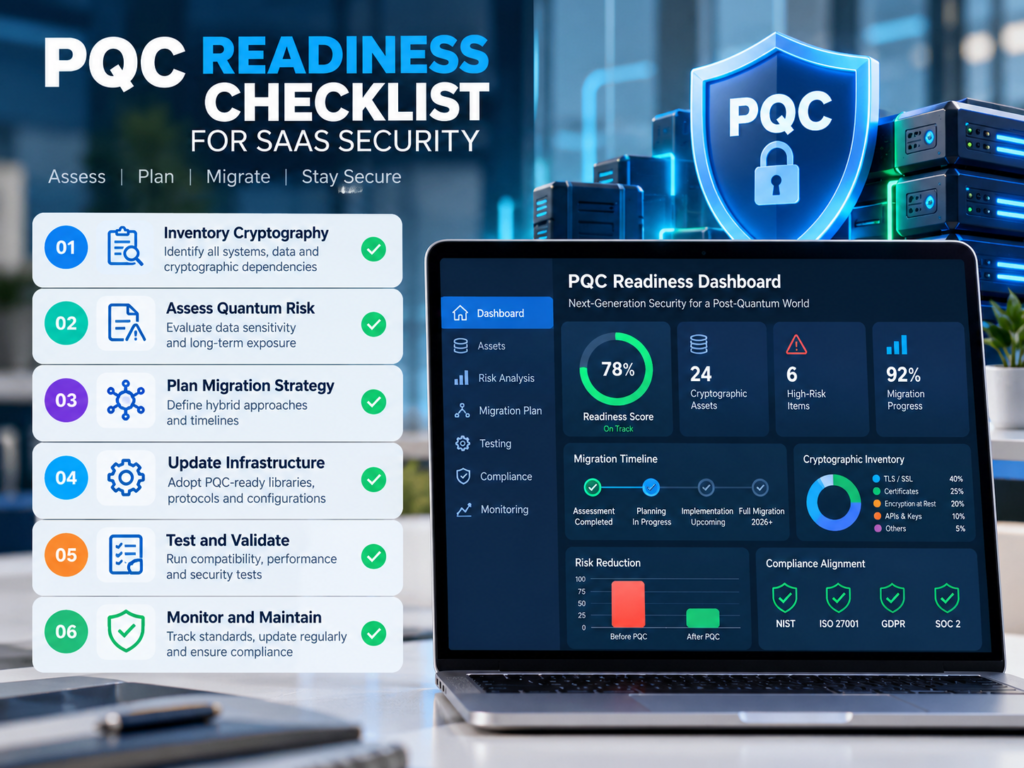
A Practical PQC Readiness Checklist for Software Vendors
Before committing to a production migration, establish what is already known, what remains uncertain, and who owns each activity.
Use this checklist to evaluate your starting position.
PQC readiness self-check
0/8
Assign Clear Responsibilities
Migration requires coordination across security, engineering, operations, and customer-facing teams.
The CTO should sponsor the technical strategy and investment decisions. The CISO should oversee security risks and governance.
Software architects define technical implementation patterns, while engineering and DevSecOps teams manage development, testing, deployment, and monitoring.
Compliance and customer success teams help communicate requirements and coordinate customer transitions.
Measure Progress with Relevant KPIs
Useful migration indicators include cryptographic inventory coverage, high-risk assets assessed, PQC-enabled implementations, interoperability test pass rates, and customer deployments completed.
A centralized business intelligence dashboard can help engineering teams and leadership monitor progress.
Review these metrics quarterly, and revise priorities when new standards, implementation support, or customer requirements emerge.
Concluding Remarks
Preparing software for the quantum era involves more than replacing a cryptographic algorithm.
It requires a coordinated approach to application architecture, supplier dependencies, customer compatibility, risk governance, and product maintenance.
For software vendors, the most practical starting point is a complete cryptographic inventory followed by risk-based prioritization.
A post-quantum cryptography migration roadmap turns a complex security challenge into a manageable engineering program, with clear responsibilities, measurable milestones, and controlled deployment decisions.
The earlier vendors understand their cryptographic dependencies, the more flexibility they have to modernize products without rushed implementation.
Protecting software against future quantum threats starts with understanding its existing cryptographic architecture.
Explore Mak It Solutions‘ software development capabilities or request a scoped technical consultation to discuss cryptographic discovery, software modernization, and migration planning requirements.
An initial technical assessment can help identify priorities before committing to a broader migration program.
Key Takeaways
Begin with discovery: Identify vulnerable algorithms, libraries, certificates, and dependencies before selecting solutions.
Follow established standards: Use NIST specifications and appropriate regional guidance.
Prioritize according to risk: Focus on long-lived sensitive information and critical systems.
Plan for compatibility: Validate TLS, PKI, APIs, SDKs, and legacy customer environments.
Build crypto-agility: Design systems to support future cryptographic changes.
Track migration progress: Assign clear ownership and establish measurable engineering milestones.
FAQs
Q : Can existing SaaS products become quantum-resistant without a complete rebuild?
A : Yes. Many SaaS products can introduce quantum-resistant mechanisms incrementally, particularly when their cryptographic libraries and authentication services are modular. Legacy systems with tightly coupled cryptographic functions may require more extensive restructuring.
Q : Does every software vendor need to replace RSA immediately?
A : No. There is no universal immediate replacement deadline for every software vendor. Priorities depend on data sensitivity, information lifespan, customer requirements, and regulatory obligations. However, cryptographic discovery and migration planning should begin before quantum attacks become practical.
Q : Should software vendors replace TLS certificates before adopting PQC?
A : Not necessarily. TLS key establishment and certificate-based authentication are different cryptographic functions and may have separate migration schedules. Vendors should validate browser, server, certificate authority, client library, and HSM compatibility before changing certificate infrastructure.
Q : What should SaaS companies ask cloud and SDK providers about PQC support?
A : Ask which NIST-standardized algorithms and software versions they support, whether vetted hybrid options are available, and what interoperability evidence exists. Request release schedules, HSM compatibility details, rollback procedures, and long-term maintenance commitments.
Q : How can customers verify a vendor’s quantum-readiness claims?
A : Request evidence such as a cryptographic inventory, risk assessment, supported algorithm list, migration roadmap, and interoperability test results. Documented supplier assessments and independent technical reviews can provide additional assurance.