


Quantum-Inspired Computing vs Quantum Computing: Win
Quantum-Inspired Computing vs Quantum Computing: Win
Quantum-Inspired Computing vs Quantum Computing: Win
Quantum computing attracts enormous attention, but CIOs face a more practical question: which technology can improve business performance without creating unnecessary costs?
The quantum-inspired computing vs quantum computing decision comes down to how each technology works, what it costs to implement, and whether it can deliver measurable value.
Quantum-inspired computing uses classical hardware to solve complex optimization problems, while quantum computing relies on physical qubits and quantum-mechanical operations. For most enterprises, the sensible approach is to benchmark conventional optimization tools first, evaluate quantum-inspired solutions for measurable operational gains, and fund genuine quantum computing through a separate, milestone-based research strategy.
For technology leaders in the USA, UK, Germany, and wider EU, understanding this distinction can prevent expensive procurement mistakes and help direct investment toward solutions that solve actual business problems.
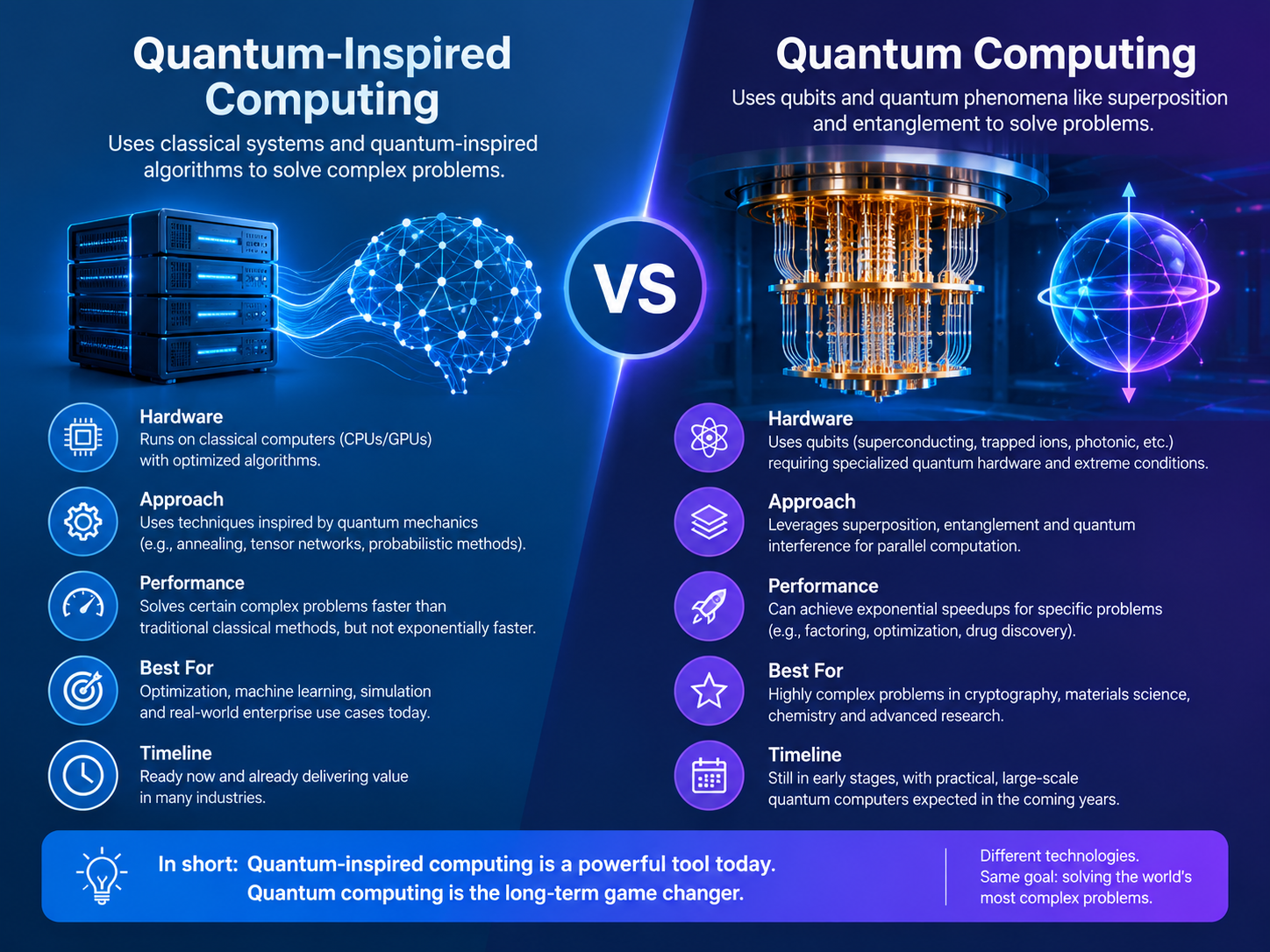
Quantum-Inspired Computing vs Quantum Computing: Key Differences
Quantum-inspired computing and quantum computing may target similar computational challenges, but they rely on fundamentally different technologies.
Quantum-inspired systems use conventional processors and algorithms influenced by quantum mathematics. Quantum computers use physical quantum systems to perform operations that classical hardware cannot directly reproduce in the same way.
That difference affects hardware requirements, costs, deployment complexity, and commercial readiness.
What Is Quantum-Inspired Computing?
Quantum-inspired computing applies mathematical methods associated with quantum systems to classical computing infrastructure.
These approaches typically run on CPUs, GPUs, or specialized classical accelerators. They do not require physical qubits.
Common techniques include.
Quadratic Unconstrained Binary Optimization (QUBO): Represents optimization problems using binary variables and mathematical objective functions.
Isang models: Provide a mathematical framework for representing interactions and optimization problems.
Simulated bifurcation: Uses classical computational techniques to search for solutions to certain combinatorial optimization problems.
Businesses can investigate these methods for vehicle routing, workforce scheduling, production planning, and resource allocation.
The main attraction is accessibility. Organizations can often experiment using existing cloud environments or enterprise infrastructure.
However, quantum-inspired software does not automatically outperform established optimization tools. Its value depends on the problem, implementation, and comparative results.
How Does Quantum Computing Work?
Quantum computing uses qubits, which behave differently from the bits used in traditional computers.
Classical bits represent either zero or one. Qubits can exist in superposition, allowing quantum algorithms to manipulate probability amplitudes through operations involving interference and, in many cases, entanglement.
Quantum hardware generally includes different approaches.
Gate-based quantum computers: Execute sequences of quantum operations through circuits.
Quantum annealers: Use physical quantum dynamics to investigate solutions to particular optimization problems.
Quantum annealing should not be confused with classical simulated annealing, which runs on conventional hardware.
Despite progress, quantum computers still face significant engineering challenges involving noise, error correction, connectivity, and hardware reliability.
Logical qubits protected through quantum error correction are especially important for the development of fault-tolerant quantum systems.
IBM’s Quantum roadmap outlines its technical development targets. These milestones are useful for understanding industry direction, but they do not guarantee commercial outcomes for every enterprise workload.
Quantum-Inspired vs Quantum Computing Comparison
|
Factor |
Quantum-Inspired Computing |
Quantum Computing |
|---|---|---|
| Hardware | CPUs, GPUs, classical accelerators | Physical quantum processors |
| Physical qubits | Not required | Required |
| Commercial maturity | Some production-ready solutions | Primarily emerging and research-oriented |
| Typical applications | Routing, scheduling, resource allocation | Chemistry, materials research, experimental optimization |
| Deployment | Enterprise software, cloud, managed services | Specialized hardware, quantum cloud platforms |
| Evaluation | ROI, operational KPIs, performance benchmarks | Technical milestones, algorithm performance, research outcomes |
| Primary investment focus | Operational improvements | Longer-term capabilities and research |
For CIOs, the important question is not which technology sounds more advanced. It is which approach delivers the best results for a defined workload.
Enterprise Use Cases for Quantum-Inspired Computing and Quantum Computing
Different industries face different computational challenges. A manufacturing company optimizing production schedules does not have the same requirements as a pharmaceutical business researching molecular interactions.
That is why enterprise investment decisions should begin with specific business problems rather than technology labels.
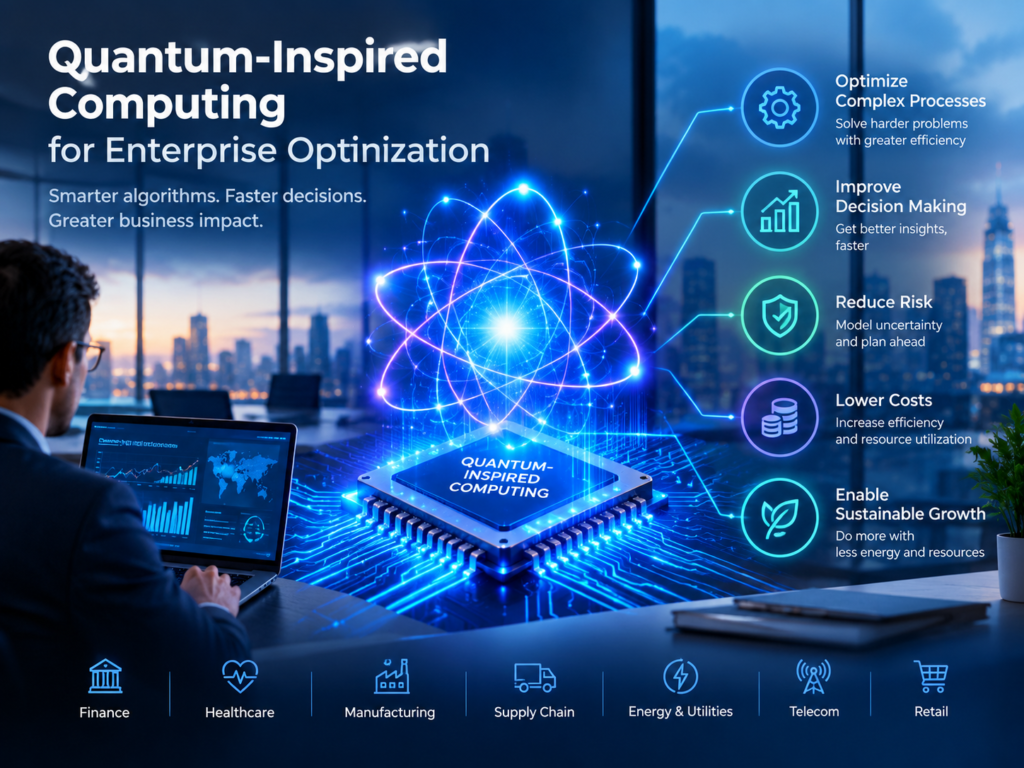
Supply Chain Optimization and Manufacturing
Manufacturing and logistics companies manage complex combinations of production capacity, delivery schedules, inventory, labor, and equipment availability.
Quantum-inspired optimization may help organizations evaluate large numbers of possible scheduling and allocation decisions.
Potential applications include.
Delivery route optimization
Factory production scheduling
Inventory and warehouse allocation
Workforce and equipment planning
Energy resource scheduling
Consider an automotive supplier in Stuttgart, Germany.
The company might need to coordinate production equipment, employee shifts, component availability, and customer delivery deadlines.
A quantum-inspired solver could be evaluated against its existing scheduling system to determine whether it produces better feasible schedules or reduces planning time.
But algorithm performance is only part of the picture. Data quality, enterprise resource planning (ERP) integration, and operational reporting also influence results.
Mak It Solutions’ business intelligence services provide relevant context for building the data and analytics capabilities required to support these initiatives.
Financial Services and Portfolio Optimization
Financial institutions regularly solve optimization problems involving investment portfolios, transaction scheduling, risk limits, and capital allocation.
Banks and investment firms in New York and London may investigate quantum-inspired computing for selected computationally demanding tasks.
For example, portfolio construction requires balancing investment objectives against risk constraints and other limitations.
Specialized algorithms may offer alternative ways to approach these problems.
However, financial institutions already use sophisticated classical optimization software. A new system must demonstrate improvements against those existing tools.
Performance assessments should consider.
Portfolio quality and constraint satisfaction
Calculation speed
Operational costs
Integration requirements
Risk management and regulatory obligations
Organizations planning further ahead can also review quantum computing readiness for businesses.
Drug Discovery, Materials Science, and Research
Quantum computing is attracting particular research interest in molecular simulation, chemistry, and advanced materials.
These fields involve quantum-mechanical behavior that can be difficult to model accurately using classical methods at larger scales.
A pharmaceutical company in Boston, for example, might investigate quantum algorithms through partnerships with universities or specialized computing providers.
Likewise, research organizations in the UK and EU may explore quantum simulation for materials and chemical processes.
These applications represent promising scientific directions, not proof that quantum computing already offers routine commercial advantages.
For enterprise decision-makers, research funding should reflect that distinction.
Quantum Computing ROI: Costs, Savings, and Financial Evaluation
Understanding the technical differences is useful. Understanding whether an investment pays for itself is essential.
Quantum-inspired projects can be assessed through operational savings and implementation costs. Quantum computing research requires a different financial perspective because its outcomes are less predictable.
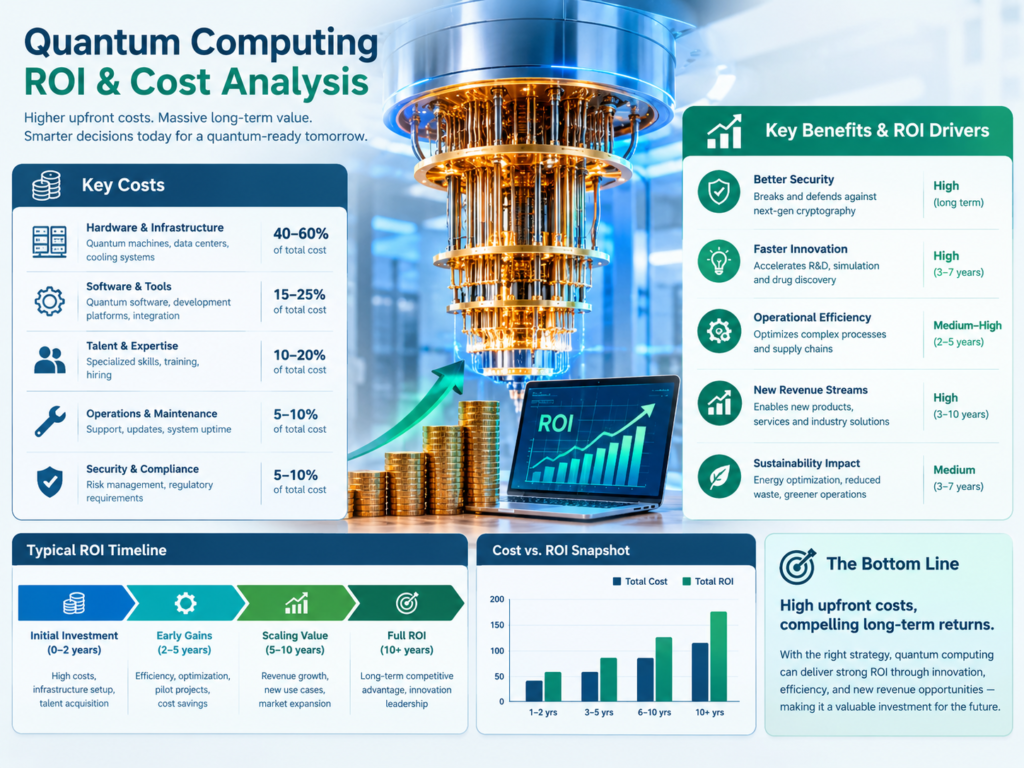
Quantum-Inspired Computing Cost vs Quantum Computing TCO
Total cost of ownership (TCO) includes considerably more than purchasing software or accessing computing resources.
Quantum-inspired computing expenses may include licensing, cloud usage, data engineering, optimization specialists, and integration.
Quantum computing projects may introduce specialized cloud-access charges, quantum algorithm development, research partnerships, and hybrid computing workflows.
Both approaches can involve additional spending on cybersecurity assessments, employee training, monitoring, and vendor management.
For organizations integrating specialized solvers into existing applications, Python development services may support workflow automation and system connectivity.
How to Calculate Quantum Optimization ROI
CIOs should calculate ROI using documented savings and realistic cost assumptions.
Annual net benefit is calculated by subtracting recurring annual operating costs from gross annual savings.
Illustrative ROI example.
All figures below are hypothetical and are not industry benchmarks.
|
Financial metric |
Amount |
|---|---|
| Annual gross savings |
$300,000 |
| Annual operating costs |
$80,000 |
| Annual net benefit |
$220,000 |
| Initial investment |
$200,000 |
| First-year net ROI |
10% |
| Simple payback period |
Approximately 11 months |
In this scenario, the organization generates $220,000 in annual net benefits against an initial investment of $200,000.
That produces a first-year net return of $20,000.
The illustration assumes savings accumulate evenly and excludes taxes, discounting, and changes in financial performance over time.
Actual outcomes will depend on workload complexity, implementation costs, and realized operational savings.
Why Classical Solver Benchmarks Matter
Before approving a specialized optimization platform, compare it against established classical alternatives.
Relevant baselines may include Gourbi, IBM CPLEX, or an organization’s existing optimization software.
Tests should use equivalent datasets, business constraints, and evaluation conditions.
Measure solution feasibility, quality, total execution time, cost per run, and reproducibility. Include data preparation and integration overhead rather than comparing only solver execution speed.
A faster solver that costs substantially more or produces impractical recommendations may offer little commercial benefit.
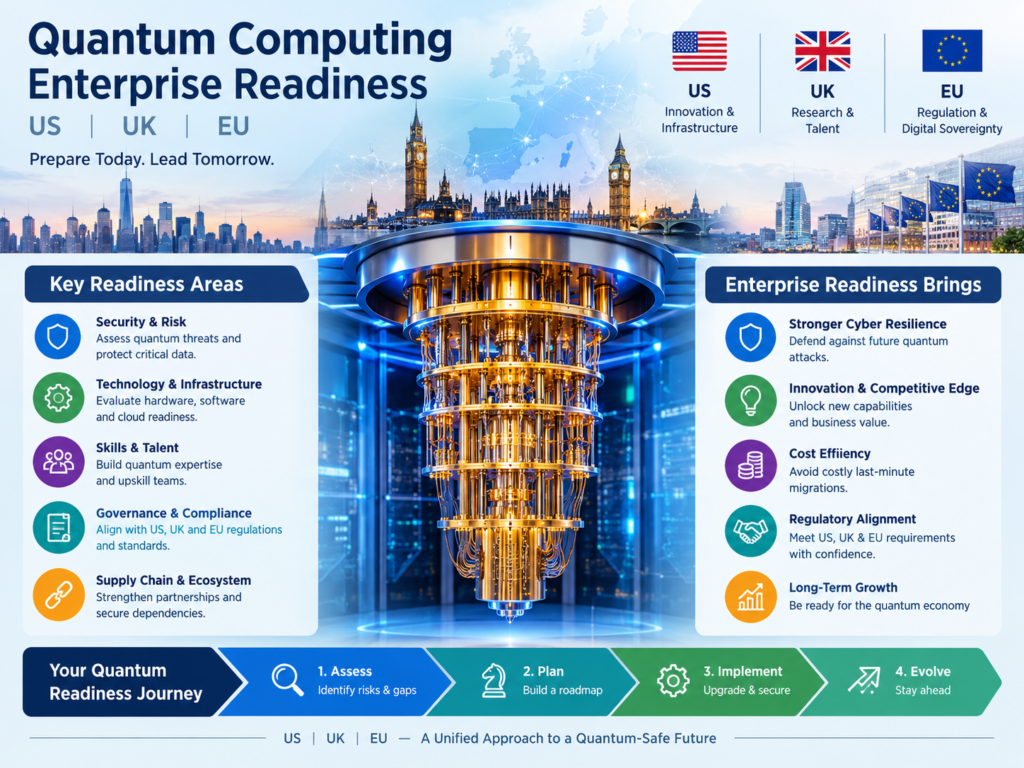
Enterprise Readiness in the USA, UK, Germany, and EU
Quantum investment decisions also depend on regional data protection rules, cybersecurity requirements, and business priorities.
Enterprises should evaluate the regulations that apply to their actual workloads rather than assuming that all quantum-related systems face identical obligations.
USA.
American enterprises can explore quantum services and ecosystems such as Amazon Braket, IBM Quantum, and Azure Quantum.
New York financial institutions, Chicago logistics businesses, and Boston life-science companies may pursue substantially different use cases.
Before using external platforms, organizations should evaluate applicable security and compliance requirements.
Depending on the workload, these may include HIPAA, PCI DSS, contractual security provisions, and SOC 2 assurance reports.
NIST cybersecurity guidance can support security planning, but it does not represent universal certification of quantum solutions.
UK.
The UK’s National Quantum Computing Centre supports quantum application exploration and workforce development.
Its SparQ programme provides a route for organizations to engage with relevant quantum computing activities.
Businesses around London, Oxford, and Harwell can investigate research partnerships and specialized technical expertise.
Financial institutions should assess applicable FCA requirements, UK GDPR obligations, and operational resilience expectations before transferring sensitive workloads to third-party platforms.
Germany and EU.
Germany’s industrial economy creates relevant opportunities for advanced scheduling and production optimization.
Manufacturers in Stuttgart and Munich may investigate specialized solvers for logistics, factory scheduling, and resource allocation.
Research networks such as Fraunhofer and European high-performance computing initiatives provide additional technical context.
For EU enterprises, GDPR obligations must be assessed against the data being processed and the services involved.
German businesses may also need to consider the BDSG alongside GDPR.
DORA and NIS2 can create further obligations for organizations within their respective scopes.
The European Commission’s Quantum Europe Strategy, published in July 2025, emphasizes research, infrastructure, commercialization, skills, and technological sovereignty.
For CIOs, the practical priority is to establish suitable data governance and procurement controls before moving experimental workloads into production.
Quantum-Inspired Computing Vendors: What Should CIOs Compare?
Enterprise technology procurement becomes more difficult when competing vendors use similar quantum-related terminology for fundamentally different products.
A quantum-inspired optimization platform, physical quantum annealer, and gate-based quantum computer should not be evaluated as interchangeable offerings.
Enterprise Quantum Vendor Comparison
|
Vendor or platform |
Primary technology category |
|---|---|
| Fujitsu Digital Annealer | Classical quantum-inspired optimization |
| Toshiba SQBM+ | Classical quantum-inspired optimization |
| IBM Quantum | Gate-based quantum computing |
| D-Wave Leap | Quantum annealing and hybrid services |
| Amazon Braket | Quantum cloud access |
| Azure Quantum | Quantum development and service ecosystem |
| Qiskit | Quantum software development framework |
This comparison identifies technology categories, not relative vendor performance.
Each offering should be evaluated according to the workload, available capabilities, integration needs, and contractual terms.
Cloud Pricing, Integration, and Security
Enterprise buyers should request clear information about subscription fees, usage charges, service commitments, and support costs.
Technical teams should also examine APIs, authentication, monitoring, availability, data residency, and exit arrangements.
An additional distinction matters for cybersecurity planning.
Adopting quantum computing is not the same as implementing post-quantum cryptography.
Organizations concerned about future threats to encryption can review the post-quantum cryptography migration roadmap.
Cryptographic migration can be necessary independently of any investment in quantum computing hardware.
A Practical Proof-of-Concept Scorecard
A weighted scorecard helps procurement teams compare vendors more consistently.
|
Evaluation criterion |
Suggested weight |
|---|---|
| Performance against classical baseline |
30% |
| Financial value and total cost |
25% |
| Integration and operational readiness |
20% |
| Security and governance |
15% |
| Vendor maturity and flexibility |
10% |
Each category can be rated from 1 (poor) to 5 (excellent), with the scores multiplied by their respective weights.
For illustration, an organization might require an overall score of at least 4.0/5, alongside mandatory security approval and reproducible performance evidence.
These weights and the threshold are proposed internal evaluation criteria, not established industry standards.
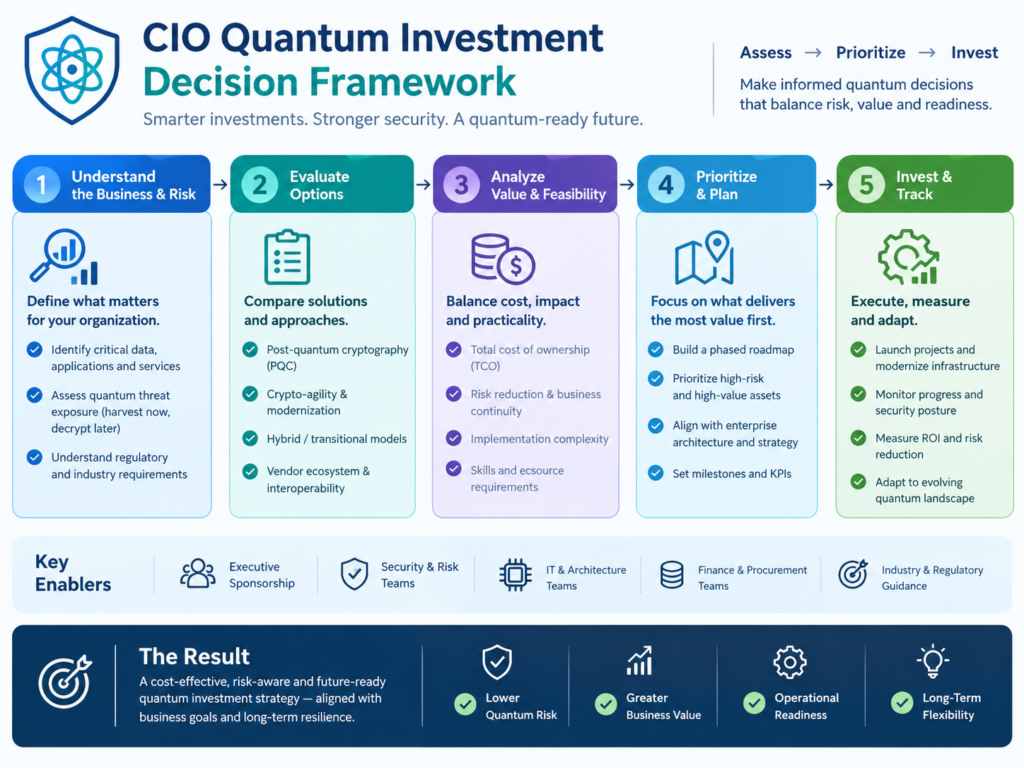
What Should CIOs Fund First? A Practical Investment Framework
The most defensible strategy is to fund proven operational improvements while maintaining a separate path for emerging quantum technologies.
That means avoiding the assumption that every complex optimization problem requires quantum-related technology.
Classical vs Quantum-Inspired vs Quantum: The Funding Decision
Start with a defined business workload
Establish KPIs, constraints, operational costs, and existing results
Does a proven classical solver meet the business need?
Yes
Fund classical optimization
Use the solution that already meets operational and financial targets.
No / Uncertain
Benchmark quantum-inspired alternatives
Fund deployment only when testing demonstrates meaningful gains.
Separate research funding
Support genuine quantum computing R&D against scientific and technical milestones, without assuming near-term financial returns.
Four Funding Gates for Enterprise Projects
A structured evaluation can help enterprises avoid scaling projects before their value is established.
Workload validation: Define the business problem and establish a credible classical baseline.
Performance verification: Demonstrate repeatable improvements under realistic conditions.
Commercial and technical assessment: Confirm ROI, integration feasibility, security, and procurement requirements.
Deployment decision: Approve production investment, revise the pilot, or discontinue the project.
Quantum research investments should use independent budgets and success criteria suited to their exploratory objectives.
A 90-Day CIO Action Plan
Days 1–30
Identify and benchmark
Choose candidate workloads, document operational constraints, and measure existing performance and costs.
Days 31–60
Run comparative pilots
Test classical and quantum-inspired solvers using equivalent workloads. Evaluate quantum research opportunities separately.
Days 61–90
Make the investment decision
Review measured ROI, vendor evidence, implementation risks, and governance requirements before deciding whether to scale, revise, or stop.
A disciplined evaluation process can turn an uncertain technology discussion into a clearer investment decision.
Concluding Remarks
The quantum-inspired computing vs quantum computing decision should begin with a business requirement, not a technology trend.
Quantum-inspired optimization can be worth investigating when established classical approaches struggle to deliver satisfactory results. Genuine quantum computing offers important research opportunities, but its commercial potential must be evaluated against technical uncertainty and workload-specific evidence.
For CIOs, the strongest investment strategy is straightforward: benchmark existing solutions, measure the value of alternatives, and fund projects that demonstrate meaningful results.
Mak It Solutions can help enterprises assess optimization workloads, data integration needs, and implementation requirements.
Request an Enterprise Optimization Assessment to define a benchmark-driven evaluation and identify the computing approach that best supports your business objectives.
Key Takeaways
Technology: Quantum-inspired computing runs on classical hardware, while quantum computing requires physical qubits.
Business applications: Routing, scheduling, and resource allocation are potential areas for quantum-inspired optimization, subject to benchmarking.
Financial evaluation: ROI should account for implementation, operating costs, realized savings, and payback.
Regional compliance: US, UK, German, and EU enterprises must assess the security and regulatory obligations relevant to their workloads.
Vendor selection: Reproducible results, transparent costs, integration compatibility, and data security matter more than marketing claims.
Funding priorities: Operational optimization and exploratory quantum research should have different investment criteria.
FAQs
Q : Can quantum-inspired algorithms run on existing enterprise servers?
A : Yes. Many quantum-inspired algorithms operate on conventional CPUs, GPUs, or cloud infrastructure without physical quantum processors.
Some specialized implementations require dedicated classical accelerators. Infrastructure requirements depend on workload size, memory needs, and the selected software.
Q : Is quantum-inspired computing suitable for small businesses?
A : It can be, particularly when businesses face complex delivery routing, scheduling, inventory, or resource allocation challenges.
However, conventional optimization tools may provide sufficient results at lower costs. Small and medium-sized enterprises should compare expected savings with implementation and ongoing expenses before investing.
Q : Does a higher qubit count guarantee better quantum computing performance?
A : No. Qubit count is only one part of quantum computing performance.
Error rates, connectivity, gate fidelity, coherence, and algorithm requirements also matter. Enterprises should request workload-specific benchmarks rather than selecting hardware based on qubit count alone.
Q : Can quantum optimization platforms integrate with SAP or ERP systems?
A : Yes, where compatible APIs, interfaces, or middleware are available.
A business can transfer relevant operational data from its ERP platform to an optimization solver and return approved recommendations. Integration must be tested for data accuracy, security, permissions, and operational reliability.
Q : What should CIOs ask quantum optimization vendors before purchasing?
A : CIOs should request reproducible performance benchmarks, transparent pricing, technical documentation, and appropriate security assurances.
They should also examine integration requirements, service-level commitments, data-processing terms, and contract termination conditions. Any claimed financial improvement should be supported by realistic operational evidence.