
Semantic Layer for AI Agents: The Missing AI Foundation
Semantic Layer for AI Agents: The Missing AI Foundation
Semantic Layer for AI Agents: The Missing AI Foundation
Your AI agent can query millions of warehouse records and still give your CFO the wrong revenue figure.
Imagine asking an enterprise AI assistant, “What was our net revenue last quarter?” It retrieves the data, writes a SQL query, and returns an answer. But the calculation includes refunded transactions, duplicates certain orders, and applies inconsistent currency conversions.
The query runs successfully. The answer is still wrong.
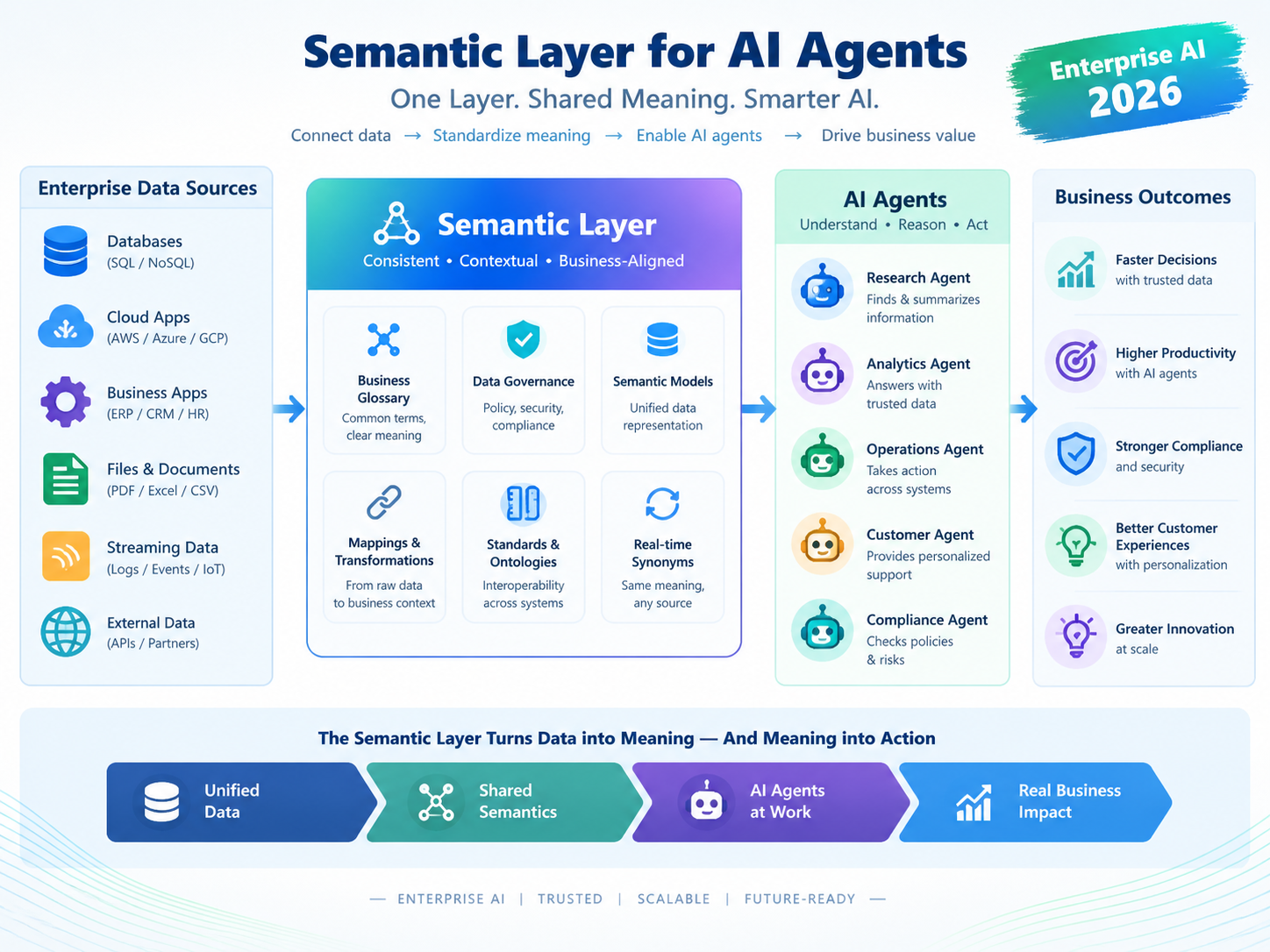
That’s the problem a semantic layer for AI agents helps solve. A semantic layer connects enterprise data to approved business definitions, metrics, relationships, and access rules. It enables AI agents to interpret information more consistently instead of guessing what database tables and columns mean.
Data warehouses remain essential for storing and processing information. But reliable enterprise AI needs more than data access. It needs governed business context.
The demand for that capability is growing. McKinsey’s 2024 State of AI survey found that 65% of respondents said their organizations regularly used generative AI, while 72% reported AI adoption more broadly.
By 2025, McKinsey reported that 62% of respondents said their organizations were at least experimenting with AI agents.
As businesses move from experimentation toward operational deployment, accurate and trustworthy analytics become increasingly important.
What Is a Semantic Layer for AI Agents?
A semantic layer for AI agents is a governed interface that translates technical data structures into business concepts an AI system can understand and query.
It defines what metrics mean, how entities relate, which calculations are approved, and what information users are authorized to access.
Think of it as a business interpretation layer between enterprise data and an AI assistant.
How Business Metrics and Relationships Work
Consider a company tracking net revenue.
Its approved definition might be.
Net revenue = Gross sales − Approved refunds − Eligible discounts
That formula looks straightforward. In practice, accurate reporting also depends on transaction status, reporting periods, currency conversion, and the level at which records are aggregated.
Without those definitions, different queries can produce different results from the same data.
A semantic model establishes reusable definitions for concepts such as.
Revenue, profit, and customer lifetime value
Active customers and subscriptions
Churn and conversion rates
Approved entity relationships and joins
Reporting periods, currencies, and aggregation rules
These definitions can then be shared across business intelligence platforms, APIs, and AI agents.
How Semantic Layers Support LLMs and Agentic Analytics
Large language models can generate natural-language-to-SQL (NL2SQL) queries. However, they don’t automatically understand an organization’s accounting policies, operational terminology, or reporting logic.
A semantic layer provides approved definitions and metadata that help the agent form more meaningful queries.
Knowledge graphs and business ontologies can extend this capability by describing relationships between enterprise entities and processes.
For example, instead of asking an LLM to infer how revenue should be calculated, an organization can expose a certified revenue metric that already contains the appropriate business rules.
This reduces ambiguity and makes analytical outputs easier to validate.
Semantic Layer vs Data Warehouse: Why AI Needs Both
A data warehouse stores and processes analytical data. A semantic layer defines how that information should be interpreted and consumed.
Neither replaces the other.
What Data Warehouses Do Well
Platforms such as Snowflake, Databricks, Google Big Query, and Amazon Redshift provide scalable infrastructure for analytical workloads.
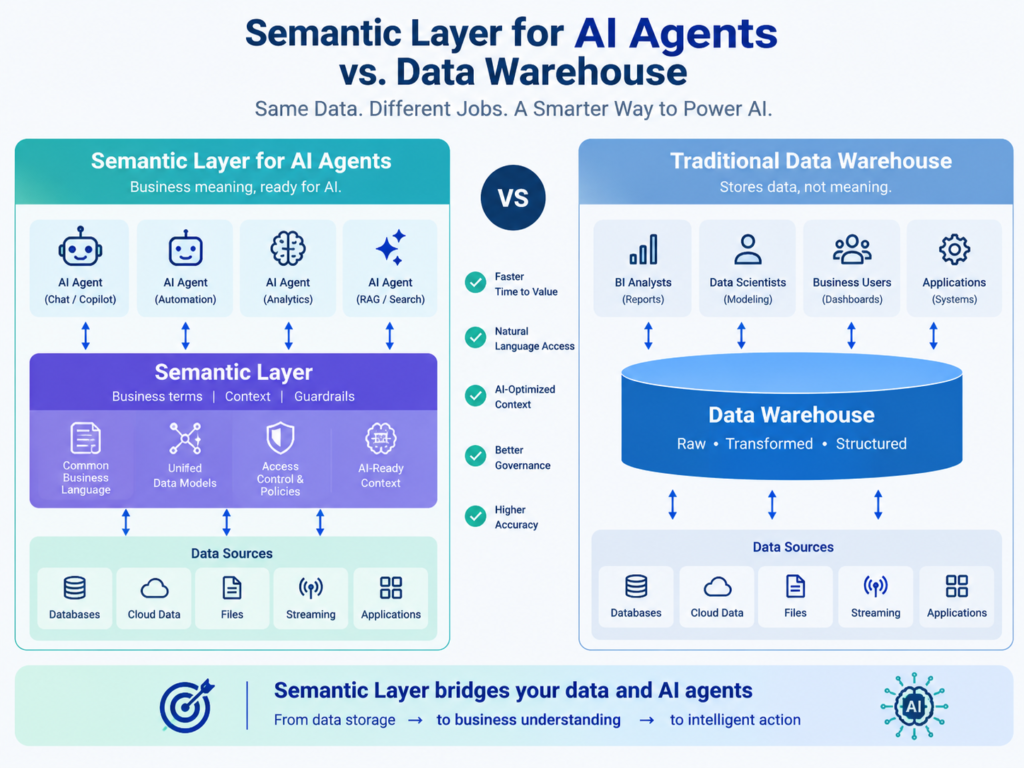
They support data storage, transformation, processing, and query execution.
However, a table named transaction doesn’t automatically tell an AI agent which transactions count toward recognized revenue or which customer identifier should be used in a particular calculation.
Those decisions require business definitions.
Data Warehouse vs Semantic Layer Comparison
| Capability | Data Warehouse | Semantic Layer |
|---|---|---|
| Data storage | Primary function | Typically uses existing storage |
| Query processing | Executes analytical workloads | Uses underlying query engines |
| Metric definitions | SQL or native semantic features | Reusable business definitions |
| Relationships | Tables and joins | Approved business relationships |
| Governance | Platform-level access controls | Governed business-facing access |
| AI integration | SQL and platform APIs | Semantic APIs and agent tools |
Warehouse-Native vs Dedicated Semantic Layers
Modern data platforms increasingly include native semantic capabilities.
Snowflake Semantic Views support business metrics, dimensions, and relationships within Snowflake. Microsoft Fabric offers semantic models, while dbt Metric Flow and Cube provide alternative ways to manage reusable business logic.
The decision isn’t simply about choosing a vendor.
An organization operating primarily within one warehouse ecosystem may find native semantic capabilities sufficient.
A business using multiple analytical platforms, reporting tools, and AI applications may benefit from a separately managed semantic layer.
Why Semantic Layers Improve AI Accuracy and Trust
The value of a semantic layer becomes especially clear when AI agents answer business-critical questions.
Consistent definitions and approved relationships reduce preventable analytical errors. They also improve traceability by making it easier to understand how a result was calculated.
Still, semantic layers don’t eliminate AI hallucinations or replace security controls.
Preventing Incorrect SQL and Metric Drift
Return to the CFO’s revenue question.
An AI agent querying raw order and refund tables could accidentally duplicate sales when joining transactions to individual refund records.
Consider this illustrative example, not a measured performance result.
| Revenue calculation | Result |
|---|---|
| Incorrect raw-table calculation | $12.4 million |
| Certified semantic metric | $10.8 million |
| Reporting difference | $1.6 million |
Both queries might execute without database errors. Only the calculation using the approved financial rules reflects the intended metric.
An authorized query against certified data could look like this.
This example assumes the financial dataset contains one reconciled record per order and approved currency conversions.
The important point is that the semantic model establishes those assumptions before the agent performs its calculation.
Strengthening Governance, Lineage, and Auditability
Reliable analytics also depends on who can access information and how that access is controlled.
Enterprise implementations should consider.
Role-based access control (RBAC)
Row-level security and data masking
User identity propagation
Approved metrics and restricted query operations
Data lineage and audit logs
Query monitoring and validation
For example, a regional sales manager might be authorized to view revenue from their territory but not company-wide payroll information.
A semantic interface should respect those permissions rather than allowing an AI agent to bypass them.
Security enforcement must also remain consistent across the semantic layer, its APIs, and the underlying warehouse.
How to Build a Semantic Layer for Enterprise AI Agents
Building a semantic layer for enterprise AI begins with business definitions, not the choice of an LLM or database connector.
The objective is to make approved business information accessible through secure, predictable interfaces.
Practical Implementation Steps
Identify business questions. Start with reporting tasks that already have verified answers, such as quarterly revenue or subscription churn.
Certify critical metrics. Document calculations, exclusions, reporting periods, and authoritative data sources.
Model relationships. Define approved joins, dimensions, and aggregation rules.
Expose governed interfaces. Make certified metrics accessible through suitable APIs or agent tools.
Enforce authorization. Preserve user identities, platform permissions, and audit requirements.
Validate agent outputs. Compare generated answers with known results and test ambiguous or unauthorized requests.
Starting with a limited set of trusted metrics is often more manageable than attempting to model every enterprise dataset at once.
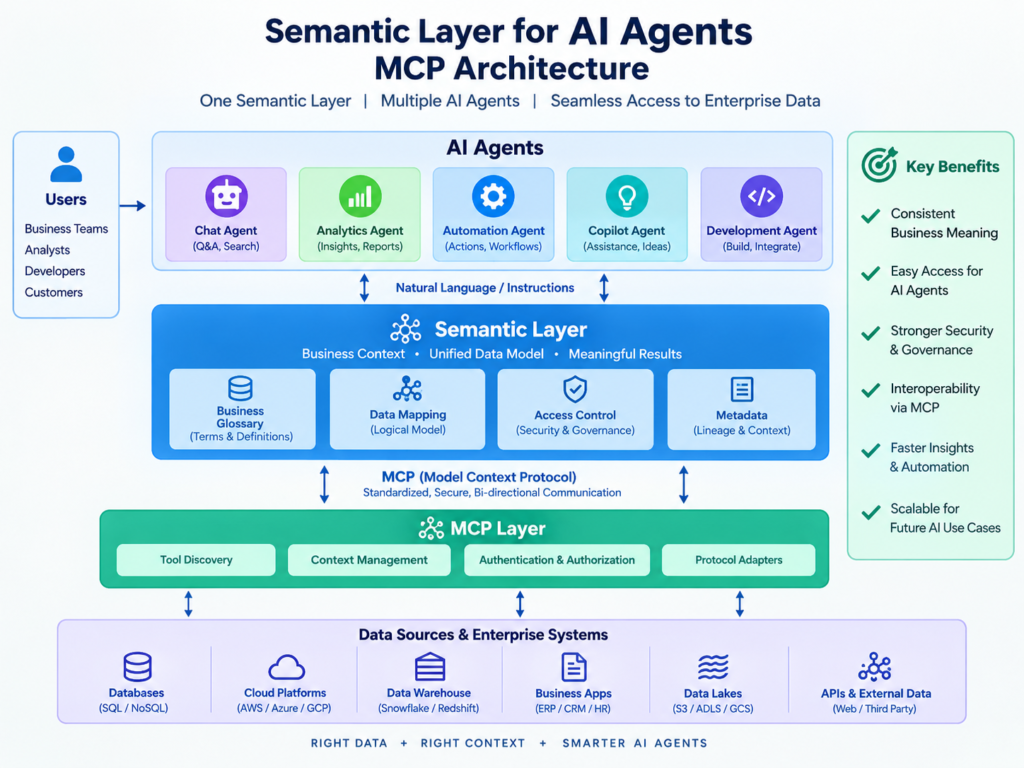
Architecture: Warehouse → Semantic Layer → MCP/API → AI Agent
A practical enterprise architecture can be represented as follows.
The agent requests information through an approved interface. The semantic layer supplies business definitions and maps the request to the underlying data platform.
Results return through governed services, with authorization, logging, and monitoring applied where required.
Connecting Semantic Models to MCP and LLMs
The Model Context Protocol (MCP) offers a standard mechanism for AI applications to discover and interact with compatible tools.
Instead of generating unrestricted SQL, an agent might call a tool such as get- net-revenue
That tool can check the requested reporting period, validate permissions, select an approved metric, and execute a controlled query.
MCP supports integration, but it isn’t a security guarantee. Identity management, authorization, input validation, and query restrictions still require implementation.
Comparing Popular Semantic-Layer Solutions
| Solution | Main approach | Potential fit |
|---|---|---|
| Cube | API-oriented semantic access and reusable metrics | Applications requiring governed metric APIs |
| dbt Metric Flow | Metrics managed through analytics engineering workflows | Organizations already using dbt |
| Snowflake | Native semantic views and platform integrations | Snowflake-centered architectures |
| Microsoft Fabric | Semantic models integrated with Power BI and Fabric | Microsoft analytics ecosystems |
Before committing to a platform, verify supported agent interfaces, authorization behavior, interoperability, performance, and operational cost.
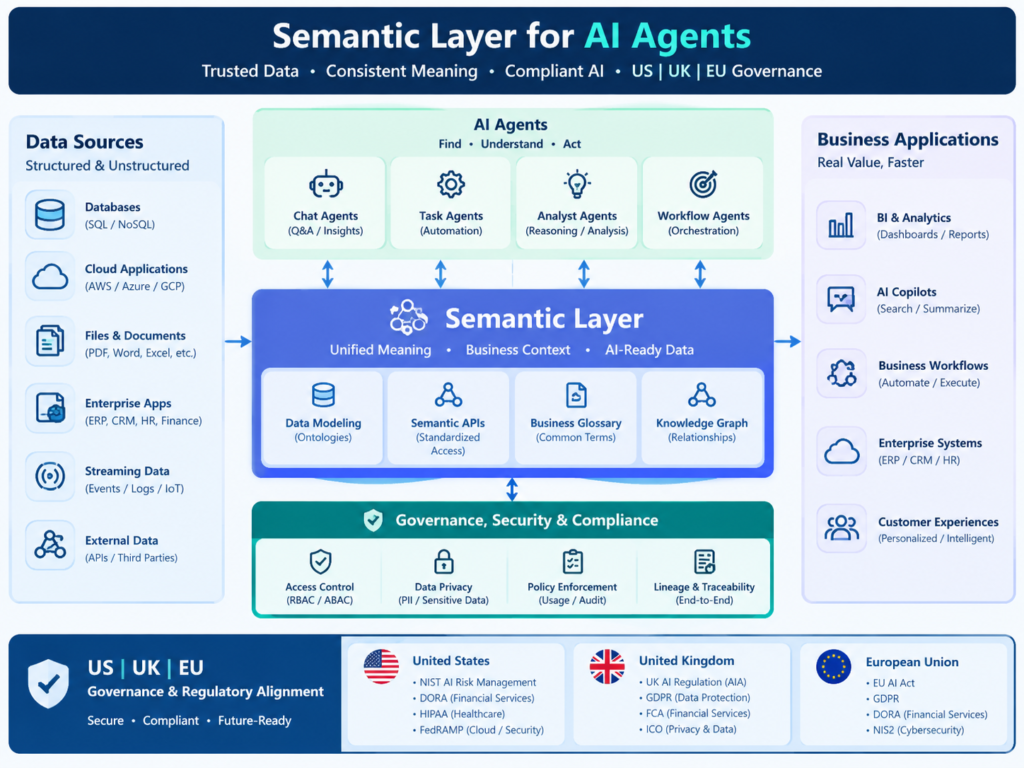
Enterprise AI Governance Across the US, UK, and EU
A semantic layer can support controlled data consumption, but it doesn’t automatically make an AI system compliant with privacy or industry regulations.
Compliance depends on the complete architecture, the information being processed, and the organization’s legal obligations.
United States.
Consider a Boston healthcare analytics provider connecting an AI assistant to patient-related reporting.
If the system processes protected health information, applicable HIPAA requirements must be assessed.
A New York financial services company may prioritize auditability, access separation, and PCI DSS requirements where payment-card data environments are involved.
In both situations, certified metrics are helpful, but technical and organizational safeguards remain essential.
United Kingdom.
A London fintech using Microsoft Fabric may want employees to query payment-risk indicators through an AI assistant.
The implementation should account for UK GDPR, applicable financial-sector requirements, and relevant Information Commissioner’s Office guidance.
Permissions, data minimization, and audit records are particularly important when customer financial information is involved.
Deployments involving NHS information may also require additional healthcare data-governance controls.
Germany and the EU.
A Munich manufacturer could connect SAP-derived operational metrics to an AI analytics system.
Its architecture may need to address GDPR requirements for lawful processing, retention, international transfers, and appropriate access restrictions.
A Frankfurt financial institution could also have supervisory obligations involving BaFin.
Depending on the use case, the EU AI Act may introduce additional requirements.
Importantly, storing information within EU data centers doesn’t automatically establish GDPR compliance.
Organizations should evaluate legal requirements with qualified specialists rather than relying on semantic-layer functionality alone.
How to Choose the Right Semantic Layer for AI Agents
The best semantic-layer architecture is the one that fits your data environment, governance requirements, and actual AI use cases.
A platform with extensive features may still be the wrong choice if it introduces unnecessary complexity or cannot enforce existing permissions.
Five Essential Evaluation Criteria
| Criterion | Question to ask |
|---|---|
| Metric consistency | Do AI agents and BI dashboards use the same certified KPIs? |
| Security | Are user identities and granular permissions enforced? |
| Interoperability | Can existing warehouses, BI tools, and APIs consume the model? |
| Performance and cost | Are query latency and operating expenses acceptable? |
| Observability | Can teams inspect lineage, queries, failures, and agent activity? |
Evaluate these capabilities using realistic business questions and production-like test conditions.
When Warehouse-Native Semantics Make Sense
Warehouse-native semantic features can be a practical option when most analytical workloads and reporting tools already operate within one platform.
They may reduce the need for additional services and simplify implementation.
Independently managed semantic layers become more attractive when different departments use separate analytical systems or require common business definitions across many applications.
Neither architecture is universally better.
Measuring Semantic-Layer ROI
Return on investment should be based on observable improvements rather than vendor promises.
Useful measures include answer accuracy against certified results, successful query execution, analyst correction effort, time to trusted insight, query latency, and computing costs.
A finance department, for example, could compare a fixed set of reporting questions before and after implementing governed semantic access.
Include licensing, development, maintenance, and operational costs when evaluating the overall business case.
Final Thoughts
An AI agent that retrieves data isn’t necessarily an AI agent that understands your business.
A semantic layer for AI agents helps close that gap by making approved metrics, relationships, and governance rules available to enterprise AI applications.
The goal isn’t to replace your existing data warehouse. It’s to make the information flowing from that warehouse more consistent, interpretable, and dependable.( Click Here’s )
Mak It Solutions can help organizations evaluate their analytics architecture, certified metrics, AI-agent integrations, and data-governance requirements.
Whether you’re developing enterprise analytics in the US or deploying AI workflows across the UK and EU, a semantic-readiness assessment can identify practical opportunities and implementation gaps.
Key Takeaways
A semantic layer for AI agents connects technical data with trusted business meaning.
Data warehouses provide storage and processing, while semantic models establish reusable metrics and relationships.
Certified definitions reduce avoidable SQL, join, and aggregation errors.
AI agents still require authentication, authorization, query validation, monitoring, and human oversight where appropriate.
MCP and semantic APIs enable governed integration but don’t guarantee security or compliance.
Enterprises across the US, UK, Germany, and EU should assess privacy and industry-specific obligations.
Platform selection should reflect business needs, interoperability, accuracy, performance, and cost.
FAQs
Q : Can AI agents use an existing BI semantic model?
A : Yes. AI agents can often reuse certified metrics, dimensions, and relationships from existing BI semantic models. However, the platform must provide a compatible integration interface and enforce appropriate user permissions. Additional API integration, validation, or authorization controls may be necessary.
Q : Does a semantic layer eliminate text-to-SQL hallucinations?
A : No. Semantic layers reduce ambiguity by providing approved metric definitions and relationships, but AI models can still misinterpret questions or apply incorrect filters. Production systems should validate generated queries, restrict operations, and test answers against certified results.
Q : Can one semantic layer connect to multiple data warehouses?
A : Some semantic-layer solutions support multiple warehouse platforms, including Snowflake, BigQuery, and Databricks. However, shared metric definitions don’t automatically guarantee efficient cross-platform query execution. Check connectors, federated-query support, permissions, and data-transfer costs.
Q : Do small enterprise AI pilots need a dedicated semantic-layer platform?
A : Not necessarily. A limited pilot using one warehouse and a small collection of trusted metrics may work with native semantic features or an existing governed BI model. A dedicated solution may become useful as the number of data sources, consuming applications, and governance requirements increases.
Q : How can businesses measure semantic-layer ROI for AI agents?
A : Compare AI-assisted analytics performance before and after implementation. Track answer accuracy, time to trusted insight, analyst rework, query reliability, latency, and operational expenses. Use controlled tests with known answers and include the full cost of implementing and maintaining the solution.