
Knowledge Graph vs Vector Database: 2026 AI Guide
Knowledge Graph vs Vector Database: 2026 AI Guide
Knowledge Graph vs Vector Database: 2026 AI Guide
Enterprise AI can find the right document and still produce the wrong answer. Imagine an assistant locating a supplier contract but missing the subsidiaries, compliance obligations, and business relationships connected to it.
That’s where the knowledge graph vs vector database decision becomes important.
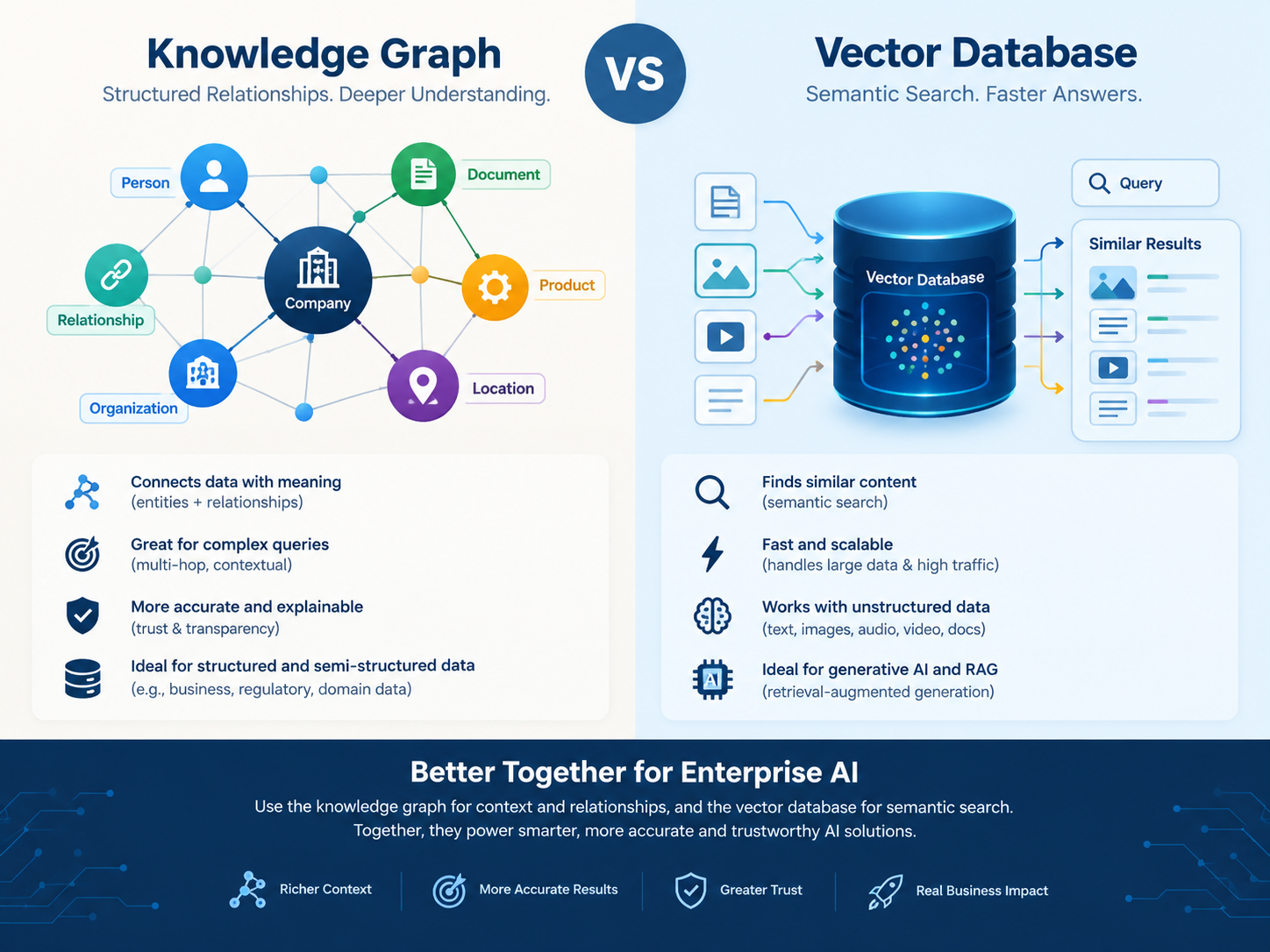
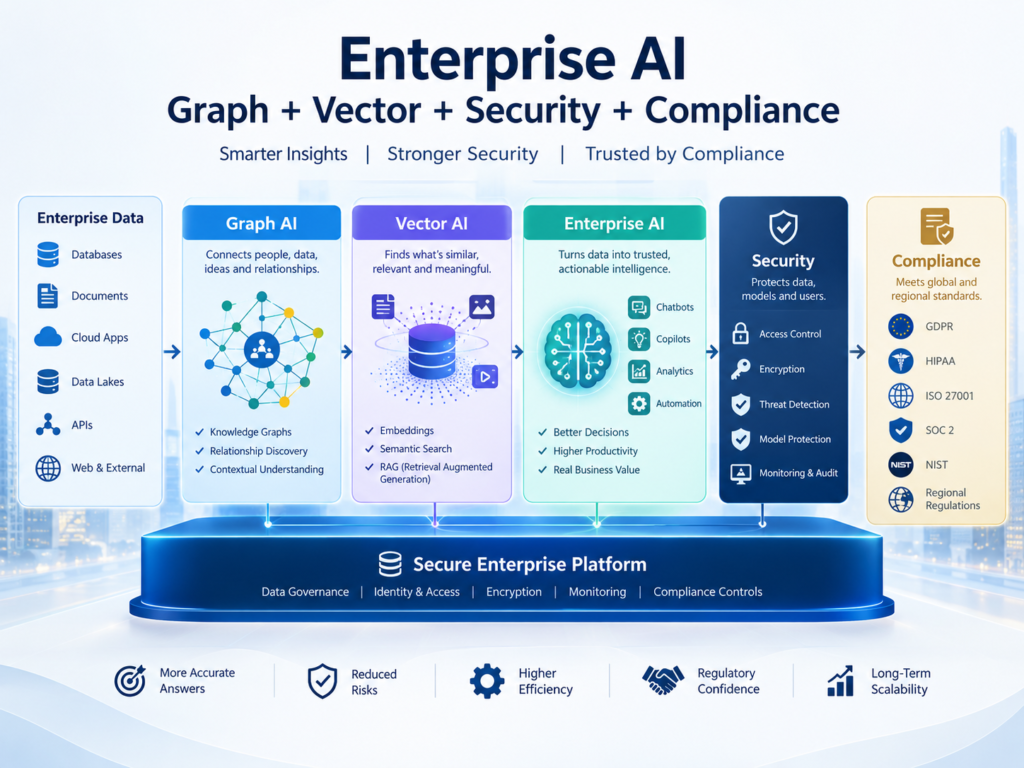
A knowledge graph represents entities and their relationships, making it useful for connected data analysis and multi-hop queries. A vector database retrieves semantically similar information using embeddings, making it effective for enterprise document search. Hybrid Graph RAG combines these approaches when an AI application needs both relevant content and relationship-aware context.
Enterprise adoption makes this choice increasingly relevant. Stanford’s 2025 AI Index reported that 78% of surveyed organizations used AI in 2024, compared with 55% in 2023.
For CTOs, CIOs, and AI architects, the challenge isn’t finding the most sophisticated database. It’s building an AI system that delivers reliable answers, predictable performance, manageable costs, and appropriate governance.
Here’s how knowledge graphs, vector databases, and hybrid Graph RAG compare for enterprises operating in the USA, UK, Germany, and the wider EU.
Knowledge Graph vs Vector Database.
The main difference lies in how each technology represents and retrieves information.
A knowledge graph focuses on explicit connections between entities. A vector database focuses on semantic similarity between data representations.
How Knowledge Graphs Work
A knowledge graph organizes information into entities and relationships.
For example, consider these business connections.
Company A owns Company B.
Company B supplies materials to Company C.
Company C operates under a specific regulatory requirement.
A knowledge graph can represent these relationships and allow queries to traverse them.
This makes graphs particularly useful for supply chain analysis, fraud detection, dependency mapping, and applications that need inspectable paths between facts.
Knowledge representation technologies include RDF, ontologies, SPARQL, and property graphs queried through languages such as Cypher.
A knowledge graph describes the connected information model. A graph database, such as Neo4j, is one way to store and query it.
How Vector Databases Work
Vector databases store embeddings: numerical representations of text, images, or other content.
An embedding model converts information into vectors so that semantically related content can be identified through similarity calculations.
For example, an employee searching for “how to reset account access” might retrieve documentation titled “credential recovery procedure,” even though the wording differs.
Vector search commonly uses approximate nearest-neighbor techniques, including HNSW, to retrieve relevant results efficiently.
Unlike graph traversal, similarity search does not inherently establish verified business relationships between entities.
Knowledge Graph vs Vector Database Comparison
| Criterion | Knowledge Graph | Vector Database |
|---|---|---|
| Main strength | Explicit relationships | Semantic similarity |
| Data model | Entities and relationships | Embeddings and metadata |
| Retrieval | Graph queries and traversal | Similarity search |
| Best for | Connected data analysis | Document discovery |
| Explain ability | Inspectable relationship paths | Retrieved supporting content |
| Main challenge | Modeling and maintenance | Missing relational context |
| Typical applications | Fraud, dependencies, supply chains | Search, support, knowledge assistants |
| Scaling considerations | Graph structure and traversal complexity | Index size, filtering, and retrieval load |
Neither architecture is inherently more accurate or faster in every situation.
Vector databases help find relevant information. Knowledge graphs help establish how that information is connected.
Graph RAG vs Vector RAG: When Is Hybrid Better?
Traditional vector RAG is effective for retrieving information from documents. Graph RAG adds structured context that can support questions involving multiple entities or relationships.
Traditional Vector RAG and Its Limitations
Retrieval-augmented generation (RAG) connects a language model to external knowledge sources.
A typical vector RAG workflow involves.
Dividing documents into searchable chunks.
Generating embeddings.
Storing embeddings in a searchable index.
Retrieving relevant passages for a query.
Supplying authorized evidence to a language model.
This approach works well for product documentation, internal knowledge bases, technical manuals, and policy searches.
However, consider this question:
Which suppliers associated with our active contracts have unresolved compliance risks?
Answering it might require joining evidence from contracts, supplier databases, ownership records, and risk reports.
Vector retrieval can find relevant passages, but similarity alone may not reliably establish those connections.
How Graph RAG Supports Multi-Hop Reasoning
Graph RAG incorporates connected entities and relationships into retrieval.
Depending on the implementation, it can extract entities, identify relationships, explore connected records, and assemble supporting evidence for an answer.
Microsoft’s Graph RAG framework also supports community-based summaries and different query approaches.
Its local search combines graph context with source documents, while global search synthesizes broader information across a dataset.
These methods can support complex enterprise questions, but they do not automatically guarantee correctness.
Poor entity extraction, outdated relationships, incomplete data, or missing authorization controls can still lead to incorrect or unsafe answers.
Hybrid RAG Architecture and Query Routing
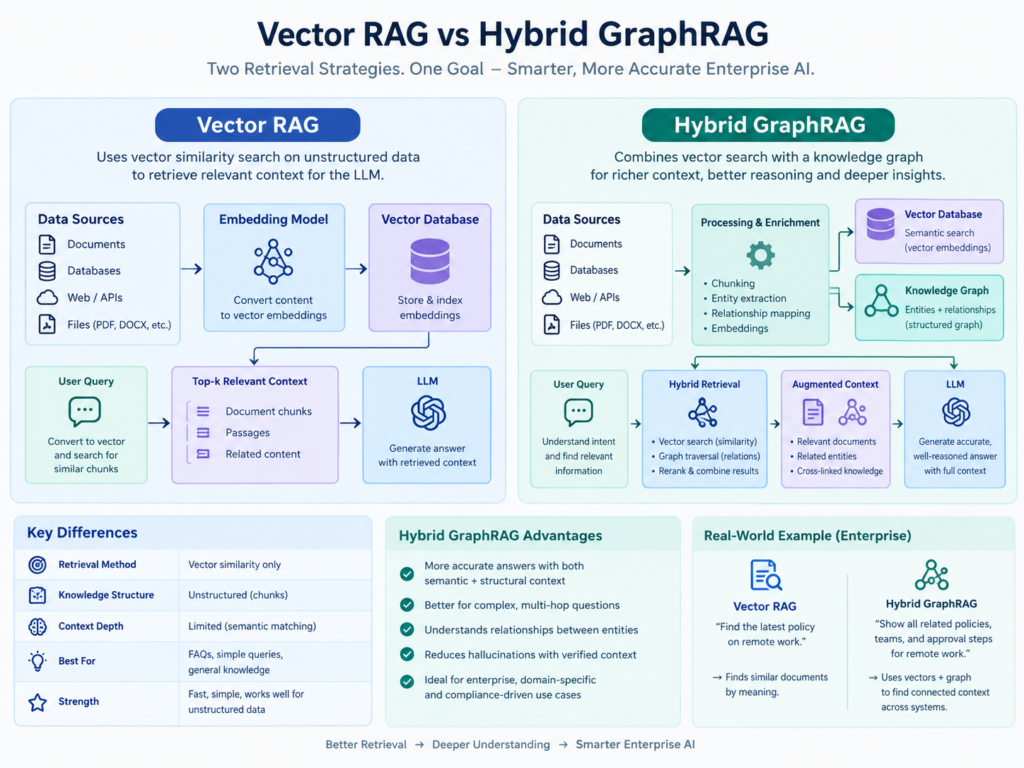
A hybrid architecture can combine vector search and graph traversal within the same retrieval workflow.
Conceptual retrieval architecture
Vector-only RAG
Hybrid Graph RAG
Illustrative workflows, not a vendor-specific performance benchmark. Authorization must apply to source access and both retrieval paths.
A hybrid system may route questions to vector search, graph traversal, or both. It then combines evidence, reranks results, and provides relevant context to the language model.
The added complexity is justified only when it improves actual task outcomes.
Reliable backend integration and database architecture are essential for connecting retrieval systems to operational data without weakening access controls.
Enterprise AI Use Cases.
The most suitable architecture depends on the questions your organization needs to answer.
Vector Databases for Enterprise Search
Vector retrieval is a natural starting point for document-heavy environments.
Common applications include employee knowledge assistants, customer support automation, technical documentation, and internal policy search.
An Austin-based SaaS company, for example, could use semantic search to help developers find troubleshooting instructions across a large documentation library.
The organization could also use business intelligence and analytics to monitor retrieval quality and operational effectiveness.
Knowledge Graphs for Fraud, Healthcare, and Supply Chains
Knowledge graphs become valuable when understanding relationships is central to the task.
A New York financial institution might map connected accounts and counterparties to support fraud investigations.
A UK healthcare organization could use entity relationships to support authorized data integration across systems, subject to NHS-related governance and privacy requirements.
In Germany, manufacturers working within Industries 4.0 environments may need to trace dependencies between suppliers, facilities, components, and production processes.
These examples are illustrative rather than claims about specific organizations.
Hybrid Graph RAG for Regulated Knowledge Assistants
Consider a US bank evaluating how a policy update affects existing counterparties.
Vector search can identify relevant policy documents, while graph queries reveal ownership relationships, contractual dependencies, and affected entities.
Hybrid retrieval brings those sources together.
This approach can be particularly useful when the answer requires both unstructured evidence and connected business records.
Cost, Accuracy, and Scalability
Graph RAG is not automatically faster, cheaper, or more accurate than vector RAG.
The right comparison considers complete system costs and performance under realistic enterprise conditions.
Neo4j vs Pinecone and Other Platforms
Neo4j is associated with graph-oriented workloads, while Pinecone focuses on vector retrieval.
Other platforms include Weaviate, Qdrant, Milvus, pgvector, Stardog, and Amazon Neptune.
Some products support multiple retrieval capabilities, including vector indexing alongside graph or database queries.
Before selecting a platform, evaluate deployment options, query requirements, security features, operational expertise, integration needs, and projected data growth.
Understanding Total Cost of Ownership
Vector systems require resources for embedding generation, index storage, updates, query execution, and monitoring.
Graph-based solutions may add entity extraction, identity resolution, ontology design, relationship maintenance, and summarization.
Microsoft specifically cautions that full Graph RAG indexing can consume substantial language-model resources.
Total cost of ownership should therefore cover infrastructure, engineering, reindexing, evaluation, security, and ongoing maintenance.
Custom Python development and automation may help integrate ingestion pipelines and retrieval orchestration.
What Should Enterprises Benchmark?
Test candidate architectures on the same representative questions, datasets, permissions, and service-level requirements.
| Metric | What it evaluates |
|---|---|
| Recall@k | Relevant evidence retrieved |
| Answer grounded ness | Whether claims are supported by evidence |
| Citation fidelity | Whether citations support the stated facts |
| p95 latency | Response time at the 95th percentile |
| Cost per successful answer | Operational efficiency |
| Authorization failures | Exposure of restricted information |
| Freshness | Accuracy after source-data changes |
Realistic tests should include simple lookups, cross-document questions, relationship queries, missing data, and unauthorized-access attempts.
Stanford’s 2025 AI Index found that 49% of surveyed respondents whose organizations used AI in service operations reported cost savings. Most reported savings below 10%.
The business lesson is straightforward: measure value rather than assuming more complex architecture produces better returns.
Enterprise AI Security and Compliance in the USA, UK, and EU
Neither a knowledge graph nor a vector database becomes compliant simply because it runs in a particular cloud region.
Security and compliance depend on data handling, access controls, logging, deletion procedures, and applicable legal obligations.
USA.
US enterprises must evaluate requirements based on their industry and the information being processed.
Healthcare applications involving protected health information may fall under HIPAA. Payment-related systems may require PCI DSS controls.
The NIST AI Risk Management Framework provides voluntary guidance for identifying and managing AI risks.
SOC 2 reports can support vendor assessments but do not independently establish compliance with sector-specific regulations.
UK.
UK enterprise AI deployments should consider lawful processing, retention, data-subject rights, and international transfers under UK GDPR.
A London healthcare technology provider might select a UK cloud region but still need to assess overseas support access, external processors, and data-sharing arrangements.
The Information Commissioner’s Office provides guidance on international transfers.
UK data hosting alone does not guarantee regulatory compliance.
Germany and EU.
German enterprises need to assess the GDPR (DSGVO), relevant national legislation, and sector-specific requirements.
Financial institutions regulated by BaFin may also have obligations under the Digital Operational Resilience Act (DORA), which became applicable on January 17, 2025.
The EU AI Act has a phased implementation schedule. Its general application date was August 2, 2026, with different dates for specified obligations. The European Commission’s October 2026 guidance identifies December 2, 2027, for certain high-risk AI uses and August 2, 2028, for high-risk systems embedded in regulated products.
A Frankfurt-based financial services company should assess embedding privacy, entity-level permissions, audit logging, retention, and deletion mechanisms before deploying enterprise AI.
Important: These are general architecture and compliance considerations, not legal advice. Applicability depends on the organization’s activities and the AI system’s classification.
Which Architecture Should Your Enterprise Choose?
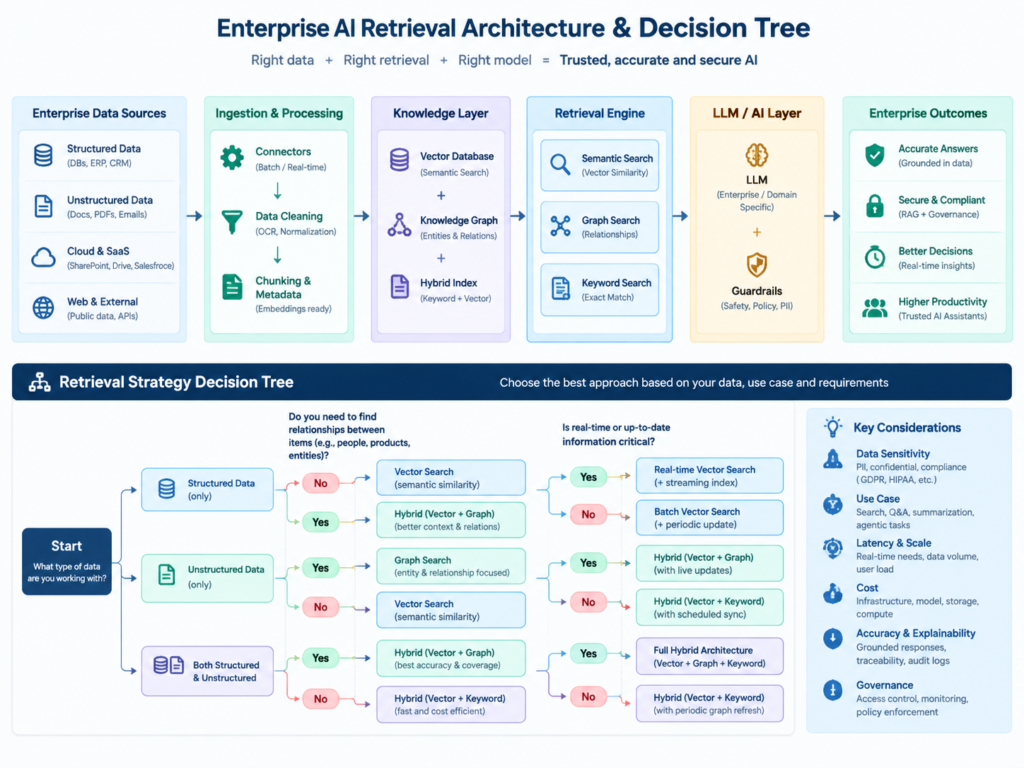
Start with the simplest retrieval architecture that meets your business requirements. Add complexity when testing demonstrates measurable benefits.
Enterprise AI Architecture Decision Guide
Select the workload that best describes your organization.
Recommended starting point: Vector-only RAG
A practical option for semantic enterprise search, technical documentation, and internal knowledge assistants.
Next step
Benchmark the proposed architecture against a vector-first baseline, including answer quality, permissions, p95 latency, and total ownership cost.
For most document-focused applications, vector RAG provides a sensible baseline.
Choose graph retrieval when connected entities and traceable relationships dominate the workload. Consider hybrid Graph RAG when neither approach independently produces sufficiently complete answers.
Before production, validate your assumptions using representative enterprise questions and predefined success thresholds.
Enterprise web application development and API and backend engineering can support the surrounding integration and application layers.
Concluding Remarks
The knowledge graph vs vector database decision is not about which technology is universally superior.
For straightforward document retrieval, vector databases often offer a practical and efficient starting point. When business relationships and explainable connections matter, knowledge graphs provide capabilities that semantic similarity alone cannot replace.
Hybrid Graph RAG becomes attractive when enterprise questions require both.
The best approach is to test real workloads, validate security requirements, and invest in additional complexity only when the benefits are measurable.
At Mak It Solutions, our development and integration services can support enterprise AI applications through backend engineering, APIs, and data workflows.
Planning a vector RAG or Graph RAG implementation? Contact Mak It Solutions to discuss your architecture requirements and practical implementation options.
Key Takeaways
Vector databases are effective for semantic search and document-centric RAG.
Knowledge graphs support explicit relationships, provenance, and connected entity analysis.
Hybrid Graph RAG can improve answers involving multiple documents and relationships, but adds operational complexity.
Cost comparisons should include indexing, infrastructure, engineering, maintenance, and evaluation.
Compliance requires authorization, privacy controls, auditability, and regulatory assessment not simply local hosting.
Architecture selection should follow measured retrieval quality, latency, business value, and governance requirements.
FAQs
Q : Can a knowledge graph store vector embeddings?
A : Yes. Some graph databases support vector embeddings and similarity indexes alongside relationship-based queries.
This enables semantic retrieval and graph exploration within one platform. However, indexing capabilities, performance, scaling, and access controls vary by product.
Q : Does Graph RAG work with existing enterprise databases?
A : Yes. Graph RAG can integrate with SQL databases, document repositories, cloud storage, and existing business applications.
Organizations can build synchronized retrieval indexes without replacing operational databases. Data quality, entity resolution, and permission propagation remain important challenges.
Q : How often should a Graph RAG knowledge graph be updated?
A : Update frequency should follow the rate of source-data changes and the business impact of outdated information.
Static documentation may require occasional reindexing, while changing financial or operational relationships may need frequent synchronization. Enterprises should establish measurable freshness requirements.
Q : Can vector embeddings expose sensitive enterprise information?
A : Yes. Embeddings and their retrieval systems can create information-leakage risks when security controls are inadequate.
Organizations should implement encryption, least-privilege access, tenant isolation, data minimization, retention policies, and tested deletion procedures. Embeddings should not automatically be treated as anonymous data.
Q : What should an enterprise test before a GraphRAG pilot?
A : Compare vector-only, graph-enhanced, and hybrid retrieval using representative questions and consistent access controls.
Measure recall, grounded ness, citation accuracy, p95 latency, indexing costs, and cost per successful answer. Include unauthorized-access and stale-data scenarios before approving production deployment.