

Quantum-Safe Data Backup: Vital GCC Strategies
Quantum-Safe Data Backup: Vital GCC Strategies

Quantum-Safe Data Backup: Vital GCC Strategies
For a Saudi bank, healthcare provider, or government organization, protecting sensitive data doesn’t end when a backup is created. Some records must remain confidential for decades, even as cybersecurity threats and encryption technologies evolve.
Quantum-Safe Data Backup is a long-term data protection strategy that combines strong encryption, post-quantum cryptography (PQC), secure key management, immutable storage, and tested disaster recovery. For businesses in Saudi Arabia, the UAE, and Qatar, it also means considering local cybersecurity regulations and data residency requirements.
The concern is not that today’s encrypted backups are suddenly unsafe. It’s that certain cryptographic systems protecting sensitive information today could become vulnerable to future quantum computers.
Organizations investing in backend infrastructure and data protection systems should consider these risks when planning long-term resilience.
What Is Quantum-Safe Data Backup?
Quantum-Safe Data Backup is an approach to protecting stored and archived information against both conventional cyber threats and future quantum-related risks.
It brings together encryption, quantum-resistant cryptographic mechanisms, secure storage, access controls, and reliable restoration procedures.
How Post-Quantum Cryptography Protects Long-Term Data
Post-quantum cryptography uses mathematical algorithms designed to resist attacks from powerful quantum computers.
In 2024, the US National Institute of Standards and Technology (NIST) finalized foundational PQC standards.
FIPS 203: ML-KEM, designed for quantum-resistant key establishment.
FIPS 204: ML-DSA, used for digital signatures.
FIPS 205: SLH-DSA, a hash-based digital signature standard.
These standards address different security functions. Implementing one algorithm does not automatically make an entire backup environment quantum-safe.
Organizations must assess how cryptography is used across their backup infrastructure, including data transfers, encryption keys, certificates, and recovery operations.
Why Harvest Now, Decrypt Later Matters in Saudi Arabia
Imagine a financial institution transferring confidential records between Riyadh and Jeddah.
An attacker might intercept and store certain encrypted communications, hoping to decrypt them when more capable quantum computers become available.
This threat is commonly called harvest now, decrypt later.
It is particularly relevant to information that must remain confidential for many years, including financial records, patient histories, government documents, and intellectual property.
However, quantum computers would not automatically decrypt every stolen backup. The actual risk depends on the encryption method, cryptographic dependencies, key exposure, and system implementation.
AES-256 vs. Quantum-Resistant Cryptography
AES-256 remains a strong encryption option for protecting stored backup data. Post-quantum algorithms address other cryptographic functions, particularly key establishment and digital signatures.
| Technology | Primary function |
Quantum-era consideration |
|---|---|---|
| AES-256 | Encrypts stored data | Remains a strong symmetric encryption choice |
| ML-KEM | Establishes shared cryptographic keys | Designed to resist quantum attacks |
| ML-DSA | Creates and verifies digital signatures | Supports quantum-resistant authentication and integrity verification |
The practical goal is not to replace AES-256 with ML-KEM. These technologies serve different purposes and can form part of the same security architecture.
How Quantum-Safe Backup Architecture Works
An effective quantum-safe backup architecture protects information throughout its lifecycle, from initial encryption to long-term storage and eventual recovery.
Encryption, HSMs, and Secure Key Management
Strong backup security begins with protecting both the data and the cryptographic keys required to access it.
A well-designed enterprise environment typically includes.
AES-256 encryption: Protects sensitive backup information at rest.
Key Management Systems (KMS): Support controlled encryption-key generation, access, rotation, and recovery.
Hardware Security Modules (HSMs): Provide hardware-based safeguards for sensitive cryptographic operations and key material.
PQC-aware key establishment: Helps protect supported communications and key-exchange processes against future quantum threats.
Cryptographic agility: Allows organizations to upgrade algorithms without losing access to historical backups.
Key recovery is especially important.
A backup can remain perfectly intact but become unusable if the organization loses the encryption key or can no longer operate the software needed to restore it.
Immutable Backups, Offline Copies, and Recovery Security
Quantum resistance addresses only part of the threat landscape.
Ransomware, unauthorized access, accidental deletion, and infrastructure failures remain immediate operational risks.
Organizations should maintain:
Immutable backups that cannot be modified during a defined retention period.
Isolated offline or appropriately protected recovery copies.
Separate administrative permissions for production and backup environments.
Backup integrity checks and monitoring.
Regular restoration tests covering data, applications, and encryption-key availability.
For application-level protection, secure website backup and maintenance practices should complement broader enterprise disaster recovery controls.
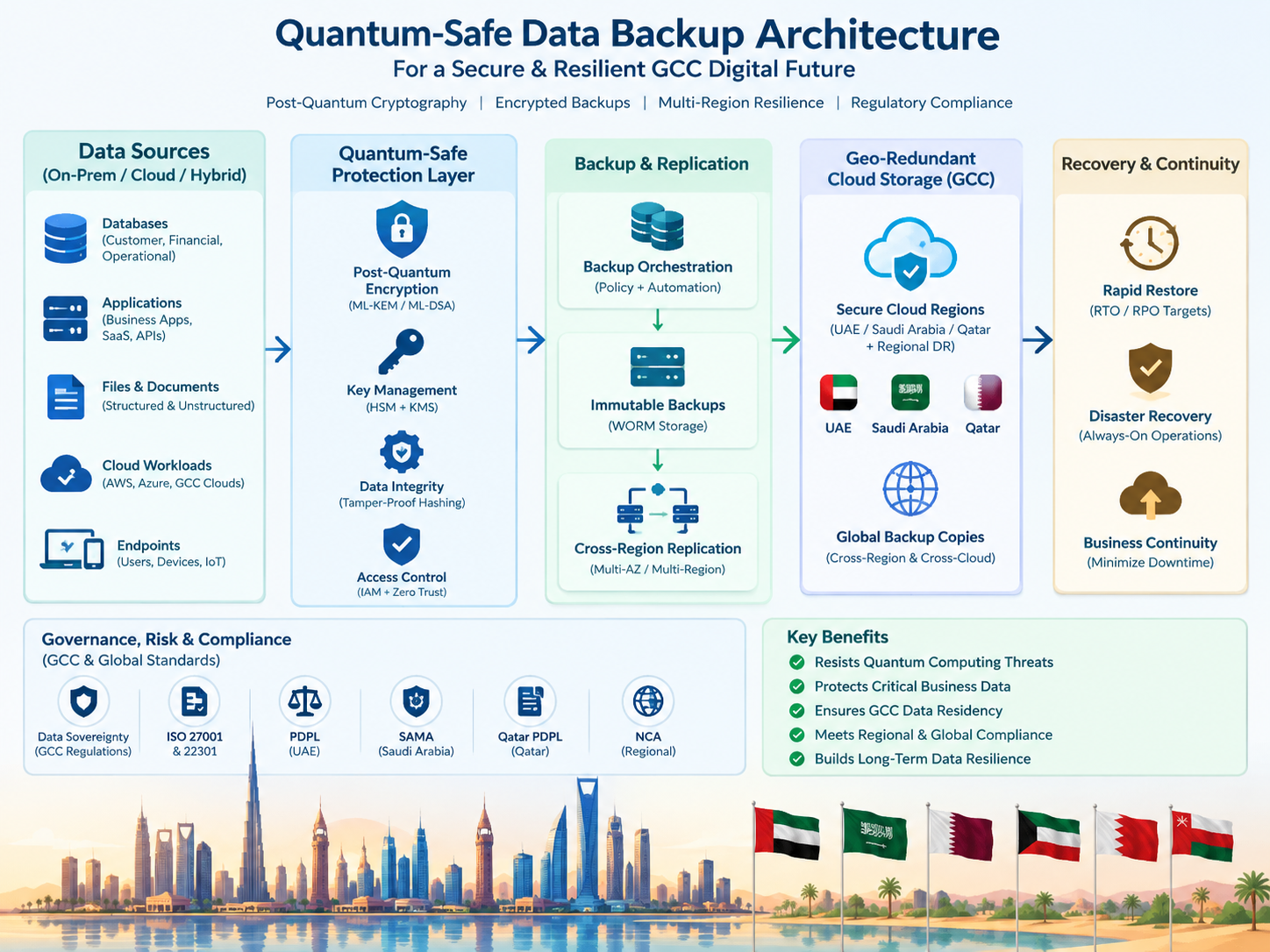
GCC Cloud and Data Residency Architecture
Businesses operating across Saudi Arabia, the UAE, and Qatar must consider where their information is stored, processed, and recovered.
Regional cloud infrastructure includes AWS Bahrain, Microsoft Azure UAE regions, and Google Cloud Doha.
Cloud-region availability, however, does not guarantee that every backup, HSM, KMS, or disaster recovery service is available locally.
As of October 2026, AWS’s announced Saudi Arabia region was targeted for a December 2026 launch. Organizations should verify its operational status and individual service availability before making deployment commitments.
A conceptual architecture might follow this sequence.
Primary Enterprise Systems
Databases, applications, confidential records
Encrypted Backup and Protected Transport
AES-256 encryption, PQC-aware key establishment
KMS / HSM
Protected keys, authorization, recovery controls
Immutable and Isolated Archives
Retention policies, integrity, access restrictions
Validated Disaster Recovery
Restoration tests, key availability, recovery evidence
Conceptual architecture; the KMS/HSM operates as a protected supporting service, not necessarily as an inline data-transfer stage.
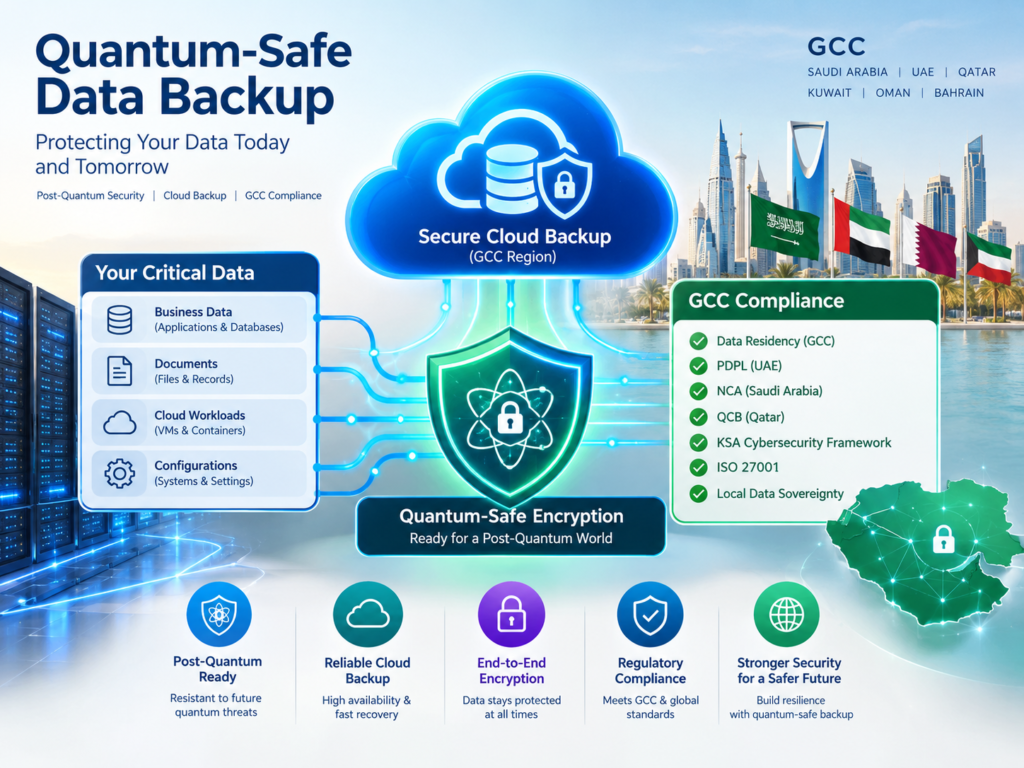
GCC Compliance Requirements for Quantum-Safe Backups
Quantum-resistant encryption does not automatically establish regulatory compliance.
Saudi Arabia, the UAE, and Qatar have distinct cybersecurity, data protection, and sector-specific requirements. Organizations must assess which rules apply to their information and operations.
Saudi Arabia.
Saudi organizations should begin with the requirements relevant to their sector, data classification, and infrastructure.
The Saudi National Cybersecurity Authority’s National Cryptographic Standards establish minimum cryptographic requirements for covered systems and information.
Other important frameworks include the Personal Data Protection Law (PDPL), applicable National Data Management Office (NDMO) policies, and NCA cybersecurity controls.
Financial institutions within scope must also review the Saudi Central Bank’s Cyber Security Framework, including cryptography, key lifecycle management, backup protection, and recovery requirements.
The central question is not simply whether an organization uses strong encryption. It is whether encryption, storage, access, retention, and recovery practices satisfy its applicable obligations.
UAE.
The UAE’s National Encryption Policy addresses encryption at rest and in transit, key management, post-quantum cryptography, and monitoring.
Businesses must also consider relevant national, emirate-level, free-zone, and sector requirements, including those associated with TDRA, DIFC, and ADGM.
For example, a Dubai retailer and an Abu Dhabi financial institution may face different legal and operational requirements for overseas backup storage.
Qatar.
Qatar’s National Cyber Security Agency (NCSA) provides guidance on data classification and cybersecurity governance.
Banks and other regulated financial institutions should also review applicable Qatar Central Bank (QCB) technology-risk and cybersecurity requirements.
Useful official references include the NCSA National Data Classification Policy and QCB Technology Risks Regulation.
Before choosing a hosting provider, organizations should verify exactly where backups, encryption keys, supporting services, and recovery copies will reside.
|
Country |
Relevant authorities |
Backup planning priorities |
|---|---|---|
| Saudi Arabia | NCA, SAMA, SDAIA/NDMO | Cryptographic controls, data classification, retention, recovery |
| UAE | Cyber Security Council, TDRA, DIFC, ADGM | Encryption governance, privacy, key management, jurisdiction |
| Qatar | NCSA, QCB | Data classification, operational resilience, hosting and transfer requirements |
Regulatory applicability depends on the organization, its activities, and the data being processed. Qualified legal and compliance review is advisable before finalizing an architecture.
Quantum-Safe Backup Use Cases Across GCC Industries
Different industries face different information-security risks. The best backup strategy depends on how sensitive the data is, how long it must remain confidential, and how quickly operations need to recover after disruption.
Saudi Fintech, Banking, and Government Records
A fintech company in Riyadh may store sensitive financial records, transaction histories, identity documents, and customer information.
Its migration priorities could include identifying vulnerable certificate dependencies, strengthening encryption-key protection, and evaluating applicable SAMA requirements.
Saudi government organizations may have additional data-classification and retention responsibilities. Their backup strategies should account for controlled access, long-term confidentiality, and reliable restoration.
UAE Healthcare, Retail, and Logistics Archives
For an Abu Dhabi healthcare provider, protecting long-lived patient records may be a priority.
A Dubai retailer may focus more heavily on transactional integrity, customer information, secure payment-related records, and business continuity.
Companies modernizing e-commerce platforms or mobile applications should consider how these systems generate, transfer, and store sensitive information.
Building security into those processes is generally easier than adding it after the systems are deployed.
Qatar Financial Institutions and Critical Infrastructure
A Doha-based bank may need to evaluate encryption, key custody, audit evidence, and recovery procedures against applicable financial-sector requirements.
Meanwhile, a logistics or critical infrastructure operator may prioritize protected operational archives, continuity planning, and appropriately located disaster recovery systems.
|
Industry |
Sensitive information |
Primary protection priority |
|---|---|---|
| Banking | Transactions and customer financial records | Long-term confidentiality |
| Healthcare | Patient histories and medical information | Privacy and recoverability |
| Government | Classified and sensitive public records | Controlled access and key protection |
| Retail and logistics | Customer transactions, contracts, operational records | Data integrity and resilience |
How to Build a Quantum-Safe Data Backup Migration Roadmap
Moving toward quantum-safe protection does not necessarily require replacing an organization’s entire backup infrastructure.
A phased migration gives IT and security teams room to evaluate compatibility, protect legacy records, and validate recovery before wider deployment.
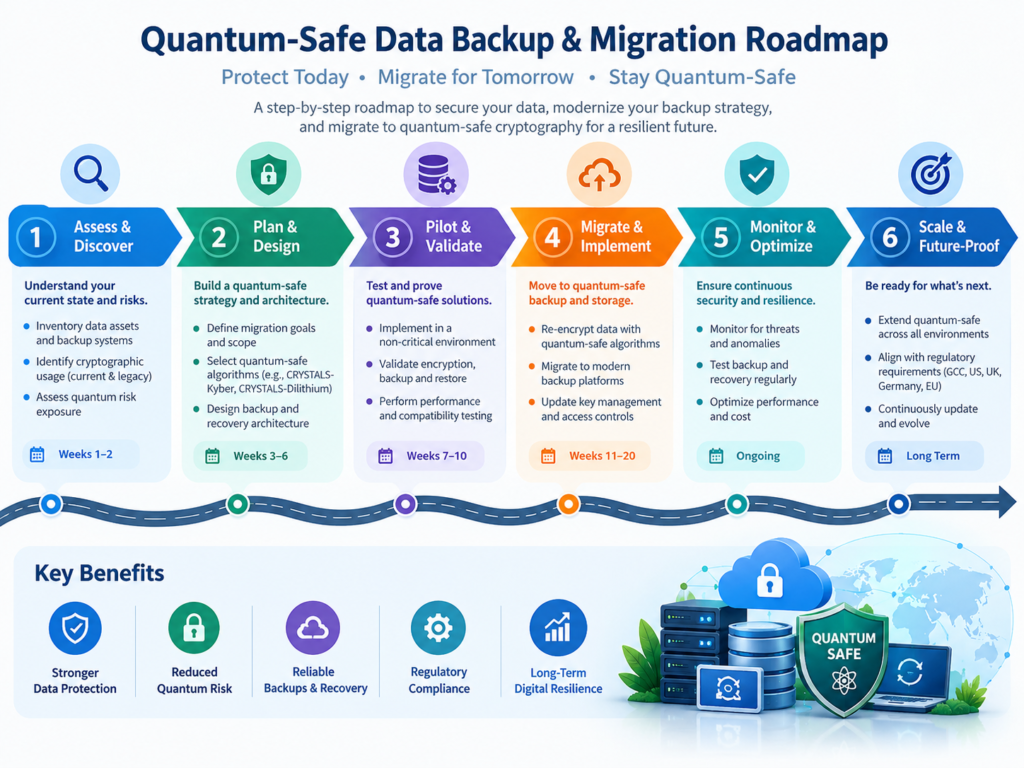
The following six-step roadmap provides a practical starting point.
Inventory.
Prioritize.
Evaluate.
Pilot.
Validate.
Expand.
Six-stage enterprise migration roadmap.
Inventory Cryptography and Prioritize Sensitive Data
Primary function
Identify the encryption technologies and dependencies used throughout your backup environment.
Review backup applications, encryption algorithms, certificates, key management systems, HSM integrations, data locations, and retention policies.
This creates a clearer picture of potential vulnerabilities and migration complexity.
Prioritize long-term sensitive information
Not every dataset requires the same migration urgency.
Prioritize information based on its sensitivity, confidentiality lifetime, exposure risk, regulatory requirements, and business importance.
A long-retention financial archive may justify earlier attention than temporary operational data.
Evaluate PQC Vendors and Pilot Hybrid Protection
Evaluate vendors and technical compatibility.
Look beyond marketing claims about quantum-resistant security.
Assess vendors against.
Support for relevant NIST cryptographic standards.
Compatibility with existing encryption and key management systems.
Clear technical documentation and interoperability.
Backup portability and restoration capabilities.
Relevant compliance documentation and data residency support.
Operational support and long-term maintenance requirements.
Pilot supported hybrid cryptography
Where appropriate, test hybrid implementations that combine established cryptographic mechanisms with post-quantum capabilities.
Pilots should examine performance, integration challenges, key handling, and compatibility with historical backup formats.
Organizations with older applications may need custom software development or legacy application modernization support during integration.
Validate Recovery and Expand Deployment
Test real recovery scenarios.
A successful encryption test does not prove that an organization can restore its business systems.
Test representative archives, key retrieval, user authorization, data integrity, legacy compatibility, and recovery procedures under controlled conditions.
Include scenarios involving unavailable keys or disconnected recovery environments.
Expand deployment gradually
After successful validation, extend the architecture to additional systems according to risk and business priorities.
Document deployment changes, monitor failures, retain audit evidence, and continue restoration testing.
Vendor Evaluation Scorecard
Organizations can use a weighted scorecard when comparing potential providers.
|
Evaluation criterion |
Suggested weight |
|---|---|
| Cryptographic standards and interoperability |
30% |
| Key management and recoverability |
25% |
| Data residency and regulatory evidence |
20% |
| Legacy integration and portability |
15% |
| Support and operational cost |
10% |
These percentages are illustrative procurement weights, not industry benchmarks. Adjust them to reflect your organization’s risk profile and regulatory obligations.
Costs, Challenges, and Best Practices for GCC Enterprises
A quantum-safe backup migration is both a technical and operational investment.
Its cost depends on the current infrastructure, existing security controls, retained data volume, and the extent of required changes.
What Determines Quantum-Safe Backup Costs in Saudi Arabia, UAE, and Qatar?
Several factors influence migration budgets.
Backup volume and long-term retention requirements.
Existing KMS and HSM capabilities.
Software licensing and cloud-service costs.
Support for post-quantum and hybrid cryptography.
Legacy system integration and data portability.
Engineering, security testing, and disaster recovery exercises.
Compliance assessment and documentation.
There is no reliable universal migration price for GCC businesses.
Organizations should request a scoped technical assessment before committing to procurement budgets.
Common Migration Challenges and Crypto-Agility Best Practices
One of the biggest challenges is maintaining access to older data while introducing newer cryptographic mechanisms.
Legacy applications may use unsupported encryption formats, outdated certificates, or proprietary recovery tools.
Poorly planned changes can increase operational risk rather than reduce it.
Practical safeguards include keeping cryptographic inventories current, documenting key ownership, maintaining secure recovery procedures, and choosing technologies that support future algorithm changes.
Avoid treating quantum-safe encryption as a substitute for conventional cybersecurity controls.
When to Request a PQC Readiness Assessment
A readiness assessment may be appropriate when an organization has.
Sensitive records requiring long-term confidentiality.
Undocumented encryption or certificate dependencies.
Upcoming cloud migration or infrastructure modernization projects.
Regulated financial, healthcare, or government information.
Backup systems with uncertain key-recovery capabilities.
Limited evidence of successful disaster recovery testing.
A useful assessment should produce a cryptographic inventory, prioritized risk findings, control-gap analysis, and actionable migration roadmap.
Before approving a solution, decision-makers should verify data classification, key ownership, vendor compatibility, jurisdiction-specific requirements, backup immutability, and successful restoration evidence.
Outlook
Quantum-Safe Data Backup is not about predicting exactly when quantum computers will threaten existing cryptography. It is about making sensible decisions today so sensitive information remains protected and recoverable in the future.
For Saudi enterprises, strong symmetric encryption, PQC-aware planning, secure key management, cryptographic agility, and dependable recovery are important parts of that strategy. Mak It Sol
Businesses operating in the UAE and Qatar must also account for their own regulatory, cloud, and data residency requirements.
The most practical starting point is a clear inventory of existing systems, followed by a risk-based migration roadmap.
Planning to strengthen your enterprise backup infrastructure?
Contact Mak It Solutions to discuss your technology requirements, review its development and infrastructure-related services, and explore an appropriate modernization approach.
For specialized post-quantum cryptography and regulatory assessments, involve suitably qualified security and compliance professionals.
FAQs
Q : Is AES-256 enough for quantum-safe backup storage in Saudi Arabia?
A : AES-256 remains a strong symmetric encryption option against currently understood quantum threats. However, long-term protection also depends on encryption-key management, public-key cryptographic dependencies, system configuration, and recovery procedures.
Saudi organizations should review applicable NCA and SAMA requirements when assessing their backup environments.
Q : Can UAE businesses store quantum-safe backups in overseas cloud regions?
A : Potentially, depending on the data, sector, legal obligations, and applicable transfer restrictions.
Using quantum-resistant cryptography does not automatically authorize international data transfers. Businesses should verify privacy requirements, key custody, provider arrangements, and disaster recovery locations before selecting overseas storage.
Q : What should Qatar banks look for in a quantum-resistant backup provider?
A : Qatar banks should examine cryptographic standards, interoperability, key recovery, auditability, backup integrity, and restoration performance.
They should also verify applicable QCB requirements and determine which services are actually available in the selected hosting region.
Q : Must businesses in Dubai and Abu Dhabi immediately replace existing encrypted backups?
A : Not necessarily.
A phased approach is generally more appropriate than replacing every backup system simultaneously. Organizations should first assess current encryption strength, key management, data sensitivity, confidentiality requirements, and exposure to vulnerable public-key cryptography.
Q : How can Saudi government organizations test quantum-safe backup recovery?
A : Recovery exercises should verify encrypted archive access, key availability, administrator authorization, data integrity, and successful restoration.
Tests should also cover legacy encryption configurations, failed key-access scenarios, and recovery in isolated environments. Documented results can help organizations identify weaknesses and support applicable cybersecurity-control requirements.