


Cloud Exit Strategy: A Smart GCC Guide to Resilience
Cloud Exit Strategy: A Smart GCC Guide to Resilience

Cloud Exit Strategy: A Smart GCC Guide to Resilience
What happens when your primary cloud provider becomes unavailable during a regional disruption? For businesses in Riyadh, Dubai, Abu Dhabi, Jeddah and Doha, the consequences can extend beyond temporary downtime. Payment processing may stop, customer records may become inaccessible, and critical deliveries could be delayed.
A cloud exit strategy is a documented and tested plan for moving applications, data and essential services away from a cloud provider without unacceptable disruption. For organizations in Saudi Arabia, the UAE and Qatar, it helps reduce vendor lock-in, maintain business continuity and address applicable data protection and regulatory obligations.
The goal is not necessarily to abandon your existing provider. It is to ensure your business can recover, migrate or continue operating when your original cloud environment is no longer a viable option.
What Is a Cloud Exit Strategy and Why Does It Matter in the GCC?
A cloud exit strategy defines how an organization can transition away from a cloud service provider while protecting its critical operations, data, security and compliance responsibilities.
This becomes particularly important when businesses rely heavily on proprietary infrastructure or when regional disruptions affect connectivity, hosting facilities or essential third-party services.
Cloud Exit Strategy vs. Disaster Recovery vs. Multi-Cloud
These approaches are related, but they solve different problems.
|
Approach |
Primary purpose |
|---|---|
| Cloud exit strategy | Transition away from a cloud provider or service |
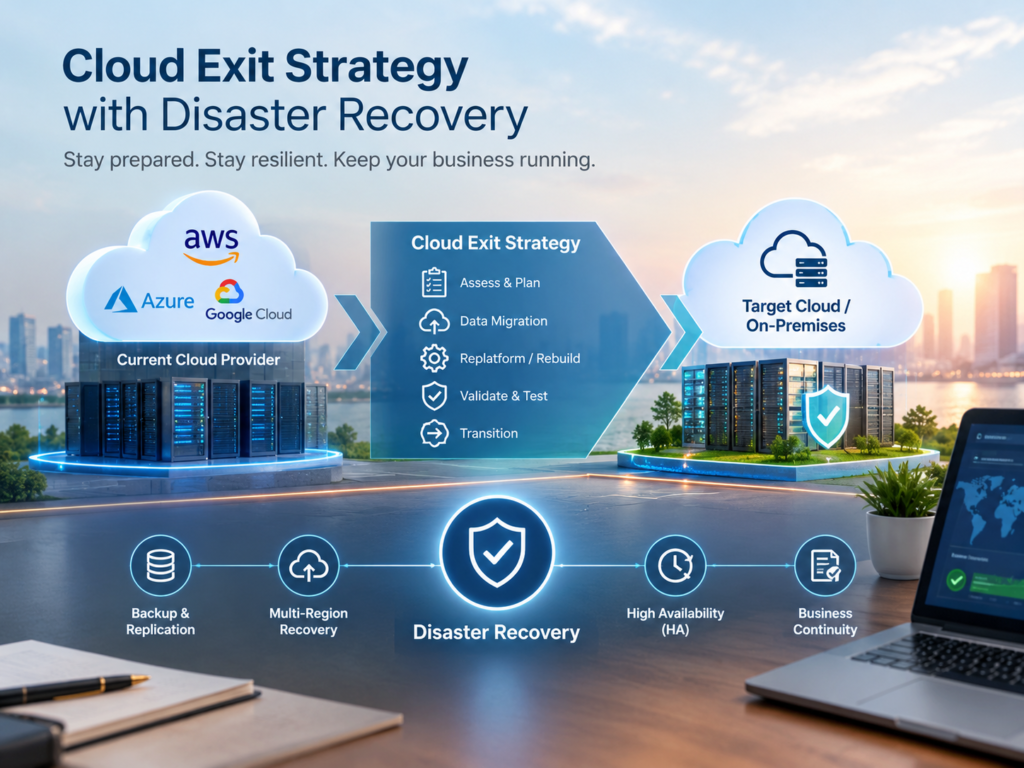
| Disaster recovery | Restore systems following disruption |
| Multi-cloud | Operate workloads across multiple cloud providers |
A disaster recovery setup within the same cloud ecosystem can protect against certain failures. However, it may not sufficiently address provider-wide outages, contractual problems or regional infrastructure disruptions.
Likewise, using multiple providers does not automatically guarantee portability. Each environment needs tested recovery procedures and manageable technical dependencies.
Why Vendor Lock-In Creates Risk for GCC Businesses
Cloud vendor lock-in occurs when applications become so dependent on a provider’s proprietary services that switching becomes costly, complex or operationally risky.
Common sources include.
Proprietary databases and storage formats.
Provider-specific APIs and serverless functions.
Cloud-native identity and access management.
Infrastructure configurations that cannot easily be recreated elsewhere.
Monitoring, encryption and security services tied to a particular ecosystem.
Consider a Riyadh fintech company whose transaction processing relies on proprietary cloud services. Moving to an alternative environment could require substantial application changes before payments can resume.
A Dubai retailer might face a similar challenge if its checkout system and inventory services depend on a single provider.
Organizations investing in scalable backend applications should evaluate cloud portability during architecture planning rather than waiting until migration becomes urgent.
Managed Cloud Exits vs. Emergency Exits
A managed cloud exit takes place under relatively predictable circumstances, such as contract renewal, cost optimization or infrastructure modernization.
An emergency exit follows a serious outage, supplier failure, security event or regional connectivity disruption.
The distinction matters. A planned migration may allow extensive testing and phased cutovers, while an emergency transition requires preapproved alternatives, accessible recovery data and clear decision-making authority.
A successful exit plan should address both scenarios.

How to Build a Cloud Exit Strategy Without Vendor Lock-In
The most practical approach starts with understanding what your organization depends on, which services are essential and what it would take to restore them elsewhere.
Audit Critical Applications, Data and Cloud Dependencies
Start by creating an inventory of business-critical workloads.
Document applications, databases, APIs, storage systems, encryption keys, network settings and third-party integrations. Assign an accountable owner to each workload and identify the supporting services it needs to operate.
Pay particular attention to personal information, financial records and other sensitive datasets that may be subject to additional legal or contractual requirements.
This inventory becomes the foundation for migration priorities, recovery planning and cost estimates.
Design Portable Architecture and Independent Recovery Options
Application portability can reduce migration barriers, but it needs to be designed intentionally.
Technologies worth considering include.
Kubernetes: Supports container orchestration across compatible environments.
PostgreSQL: Provides an open-source relational database option.
OpenTofu: Helps manage infrastructure through reusable configuration.
Containerization: Packages applications and dependencies for more consistent deployment.
S3-compatible storage: Can simplify data transfer between compatible storage platforms, although implementations and features may differ.
These technologies are not guaranteed solutions to vendor lock-in. Applications can still depend on proprietary managed services, networking configurations, authentication systems or operational tooling.
Well-documented interfaces and custom Python applications can also support adaptable architectures.
For organizations modernizing legacy systems, web development and application modernization services may help reduce dependencies before migration.
Cloud Exit Strategy Checklist for GCC Enterprises
Use this checklist to evaluate whether your organization could move a critical workload to an alternative environment.
Cloud exit readiness checklist
0 of 8 complete
Completing the documentation is only the beginning. A strategy becomes credible when independent recovery tests demonstrate that the required applications, records and security controls work in the alternative environment.
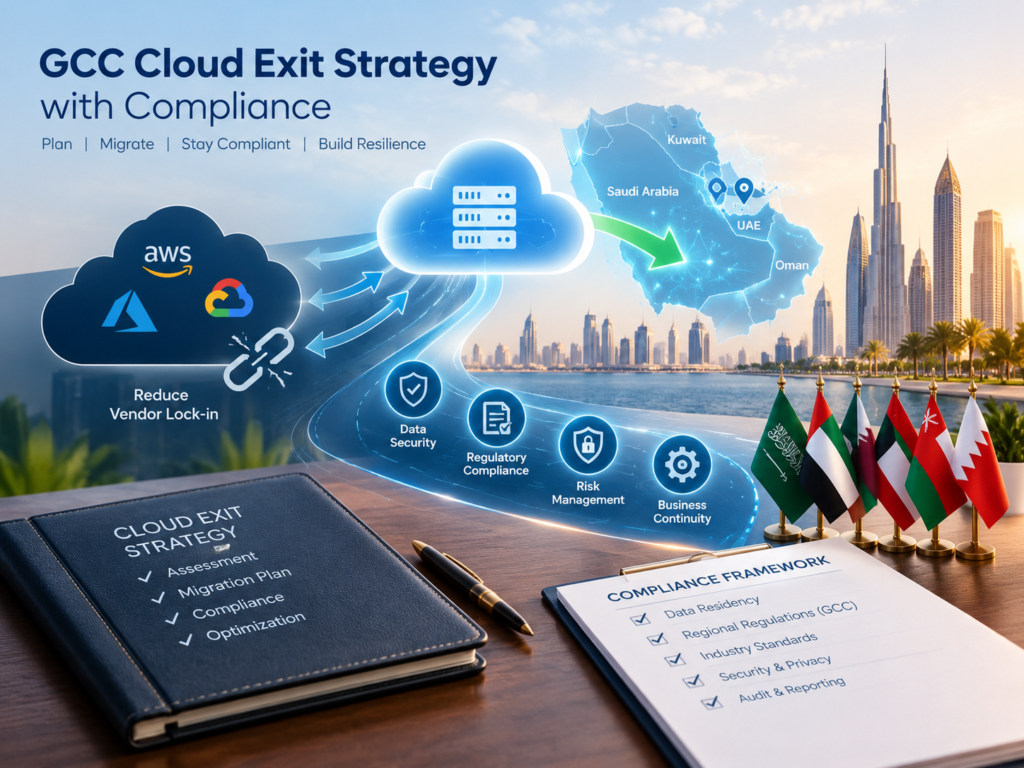
GCC Cloud Exit Compliance: Saudi Arabia, UAE and Qatar
Cloud exits in the GCC must account for national laws, sector-specific regulations, data classification rules and contractual commitments.
There is no single data residency requirement that applies identically to every organization across Saudi Arabia, the UAE and Qatar.
Saudi Arabia.
Saudi businesses should evaluate the National Cybersecurity Authority’s Cloud Cybersecurity Controls (CCC-2:2024), relevant National Data Management Office policies and applicable Saudi Central Bank (SAMA) requirements.
The NCA framework addresses cloud cybersecurity obligations for cloud service providers and cloud service tenants. Its application depends on the organization’s regulatory scope and operating arrangements.
For example, a Riyadh financial institution considering a new cloud provider should assess outsourcing requirements, cybersecurity controls, data classification, authorized hosting locations and continuity arrangements before proceeding.
A technically successful migration is not sufficient if the destination architecture fails to satisfy applicable regulatory requirements.
UAE.
The Central Bank of the UAE (CBUAE) provides particularly relevant guidance for regulated financial institutions.
Its cloud computing guidance addresses business continuity, outsourced cloud arrangements, stressed exits and the need for documented exit plans.
Relevant provisions also discuss data recovery and permanent deletion when outsourced cloud services terminate.
Organizations should separately assess the requirements of the Telecommunications and Digital Government Regulatory Authority (TDRA), as well as applicable ADGM or DIFC frameworks.
A Dubai-based financial institution, for example, may need a more formal exit and outsourcing governance process than a general commercial retailer.
Qatar.
The Qatar Central Bank’s Cloud Computing Regulation covers cloud outsourcing, contract termination and exit planning for institutions within its scope.
It addresses matters including data return, cloud provider exit assistance, secure deletion and planned versus stressed exits.
For a Doha financial institution, cloud recovery planning should confirm that the intended backup locations, service providers and transfer arrangements are legally and operationally acceptable.
The availability of a foreign cloud region does not establish permission to store regulated data there.
GCC Cloud Compliance Comparison
|
Market |
Key regulatory references |
Cloud exit priority |
|---|---|---|
| Saudi Arabia |
NCA, NDMO, SAMA |
Data classification, cloud security and sector controls |
| UAE |
CBUAE, TDRA, ADGM, DIFC |
Outsourcing governance, continuity and stressed exit |
| Qatar |
QCB, NCSA |
Exit planning, data sovereignty and contractual recovery |
These are starting points for compliance assessment, not exhaustive lists of legal obligations.
Organizations should confirm current regulatory applicability with qualified legal, compliance and cybersecurity professionals before approving cross-border migrations.
Cloud Resilience During Regional Disruption
Cloud resilience is not simply about purchasing services from multiple providers. It depends on whether an organization can restore critical operations when its usual infrastructure becomes unavailable.
That means considering network independence, backup accessibility, authentication, recovery locations and operational readiness.
Single-Cloud Failover vs. Multi-Cloud Disaster Recovery
Different recovery architectures offer different trade-offs.
|
Architecture |
Main advantage |
Potential limitation |
|---|---|---|
| Single-cloud failover | Simpler operations and management | Continued provider concentration |
| Multi-cloud disaster recovery | Greater provider diversification | Higher cost and technical complexity |
| Hybrid infrastructure | Flexible placement and recovery options | Additional security and management responsibilities |
For some businesses, geographically separated recovery infrastructure within a single provider may be sufficient.
Others may need independent hosting, multiple cloud providers or hybrid environments to meet their recovery objectives.
The right choice depends on business impact, data sensitivity, regulatory requirements and the organization’s ability to test and operate the design.
Cloud Hosting and Data Residency Across Riyadh, Dubai and Doha
GCC businesses can evaluate established regional cloud infrastructure, including AWS Middle East (Bahrain), Microsoft Azure UAE regions and Google Cloud’s Doha region, alongside eligible local hosting providers.
However, not every cloud service is available in every region. For example, Microsoft documents specific access restrictions for Azure UAE Central.
Before selecting a primary or recovery environment, confirm:
Availability of the required cloud services and features.
Permitted locations for data processing, storage and backups.
Network connectivity and potential shared failure points.
Access to encryption keys, identity services and monitoring.
Regulatory and contractual restrictions on data transfer.
The ability to restore services independently of the original provider.
A nearby data center is not automatically the safest alternative. Regional dependencies may include telecommunications providers, power infrastructure and operational support arrangements.
Continuity Examples for GCC Fintech, Government, Retail and Logistics
Different industries need different recovery priorities.
Riyadh fintech: A financial technology provider maintains independent transaction backups and rehearses recovery of payment-processing services, including reconciliation and security checks.
Abu Dhabi government: A public-sector organization validates whether citizen-facing systems can recover on infrastructure approved for its data and security classifications.
Dubai retail: An online retailer protects checkout and order continuity through portable e-commerce systems, recoverable order records and tested payment integrations.
Doha logistics: A logistics company prepares alternative hosting for shipment tracking and verifies that warehouse and delivery integrations reconnect correctly after recovery.
Organizations operating customer-facing mobile applications should also test authentication, push notifications and API availability during cutover.
These illustrative scenarios show why a cloud exit plan must consider the complete service, not just its servers.
Cloud Exit Costs, Contracts and Migration Timelines in the GCC
A cloud exit strategy has a financial dimension. Organizations need to understand how much a planned migration could cost and what emergency recovery would require.
What Drives Cloud Exit and Data Egress Costs?
Potential expenses include.
Data transfer and egress fees.
Storage retrieval and backup restoration.
Temporary parallel hosting.
Engineering and migration support.
Application refactoring.
Security testing and compliance reviews.
Staff training and operational handover.
Data volumes alone do not determine the total cost.
A small application with extensive proprietary dependencies could be more difficult to migrate than a larger but portable application.
Organizations should assess both controlled migrations and emergency scenarios, including the cost of operational downtime.
Cloud Contract Termination Clauses Every GCC Enterprise Should Review
The best time to negotiate cloud exit protections is before signing a long-term agreement.
Important provisions include data ownership and export rights, usable file formats, termination conditions, transition assistance, audit access, subcontractor responsibilities and service-level commitments.
Contracts should also address the return of customer data, secure deletion procedures, evidence of deletion and any applicable governing law.
Where a provider relies on subcontractors, organizations should understand whether those dependencies could delay recovery or data retrieval.
How Long Does a Cloud Exit Strategy Take to Execute?
There is no universal migration timeline.
A relatively small, containerized workload with straightforward dependencies may be easier to transfer. Complex financial, government or enterprise platforms can require substantial preparation and coordinated testing.
Important factors include data volume, application architecture, migration permissions, regulatory approvals, provider cooperation and the availability of skilled technical teams.
An emergency exit can be significantly slower than anticipated when backup access, credentials or infrastructure reconstruction have not been tested.
For this reason, cloud exit planning should begin before a migration becomes necessary.
How to Test and Improve Cloud Exit Readiness
A documented strategy is valuable, but testing determines whether it will work under pressure.
Set RTO, RPO and Exit Success Criteria
Recovery Time Objective (RTO) defines the maximum targeted duration for restoring a service after disruption.
Recovery Point Objective (RPO) defines the maximum acceptable data loss, measured as a period of time.
Both objectives should reflect business requirements rather than arbitrary technical targets.
Exit success criteria should also address.
Application functionality and transaction processing.
Data completeness and integrity.
Encryption-key availability.
User authentication and authorization.
Network and third-party connectivity.
Regulatory and security controls.
Rollback capability if the migration fails.
An application that restarts but cannot authenticate users or process transactions has not achieved full operational recovery.
Run Cloud Exit Simulations and Validate Recovery Evidence
Testing should cover realistic scenarios instead of relying only on backup-success notifications.
Useful exercises include tabletop simulations, independent-provider restorations, infrastructure reconstruction, DNS changes, application cutovers and rollback tests.
For critical workloads, organizations should verify that restoration remains possible when the original provider’s management console or identity services are unavailable.
Retain test logs, recovery measurements, outstanding issues and remediation records.
These records help teams evaluate readiness and provide evidence for internal governance or applicable regulatory reviews.
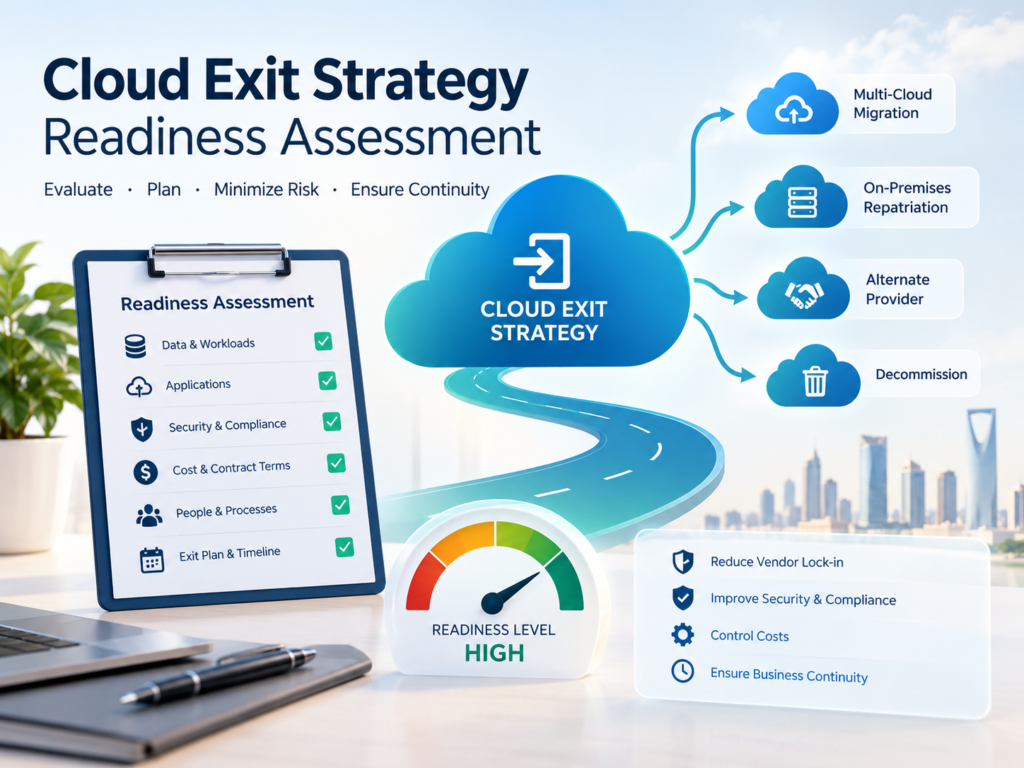
When Should a GCC Enterprise Request a Cloud Exit Readiness Assessment?
An assessment is particularly valuable before.
A cloud contract renewal.
A major infrastructure migration.
Adoption of proprietary managed cloud services.
A regulatory or internal compliance review.
Repeated infrastructure or connectivity incidents.
Expansion into another GCC market.
An effective assessment should identify vendor dependencies, practical hosting alternatives, security gaps, contract limitations and the likely cost of improving resilience.
It should also distinguish urgent continuity risks from longer-term architecture improvements.
Last Words
A dependable cloud exit strategy is more than an alternative hosting contract or a collection of backups. It combines portable architecture, verified recovery options, regulatory awareness and measurable testing.
For businesses in Saudi Arabia, the UAE and Qatar, this preparation can reduce vendor concentration risk and improve operational resilience during regional disruption.
The priority is straightforward: know what your business depends on, confirm where critical workloads can legally operate, and prove that essential services can recover when your primary cloud environment is unavailable.
Is your cloud infrastructure prepared for a provider outage, regional connectivity disruption or an unexpected migration?
Explore Mak It Solutions’ technology services or contact our team to discuss application portability, infrastructure dependencies and recovery priorities.
A tailored GCC cloud exit readiness consultation can help identify technical risks, evaluate migration options and prioritize practical improvements before disruption affects your operations.
FAQs
Q : Can Saudi banks switch cloud providers without violating SAMA requirements?
A : Saudi banks may be able to switch providers if the migration meets applicable SAMA obligations, outsourcing conditions, security requirements and data governance rules.
The destination environment must be assessed for regulatory suitability, and the transition should preserve operational continuity and appropriate audit evidence. Provider replacement alone does not establish compliance.
Q : What should Dubai businesses include in cloud provider termination contracts?
A : Dubai businesses should consider data export rights, standard formats, migration assistance, transition periods, service continuity, termination triggers and secure deletion procedures.
CBUAE-regulated institutions and businesses operating under ADGM or DIFC frameworks may have additional obligations. Contractual protections should be reviewed before the organization becomes dependent on a provider.
Q : Can Qatar companies store disaster recovery backups outside the country?
A : Potentially, but permissibility depends on applicable laws, regulatory scope, data classification and contractual requirements.
QCB-regulated entities should review their relevant cloud outsourcing and data protection obligations before using offshore recovery infrastructure. A destination such as AWS Bahrain should not be assumed compliant simply because it is technically available.
Q : Which cloud disaster recovery approach suits Abu Dhabi retail businesses?
A : The right approach depends on transaction volume, downtime tolerance, budget and application complexity.
A smaller retailer may find single-cloud recovery sufficient, while a larger omnichannel business may benefit from hybrid or multi-cloud arrangements. In either case, payment processing, inventory records and customer transactions should be included in recovery testing.
Q : How can Kuwait, Bahrain and Oman businesses reduce reliance on one cloud provider?
A : Businesses can reduce vendor concentration risk by adopting portable applications, maintaining independent backups, documenting proprietary dependencies and negotiating clear exit rights.
Regular recovery simulations can expose migration barriers before an emergency. Organizations should also check relevant local laws and sector-specific requirements when choosing alternative hosting locations.