


Industry-Specific Landing Pages: GCC B2B Success
Industry-Specific Landing Pages: GCC B2B Success
Industry-Specific Landing Pages: GCC B2B Success
A manufacturing director in Riyadh, a logistics manager in Dubai, and a fintech founder in Doha visit the same technology company’s website. Each has different business challenges, technical requirements, and purchasing priorities.
Would a generic “Industries We Serve” page convince all three to request a consultation? Probably not.
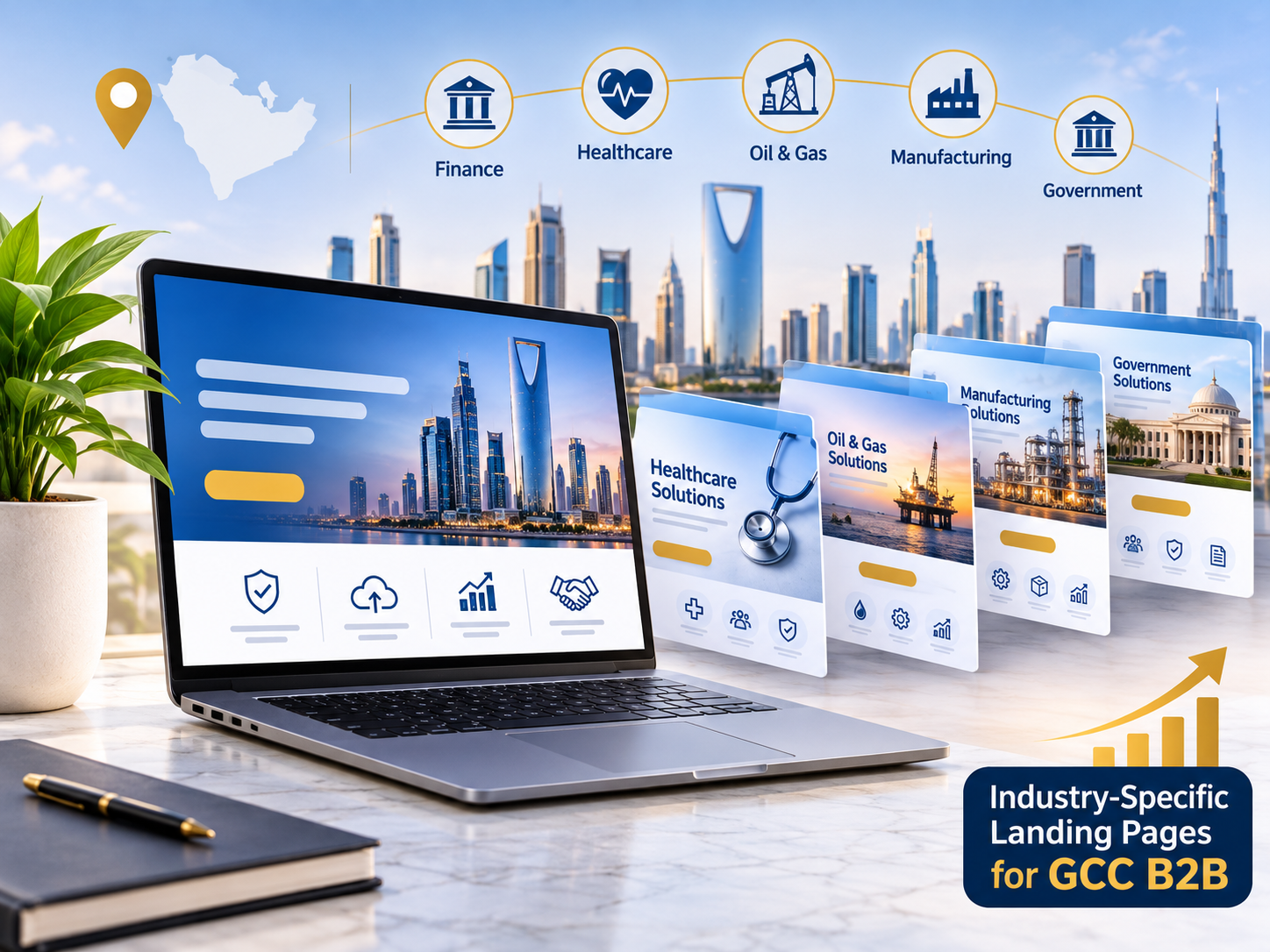
Industry-specific landing pages help GCC B2B companies attract relevant buyers by connecting sector challenges with suitable solutions, local market knowledge, and clear next steps. For businesses targeting Saudi Arabia, the UAE, and Qatar, these pages can improve search visibility, strengthen buyer confidence, and generate more qualified inquiries.
The difference is simple: an industry hub tells visitors whom you serve. A dedicated industry page shows them how you can help.
What Are Industry-Specific Landing Pages in GCC B2B?
Industry-specific landing pages are dedicated website pages built around the needs of a particular business sector, such as manufacturing, healthcare, logistics, construction, or fintech.
Rather than promoting general services, these pages explain industry challenges, relevant solutions, implementation considerations, and the business value a provider can deliver.
Industry Landing Pages vs. Generic “Who We Help” Pages
A generic page might list manufacturing, retail, construction, and healthcare without explaining the company’s capabilities in those sectors.
A dedicated manufacturing page, however, could cover production reporting, inventory synchronization, ERP integration, and operational visibility.
That level of detail gives potential customers a clearer understanding of whether the solution fits their requirements.
Why Saudi, UAE, and Qatar B2B Buyers Need Sector Relevance
Business buyers across the GCC often evaluate technical compatibility, procurement requirements, regional support, and data protection considerations before contacting a provider.
A Saudi enterprise may require Arabic documentation and locally relevant integrations. A Dubai-based international company may prioritize bilingual interfaces and compatibility with existing systems.
Effective business website design helps communicate these differences without making the buying journey unnecessarily complicated.
How Vertical-Specific Value Propositions Improve Lead Quality
A vertical-specific value proposition explains how a service solves a particular industry’s problems.
For example, a Saudi manufacturing company searching for ERP solutions may want to understand inventory integration, production reporting, and financial workflows.
A page addressing those needs directly is more useful than one making broad claims about digital transformation.
It also helps potential buyers assess whether the provider is a suitable match before submitting an inquiry.
How to Structure Industry-Specific Landing Pages for GCC SEO
A strong industry-page strategy needs clear website architecture, relevant keyword targeting, and content grounded in real service capabilities.
Build an Industries Hub With Dedicated Sector Pages
Start with a central industries hub that connects visitors to individual sector pages.
A practical website structure could look like this.
/industries/
/manufacturing/
/logistics/
/fintech/
/healthcare/
This is a proposed website architecture, not a list of existing Mak It Solutions pages.
Each sector page should link naturally to related technology services, relevant case studies, and contact options.
Breadcrumb navigation and contextual internal links also help visitors move between industry challenges and the services designed to address them.
Map Service, Industry, and Country Keywords
GCC B2B search strategies become more focused when they combine service, industry, and geographic intent.
Examples include.
Manufacturing ERP solutions in Saudi Arabia
Logistics automation services in Dubai
Construction management software in Qatar
These phrases represent different commercial search needs.
However, creating a separate page for every city or country is not always necessary.
Publish localized pages when buyer expectations, available services, regulatory considerations, or supporting evidence genuinely differ.
Otherwise, a well-developed regional industry page may serve visitors more effectively.
Create a B2B Industry Page Brief in Five Steps
Before developing a page, prepare a content brief covering the following:
Choose your target market and industry. Prioritize sectors where your company has relevant capabilities and genuine business opportunities.
Research commercial search intent. Identify how buyers describe their problems and search for potential providers.
Connect challenges with solutions. Explain the actual services, integrations, and support available.
Gather credible evidence. Collect authorized testimonials, documented implementations, and applicable regulatory references.
Plan SEO and conversions. Include descriptive headings, internal links, FAQs, and a relevant consultation CTA.
For companies managing multiple sector pages, professional SEO services can support keyword mapping, website structure, and ongoing optimization.
Looking to scale your store in UAE/Saudi Arabia? Contact our expert IT team today for a free consultation. ( Click Here’s )

GCC Localization and Compliance: Building Buyer Trust
Local relevance means more than inserting Riyadh, Dubai, or Doha into a headline.
Effective GCC industry pages reflect language preferences, business practices, service availability, and applicable regulatory requirements.
Saudi Arabia.
Saudi B2B websites collecting personal information through contact forms should consider applicable Personal Data Protection Law (PDPL) requirements.
The Saudi Data and Artificial Intelligence Authority’s regulations provide useful regulatory context. National Data Management Office (NDMO) policies may also be relevant depending on the organization’s activities.
Financial technology providers should reference Saudi Central Bank (SAMA) requirements only where applicable.
Similarly, ERP providers should mention ZATCA-related integrations only when those capabilities are genuinely supported.
Relevant compliance information can support buyer confidence, but it should never imply certification, approval, or regulatory compliance without evidence.
UAE and Qatar.
Technology providers operating in the UAE should distinguish between general national requirements and rules applicable within specific financial jurisdictions.
For example, Abu Dhabi Global Market (ADGM) and Dubai International Financial Centre (DIFC) have distinct regulatory frameworks relevant to certain businesses.
Companies offering supported digital identity integrations may also reference the UAE’s TDRA guidance on UAE PASS.
In Qatar, fintech providers should consider applicable Qatar Central Bank requirements. Businesses operating through the Qatar Financial Centre may face additional or different obligations.
The goal is to explain relevant capabilities and responsibilities accurately, not overwhelm visitors with regulatory terminology.

Arabic UX, Privacy Statements, and Data Residency
For businesses serving Arabic-speaking stakeholders, localization should extend beyond translated paragraphs.
Consider.
Clear Arabic-English navigation and consistent terminology
Proper right-to-left layouts for Arabic content
Accessible contact forms and localized calls to action
Transparent privacy notices and data collection practices
Accurate hosting and data residency information
Cloud locations such as AWS Bahrain, Azure UAE Central, and Google Cloud Doha may be relevant to infrastructure discussions.
However, selecting a regional cloud location does not automatically establish compliance with applicable data protection or residency requirements.
Industry Landing Page Examples for Saudi Arabia, UAE, and Qatar
The following examples are illustrative scenarios, not verified customer case studies.
Riyadh Manufacturing and Jeddah Construction
A Riyadh-based manufacturing technology provider could develop a page explaining inventory synchronization, ERP integration, and production dashboards.
Rather than listing generic software features, the page could show how these capabilities support manufacturing workflows.
A Jeddah construction technology company might focus on project reporting, contractor coordination, documentation management, and implementation support.
Both pages should lead visitors toward a relevant demo or consultation rather than a generic contact form.
Dubai Logistics and Abu Dhabi Retail Technology
A Dubai logistics company could build an industry page around warehouse automation, shipment visibility, delivery tracking, and integration requirements.
An Abu Dhabi retail technology provider might focus on omnichannel inventory management, store operations, and digital customer acquisition strategies.
Although both companies offer technology solutions, their customers have different priorities.
Their landing pages should reflect those differences through industry terminology, useful examples, and relevant service information.
Doha Fintech, Government, and Enterprise Solutions
A Doha fintech provider could explain payment integrations, information security considerations, and relevant Qatar Central Bank expectations.
A government technology provider may instead focus on procurement documentation, integration standards, service continuity, and implementation processes.
Both approaches help enterprise buyers evaluate practical suitability.
When publishing case studies, companies should obtain appropriate permissions and use verifiable information. Anonymized examples can be valuable when they accurately represent genuine project experience.

How to Optimize GCC Industry Pages for SEO, AEO, GEO, and Conversions
A page that ranks but fails to address buyer questions may attract traffic without generating useful business opportunities.
Effective optimization combines search relevance, answer-focused content, credible information, and a clear conversion path.
Write Clear Answers and Useful Industry FAQs
Answer important customer questions early.
For example, a manufacturing ERP landing page should quickly explain what the solution does, which operational challenges it addresses, and what integrations are supported.
Use descriptive headings, concise explanations, and authentic examples that match buyer search intent.
These practices can improve content clarity for traditional search engines and AI-powered search experiences, although they do not guarantee inclusion in AI-generated answers.
Strengthen Internal Links and Structured Data
Connect industry pages with relevant services, supporting articles, company information, and contact pages.
This creates a more useful browsing experience and helps search engines understand relationships between topics.
For additional guidance, review this service page SEO guide.
Use appropriate structured data that accurately represents visible website content.
Structured data should support content understanding rather than make unsupported claims or duplicate existing markup unnecessarily.
Turn Organic Visitors Into Qualified B2B Consultations
Industry pages need calls to action that match visitor intent.
Instead of using only “Contact Us,” consider.
Discuss Your Manufacturing ERP Requirements
Request a Logistics Automation Consultation
Explore Fintech Integration Solutions
Speak With Our Enterprise Technology Team
Keep inquiry forms concise and request only information needed to begin a useful conversation.
Where possible, connect form submissions to CRM tracking so marketing teams can evaluate lead quality and identify which industry pages generate meaningful inquiries.
Costs, Timelines, and Best Practices for Scaling GCC Industry Pages
Industry landing page costs vary depending on content complexity, technical requirements, and localization needs.
What Affects Landing Page Costs and Production Time?
Major considerations include industry research, SEO planning, content development, bilingual localization, design, development, stakeholder approvals, and regulatory review.
A straightforward page built using an existing website template generally requires fewer resources than a multilingual enterprise page with custom functionality.
Companies publishing multiple sector pages can benefit from reusable templates and organized content workflows.
WordPress development services can support consistent page layouts and scalable publishing processes.
Prioritize Markets Without Creating Repetitive Content
For companies focusing primarily on Saudi Arabia, begin with the industries where service capabilities and buyer demand justify dedicated pages.
Expansion into the UAE and Qatar should follow genuine market opportunities and available local evidence.
The same principle applies when targeting Kuwait, Bahrain, and Oman.
Avoid copying existing pages and changing only the city or country names. Each localized page should offer distinct value through relevant solutions, terminology, market considerations, or supporting proof.
The strongest industry pages connect specific customer problems with useful solutions, credible regional context, and a clear next step.

Outlook
Generic “Who We Help” pages can introduce your capabilities, but they rarely provide the depth required by buyers evaluating complex B2B solutions. Mak it Sol
Industry-specific landing pages give Saudi, UAE, and Qatar businesses an opportunity to demonstrate sector knowledge, explain genuine service capabilities, and create more relevant consultation journeys.
The priority is not to publish as many pages as possible. It is to build pages that answer real questions and help qualified buyers make informed decisions.
Planning industry-specific landing pages for your GCC business? Contact Mak It Solutions to discuss your B2B SEO requirements and explore a tailored industry-page strategy.
Looking to scale your store in UAE/Saudi Arabia? Contact our expert IT team today for a free consultation. ( Click Here’s )
FAQs
Q : Why Should Saudi Manufacturing Companies Have Dedicated Industry Pages?
A : Saudi manufacturers often need solutions for production scheduling, inventory control, procurement, and financial reporting. Dedicated industry pages help technology providers explain how their actual services address those requirements.
Relevant ZATCA functionality and Saudi Vision 2030 industrial objectives can provide useful context when directly connected to the offering.
Q : Should Dubai B2B Companies Publish Industry Pages in Arabic and English?
A : Yes, when both language audiences represent meaningful business opportunities.
English supports communication with international businesses, while Arabic improves accessibility for local stakeholders. Companies should provide accurate translations, appropriate right-to-left layouts, localized calls to action, and correctly implemented hreflang signals.
Q : What Local Evidence Should a Doha B2B Service Page Include?
A : Useful evidence includes authorized customer testimonials, documented implementations, supported integrations, and clearly described local service arrangements.
Fintech providers should also explain applicable QCB considerations without implying regulatory endorsement. Authentic evidence is more valuable than unsupported claims of industry leadership.
Q : Can an Abu Dhabi Technology Company Use One Page for Multiple Industries?
A : Yes, if the industries share similar requirements and the company delivers essentially the same solution.
Separate pages become more valuable when customer expectations differ significantly. For example, healthcare software buyers may focus on patient data protection, while logistics companies prioritize operational visibility and shipment tracking.
Q : When Should GCC B2B Companies Create Separate Pages for Kuwait, Bahrain, and Oman?
A : Create dedicated country pages when there is meaningful buyer demand, genuine service coverage, and sufficient local information to offer distinct value.
For example, a Bahrain fintech page should consider applicable Central Bank of Bahrain requirements rather than recycling content about Saudi SAMA regulations.
Expansion should follow business relevance and content quality, not simply increase the number of location pages.
Looking to scale your store in UAE/Saudi Arabia? Contact our expert IT team today for a free consultation. ( Click Here’s )