
AI Agents & Multi-Agent Systems for GCC Businesses (Guide)
AI Agents & Multi-Agent Systems for GCC Businesses (Guide)

AI Agents & Multi-Agent Systems for GCC Businesses (Guide)
AI agents and multi-agent systems help GCC businesses move beyond simple chatbots into end-to-end, autonomous workflows that plan, execute and coordinate work across multiple systems. In KSA, UAE and Qatar, they can be deployed on local cloud regions, aligned with SDAIA, TDRA and QCB expectations, and piloted in 90 days to prove ROI before scaling.
Introduction
In 2026, AI agents and multi-agent systems for GCC businesses are suddenly everywhere—from boardroom slide decks in Riyadh to innovation labs in Dubai and Doha. Yet many executives are still stuck in endless “PoCs” around one chatbot or copilot, unsure how to scale to real, regulated, Arabic-first operations.
For GCC leaders, the real opportunity is to treat agentic AI as a way to automate full workflows, not just answer questions. This guide explains what AI agents are, where multi-agent systems fit in Saudi Vision 2030 and UAE AI Strategy 2031, the most relevant 2026 use cases in KSA, UAE and Qatar, how to design a multi-agent architecture that respects data residency, and how to run a practical 90-day pilot instead of another endless experiment. Along the way, we’ll highlight where a GCC-focused partner like Mak It Solutions can help you move from slideware to production.
What Are AI Agents and Multi-Agent Systems for GCC Leaders?
What are AI agents and multi-agent systems, and how can GCC businesses use them beyond simple chatbots?
AI agents are software entities that can understand goals, plan actions, call tools and APIs, and complete tasks with minimal human hand-holding. Multi-agent systems connect several of these autonomous AI agents so they can collaborate on more complex workflows across your banking, government, logistics or retail operations in KSA, UAE and Qatar.
From Chatbots to Autonomous AI Agents in GCC Enterprises
Most GCC organizations started with a simple chatbot on their website or WhatsApp channel. An AI agent, by contrast, can read a customer request in Arabic or English, look up data in your CRM, check eligibility rules, generate a draft response, and even open a ticket or trigger a workflow in SAP or Oracle all inside your Riyadh bank or Dubai utility.
Think of.
A customer-service agent that triages queries, summarizes history and proposes actions to a human agent.
An internal knowledge agent that searches policies, SOPs and NDMO-aligned data catalogs for a Jeddah or Abu Dhabi operations team.
An operations agent that monitors queues (payments, shipments, permits) and nudges humans only when thresholds or SLAs are at risk.
Multi-Agent Systems Explained for AI & Innovation Leaders
In a multi-agent system, you don’t rely on one “super bot” to do everything. Instead, you combine specialists:
A planner agent that breaks a request into steps.
A researcher agent that pulls data from core systems and external APIs.
A compliance checker that validates actions against SAMA, QCB or TDRA rules.
An executor that writes to your core banking, ERP or ticketing systems.
Imagine a GCC bank: a corporate client in Doha requests a new credit facility. The planner structures the process, the researcher gathers KYC and transaction data, the compliance agent checks limits and Sharia rules, and the executor prepares documentation and tasks all coordinated through a multi-agent orchestration layer.

AI Agents vs Copilots vs RPA in GCC Workflows
Traditional RPA scripts repeat fixed actions on one screen. A single copilot helps a human within one app (for example, summarizing emails in Outlook). AI agents and multi-agent systems, however, can move across CRM, ERP, core banking and service-desk tools, coordinating steps end to end.
For Saudi Vision 2030 programs or UAE AI Strategy 2031 initiatives, that distinction matters: copilots improve individual productivity, while multi-agent workflows can redesign whole “request-to-resolution” journeys that match national digital-government ambitions.
Why GCC Companies Are Moving from Single Copilots to Multi-Agent Workflows in 2026
Why are UAE and KSA companies shifting from single “copilot” tools to multi-agent workflows in 2026?
Because isolated copilots rarely change KPIs that matter to boards, like STP (straight-through processing), NPS and opex. Multi-agent workflows, when designed around real GCC processes and regulations, can automate full journeys onboarding, permits, claims, inspections at scale.
Signals from UAE and Saudi Markets in 2025–2026
Across Dubai, Abu Dhabi and Riyadh, a common pattern has emerged: organizations started with one chatbot or helpdesk copilot but quickly hit ceilings on value. Government AI programs, national data strategies and large cloud investments have now pushed CIOs to explore agentic AI workflows that touch multiple back-end systems. TDRA guidance in the UAE and SDAIA roadmaps in KSA have also increased confidence that agentic AI can be governed, not just experimented with.
Business Benefits of Multi-Agent Workflows for GCC Teams
For GCC teams working bilingually in Arabic and English, multi-agent systems can:
Keep 24/7 customer experiences running smoothly during Ramadan and peak travel seasons.
Coordinate cross-border operations across KSA–UAE–Qatar without endless email chains.
Reduce opex by automating repetitive checks and data entry, while keeping humans for judgment and relationship roles.
In practice, this looks like enterprise AI automation in GCC call centers, shared-service centers and branch networks, anchored in clear KPIs like reduced handling times and fewer manual approvals.
When a Single AI Copilot Is Not Enough
A single assistant in one system can summarize or draft content, but it can’t reliably close the loop. Example: a chatbot may answer a card-dispute question, yet still force the customer to call or visit a branch. A multi-agent setup can instead validate data, open a dispute case in core banking, generate required forms and notify the customer without human rekeying. That’s the jump from “nice productivity tool” to serious transformation.
2026-Ready AI Agent Use Cases by Sector in KSA, UAE and Qatar
BFSI & Fintech Compliance-Aware AI Agents under SAMA, QCB, ADGM & DIFC
In BFSI and fintech, AI agents and multi-agent systems must be compliance-aware by design. Under Saudi Central Bank (SAMA), Qatar Central Bank (QCB), ADGM and DIFC, typical 2026 use cases include:
Multi-agent KYC and onboarding that collects documents, screens risks and routes exceptions.
Transaction-monitoring agents that flag suspicious patterns and prepare analyst-ready case summaries.
Open Banking–compliant advisors that aggregate accounts while respecting consent and data-residency rules.
Sharia-aware product recommendation agents that check products against internal Sharia-board rules.
A partner like Mak It Solutions’ digital services team can help design these workflows so they fit your existing core and regulatory obligations.
Government, Smart Cities and Utilities in Riyadh, Dubai and Doha
For digital government, smart cities and utilities in Riyadh, Dubai and Doha, multi-agent systems can orchestrate.
Permit and license processing, with one agent validating documents, another checking rules, and another scheduling inspections.
Citizen-service agents that respond through web, mobile apps and WhatsApp integrated with national ID platforms like UAE Pass or Saudi digital ID.
Field-inspection and maintenance agents that assign jobs, optimize routes and generate reports aligned with initiatives such as Qatar Digital Government.
These use cases align tightly with the smart-city ambitions of Dubai and NEOM and can be implemented using robust, secure web backends such as those built by Mak It Solutions’ web development services.

Logistics, Retail & Shared Service Centers Across the GCC
Ports, logistics hubs, e-commerce players and shared services across Kuwait, Bahrain and Oman, as well as KSA, UAE and Qatar, can benefit from:
Demand-forecasting agents that combine sales, shipment and external signals.
Routing and customs-documentation agents for Jeddah, Dubai and Doha operations.
Finance back-office agents that reconcile invoices, match payments and chase missing data.
Arabic-first contact-center agents serving multiple GCC countries with localized language and holidays.
Here, agentic AI workflows can sit behind the scenes, while your front-end apps and portals remain familiar to staff and customers.
Designing a Multi-Agent Architecture That Fits GCC IT Stacks
Designing the Multi-Agent Orchestration Layer
At the core is a multi-agent orchestration layer that coordinates LLMs, agents, tools and APIs. It sits between your language models and enterprise systems, enforcing guardrails (rate limits, approval rules, logging) and connecting to GCC-hosted data lakes in Saudi, UAE or Qatar regions. For many enterprises, this layer is where they embed SDAIA, NDMO or TDRA data-classification and access rules.
Integrating AI Agents with ERP, Core Banking and CRM Systems
A practical architecture respects the reality of GCC IT stacks.
SAP or Oracle ERP for finance and supply chain.
Core banking systems in KSA and Qatar.
CRMs, ITSM and ticketing tools across Dubai and Abu Dhabi shared services.
Integration patterns range from API-based tools (agents call REST APIs), to message-bus integrations, to carefully controlled RPA fallbacks where APIs don’t exist. A GCC-focused technology partner such as Mak It Solutions can help design secure adapters and secure web integrations using enterprise web development capabilities.
Data Residency and Cloud Choices in Saudi, UAE and Qatar
Data-residency expectations from regulators mean multi-agent platforms must be conscious of where data is processed and stored. Many GCC enterprises now favor.
Saudi cloud regions for workloads under Vision 2030 and SDAIA oversight.
UAE regions (Dubai/Abu Dhabi) for TDRA-governed entities and free zones.
Qatar Doha regions for QCB- and Qatar Digital Government–aligned systems.
Agentic AI platforms can be deployed on these regions while using vetted external models via privacy-preserving patterns. Your services strategy should include clear mapping of data classes, residency and cross-border flows ideally captured as part of a broader digital transformation roadmap.
Compliance, Governance and Risk for Agentic AI in the GCC
How can Saudi enterprises deploy agentic AI while staying aligned with national AI and data-governance frameworks?
Saudi organizations should ground their AI agents and multi-agent systems in SDAIA and NDMO frameworks, treating them as extensions of existing data-governance and IT-risk programs. That means classifying data, defining risk tiers, setting human-in-the-loop controls and maintaining clear audit trails for agent actions.

Working Within SDAIA, NDMO and Vision 2030 in KSA
In KSA, SDAIA and NDMO provide the compass for AI and data governance under Vision 2030. For agentic AI.
Classify data (public, internal, confidential, highly sensitive).
Decide which classes agents can read, write or only summarize.
Keep humans in the loop for high-impact or high-risk decisions (e.g., credit approvals, sanctions-related actions).
This turns AI agents into governed components inside your existing controls, not “wild” experiments.
TDRA, UAE AI Strategy 2031 and Free-Zone Considerations
In the UAE, TDRA and UAE AI Strategy 2031 stress trustworthy, human-centric AI. Free-zone entities in ADGM and DIFC must also consider cross-border data handling and where their multi-agent platforms are hosted. For example, you might keep identifiable customer data in-region, while using global AI models only on anonymized or aggregated data, with explicit logging and opt-ins.
AI Governance Models for Regulated GCC Sectors
Across banking, government and telecom in the GCC, leading organizations are adopting:
AI and model-risk committees that review key agentic workflows.
Audit trails of all agent prompts, tool calls and actions.
Approval workflows where agents propose actions and humans approve.
External regulators such as Saudi Central Bank (SAMA) guidelines are evolving, so your AI governance and risk management should be adaptable, with clear owners in risk and technology.
Measuring ROI and Scaling Multi-Agent Systems Beyond Pilots
KPIs and Value Metrics for Multi-Agent Systems in GCC Enterprises
To convince boards in Riyadh, Dubai or Doha, you need hard numbers. Useful KPIs include:
Average handling time (AHT) reduction in call centers and back offices.
Straight-through-processing (STP) rate for onboarding, permits or claims.
Cost per ticket or case, especially in shared services.
Compliance-breach reduction and fewer manual rule violations.
Tie each metric to Saudi Vision 2030, UAE AI Strategy 2031 or Qatar Digital Government targets to show strategic alignment, not just tactical efficiency.
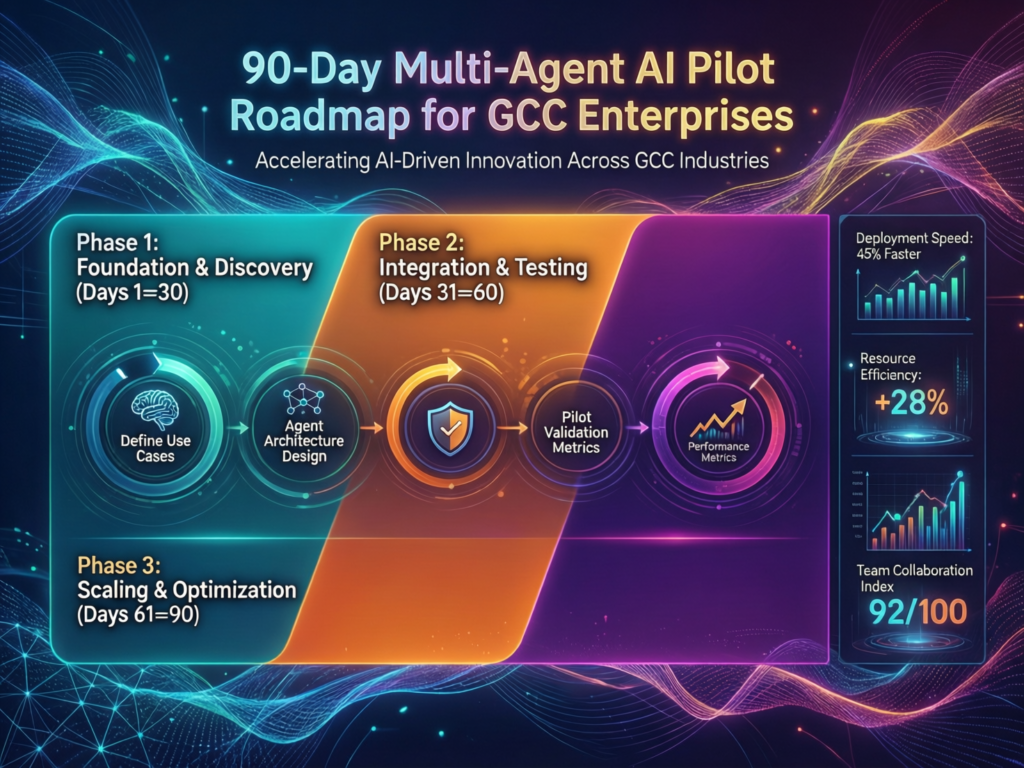
A 90-Day Pilot Roadmap for KSA, UAE and Qatar Organizations
A simple, realistic 90-day pilot for AI agents and multi-agent systems can follow these steps.
Weeks 1–2 Use-case selection & scoping
Pick one high-impact, low-regret workflow (e.g., Riyadh fintech onboarding under SAMA, Dubai logistics shipment tracing, Doha permit-status inquiries). Define success metrics and guardrails.
Weeks 3–4 Data readiness & architecture spike
Map data sources, access rules and residency. Build a thin multi-agent orchestration layer connected to one or two systems only.
Weeks 5–8 Sandbox build & governance sign-off
Implement 2–3 collaborating agents, integrate with ERP/CRM or core systems, and define approvals with risk, compliance and data teams (SDAIA, TDRA, QCB where relevant).
Weeks 9–10 Limited production rollout
Expose the workflow to a subset of staff or customers, measure KPIs and capture qualitative feedback.
Weeks 11–12 Evaluation & scale plan
Compare metrics against baseline, refine governance and design the next two or three workflows to scale.
Choosing the Right Consulting and Build Partners in the GCC
When selecting partners, look beyond generic AI credentials. For GCC, you should ask:
Do they understand SDAIA/NDMO, TDRA, QCB and your sector’s regulations?
Can they handle Arabic NLP, dialects and RTL UX for citizens?
Have they integrated with systems like UAE Pass, national ID platforms and regional cloud regions?
A GCC-focused partner such as Mak It Solutions, your GCC technology partner can combine agentic AI design, integration skills and end-to-end digital services to deliver a pilot that is both innovative and regulator-friendly.
Concluding Remarks
For GCC enterprises, AI agents and multi-agent systems are the next step after chatbots and isolated copilots. They unlock end-to-end automation across banking, government, logistics and shared services when built on the right architecture, cloud regions and governance frameworks.
The opportunity is real, but so is the responsibility to align with SDAIA, TDRA, QCB and national digital strategies while proving ROI in months, not years. If you’re ready to move from experiments to production, Mak It Solutions can help you design a 90-day pilot, integrate with your existing stack and create a roadmap tailored to KSA, UAE, Qatar and the wider GCC.
If you’re a leader in banking, government, logistics, utilities or telecom and want to explore agentic AI workflows without losing control of risk and compliance, now is the right moment. Book a discovery session with Mak It Solutions to map AI agents and multi-agent systems to your GCC strategy and regulations.
Our team can help you design a 90-day pilot, integrate with your existing ERP and core systems, and build a practical roadmap from PoC to production. Let’s co-create a GCC-ready agentic AI platform that matches your ambition and your regulators’ expectations.( Click Here’s )
FAQs
Q : Is this type of AI agent deployment allowed under Saudi SDAIA and SAMA rules?
A : Yes provided you treat AI agents and multi-agent systems as part of your existing data and IT-risk frameworks, not as side experiments. SDAIA and NDMO expect clear data classification, access control and logging, while SAMA focuses on operational resilience, outsourcing and technology risk for financial institutions. In practice, that means limiting which data agents see, enforcing human approvals for sensitive actions and keeping full audit trails for all agent activity. Many Saudi banks and fintechs are already designing pilots that align with SAMA’s risk guidelines and SDAIA’s data-governance expectations.
Q: Do UAE free-zone companies in ADGM or DIFC have different data-residency options for multi-agent AI platforms?
A : ADGM and DIFC entities often have more flexibility around cross-border data, but they still must meet UAE federal and sectoral requirements, as well as their own internal risk appetite. In practice, many free-zone firms keep core customer data in-region (for example, in an Abu Dhabi or Dubai cloud region) while using global AI models only on anonymized or masked datasets. The key is to document where data is processed, ensure contracts and DPAs reflect this, and align with TDRA guidance on digital services. Multi-agent systems should make these flows transparent and fully auditable.
Q : How can Doha-based government entities ensure Arabic-first experiences in multi-agent digital services?
A : Doha ministries and agencies can design their multi-agent platforms to treat Arabic as the primary language, not an add-on. That starts with choosing models fine-tuned for Arabic, designing prompts and workflows in Arabic, and training agents on Qatar-specific policies and Qatar Digital Government guidelines. For citizen-facing services, you can still offer English options, but the orchestration layer should default to Arabic interfaces and content. Partnering with a GCC-focused provider that has delivered Arabic-first portals and contact-center automation such as Mak It Solutions’ web development and digital teams helps ensure both language quality and user experience.
Q : What budget range do GCC enterprises typically allocate for a 90-day multi-agent AI pilot?
A : Budgets vary widely by sector and scope, but many mid to large GCC enterprises allocate a mid-five-figure to low-six-figure USD budget for a focused 90-day pilot. The main cost drivers are integration effort (number of systems), complexity of compliance requirements and the breadth of channels (web, mobile, contact center). A Riyadh bank with SAMA oversight and complex core systems will spend more than a single-process pilot in a Dubai logistics SME. The goal is not to build the final platform, but to prove ROI and regulatory fit fast enough to justify a broader multi-year roadmap.
Q : Can GCC organizations use global AI clouds while still complying with local data-residency and Open Banking regulations?
A : Yes, but they must be deliberate about which data leaves local regions and under what safeguards. A common pattern is to keep identifiable customer data in GCC cloud regions (e.g., Saudi, UAE, Qatar) and use global AI services only on de-identified text or embeddings, with strict logging and encryption. For Open Banking in KSA or under QCB in Qatar, agents should call APIs via secure, regulated channels, and any external AI processing should be documented in risk assessments and vendor registers. With a well-designed multi-agent orchestration layer and clear data maps, global AI capabilities and GCC data-residency rules can be reconciled.
[…] AI agents are autonomous software systems that use foundation models, tools and enterprise data to plan and […]