


AI in Cybersecurity: Winning the New Digital Arms Race
AI in Cybersecurity: Winning the New Digital Arms Race
AI in Cybersecurity: Winning the New Digital Arms Race
Introduction
AI in cybersecurity is no longer a “nice to have” experimental add-on. It sits at the heart of how attackers and defenders operate from AI-written phishing emails and deepfake phone calls to AI-augmented SOCs that can triage thousands of alerts in minutes.
If you’re responsible for security in the US, UK or EU, the real question is no longer “Should we use AI in cybersecurity?” but “Are we adopting it faster, more safely and more transparently than attackers – and our peers?”
AI in cybersecurity uses machine learning, generative AI and automation to detect, investigate and respond to threats faster and at greater scale than human teams alone. To win the new digital arms race, US, UK and EU organisations need to combine AI-powered defenses with strong governance, regulatory compliance and human expertise so attackers can’t simply turn the same tools against them.
AI in cybersecurity: the new arms race
AI in cybersecurity means using artificial intelligence to detect, investigate and respond to threats faster and at a scale humans can’t match on their own. Because both attackers and defenders use AI, it has become a genuine arms race: the side that learns, adapts and integrates AI more effectively wins more often.
Why AI is reshaping cyber risk in 2025 for US, UK and EU organisations
Several trends are pushing AI from innovation project to operational necessity.
Global ransomware incidents rose by roughly 10–15% in 2024, with public datasets showing more than 5,000 successful attacks worldwide.
Around 65% of financial organisations reported a ransomware attack in 2024 alone, highlighting how exposed critical sectors are.
A 2024 survey found about 65% of organisations regularly using generative AI by mid-year – almost double the previous year.
Many of those AI-enabled workflows involve sensitive data, credentials and code – prime targets if tools are misconfigured, over-permissioned or abused.
For US critical infrastructure in and around cities like Austin or Washington D.C., for UK public bodies such as the NHS, and for German Industrie 4.0 plants around Munich, AI is now intertwined with operational resilience. That makes AI security a board-level topic, not just another item on the SOC backlog.
Key AI in cybersecurity statistics 2025.
AI is already reshaping day-to-day security operations:
In a 2024–2025 survey, about 70% of cybersecurity professionals said AI helps detect threats that previously went unnoticed, but only around 18% said their organisations had fully adopted AI cyber tools
Around half of respondents reported relying on AI to help bridge the cybersecurity skills gap in their teams.
The 2024 ISC2 workforce study shows 90% of security teams now have at least some policies on generative AI, yet 65% believe they need stricter rules and clearer guidance.
Spending is following this pattern. Many US, UK and EU organisations are quietly shifting budget away from legacy products and towards AI-driven SOC platforms, XDR and managed detection and response (MDR).
If you want a deeper dive into how AI is reshaping ransomware and incident response, Mak It Solutions’ guide on ransomware trends 2025 covers those dynamics in more detail. (Makitsol)
How the AI cyber arms race changes board-level risk discussions
At board and audit committee level, AI in cybersecurity typically shows up across three conversations:
Exposure
How are attackers using AI against our sector and geography?
Capability
Where are we already using AI in our SOC and wider security stack – and how is it governed?
Accountability
Can we show regulators such as BaFin, the FCA, the SEC and data protection authorities that our AI use is controlled, documented and auditable?
NIS2 in the EU and updated UK regulations explicitly push cyber accountability to executive and board level, including for AI-enabled tooling.Directors now need to understand AI risk in language tied to revenue, uptime, safety and reputation not just in terms of models and algorithms.
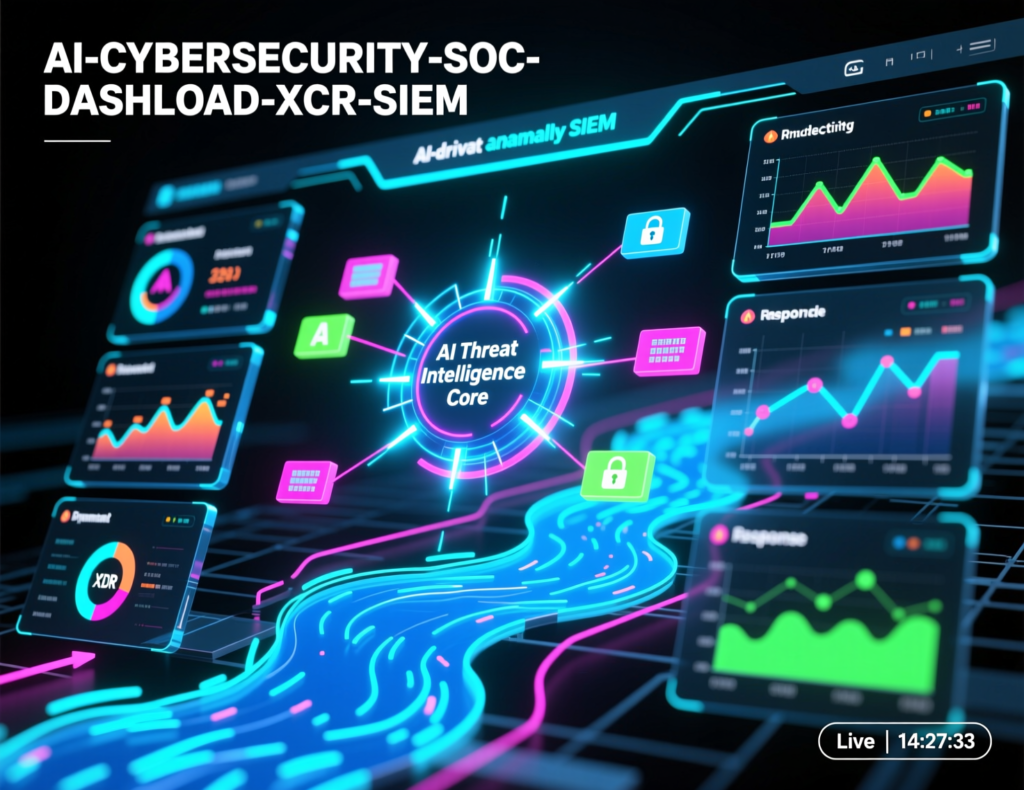
What is AI in cybersecurity and how does it protect networks, systems and data?
AI in cybersecurity is the use of machine learning, generative AI and advanced analytics to automatically spot anomalies, flag threats and support or trigger responses that protect networks, endpoints, cloud workloads and data. It doesn’t replace your existing tools; it makes them faster, more adaptive and better at filtering out noise.
Core definition: artificial intelligence in cyber security vs traditional tools
Traditional security tools often rely on static rules and signatures: “if X happens, raise an alert.” AI-driven cyber security systems go further by learning what “normal” looks like across your users, devices and applications, then flagging behaviour that deviates from that baseline.
In practice, AI in cybersecurity usually includes.
Behavioural analytics on endpoints, servers and SaaS apps
User and entity behaviour analytics (UEBA)
AI-assisted threat hunting and alert triage in the SOC
Generative AI copilots that help analysts summarise incidents and draft responses
Mak It Solutions often pairs these AI controls with more conventional measures, as described in our articles on generative AI security risks in the workplace and AI content guardrails. (Makitsol)
How machine learning, gen AI and automation work together in AI cybersecurity
Think of three layers working together in your AI cyber defense stack:
Machine learning (ML)
Models analyse log streams, network flows and endpoint behaviour to detect anomalies and suspicious patterns.
Generative AI
Large language models summarise complex alerts, correlate related events and suggest likely root causes or remediation steps.
Automation & orchestration
Playbooks in XDR/SOAR tools execute responses – isolating hosts, resetting credentials, blocking IPs or opening tickets.
Once this is wired into your SIEM or XDR, detection and response becomes a continuous feedback loop instead of a purely manual queue.
Benefits and limitations of AI in cybersecurity for enterprises and SMEs
The main benefits of AI in cybersecurity are speed, scale and consistency. AI doesn’t get tired at 3 a.m., and it can process millions of events across AWS, Azure, Google Cloud and on-prem networks in a fraction of the time a human team would need. For SMEs in Manchester or Austin that can’t staff a 24/7 SOC, AI-powered managed services are sometimes the only realistic option.
However, there are important limitations and pitfalls:
Blind spots and bias in training data can skew detection.
Adversarial attacks against models can reduce their effectiveness or cause harmful outputs.
Over-reliance on automation can lead to risky decisions if humans stop asking questions.
This is why many organisations now treat AI systems as high-risk building blocks in their security architecture, subject to rigorous testing, governance and monitoring rather than “plug-and-play” deployment.
How cyber attackers are using AI to make threats more effective
Offensive AI is not theoretical. Attackers already use AI to personalise phishing at scale, clone voices and faces, write evasive malware, scan for weaknesses automatically and probe or corrupt defenders’ own AI models.
AI-generated phishing, deepfakes and voice scams targeting US, UK and EU victims
Generative AI makes it trivial to craft convincing phishing emails in fluent English or German, mirror your internal tone of voice and reference specific offices in Berlin, New York or London. Deepfake audio and video can impersonate executives, suppliers or even clinicians in an NHS trust.
We’re already seeing deepfake voice scams used to authorise fraudulent payments and AI-written phishing that convincingly mimics banks regulated by the FCA or BaFin. This undermines traditional “spot the dodgy email” awareness training and demands more advanced technical controls plus updated training content – especially in sectors highlighted in Mak It Solutions’ guides on human-centred cyber awareness and GCC data protection laws. (Makitsol)
AI-powered malware, ransomware and automated vulnerability scanning
On the technical side, attackers are leaning on AI to:
Generate polymorphic malware that constantly changes to evade signature-based tools
Automate discovery of misconfigurations in cloud and SaaS environments
Chain together public exploits and misconfigurations at machine speed
Global ransomware attacks increased again in 2024, with some datasets reporting more than 5,000 incidents worldwide and double-digit year-on-year growth. This is exactly the sort of campaign where offensive AI gives attackers leverage: once a playbook works, they can scale it with minimal extra effort.
Adversarial AI: data poisoning, model attacks and bypassing AI cyber defenses
A more advanced frontier is adversarial AI, where attackers target the models themselves:
Data poisoning
Feeding corrupted data into training pipelines so models learn the wrong behaviour.
Prompt injection / jailbreaks
Manipulating gen AI security copilots to reveal sensitive data or ignore rules.
Model evasion
Crafting inputs that bypass anomaly detection yet still deliver malicious payloads.
Guidance from agencies such as NIST and CISA stresses that AI models must now be treated as assets that can be attacked, monitored and patched.
What are the main ways cyber attackers are using AI today?
Today, cyber attackers primarily use AI to:
Personalise phishing and social engineering at scale
Clone voices and faces for deepfake fraud
Write and mutate malware to evade traditional detection
Scan internet-facing and cloud environments for vulnerabilities automatically
Probe, poison or evade defenders’ own AI models
If your defenses don’t assume this level of offensive AI capability, you’re planning against an outdated threat model.
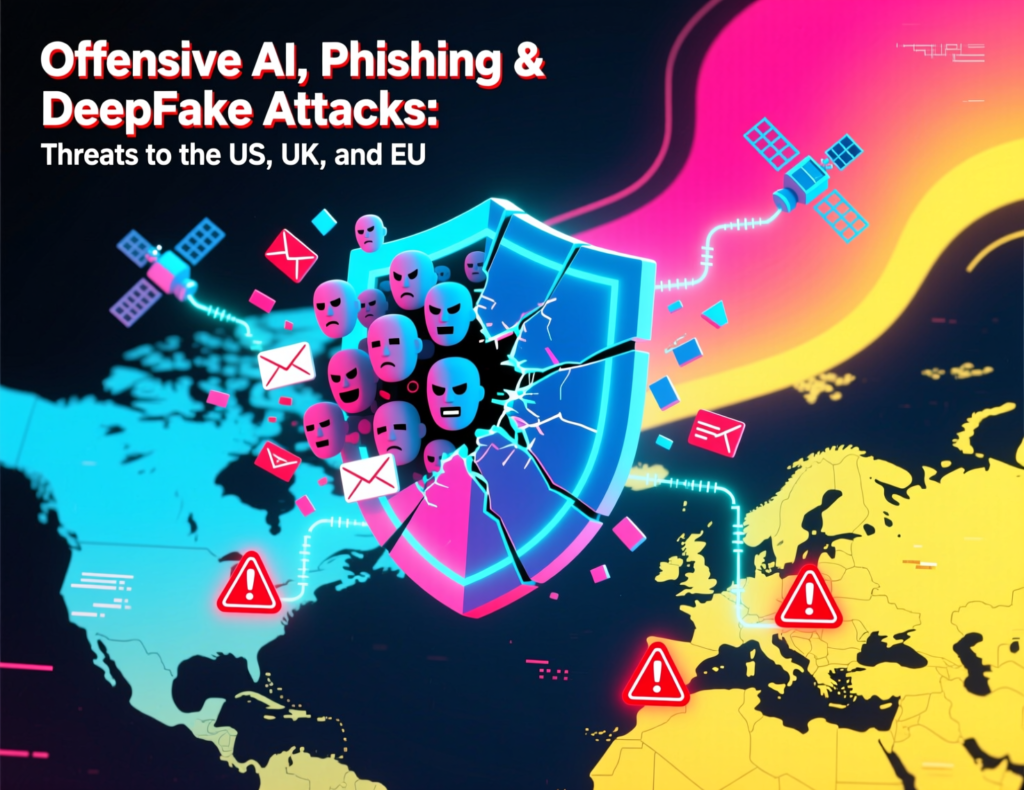
AI cyber defense in the SOC: tools, platforms and automation
AI-powered SOC tools.
Modern SOCs in the US, UK and across Europe increasingly rely on.
AI-augmented SIEM (for example, Elastic, IBM Security, Microsoft Sentinel)
XDR platforms from vendors such as CrowdStrike, Palo Alto Networks, Fortinet and Sophos
Autonomous cyber defense systems that continuously model “normal” behaviour and block deviations in real time
These tools ingest telemetry from endpoints, identities, networks, OT and cloud, then apply a mix of ML and rules-based logic to surface high-fidelity alerts.
How AI-driven threat detection and response works in practice
A typical AI-driven workflow in the SOC looks like this.
Scoring and detection
ML models score events and flag anomalies.
Context and narrative
Gen AI summarises related events into a human-readable storyline (for example, “Suspected credential theft from Berlin office VPN, lateral movement to AWS workload”).
Playbooks and actions
Automation kicks in isolating a host, challenging a user with MFA, blocking IP ranges or opening tickets in ITSM.
This is where Mak It Solutions often helps clients connect AI-driven detection to practical runbooks, integrating with existing SIEMs and XDR tools instead of ripping and replacing everything.
Why regulated industries rely on AI-driven SOC and XDR tools
In finance, healthcare and government, AI-driven SOC and XDR tools help teams handle alert volume and complexity, meet strict uptime and reporting requirements, and reduce dwell time. AI capabilities can support regulatory expectations under HIPAA, PCI DSS, SOC 2 and US sector guidance for critical infrastructure provided access controls, logging and oversight remain robust.)
For UK NHS trusts and EU banks under DORA and NIS2, AI-augmented monitoring is rapidly becoming the only realistic way to prove continuous control over complex hybrid and multi-cloud architectures.
Choosing an AI cybersecurity platform in the US, UK and Germany/EU
When shortlisting AI cybersecurity platforms, focus on.
Data residency and sovereignty
Can you keep logs in EU or UK regions (for example, Dublin, Frankfurt, London) and meet GDPR/DSGVO expectations?
Model transparency
Can vendors explain how their models make decisions that affect customers, patients or citizens?
Integration depth
How well do they integrate with your identity stack, OT, cloud platforms and existing SOC tooling?
Local support
Especially important for German Mittelstand manufacturers or regulated UK financial firms that need local language support and regulator-aware partners.
Mak It Solutions often combines these criteria with cloud guidance from our content on edge vs cloud for AI workloads and Middle East cloud providers when working with multinational clients.
Governance, compliance and responsible AI in cybersecurity
Securing AI systems in cybersecurity programs.
In the US, agencies such as CISA, NSA and NIST have published guidance on secure AI deployment, emphasising “secure by design”, strong data controls and continuous monitoring. For sectors like healthcare (HIPAA/HHS), payments (PCI DSS) and SaaS (SOC 2), AI-based tools must fit into existing control frameworks for access control, logging, encryption, incident response and vendor risk management.
If your AI security provider can’t show clear alignment with both the NIST Cybersecurity Framework and NIST AI RMF 1.0, that’s a warning sign.
GDPR/DSGVO, UK-GDPR, NIS2 and the EU AI Act
In Europe, GDPR/DSGVO and UK-GDPR already govern how security logs and behavioural data are collected, processed and stored. NIS2 raises the bar further for essential and important entities in sectors such as energy, transport, healthcare and digital infrastructure.
On top of this, the EU AI Act introduces a risk-based regime for AI systems. Bans on certain “unacceptable risk” AI practices apply from early 2025, with obligations for general-purpose and high-risk AI ramping up through 2027. Many AI-powered cyber defense tools will fall into “high-risk” categories when they materially affect critical infrastructure or citizens’ rights.
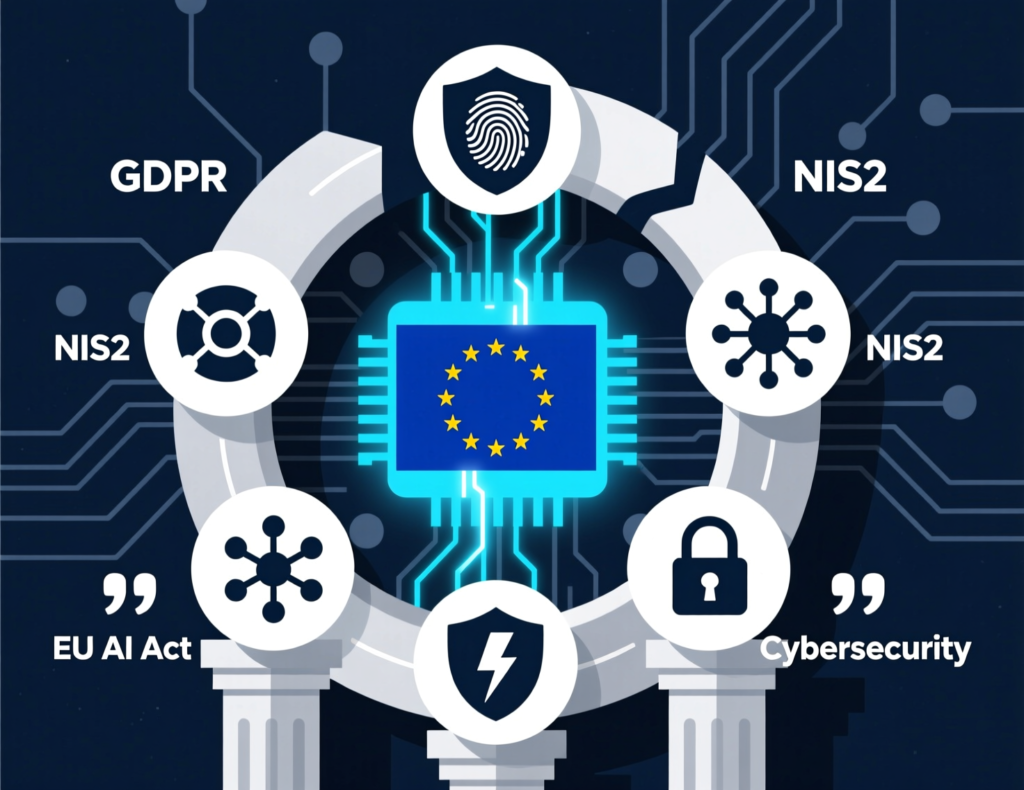
DORA, BaFin, FCA, NHS and other sector regulators to watch
Sector regulators are also tightening expectations.
Finance
DORA in the EU, BaFin and the ECB in Germany, and the FCA in the UK all expect tighter oversight of ICT and security providers, including AI-enabled services.
Healthcare
NHS bodies in the UK and national health regulators across the EU are publishing AI procurement, safety and data-handling guidance.
Critical infrastructure
CISA, NSA and European energy regulators are starting to align AI-specific security expectations with existing OT/ICS safety rules.
Your AI cyber defense stack needs to align with these sector rules, not just generic frameworks.
Principles of responsible AI security.
Practical principles for responsible AI in cybersecurity include:
Transparency
Document what data you collect, how models are trained and updated, and how AI outputs are used in decisions.
Human-in-the-loop
Keep analysts accountable for high-impact decisions, with AI acting as a copilot, not an unchecked black box.
Auditability
Retain logs of AI inputs, outputs and human overrides so regulators and internal teams can reconstruct decisions after an incident.
Mak It Solutions applies similar principles in our work on AI content guardrails, and they translate cleanly into AI cyber defense.
How should European companies align AI cyber defense with GDPR, NIS2 and the EU AI Act?
European companies should treat AI security tools as high-risk data processors, map their data flows, use EU-hosted or EU-compliant platforms, and document risk assessments that tie into GDPR, NIS2 and the EU AI Act. In practice, that usually means:
Performing DPIAs and AI risk assessments for major tools
Classifying logs and telemetry under your existing data protection framework
Prioritising EU or EEA data centres (Frankfurt, Dublin, Amsterdam, Paris) for log storage and processing
Updating incident response runbooks to cover AI model failures, misuse and adversarial attacks
How US, UK and European organisations can adopt AI cybersecurity tools safely
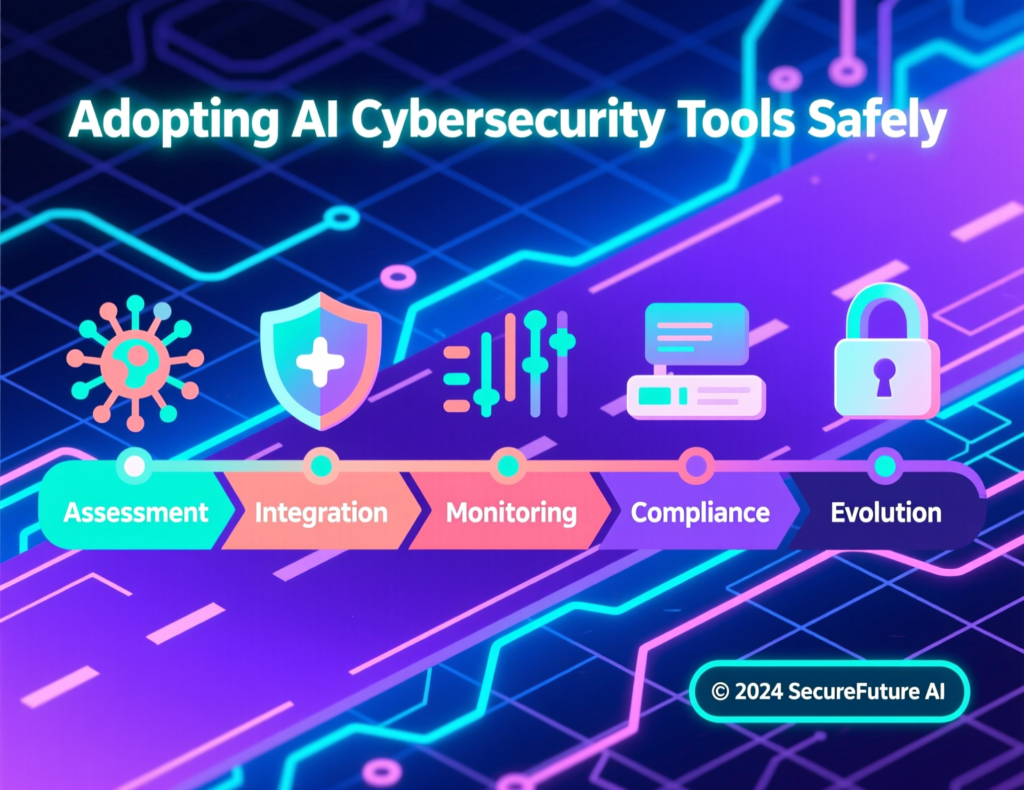
Step-by-step roadmap: from AI pilots to an AI-enabled cyber program
A simple roadmap for adopting AI in cybersecurity looks like this:
Clarify drivers and constraints
Map your top threats, regulatory obligations (HIPAA, GDPR, NIS2, DORA) and key business services – for example, payment processing in New York, patient portals in London, or OT operations in Munich.
Inventory data and existing tooling
Understand where your logs, identities and cloud workloads live today, and where AI is already creeping in via shadow tools or early copilots.
Run narrow AI pilots in the SOC
Start with contained use cases such as AI-assisted alert triage or phishing classification before attempting fully autonomous response.
Integrate AI into incident response
Connect AI insights into ticketing systems, playbooks and communications so humans always have context, oversight and a clear rollback path.
Industrialise governance and continuous tuning
Formalise AI policies, risk assessments, vendor reviews and regular red-teaming of models to keep pace with evolving threats and regulations.
This “crawl, walk, run” pattern is similar to the multi-phase approaches Mak It Solutions uses in cloud and AI projects across regions like the GCC and Europe.
How small and mid-sized businesses can use AI cybersecurity without new compliance risks
Small and mid-sized businesses should generally start with managed AI SOC or MDR/XDR services, choosing vendors with clear data-handling and compliance guarantees. Limit data feeds to what’s necessary, configure sensible retention periods and review AI outputs regularly with human experts.
For a 200-person manufacturer near Manchester or a SaaS scale-up in Berlin, this often delivers enterprise-grade monitoring without the need to build a 24/7 in-house SOC from scratch.
Be explicit with providers about:
How they handle log retention and deletion
Whether they transfer data across borders
Whether your data is used to train shared models – and how to opt out
Make sure these answers are reflected in contracts and data processing agreements.
Tackling the cyber skills gap with AI tools, training and managed SOC services
AI cannot magically solve the cyber skills shortage, but it can help teams stay afloat. Analysts can offload repetitive triage tasks to AI tools, focus on higher-value investigations and use AI copilots to speed up learning and documentation.
The ISC2 2024 workforce study shows strong appetite for better gen AI guidelines inside security teams, confirming that practitioners want structured, safe ways to use AI. Mak It Solutions often combines internal enablement with external support, building on themes from our guide to closing the cybersecurity talent gap and adapting them for US, UK and EU contexts.
Questions to ask AI cybersecurity vendors about data residency, model training and accountability
When you talk to vendors, use a simple checklist.
Where is all data stored and processed including backups and telemetry used for model training?
Can we opt out of our data being used to train global or shared models?
How do you handle access control for your engineers and support staff?
What certifications (for example, ISO 27001, SOC 2, PCI DSS for relevant components) back your claims?
How do you log and audit AI decisions that affect our users or systems?
What is your process for responding to model failures or adversarial attacks?
This kind of questioning is particularly important in regulated environments and whenever you rely on vendors for 24/7 monitoring.
US critical infrastructure, UK NHS data and German Mittelstand manufacturers
US critical infrastructure
Utilities around Austin or Washington D.C. increasingly use AI for anomaly detection in OT/ICS environments, guided by joint NSA/CISA principles on integrating AI into OT.
UK NHS data
NHS trusts that deploy AI for cyber monitoring must align with UK-GDPR and NHS digital guidance, especially when dealing with patient-identifiable information and long-term log retention.
German Mittelstand manufacturers
Mittelstand firms around Munich and Stuttgart are blending AI-driven SOC services with strict DSGVO controls and BaFin/industry guidance when they supply components into critical European supply chains.
Your next steps in the AI cyber arms race
Is your AI cyber defense keeping pace with attackers?
You’re in reasonable shape if you can answer “yes” to most of these.
We know where AI is already used in our security stack including shadow or pilot tools.
We have policies that cover AI usage, data handling and vendor controls.
Our SOC has at least one AI-assisted detection or response capability in production.
We can show auditors how AI-related decisions are logged, reviewed and escalated.
We’ve tested how our AI systems behave under attack or failure conditions.
If several of these are “no”, you’re likely behind both attackers and peers in the US, UK and EU.
When to move from tools to a unified AI cyber defense architecture
If you’ve accumulated multiple point solutions an AI email filter here, an XDR deployment there, a gen AI copilot in your SIEM but they’re not well integrated, you’re probably at the “tool sprawl” stage. That’s usually the right moment to:
Consolidate data into fewer, richer telemetry pipelines
Choose a primary AI-enabled XDR/SIEM platform
Standardise playbooks, metrics and governance across teams
Unified architectures make it easier to meet NIS2, DORA and EU AI Act expectations and to report coherently to your board.
How to turn this guide into an action plan
This guide is a starting point, not a finished blueprint. The next step is to map these ideas to your own context: sector, regulators, existing tools and data flows across your US, UK and EU footprint.
Mak It Solutions works with organisations to run focused assessments, design AI-enabled SOC roadmaps and implement practical guardrails building on experience in AI, cloud, cybersecurity and analytics across multiple regions. (Makitsol)
None of this is legal, regulatory or financial advice; always involve your legal, risk and compliance teams when making final decisions.
If you’re not sure whether your current defenses are keeping pace with AI-driven attackers or with evolving rules like NIS2, DORA and the EU AI Act now is the time to reassess. Mak It Solutions can help you baseline your AI exposure, design a practical AI-enabled SOC roadmap and implement AI cybersecurity controls your board, regulators and customers can trust. ( Click Here’s )
Key Takeaways
AI in cybersecurity is now an arms race: attackers and defenders both use AI, so speed, learning and governance determine who wins.
Offensive AI is already real, from targeted phishing and deepfakes to AI-powered ransomware and adversarial attacks on models.
Winning defenders combine AI-augmented SOC tooling (SIEM, XDR, SOAR) with strong human oversight, clear playbooks and robust logging.
Compliance frameworks such as GDPR/DSGVO, UK-GDPR, NIS2, DORA, the EU AI Act, NIST AI RMF and CISA guidance now directly shape how AI-based defenses must be designed and operated.
A practical roadmap runs from narrow pilots to integrated, governed AI architectures, often delivered via managed SOC/MDR services for SMEs.
Vendor selection matters as much as model selection: data residency, model training policies and accountability mechanisms are just as important as detection accuracy.
FAQs
Q : Will AI in cybersecurity replace human SOC analysts or just augment them?
A : In the near term, AI in cybersecurity will mostly augment, not replace, human SOC analysts. AI is excellent at sifting huge volumes of logs, ranking alerts and suggesting likely attack paths, but it still struggles with business context, ambiguous signals and creative attacker behaviour. Regulators and frameworks like NIST AI RMF and NIS2 also expect accountable humans to stay in the loop for high-impact decisions.
Q : How much does an AI cybersecurity platform typically cost for a mid-sized enterprise in the US or Europe?
A : Costs vary widely, but many mid-sized organisations in the US, UK and EU pay low six-figure annual amounts for AI-augmented XDR/SIEM plus managed services. Pricing is usually based on data volume (GB/day), number of endpoints or users, and whether 24/7 monitoring is included. The key is to compare cost against the potential impact of a major incident and to check how AI features are licensed – some vendors bundle them, others charge extra. This is not financial advice; always do your own budgeting and risk analysis.
Q : What are the best first use cases for AI in cybersecurity if our organisation is just starting out?
A : Great first use cases include phishing detection, alert triage and log anomaly detection in a constrained scope (for example, one cloud account or business unit). These use cases show quick value, are straightforward to measure and don’t require fully autonomous response from day one. Once you’ve proven outcomes, you can extend AI to threat hunting, OT monitoring or identity analytics, following the roadmap outlined above.
Q : How can industrial and OT environments (manufacturing, utilities, transport) safely adopt AI cyber defense?
A : For OT-heavy environments such as German manufacturers or European energy providers, the safest path is to start with passive monitoring and AI-assisted anomaly detection that doesn’t interfere with real-time controls. Follow guidance from agencies like CISA and NSA on integrating AI into OT, ensure strong network segmentation between IT and OT, and run joint tabletop exercises with engineering teams.Over time, you can carefully automate responses such as isolating infected engineering workstations while keeping safety systems prioritised.
Q : How do CISOs measure ROI and risk reduction from AI-driven threat detection and response tools?
A : CISOs typically track ROI using reduced mean time to detect (MTTD) and mean time to respond (MTTR), fewer critical incidents, improved analyst productivity and a stronger compliance posture. For example, if AI-assisted triage allows your SOC to cut MTTR by 30–50% and avoid even one major ransomware incident, the platform may effectively pay for itself. Many boards also look at NIS2 and EU AI Act readiness as part of ROI because fines and downtime can be substantial