
AI in Education: How AI and VR Are Transforming Classrooms
AI in Education: How AI and VR Are Transforming Classrooms

AI in Education: How AI and VR Are Transforming Classrooms
AI in education means using tools like adaptive learning platforms, AI teaching assistants and learning analytics to personalise instruction, reduce teacher workload and support school operations. When combined with VR, schools in the US, UK and Europe can build immersive, data-informed classrooms while staying compliant with FERPA, COPPA, GDPR/DSGVO, UK-GDPR and the EU AI Act if they design governance, procurement and training carefully. This article is for general information only and is not legal advice; always consult your legal or data protection team for specific decisions.
Introduction.
In schools across the US, UK and Europe, AI in education has shifted from hype to everyday practice. Teachers now use AI to plan lessons, differentiate tasks, support SEND/SEN learners and streamline admin, while leaders experiment with VR field trips and virtual labs to boost engagement. At the same time, they must navigate ethics, equity, data protection and new regulations like the EU AI Act and UK-GDPR.
Who This Guide Is For
This guide is written for school and district leaders, multi-academy trust executives, EdTech strategists and classroom teachers in the United States, United Kingdom, Germany and wider Europe who need a practical, non-hyped view of AI and VR. Whether you work in a New York district, a London MAT or a Schulamt in Berlin, the goal is to help you ask better questions, challenge vendors constructively and make safer decisions.
What You’ll Learn
You’ll see what AI in education actually is, how it’s already used in K-12 and higher education, and why VR and mixed reality are becoming part of mainstream digital classroom tools. The guide covers benefits and risks, regional policy drivers, compliance guardrails (FERPA, COPPA, GDPR/DSGVO, UK-GDPR, EU AI Act) and a pragmatic roadmap so your first 12 months feel structured rather than experimental.
What Is AI in Education?
AI in education is the use of artificial intelligence tools such as adaptive learning platforms, AI teaching assistants and analytics to support teaching, learning and school operations in K-12 and higher education. In practical terms, it means machines augmenting (not replacing) human teachers: surfacing insights, tailoring content and automating repetitive tasks while humans retain responsibility for pedagogy, relationships and judgement.
Core Building Blocks of AI in the Classroom
Modern classroom AI typically sits on a few core building blocks.
Machine learning and predictive analytics spotting patterns in assessment data, attendance and behaviour to flag learning gaps or at-risk students.
Large language models (LLMs) powering chat-style teaching assistants, writing helpers and code tutors embedded into tools across Microsoft, Google and Apple ecosystems.
Recommendation systems suggesting next activities, readings or practice sets in adaptive platforms.
Chatbots and virtual assistants answering common student or parent questions about homework, timetables or deadlines.
Most of this reaches classrooms through familiar vendors: Microsoft Education (Copilot in Microsoft 365), Google for Education (Gemini in Google Workspace), Apple-centred ecosystems, or cloud platforms like AWS, Azure and Google Cloud providing the backend.
How AI Is Already Used in US, UK and EU Classrooms
Across the US, UK, Germany and other EU countries, AI is already woven into everyday workflows:
Personalised practice in maths and languages, tuned to each learner’s pace.
Automatic quiz and worksheet generation aligned to state standards or exam board specs.
Assistive technologies for SEND/SEN: dyslexia-friendly fonts, text-to-speech, captioning and translation.
Teacher support for grading rubrics, feedback comments and lesson sequencing.
Recent research suggests around 60% of teachers globally have incorporated AI into their regular teaching routines, often for planning and content generation rather than direct grading.
In cities like New York or London, AI pilots often sit alongside 1:1 device programmes and cloud-based MIS/VLEs; in Berlin or Munich, they’re increasingly tied to data-residency-aware architectures and GDPR impact assessments.
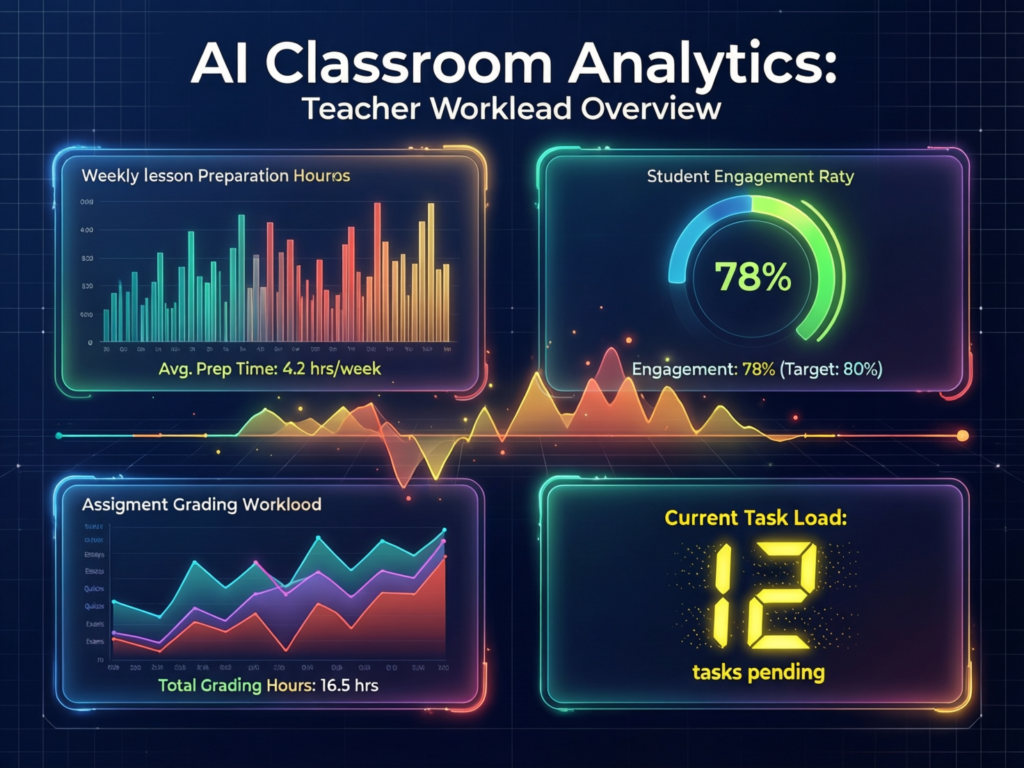
AI Beyond Teaching.
AI in education isn’t only about instruction. Schools also use it to:
Automate attendance tracking and follow-up alerts for safeguarding.
Generate early-warning signals using behaviour, grades and absenteeism data.
Streamline admissions and fee flows, often through PCI DSS-aware payment platforms.
Power multilingual messaging to families, turning teacher updates into multiple languages in seconds.
Under the surface, many districts are modernising their data stacks—moving toward architectures similar to enterprise data lakehouses for US and EU organisations to make analytics and AI safer and more consistent across schools. Mak It Solutions regularly helps education teams design these foundations before they roll out AI tools at scale.
Benefits and Risks of AI in the Classroom
The main benefits of AI in education are personalised learning, reduced teacher workload and richer insights. The main risks are data privacy breaches, embedded bias, widening digital divides and academic integrity issues.
Key Benefits for Teachers and Students
Done well, AI can.
Save teachers several hours a week on planning, resource creation and low-stakes marking. Some 2024–25 surveys report that a majority of teachers using AI save multiple hours per week on admin and preparation.
Make differentiation more practical, with adaptive tasks for mixed-ability classes in Manchester or Austin.
Improve accessibility, from live captions for hearing-impaired learners in London to text simplification for multilingual students in Hamburg.
Provide constant formative feedback, helping students iterate on essays or code before they submit.
These benefits mirror patterns we see in other analytics-heavy domains like self-service business intelligence, where governed, user-friendly tools empower non-technical staff while central teams retain control of data quality.
Risks, Limitations and Common Failure Modes
The risks are equally real
Hallucinations and inaccuracies in LLM-generated content.
Bias in training data leading to unfair recommendations or interventions.
Over-reliance, where students (or teachers) outsource too much thinking.
Opaque, “black-box” decisions influencing grading, set placement or behavioural interventions.
Academic integrity concerns: AI-written essays, AI-generated code and undetected plagiarism.
Reports from K-12 systems in the US show that over 80% of teachers and students now use AI in some form, but most feel under-prepared to handle the risks.
Mitigating Risks with Human-in-the-Loop Design
Responsible AI in education means designing tools and policies so humans stay firmly in the loop:
Teachers review AI-generated content before it reaches students.
School policies set age-appropriate boundaries and clearly define “allowed”, “discouraged” and “prohibited” uses.
Systems maintain audit trails for key decisions, particularly where AI influences interventions or grades.
Vendors align to frameworks like FERPA and COPPA in the US, which govern student data privacy and online children’s data, and GDPR/DSGVO and UK-GDPR in Europe, which set strict rules on lawful processing, minimisation and transparency.
Many districts now pair AI pilots with stronger AI content guardrails, borrowing techniques from corporate AI programmes to make usage safe, observable and auditable.
VR in Education and Immersive Classrooms
VR in education uses virtual reality headsets and 3D environments to create immersive lessons from virtual science labs to historical site visits that can deepen understanding when combined with good teaching practice and clear safety protocols.
What Is Virtual Reality in the Classroom?
In classrooms from San Francisco to Brussels, immersive tech now spans:
Virtual reality (VR) fully immersive head-mounted displays (HMDs) like Meta Quest or ClassVR.
Augmented reality (AR) overlays on tablets or phones that blend digital objects into the physical classroom.
Mixed reality (MR) more advanced, headset-driven experiences that anchor 3D objects in real space.
Schools can choose stand-alone headsets (no PC required) for easy deployment, or tethered setups for high-fidelity simulations in specialist labs.
High-Impact VR Use Cases in Schools
Common high-impact scenarios include.
Virtual science labs, where students in rural Germany or Texas safely explore dangerous experiments.
History and geography field trips, from walking ancient Rome to exploring glaciers under climate change scenarios.
Language immersion, placing learners into virtual cafés in Madrid or marketplaces in Lisbon.
SEN/SENCO support, with controlled environments for social stories and anxiety-reducing rehearsals.
Studies in the UK suggest VR lesson plans can boost classroom engagement by around 30%, with particularly strong responses from SEN learners and those who struggle with traditional text-heavy instruction.

Practical Requirements, Costs and Safety Considerations
Before buying a trolley of headsets, leaders in London, New York or Munich should map:
Hardware and network: robust Wi-Fi, charging/storage solutions and device-management tools.
Space and supervision: safe physical spaces, supervised rotations, clear time limits.
Health and accessibility: guidelines for motion sickness, visual impairments and age thresholds.
Data protection: how headsets and platforms process student data, where data is stored, and how this aligns with GDPR/DSGVO, UK-GDPR and local regulators (for example, national data protection authorities).
With VR in education projected to grow to tens of billions of dollars globally over the coming decade, schools need to treat VR as infrastructure, not a gadget, and include it in long-term budgeting and IT cost-optimisation plans.
Why Schools in the US, UK and Europe Are Investing in AI & VR
Schools across the US, UK, Germany and wider Europe are investing in AI and VR to tackle teacher workload, close learning gaps, improve STEM participation and align with national digital strategies and AI policies.
Policy and Funding Drivers by Region
United States
Federal and state initiatives, ESSER-style funding streams and state AI strategies push districts to pilot AI tutoring, analytics and VR CTE experiences, all against the backdrop of FERPA/COPPA and evolving state privacy laws.
United Kingdom
The Department for Education and Education Hub publish guidance on digital and AI use, while Ofsted and exam boards pressure schools to show impact. NHS-linked wellbeing tools increasingly rely on AI, raising health-adjacent privacy questions similar to HIPAA in the US.
Germany and EU
The EU Digital Education Action Plan, GDPR and the emerging EU AI Act frame AI/VR as “high-risk” where they affect student rights, requiring strong governance and transparency.
Market Trends and EdTech Innovation Hotspots
Innovation tends to cluster in hubs like London, Berlin, Munich, New York, Boston, San Francisco, Austin, Tallinn and Brussels. Many leading EdTechs build on cloud providers such as AWS, Azure and Google Cloud and ship experiences tailored for Apple/iPad or Chromebook fleets. Analytic-heavy platforms increasingly use unified data architectures akin to real-time analytics stacks in enterprises, so that insights arrive quickly but remain governed.
What Decision-Makers Look For in AI and VR Solutions
When a district in Manchester or a Gymnasium network in Hamburg runs a procurement, they typically look for:
Evidence of impact from pilots and independent studies.
Interoperability with their LMS/MIS and identity systems.
Security and compliance – SOC 2, ISO 27001, strong encryption and clear data-residency options for EU/UK.
Accessibility features baked into platforms, not bolted on.
Total cost of ownership (TCO) over 3–5 years, including training, support and hardware refresh.
Mak It Solutions often supports CIOs and IT directors through this evaluation, drawing on work in neighbouring domains like top CIO priorities for 2025 and IT cost optimisation to align AI/VR investments with broader digital strategy and budget realities.
Ethics, Equity and Regulation in AI/VR EdTech
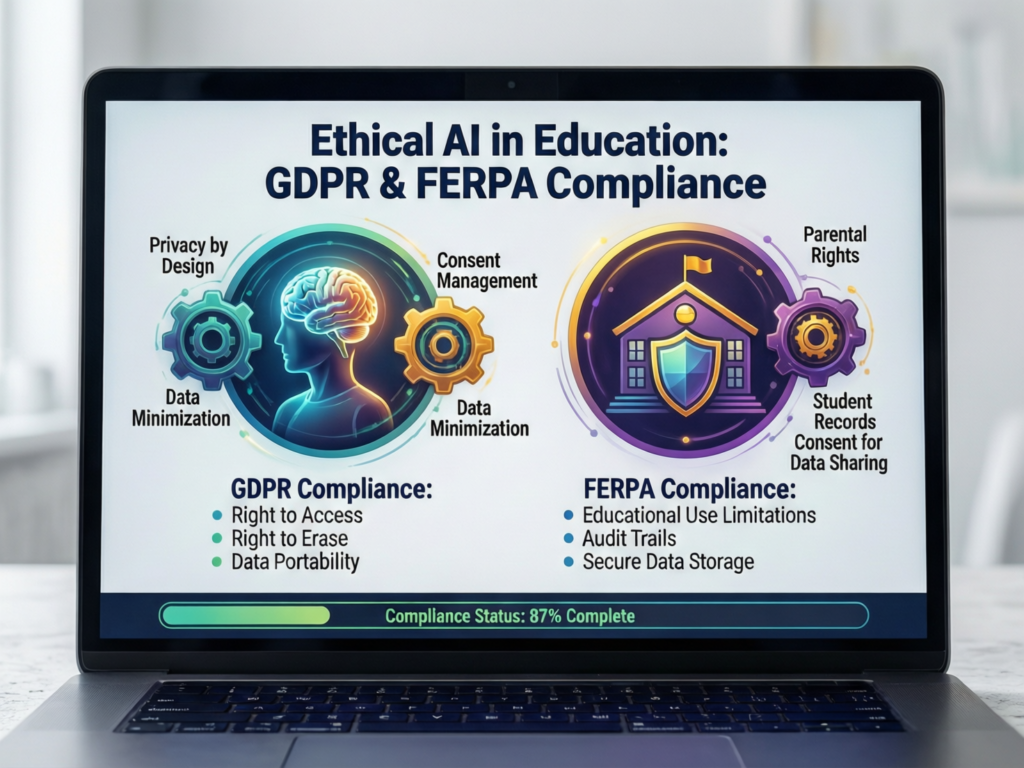
To use AI and VR responsibly, schools need strong pedagogy plus clear policies on privacy, fairness, wellbeing and academic integrity anchored in FERPA, COPPA, GDPR/DSGVO, UK-GDPR and emerging frameworks like the EU AI Act.
Data Protection and Regulatory Landscape
Key pillars include.
FERPA in the US: governs access to and disclosure of student education records.
COPPA and its updated rules: restrict data collection from children under 13 by online services, including many EdTech tools.
GDPR/DSGVO and UK-GDPR.
Define lawful bases, data-minimisation, rights of access and erasure, and DPIA requirements for high-risk processing in EU and UK schools. EU AI Act: introduces a risk-based regime where many educational AI systems will be treated as “high risk”, demanding transparency, human oversight and robust documentation.
The European Commission’s ethical guidelines for educators on AI emphasise teacher agency, transparency and student wellbeing principles that are just as relevant in New York or Dublin as they are in Tallinn.
Equity, Digital Divide and Accessibility
AI and VR can close or widen gaps. Urban schools in Washington D.C. or London might pilot cutting-edge tools, while rural schools in Bavaria, Texas or Poland lack devices or connectivity. Equity-minded leaders:
Budget for devices, connectivity and support, not just licenses.
Design blended experiences where key learning is still possible offline or on low-spec hardware.
Prioritise accessibility by design, following standards similar to those used in web development for accessibility-first projects Mak It Solutions delivers across KSA, UAE and Europe.
Academic Integrity and Responsible Use of Generative AI
Universities from Boston to Berlin are stress-testing assessments as generative AI becomes ubiquitous. Responsible practice typically includes:
Clear policies on when AI is allowed, acknowledged or banned in assessments.
AI literacy programmes that explain how models work, where they fail and how to critique outputs.
Redesigning assessments toward process, oral defence, project work and applied tasks rather than pure recall essays.
Many institutions pair this with internal AI content guardrails and shadow-IT management strategies borrowed from enterprise IT, so students and staff use approved, monitored tools rather than random consumer apps.

Designing the Classroom of Tomorrow with AI and VR
Over the next 5–10 years, AI in education and immersive technologies will power hybrid “phygital” classrooms where analytics, automation and VR content sit behind human-led, relationship-driven teaching.
Year Vision for US, UK and EU Classrooms
Expect to see.
AI-first lesson planning, where teachers in Austin or Birmingham start from AI-generated skeletons and refine.
Adaptive curricula that continuously adjust difficulty and modality.
VR/AR labs integrated into STEM and vocational pathways in cities like Munich or Manchester.
Real-time dashboards showing concept mastery, wellbeing indicators and engagement, built on top of unified data platforms similar to modern data lakehouse architectures.
Aligning AI and VR with Curriculum and Assessment
Technology must bend to curriculum and assessment, not the other way around. That means:
Mapping AI/VR tools to national standards (Common Core, NGSS, GCSE/A-levels, Abitur, etc.).
Ensuring VR simulations support key lab skills and exam-board practicals.
Building cross-subject projects—e.g., a VR climate expedition that blends geography, science and citizenship.
From Pilot to Scale.
Scaling beyond a single enthusiastic department requires:
A steering group with leaders, teachers, IT, data protection officers and student voice.
Ethics and safety panels to review high-risk use cases.
Formal DPIAs, vendor due-diligence and contract reviews with clear data-processing agreements.
6–12 month review cycles, where usage, equity and outcomes drive decisions to expand, pivot or retire tools.
Mak It Solutions often works with CIOs and education leaders on human-centred change management so AI/VR rollouts feel supported, not imposed.
How Teachers and Schools Can Get Started Today
Start small with low-risk AI tools that save time, pilot targeted VR in one or two subjects, and build staff confidence through training and clear policies before moving to high-stakes uses.
Low-Lift AI Tools Teachers Can Try Now
Teachers in New York, London or Vienna can begin with:
Lesson-planning assistants embedded in Microsoft 365 or Google Workspace.
Quiz and worksheet generators for retrieval practice.
Feedback helpers that suggest comments while you retain final say.
Built-in accessibility tools (captions, dictation, translation) already present on iPads, Chromebooks and major platforms.
These sit alongside broader data initiatives such as unstructured data analytics or real-time analytics that districts may already be running with partners like Mak It Solutions.
Building AI Literacy and Confidence in Staff
Professional development is critical:
Short, focused CPD sessions on concrete tasks (e.g., “Use AI to differentiate a lesson for three reading levels”).
Communities of practice where teachers share prompts, policies and pitfalls.
Partnerships with universities, unions and professional bodies to align with emerging standards and research.
Working with Vendors and Partners
When talking to EdTech vendors or consulting partners:
Ask for case studies from similar districts in the US, UK or Germany.
Review SLAs, data-processing agreements and security certifications in detail.
Explore options for grants, pilots and phased rollouts to reduce risk.
Mak It Solutions frequently supports schools and universities in selecting platforms, optimising cloud costs and designing AI architectures that comply with GDPR, UK-GDPR and sector-specific requirements.
Key Takeaways for Leaders and Teachers
AI and VR are no longer fringe experiments they’re becoming part of normal teaching, assessment and school operations across the US, UK and Europe. The opportunity is to use them to reduce workload, increase engagement and improve equity, while guarding against bias, privacy risks and over-reliance. That requires strong governance, thoughtful curriculum integration and a serious approach to infrastructure and training.
How to Prioritise Your First 12 Months
A simple 12-month path might look like this:
Audit your current tools, data flows and policies (including shadow IT).
Pilot a small set of AI and VR use cases in willing departments with clear success metrics.
Train staff through CPD, playbooks and AI literacy resources.
Evaluate impact, equity and compliance using real data.
Scale what works, retire what doesn’t and embed guardrails and governance for the long term.
Partners like Mak It Solutions can help you design that roadmap from analytics foundations to AI guardrails and immersive experiences so your “classroom of tomorrow” is safe, sustainable and genuinely better for learners.
If you’re mapping out AI and VR in your school, district or university and want a clear, compliant roadmap, Mak It Solutions can help. Our team works with education and enterprise clients across the US, UK, Germany and the wider EU on data platforms, AI content guardrails, cloud architecture and modern web and mobile experiences. Share your current challenges and we’ll help you scope a practical 12-month plan no hype, just an honest view of what’s realistic for your context. ( Click Here’s )
FAQs
Q : Is AI in education only suitable for high-budget schools and universities?
A : No. While early pilots often happen in better-funded schools, many AI tools are now bundled into platforms you already pay for like Microsoft 365, Google Workspace or your LMS. The real differentiator isn’t budget but planning: clear use cases, basic device access and staff training. Even small schools in rural areas can start with low-lift AI for planning, feedback and accessibility before moving to more advanced analytics or VR.
Q : What are some low-cost ways to try VR in the classroom without buying a full class set of headsets?
A : You don’t need 30 headsets to get value from VR. Many schools start with 4–6 shared headsets and run rotational activities, or use smartphone-based viewers with existing devices. You can also lean on AR apps for tablets, which are often cheaper and easier to manage. Focus on a handful of high-impact scenarios like a science topic or careers lesson and evaluate engagement and learning outcomes before scaling hardware.
Q : How can schools explain AI and data use to parents and guardians clearly?
A : The best approach is plain language and concrete examples. Instead of “LLMs” and “predictive models,” describe how tools help personalise homework, generate resources or flag students who may need extra support. Publish a simple AI and data FAQ on your website, tie it to FERPA/GDPR obligations where relevant, and explain what you will not do (e.g., sell data, use AI to make final exclusion decisions). Parent evenings and short explainer videos can also build trust.
Q : Which AI tasks should teachers never fully automate in the classroom?
A : Tasks that require nuanced judgement, ethics or deep understanding should never be fully automated. That includes final grading decisions, safeguarding referrals, behavioural sanctions and high-stakes placement choices. AI can help draft comments, surface patterns or suggest interventions, but a qualified human should always make the final call and be able to explain it. Keeping humans in the loop protects students and supports professional accountability.
Q : How can small schools in rural areas close the digital divide when adopting AI and VR tools?
A : Rural schools often face bandwidth, device and staffing constraints, so the strategy must be phased. Start with cloud tools that work on low-spec devices and support offline or low-bandwidth modes. Explore regional or national grants for connectivity and devices, and consider shared services across clusters of schools. Focus on high-leverage uses like AI-assisted planning and accessibility before investing in VR hardware, which may come later through regional hubs or mobile labs.