
AI Upskilling for Employees in MENA: Saudi, UAE, Qatar
AI Upskilling for Employees in MENA: Saudi, UAE, Qatar
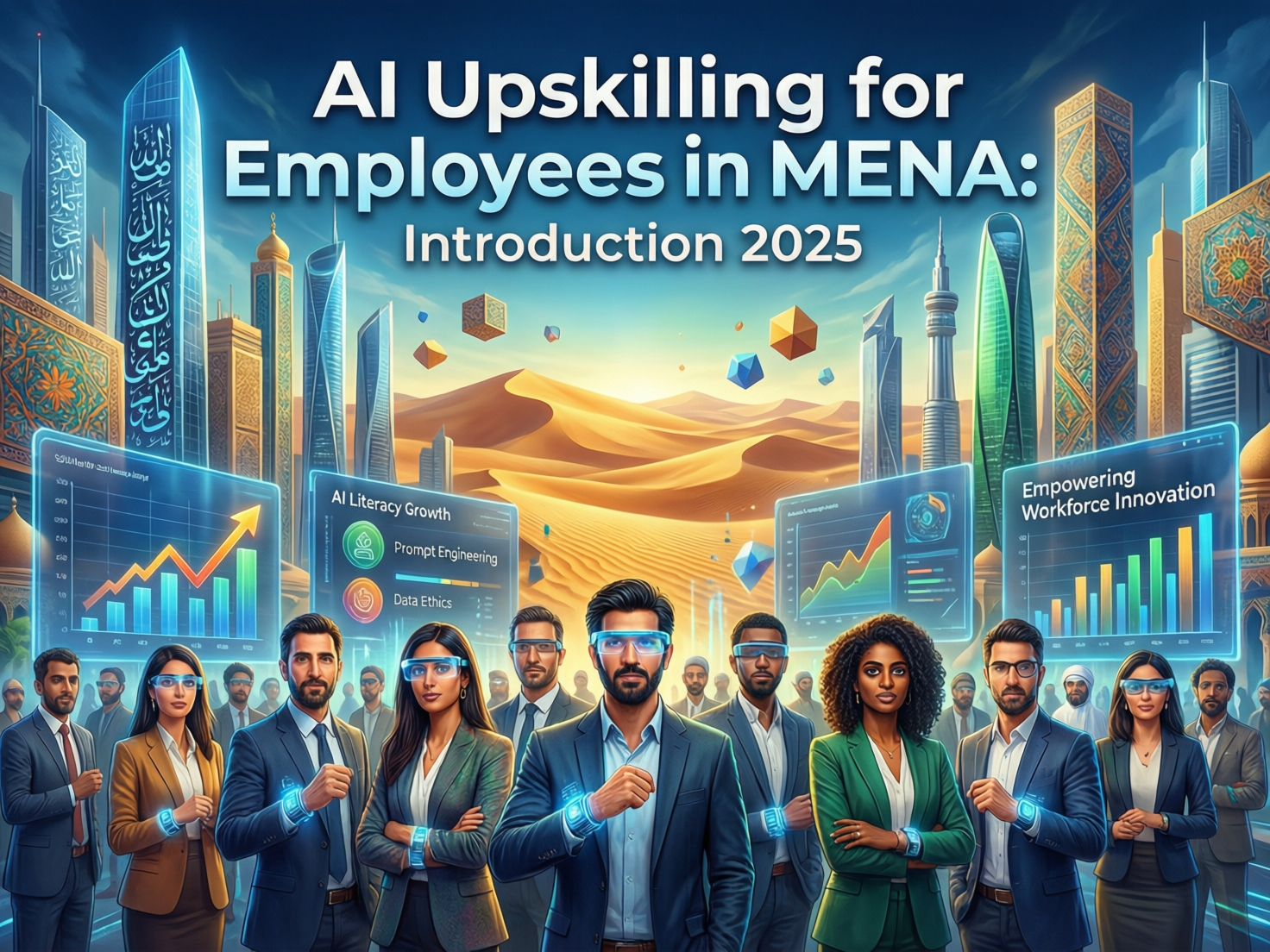
AI Upskilling for Employees in MENA: Saudi, UAE, Qatar
AI upskilling for employees in MENA means giving teams in Saudi Arabia, the UAE and Qatar practical AI literacy, role-based use cases and compliant tools so they can work alongside automation instead of being replaced by it. For GCC HR and L&D leaders, the fastest path is to design structured AI learning journeys aligned with national visions (Saudi Vision 2030, UAE AI Strategy 2031, Qatar’s Digital Agenda 2030) using partners who understand local regulation, languages and cloud requirements.
Introduction
In 2025, AI upskilling for employees in MENA has shifted from a “nice to have” to a survival issue for HR and L&D teams. Labour markets in Riyadh, Dubai and Doha are digitising faster than most companies can rewrite job descriptions, let alone hire ready-made AI talent.
In practice, AI upskilling for employees in MENA means giving teams in Saudi Arabia, UAE and Qatar practical AI literacy, role-based use cases and compliant tools so they can work alongside automation, not be replaced by it. For GCC leaders, the winning move is to build structured AI learning journeys that track with national digital agendas and local regulations, rather than importing generic training from abroad.
HR and L&D leaders across fintech, government, logistics, healthcare and retail feel the same pressure: they can’t hire senior AI talent fast enough, and vendor pitches don’t always respect Arabic language needs, data residency, or regulators like SAMA, TDRA and QCB. Below, we’ll look at which AI skills actually matter, how GCC governments are steering the change, and how to design a realistic training journey for your workforce with examples from Riyadh to Dubai to Doha.
If your organisation wants help turning this into a concrete roadmap, a partner like Mak It Solutions can support with strategy, platforms and implementation, not just slides.
The 2025 Future of Work in MENA.
How AI and Automation Are Reshaping Jobs in Saudi, UAE and Qatar
Saudi Vision 2030, the UAE’s AI Strategy 2031 and Qatar’s Digital Agenda 2030 all treat data and AI as infrastructure, not experiments. In Riyadh, events like LEAP showcase AI in banking, smart cities and industry; in Dubai, initiatives under Digital Dubai and DGOV are digitising government services; in Doha, new cloud regions and digital programs support smart logistics and energy.
For employers, the implication is clear: tasks in HR, finance, customer service and operations will increasingly be co-piloted by AI. Your people need to be ready to orchestrate those systems, not compete with them.
MENA Digital Skills Gap and the Risk of “Automation Inequality”
Across the region, there is a widening MENA digital skills gap between highly skilled knowledge workers and frontline or back-office staff. Non-technical employees often lack basic AI literacy: what data is, how AI tools work, and how to use them safely with customer or citizen information.
Sectors like fintech, government, logistics and retail are under particular pressure as chatbots, RPA and analytics platforms roll out faster than training plans. Without inclusive upskilling, GCC labour markets could see “automation inequality” a small group of highly skilled workers gaining value while others stagnate.
Why Companies Are Upskilling Instead of Only Hiring AI Talent
Senior AI talent in MENA is scarce and expensive, and global platforms often compete for the same profiles. Rather than only hiring new specialists, many Saudi, Emirati and Qatari employers are reskilling existing teams, especially national talent, to meet both business and localisation targets.
Upskilling aligns directly with Saudization, Emiratisation and Qatarisation goals: instead of importing every new skill, organisations grow internal capability and retain institutional knowledge. For HR leaders, that mix of talent economics and national policy makes AI upskilling one of the most strategic L&D bets of this decade.
What AI Skills Do Employees in MENA Need by 2025?
What AI skills do employees in Saudi Arabia, UAE and Qatar need most by 2025? They need a blend of core AI literacy, role-specific use cases and future-facing skills in data, automation and human collaboration. The goal is not to make everyone a data scientist, but to ensure every employee can safely and confidently work with AI tools in Arabic and English.

Core AI Literacy for Non-Technical Staff
At a minimum, non-technical employees should understand AI basics (what systems can and can’t do), prompt engineering for chat-based tools, data awareness, and AI ethics. They should know what data is safe to put into copilots, how to verify AI outputs, and how bias or hallucinations can appear.
In GCC workplaces, this core literacy must support bilingual workflows: using AI copilots in Arabic and English across email, documents and customer interactions, with examples drawn from local industries and regulations.
Role-Based AI Skills for HR, Finance, Operations and Customer Service
Role-based skills turn abstract AI into daily practice. HR teams need to use AI for talent analytics, workforce planning and screening support. Finance teams can use AI for forecasting, anomaly detection and scenario modelling. Operations and logistics in Dammam, Jebel Ali or Hamad Port can apply RPA and computer vision to reduce bottlenecks, while contact centres in Jeddah, Dubai and Doha adopt AI chat and voice bots to handle routine enquiries.
Banks in Riyadh regulated by SAMA, Dubai government entities under Digital Dubai, and energy/logistics firms in Doha overseen by QCB and MCIT are already piloting such tools but the real impact comes when line managers and operators are trained, not just IT.
Future Skills.
Future-proof employees combine data literacy (reading dashboards, asking good questions), comfort with automation workflows (RPA, low-code tools) and human skills like critical thinking, collaboration and emotional intelligence.
These align with the future skills frameworks promoted by SDAIA in Saudi Arabia, TDRA and DGOV in the UAE, and Qatar’s Digital Agenda 2030, all of which emphasise digital fluency plus adaptability and problem solving.
Corporate AI Training Programs and Platforms in GCC
Common AI Upskilling Models.
GCC organisations typically mix four models: internal AI academies, vendor-led bootcamps, AI-powered learning experience platforms (LXPs) and blended programs combining microlearning with live workshops.
Riyadh-headquartered groups may launch internal academies aligned with Vision 2030; Dubai entities often tap Digital Dubai or TDRA-linked academies alongside private providers; Doha organisations increasingly use cloud-based LXPs hosted in nearby regions to respect data policies.
If your stack includes custom portals or apps, a partner experienced in web development services can help integrate AI learning experiences into existing systems instead of adding yet another silo.
What GCC HR Leaders Look for in an AI Training Partner
HR and L&D buyers in GCC usually evaluate partners on:
Arabic and English content and facilitation
Sector-specific case studies (e.g., SAMA-regulated banking, Dubai government, Qatar energy)
GCC compliance, including data residency and regulator expectations
In-region cloud (AWS Middle East, Azure UAE regions, GCP Doha) for sensitive training data.
Decision makers typically include the CHRO, Chief Digital Officer and L&D manager, often with input from CIO/CISO. Many look for partners who can also support business intelligence and analytics to measure training outcomes.
Comparing Local vs Global AI Training Providers
Global platforms offer breadth, brand and large content libraries, but often lack Arabic content, GCC case studies and local compliance. Local and regional providers bring on-the-ground facilitation, understanding of Vision 2030, UAE AI Strategy 2031 and Qatar’s Digital Agenda, plus relationships with regulators and free zones like ADGM and DIFC.
For many GCC organisations, the sweet spot is a hybrid: global tools where appropriate, wrapped by a local partner who localises, facilitates and integrates AI skills into real workflows.
Government and Regulator-Led AI Skills Initiatives in GCC
How SAMAI, SDAIA and SAMA Influence AI Skills in Saudi Workplaces
In Saudi Arabia, SDAIA leads national data and AI strategy under Vision 2030, driving AI adoption across government and industry. At the same time, SAMA sets standards for open banking and data sharing, which directly affect how banks and fintechs in Riyadh and Jeddah can use AI on customer data. (sama.gov.sa)
For HR and compliance teams, this means AI training for employees must include modules on data governance (NDMO), consent, and sector-specific rules — especially in financial services and government-linked entities.
UAE National AI Strategy 2031, TDRA and Digital Dubai as Skills Catalysts
The UAE Strategy for Artificial Intelligence 2031 aims to make the country a global AI leader, with a focus on government performance and economic growth. TDRA’s digital government initiatives and Digital Dubai programs translate this into practical curricula for civil servants and tech leaders in Dubai and Abu Dhabi.
B2G and leadership programs often combine AI strategy, ethics and practical labs, with a strong emphasis on developing Emirati talent for AI-intensive roles. Private companies can mirror these structures internally.
Qatar Digital Academy, QCB and MCIT.
Qatar’s Ministry of Communications and Information Technology launched Qatar Digital Academy to upskill the workforce and support Digital Agenda 2030, including AI-related competencies.
For HR teams in Doha, especially in regulated sectors under QCB or major energy/logistics players, aligning internal AI training with Qatar Digital Academy frameworks helps ensure compatibility with public-sector standards and national transformation goals.
Designing an AI Upskilling Journey for GCC Employees
How can HR and L&D teams in GCC design AI upskilling journeys that align with Vision 2030 and UAE AI 2031? Start by assessing current skills and priority use cases, then build role-based learning paths linked to national strategies, and finally deploy training with strong change management so habits actually change.
Assess Your AI Readiness and Skills Gaps in Riyadh, Dubai and Doha
Begin with diagnostics: surveys, skills assessments and workshops per business unit and location. Map current tools, data maturity, and where AI is already emerging (e.g., chatbots, RPA, analytics).
For multi-country groups, compare readiness between Riyadh, Dubai, Abu Dhabi and Doha offices to prioritise pilots. A tech partner with digital marketing and analytics experience can also help gauge how AI-ready your customer-facing channels are.
Build Role-Based Learning Paths Aligned with Vision 2030 and UAE AI 2031
Next, group roles into families (HR, finance, operations, frontline, leadership) and define specific AI outcomes for each: “HR business partners can use AI to build headcount scenarios”, “call-centre supervisors can design AI-assisted scripts”, and so on.
Ensure content references Saudi Vision 2030, UAE AI 2031 and Qatar’s Digital Agenda in clear, non- (SDAIA)
Deploy AI Training with Microlearning, On-the-Job Coaching and Change Management
Finally, roll out in waves: short e-learning modules, live virtual or in-person workshops, AI labs where people try tools on real data, and manager-led coaching to reinforce skills.
Change management is critical: communication from senior leaders, clear policies on AI usage, and visible success stories. Here, an experienced mobile app development or SEO partner can help deliver training through mobile-friendly experiences and findable knowledge hubs, not just one-off webinars.

Compliance, Data Residency and Trust in AI Training Programs
Data Residency and Cloud Choices for AI Tools in Saudi, UAE and Qatar
Many GCC organisations insist AI tools used in training keep data within approved regions. AWS offers Middle East regions in Bahrain and UAE; Azure provides UAE regions such as UAE North and UAE Central; Google Cloud now operates a cloud region in Doha.
Designing AI upskilling often means restricting use to tenants hosted in these regions, or using anonymised datasets for exercises, especially in banking, healthcare and government.
Sector-Specific Compliance.
Banking and fintech must satisfy SAMA or QCB rules; telecoms and digital services in the UAE must align with TDRA; public-sector entities across the GCC answer to their respective digital authorities.
That means any AI training platform including simple copilots should be risk-assessed like any other SaaS system. Training content itself should model compliant behaviour, not just tell people “be compliant”.
Building Employee Trust
Employees worry that AI tools may be used for surveillance or to justify layoffs. To build trust, be transparent: explain why AI is being introduced, what data it uses, and what protections apply.
Accessible Arabic/English interfaces, clear opt-out rules for sensitive pilots, and visible ethical guidelines aligned with SDAIA, TDRA or MCIT principles all help staff feel that AI is there to augment, not punish, them. (SDAIA)
Measuring ROI from AI and Automation Training in MENA
How should MENA companies measure ROI from AI and automation training for employees? Link learning outcomes to clear KPIs — such as time saved, error reduction and compliance scores and track them in dashboards combining LXP, HR and operational data.
Defining Success Metrics.
Start with a short list of metrics: minutes saved per task, reduced processing errors, improved SLA adherence, higher Net Promoter Scores and better audit results.
Where nationalisation is a priority, additional KPIs might include percentage of critical AI-enabled roles held by Saudi, Emirati or Qatari nationals after training.
Linking AI Upskilling to Business Cases and National KPIs
Every AI upskilling initiative should map to both internal business cases and national agendas. A Riyadh fintech might link automation in onboarding to Vision 2030 financial-sector KPIs; a Dubai e-commerce brand might tie AI-assisted merchandising to UAE digital economy goals; a Doha SME using GCP Doha can demonstrate alignment with Qatar’s Digital Agenda 2030.
These narratives help secure budget from boards who increasingly ask how initiatives support national visions, not just profit.

Building an ROI Dashboard for HR and L&D Leaders
Combine data from your LMS/LXP, HRIS and key business systems into a simple “AI Upskilling Dashboard.” Track training completion, skills assessments, adoption of AI features in tools, and impact metrics like case-handling time or backlog reduction.
Partners skilled in business intelligence and webflow or web development can help design these dashboards so HR, L&D and business leaders see impact in one place. (Mak it Solutions)
Real-world GCC examples include:
A Riyadh fintech reducing onboarding time by 30% after upskilling operations staff on AI-assisted KYC.
A Dubai retail brand boosting conversion via AI-personalised product recommendations and trained merchandisers.
A Doha logistics SME using cloud-based routing optimisation after training dispatch teams on data and automation concepts.
How GCC Companies Can Get Started in 2025
Quick Wins in the Next 90 Days for Saudi, UAE and Qatar Teams
You don’t need a multi-year program to start. In the next 90 days, you can run an AI literacy pilot for one function, host an AI “day” or hackathon in Riyadh, Dubai or Doha, and launch a short microlearning series about safe AI usage in Arabic and English.
Capture before/after stories and simple metrics; they’ll fuel your business case for scaling.
Selecting the Right AI Training Partner for Your Sector and Country
Build a simple decision matrix: industry (fintech, government, retail, logistics), language mix, budget, cloud requirements and preferred delivery model (onsite, hybrid, fully remote).
Evaluate whether potential partners understand regulators like SAMA, TDRA and QCB, and whether they can integrate content into your existing systems for example, via your core services stack or digital marketing channels.
From Pilot to Scale
Think in phases
Awareness (2025): basic literacy, leadership alignment, policy setting.
Enablement (2026–2027): role-based paths, hands-on labs, embedded coaching.
Specialisation (2028–2030): deep technical paths, internal AI champions, cross-GCC communities of practice.
By 2030, the most resilient organisations in MENA will be those that treated AI upskilling for employees in MENA as a continuous journey, not a one-off course.

If you’re responsible for HR, L&D or digital transformation in Saudi Arabia, the UAE or Qatar, this is the moment to turn AI upskilling from a slide into a real program. Start small, prove value in one function, then scale with clear governance and ROI tracking.
Mak It Solutions can help you map skills, choose the right platforms, and build bilingual, regulator-aware training that actually fits how your teams work. Talk to us about a tailored AI skills roadmap for your organisation visit our contact page and let’s plan your 2025–2030 AI journey together.
FAQs
Q : Is AI training for employees mandatory under any Saudi Vision 2030 or SDAIA programs?
A : AI training is not universally “mandatory” for all Saudi employers, but Vision 2030 and SDAIA’s national data and AI strategy strongly encourage organisations to adopt AI and build local skills. In practice, many government-linked entities and heavily regulated sectors (like banking and utilities) face clear expectations to build AI and data capabilities. For HR and L&D teams, the safest assumption is that employees in Riyadh, Jeddah and Dammam should receive structured AI literacy and role-based skills aligned with SDAIA and NDMO guidance, even if no single law mandates a fixed curriculum.
Q : Are there government subsidies or grants for AI upskilling in the UAE for private companies?
A : The UAE regularly launches funds, sandboxes and incentives that can indirectly support AI skills, especially via free zones like ADGM and DIFC, and through programs attached to the UAE AI Strategy 2031. While there may not always be a “pure” AI training grant, private companies can often tap innovation vouchers, R&D incentives or co-funded leadership programs. It’s wise for HR and L&D leaders in Dubai, Abu Dhabi and Sharjah to monitor TDRA, the UAE Ministry of AI and local free zones for new initiatives and eligibility criteria.
Q : How can Qatar SMEs start AI upskilling if most courses target government or large enterprises?
A : Qatar SMEs can begin by leveraging public resources from MCIT, Qatar Digital Academy and Digital Agenda 2030, then layering affordable online courses and targeted workshops on top. A practical approach is to pick one or two priority use cases (for example, customer support automation or basic analytics), train a small “core team” first, and then roll skills out to the wider staff. Partnering with local providers who understand QCB and sector-specific requirements helps SMEs in Doha benefit from AI without over-investing in heavy enterprise solutions.
Q : Can GCC organisations deliver AI training in both Arabic and English within the same program?
A : Yes, and for many GCC organisations it is essential. Mixed-language programs let leadership and regional teams learn in English while frontline staff and public-facing roles train primarily in Arabic. The key is to design content, examples and interfaces so they feel native in both languages, not simply translated. For example, including Saudi Vision 2030 or UAE government case studies in Arabic can boost relevance and trust. Many companies work with bilingual providers like Mak It Solutions to create dual-language learning paths and materials.
Q : Do data residency rules in Saudi, UAE and Qatar limit which AI tools we can train staff to use?
A : Yes. While policies vary, Saudi Arabia, the UAE and Qatar all emphasise data sovereignty and protection, especially for government and regulated sectors. That often means preferring AI tools hosted in approved regions, such as AWS Bahrain/UAE, Azure UAE regions or Google Cloud Doha, and avoiding training scenarios that send sensitive data to offshore environments. HR, IT and compliance should jointly review AI tools and training exercises against requirements from bodies like SDAIA, TDRA, SAMA and QCB before large-scale rollouts.