
AR and VR in Education in Saudi Arabia for GCC Schools
AR and VR in Education in Saudi Arabia for GCC Schools
AR and VR in Education in Saudi Arabia for GCC Schools
AR and VR in education in Saudi Arabia are helping schools move from lecture-based teaching to immersive, skills-focused learning that fits Vision 2030, UAE Vision 2031 and Qatar National Vision 2030. Over the next 12–24 months, GCC schools that start pilots, secure the right hardware and align with local data and accessibility rules are best placed to see higher student engagement, stronger STEM results and better readiness for the digital economy.
Introduction
Across Riyadh, Dubai and Doha, ministries and school groups are under pressure to prove that digital transformation in education is more than just tablets and smart boards. AR and VR in education in Saudi Arabia give leaders a practical way to connect classrooms to Vision 2030, UAE Vision 2031 and Qatar National Vision 2030 by building real digital skills, not just e-textbooks. At the same time, many schools still struggle with disengaged students, theory-heavy teaching and the need to show measurable learning outcomes to boards, regulators and parents.
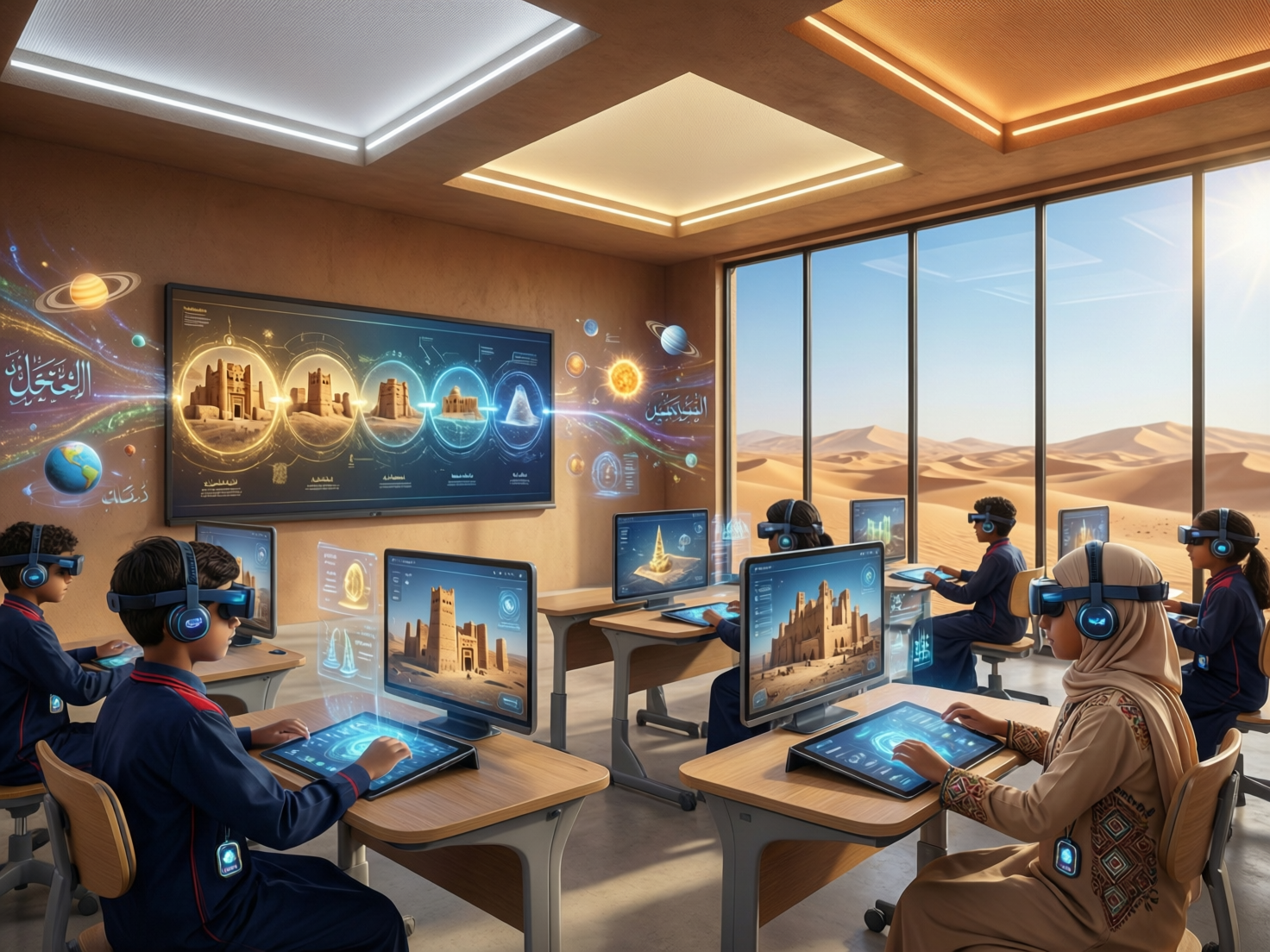
In reality, immersive learning environments in GCC classrooms can already deliver safer science experiments, richer language practice and virtual field trips in Arabic. For decision-makers exploring the best VR education solution for Saudi schools or an AR VR learning system for UAE students, the real opportunity is to start focused pilots now, rather than waiting for “perfect” technology that never arrives.
For schools that want a guided journey, partners like Mak It Solutions can connect strategy, technology and content into one practical roadmap.
AR and VR in Education in Saudi Arabia.
What AR and VR mean for K-12 and higher education in KSA
Augmented reality overlays digital objects on the real world through mobiles or tablets, while virtual reality places students inside a fully digital environment using headsets. Together with mixed reality, this is often called extended reality (XR) in classrooms.
In practical terms, a Riyadh Grade 9 class might use an AR app to view a 3D heart model on their desks, while a Jeddah university runs a VR lab where engineering students walk inside a virtual oil refinery. Compared with full XR labs, AR mobile apps are the fastest way to start, while VR headsets and labs offer deeper simulations for STEM, medical and vocational training.
What is the role of AR and VR in transforming classrooms in Saudi Arabia under Vision 2030?
Under Vision 2030’s Human Capability Development Program, AR and VR in education in Saudi Arabia help shift learning from memorisation to application by simulating real-life scenarios in science, engineering, languages and soft skills. When integrated with platforms like the Ministry of Education’s iEN portal and national digital resources, they support a knowledge economy where students build problem-solving, collaboration and digital fluency from primary school through university.
How AR and VR in education in Saudi Arabia support Vision 2030 goals
Immersive learning directly supports Saudi Vision 2030 themes such as digital skills, human capability development and a diversified knowledge economy. When a public school in Dammam runs VR safety drills or a technical college uses simulations for renewable energy, they are building exactly the competencies employers and regulators demand.
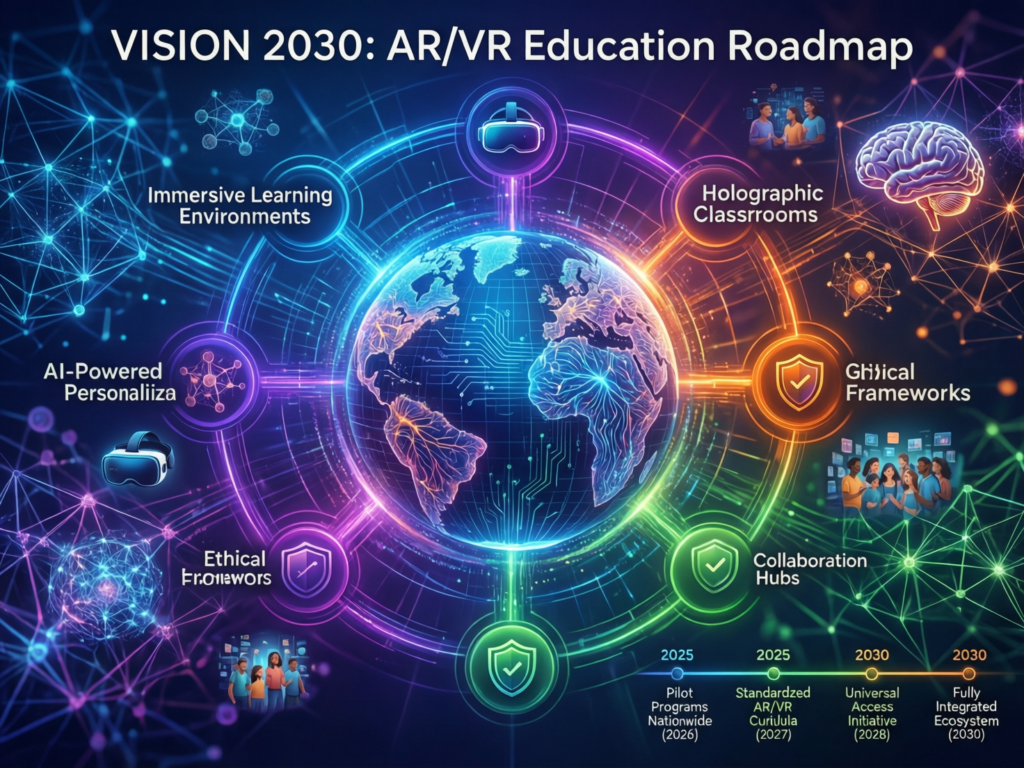
By connecting AR/VR scenarios to iEN content and national exams, leaders can show how each virtual lesson improves specific outcomes, from science scores to employability skills. This makes it easier to defend budgets, win approvals and prove that AR and VR are core to digital transformation, not just “nice-to-have” gadgets.
Comparing AR/VR adoption across Saudi, UAE and Qatar
Today, AR and VR in education in Saudi Arabia are moving from small pilots to larger district and university projects, giving KSA the biggest scale opportunity. The UAE often leads in early pilots, with Dubai and Abu Dhabi schools testing VR labs for STEM and soft skills, supported by active regulators like KHDA and TDRA. Qatar stands out in accessibility and innovation, with organizations such as Mada, Qatar Foundation and Qatar University exploring spatial computing and virtual reality in education in the Middle East through dedicated innovation centers.
How AR/VR Improve Outcomes for Arabic-Speaking Students
Immersive learning environments in GCC classrooms and student engagement
When students in Riyadh step into a VR lab to see a volcano erupt or Dubai learners use AR to dissect a frog safely, attention and participation tend to rise dramatically. Research and real-world pilots show that immersive learning environments in GCC schools help students retain complex concepts longer because they “experience” rather than just read about them.
For Arabic-speaking students who may struggle with abstract textbooks, interactive 3D content and gamified tasks make lessons feel closer to real life. Teachers also gain new ways to check understanding through in-app quizzes, simulations and scenario-based assessments instead of only traditional worksheets.
AR/VR for STEM, languages and social studies in Arabic-first classrooms
AR and VR in education in Saudi Arabia are especially powerful for STEM: dangerous or expensive experiments in chemistry or physics can be simulated safely in VR labs for schools in UAE and KSA. Virtual field trips let Doha students explore historic sites in Makkah, Madinah or Petra through Arabic narration, connecting social studies to lived culture.
In the same environment, learners can switch to English to practise vocabulary or communication skills, supporting bilingual goals across Gulf schools. This mix of Arabic-first content and English practice also supports e-learning innovation in Saudi Arabia and the UAE by making digital lessons more relevant to everyday life in the region.
AR/VR for students with disabilities in Qatar and GCC
GCC educators are increasingly using AR/VR to support students with disabilities, inspired by centers like Mada in Qatar that specialise in assistive technology. Customisable fonts, audio narration, subtitles and adaptable interaction methods allow visually impaired, hearing-impaired or autistic learners to access the same concepts in different ways.
For example, a Doha student with motor challenges can experience a virtual science experiment by using voice commands instead of physical lab tools. With the right design, AR VR in education in Qatar and Saudi Arabia becomes a powerful inclusion tool, not a barrier—supporting national goals around equity and accessibility.
Implementing AR/VR Labs and Classrooms in GCC Schools
Choosing Saudi- and UAE-friendly VR hardware and headsets for schools
For GCC leaders, choosing hardware is as strategic as choosing content. Devices must withstand heavy classroom use, offer local warranty and support Arabic menus where possible. Low-cost mobile-based VR kits are ideal for first pilots in a Sharjah or Jeddah school, while all-in-one headsets and dedicated XR labs suit universities and large school groups.
Robust device management tools are critical so IT teams can centrally update apps, manage classes and apply safe-use policies across campuses. Partners providing end-to-end solutions and education-focused services help simplify this complexity and reduce pressure on internal IT teams.
Network, Wi-Fi and safety requirements for AR/VR in GCC classrooms
What hardware and network requirements do GCC schools need to run AR/VR lessons safely and reliably?
Schools should plan for high-density Wi-Fi, with enough bandwidth to support 20–30 concurrent VR sessions per classroom and low latency for smooth simulations. Classrooms in Abu Dhabi or Riyadh need well-ventilated layouts, clear walking zones and hygiene procedures for shared headsets, including cleaning routines and usage time limits.
From a regulatory view, guidelines from bodies like the UAE’s TDRA and national ICT frameworks should shape cyber safety, content filtering and device management policies. This keeps immersive learning aligned with national standards for student wellbeing and online safety.
Localised AR/VR content libraries for Arabic curriculum and Islamic studies
No matter how advanced the headsets are, AR and VR in education in Saudi Arabia only work if content matches Saudi, UAE and Qatar curriculum standards. That means Arabic UX, right-to-left interfaces, culturally appropriate avatars and scenarios, and virtual field trips that respect Islamic values.
GCC ministries and school groups typically mix off-the-shelf content (for generic STEM) with custom-built modules for Islamic studies, local geography and national history. Partnerships with regional universities, content studios and solution providers such as Mak It Solutions’ web development experts can significantly accelerate this localization.

Policy, Compliance and Data Privacy for AR/VR in Middle Eastern Education
Aligning AR/VR programs with Vision 2030, UAE Vision 2031 and Qatar National Vision 2030
Immersive learning is a natural fit for national visions that emphasise innovation, digital transformation in Middle Eastern education and lifelong learning. In Saudi Arabia, AR VR in higher education in Saudi Arabia can support Vision 2030 by training engineers, doctors and digital professionals on realistic simulations.
The UAE Ministry of Education and KHDA prioritise future-ready skills and wellbeing, both of which benefit from safe, engaging simulations. Qatar’s Ministry of Education & Higher Education sees virtual reality in education in the Middle East as part of a broader innovation ecosystem together with Qatar Foundation and Qatar University.
Data privacy, child safety and data residency for immersive classrooms
How can GCC education providers ensure AR/VR learning tools follow data privacy and accessibility rules?
First, host platforms in local or regional cloud regions such as AWS Middle East (KSA), Azure UAE Central or GCP Doha, in line with national data residency expectations and Qatar Digital Government frameworks. Second, minimise personal data collected from students, and ensure any digital ID integration (for example, Qatar Digital ID) follows national standards.
Finally, use clear consent forms, age-appropriate content and strong access controls aligned with TDRA, KHDA and Saudi or Qatari cyber-security guidelines so AR/VR remains a safe space for minors. For any project that touches sensitive data, it is wise to involve legal and compliance teams early.
Accessibility and inclusive design standards across KSA, UAE and Qatar
Accessibility is rapidly moving from a “nice-to-have” to a regulatory expectation across the GCC, influenced by disability inclusion frameworks and organisations like Mada. AR and VR in education in Saudi Arabia, the UAE and Qatar must include subtitles, screen-reader-friendly menus and alternative interaction modes so that all learners can participate.
As ministries update digital-accessibility requirements, projects that embed inclusive design from day one will be more likely to win approvals, grants and positive inspection outcomes.
High-Impact AR/VR Use Cases Across GCC Schools, Universities and Training Providers
VR science and engineering labs for Riyadh, Dubai and Doha schools
A private school in Riyadh might convert a small computer lab into a VR science space, letting students safely experiment with electricity, chemical reactions and engineering basics. In Dubai, VR labs for schools in UAE can replace or extend costly physical labs, especially for robotics and physics, while schools in Doha can use virtual labs to equalise access between well-funded and smaller campuses.
For many leaders asking how to use virtual reality in Qatar classrooms, these labs are a practical first step that aligns with both academic goals and national innovation strategies.
AR/VR in medical, engineering and vocational education in Saudi, UAE and Qatar universities
Universities across the region are piloting AR/VR for high-stakes professional training. Medical colleges in Jeddah or Abu Dhabi can simulate surgeries and clinical practice, while engineering faculties run virtual site visits to construction projects or energy facilities.
Qatar University and regional partners like the EON Reality Qatar Spatial AI Center help explore advanced XR for vocational training and research. Together, these projects show how AR VR in education in UAE, KSA and Qatar can reduce risk and cost while increasing practice time for students before they enter real workplaces.
XR for corporate and government academies across GCC
Beyond schools, extended reality (XR) in classrooms and training centers is reshaping corporate and government academies. Banks governed by SAMA in Saudi Arabia or QCB in Qatar can train staff on compliance scenarios in VR before they face real customers. Government entities across Riyadh, Abu Dhabi and Doha use simulations for emergency response, leadership and customer service training.
Here, AR and VR in education in Saudi Arabia extend into workforce development, closing the loop between school, university and professional learning.
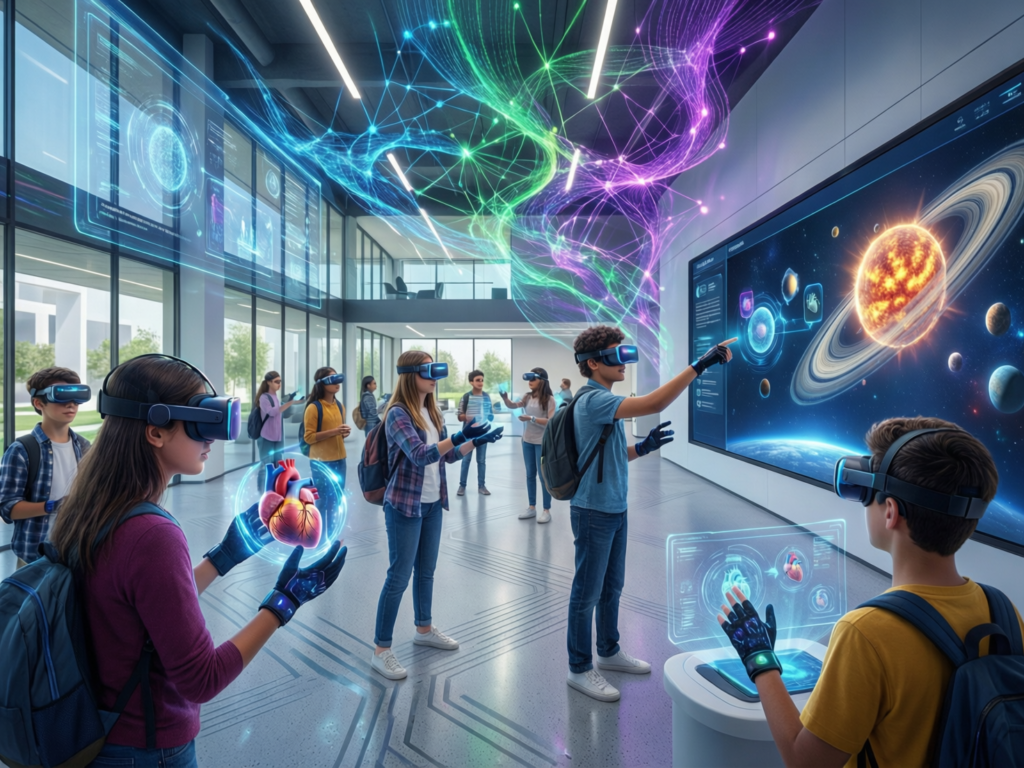
Building a Sustainable AR/VR Strategy for GCC Education Leaders
Budgeting, ROI and funding models for VR labs in KSA, UAE and Qatar
For a small pilot in a Riyadh or Jeddah private school, a basic AR VR learning system for UAE students or KSA learners might start from a modest set of headsets, content licences and teacher training. Larger VR labs for universities or multi-campus groups require structured CAPEX and OPEX planning, often mixing government grants, innovation funds, CSR sponsorships and internal budgets.
To prove ROI, leaders should track engagement, assessment results and employability metrics over time, linking immersive projects directly to Vision 2030 and similar objectives across the GCC. This is not financial advice; each institution should review its own risk appetite and funding rules.
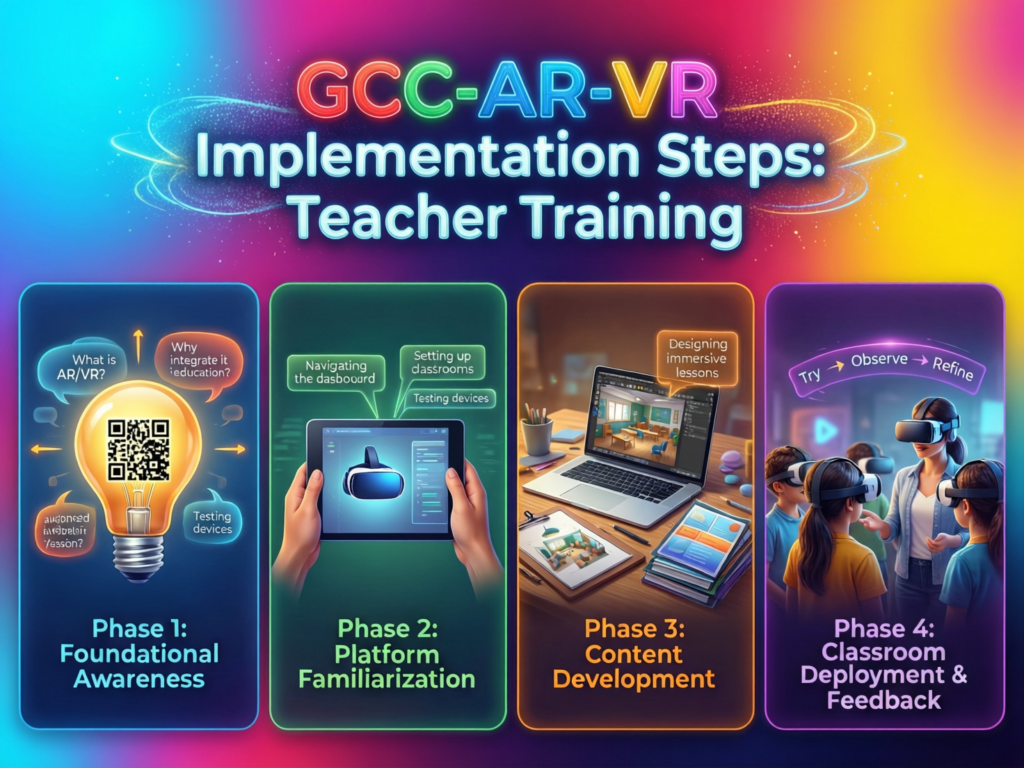
Pilots, teacher training and change management for large-scale AR/VR adoption
A sustainable rollout of AR and VR in education in Saudi Arabia, UAE and Qatar usually follows a clear, phased approach:
Discovery
Assess curriculum fit, infrastructure and readiness.
Pilot design
Select 1–3 subjects and a small set of schools or departments.
Implementation
Deploy hardware, content and classroom management tools.
Teacher training
Build digital champions and provide ongoing coaching.
Scale-up
Refine based on data, then expand to more campuses and grades.
This step-by-step path reduces risk, builds internal confidence and helps teachers feel that change is manageable rather than overwhelming.
How a GCC-focused AR/VR partner supports ministries, school groups and universities
Regional partners with Arabic content expertise, GCC compliance knowledge and implementation experience can drastically shorten time-to-value. A provider like Mak It Solutions’ education-focused team can support leaders with strategy, hardware selection, custom content, integration with existing LMS platforms and managed services.
For ministries and large groups, this often includes workshops, Vision 2030 alignment audits and co-designed pilots across Riyadh, Dubai, Abu Dhabi and Doha ensuring that AR/VR projects match both policy requirements and real classroom realities.
Concluding Remarks
AR and VR in education in Saudi Arabia are no longer experimental gadgets; they are becoming central tools for building GCC future skills and enabling digital transformation. In the next 90 days, leaders can (1) assess infrastructure and curriculum readiness, (2) identify 2–3 pilot schools or departments, and (3) shortlist GCC-focused partners capable of delivering compliant, Arabic-first immersive solutions.
With the right roadmap, GCC schools, universities and training providers can move confidently from theory to hands-on learning in virtual environments that genuinely prepare students for tomorrow’s jobs and the wider digital economy.
If you’re planning AR/VR pilots in Saudi Arabia, the UAE or Qatar and want a strategy that matches local regulations and real classroom realities, Mak It Solutions is ready to help. Explore our IT and digital services, connect with our team via the main website, and request a tailored GCC AR/VR readiness assessment or pilot design workshop for your organisation.( Click Here’s )
FAQs
Q : Is AR/VR content allowed in Saudi public schools under Ministry of Education and iEN guidelines?
A : Yes, AR/VR content can be used in Saudi public schools as long as it aligns with Ministry of Education policies, supports curriculum goals and respects cultural and religious values. In practice, this means choosing content that reinforces national learning outcomes, integrating with platforms like the iEN portal where possible, and avoiding inappropriate or non-educational simulations. Many schools start with STEM and safety-focused modules that clearly support Vision 2030’s Human Capability Development objectives. Working with partners that understand Saudi guidelines helps ensure smooth approvals.
Q : Do Dubai and Abu Dhabi schools need KHDA or UAE Ministry of Education approval before installing VR labs?
A : Private and public schools in Dubai and Abu Dhabi should always review KHDA and UAE Ministry of Education requirements before deploying full VR labs, especially when student data is collected or new content platforms are introduced. Often, small classroom pilots using approved devices and age-appropriate content can begin under existing digital-learning policies, but larger rollouts may require formal notification or approval. Schools should also align with TDRA guidance on network security, safe internet use and device management. Consulting early with regulators helps avoid surprises during inspection cycles.
Q : What is a realistic starting budget for a small VR classroom in a Riyadh or Jeddah private school?
A : A basic VR classroom pilot for 10–15 students in a Riyadh or Jeddah private school can often start with a modest budget covering headsets, licences for a few core subjects and initial teacher training. Costs vary by vendor and hardware type, but many schools treat the first year as a proof-of-concept to validate learning impact before scaling. Some institutions tap into innovation or CSR funds from local companies that support Vision 2030 skills development. A specialised GCC technology partner can help compare options, optimise spending and avoid hidden costs like maintenance and upgrades.
Q : Can GCC schools host AR/VR platforms on local cloud regions like AWS Middle East, Azure UAE or Google Cloud Qatar?
A : Yes, many AR/VR platforms can be hosted or integrated with regional cloud regions such as AWS Middle East (KSA), Azure UAE Central or Google Cloud Qatar (GCP Doha). Hosting closer to Riyadh, Dubai or Doha helps meet national data residency expectations and improves performance for real-time simulations. Schools and ministries should ensure that any vendor supports local or regional hosting, strong encryption and clear data-processing agreements. Aligning with frameworks from bodies like TDRA, SAMA, QCB and Qatar Digital Government gives additional assurance that student and staff data remain protected.
Q : How can Arabic language and Islamic studies be integrated effectively into VR lessons for GCC students?
A : To integrate Arabic language and Islamic studies, schools should prioritise content with native Arabic interfaces, right-to-left layouts and narration in local dialects where appropriate. VR lessons can bring Quranic stories, Islamic history and key locations to life in respectful, immersive experiences that deepen understanding. Combining these with language-learning features allows students to practise Modern Standard Arabic and English in meaningful contexts. Collaboration with local scholars, curriculum designers and Arabic-speaking developers ensures accuracy and cultural sensitivity. Many GCC ministries see this as a strategic way to modernise Islamic and Arabic education while safeguarding values.