
Arabic AI Voice Bots for Call Centers in GCC
Arabic AI Voice Bots for Call Centers in GCC
Arabic AI Voice Bots for Call Centers in GCC
Arabic AI voice bots for call centers use speech recognition, natural language understanding and smart call routing to automate large parts of Arabic customer conversations while keeping humans in the loop for complex cases. For GCC brands in Saudi Arabia, UAE and Qatar, they improve CX, reduce wait times and protect sensitive data by running on region-hosted, dialect-aware AI platforms.
Introduction
Across Riyadh, Dubai, Abu Dhabi and Doha, contact centers are under pressure: call volumes keep climbing, customers expect instant answers in Arabic, and frontline agents are burning out. Long IVR menus, generic chatbots and overstretched teams simply can’t keep up with omni-channel journeys and 24/7 expectations anymore.
Arabic AI voice bots for call centers bring an “always-on” Arabic-speaking agent that can understand Gulf dialects, resolve routine queries end-to-end and hand over smoothly to humans when needed. For GCC enterprises, this means shorter queues, better CX metrics and more focused human agents instead of endless hiring cycles.
Rising call volumes and CX expectations across GCC contact centers
In Saudi Arabia and the wider GCC, Vision 2030 and similar national agendas are pushing more services online from government e-services to digital banking and logistics tracking. That translates into huge call spikes around salary days, bill due dates, travel seasons and major events like Hajj and Expo-style conferences.
Contact centers in Riyadh, Jeddah, Dubai, Abu Dhabi and Doha often struggle with:
20–40 minute peaks in queue times
Agent churn from repetitive inquiries
Fragmented experiences between phone, WhatsApp and web chat
Traditional DTMF IVR (“press 1, press 2”) or simple FAQ chatbots don’t understand intent, dialect or emotion. They frustrate customers instead of helping especially when the caller is speaking Khaleeji Arabic at speed. This is where conversational IVR in Arabic powered by AI changes the game.
What Arabic AI voice bots for call centers actually are
An Arabic AI voice bot is different from a normal IVR because it listens to what the caller says in natural Arabic, understands intent using NLU, and responds in a human-like Arabic voice instead of forcing the caller through rigid “press 1–2–3” menus. In GCC call centers, this means customers can speak freely in Gulf Arabic, get routed automatically and complete self-service flows without memorising menu options.
Practically, an Arabic AI voice bot for call centers combines.
ASR (Automatic Speech Recognition): turns noisy Arabic speech into text
Arabic natural language understanding for CX: detects intent, entities and sentiment
TTS (Text-to-Speech): natural-sounding Arabic voices (e.g. Najdi, Emirati tones)
AI-powered call routing for Middle East call centers: sends the call to the right bot flow or human queue
Arabic voice analytics for customer sentiment: highlights churn risk, complaints and upsell moments
You can plug this into your existing PBX or cloud contact center platform and integrate with CRM, core banking, billing or ticketing systems. If you’re exploring this, a partner like Mak It Solutions’ GCC-focused CX and AI services can help design and integrate the full stack.
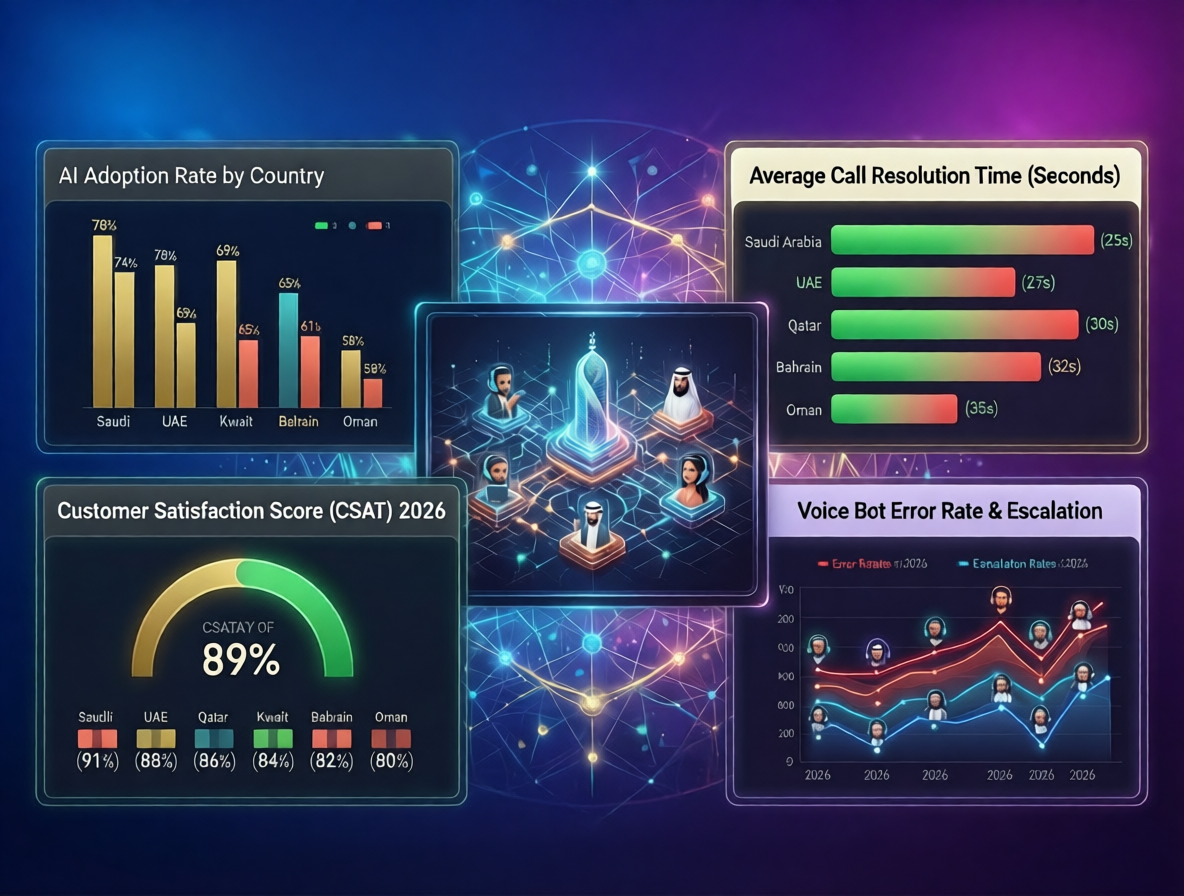
Snapshot of 2026 adoption in Saudi, UAE and Qatar
By 2026, early adopters in Saudi banks, fintechs and telecoms, UAE digital-native retailers and Qatar government hotlines are already piloting or scaling Arabic AI voice agents. Regulated sectors want better CX but must stay aligned with SAMA, NDMO, TDRA, QCB and other regulators, so most deployments start in limited, low-risk use cases like balance inquiries, bill status or appointment booking.
When does it make sense?
High-volume, repeatable intents (e.g. “where is my delivery?”, “pay my bill”)
Clear policies and scripts that can be automated
Desire to provide 24/7 Arabic support without 24/7 staffing
When should humans stay in the loop? Complaints, vulnerable customers, complex lending, medical decisions or anything involving negotiation should always have an easy escalation path to a trained human agent.
Core Capabilities of Modern Arabic AI Voice Bots for Call Centers
Arabic speech recognition and NLU built for noisy call centers
Real GCC hotlines are messy: overlapping voices, kids in the background, airport or mall noise, and low-quality mobile lines from remote areas. An Arabic-first speech-to-text engine for Arabic dialects is trained specifically on Gulf and regional accents not just generic Modern Standard Arabic (MSA).
“Arabic-enabled” engines often treat Arabic as an add-on and struggle with Najdi, Hijazi, Emirati and Qatari pronunciation. “Arabic-first” engines are trained on millions of hours of regional speech, so they maintain accuracy under noise, crosstalk and fast code-switching. That accuracy is what later drives better CSAT and containment.
Omnichannel Arabic AI voice agents across phone, WhatsApp and web
Modern platforms use the same Arabic AI brain across.
Inbound IVR and hotline calls
WhatsApp voice notes and call flows
Web or in-app voice widgets
They integrate into CRM, ticketing tools and telecom BSS/OSS stacks so the bot can:
Identify the caller
See orders, tickets or account details
Update records after each conversation
If you’re already investing in broader IT and digital services, consolidating your customer channels around a single Arabic AI layer reduces fragmentation and rework for your teams.
Smart call routing, escalation and AI-assisted human agents
Smart call routing lets the bot decide.
Contain: handle the entire call in Arabic self-service
Warm transfer: keep context and send the caller to the right skill queue
Agent-assist only: listen in, transcribe and guide the human agent
Agent-assist features summarise Arabic calls, suggest replies, surface knowledge articles and auto-fill CRM fields. In a busy Riyadh or Dubai contact center, this can cut wrap-up time dramatically and help new agents perform like seniors within weeks.
Dialect-Aware and Gulf Arabic Understanding.
Gulf Arabic vs Modern Standard Arabic in real customer calls
Saudi and Gulf call centers need voice bots that understand Najdi, Hijazi, Emirati, Qatari and other local dialects because customers rarely speak pure MSA on the phone. If the bot only understands “textbook Arabic,” it will mis-hear key phrases, fail intents and make customers feel it’s “foreign,” even if it technically supports Arabic.
Real calls mix phrases like “shlonak”, “wesh al-salfa?”, “kefa 7alek?”, “3adi a’jil al-daf3a?” or Emirati/Qatari slang around bills, offers and complaints. A generic MSA model often misrecognises these, leading to wrong actions or endless “Can you repeat, please?”. Dialect-aware models trained on Khaleeji Arabic voice bot for customer service interactions drastically reduce that friction.

Handling Arabic English code-switching and slang in GCC hotlines
In UAE and Qatar, it’s normal to hear “I want to upgrade el package”, “reset my online banking password please” or “issue in loyalty points”. Good Arabic AI voice bots:
Understand English brand names and fintech terms
Recognise telecom jargon (bundles, roaming, add-ons)
Handle channel names like WhatsApp, SMS, email and app
Design-wise, your conversation flows should.
Include mixed-language training data
Map common brand and product names as entities
Define safe fallbacks when the bot isn’t sure
How dialect-aware AI moves CSAT, FCR and NPS in GCC contact centers
When recognition accuracy goes up, average handling time (AHT) comes down and first-call resolution (FCR) improves. Dialect-aware Arabic AI reduces transfers, avoids re-asking the same questions, and keeps more customers in self-service.
For GCC contact centers, you can A/B test.
Group A: generic Arabic bot
Group B: dialect-aware Gulf Arabic bot
Measure containment, repeat-call rates, customer effort scores and NPS. Over a few weeks, you’ll see whether your Arabic AI voice bots for call centers are truly Gulf-ready or just “demo-ready.”
Compliance, Sovereign AI and Data Residency in Saudi, UAE and Qatar
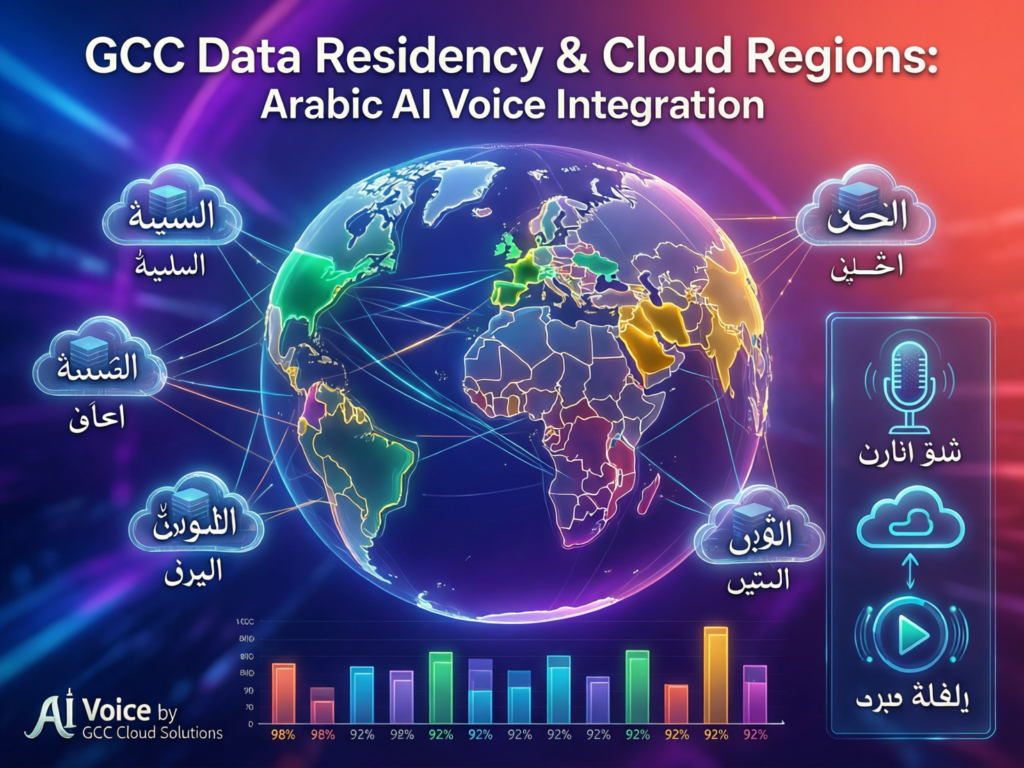
Data residency and cloud choices for regulated GCC industries
Banks, insurers, healthcare providers and government entities in Saudi Arabia, UAE and Qatar must keep sensitive personal data within specific jurisdictions and under strict controls. Saudi’s NDMO data management standards and PDPL emphasise strong governance, consent and restrictions on cross-border transfers.
Practically, this means choosing cloud regions such as AWS Bahrain, Azure UAE Central and GCP Doha, or dedicated in-kingdom hosting for call recordings and AI models. QCB’s cloud computing regulations similarly require strong controls and approvals when QCB-licensed entities use cloud providers.
A GCC-focused partner like Mak It Solutions can help you align CX innovation with your internal InfoSec and risk policies instead of working against them.
Working within GCC regulatory frameworks for call recording and AI
Saudi Central Bank (SAMA) requires banks to document calls with retail consumers and retain records for defined periods, with clear notification that calls are recorded. UAE’s TDRA regulates telecom services, including VoIP and cloud communications, and only licensed or approved services are allowed. Qatar Central Bank also issues detailed information security and cloud rules for financial institutions.
So your Arabic AI voice bots should.
Play clear consent and recording prompts in Arabic and English
Apply retention and deletion policies per sector regulation
Redact or mask sensitive utterances (ID, card numbers, IBANs) in transcripts
UAE and GCC companies can deploy Arabic AI voice agents without sending customer data outside the region by hosting call recordings, AI models and analytics in approved in-country or GCC cloud regions, and by ensuring their providers comply with local regulations from bodies like NDMO, TDRA, SAMA and QCB on data residency and security controls.
Sovereign and region-hosted Arabic AI models for call centers
For banks, telcos and government hotlines in Riyadh, Dubai, Abu Dhabi and Doha, the safest path is “sovereign” or region-hosted Arabic AI.
Models trained on in-region data under local law
Deployed on GCC data centers with strong controls
Auditable against QCB, TDRA, ADGM and DIFC requirements
This positions your Arabic AI voice bots not as experimental toys, but as fully compliant CX infrastructure.
2026 Use Cases for Arabic AI Voice Bots in Banking, Telecom, Government and Beyond
Inbound self-service and smart routing for service hotlines
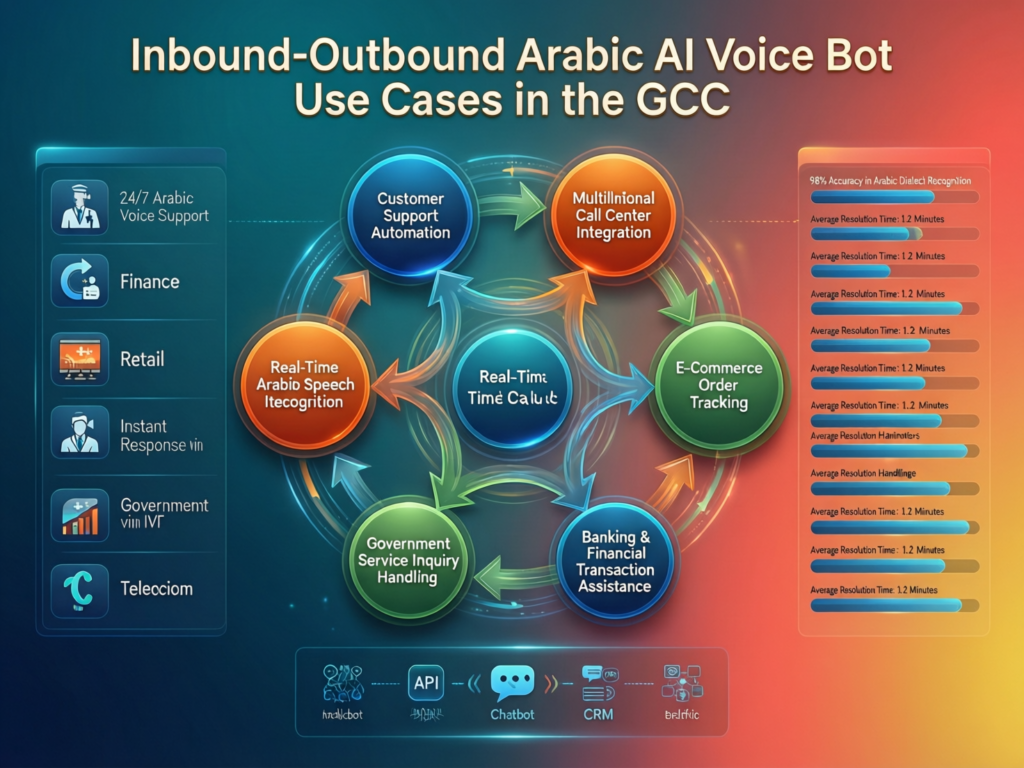
Common inbound flows across GCC hotlines include:
Account balance, card status and Open Banking KSA consents
SIM activation, roaming bundles and package changes
Appointment booking for clinics and government services
Delivery status, returns and logistics updates
Arabic AI voice agents can adapt flows for Saudi, Emirati, Qatari and expat callers – for example, offering Urdu or English fallback for labour-intensive sectors, while keeping core flows in Gulf Arabic.
Collections, renewals, reminders and surveys
Banks and fintechs in KSA can run compliant outbound reminders for payments and instalments, respecting SAMA’s limits on call frequency and tone when collecting debts. (rulebook.sama.gov.sa) Insurers and telecoms can use dialect-aware bots to:
Remind customers about policy or package renewals
Confirm delivery slots and reschedule failed attempts
Run quick NPS or CSAT surveys after calls
In all GCC markets, ensure your outbound strategies align with telecom and consumer-protection rules and log consent clearly in your CRM.
Fintech, telco, government, airlines and hospitality
A few real-world style scenarios:
Riyadh fintech startup:
Uses Arabic AI voice bots integrated with Open Banking KSA APIs for secure balance and transaction inquiries, while remaining aligned with PDPL and SAMA guidance.
Dubai e-commerce brand
Runs a multilingual, mobile-first hotline where a Khaleeji Arabic bot resolves “where is my order?” calls and WhatsApp voice notes before escalating to agents.
Doha SME in logistics
Chooses GCP Doha and a region-hosted AI stack so Qatar Digital ID linked services and QCB regulations are respected for financial and shipping data.
Bahrain and Kuwait regional bank
Uses one Arabic AI voice bot with tuned dialect profiles per country, sharing a common architecture but localising language, limits and disclosures.
Oman airlines and hospitality group
Deploys Arabic AI voice agents to manage disruptions, hotel bookings and loyalty queries across GCC, with tailored experiences for Jeddah Hajj/Umrah travelers and Dubai-based transit passengers.
If you’re planning similar journeys, aligning them with your broader digital services roadmap keeps the stack maintainable.
How to Select, Deploy and Measure Arabic AI Voice Bots in GCC Call Centers
Evaluation checklist for GCC CX and IT leaders
When shortlisting vendors, Saudi, UAE and Qatar buyers should look at:
Dialect coverage: Gulf, Najdi, Hijazi, Emirati, Qatari, Egyptian, Levantine
Telephony compatibility: on-prem PBX, SIP, cloud contact center platforms
Integrations: CRM, core banking, billing, ticketing
Security & residency: GCC or in-country data hosting, encryption, access control
SLAs & support: Arabic-speaking support teams and 24/7 coverage
It often helps to bring a partner like Mak It Solutions’ CX experts into vendor evaluations so IT, CX and compliance teams are aligned from day one.
Deployment roadmap.
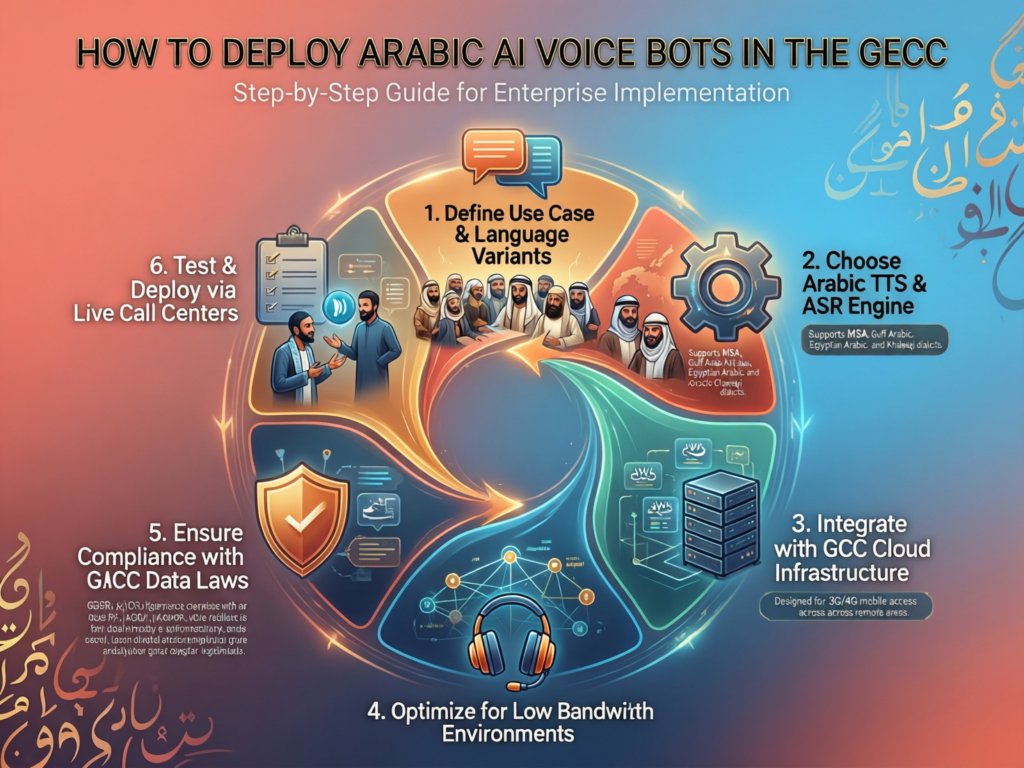
A practical GCC-ready roadmap looks like this:
Discovery & call analysis Analyse recordings to find top intents and pain points.
Conversation design Design Arabic flows for 3–5 high-value, low-risk journeys.
Pilot in one country For example, start with Arabic AI voice agents for Dubai contact centers or a single Saudi business unit.
Optimisation loop Tune intents, add dialect patterns, refine escalation rules.
Rollout across GCC Expand to Qatar, Bahrain, Kuwait and Oman with local tweaks.
Choose quick-win use cases such as password reset, balance inquiry or delivery status so executives can see impact within weeks.
Measuring ROI and ongoing optimisation in 2026
To prove value, compare.
Bot vs human cost per call in Saudi, UAE and Qatar
Containment rate, AHT, CSAT, NPS and agent productivity
Revenue uplift from saved churn or cross-sell opportunities
Set up dashboards so CX leads in Riyadh, Dubai and Doha can see the same metrics. Over time, keep retraining your models on new dialect expressions, seasonal topics and product launches and treat your bot like a living channel, not a one-off project.
Building a GCC-Ready Arabic Voice AI Strategy.
Dialect-aware Arabic AI voice bots for call centers have moved from “nice to have” to strategic CX capability across the GCC. When they understand Gulf Arabic, respect data residency and plug into your existing systems, they can transform how your brand serves millions of customers across Saudi Arabia, UAE, Qatar, Kuwait, Bahrain and Oman.
If you’re wondering how your current IVR compares, this is a good moment to benchmark it against an Arabic AI pilot. Start with a focused discovery workshop, move into a proof of concept in one market, and then scale with a multi-country blueprint.
Mak It Solutions can help you design, deploy and optimise a GCC-ready Arabic voice AI strategy that fits your compliance, technology and CX goals. Explore our services page or visit the Mak It Solutions homepage to start a conversation with our regional team.
If you lead CX, digital or contact center operations in the GCC and want to see how Arabic AI voice bots for call centers could work in your environment, let’s talk. Our team can review your current IVR, call KPIs and regulatory constraints, then propose a pragmatic roadmap tailored to Saudi, UAE, Qatar and wider GCC markets.
FAQs
Q : Is AI-based call recording for Arabic voice bots allowed under Saudi banking and telecom rules?
A : Yes, AI-based call recording can be allowed in Saudi Arabia as long as it follows the same regulations that apply to traditional call recording. SAMA requires banks to document and retain calls with retail consumers for defined periods, and customers must be clearly informed that their calls are recorded. Your Arabic AI voice bots should therefore play recording notifications in Arabic (and English where relevant), store recordings in compliant in-kingdom or GCC data centers, and respect PDPL and NDMO requirements on data retention, minimisation and cross-border transfers.
Q : How accurate are Khaleeji Arabic voice bots compared to human agents in busy Dubai and Riyadh contact centers?
A : A well-trained Khaleeji Arabic voice bot will rarely match a top-performing human agent on empathy, but it can reach comparable accuracy on routine tasks such as identification, balance inquiries, bill explanations and booking. The key is using Arabic-first ASR and NLU models trained on Gulf accents, noise and code-switching patterns. In Dubai and Riyadh contact centers, this can result in high containment rates for simple intents, freeing human agents to focus on complex or sensitive cases. Over time, continuous retraining and feedback loops help the bot close the gap even further.
Q : Can one Arabic AI voice bot handle callers from Qatar, Kuwait, Bahrain and Oman with different dialects?
A : Yes, a single platform can support multiple dialect profiles and routing rules for Qatar, Kuwait, Bahrain and Oman. In practice, you create shared intents (e.g. “check delivery status”) but tune synonyms, lexicons and prompts for each dialect group. For example, Qatari callers might use slightly different phrasing from Kuwaiti or Bahraini callers, and Oman might need more English fallback in tourism-heavy journeys. Your platform should let you configure country-level language packs, test flows market by market and comply with local rules such as QCB’s cloud and data regulations in Qatar.
Q : How long does it typically take to launch an Arabic AI voice bot pilot in a GCC call center?
A : Most GCC organisations can go from discovery to a live pilot in 8–12 weeks, assuming governance is clear and integrations are straightforward. The timeline covers call analytics, intent design, bot building, integration with telephony and CRM, testing and agent training. Regulated sectors like banking may add extra time for security reviews, SAMA or QCB compliance checks and data residency assessments. Working with an experienced GCC implementation partner helps keep the project on track and aligned with Saudi Vision 2030 and national digital transformation initiatives.
Q : What skills do GCC call center teams need to manage and improve Arabic AI voice bot conversations over time?
A : Beyond traditional contact center skills, GCC teams need people who understand conversation design, Arabic language nuances and analytics. Ideal roles include a conversation designer who knows Gulf Arabic, a bot operations owner to manage releases, and analysts to track KPIs like containment, CSAT and NPS. Collaboration with compliance teams is essential to keep bots aligned with SAMA, TDRA, QCB and NDMO requirements as regulations evolve. Many organisations also reskill senior agents into “bot coaches” who review transcripts, suggest improvements and align bot behaviour with Saudi Vision 2030 and other national CX priorities.